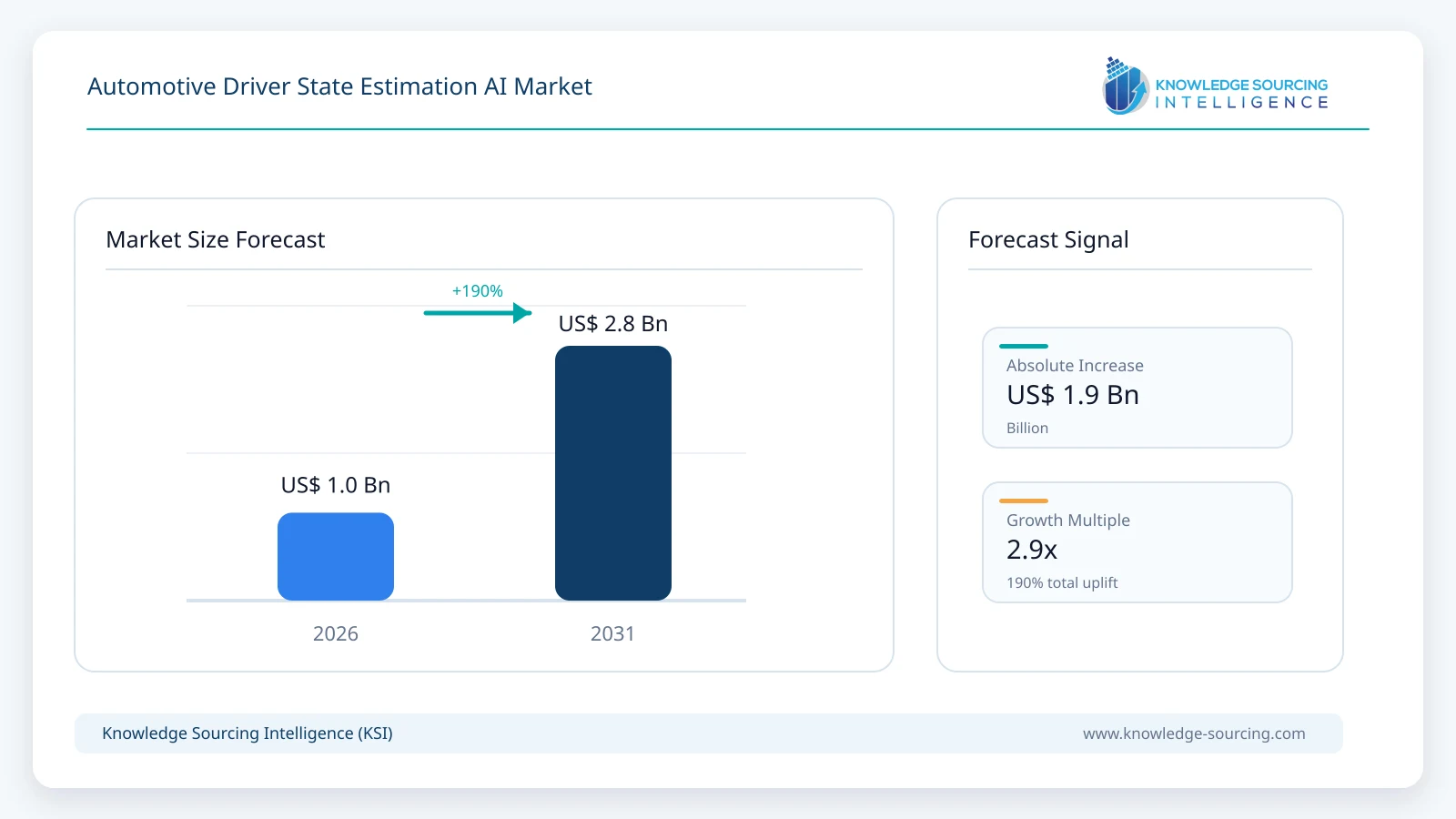
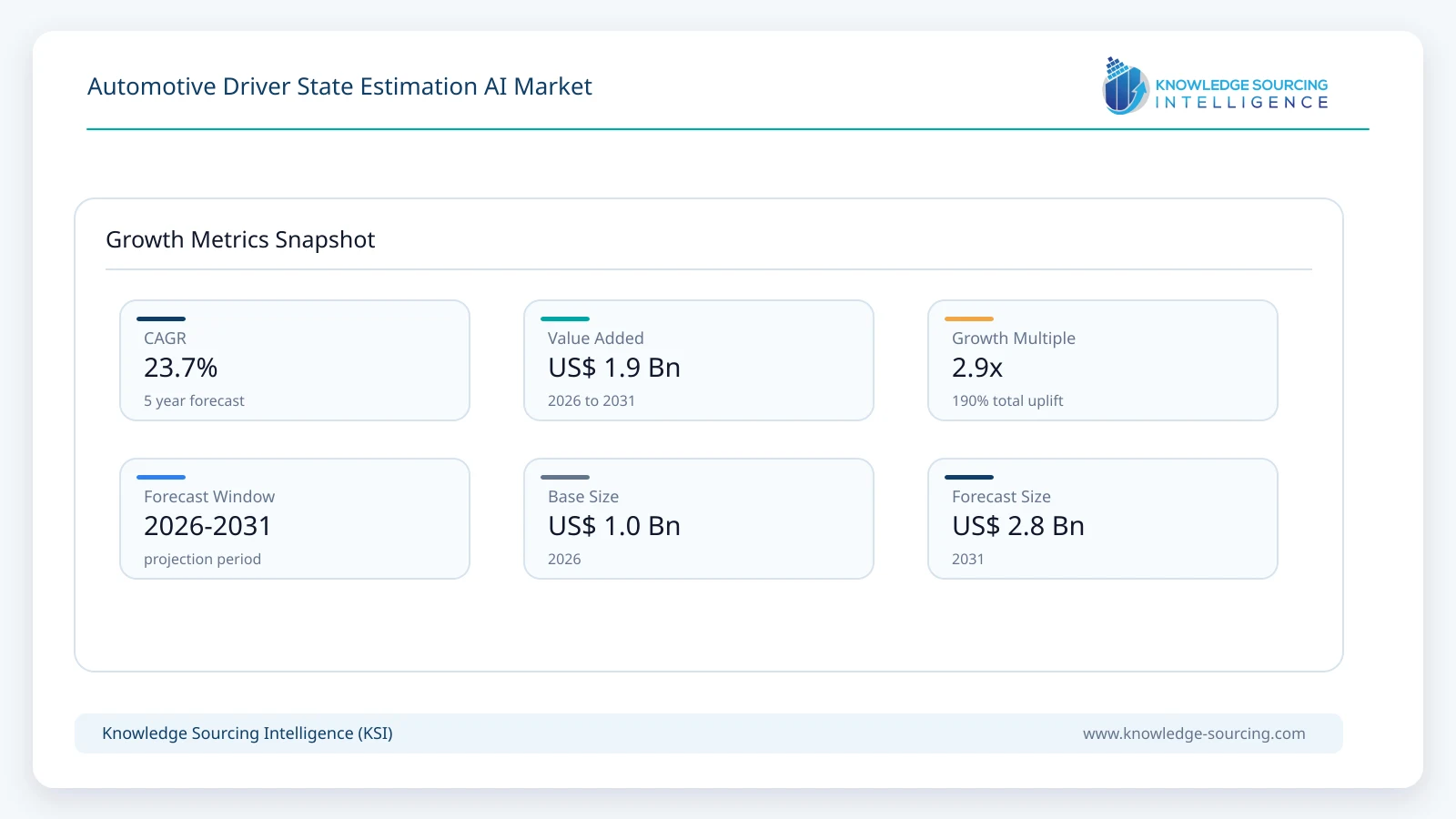
The Automotive Driver State Estimation AI Market is forecast to grow at a CAGR of 23.7%, reaching USD 2.84 billion in 2031 from USD 0.98 billion in 2026.
Highlights:
- 1Distraction and inattention models represent approximately 35% of 2026 AI state-estimation revenue, anchored by regulatory attention assessment.
- 2Camera-based visual inference represents approximately 61% of 2026 value, while multimodal combinations gain importance in readiness and impairment assessment.
- 3Safety warning and intervention uses account for approximately 48% of 2026 market value, with assisted-driving readiness gaining share through 2031.
- 4Passenger vehicles contribute approximately 87% of 2026 demand through platform-wide camera and AI-software deployment.
- 5Europe accounts for approximately 38% of 2026 value, while Asia Pacific has the strongest expected incremental adoption through 2031.
- 6Supplier advantage increasingly depends on validated temporal models and low false-warning rates rather than additional sensor installation.
Demand is concentrated in inference algorithms, embedded software licensing, model calibration, validation and related engineering that convert raw driver observations into confidence-weighted assessments and vehicle actions. Increasing use of existing camera modules and centralized cockpit computers enables OEMs to add more sophisticated decision logic without matching growth in dedicated hardware content.
European safety rules create a minimum deployment requirement for distraction and drowsiness functions, while the Euro NCAP 2026 assessment rewards reliable continuous eye and head tracking linked to driver assistance. The software challenge is broader than recognizing a face: learned models must distinguish harmless glances from sustained inattention, identify worsening fatigue across minutes of driving, and recognize when a person cannot supervise automation. These decisions affect warning escalation and vehicle control, making validation quality and real-world robustness important supplier selection criteria.
Market Overview
Driver state estimation AI processes streams of visual features and driving signals to infer conditions that cannot be measured reliably from one frame or one steering correction. Near-infrared cameras provide eye opening, gaze direction, and head position; temporal models interpret their duration and sequence alongside speed, assistance mode, steering behavior, and road context. Continuous confidence scoring reduces the risk that a normal mirror check or a brief glance toward a display will trigger the same response as sustained distraction.
Automotive deployments increasingly combine trained perception models with deterministic vehicle safety logic. Bosch describes camera-based systems that use artificial intelligence to detect driver attention and fatigue, while Smart Eye and Seeing Machines provide software engines integrated into OEM monitoring programs. In May 2026, Magna described a mirror-integrated European OEM system designed for centralized architectures, and Smart Eye with Visteon demonstrated an LCD cluster with an integrated camera. Their implementations show how estimation intelligence can move between the mirror, instrument display, and vehicle computer without changing its underlying safety objective.
Commercial differentiation depends on sustained accuracy across drivers, lighting, eyewear, cabin positions, and different levels of automation. A system intended only to issue an attention warning can tolerate a narrower decision set than one governing hands-off assistance or identifying medical and impairment risks. Reuse of the camera across several functions reduces physical duplication, but it increases demand for validated training data, explainable decision boundaries, privacy-conscious processing and careful integration with ADAS interventions.
Market Trends
Driver-state models are moving from fixed thresholds to temporal interpretation
Camera-based monitoring increasingly considers the sequence of gaze changes, blink behavior, and head movements rather than acting on isolated observations. The value of temporal inference is clearest when a driver makes repeated brief off-road glances or when fatigue develops gradually without a long eye closure. Supplier models must retain high sensitivity to unsafe behavior while limiting nuisance warnings that cause drivers to distrust or disable the feature.
Driver availability is becoming an input to supervised ADAS control
Supervised highway and lane-centering functions require confirmation that the driver remains visually engaged and can respond to a takeover request. Driver-state AI can combine gaze history with the mode of vehicle assistance, the driver’s current posture and the timing of recent alerts to determine when a warning should become more urgent. Euro NCAP’s 2026 framework explicitly recognizes the link between driver monitoring and assistance sensitivity, increasing demand for richer state outputs.
Integration adds validation responsibilities because a false estimate can either interrupt a safe driver unnecessarily or allow an inattentive driver to remain in an assisted mode. OEMs therefore evaluate state-estimation performance together with warning behavior and minimum-risk strategy, not merely the accuracy of the eye-tracking camera.
Impairment inference is expanding beyond fatigue and distraction
Behavioral inference is widening to include signs of alcohol impairment, unusual cognitive load and other conditions that affect driving ability. In January 2026, Smart Eye disclosed Japanese OEM nominations that include alcohol-impairment detection, with production planned for 2028, and its acquisition of Sightic followed in February to extend drug-impairment capabilities. These developments show a route toward broader state estimation but do not establish that every advanced feature is already produced at mass-market scale.
Impairment classification requires particularly careful research design because similar gaze and facial patterns may arise from illness, tiredness, lighting, or individual differences. Suppliers need representative datasets and controlled validation before such outputs can support stronger interventions, creating a higher software and engineering value layer than basic warning logic.
Existing cameras are becoming platforms for software feature expansion
Camera installation is increasingly a fixed part of regulated vehicle architecture, allowing software vendors to expand useful functions through new inference models and revisions to the decision stack. Smart Eye introduced remote physiological signal analysis in June 2026 using existing DMS camera hardware, while HARMAN described improved Ready Care stress and heartbeat-related capabilities in January. Those announcements demonstrate how suppliers can develop additional state insights without necessarily adding another camera.
Centralized computing increases software portability requirements
Automakers are relocating parts of driver monitoring from dedicated modules into cockpit processors and centralized vehicle computers, which changes how inference software is packaged, updated and tested. Magna, Visteon and AUMOVIO describe integration approaches spanning mirror-based hardware, hidden cameras and shared software platforms. Software vendors that preserve performance across different camera optics, processors and vehicle programs can extend design wins without fully redeveloping models for every installation.
Segment Analysis
By Driver State: Distraction and Inattention Estimation
Distraction and inattention models represent an estimated 35% of 2026 AI state-estimation value because OEM compliance programs first require reliable assessment of visual attention while driving. Their principal inputs include gaze direction, off-road glance duration, eyelid opening and head orientation, with contextual logic used to distinguish relevant driving checks from unrelated secondary tasks. The software must remain effective in darkness, when a driver wears corrective glasses, and across left- and right-hand-drive cabin configurations.
Through 2031, the category retains the largest absolute value pool, but its share moderates as readiness, impairment and cognitive-state functions expand. Suppliers require repeatable performance against regulatory and OEM field tests.
By Inference Architecture: Camera-Based Visual AI
Camera-based visual inference represents about 61% of 2026 market value because a direct view of the eyes and face provides the clearest scalable evidence for distraction and drowsiness assessment. Automotive near-infrared imaging and onboard neural inference help maintain performance when ambient light changes, while trained models use learned visual patterns and temporal features to estimate driver condition. This architecture is commercially attractive because it can operate on a dedicated DMS processor or a shared cockpit computer.
Camera-only systems remain the largest category through 2031, although combinations with steering, physiological and vehicle-context signals gain share where they improve readiness assessment and reduce ambiguity.
By Output Application: Safety Warning and Driver Intervention
Safety warning and intervention accounts for an estimated 48% of 2026 AI state-estimation value because most driver-monitoring programs are initially justified by distraction and fatigue alerts. State models classify severity and persistence, enabling visual, acoustic and haptic warnings to increase in intensity only when the observed behavior warrants them. The resulting decision must be compatible with vehicle HMI principles and should not generate a distraction of its own.
As assistance systems use driver-state confidence to decide whether hands-off functions remain available, a larger share of software value shifts toward automation engagement and takeover logic. Warning models nevertheless remain essential across regulated passenger vehicles and fleet applications, maintaining a large recurring validation workload.
By Vehicle Type: Passenger Vehicles
Passenger vehicles account for an estimated 87% of 2026 market value because European safety requirements, NCAP assessment and high-volume driver-facing camera installations are most established in cars and SUVs. Shared software platforms allow manufacturers to deploy a common state-estimation foundation across vehicle grades while tailoring available impairment and readiness features to equipment level and regulatory market.
Market Drivers
Mandatory attention and distraction monitoring across European vehicle registrations
European driver-distraction and drowsiness requirements are extending direct monitoring across larger numbers of newly registered vehicles, creating a clear production base for embedded estimation software. The need to recognize off-road attention, unusual eyelid activity, and prolonged fatigue under consistent test conditions encourages OEMs to qualify robust inference models rather than rely only on steering-angle thresholds. Euro NCAP’s 2026 Safe Driving approach adds a performance incentive by assessing eye and head tracking, driver engagement, and links to vehicle assistance. As baseline camera fitment spreads, demand moves toward calibration, temporal modeling and validated decision algorithms that can be reused across platforms.
Supervised automation depends on reliable driver availability assessment
Automated lane keeping and supervised hands-off functions place the driver in a different role from conventional manual driving, requiring continuous evidence that the person remains able to respond to a takeover request. Software must interpret visual attention alongside assistance mode, alert history, and engagement patterns, then deliver a usable readiness estimate to ADAS controllers. More capable state AI reduces unnecessary interruptions while supporting escalation when attention deteriorates. Vehicle manufacturers consequently have a reason to procure deeper estimation functionality even when the baseline regulatory warning could be delivered by a simpler model.
Expansion of AI functions on installed driver-facing camera hardware
Driver-facing near-infrared cameras and processing electronics can support several inference functions without being replaced for every software upgrade. Suppliers are adding behavioral impairment detection, more nuanced fatigue models and early physiological estimates as software extensions to established DMS architectures. Smart Eye’s 2026 impairment design wins and remote vital-sign announcement show different stages of this expansion, from future OEM nomination to feature demonstration. OEMs benefit from wider functionality on a common platform, while developers gain opportunities for separately attributable model licenses, calibration and software maintenance.
OEM platform sourcing supports reusable perception and validation investments
Major automakers are increasingly procuring driver-monitoring software across families of vehicles rather than for isolated premium models, spreading development expenditure over more annual production units. Seeing Machines reports new program awards and an expansion of an established automotive program during 2026, while Magna and Gentex emphasize scalable hardware and software integration. Common model libraries can be tuned to different camera placements or compute environments without recreating the entire technology stack. This sourcing pattern supports increasing software revenue even as physical camera hardware faces cost pressure.
Fleet safety and risk analytics extend demand beyond passenger cars
Commercial fleets face persistent financial exposure from fatigue, distraction and collisions, especially on long-distance routes or irregular duty schedules. AI-based driver state estimation can identify deteriorating alertness earlier than rule-based steering inputs and provide context to managers without requiring permanent storage of identifiable cabin imagery. Bosch and other suppliers position interior sensing for commercial-vehicle operation, where installation decisions depend on measurable reduction in risk and acceptable warning burden. The segment is smaller than passenger vehicles but supports targeted engineering and fleet analytics deployments.
Market Restraints
Variable real-world conditions complicate model reliability
Production inference models must remain accurate when drivers wear sunglasses, turn away briefly, change seating position or move between bright sunlight and poorly illuminated roads. Camera placement in steering columns, mirrors or displays changes viewing angles and image quality, requiring calibration for each vehicle platform. The same visible behavior may indicate harmless activity, fatigue or distraction depending on context. OEM validation therefore requires extensive edge-case datasets, demographic coverage and repeatable road tests, increasing development cost and lengthening approval cycles for advanced models.
Nuisance warnings can erode driver trust and feature effectiveness
Driver-monitoring systems lose practical value when safe mirror checks or ordinary cockpit interactions produce frequent warnings, encouraging drivers to ignore alerts or view the feature as intrusive. Making algorithms less sensitive may improve acceptance but risks missing genuinely hazardous behavior. The difficulty is greater for impairment and cognitive-state estimation, where ground truth is less clear than eye location. Suppliers must tune temporal confidence, escalation, and the HMI response together, adding iterative fieldwork beyond a standard computer-vision accuracy test.
Physiological and cognitive states are difficult to validate at scale
Visual attention and sustained eyelid closure can be assessed comparatively directly, whereas mental workload, illness, stress and alcohol or drug impairment require more specialized data and careful interpretation. Differences among individuals and overlapping symptoms complicate labeling, and controlled studies may not represent ordinary vehicle use. Smart Eye and other vendors are extending the available data and model capabilities, but OEMs cannot assume demonstration performance translates immediately into broad certification. Limited availability of reliable benchmark datasets may delay richer AI functions despite rising technical interest.
Privacy and cybersecurity requirements limit unrestricted data collection
Driver-facing cameras observe identifiable facial and behavioral information, making data handling and cybersecurity integral to procurement decisions. OEMs often favor local edge inference, limited retention of raw imagery, and tightly scoped access to driver-state outputs, which restricts some cloud-training and fleet-analysis workflows. Continuous updating of learned models also requires careful software integrity, rollback and audit controls. Compliance engineering can increase cost even when the underlying camera and processor are already installed across the vehicle platform.
Safety integration and hardware cost ceilings constrain feature expansion
Software that only recommends a break carries a different intervention risk from models influencing supervised-driving availability or initiating minimum-risk action. Advanced driver-state outputs must be reviewed alongside ADAS safety concepts, warning timing and system failure behavior, increasing the burden of validation and integration. At the same time, OEMs demand lower total sensor and compute cost as DMS spreads into mass-market vehicles. Suppliers must deliver new inference functions within fixed processor and memory budgets, limiting the feasible complexity of models and slowing adoption of compute-intensive features.
Regional Outlook
Europe
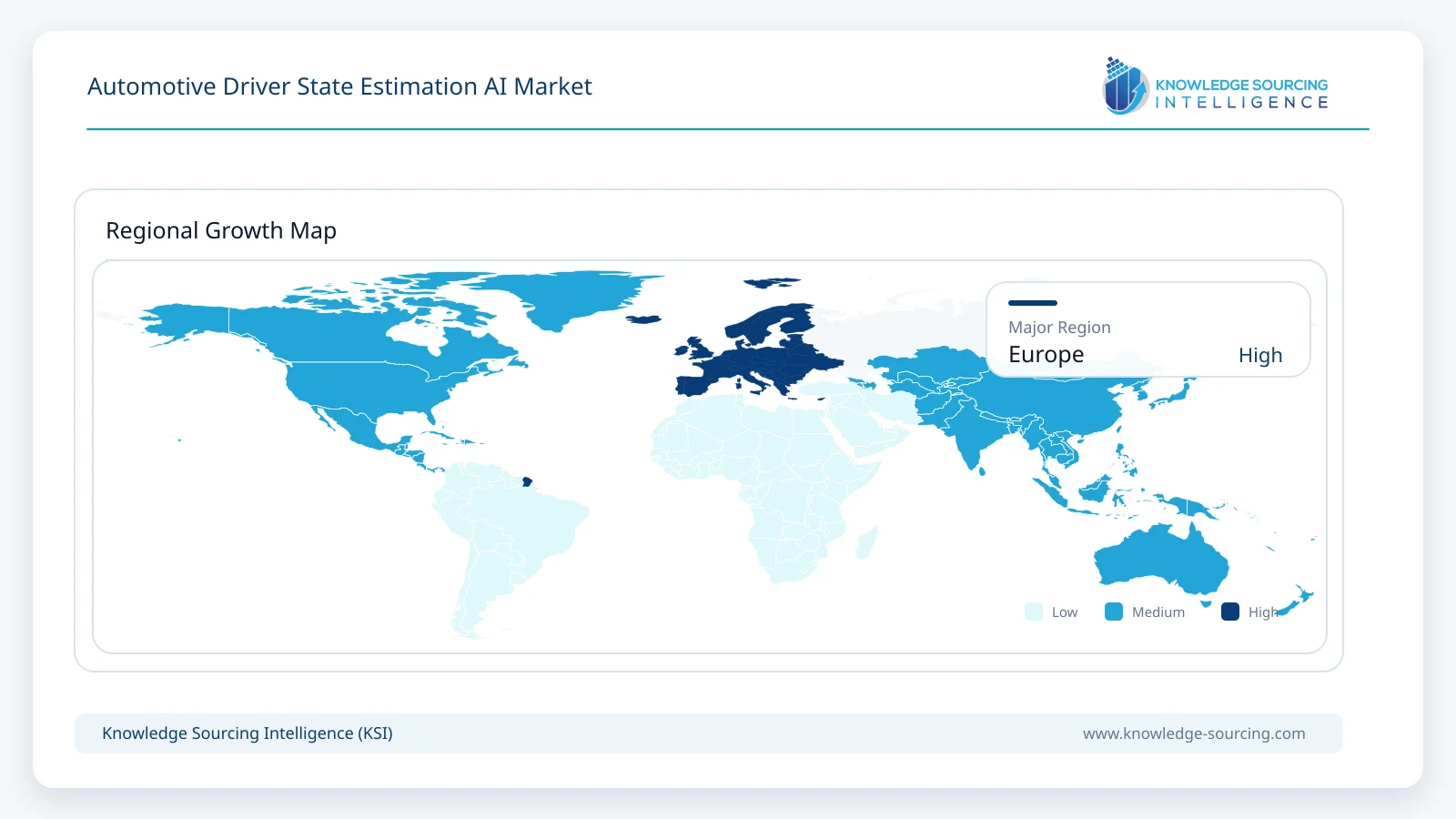
Europe represents an estimated 38% of the market in 2026 because advanced driver distraction warning obligations and Euro NCAP performance scoring give European programs the clearest reason to invest in validated state-estimation algorithms. Direct eye and head tracking provides the basis for mass-market attention functions, while premium and supervised-driving platforms need richer engagement, impairment and unresponsive-driver logic. The regulatory environment therefore supports both high-volume baseline inference and higher-value applications that link driver state with vehicle assistance.
European OEM and Tier 1 supply chains also include major DMS software and systems specialists operating across vehicle brands. As camera installation becomes more standardized, future spending is likely to favor robust calibration, feature expansion and platform validation rather than proportional growth in dedicated hardware. Privacy requirements and driver acceptance will remain important when selecting how much human-state information to process or retain.
Asia Pacific
Asia Pacific is expected to deliver the fastest incremental demand through 2031 as Chinese, Japanese and South Korean OEMs expand smart-cockpit and driver-assistance functions across larger production portfolios. Export models must meet requirements in destination markets, while domestic competition encourages compact hidden-camera packaging and added attention or impairment features. Smart Eye’s January 2026 Japanese OEM nomination and its Visteon under-display demonstration illustrate different aspects of this supplier activity.
High local volumes can lower the unit cost of cameras and embedded processors, but local vehicle interfaces, cabin geometries and semiconductor platforms require software adaptation. The region is consequently important for both automotive AI model deployment and OEM-specific integration services, even though Europe remains the more regulation-intensive market in the base year.
Competitive Landscape
Competition spans specialist driver-monitoring AI vendors, Tier 1 hardware integrators and cockpit-software platforms. Smart Eye, Seeing Machines and Cipia focus on visual perception and inference software, whereas Bosch, Magna, Gentex, HARMAN, AUMOVIO, Valeo and Visteon combine software with integration and vehicle-platform capabilities. OEM selection increasingly weighs validated driver engagement, demographic and environmental robustness, hardware portability and the capability to improve models without redesigning the sensing package.
Commercial evidence must be interpreted at the correct level. Smart Eye publishes design-win commitments and software-related contract values, while Gentex discloses broader driver/in-cabin monitoring system revenue expectations. Those figures help assess vendor scale but cannot be treated as direct measurements of AI state-estimation turnover. As vehicle manufacturers move functions onto shared cockpit compute, software reuse and system-level validation are likely to matter more than standalone camera specifications.
Recent Developments
27 August 2026: Smart Eye disclosed a follow-on DMS software award for a European premium electric vehicle scheduled to enter production in 2027.
9 June 2026: Smart Eye introduced remote pulse and estimated breathing-rate software using existing DMS camera hardware, presenting an additional physiological capability.
26 May 2026: Smart Eye and Visteon introduced a driver-monitoring camera integrated behind an LCD instrument cluster for evaluation by automotive manufacturers.
19 May 2026: Magna reported a European OEM driver and occupant monitoring award using mirror-integrated sensing and software architecture compatible with centralized computing.
4 February 2026: Smart Eye agreed to acquire Sightic, adding behavioral drug-impairment expertise to its driver-state technology portfolio.
29 January 2026: Smart Eye announced DMS software selections for two Japanese OEM models, including alcohol-impairment detection, with production targeted for 2028.
Market Outlook
The driver state estimation AI market is gaining momentum as camera-based attention recognition becomes increasingly widespread and automotive manufacturers integrate more advanced behavioral and contextual interpretation capabilities. Basic distraction and fatigue detection continue to represent the most established applications, supporting adoption across modern vehicle platforms.
Meanwhile, takeover-readiness assessment and impairment detection are gaining importance as manufacturers develop more sophisticated driver-monitoring systems. These applications require advanced algorithms capable of interpreting driver behavior, evaluating attention levels, and identifying potential safety risks under varying driving conditions. Continued advancements in artificial intelligence, computer vision, and in-cabin sensing are strengthening the capabilities of driver state estimation systems, supporting their integration into next-generation vehicles and enhancing driver safety, situational awareness, and intelligent vehicle operation.
Supplier competition will be shaped by the reliability of state confidence over time, the cost of adapting models to new vehicle platforms and the extent to which outputs can be integrated safely with ADAS and driver warnings. Model accuracy alone will not be sufficient because privacy safeguards, nuisance-warning behavior, processor limits and real-world validation directly affect OEM sourcing decisions. Europe should remain the strongest regulatory market, while Asia Pacific contributes a larger share of new deployments as platform-wide adoption advances.
Automotive Driver State Estimation AI Market Scope:
| Report Metric | Details |
|---|---|
| Total Market Size in 2026 | USD 0.98 billion |
| Total Market Size in 2031 | USD 2.84 billion |
| Forecast Unit | USD Billion |
| Growth Rate | 23.7% |
| Study Period | 2021 to 2031 |
| Historical Data | 2021 to 2024 |
| Base Year | 2025 |
| Forecast Period | 2026 – 2031 |
| Segmentation | Driver State, Inference Architecture, Output Application, Deployment Architecture |
| Companies |
|
Market Segmentation
By Driver State
Distraction and Inattention
Drowsiness and Fatigue
Takeover Readiness and Engagement
Alcohol and Other Impairment
Cognitive and Physiological State
By Inference Architecture
Camera-Based Visual AI
Camera and Vehicle-Signal Fusion
Camera and Physiological-Signal Fusion
Advanced Multimodal State Fusion
By Output Application
Safety Warning and Intervention
ADAS Readiness and Takeover Control
Impairment and Health Response
Fleet Coaching and Risk Analytics
By Deployment Architecture
Dedicated DMS Processing
Cockpit Domain and Display Computing
Centralized Vehicle Compute
By Revenue Component
Embedded AI Software Licensing
Engineering and Validation Services
Platform Support and Model Operations
By Vehicle Type
Passenger Vehicles
Light Commercial Vehicles
Medium and Heavy Commercial Vehicles
Buses and Coaches
By Geography
North America
United States
Canada
Mexico
South America
Brazil
Argentina
Others
Europe
Germany
United Kingdom
France
Italy
Spain
Others
Middle East and Africa
Saudi Arabia
UAE
South Africa
Others
Asia Pacific
China
Japan
India
South Korea
Indonesia
Thailand
Others
Table of Contents
1. EXECUTIVE SUMMARY
1.1. Key Market Findings
1.2. 2026 and 2031 Global Market Outlook
1.3. Technology and Regional Highlights
2. MARKET SNAPSHOT
2.1. Market Overview
2.2. Market Definition and Commercial Scope
2.3. Base and Forecast Years
2.4. Market Segmentation
3. BUSINESS LANDSCAPE
3.1. Market Drivers
3.1.1. Mandatory attention and distraction monitoring across European vehicle registrations
3.1.2. Supervised automation depends on reliable driver availability assessment
3.1.3. Expansion of AI functions on installed driver-facing camera hardware
3.1.4. OEM platform sourcing supports reusable perception and validation investments
3.1.5. Fleet safety and risk analytics extend demand beyond passenger cars
3.2. Market Restraints
3.2.1. Variable real-world conditions complicate model reliability
3.2.2. Nuisance warnings can erode driver trust and feature effectiveness
3.2.3. Physiological and cognitive states are difficult to validate at scale
3.2.4. Privacy and cybersecurity requirements limit unrestricted data collection
3.2.5. Safety integration and hardware cost ceilings constrain feature expansion
3.3. Market Opportunities
3.4. Porter’s Five Forces Analysis
3.5. Industry Value Chain Analysis
3.6. EU Regulation, Euro NCAP and Driver-State Performance
3.7. Privacy, Cybersecurity and Functional Safety
3.8. Strategic Recommendations
4. TECHNOLOGICAL OUTLOOK
4.1. Near-Infrared and RGB-IR Camera AI
4.2. Eye Gaze and Head Pose Estimation
4.3. Blink and Drowsiness Temporal Models
4.4. Cognitive Load and Behavioral Impairment AI
4.5. Driver Availability and Takeover State
4.6. Camera and Vehicle-Signal Fusion
4.7. Contactless Physiological Indicators
4.8. Contextual Confidence and Warning Policy
4.9. Centralized Compute and Model Lifecycle
4.10. Model Robustness and Validation
5. AUTOMOTIVE DRIVER STATE ESTIMATION AI MARKET BY DRIVER STATE
5.1. Introduction
5.2. Distraction and Inattention
5.3. Drowsiness and Fatigue
5.4. Takeover Readiness and Engagement
5.5. Alcohol and Other Impairment
5.6. Cognitive and Physiological State
6. AUTOMOTIVE DRIVER STATE ESTIMATION AI MARKET BY INFERENCE ARCHITECTURE
6.1. Introduction
6.2. Camera-Based Visual AI
6.3. Camera and Vehicle-Signal Fusion
6.4. Camera and Physiological-Signal Fusion
6.5. Advanced Multimodal State Fusion
7. AUTOMOTIVE DRIVER STATE ESTIMATION AI MARKET BY OUTPUT APPLICATION
7.1. Introduction
7.2. Safety Warning and Intervention
7.3. ADAS Readiness and Takeover Control
7.4. Impairment and Health Response
7.5. Fleet Coaching and Risk Analytics
8. AUTOMOTIVE DRIVER STATE ESTIMATION AI MARKET BY DEPLOYMENT ARCHITECTURE
8.1. Introduction
8.2. Dedicated DMS Processing
8.3. Cockpit Domain and Display Computing
8.4. Centralized Vehicle Compute
9. AUTOMOTIVE DRIVER STATE ESTIMATION AI MARKET BY REVENUE COMPONENT
9.1. Introduction
9.2. Embedded AI Software Licensing
9.3. Engineering and Validation Services
9.4. Platform Support and Model Operations
10. AUTOMOTIVE DRIVER STATE ESTIMATION AI MARKET BY VEHICLE TYPE
10.1. Introduction
10.2. Passenger Vehicles
10.3. Light Commercial Vehicles
10.4. Medium and Heavy Commercial Vehicles
10.5. Buses and Coaches
11. AUTOMOTIVE DRIVER STATE ESTIMATION AI MARKET BY GEOGRAPHY
11.1. North America
11.1.1. United States
11.1.2. Canada
11.1.3. Mexico
11.2. South America
11.2.1. Brazil
11.2.2. Argentina
11.2.3. Others
11.3. Europe
11.3.1. Germany
11.3.2. United Kingdom
11.3.3. France
11.3.4. Italy
11.3.5. Spain
11.3.6. Others
11.4. Middle East and Africa
11.4.1. Saudi Arabia
11.4.2. UAE
11.4.3. South Africa
11.4.4. Others
11.5. Asia Pacific
11.5.1. China
11.5.2. Japan
11.5.3. India
11.5.4. South Korea
11.5.5. Indonesia
11.5.6. Thailand
11.5.7. Others
12. COMPETITIVE ENVIRONMENT AND ANALYSIS
12.1. Major Players and Strategy Analysis
12.2. Market Share Analysis
12.3. AI Algorithm and Feature Benchmarking
12.4. OEM Programs and Production Readiness
12.5. Software and Integration Economics
12.6. Competitive Dashboard
13. COMPANY PROFILES
13.1. Smart Eye AB
13.2. Seeing Machines Limited
13.3. Cipia Vision Ltd.
13.4. Robert Bosch GmbH
13.5. HARMAN International
13.6. Magna International Inc.
13.7. Gentex Corporation
13.8. AUMOVIO SE
13.9. Valeo
13.10. Visteon Corporation
13.11. FORVIA
13.12. Mitsubishi Electric Corporation
14. APPENDIX
14.1. Currency
14.2. Assumptions
14.3. Base and Forecast Years
14.4. Key Benefits for Stakeholders
14.5. Research Methodology
14.6. Abbreviations
14.7. Data Sources
Navigate
Trusted by the world's leading organizations