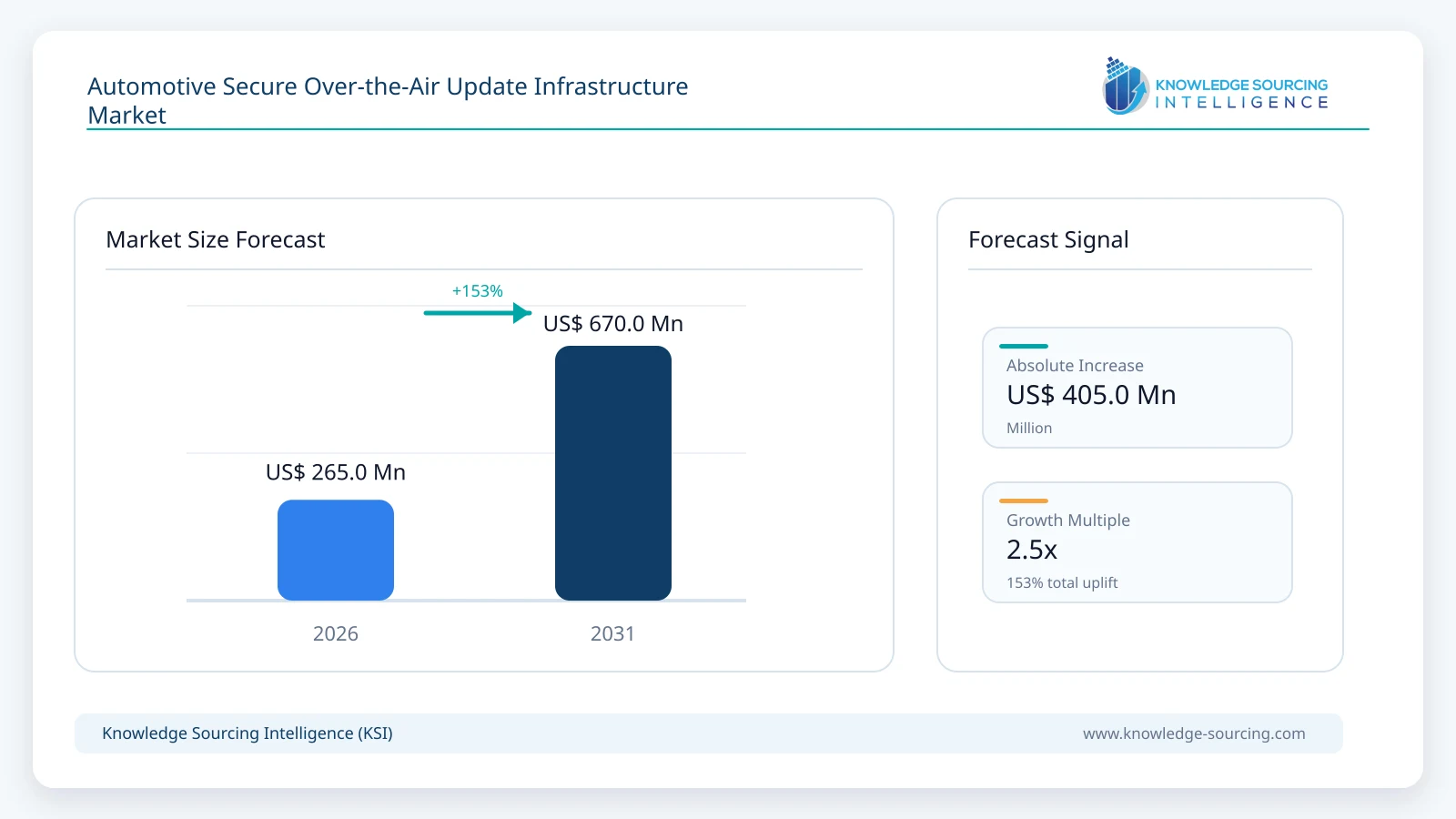
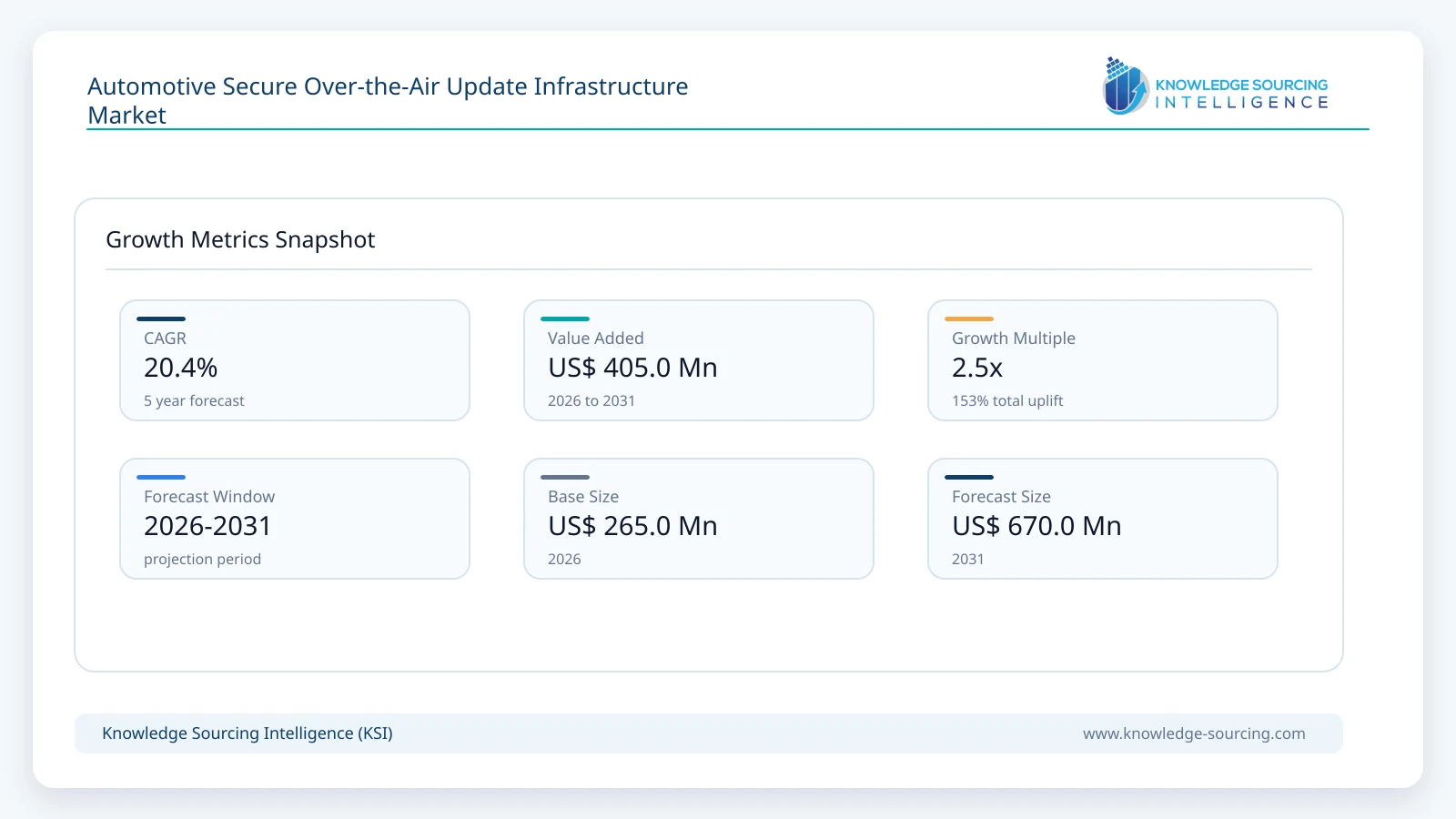
The automotive secure over-the-air update infrastructure market is estimated at USD 265 million in 2026 and is projected to reach USD 670 million by 2031, representing a 20.4% CAGR during the forecast period.
Highlights:
- 1Secure update backend and campaign orchestration accounts for an estimated 35% of the market in 2026, reflecting the continuing need to control update eligibility, package release and vehicle compatibility.
- 2Platform and embedded software licensing account for approximately 64% of 2026 revenue, while managed operations and recurring lifecycle support gain relevance as connected fleets mature.
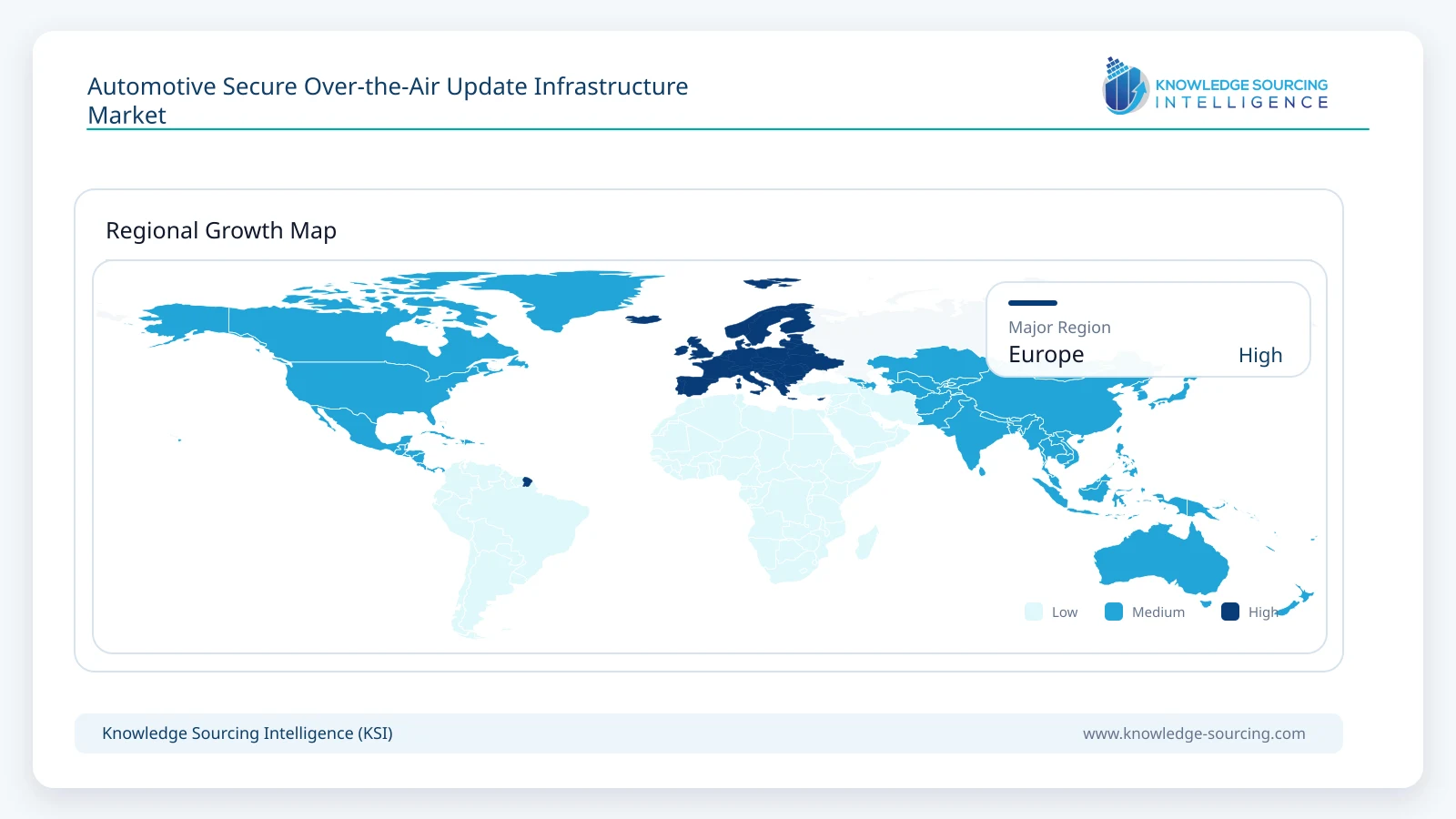
- 3Europe represents an estimated 34% of market value in 2026, with regional demand shaped by vehicle type-approval systems and established premium OEM software programs.
- 4Asia Pacific is projected to become the largest region by 2031 as Chinese, Japanese, South Korean and Indian OEM programs extend secure OTA capabilities across broader vehicle portfolios.
- 5In-vehicle agents, trust services and safe rollback controls are increasingly important as ECU firmware, high-performance computing and safety-relevant applications are updated through common workflows.
- 6Supplier competition centers on integration with diverse vehicle architectures, cryptographic assurance, campaign success rates, standards support and traceable lifecycle operations.
The scope includes purpose-built security controls associated with preparing, authorizing, installing and verifying OTA software changes, as well as their directly attributable implementation and operating services. General network traffic, connected-car hardware, unrelated software development and broad software compliance administration are excluded.
Authenticated update systems must establish that a software package is legitimate, suitable for the intended vehicle configuration and safe to install. Uptane specifies separate image and director repositories, signed metadata, vehicle version manifests and verification by vehicle controllers. Suppliers such as HARMAN, Elektrobit and KPIT commercialize these principles through secure update agents, software catalogs, validation and recovery functions. The shift from occasional infotainment changes to updates affecting propulsion, driver assistance and vehicle-wide computing increases the technical value of coordinated security controls.
Market Overview
Automotive OTA security infrastructure combines cloud-side policy and software inventory management with authenticated execution inside the vehicle. Before an update can proceed, the system must identify the target vehicle and electronic control units, verify package integrity, assess installed versions and manage dependencies. Vehicle-side controllers then perform the required validation and installation steps, while monitoring systems record whether the operation completed or requires recovery. These activities are more specialized than moving encrypted files across a communications network.
HARMAN’s Smart Delta platform incorporates digitally signed update packages, software version management and rollback capabilities to support secure updates across connected vehicle systems. Elektrobit addresses in-vehicle software updating through its EB corbos Adaptive AUTOSAR platform and EB tresos FOTA components, while KPIT provides cloud-based OTA infrastructure and vehicle-side bootloader technologies. ETAS supplies cryptographic key and certificate management capabilities used for software authentication and signing. These technologies operate at different points in the update process, requiring automakers to coordinate backend security, in-vehicle verification and recovery mechanisms across their software architectures.
Automakers operating proprietary OTA platforms can retain control over update orchestration while sourcing cryptographic signing, ECU update components and specialist integration services from external suppliers. Manufacturers without extensive in-house software infrastructure may depend more heavily on integrated OTA platforms to manage secure deployment across different vehicle architectures. As connected vehicles accumulate software versions and hardware configurations throughout their operating lives, certificate renewal, compatibility verification, security patch deployment and recovery from failed updates create continuing requirements for infrastructure maintenance and technical support.
Market Trends
Authenticated Software Supply Chains Are Becoming Central to OTA Design
Cryptographic protection of automotive software updates involves more than encryption during transmission. Update systems must establish which organization approved the software, whether the package has been altered and whether the requesting vehicle is eligible to install it. Uptane defines signed metadata and a vehicle-specific director function that can help resist repository compromise and version rollback attacks.
ETAS’s automotive key-management offering addresses certificate-based authorization and authenticated software signing, while Excelfore described cryptographic checks on differential update packages in April 2026. When firmware from several suppliers passes through one OEM-controlled deployment channel, these controls help preserve software provenance and clarify which release has been authorized for each vehicle configuration.
OTA Orchestration Is Extending Beyond Infotainment
High-performance computers, domain controllers and legacy ECUs require different programming methods, activation conditions and dependency sequences during vehicle-wide software update campaigns. Vehicle variants can also carry different processor generations and installed software versions within the same model line. Elektrobit’s AUTOSAR update and configuration management functions and HARMAN’s vehicle software catalog address the resulting need to coordinate compatible packages before installation.
Toyota’s introduction of Arene in the new RAV4 and continued work toward broader, simultaneous software updates demonstrate a manufacturer-level shift toward software lifecycle engineering. Full-vehicle update architectures raise demand for verification and recovery controls because a failure can affect multiple connected functions rather than a standalone infotainment module.
Safe Rollback and Verification Are Moving into Mainstream Architecture
Interrupted firmware installation can leave an ECU unusable or cause a mismatch between software versions even when the original update package was authentic. Vehicle manufacturers therefore evaluate systems for dual-bank installation, secure boot mechanisms, recovery after power loss and verification of the installed image. Elektrobit’s EB tresos ACO FOTA Handler supports dual-bank recovery, while KPIT documents secure verification and rollback capabilities.
Commercial fleets and vehicles operating far from service facilities place greater value on automatic recovery because a failed update may otherwise require workshop intervention. ECU-level validation, dependable fallback behavior and post-installation monitoring therefore remain important parts of supplier integration and support contracts.
Cloud-Managed Delivery Is Increasing but Does Not Eliminate OEM Control
Cloud-managed update services can maintain software catalogs, vehicle identity records and campaign telemetry across large fleets, but vehicle manufacturers retain responsibility for release authorization and software provenance. Hybrid architectures allow OEMs to keep sensitive signing keys and final release approvals within their controlled environments while using externally managed infrastructure for distribution and monitoring.
Sibros and Sonatus provide connected-vehicle software platforms combining cloud services with vehicle-side capabilities, illustrating how OTA operations can be integrated with diagnostics and ongoing software management. Supplier differentiation depends on how securely those platforms manage authorized packages, vehicle eligibility, deployment status and recovery across varied ECU architectures.
Segment Analysis
By Infrastructure Layer: Secure Update Backend and Campaign Orchestration
Secure update backends and campaign orchestration account for an estimated 35% of the market in 2026. OEMs need a reliable method to authorize releases, identify compatible vehicles, sequence multi-ECU changes and confirm the security state of deployed software. HARMAN’s firmware catalog and Elektrobit’s update management components illustrate the software inventory and installation controls required for coordinated distribution.
Secure update backend and orchestration revenue is projected to approach USD 214 million by 2031, although its proportion of overall security infrastructure spending declines moderately as signing services and ECU-level verification gain weight. Centralized campaign authorization remains necessary to manage vehicles with different hardware configurations, feature levels and software baselines.
By Security Function: Package Authenticity and Integrity Verification
Package authenticity and integrity verification represent the largest defined security function, accounting for about 30% of 2026 revenue. Cryptographic hashes, digital signatures, signed metadata and release authorization collectively reduce the risk of installing malicious or inconsistent firmware. Uptane’s verification model and ETAS’s automotive key-management tools illustrate different layers of that control system.
Vehicle- and ECU-specific authorization is expected to gain share through 2031 as software releases must be matched to increasingly varied controller configurations. Secure identity management and update eligibility checks become more demanding when different Tier-1 suppliers, hardware revisions and software baselines coexist within an OEM fleet.
By Revenue Component: Platform and Embedded Software Licensing
Licensing of platform software and vehicle-resident update agents accounts for an estimated 64% of 2026 market revenue. Contractual arrangements include OEM program licenses, software subscriptions and attributable embedded OTA security components. Integration and validation work remains material when a platform must coordinate ECUs supplied by multiple companies with different memory, bootloader and recovery characteristics.
Platform and embedded software licensing is expected to account for approximately 68% of market value in 2031 as reusable secure update architectures spread across vehicle programs. Recurring security operations also expand as OEMs maintain software certificates, vehicle identities and update controls long after the original model launch.
By Deployment Architecture: OEM-Managed Private Infrastructure
OEM-managed private environments hold an estimated 44% share in 2026, reflecting established manufacturer security controls and the sensitivity of software signing infrastructure. Many automakers retain key material, version authorization and release approval within their own systems even when using supplier-provided update agents or third-party engineering support.
Cloud-managed and hybrid infrastructure gain share as automakers operate recurring update campaigns across larger connected fleets. Many OEMs are still expected to retain sensitive root keys and final release approvals in controlled environments, combining private signing and authorization systems with externally managed delivery and monitoring services.
By Vehicle Software Domain: ADAS and Automated Driving
ADAS and automated-driving applications account for approximately 27% of 2026 secure OTA infrastructure value. Updates in these domains can affect perception, decision support and safety-relevant vehicle behavior, increasing the value of software authenticity, version eligibility and documented recovery provisions. The modeled share increases toward 31% in 2031 as advanced assistance capabilities spread beyond premium vehicles.
Powertrain and energy-management software also represents an important secure-update workload, particularly in electrified vehicles where battery and propulsion calibration may change during the ownership period. Cockpit applications remain a high-volume update category, although their share of security-specific spending is moderated by comparatively established app and infotainment deployment methods.
By Vehicle Type: Passenger Vehicles
Passenger vehicle programs represent about 75% of secure OTA infrastructure revenue in 2026. Production volumes, increasingly sophisticated electrical architectures and frequent changes to infotainment, driver assistance and electric propulsion software sustain this position. The share is modeled to ease toward 72% by 2031 as commercial vehicle fleet operators invest in remote patching and update recovery for vehicles that cannot be removed from service easily.
Light commercial and medium-to-heavy commercial vehicle programs prioritize fleet uptime and workshop avoidance, making reliable remote patching and recovery important purchase criteria. HARMAN offers OTA capabilities for commercial platforms, and KPIT describes cloud and vehicle-side software update applications relevant to these operating requirements.
Market Drivers
Software-Defined Vehicle Programs Are Expanding Post-Sale Update Requirements
OEMs deploying new vehicle operating platforms need a controlled mechanism to deliver software changes over several years of field operation. Toyota’s Arene program and the development of cloud-to-vehicle platforms show that updates are becoming a routine part of product engineering rather than an occasional repair procedure. Update authorization, identity checks and installed-configuration validation must therefore function across multiple model years and vehicle variants.
Reusable secure-update agents and signing workflows reduce the amount of engineering work required when an OEM introduces additional vehicle variants on a common platform. Over the operating life of those vehicles, certificate maintenance, eligibility checks and campaign monitoring sustain demand beyond the original software integration contract.
Vehicle Software Regulation Is Raising Traceability and Integrity Requirements
UN Regulation No. 156 requires a software update management system for vehicles within its regulatory scope and type-approval regime, while ISO 24089 describes software update engineering requirements and recommendations. Neither standard universally mandates procurement of a standalone commercial OTA security platform. Manufacturers nevertheless require robust procedures for identifying installed software, managing changes and keeping appropriate update records.
Secure software catalogs, vehicle eligibility controls and installation evidence help OEMs apply update governance requirements in day-to-day fleet operations. Dedicated update infrastructure supports these technical tasks, whereas separate approval documentation and regulatory conformity services perform a different role in the software lifecycle.
Safety-Relevant Software Updates Require Stronger Installation Controls
Software updates affecting driver assistance, energy systems and chassis controllers create more demanding validation and recovery requirements than routine map or interface changes. An incorrect installation can disrupt related vehicle functions, so manufacturers need software dependency checks, controller-level authorization and reliable recovery procedures.
Elektrobit’s EB tresos FOTA components and KPIT’s OTA architecture provide secure installation, verification and rollback mechanisms for supported controller environments. These capabilities reduce the risk of failed updates across heterogeneous vehicle networks, where hardware constraints and software dependencies matter more than the volume of data transferred.
Recall and Maintenance Economics Favor Controlled Remote Remediation
Remote software repair can reduce visits to repair facilities when a defect can be corrected without replacing hardware. However, automakers cannot rely on that economic advantage unless an update can be delivered to eligible vehicles, checked after installation and recovered when disrupted. Controlled rollout and accurate status reporting therefore have operational value beyond communications efficiency.
Connected commercial fleets place particular value on predictable service availability, making controlled firmware campaigns relevant to logistics uptime and maintenance planning. Secure installation, vehicle-level status confirmation and dependable fallback reduce the chance that remote remediation creates an additional workshop visit.
Multi-Supplier ECU Architectures Increase Update Trust Complexity
Modern vehicle programs integrate software from semiconductor vendors, Tier-1 suppliers, OEM engineering groups and outside developers. An update campaign must identify compatible binaries and maintain a chain of responsibility while handling diverse programming interfaces. Uptane’s repository and signed metadata mechanisms provide one security design model for this supply-chain problem.
Automakers coordinating software from several suppliers can use specialist OTA platforms to link version records, signed packages and vehicle-side verification within a single deployment process. OEMs with substantial internal software teams may instead develop the orchestration layer themselves and purchase only selected security components.
Market Restraints
Integration With Heterogeneous ECUs and Bootloaders
Legacy vehicle networks combine controllers with widely different memory sizes, processors, communications interfaces and update support. Some devices cannot retain a complete fallback image, while others require specific vehicle conditions before firmware installation. A generic backend cannot resolve these differences without development and validation at the controller level.
ECU-specific integration and testing raise deployment costs when secure update support is added late in a vehicle program. Smaller OEMs and lower-volume vehicle platforms may therefore prioritize controllers with the clearest maintenance or safety benefit instead of enabling equivalent capabilities across every ECU at launch.
Cybersecurity Failures Can Affect Entire Fleets
Centralizing software signing and campaign management creates valuable security controls but also high-consequence infrastructure dependencies. Compromised credentials, incorrect release authorization or flawed campaign targeting could affect many connected vehicles simultaneously. Manufacturers must protect update signing systems, restrict operator privileges and monitor unusual distribution activity.
Protecting update-signing credentials and restricting campaign authorization add assurance, audit and operations costs to platform deployments. The possibility of a fleet-wide failure also strengthens OEM requirements for proven software recovery procedures and controlled release testing.
In-House Development and Bundled Supply Contracts Limit Addressable Revenue
Automakers with large in-house software teams may develop substantial parts of their OTA security infrastructure rather than purchase a complete supplier-managed platform. Tier-1 suppliers can also integrate secure update modules into broader controller or connectivity contracts, making standalone security tools less common in some vehicle architectures.
Specialist suppliers consequently compete most directly where automakers need reusable cryptographic services, trusted update agents or engineering expertise that is difficult to maintain across multiple vehicle programs. Procurement may involve selected components and integration support rather than a single full-stack OTA contract.
Release Approval and Compliance Costs Delay Campaigns
Software updates may require functional safety review, cybersecurity analysis, version compatibility evidence and regulatory impact assessment before a campaign begins. These controls are necessary but can extend engineering schedules, particularly when multiple suppliers contribute to one vehicle platform.
Automated package authorization and installation monitoring reduce the manual work involved in secure deployment, but manufacturers still need to approve changes and complete any applicable safety or regulatory evaluation. These reviews are particularly demanding where one update alters software dependencies across several vehicle domains.
Connectivity and Field Recovery Remain Uneven
Vehicles operate in locations with inconsistent cellular coverage, constrained data plans and varying power conditions. A partially downloaded update or interrupted installation can require secure resumption, local fallback or later workshop recovery. These conditions are especially important for commercial vehicles and markets with uneven network infrastructure.
Differential software packages and reliable vehicle-side agents can lower the disruption caused by poor connectivity or interrupted installation. The economic benefit is strongest when the platform can resume downloads, verify a recovered installation and avoid a physical service visit.
Regional Outlook
Europe
Europe is estimated to represent 34% of secure OTA infrastructure market value in 2026. Vehicle programs in Germany, the United Kingdom, France and other European countries operate within a regulatory environment that places substantial emphasis on software update management and cybersecurity assurance. The region also contains major premium OEMs and engineering suppliers that have invested in complex update platforms, embedded security components and software lifecycle operations.
Europe’s secure OTA infrastructure market is projected to reach approximately USD 208 million in 2031. German and other European vehicle manufacturers continue to invest in traceable updates to safety-relevant controllers, software provenance and the maintenance of approved vehicle configurations, although their collective regional share is expected to ease as Asian programs expand.
Asia Pacific
Asia Pacific accounts for approximately 32% of estimated revenue in 2026 and is projected to become the largest regional market by 2031. China supports substantial demand from connected electric and software-intensive passenger vehicles, while Japanese and South Korean OEMs are expanding their software-defined vehicle programs. Supplier investment in India creates additional demand for interoperable update systems and integration services.
Asia Pacific’s secure OTA infrastructure market is projected to reach approximately USD 241 million by 2031. Excelfore’s announced production deployment for Tata Motors Passenger Vehicles provides an example of secure update infrastructure entering an Indian vehicle program. Procurement patterns differ across the region because automakers vary in connected fleet maturity, platform architecture, internal software capabilities and the balance of cloud and embedded security functions.
Competitive Landscape
Automotive secure OTA suppliers compete across distinct parts of the update process rather than through one uniform product category. HARMAN and Excelfore provide update platforms spanning cloud orchestration and vehicle-side execution, while Sibros and Sonatus integrate OTA functions with broader connected-vehicle software services. Elektrobit and Vector focus on software infrastructure within automotive controller architectures; KPIT supplies engineering and deployment capabilities, and ETAS specializes in security functions including cryptographic key management.
HARMAN combines software catalog management, signed package handling and recovery functions within its OTA offering, while Excelfore emphasizes standards-based update execution across vehicle platforms. Elektrobit’s FOTA components address controller-level installation needs, and Sonatus integrates updating with connected-vehicle operations. OEM selection depends on integration effort, control over signing keys, legacy ECU support, successful recovery from interrupted updates and operational consistency across regional fleets.
Recent Developments
April 7, 2026: Excelfore announced deployment of a standards-based OTA update and remote diagnostics platform for Tata Motors Passenger Vehicles, beginning with the new Tata Sierra. The supplier identified it as a production program rather than a concept demonstration.
March 13, 2026: Aptiv published a demonstration of its LINC software-defined vehicle platform emphasizing application portability and OTA updates. The development highlights the integration of update management into wider cross-domain software architectures.
January 2026: Sonatus showcased Sonatus Updater with Bosch at CES 2026 in a joint demonstration of efficient OTA updates and feature-on-demand capabilities. The demonstration is evidence of ecosystem integration, not proof of a new large-scale production contract.
January 5, 2026: Sibros introduced an SDV application marketplace incorporating cybersecurity, diagnostics and compliance-related services on its Deep Connected Platform, broadening the applications carried by connected vehicle infrastructure.
December 17, 2025: Toyota launched the new RAV4 in Japan using its Arene software platform and described future simultaneous updates across multiple vehicle functions. The launch illustrates an OEM vehicle-platform commitment rather than a third-party secure OTA contract.
April 17, 2026: Excelfore published implementation details for the integrity checks applied to differential OTA software updates, including final installed-image hash verification. The disclosure is a technical clarification rather than a newly announced vehicle contract.
Market Outlook
As vehicle platforms consolidate more software functions onto domain controllers and high-performance computers, secure OTA systems must coordinate approved packages across safety-relevant applications and older ECUs. This complexity supports continued spending on campaign orchestration, cryptographic trust and controller-level authorization through 2031. Reusable update software should account for a growing share of commercial contracts, while integration and operations services remain important for mixed-generation fleets.
The automotive secure OTA infrastructure market is projected to reach USD 670 million in 2031, with Asia Pacific overtaking Europe in the modeled regional ranking. Suppliers capable of reliable signed updates, configuration-aware installation and secure fallback across different vehicle architectures should be better positioned in OEM platform selection. Continued demand will depend on the ability to maintain these controls throughout vehicle life, not solely on the frequency of software releases.
Automotive Secure Over-the-Air Update Infrastructure Market Scope
| Report Metric | Details |
|---|---|
| Total Market Size in 2026 | USD 265 million |
| Total Market Size in 2031 | USD 670 million |
| Forecast Unit | Million |
| Growth Rate | 20.4% |
| Study Period | 2021 to 2031 |
| Historical Data | 2021 to 2024 |
| Base Year | 2025 |
| Forecast Period | 2026 – 2031 |
| Segmentation | Infrastructure Layer, Security Function, Revenue Component, Deployment Architecture, Vehicle Software Domain, Vehicle Type, Geography |
| Companies |
|
Market Segmentation
By Infrastructure Layer
Secure Update Backend and Campaign Orchestration
Signing, PKI and Trust Services
In-Vehicle Secure Update Agents
Verification, Recovery and Field Monitoring
By Security Function
Package Authenticity and Integrity Verification
ECU Identity and Update Authorization
Safe Deployment and Rollback Controls
Anomaly Monitoring and Update Evidence
By Revenue Component
Platform and Embedded Software Licensing
Deployment Integration and Validation
Managed Operations and Lifecycle Support
By Deployment Architecture
OEM-Managed Private Infrastructure
Managed Cloud Infrastructure
Hybrid Cloud and Private Infrastructure
By Vehicle Software Domain
ADAS and Automated Driving
Powertrain and Energy Management
Cockpit and Infotainment
Body, Chassis and Cross-Domain Systems
Connectivity and Other Functions
By Vehicle Type
Passenger Vehicles
Light Commercial Vehicles
Medium and Heavy Commercial Vehicles
By Geography
Europe
Germany
United Kingdom
France
Italy
Spain
Others
Asia Pacific
China
Japan
South Korea
India
Taiwan
Thailand
Indonesia
Others
North America
United States
Canada
Mexico
South America
Brazil
Argentina
Others
Middle East and Africa
Saudi Arabia
United Arab Emirates
Israel
South Africa
Others
Table of Contents
1. EXECUTIVE SUMMARY
2. MARKET SNAPSHOT
2.1. Market Overview
2.2. Market Definition
2.3. Scope of the Study
2.4. Market Segmentation
3. BUSINESS LANDSCAPE
3.1. Market Drivers
3.1.1. Software-Defined Vehicle Programs Are Expanding Post-Sale Update Requirements
3.1.2. Vehicle Software Regulation Is Raising Traceability and Integrity Requirements
3.1.3. Safety-Relevant Software Updates Require Stronger Installation Controls
3.1.4. Recall and Maintenance Economics Favor Controlled Remote Remediation
3.1.5. Multi-Supplier ECU Architectures Increase Update Trust Complexity
3.2. Market Restraints
3.2.1. Integration With Heterogeneous ECUs and Bootloaders
3.2.2. Cybersecurity Failures Can Affect Entire Fleets
3.2.3. In-House Development and Bundled Supply Contracts Limit Addressable Revenue
3.2.4. Release Approval and Compliance Costs Delay Campaigns
3.2.5. Connectivity and Field Recovery Remain Uneven
3.3. Market Opportunities
3.4. Porter’s Five Forces Analysis
3.5. Industry Value Chain Analysis
3.6. Policies and Regulations
3.7. Strategic Recommendations
4. TECHNOLOGICAL OUTLOOK
4.1. Signing, PKI and Trust Architecture
4.2. Secure Vehicle and ECU Identity
4.3. Uptane-Based Update Verification
4.4. A/B Installation, Rollback and Recovery
4.5. Cloud-to-Vehicle Orchestration and Monitoring
5. AUTOMOTIVE SECURE OVER-THE-AIR UPDATE INFRASTRUCTURE MARKET BY INFRASTRUCTURE LAYER
5.1. Introduction
5.2. Secure Update Backend and Campaign Orchestration
5.3. Signing, PKI and Trust Services
5.4. In-Vehicle Secure Update Agents
5.5. Verification, Recovery and Field Monitoring
6. AUTOMOTIVE SECURE OVER-THE-AIR UPDATE INFRASTRUCTURE MARKET BY SECURITY FUNCTION
6.1. Introduction
6.2. Package Authenticity and Integrity Verification
6.3. ECU Identity and Update Authorization
6.4. Safe Deployment and Rollback Controls
6.5. Anomaly Monitoring and Update Evidence
7. AUTOMOTIVE SECURE OVER-THE-AIR UPDATE INFRASTRUCTURE MARKET BY REVENUE COMPONENT
7.1. Introduction
7.2. Platform and Embedded Software Licensing
7.3. Deployment Integration and Validation
7.4. Managed Operations and Lifecycle Support
8. AUTOMOTIVE SECURE OVER-THE-AIR UPDATE INFRASTRUCTURE MARKET BY DEPLOYMENT ARCHITECTURE
8.1. Introduction
8.2. OEM-Managed Private Infrastructure
8.3. Managed Cloud Infrastructure
8.4. Hybrid Cloud and Private Infrastructure
9. AUTOMOTIVE SECURE OVER-THE-AIR UPDATE INFRASTRUCTURE MARKET BY VEHICLE SOFTWARE DOMAIN
9.1. Introduction
9.2. ADAS and Automated Driving
9.3. Powertrain and Energy Management
9.4. Cockpit and Infotainment
9.5. Body, Chassis and Cross-Domain Systems
9.6. Connectivity and Other Functions
10. AUTOMOTIVE SECURE OVER-THE-AIR UPDATE INFRASTRUCTURE MARKET BY VEHICLE TYPE
10.1. Introduction
10.2. Passenger Vehicles
10.3. Light Commercial Vehicles
10.4. Medium and Heavy Commercial Vehicles
11. AUTOMOTIVE SECURE OVER-THE-AIR UPDATE INFRASTRUCTURE MARKET BY GEOGRAPHY
11.1. Introduction
11.2. Europe
11.2.1. By Country
11.2.1.1. Germany
11.2.1.2. United Kingdom
11.2.1.3. France
11.2.1.4. Italy
11.2.1.5. Spain
11.2.1.6. Others
11.3. Asia Pacific
11.3.1. By Country
11.3.1.1. China
11.3.1.2. Japan
11.3.1.3. South Korea
11.3.1.4. India
11.3.1.5. Taiwan
11.3.1.6. Thailand
11.3.1.7. Indonesia
11.3.1.8. Others
11.4. North America
11.4.1. By Country
11.4.1.1. United States
11.4.1.2. Canada
11.4.1.3. Mexico
11.5. South America
11.5.1. By Country
11.5.1.1. Brazil
11.5.1.2. Argentina
11.5.1.3. Others
11.6. Middle East and Africa
11.6.1. By Country
11.6.1.1. Saudi Arabia
11.6.1.2. United Arab Emirates
11.6.1.3. Israel
11.6.1.4. South Africa
11.6.1.5. Others
12. COMPETITIVE ENVIRONMENT AND ANALYSIS
12.1. Major Players and Strategy Analysis
12.2. Market Share Analysis
12.3. Mergers, Acquisitions, Agreements and Collaborations
12.4. Competitive Dashboard
13. COMPANY PROFILES
13.1. HARMAN International
13.2. Excelfore
13.3. Sibros
13.4. Sonatus
13.5. Vector Informatik GmbH
13.6. Robert Bosch GmbH
13.7. ETAS GmbH
13.8. Elektrobit Automotive GmbH
13.9. KPIT Technologies Limited
13.10. Aptiv PLC
13.11. AUMOVIO SE
14. APPENDIX
14.1. Currency
14.2. Assumptions
14.3. Base and Forecast Years Timeline
14.4. Key Benefits for Stakeholders
14.5. Research Methodology
14.6. Abbreviations
Navigate
Trusted by the world's leading organizations