
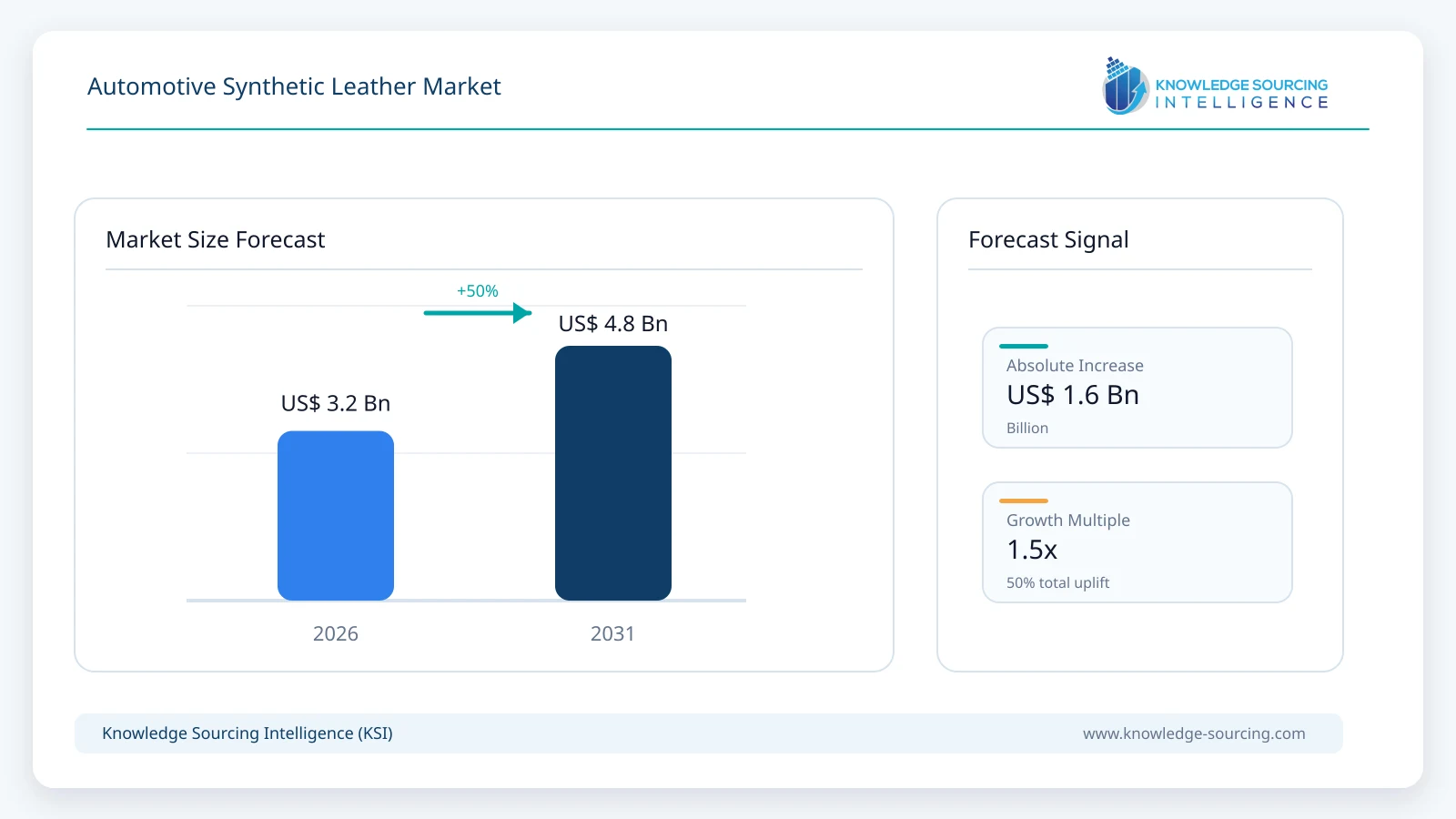
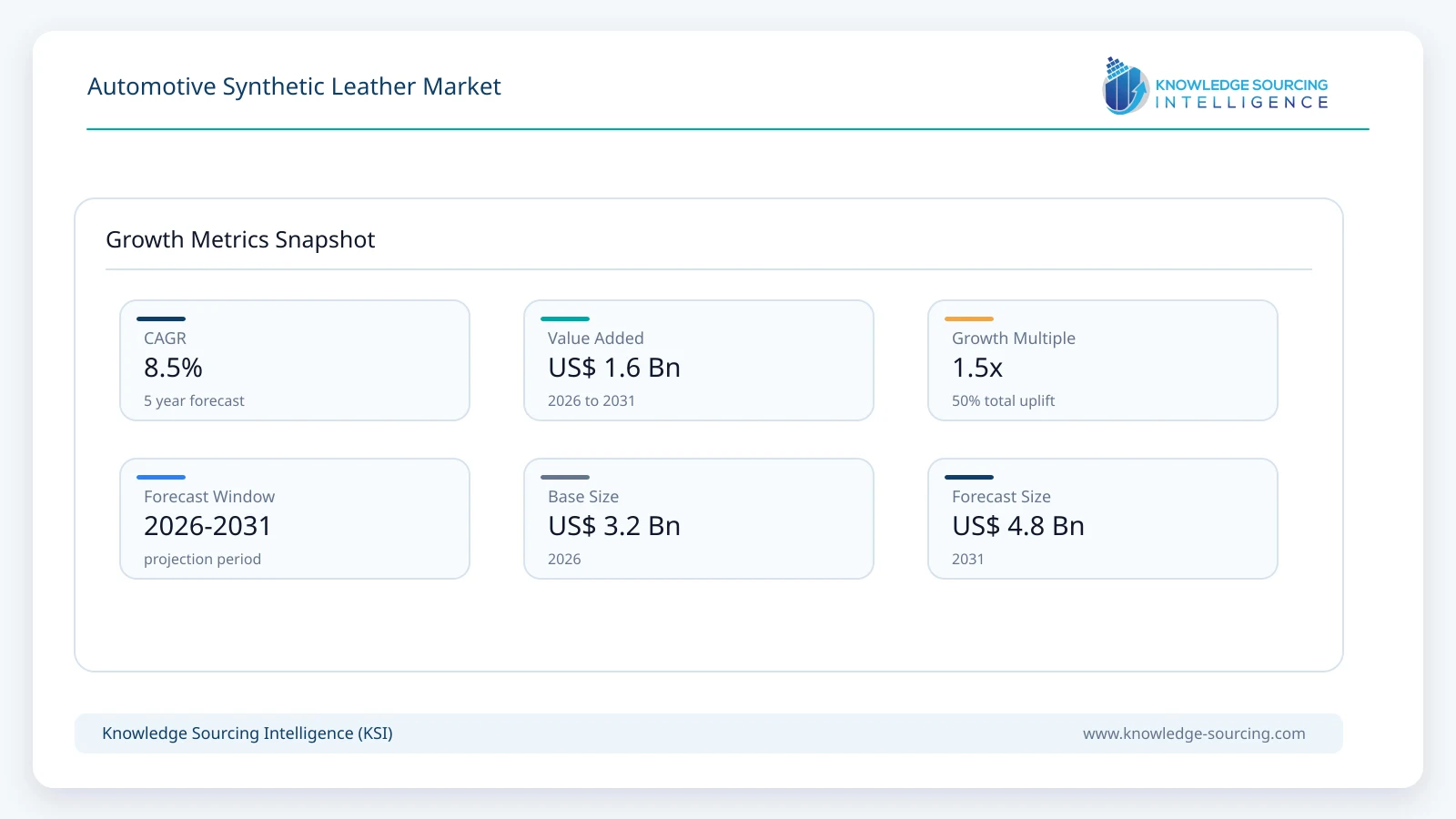
The automotive synthetic leather market is estimated at USD 3.23 billion in 2026 and is projected to reach USD 4.85 billion in 2031, representing annual growth of approximately 8.5% during the forecast period.
Highlights:
- 1Polyurethane synthetic leather represents approximately 55.7% of estimated global value in 2026, increasing toward 60.6% by 2031 as premium-feel and lower-solvent technologies gain traction.
- 2PVC synthetic leather accounts for roughly 36.1% of 2026 market value, reflecting economical processing and its established use in cost-sensitive interior coverings.
- 3Seat upholstery represents approximately 68% of modeled 2026 demand because cushion, backrest and bolster coverings account for the greatest area of leather-look materials.
- 4Asia Pacific represents approximately 48% of 2026 demand, supported by China, Japan, India and regional material conversion networks.
- 5OEM supply remains the principal channel, at approximately 92% of 2026 market value, because covering materials require repeated automotive validation and specified colors.
- 6Waterborne and solvent-free PU technologies are expanding qualification options; these routes are not interchangeable with the PVC manufacturing platform.
The market covers automotive-grade PU and PVC synthetic leather, along with qualifying engineered non-animal leather alternatives, sold as coated rolls, laminated surfaces or prepared automotive covering substrates. Finished seats, complete cabin modules, bare resin sales and ordinary woven upholstery fabrics do not form part of the market value.
Synthetic leather provides a consistent surface finish across high-volume vehicle programs where genuine hide selection, appearance variation and cutting losses can complicate procurement. Kyowa Leather Cloth supplies urethane-based covers for seating, door panels and cockpit areas, while Continental offers its Acella automotive surface family with different weight and wear specifications. Seiren manufactures QUOLE synthetic leather for vehicle interiors, supported by automotive-specific textures and perforation options.
Market Overview
Automotive synthetic leather consists of a flexible textile or nonwoven backing with a coated, laminated or impregnated polymer surface designed to reproduce leather-like grain and tactile behavior. PVC-coated fabrics generally offer broad formulation flexibility and competitive processing economics, whereas PU systems support softer touch and a wider range of specialty surface properties. Synthetic leather used on seat bolsters must resist repeated bending and abrasion, while instrument-panel coverings place additional emphasis on heat aging, light stability and emissions.
Kyowa Leather Cloth manufactures high-durability synthetic covers for seats, cockpits and door trims, including perforated urethane materials for ventilated seating. Seiren offers QUOLE grades with different finishes and functional treatments, while Continental specifies Acella and Benova materials for seating and other soft-touch cabin zones. Mayur Uniquoters supplies PVC and PU synthetic leather to automotive original-equipment and replacement markets, supported by integrated coating and textile infrastructure.
The upstream chemistry supply chain is also relevant because polymer chemistry affects manufacturing emissions and in-service durability. BASF positions Haptex as a solvent-free PU platform for synthetic-leather manufacturing, while Covestro offers INSQIN waterborne polyurethane coating and impregnation technologies for automotive textile surfaces. Kyowa, Seiren and other conversion specialists combine coatings with fabric or microfiber backings to achieve specific surface performance. Changes to resin systems can require fresh tests for fogging, hydrolysis, tear strength and interior flammability before automakers authorize substitution.
Market Trends
Waterborne and Solvent-Free Polyurethane Systems Are Broadening Automotive Specifications
Lower-emission coating technologies are gaining prominence as automotive manufacturers consider production energy, material odor and solvent management alongside conventional wear resistance. BASF demonstrated a Haptex synthetic-leather automotive seat at PU TECH 2025 and reported lower process emissions than a defined conventional synthetic-leather reference. Covestro develops INSQIN waterborne PU coatings for textile-based car-interior surfaces, including soft-touch applications. Both systems illustrate changes in process chemistry, although an attractive environmental profile alone does not establish vehicle-program approval.
Synthetic Leather Is Moving Beyond Seat Centers
Door panels, armrests, instrument-panel wraps and console-side coverings increasingly use coordinated soft-touch materials to create a consistent appearance across the cabin. Kyowa Leather Cloth lists cockpit and door-trim surfaces alongside seating, while Continental supplies Acella constructions for seat covers, side panels and interior contact zones. Synthetic leather can extend a premium visual treatment to larger areas at lower material cost than comparable genuine-leather coverage. Expansion beyond seating increases material area per equipped vehicle but requires different texture, thickness and durability specifications.
Material Recovery and Lower-Impact Backings Are Influencing Development
Coated textiles are mechanically difficult to recycle when polyurethane or PVC layers are permanently attached to mixed-fiber backing materials. Seiren offers QUOLE ZERO using a solvent-free manufacturing route and QUOLE Bio with biomass polyurethane and polyester constituents. Continental likewise markets synthetic seat surfaces with recycled or bio-based content options.
Segment Analysis
By Material Type: Polyurethane Synthetic Leather
Polyurethane synthetic leather holds an estimated 55.7% share in 2026 and is projected to account for approximately 60.6% by 2031. The growth reflects PU performance across seat inserts, steering surfaces and premium cabin trim, together with greater interest in solvent-free and waterborne processing. Seiren’s QUOLE portfolio, BASF Haptex chemistry and Covestro INSQIN technology illustrate separate material conversion and upstream-chemistry capabilities. The PU segment is expected to reach approximately USD 2.94 billion by 2031, with faster growth than the remaining major material types.
By Material Type: PVC Synthetic Leather
PVC synthetic leather accounts for approximately 36.1% of the estimated 2026 market, with a substantial position in seat sides, headrests, door inserts and price-sensitive coverings. Mayur Uniquoters operates large PVC coating capacity and supplies both automotive OEM and replacement markets, while Kyowa manufactures different automotive synthetic covering platforms. PVC processing remains attractive where consistent color, surface finish and competitive material cost are central to procurement. The PVC segment is expected to grow in absolute value but represent approximately 28.8% of the total by 2031 as PU alternatives capture a larger share of new programs.
By Application: Seat Upholstery
Seat upholstery represents approximately 68% of synthetic-leather market value in 2026 because passenger seats require large visible surface areas and repeated contact with occupants. Cushion and backrest coverings must withstand abrasion, stretching, temperature changes and cleaning while supporting features such as ventilation or heating. Perforated automotive PU supplied by Kyowa and special QUOLE finishes offered by Seiren address such application-specific requirements. Seat upholstery remains the principal application through 2031 even as door and cockpit surfaces gain incremental value.
By Sales Channel: OEM
Automotive OEM contracts account for approximately 92% of modeled 2026 demand because covering materials enter long vehicle-development and validation cycles. Suppliers support color approval, prototype evaluations, performance testing and regional material logistics before series supply begins. Continental, Kyowa and Seiren participate through automotive-specialized product ranges, while seating integrators such as Adient specify approved material combinations. The aftermarket remains important for replacement seat covers and customization, but typically operates with more varied specifications and smaller individual order volumes.
By Vehicle Type: Passenger Vehicles
Passenger vehicles represent approximately 91% of 2026 demand, reflecting global passenger-car production and higher leather-look covering content in mainstream and premium seating. Sport-utility vehicles and larger passenger cabins provide additional surface area for seat and door coverings, although installed value varies significantly by trim take rate. Commercial vehicles still purchase durable vinyl and synthetic coverings for high-use seats and easy-clean surfaces.
Market Drivers
Broader Adoption of Leather-Look Interior Packages
Automakers increasingly use synthetic leather to offer coordinated high-quality surfaces across mid-market vehicle variants without the sourcing and conversion cost associated with genuine leather. Interior packages can apply PU or PVC coverings to seat contact areas, side bolsters, steering surfaces and selected door trims. Seiren, Kyowa Leather Cloth and Continental maintain dedicated automotive product families covering several of these applications. Wider material coverage supports growth in qualified square meters per vehicle beyond changes in vehicle output.
Improving Solvent-Free and Waterborne Coating Technologies
Synthetic-leather manufacturers face growing demand for processes that reduce solvent handling and material emissions without sacrificing performance. BASF Haptex and Covestro INSQIN provide documented examples of PU chemistry designed for leather-like textile coatings. Seiren also markets solvent-free QUOLE variants that meet automotive material specifications. Such technologies expand the range of surface products available to automakers with more demanding chemical and interior-air requirements.
Expansion of Global Automotive Production and Local Conversion
OICA recorded 96.4 million motor vehicles produced globally in 2025, with a larger share of industry growth concentrated in Asia. Leather-like material suppliers need reliable production near seat and interior-module plants to manage launches, replacement colors and engineering updates. Mayur and Kyowa have established manufacturing or market development footprints serving major automotive regions. Vehicle production and supplier localization provide a stable foundation for additional material demand, even where vehicle growth is moderate.
Greater Technical Demands on Seat and Contact Surfaces
Ventilated seats, frequent cabin cleaning and extended upholstery life place greater performance demands on synthetic coverings. Perforation, grain definition, coating adhesion and crack resistance are selected according to specific seating positions and component geometry. Continental’s Acella variants and Kyowa’s perforated urethane materials show how automotive suppliers provide different constructions for these operating conditions. Higher specification content can increase realized material value even without proportionate gains in area.
Renewable and Recycled Input Development
Vehicle manufacturers are requesting evidence about material sourcing, recycled content and emissions across interior components. Seiren offers biomass-derived and solvent-free synthetic leather grades, while Adient lists bio-attributed PU, PVC and recycled-content faux leather among available seat-surface options. Renewable input strategies remain constrained by durability qualification and traceability needs. Suppliers able to demonstrate performance with verified material content may secure differentiated positions in future automotive programs.
Market Restraints
Hydrolysis, Abrasion and Temperature Qualification
PU and PVC coatings must maintain surface performance after exposure to humid heat, cold conditions, ultraviolet light and repeated occupant contact. The wrong resin or backing construction can crack, peel, discolor or lose adhesion during service. Seat-perforation and stitch designs introduce additional stress concentrations that require component-specific qualification. Long validation cycles slow replacement of existing synthetic-leather specifications even when new formulations show environmental benefits.
Cost Premiums for Advanced PU Production
Waterborne, solvent-free or specialty PU synthetic leather can require different processing equipment, resin packages and quality controls from conventional PVC manufacturing. The conversion-cost advantage of PVC can be important in lower-priced vehicles where leather-like appearance is valued but premium performance is not always specified. Kuraray’s 2026 CLARINO price revision also illustrates cost pressure within the broader man-made leather industry, although that announcement does not isolate automotive sales.
Multi-Material Recycling Challenges
Conventional synthetic leather combines polymers, textile backing and sometimes adhesive or foam layers that are difficult to separate economically after vehicle use. Higher recycled input content does not by itself guarantee end-of-life recyclability for a finished laminated seat cover. The EU’s vehicle-circularity regulation increases longer-term attention to recovery and material documentation, but recycled-plastic quotas begin after the current forecast period. Developing easily recoverable coating systems remains a technical and commercial challenge.
Competition from Textiles and Genuine Leather
Woven fabrics, technical nonwovens, premium microfiber textiles and genuine leather can each satisfy different combinations of appearance, ventilation, price and sustainability requirements. Natural leather remains important in some premium seat packages, while fabrics often offer lower material cost and differing thermal comfort. Synthetic-leather producers therefore compete for surface area rather than all available interior-trim expenditure. Substitution can limit growth when automakers prioritize textile-based trim or narrow leather-look options.
OEM Concentration and Capacity Utilization Risk
Automotive coating lines require capital expenditure, color controls, trained operators and customer approval before substantial production volumes can be supplied. Changes in vehicle-platform demand or trim take rates can leave specialized capacity underutilized. Mayur reports large PVC production lines and a separate developing PU capability, illustrating the material-specific nature of manufacturing assets. Suppliers with limited customer diversification face greater exposure to launch delays and material redesigns.
Regional Outlook
Asia Pacific
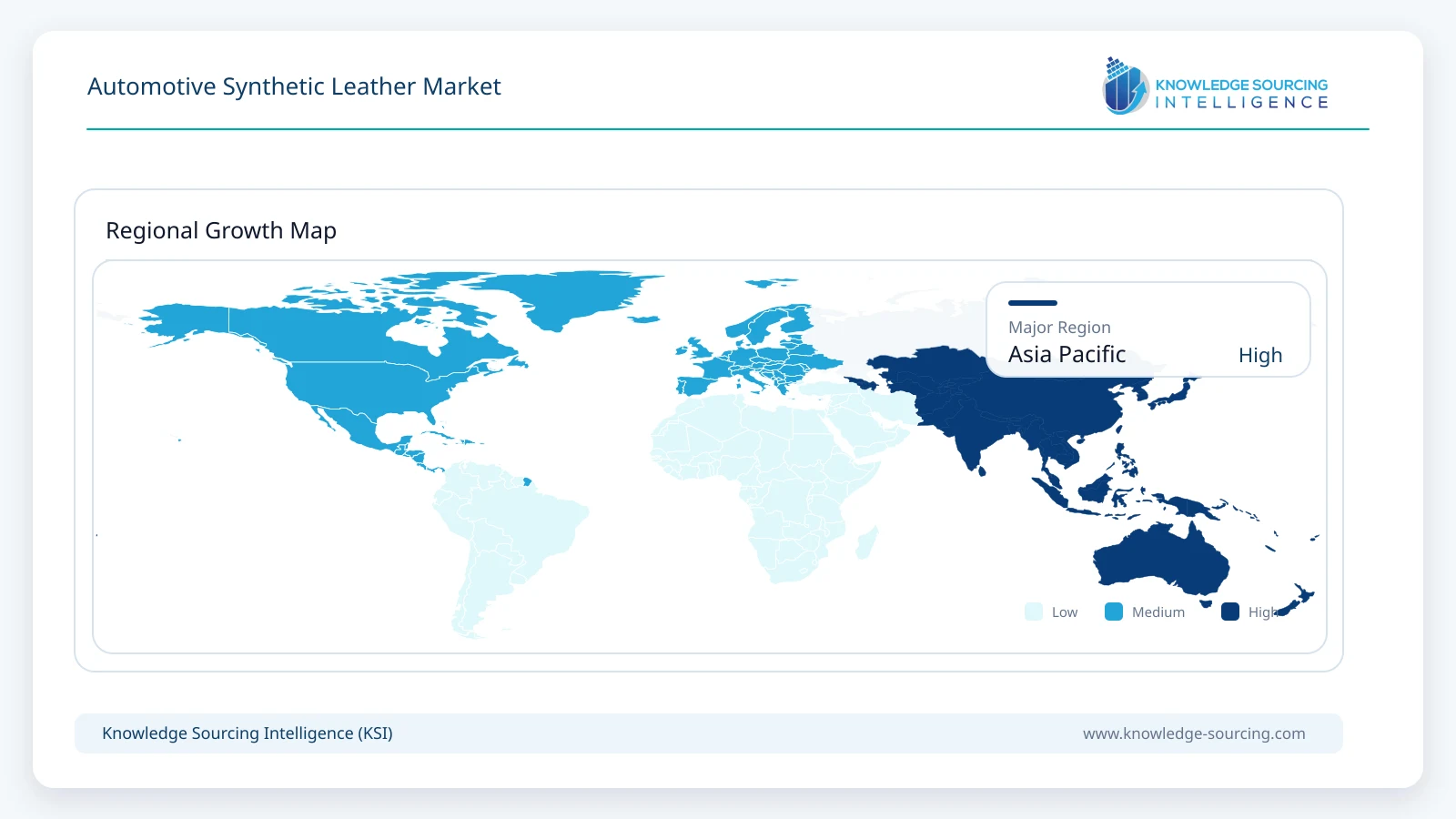
Asia Pacific is estimated to account for approximately 48% of automotive synthetic leather market value in 2026, driven by vehicle production and established covering-material production in China, Japan, India and neighboring economies. Japan is home to Kyowa Leather Cloth and Seiren, both suppliers of specialized automotive PU surfaces, while India supports scaled PVC manufacture and developing PU production through Mayur Uniquoters. China provides a large combination of OEM vehicle demand and domestic interior surface conversion. Asia Pacific is forecast to exceed USD 2.47 billion by 2031 as automotive programs adopt greater synthetic covering content.
The region’s market is differentiated by coating platform and vehicle price tier. PVC remains important in cost-sensitive seating, while higher-specification PU materials compete on soft touch, color stability and low-emission performance. Material localization helps automotive customers manage launch schedules and avoid extended cross-border supply chains. Strong price competition and variations in local qualification standards remain important constraints on supplier margins.
Europe
Europe accounts for approximately 23% of modeled market value in 2026, with automotive-grade coverings used by established premium and mass-market vehicle assemblers. Continental supplies Acella and Benova surface materials, while BASF and Covestro support PU chemistry development for automotive synthetic coverings. The European market also requires stringent attention to interior material emissions, resistance to heat and light and future vehicle circularity obligations. By 2031, European demand is projected to reach approximately USD 1.07 billion, retaining a significant engineering and qualification role.
European material development increasingly emphasizes production emissions, reduced solvent use and compatibility with component recovery strategies. The 2026 EU vehicle-circularity regulation will start general application in 2028, while the 15% recycled-plastic content requirement begins in 2032. The regulation therefore influences development planning during the forecast horizon without creating an immediate 2026–2031 material-content quota. Proven automotive performance and material economics remain central to purchasing decisions throughout the period.
Competitive Landscape
Automotive synthetic leather supply combines direct coated-surface producers, upstream polymer developers and qualified seat-material integrators. Kyowa Leather Cloth, Seiren, Continental and Mayur Uniquoters offer automotive-specific coated materials, while BASF and Covestro supply PU technologies that allow coating manufacturers to develop alternative processing methods. FORVIA and Adient participate through upholstery surfaces and vehicle-seat integration, while Toray and Kuraray provide advanced engineered leather-like materials for selected premium applications.
Recent Developments
August 2026: The European Union brought its updated End-of-Life Vehicles Regulation into force, establishing a future framework for vehicle-material documentation, recyclability and recycled-plastic content. The principal recycled-plastic targets begin in 2032 and 2036, so no immediate synthetic-leather quota is assumed for 2026–2031.
April 2026: Covestro, Marquardt and E Ink presented a concept door panel combining waterborne PU-coated film with a concealed color-changing display. The demonstration indicates new design possibilities for coated interior surfaces but is not evidence of a disclosed series-production contract.
March 2026: Kuraray announced a price increase of at least 10% for CLARINO man-made leather beginning in April 2026, citing energy-related, raw-material, labor and facility-cost pressures. The announcement concerns CLARINO overall and cannot be read as an automotive-only price index.
FY2025–26: Mayur Uniquoters documented 3.5 million linear meters of monthly PVC-coating capacity and automotive applications across seats, door trim and steering surfaces in its sustainability disclosures. Reported capacity covers multiple industries and is not equivalent to realized automotive output.
April 2025: Toyota Boshoku, Kyowa Leather Cloth and Fujifilm showcased inkjet decoration on synthetic-leather seat surfaces at Auto Shanghai. The concept highlights potential production flexibility for personalized upholstery but did not disclose commercial vehicle-program volumes.
April 2025: BASF showcased an automotive seat using Haptex synthetic leather at PU TECH 2025 and published a comparative footprint assessment for the specific system. The performance claims relate to the defined reference process and should not be generalized to every automotive PU formulation.
Market Outlook
The automotive synthetic leather market is projected to expand mainly through wider PU surface adoption, more leather-look coverage on passenger vehicles and continued demand for economical PVC applications. Seat upholstery remains the largest application, while door trims and cockpit coverings contribute increasing value through broader soft-touch design. New processing chemistry creates additional routes to low-emission materials, but vehicle-specific durability and production economics will govern qualification. PVC is likely to remain a substantial category even as its market share declines.
Asia Pacific should generate the largest absolute increase in synthetic-leather material demand through 2031, with Europe retaining an important role in premium finish specification and advanced PU chemistry. Supplier investment is expected to focus on coating quality, substrate engineering, regional delivery and material traceability. Growth forecasts are sensitive to vehicle production, the proportion of vehicles using synthetic covers and the amount of qualified leather-like material fitted to each vehicle. These variables are more significant to the outlook than the total number of vehicles advertising leather-style trim.
Automotive Synthetic Leather Market Scope
| Report Metric | Details |
|---|---|
| Total Market Size in 2026 | USD 3.23 billion |
| Total Market Size in 2031 | USD 4.85 billion |
| Forecast Unit | Billion |
| Growth Rate | 8.5% |
| Study Period | 2021 to 2031 |
| Historical Data | 2021 to 2024 |
| Base Year | 2025 |
| Forecast Period | 2026 – 2031 |
| Segmentation | Material Type, Application, Sales Channel, Vehicle Type, Geography |
| Companies |
|
Market Segmentation
By Material Type
Polyurethane (PU) Synthetic Leather
Polyvinyl Chloride (PVC) Synthetic Leather
Other Engineered Leather Alternatives
By Application
Seat Upholstery
Door, Pillar and Side Trim
Steering-Wheel and Control Coverings
Instrument Panels and Consoles
Other Interior Coverings
By Sales Channel
OEM
Aftermarket
By Vehicle Type
Passenger Vehicles
Light Commercial Vehicles
Medium/Heavy Commercial Vehicles and Buses
By Geography
North America
United States
Canada
Mexico
South America
Brazil
Argentina
Others
Europe
Germany
United Kingdom
France
Italy
Spain
Others
Middle East and Africa
Saudi Arabia
UAE
South Africa
Others
Asia Pacific
China
Japan
India
South Korea
Indonesia
Thailand
Others
Table of Contents
1. EXECUTIVE SUMMARY
2. MARKET SNAPSHOT
2.1. Market Overview
2.2. Market Definition
2.3. Scope of the Study
2.4. Market Segmentation
3. BUSINESS LANDSCAPE
3.1. Market Drivers
3.1.1. Broader Adoption of Leather-Look Interior Packages
3.1.2. Improving Solvent-Free and Waterborne Coating Technologies
3.1.3. Expansion of Global Automotive Production and Local Conversion
3.1.4. Greater Technical Demands on Seat and Contact Surfaces
3.1.5. Renewable and Recycled Input Development
3.2. Market Restraints
3.2.1. Hydrolysis, Abrasion and Temperature Qualification
3.2.2. Cost Premiums for Advanced PU Production
3.2.3. Multi-Material Recycling Challenges
3.2.4. Competition from Textiles and Genuine Leather
3.2.5. OEM Concentration and Capacity Utilization Risk
3.3. Market Opportunities
3.4. Porter’s Five Forces Analysis
3.5. Industry Value Chain Analysis
3.6. Policies and Regulations
3.7. Strategic Recommendations
4. TECHNOLOGICAL OUTLOOK
4.1. Polyurethane Coating and Lamination
4.2. PVC Coating, Calendaring and Transfer Processes
4.3. Waterborne and Solvent-Free Polyurethane
4.4. Microfiber and Engineered Backing Systems
4.5. Recycled and Bio-Attributed Synthetic Leather
4.6. Perforation, Functional Finishes and Cabin Emissions
5. AUTOMOTIVE SYNTHETIC LEATHER MARKET BY MATERIAL TYPE
5.1. Introduction
5.2. Polyurethane (PU) Synthetic Leather
5.3. Polyvinyl Chloride (PVC) Synthetic Leather
5.4. Other Engineered Leather Alternatives
6. AUTOMOTIVE SYNTHETIC LEATHER MARKET BY APPLICATION
6.1. Introduction
6.2. Seat Upholstery
6.3. Door, Pillar and Side Trim
6.4. Steering-Wheel and Control Coverings
6.5. Instrument Panels and Consoles
6.6. Other Interior Coverings
7. AUTOMOTIVE SYNTHETIC LEATHER MARKET BY SALES CHANNEL
7.1. Introduction
7.2. OEM
7.3. Aftermarket
8. AUTOMOTIVE SYNTHETIC LEATHER MARKET BY VEHICLE TYPE
8.1. Introduction
8.2. Passenger Vehicles
8.3. Light Commercial Vehicles
8.4. Medium/Heavy Commercial Vehicles and Buses
9. AUTOMOTIVE SYNTHETIC LEATHER MARKET BY GEOGRAPHY
9.1. Introduction
9.2. North America
9.2.1. By Material Type
9.2.2. By Application
9.2.3. By Sales Channel
9.2.4. By Vehicle Type
9.2.5. By Country
9.2.5.1. United States
9.2.5.2. Canada
9.2.5.3. Mexico
9.3. South America
9.3.1. By Material Type
9.3.2. By Application
9.3.3. By Sales Channel
9.3.4. By Vehicle Type
9.3.5. By Country
9.3.5.1. Brazil
9.3.5.2. Argentina
9.3.5.3. Others
9.4. Europe
9.4.1. By Material Type
9.4.2. By Application
9.4.3. By Sales Channel
9.4.4. By Vehicle Type
9.4.5. By Country
9.4.5.1. Germany
9.4.5.2. United Kingdom
9.4.5.3. France
9.4.5.4. Italy
9.4.5.5. Spain
9.4.5.6. Others
9.5. Middle East and Africa
9.5.1. By Material Type
9.5.2. By Application
9.5.3. By Sales Channel
9.5.4. By Vehicle Type
9.5.5. By Country
9.5.5.1. Saudi Arabia
9.5.5.2. UAE
9.5.5.3. South Africa
9.5.5.4. Others
9.6. Asia Pacific
9.6.1. By Material Type
9.6.2. By Application
9.6.3. By Sales Channel
9.6.4. By Vehicle Type
9.6.5. By Country
9.6.5.1. China
9.6.5.2. Japan
9.6.5.3. India
9.6.5.4. South Korea
9.6.5.5. Indonesia
9.6.5.6. Thailand
9.6.5.7. Others
10. COMPETITIVE ENVIRONMENT AND ANALYSIS
10.1. Major Players and Strategy Analysis
10.2. Market Share Analysis
10.3. Mergers, Acquisitions, Agreements and Collaborations
10.4. Competitive Dashboard
11. COMPANY PROFILES
11.1. Kyowa Leather Cloth Co., Ltd.
11.2. Seiren Co., Ltd.
11.3. Continental AG
11.4. Mayur Uniquoters Limited
11.5. BASF SE
11.6. Covestro AG
11.7. FORVIA SE
11.8. Kuraray Co., Ltd.
11.9. Toray Industries, Inc.
11.10. Toyobo Co., Ltd.
11.11. Ultrafabrics, Inc.
11.12. Adient plc
12. APPENDIX
12.1. Currency
12.2. Assumptions
12.3. Base and Forecast Years Timeline
12.4. Key Benefits for Stakeholders
12.5. Research Methodology
12.6. Abbreviations
Navigate
Trusted by the world's leading organizations











