
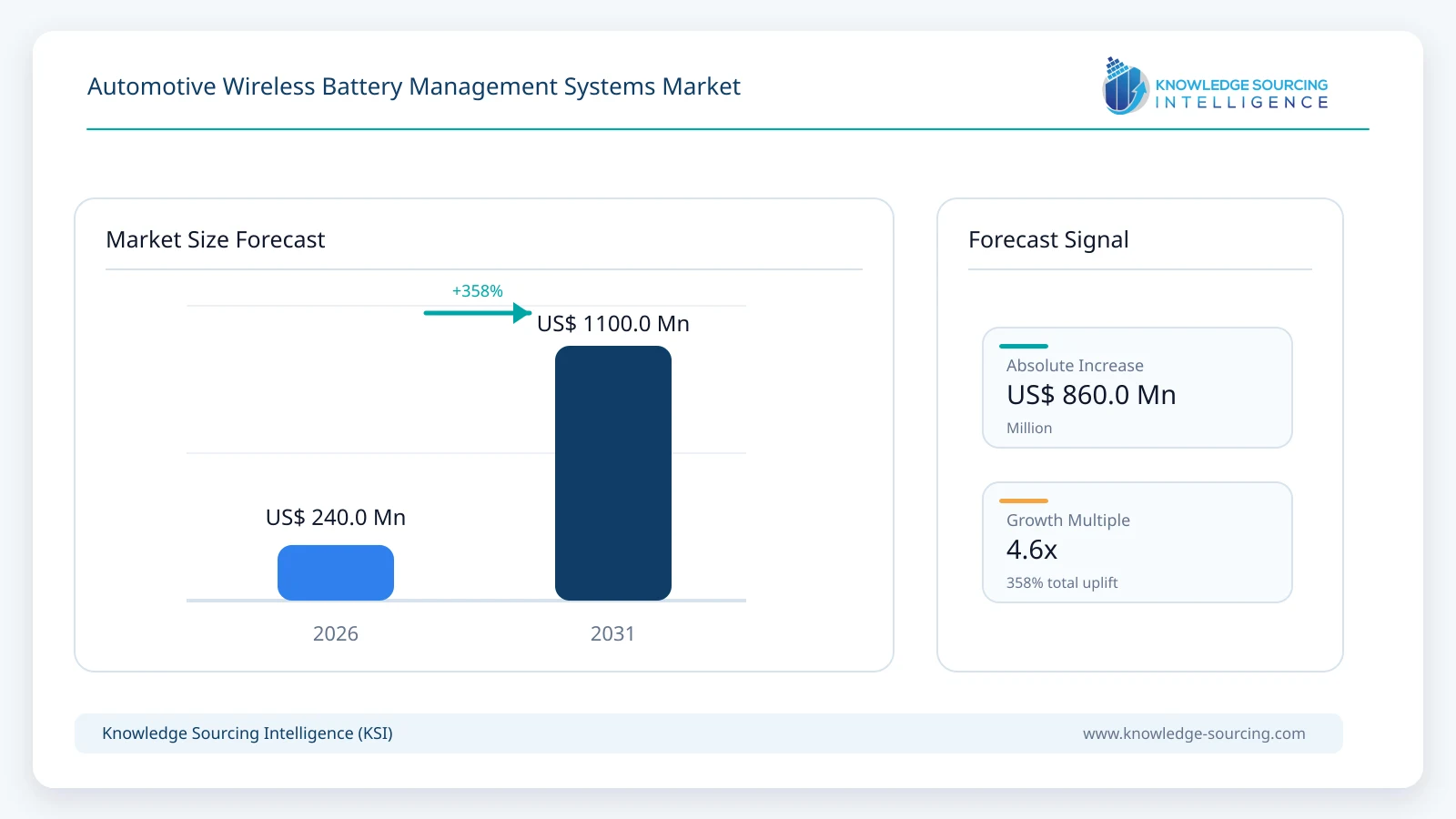
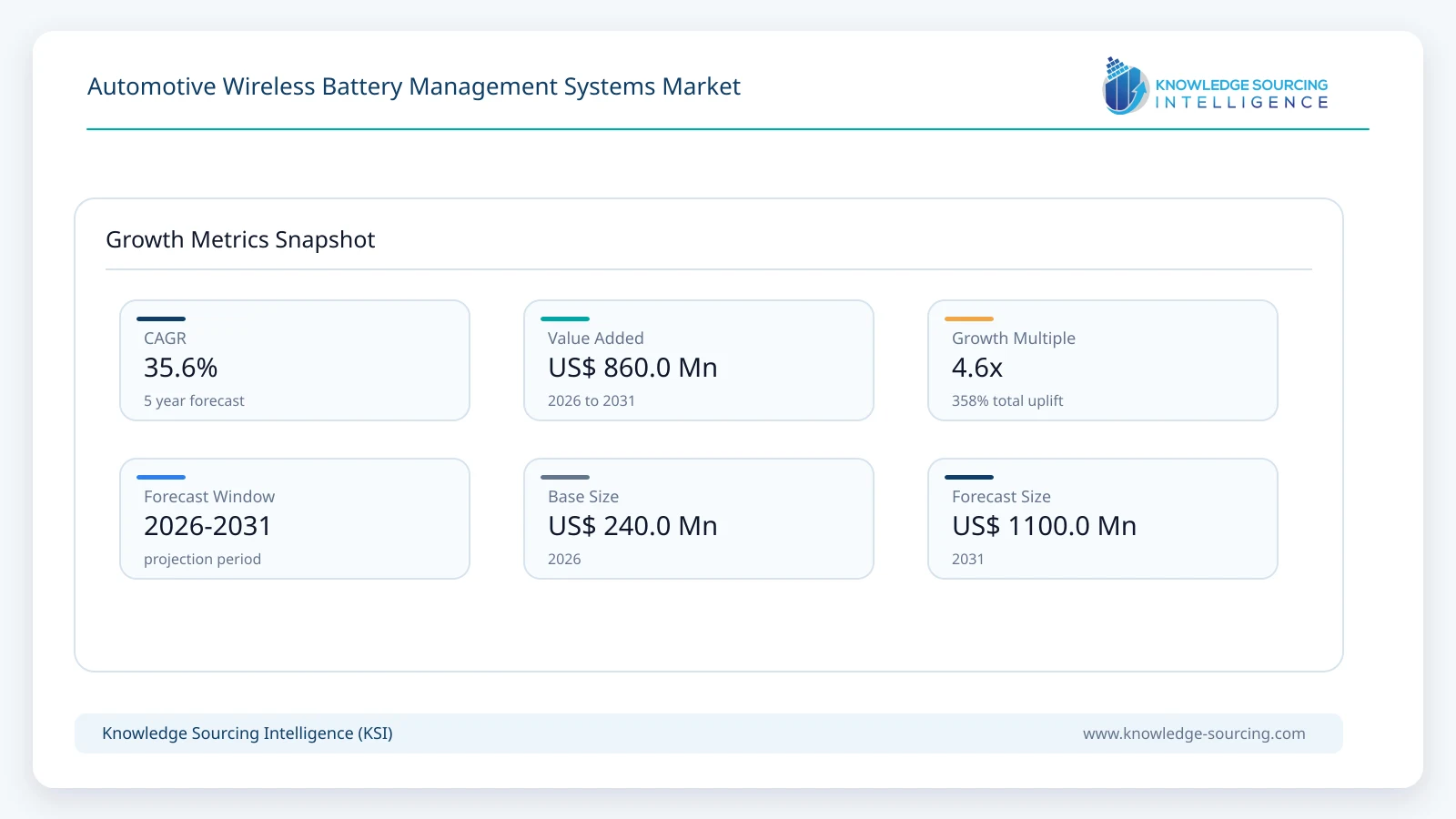
The automotive wireless battery management systems market is forecast to grow at a CAGR of 35.6%, increasing from USD 240 million in 2026 to USD 1,100 million by 2031.
Highlights:
- 1Wireless cell-monitor and RF node assemblies represent 52% of modeled 2026 revenue, as distributed measurement and communication hardware accounts for most identifiable per-pack content.
- 2Proprietary and dedicated 2.4 GHz links remain the largest 2026 technology group, while ultra-wideband systems gain modeled share as qualification programs progress.
- 3Battery-electric passenger vehicles account for 70% of 2026 demand; commercial vehicles offer higher module counts but a smaller immediate installation base.
- 4Asia Pacific represents 39% of estimated 2026 revenue and grows to 49% by 2031, reflecting electric-vehicle and battery-pack production scale.
- 5The forecast separates existing OEM production applications from supplier reference designs and preproduction wireless components.
- 6Functional safety, authenticated radio messages, interference tolerance and fail-operational behavior remain decisive award criteria.
The automotive wireless battery management systems market covers the attributable supplier value of wireless cell-monitoring nodes, pack-side wireless manager electronics, secure protocol and diagnostic software, and directly related integration and lifecycle engineering. A qualifying installation replaces the conventional physical data link between distributed battery monitoring units and the central battery controller with a radio network designed for automotive safety, availability and security. The scope excludes conventional wired BMS assemblies, complete traction batteries, ordinary battery cells, standalone cloud analytics and cellular telematics.
Analog Devices established commercial production with General Motors through its Ultium battery platform, combining wireless cell-monitoring controllers and a network manager with cell-measurement functions. NXP has developed an ultra-wideband alternative under its FlexCom family, while Texas Instruments and Renesas provide automotive wireless chipsets and reference architectures. Different suppliers are at different commercialization stages: an evaluation kit or preproduction transceiver should not be treated as evidence of a confirmed series-production vehicle award.
Market Overview
In a conventional high-voltage battery, multiple cell-monitoring boards transmit measurements through an isolated wired daisy chain or other physical interconnect to a battery management unit. Each harness route and connector requires packaging space, assembly operations and service controls. Wireless monitoring substitutes a coordinated radio network for those data connections while retaining voltage, temperature and balancing electronics close to the cells. The architecture therefore changes the pack manufacturing process and monitoring communications; it does not remove the electrical power path or eliminate essential hardware protection.
Analog Devices combines wireless cell-monitoring controllers and a battery-side wireless manager in a production-oriented system designed for secure, synchronized measurements. Texas Instruments offers the CC2662R-Q1 wireless controller and associated battery-control and cell-supervisor evaluation boards, including an automotive 18-cell design that supports wired and wireless comparison. NXP uses ultra-wideband links in its BMA606X family, while Renesas illustrates a Bluetooth Low Energy approach. These alternatives compete on deterministic data delivery, fault coverage, integration effort and radio performance within metal-enclosed battery packs, not simply maximum transmission speed.
OEMs must decide whether to purchase a complete validated wireless architecture, combine semiconductor and software elements internally, or have a Tier 1 integrate monitoring modules into the battery pack. Pack construction affects the number of radio nodes, antenna placement and production test procedure, while high-voltage isolation and fire-containment structures create additional signal-path constraints. Qualification activity also extends beyond vehicle operation to assembly plants, service facilities and battery-module replacement, where device authentication and network reconfiguration must remain reliable.
Market Trends
UWB Architecture Is Expanding the Choice of Pack Networks
NXP’s FlexCom wireless BMS architecture uses ultra-wideband radio links to connect cell monitoring units with a battery management unit. Its BMA6060 responders and BMA6061 network controller are positioned as a wireless substitute for the electrical daisy-chain connection, supported by common software foundations for wired and wireless implementations. The approach addresses radio reflections and selective fading inside densely packaged batteries, although NXP currently identifies the BMA606X devices as preproduction rather than a mature vehicle-shipment base.
Battery suppliers evaluating alternative radio stacks must reproduce safety-relevant communication behavior across pack geometry changes, aging, temperature extremes and electromagnetic disturbances. Strong development interest does not immediately translate into component revenue: validation cycles and customer qualification can delay the shift from demonstration to production even when the electronics are technically available.
Pack Manufacturing Is Becoming a Stronger Procurement Criterion
General Motors’ implementation of Analog Devices’ wireless BMS illustrates the commercial importance of removing the monitoring communication harness from modular battery packs. Fewer manual signal connections can simplify assembly sequencing, reduce connector inspection requirements and support automated module handling. Analog Devices has described substantial reductions in communication wiring and battery-pack volume for its reference implementation, but these supplier-reported benefits depend on the final pack design.
An OEM may accept a higher electronics bill of materials if the battery factory captures sufficient savings in assembly labor, wiring procurement, defect detection and service operations. Manufacturers with already optimized wired pack production face a different calculation because changing architectures requires new RF test stations, diagnostic processes and safety evidence. The largest opportunities therefore lie in planned platform replacements, not assumed retrofits of every existing battery.
Wireless Cybersecurity and Lifecycle Traceability Are Converging
Automotive radio nodes require mutual authentication, encrypted communication, secure commissioning and protection against replay or spoofed measurement messages. Analog Devices positions secure wireless networking as a core element of its architecture, while ISO/SAE 21434 establishes lifecycle cybersecurity engineering expectations relevant to such electronic systems. Cybersecurity controls cannot compensate for missed or corrupted measurements, so designers must also provide deterministic fault detection and appropriate safe-state behavior.
Pack modules that retain a stable electronic identity through storage, installation and later replacement can support better lifecycle records. Wireless BMS is an enabling data path rather than a substitute for battery digital twins or remote battery health services. Commercially attributable battery-cloud analytics are excluded from this system value unless part of a nonduplicative wireless communications service contract.
Segment Analysis
By Wireless Communication Technology: Dedicated 2.4 GHz Networks
Dedicated and proprietary 2.4 GHz radio networks are estimated to hold 61% of 2026 market value, reflecting the head start of established production-oriented architectures and automotive-specific synchronization protocols. These systems prioritize frequent authenticated measurements from many battery nodes, controlled latency and recovery following packet loss, rather than the user-facing data rates associated with infotainment radios.
Ultra-wideband links are modeled to increase from 9% of revenue in 2026 to 32% in 2031 as additional OEM programs pass validation, while Bluetooth Low Energy and alternative qualified implementations serve selected module architectures. These shares are KSI technology-adoption assumptions; no supplier publishes comprehensive industry shipment splits by wireless protocol.
By Revenue Component: Wireless Cell-Monitoring Assemblies
Cell monitoring assemblies account for 52% of modeled 2026 value because each installed pack contains several measurement positions requiring radio-capable nodes. Their attributable selling value includes qualified communication electronics and the monitoring content supplied as part of the wireless assembly, counted once at the final transaction level. The network manager and central gateway form a smaller recurring hardware component because only one or a limited number are required per pack.
Embedded communication, security and diagnostic software expands as OEMs seek common platforms across chemistries and cell counts. Separately billed validation and integration remain meaningful because each vehicle program needs electromagnetic testing, secure enrollment and safety-case evidence. Semiconductor content already embedded in a complete module is not added again as upstream IC revenue.
By Battery-Pack Architecture: Conventional Modular Packs
Conventional modular battery packs account for an estimated 66% of 2026 value because a wireless network can replace multiple inter-module monitoring connections without first requiring a radical change in pack geometry. Analog Devices’ General Motors implementation demonstrates the value of using common monitoring units across scalable pack layouts and vehicle programs.
Cell-to-pack and structural arrangements gain share by 2031, although removing physical module boundaries can also reduce the number of monitoring boards and change the economics of wireless networking. Multi-pack commercial vehicles create additional communication complexity, while removable modules require authenticated rejoining and commissioning after service or replacement.
By Vehicle Application: Battery-Electric Passenger Vehicles
Battery-electric passenger vehicles represent approximately USD 168 million of modeled 2026 revenue because they combine relatively large high-voltage packs with a growing number of common vehicle platforms. Plug-in hybrids and range-extended vehicles also use high-voltage monitoring but often have smaller pack capacities and different trade-offs between wireless electronics and harness savings.
Electric vans, buses and trucks create opportunities for larger multi-pack configurations, where the ability to avoid extended signal wiring can be valuable. Their supplier value depends on pack topology, environmental validation and OEM volumes; a heavy commercial battery does not automatically carry proportionally higher wireless-BMS revenue.
Market Drivers
Higher Electric-Vehicle and Battery-Pack Production
The International Energy Agency reports more than 20 million electric-car sales in 2025 and forecasts about 23 million in 2026, providing a large manufacturing base for future wireless-pack qualification. Wireless BMS adoption is far smaller than total EV deployment, but additional battery plants and vehicle platforms create repeated opportunities to standardize monitoring architectures.
Pressure to Reduce Battery Harness and Assembly Complexity
Automotive battery assembly involves extensive quality control of voltage-sensing and communication connections, especially where packs contain many modules. Eliminating monitoring data harnesses reduces physical assembly interfaces and can simplify robotic handling. The benefit is commercially strongest where avoided inspection time and mechanical faults offset wireless electronics and test equipment.
Growth in Reconfigurable Battery Platform Strategies
Automakers designing different energy capacities, wheelbases or cell suppliers on a common electrical architecture need monitoring configurations that adapt without redesigning each signal harness. Analog Devices and NXP position wireless networking as a way to reuse hardware and software across pack variants. That flexibility becomes more valuable when the same battery platform serves multiple vehicle models.
Improved Automotive-Qualified Radio and Design Tool Availability
Texas Instruments supplies automotive wireless MCUs, cell-supervisor evaluation boards and reference software, while NXP and Renesas offer alternative wireless architectures. Broader choice allows OEM engineers to benchmark link reliability, safety functions and system cost against existing wired systems. Competitive design tools may reduce proof-of-concept effort but do not remove production qualification.
Battery Service and Traceability Requirements
Secure identification of individual battery modules can simplify pack commissioning, module replacement and diagnostic access without reopening signal-harness connections. Lifecycle applications matter particularly to commercial fleets and used-vehicle battery service, provided that identity and measurement integrity are maintained from factory to repair. These capabilities support OEM procurement without implying that every wireless system includes a paid cloud analytics subscription.
Market Restraints
Radio Reliability Inside Shielded High-Voltage Packs
Battery enclosures, module busbars and cooling plates can obstruct or reflect radio signals, while operating vehicles expose electronics to conducted and radiated interference. A communication failure that interrupts temperature or voltage monitoring must be detected and handled through a safety-qualified fallback strategy. Antenna placement and packet-loss testing consequently increase validation requirements.
Functional-Safety and Cybersecurity Qualification Costs
Wireless battery links carry safety-relevant measurements, requiring fault detection, deterministic network response and authenticated device participation. ISO 26262 and ISO/SAE 21434 engineering activities impose documentation, security testing and change-control costs beyond an ordinary low-power radio network. Requalification is especially demanding when suppliers change protocol stacks or battery pack structure.
Established Economics of Wired BMS Platforms
High-volume wired monitoring chains remain familiar to battery suppliers and can offer predictable component cost, mature diagnostics and an extensive field record. A manufacturer using compact packs or an automated wiring process may find that wireless communication offers limited net savings. Suppliers must demonstrate a complete manufacturing and warranty cost case rather than relying on nominal harness-weight reduction.
Supplier Interoperability and Protocol Fragmentation
Analog Devices, NXP, Texas Instruments and Renesas approach wireless monitoring with different radio, software and network-control designs. Proprietary link behavior can bind OEMs to a particular semiconductor platform for multiple vehicle generations, raising concerns over sourcing flexibility. A nominally standard radio does not ensure interchangeability of safety software, diagnostics or commissioning tools.
Production Changeover and Manufacturing Test Investment
Battery pack plants moving from wired monitoring to wireless networks require radio-frequency test equipment, secure provisioning stations, node identification procedures and new service documentation. These investments occur before large-scale annual cost savings are proven and compete with other battery factory projects. Automakers introducing additional cell chemistries or pack designs may prioritize mature production processes until a major platform replacement.
Regional Outlook

Asia Pacific
China’s concentration of electric-vehicle and battery manufacturing provides the region’s largest potential installation pool, while Japan and South Korea retain significant automotive electronics and battery-system engineering activity. KSI estimates Asia Pacific at 39% of 2026 wireless-BMS revenue, rising to 49% by 2031 as technology qualification extends beyond early premium and North American programs. The expansion assumes adoption among a subset of high-volume platforms rather than industry-wide replacement of wired monitoring.
Battery procurement decisions in the region are sensitive to module count, pack design and supplier localization. Manufacturers using cell-to-pack construction must determine whether the reduced need for discrete module boards justifies wireless networking, while export-oriented OEMs must meet functional-safety and cybersecurity requirements across destination markets. Regional value therefore depends on qualified product mix as well as electric-car output.
North America
Analog Devices’ production program with General Motors gives North America a relatively strong early position in wireless battery monitoring. The direct link between a wireless semiconductor platform and an OEM battery architecture has provided a visible example of how harness simplification can be integrated into pack design and production. KSI models North America at 31% of 2026 revenue, reflecting these early platforms rather than a proportional allocation of global EV sales.
Further deployment depends on additional validated vehicle generations, higher battery-factory automation and competition from mature wired systems. US battery manufacturing investments may support local engineering activity, although announced capacity cannot be treated as proof of wireless-BMS orders. Canadian and Mexican vehicle assembly and supplier operations participate through cross-border powertrain and electronics supply chains.
Competitive Landscape
Analog Devices has the clearest publicly identified mass-production wireless-BMS position through its General Motors implementation, supported by an integrated set of cell monitoring, radio communication and security functions. NXP competes through ultra-wideband links and a common wired/wireless development architecture; its BMA606X components remain marked preproduction. Texas Instruments supplies automotive wireless MCUs, monitoring hardware and design kits, while Renesas offers a Bluetooth Low Energy wireless BMS architecture and Infineon demonstrates wired and wireless battery-monitor options.
Automotive-qualified wireless BMS competition increasingly depends on the ability to supply a safety-validated communications system rather than an isolated radio chip. Customers compare measured link availability, functional-safety evidence, bill-of-materials integration and factory commissioning support when selecting a network architecture. Semiconductor companies may supply monitoring devices or wireless communication electronics to a Tier 1 pack integrator, which then delivers the complete system under a vehicle program. Long-term differentiation will depend on production reliability, protocol maintainability and support for changing cell counts and pack construction.
Recent Developments
Q2 2025 | NXP scheduled customer evaluation and development availability for its FlexCom ultra-wideband wireless BMS architecture, following its November 2024 product announcement; this availability milestone is not equivalent to a volume production award.
2026 supplier portfolio status | Texas Instruments listed its CC2662R-Q1 alongside the TIDA-020076 wired-or-wireless 18-cell supervisor design, offering an engineering route for side-by-side architecture evaluation rather than evidence of a new production award.
May 2026 | Infineon published a demonstration of the TLE9012DQU battery monitoring IC operating in wired and wireless configurations, illustrating a configurable monitoring path rather than a disclosed full-vehicle wireless system launch.
May 2026 | The International Energy Agency reported more than 20 million electric-car sales for 2025 and a 2026 market outlook near 23 million, increasing the prospective vehicle platform base for battery monitoring investment without specifying wireless adoption.
October 2026 product status | NXP listed its BMA6060/BMA6061 wireless BMS chipset as preproduction. The published technical architecture distinguishes pack-side network control from module responders and should not be presented as series production.
October 2026 supplier portfolio status | Renesas continued to present its Bluetooth Low Energy wireless EV battery-management reference architecture for battery-module integration. Public product availability is distinct from verified vehicle production.
Market Outlook
Wireless battery management systems are gaining traction as automakers seek to simplify battery pack manufacturing, improve modularity, and integrate automotive-qualified semiconductor technologies. Adoption is expected to progress gradually as manufacturers evaluate performance, reliability, safety, and integration requirements, rather than replacing wired battery management systems across all new electric vehicles.
Dedicated 2.4 GHz implementations retain an important installed advantage, while ultra-wideband architectures could gain material share if OEM validation confirms predictable performance across battery structures and manufacturing environments. Software and security-related content also becomes more important because RF network behavior must remain consistent through battery service, updates and component replacement. Supplier design wins will remain concentrated until additional public production references and shipment records emerge.
Asia Pacific is projected to account for the largest 2031 market value as high-volume battery production adopts more flexible monitoring designs. North America retains a meaningful installed position through existing production experience, while Europe contributes advanced vehicle electronics and battery-system integration demand. The market remains sensitive to adoption timing, the installed node count per pack and whether OEMs capture sufficient factory savings to justify new electronics and qualification costs.
Automotive Wireless Battery Management Systems Market Scope
| Report Metric | Details |
|---|---|
| Total Market Size in 2026 | USD 240 million |
| Total Market Size in 2031 | USD 1,100 million |
| Forecast Unit | Million |
| Growth Rate | 35.6% |
| Study Period | 2021 to 2031 |
| Historical Data | 2021 to 2024 |
| Base Year | 2025 |
| Forecast Period | 2026 – 2031 |
| Segmentation | Wireless Communication Technology, Revenue Component, Battery-Pack Architecture, Voltage Class, Battery Chemistry, Vehicle Application, Supply Arrangement, Geography |
| Companies |
|
Market Segmentation
By Wireless Communication Technology
Proprietary and Dedicated 2.4 GHz Links
Ultra-Wideband (UWB) Links
Bluetooth Low Energy (BLE) Links
Hybrid and Other Qualified Radio Links
By Revenue Component
Wireless Cell-Monitor and RF Node Assemblies
Wireless Network Manager and Gateway Electronics
Embedded Protocol, Security and Diagnostic Software
Integration, Validation and Lifecycle Services
By Battery-Pack Architecture
Conventional Modular High-Voltage Packs
Cell-to-Pack and Structural Integration
Multi-Pack Commercial-Vehicle Architectures
Removable or Exchangeable Module Systems
By Voltage Class
400 V-Class Systems
800 V-Class Systems
Other and Above-800 V High-Voltage Systems
By Battery Chemistry
Lithium Iron Phosphate (LFP)
Nickel-Rich Lithium-Ion (NMC/NCA)
Other Lithium-Ion and Emerging Chemistries
By Vehicle Application
Battery-Electric Passenger Vehicles
Plug-In Hybrid and Range-Extended Vehicles
Electric Light Commercial Vehicles
Electric Buses and Medium/Heavy Trucks
By Supply Arrangement
Direct OEM-Integrated wBMS Sourcing
Tier-One Turnkey Modules and Pack Contracts
Battery Integrator and Specialty Vehicle Programs
By Geography
North America
United States
Canada
Mexico
South America
Brazil
Argentina
Others
Europe
Germany
France
United Kingdom
Spain
Italy
Sweden
Others
Middle East and Africa
Saudi Arabia
United Arab Emirates
Others
Asia Pacific
China
Japan
South Korea
India
Thailand
Indonesia
Others
Table of Contents
1. EXECUTIVE SUMMARY
1.1. Market Opportunity and Key Findings
1.2. Wireless Battery Management Outlook
1.3. Commercialization and Adoption Drivers
2. MARKET SNAPSHOT
2.1. Market Overview
2.2. Market Definition
2.3. Scope of the Study
2.4. Market Segmentation
3. BUSINESS LANDSCAPE
3.1. Market Drivers
3.1.1. Electric-Vehicle Production and Pack Investment
3.1.2. Battery Harness and Assembly Simplification
3.1.3. Reconfigurable Battery Platforms
3.1.4. Automotive Wireless IC Availability
3.1.5. Battery Service and Traceability
3.2. Market Restraints
3.2.1. Radio Reliability in Shielded Packs
3.2.2. Functional Safety and Cybersecurity
3.2.3. Cost Competitiveness of Wired Platforms
3.2.4. Protocol Interoperability
3.2.5. Factory Changeover and Test Investment
3.3. Market Opportunities
3.4. Porter’s Five Forces Analysis
3.5. Industry Value Chain Analysis
3.6. Policies and Regulations
3.7. Strategic Recommendations
4. TECHNOLOGICAL OUTLOOK
4.1. Distributed Monitoring Node Architecture
4.2. Radio Coordination and Synchronization
4.3. Functional Safety and Cybersecurity
4.4. Battery Factory Provisioning and Commissioning
4.5. Development and Validation Roadmap
5. AUTOMOTIVE WIRELESS BATTERY MANAGEMENT SYSTEMS MARKET BY WIRELESS COMMUNICATION TECHNOLOGY
5.1. Introduction
5.2. Proprietary and Dedicated 2.4 GHz Links
5.3. Ultra-Wideband (UWB) Links
5.4. Bluetooth Low Energy (BLE) Links
5.5. Hybrid and Other Qualified Radio Links
6. AUTOMOTIVE WIRELESS BATTERY MANAGEMENT SYSTEMS MARKET BY REVENUE COMPONENT
6.1. Introduction
6.2. Wireless Cell-Monitor and RF Node Assemblies
6.3. Wireless Network Manager and Gateway Electronics
6.4. Embedded Protocol, Security and Diagnostic Software
6.5. Integration, Validation and Lifecycle Services
7. AUTOMOTIVE WIRELESS BATTERY MANAGEMENT SYSTEMS MARKET BY BATTERY-PACK ARCHITECTURE
7.1. Introduction
7.2. Conventional Modular High-Voltage Packs
7.3. Cell-to-Pack and Structural Integration
7.4. Multi-Pack Commercial-Vehicle Architectures
7.5. Removable or Exchangeable Module Systems
8. AUTOMOTIVE WIRELESS BATTERY MANAGEMENT SYSTEMS MARKET BY VOLTAGE CLASS
8.1. Introduction
8.2. 400 V-Class Systems
8.3. 800 V-Class Systems
8.4. Other and Above-800 V High-Voltage Systems
9. AUTOMOTIVE WIRELESS BATTERY MANAGEMENT SYSTEMS MARKET BY BATTERY CHEMISTRY
9.1. Introduction
9.2. Lithium Iron Phosphate (LFP)
9.3. Nickel-Rich Lithium-Ion (NMC/NCA)
9.4. Other Lithium-Ion and Emerging Chemistries
10. AUTOMOTIVE WIRELESS BATTERY MANAGEMENT SYSTEMS MARKET BY VEHICLE APPLICATION
10.1. Introduction
10.2. Battery-Electric Passenger Vehicles
10.3. Plug-In Hybrid and Range-Extended Vehicles
10.4. Electric Light Commercial Vehicles
10.5. Electric Buses and Medium/Heavy Trucks
11. AUTOMOTIVE WIRELESS BATTERY MANAGEMENT SYSTEMS MARKET BY SUPPLY ARRANGEMENT
11.1. Introduction
11.2. Direct OEM-Integrated wBMS Sourcing
11.3. Tier-One Turnkey Modules and Pack Contracts
11.4. Battery Integrator and Specialty Vehicle Programs
12. AUTOMOTIVE WIRELESS BATTERY MANAGEMENT SYSTEMS MARKET BY GEOGRAPHY
12.1. Introduction
12.2. North America
12.2.1. United States
12.2.2. Canada
12.2.3. Mexico
12.3. South America
12.3.1. Brazil
12.3.2. Argentina
12.3.3. Others
12.4. Europe
12.4.1. Germany
12.4.2. France
12.4.3. United Kingdom
12.4.4. Spain
12.4.5. Italy
12.4.6. Sweden
12.4.7. Others
12.5. Middle East and Africa
12.5.1. Saudi Arabia
12.5.2. United Arab Emirates
12.5.3. Others
12.6. Asia Pacific
12.6.1. China
12.6.2. Japan
12.6.3. South Korea
12.6.4. India
12.6.5. Thailand
12.6.6. Indonesia
12.6.7. Others
13. COMPETITIVE ENVIRONMENT AND ANALYSIS
13.1. Major Players and Strategies
13.2. Market Share Analysis
13.3. Partnerships and Product Development
13.4. Competitive Dashboard
14. COMPANY PROFILES
14.1. Analog Devices, Inc.
14.2. NXP Semiconductors N.V.
14.3. Texas Instruments Incorporated
14.4. Renesas Electronics Corporation
14.5. Infineon Technologies AG
15. APPENDIX
15.1. Currency and Exchange Rates
15.2. Assumptions and Base Years
15.3. Stakeholder Benefits
15.4. Research Methodology
15.5. Abbreviations
Navigate
Trusted by the world's leading organizations











