
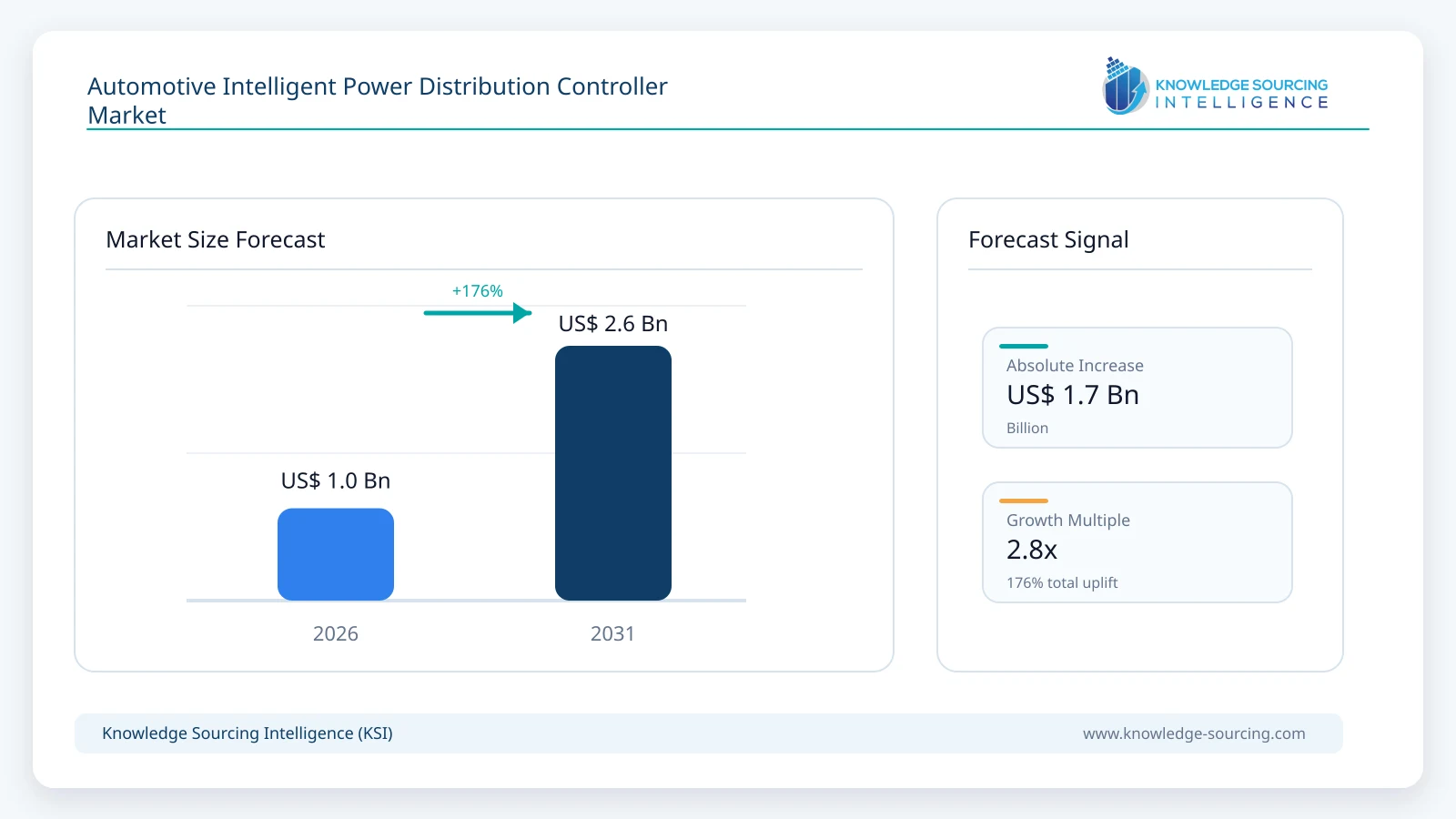
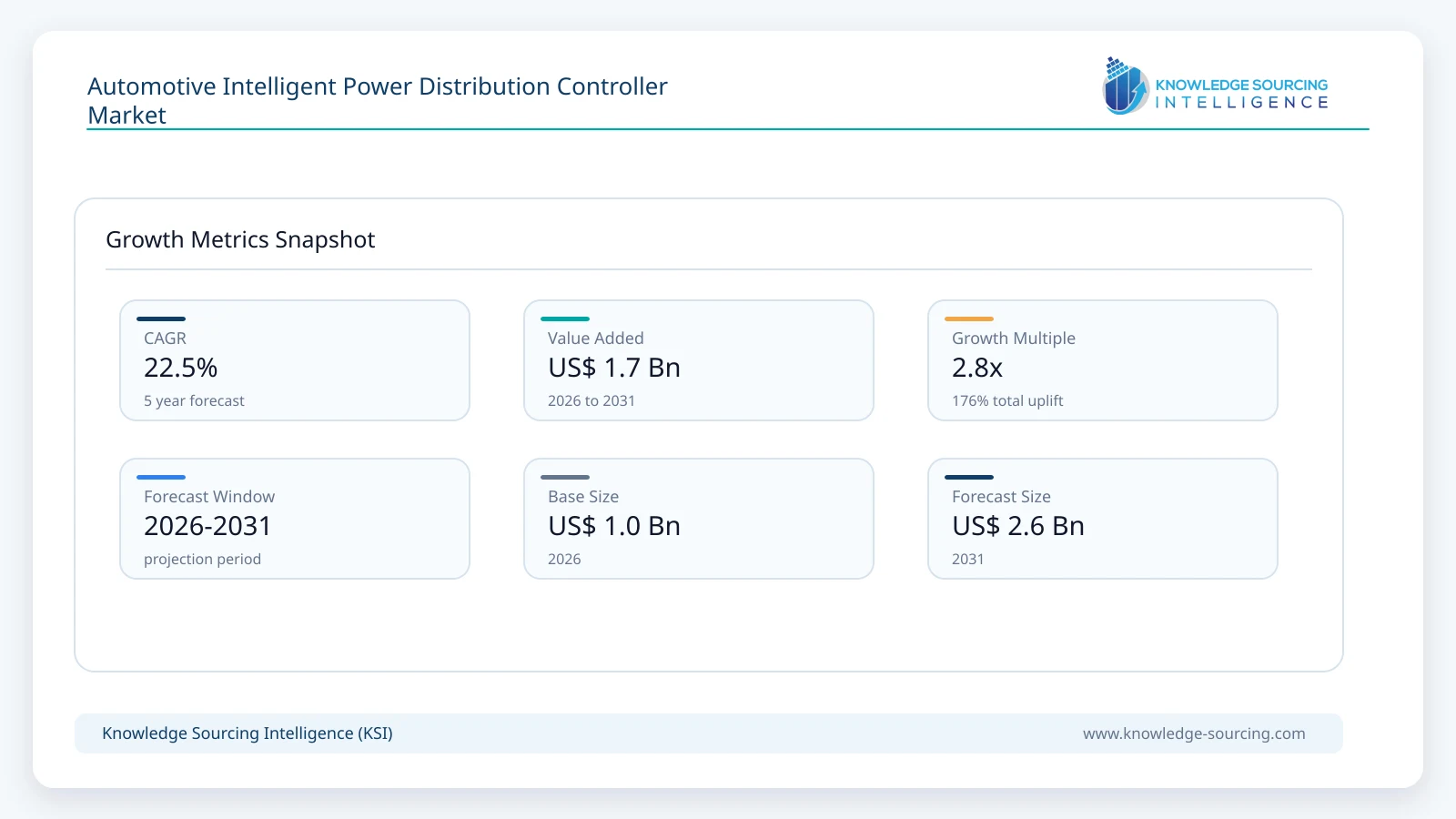
The automotive intelligent power distribution controller market is projected to grow from USD 0.96 billion in 2026 to USD 2.65 billion by 2031, at an annual growth rate of approximately 22.5% over the forecast period.
Highlights:
- 1Body and domain controller-integrated protection represents an estimated 30% of 2026 value, while zonal integration gains share on new E/E architectures.
- 2Programmable load switching and electronic-fuse functionality accounts for approximately 40% of modeled 2026 demand.
- 312 V controller architectures represent around 78% of 2026 market value; mixed 12 V/48 V systems gain share through 2031.
- 4Battery-electric vehicles contribute approximately 34% of 2026 value and are projected to account for 52% by 2031.
- 5Asia Pacific represents an estimated 44% of 2026 market value and is forecast to retain regional leadership.
- 6Selective fault isolation, current diagnostics and software-controlled power states are emerging differentiators in safety-relevant electrical networks.
Low-voltage electricity in a modern passenger vehicle supplies body actuation, lighting, cameras, cabin electronics, infotainment, steering and braking support, pumps and other auxiliaries. Mechanical fuses and relays provide economical circuit protection, but their fixed characteristics limit real-time supervision of individual loads. Electronically controlled switching adds measurable current thresholds, short-circuit response, diagnostic messages and configurable operating states that can be adjusted to the needs of individual vehicle programs.
Protection requirements differ substantially between low-current body circuits and high-current supply rails. Renesas demonstrates a compact multichannel solid-state distribution board that uses intelligent power devices and microcontroller-based fuse logic to supervise individual loads, while STMicroelectronics offers configurable high-side controllers for 12 V, 24 V and 48 V circuits. Texas Instruments reference designs address system-level current sensing and load protection across 12 V/48 V architectures. OEMs consequently qualify complete power-control designs against conductor ratings, thermal limits, reset behavior and the availability required by each electrical load.
Automakers retain both centralized and local distribution hardware during the transition toward zonal electrical architectures. A primary protection module can feed multiple lower-level controllers, while individual zones isolate secondary circuits close to the loads they serve. Mixed 12 V and 48 V systems introduce additional supply coordination requirements, particularly where high-current auxiliaries coexist with computing and safety-related loads. Controller cost is consequently determined by protected channel count, safety requirements and integration depth, not simply the number of electronic fuses fitted.
Market Trends
Electronic Protection Is Moving Into Production Power Networks
FORVIA HELLA began series manufacture of its intelligent Power Distribution Module for a premium vehicle manufacturer in 2025. Its electronic-fuse architecture is intended to monitor circuits and maintain controlled supply under fault conditions, giving automakers a production alternative to selected serviceable fuses and mechanical relays. Hardware-based protection still needs to respond locally to overloads and short circuits even when higher-level control commands originate elsewhere in the vehicle.
Infineon and BMW Group described a Neue Klasse architecture in which software-controlled eFuses replace up to 150 conventional fuses on a vehicle. BMW also links selective switching to lower standby demand across driving, parking, charging and software-update states. Actual savings depend on the complete electrical architecture; the announced benefit cannot be attributed to individual switching chips alone.
Zonal and Domain Architectures Are Changing Controller Placement
Aptiv distributes power and data through its zone-controller architecture, while Bosch distinguishes centralized supply protection from local distribution needed for safety-critical loads. Centralized body controllers continue to serve cost-sensitive platforms, but newer architectures assign more switching and diagnostic responsibility to physical zones. Controller suppliers must therefore support both consolidated power boards and smaller distributed units rather than relying on one enclosure design.
NXP introduced the CoreRide Z248 reference system in March 2026 with pre-integrated 48 V energy distribution, functional safety and deterministic communications. The announcement establishes an engineering route to mixed-voltage zonal implementations, although a reference platform does not by itself establish vehicle-production penetration. Procurement shifts toward validated hardware-software combinations when OEMs need to synchronize protection actions with local sensing, vehicle state and central computing.
48 V Electrical Rails Are Increasing Protection Requirements
Texas Instruments released its 48 V zone reference design in 2026 using smart high-side controllers, electronic fuses and evaluation paths for 48 V-to-12 V distribution. Higher power transfer at manageable current can reduce the conductor burden for selected loads, but transient behavior, contact resistance and switch dissipation remain important engineering constraints. A mixed architecture still retains 12 V branches for equipment that cannot economically migrate.
STMicroelectronics offers STi2Fuse controllers designed for 12 V, 24 V and 48 V power rails with diagnostic conversion, configurable protection and SPI control. Voltage coverage expands platform reuse but does not remove qualification work for each load class, especially where high inrush current and high availability requirements must be balanced against wire protection.
Power Diagnostics Are Becoming Part of Availability Management
Bosch describes powernet guardian functionality that separates lower-priority loads from safety-critical supply during abnormal conditions. Renesas likewise highlights monitored current and programmable fuse behavior in its solid-state distribution designs. Controller-level diagnosis gives vehicle software more precise information about a failing circuit than a blown mechanical fuse, allowing selected systems to isolate the affected branch while retaining other loads.
FORVIA HELLA and Analog Devices announced joint work on the iConF configurable-fuse technology in January 2026, combining dedicated control silicon, software and protection concepts. Production is expected on a premium automaker program from 2028, not assumed to be already deployed in 2026. Future differentiation will depend on fault selectivity, supply continuity and validated behavior across the full vehicle electrical system.
Automotive Intelligent Power Distribution Controller Market Segment Analysis
By Controller Architecture
Body and Domain Controller-Integrated Distribution
Body and domain controller-integrated power distribution represents approximately 30% of estimated 2026 revenue because many vehicle programs still centralize substantial groups of protected body, lighting and auxiliary loads. Existing controller boards can adopt more diagnostic high-side switches without requiring a complete migration to zonal networking. Automotive electronics suppliers benefit from reusing established body-control packaging and validation processes while increasing the number of monitored channels.
Zonal controller-integrated power distribution is projected to rise from approximately 27% of the market in 2026 to 48% by 2031 as new platforms move local protection nearer to individual loads. This is an allocation of the intelligent distribution-controller value only and does not include the networking processors or unrelated I/O functionality present in a complete zone controller.
By Control Function
Programmable Load Switching and Electronic Fusing
Programmable switching and electronic-fuse control account for approximately 40% of the modeled 2026 market because digitally managed protection is the primary hardware function across both stand-alone and integrated products. Suppliers such as Infineon, Renesas and STMicroelectronics provide different combinations of sensing, adjustable trip characteristics, thermal protection and reset logic that support load-specific circuit design.
Fault isolation, power prioritization and controlled supply recovery are expected to gain relative weight through 2031 as electrified and safety-critical systems require more selective power behavior. Protection performance depends on hardware response time and validated system-level coordination, not simply the presence of software-configurable thresholds.
By Low-Voltage Architecture
12 V and Mixed 12 V/48 V
12 V systems are estimated to account for 78% of market revenue in 2026 because conventional automotive loads and established controller designs remain concentrated on this rail. Body-control platforms continue to add intelligent protection and current sensing within familiar electrical limits, supporting adoption even in vehicles that do not migrate to zonal architectures.
Mixed 12 V/48 V configurations are projected to rise from 13% to 29% of value between 2026 and 2031. Higher-power auxiliary circuits increasingly benefit from a 48 V supply, while numerous sensors and established actuators remain on 12 V. Intelligent controllers must maintain coordinated fault isolation and power-state behavior across both levels.
By Revenue Component
Controller and Protection Electronics
Smart switching and electronic-fuse devices represent approximately 36% of 2026 value, while controller boards and attributable power electronics represent a further 34%. The latter portion includes the processor, gate-control and protection circuitry specifically necessary for power distribution, not the complete cost of a body or zonal computer. Semiconductor suppliers compete on low on-state resistance, current-measurement accuracy, channel density and thermal performance.
Embedded control software and integration work become more valuable as OEMs move from stand-alone circuits to distributed architectures that require coordinated diagnostics and configurable power policies. The model counts those services only where independently sold or directly attributable, excluding unrelated whole-vehicle software programs.
By Controlled Load Application
Body and Safety-Critical Loads
Body, lighting and convenience loads account for approximately 35% of estimated revenue in 2026 because vehicles contain many distributed circuits that require predictable switching and fault reporting. Load types range from lighting and wipers to comfort electronics and body actuators, allowing intelligent controllers to substitute gradually for relay and fuse arrangements without changing the entire E/E architecture.
Active safety, chassis and other availability-critical circuits are projected to reach 30% of the market by 2031. Applications that must retain supply under partial electrical faults require selective disconnection, monitoring and verified protection coordination, increasing the controller content allocated to those load classes.
By Vehicle Type and Propulsion
Passenger Vehicles and BEVs
Passenger vehicles account for approximately 88% of estimated 2026 value because high production volume and premium electrical-platform upgrades drive most early intelligent distribution procurement. Light and heavy commercial vehicle programs use comparable protection principles but place greater emphasis on service availability, 24 V legacy networks and durable operation across varied duty cycles.
Battery-electric vehicles represent an estimated 34% of 2026 value, increasing to 52% by 2031 as auxiliary loads, mixed-voltage networks and software-defined electrical management become more common. Internal-combustion and hybrid vehicles remain material demand sources, however, because digitally protected body and safety circuits do not depend on an electric traction battery.
By Geography
Asia Pacific
Asia Pacific is estimated to represent approximately 44% of global value in 2026, supported by production scale, the high concentration of electrified platforms in China and the presence of major electronic-component supply chains across Japan and South Korea. China provides a significant share of early OEM electrical-architecture changes, while Japanese semiconductor and Tier 1 capabilities support regional system design.
The region is projected to account for 48% of global value in 2031 as intelligent protection is applied more broadly to locally designed vehicles and newer zonal platforms. Regional growth still depends on controller content per vehicle and sourcing decisions; production scale alone does not guarantee the same revenue per unit as high-end European programs.
Market Drivers
Migration from Mechanical to Semiconductor Protection
Renesas and STMicroelectronics offer protected semiconductor switching suitable for replacing selected conventional fuses and relays. Programmable current thresholds, electronic diagnostics and reset capability allow a controller to supervise circuits more closely, reducing the need for manual fuse replacement and enabling earlier fault detection. The economic benefit is greatest where monitoring and harness optimization offset incremental semiconductor costs.
Increasing Availability Requirements for Critical Loads
Bosch’s powernet guardian illustrates the need to separate lower-priority consumers from safety-relevant electrical loads during faults. Automated driving support and by-wire functions increase the importance of controlled supply continuity, requiring deterministic switching and selective isolation rather than undifferentiated interruption. The result is higher-value protection content on vehicles designed around demanding electrical availability targets.
Adoption of Zonal Electrical Architectures
BMW’s Neue Klasse uses local controllers and smart digital fuses to coordinate the electrical supply across operating states, while Aptiv’s zonal solution assigns power and data functions to distributed nodes. Shorter cable routes can reduce conductor mass, but electronic protection is needed to retain precise control of local load groups. Each new zonal vehicle program therefore creates demand for qualified power-control functionality even when the module itself integrates several other systems.
Growth in 48 V and Mixed-Voltage Platforms
NXP’s CoreRide Z248 and Texas Instruments’ 48 V reference design show how higher-voltage low-voltage rails are being introduced alongside established 12 V consumers. New switches, monitoring channels and protection coordination become necessary when electrical networks span different voltage levels. The transition is particularly relevant to high-current auxiliaries and compute-intensive platforms, although many lower-power circuits continue to operate at 12 V.
Software-Controlled Operating States and Diagnostics
BMW describes distinct electrical operating states for driving, parking, charging and updating in the Neue Klasse, supported by digitally configurable fuses. Controllers capable of load prioritization can reduce unnecessary consumption while making electrical faults easier to localize. Such capabilities increase integration requirements between protection hardware, vehicle-state control and diagnostic software, supporting recurring engineering demand.
Market Restraints
Higher Device Cost and Thermal Design Burden
Electronic switches, current measurement and controller processing add hardware cost relative to basic fuses and relays. Higher channel density can concentrate heat inside compact body or zonal modules, increasing the need for board-level thermal management and qualification. Cost-sensitive vehicle programs may therefore electrify only selected circuits rather than convert every protection path at once.
Fault-Selectivity and System Safety Validation
Safety-critical circuits require proof that one branch fault will not unintentionally disable a second load or defeat a backup electrical path. Validation must account for short circuits, inrush current, contact faults, processor resets and supply transients. The associated engineering and testing workload can slow program launches where traditional protection is already adequate.
Mixed-Voltage Integration Complexity
48 V systems must coexist with a large installed base of 12 V equipment and carefully managed power conversion. Differences in connector ratings, current behavior and protection characteristics add hardware design complexity, especially where one controller supervises loads on more than one rail. OEMs cannot obtain full cost benefits from higher voltage without redesigning parts of the surrounding electrical architecture.
Uneven Platform Adoption and Vehicle Production Cycles
Major changes to electrical distribution are usually aligned with new vehicle platforms because harness routing, controller placement and functional safety verification are defined early in development. Mid-cycle replacement of a central fuse architecture with distributed electronic protection can be uneconomic. Adoption therefore proceeds by vehicle program rather than through immediate replacement of the existing vehicle fleet.
Bundled Procurement and Software Ownership
Automakers may purchase power-control functionality as part of a body controller, power distribution module or larger zonal assembly. The same protection circuitry may be supplied by a semiconductor vendor and incorporated into a Tier 1 system, while software policy remains with the OEM. Bundling restricts separately contracted controller revenue and limits the number of suppliers able to capture high integration margins.
Regional Outlook
Asia Pacific
Asia Pacific is the largest modeled market in 2026 because China combines substantial vehicle production with rapid deployment of electrified and software-defined electrical platforms. Japan and South Korea contribute deep semiconductor and automotive-electronics supply capabilities. Intelligent distribution is used on both conventional body-control platforms and more advanced zonal designs, widening the region’s addressable vehicle mix.
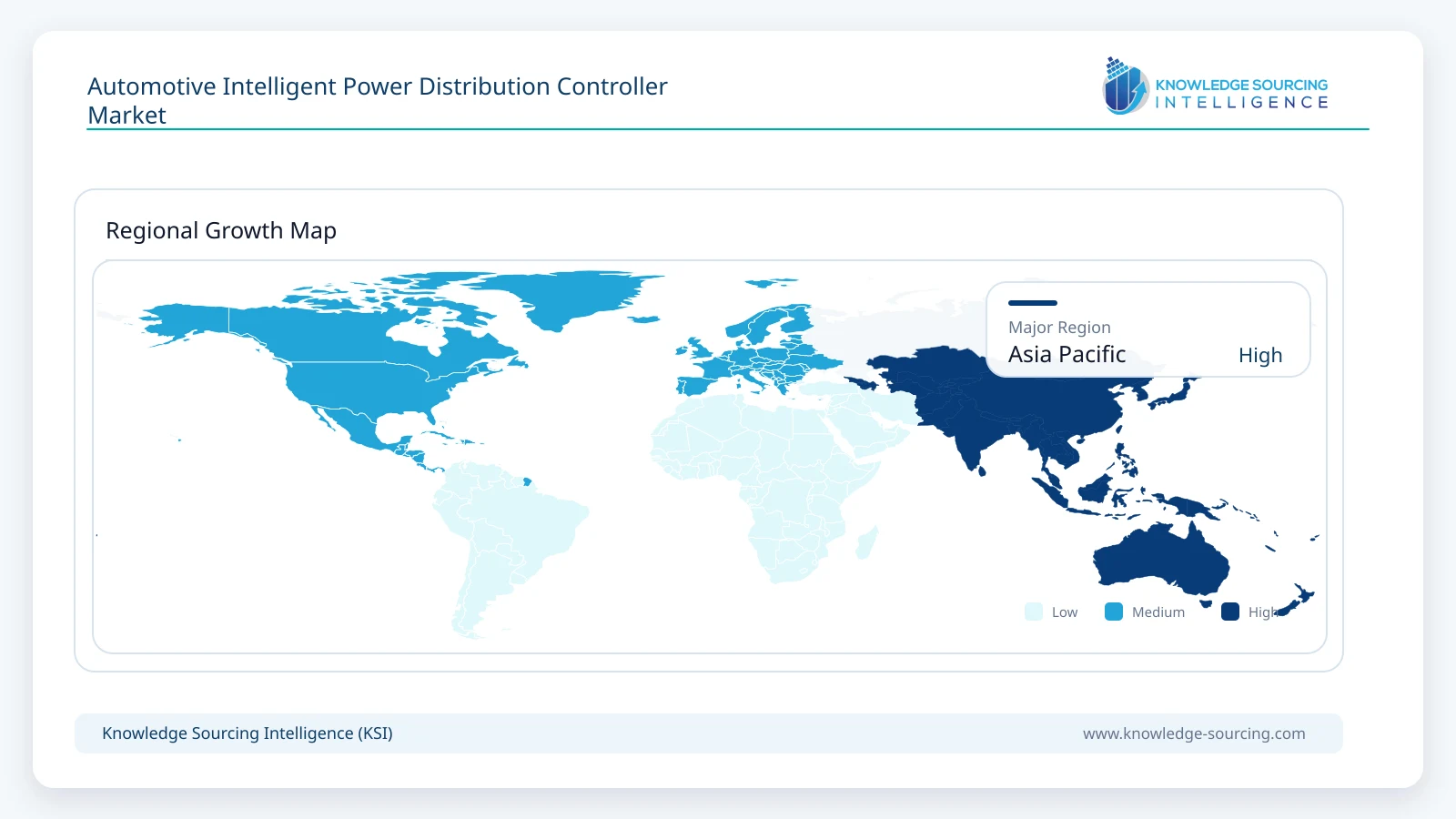
Asia Pacific is projected to reach approximately USD 1.27 billion in 2031. China remains the main regional contributor as new platforms place more loads under electronically monitored protection, while India and Southeast Asia offer scope for cost-optimized intelligent controllers in higher-volume vehicle categories.
Europe
European demand is supported by premium electrical architectures, established Tier 1 engineering and the development of protection systems for safety-relevant vehicles. FORVIA HELLA’s production iPDM and Bosch’s powernet guardian illustrate separate routes toward reliable low-voltage control, while BMW’s Neue Klasse demonstrates vehicle-level integration of digital fusing with energy-management modes.
The regional market is estimated to reach approximately USD 663 million in 2031. Growth will be influenced by the pace at which intelligent switching moves beyond premium platforms and by how much of the controller function is consolidated into broader zone computers rather than procured as a separate module.
Competitive Landscape
FORVIA HELLA, Bosch and Aptiv participate primarily through automotive electrical-system designs and control modules, while Infineon, STMicroelectronics, Renesas, Texas Instruments, onsemi, NXP and Analog Devices supply or enable the semiconductor and controller foundations. Different suppliers compete at different layers of the same module bill of materials. Complete module sales and the value of semiconductor devices incorporated within them should not be added as independent end-market revenues.
Hardware differentiation is determined by protection selectivity, diagnostic accuracy, energy losses, temperature performance and integration with vehicle control software. Tier 1 suppliers increasingly compete through system validation, software configuration and OEM program responsibility, whereas semiconductor companies emphasize channel density, functional integration and scalable 12 V/48 V device families. The transition toward zonal platforms shifts value between supplier tiers without making entire zone-controller revenue a direct part of this narrowly defined market.
Recent Developments
September 2026: FORVIA HELLA Presented the iPDM as part of its commercial-vehicle energy-management portfolio at IAA Transportation. The commercial-vehicle application was presented as a technology concept; it should not be confused with the passenger-car iPDM already in series production.
March 2026: NXP Semiconductors Introduced CoreRide Z248 as a pre-validated 48 V zonal reference system combining power distribution, safety and data handling. It is a design foundation, not a reported series-vehicle shipment.
February 2026: Infineon Technologies Confirmed its involvement in BMW Neue Klasse power distribution, including smart power components that support digital electrical management in a production vehicle platform.
January 2026: FORVIA HELLA and Analog Devices Announced their iConF intelligent configurable-fuse development cooperation, with targeted series deployment from 2028 rather than 2026.
September 2025: FORVIA HELLA Announced the start of series production for an intelligent Power Distribution Module serving a premium automaker, providing a concrete commercial reference for electronically protected supply.
May 2025: FORVIA HELLA Received an additional Advanced Control Module nomination with an announced 2028 series start, extending a power-control architecture using electronic fuses and intelligent software.
Market Outlook
Intelligent power distribution controllers are projected to grow from approximately USD 960 million in 2026 to USD 2.65 billion in 2031 as semiconductor protection replaces selected mechanical distribution functions and software-defined vehicle platforms require better electrical visibility. Continued deployment in body and domain controllers ensures that adoption is not dependent on the complete transition to zonal architectures.
Zonal controller-integrated protection is expected to gain share over the forecast period, while dedicated modules remain necessary for primary distribution and selected safety-related power networks. Mixed 12 V and 48 V platforms will increase controller-design requirements, particularly for power continuity, fault discrimination and efficient management of electrical operating states.
Asia Pacific is expected to retain the largest regional market, with Europe remaining important for premium, safety-oriented system design. Supplier competitiveness will depend on demonstrable production readiness, cost-effective hardware integration, circuit-level fault handling and the ability to coordinate low-voltage protection with vehicle software over a platform lifetime.
Automotive Intelligent Power Distribution Controller Market Scope:
| Report Metric | Details |
|---|---|
| Total Market Size in 2026 | USD 0.96 billion |
| Total Market Size in 2031 | USD 2.65 billion |
| Forecast Unit | USD Billion |
| Growth Rate | 22.5% |
| Study Period | 2021 to 2031 |
| Historical Data | 2021 to 2024 |
| Base Year | 2025 |
| Forecast Period | 2026 – 2031 |
| Segmentation | Controller Architecture, Intelligent Control Function, Revenue Component, Low-Voltage Architecture, Controlled Load Application, Vehicle Type, Propulsion, Geography |
| Companies |
|
Market Segmentation
By Controller Architecture
Standalone Intelligent Power Distribution Modules
Body and Domain Controller-Integrated Distribution
Zonal Controller-Integrated Power Distribution
Primary Powernet Safety and Guardian Controllers
By Intelligent Control Function
Programmable Load Switching and Electronic Fusing
Current, Voltage and Thermal Diagnostics
Selective Fault Isolation and Redundant Supply
Power Priority and Load Shedding
Power-State Configuration and Self-Test
By Revenue Component
Smart Switching and Electronic-Fuse Devices
Controller Boards and Attributable Power Electronics
Monitoring and Diagnostic Electronics
Embedded Power-Control Software
Integration and Lifecycle Engineering
By Low-Voltage Architecture
12 V
Mixed 12 V and 48 V
48 V-Focused
24 V Commercial and Other Low-Voltage
By Controlled Load Application
Body, Lighting and Convenience
Active Safety, Chassis and Critical Loads
Compute, Connectivity and Infotainment
Thermal and Electrical Auxiliaries
Other Controlled Vehicle Loads
By Vehicle Type
Passenger Vehicles
Light Commercial Vehicles
Medium and Heavy Commercial Vehicles
By Propulsion
Internal Combustion and Mild Hybrid
Full Hybrid and Plug-in Hybrid
Battery Electric
By Geography
North America
United States
Canada
Mexico
South America
Brazil
Argentina
Others
Europe
Germany
United Kingdom
France
Italy
Spain
Others
Middle East and Africa
Saudi Arabia
United Arab Emirates
South Africa
Israel
Others
Asia Pacific
China
Japan
South Korea
India
Thailand
Indonesia
Others
Table of Contents
1. EXECUTIVE SUMMARY
2. MARKET SNAPSHOT
2.1. Market Overview
2.2. Market Definition
2.3. Scope of the Study
2.4. Market Segmentation
3. BUSINESS LANDSCAPE
3.1. Market Drivers
3.1.1. Migration from Mechanical to Semiconductor Protection
3.1.2. Increasing Availability Requirements for Critical Loads
3.1.3. Adoption of Zonal Electrical Architectures
3.1.4. Growth in 48 V and Mixed-Voltage Platforms
3.1.5. Software-Controlled Operating States and Diagnostics
3.2. Market Restraints
3.2.1. Higher Device Cost and Thermal Design Burden
3.2.2. Fault-Selectivity and System Safety Validation
3.2.3. Mixed-Voltage Integration Complexity
3.2.4. Uneven Platform Adoption and Vehicle Production Cycles
3.2.5. Bundled Procurement and Software Ownership
3.3. Market Opportunities
3.4. Porter’s Five Forces Analysis
3.5. Industry Value Chain Analysis
3.6. Policies and Regulations
3.7. Strategic Recommendations
4. TECHNOLOGICAL OUTLOOK
4.1. Programmable Electronic-Fuse Protection
4.2. Current Monitoring and Fault Isolation
4.3. 12 V and 48 V Power Distribution
4.4. Software-Defined Load Prioritization
4.5. Functional Safety and Electrical Resilience
5. AUTOMOTIVE INTELLIGENT POWER DISTRIBUTION CONTROLLER MARKET BY CONTROLLER ARCHITECTURE
5.1. Standalone Intelligent Power Distribution Modules
5.2. Body and Domain Controller-Integrated Distribution
5.3. Zonal Controller-Integrated Power Distribution
5.4. Primary Powernet Safety and Guardian Controllers
6. AUTOMOTIVE INTELLIGENT POWER DISTRIBUTION CONTROLLER MARKET BY INTELLIGENT CONTROL FUNCTION
6.1. Programmable Load Switching and Electronic Fusing
6.2. Current, Voltage and Thermal Diagnostics
6.3. Selective Fault Isolation and Redundant Supply
6.4. Power Priority and Load Shedding
6.5. Power-State Configuration and Self-Test
7. AUTOMOTIVE INTELLIGENT POWER DISTRIBUTION CONTROLLER MARKET BY REVENUE COMPONENT
7.1. Smart Switching and Electronic-Fuse Devices
7.2. Controller Boards and Attributable Power Electronics
7.3. Monitoring and Diagnostic Electronics
7.4. Embedded Power-Control Software
7.5. Integration and Lifecycle Engineering
8. AUTOMOTIVE INTELLIGENT POWER DISTRIBUTION CONTROLLER MARKET BY LOW-VOLTAGE ARCHITECTURE
8.1. 12 V
8.2. Mixed 12 V and 48 V
8.3. 48 V-Focused
8.4. 24 V Commercial and Other Low-Voltage
9. AUTOMOTIVE INTELLIGENT POWER DISTRIBUTION CONTROLLER MARKET BY CONTROLLED LOAD APPLICATION
9.1. Body, Lighting and Convenience
9.2. Active Safety, Chassis and Critical Loads
9.3. Compute, Connectivity and Infotainment
9.4. Thermal and Electrical Auxiliaries
9.5. Other Controlled Vehicle Loads
10. AUTOMOTIVE INTELLIGENT POWER DISTRIBUTION CONTROLLER MARKET BY VEHICLE TYPE
10.1. Passenger Vehicles
10.2. Light Commercial Vehicles
10.3. Medium and Heavy Commercial Vehicles
11. AUTOMOTIVE INTELLIGENT POWER DISTRIBUTION CONTROLLER MARKET BY PROPULSION
11.1. Internal Combustion and Mild Hybrid
11.2. Full Hybrid and Plug-in Hybrid
11.3. Battery Electric
12. AUTOMOTIVE INTELLIGENT POWER DISTRIBUTION CONTROLLER MARKET BY GEOGRAPHY
12.1. North America
12.1.1. United States
12.1.2. Canada
12.1.3. Mexico
12.2. South America
12.2.1. Brazil
12.2.2. Argentina
12.2.3. Others
12.3. Europe
12.3.1. Germany
12.3.2. United Kingdom
12.3.3. France
12.3.4. Italy
12.3.5. Spain
12.3.6. Others
12.4. Middle East and Africa
12.4.1. Saudi Arabia
12.4.2. United Arab Emirates
12.4.3. South Africa
12.4.4. Israel
12.4.5. Others
12.5. Asia Pacific
12.5.1. China
12.5.2. Japan
12.5.3. South Korea
12.5.4. India
12.5.5. Thailand
12.5.6. Indonesia
12.5.7. Others
13. COMPETITIVE ENVIRONMENT AND ANALYSIS
13.1. Major Players and Strategy Analysis
13.2. Market Share Analysis
13.3. Mergers, Acquisitions, Agreements and Collaborations
13.4. Competitive Dashboard
14. COMPANY PROFILES
14.1. FORVIA HELLA
14.2. Robert Bosch GmbH
14.3. Aptiv PLC
14.4. Infineon Technologies AG
14.5. STMicroelectronics N.V.
14.6. Renesas Electronics Corporation
14.7. Texas Instruments Incorporated
14.8. NXP Semiconductors N.V.
14.9. onsemi
14.10. Analog Devices, Inc.
15. APPENDIX
15.1. Currency
15.2. Assumptions
15.3. Base and Forecast Years Timeline
15.4. Key Benefits for Stakeholders
15.5. Research Methodology
15.6. Abbreviations
Navigate
Trusted by the world's leading organizations











