
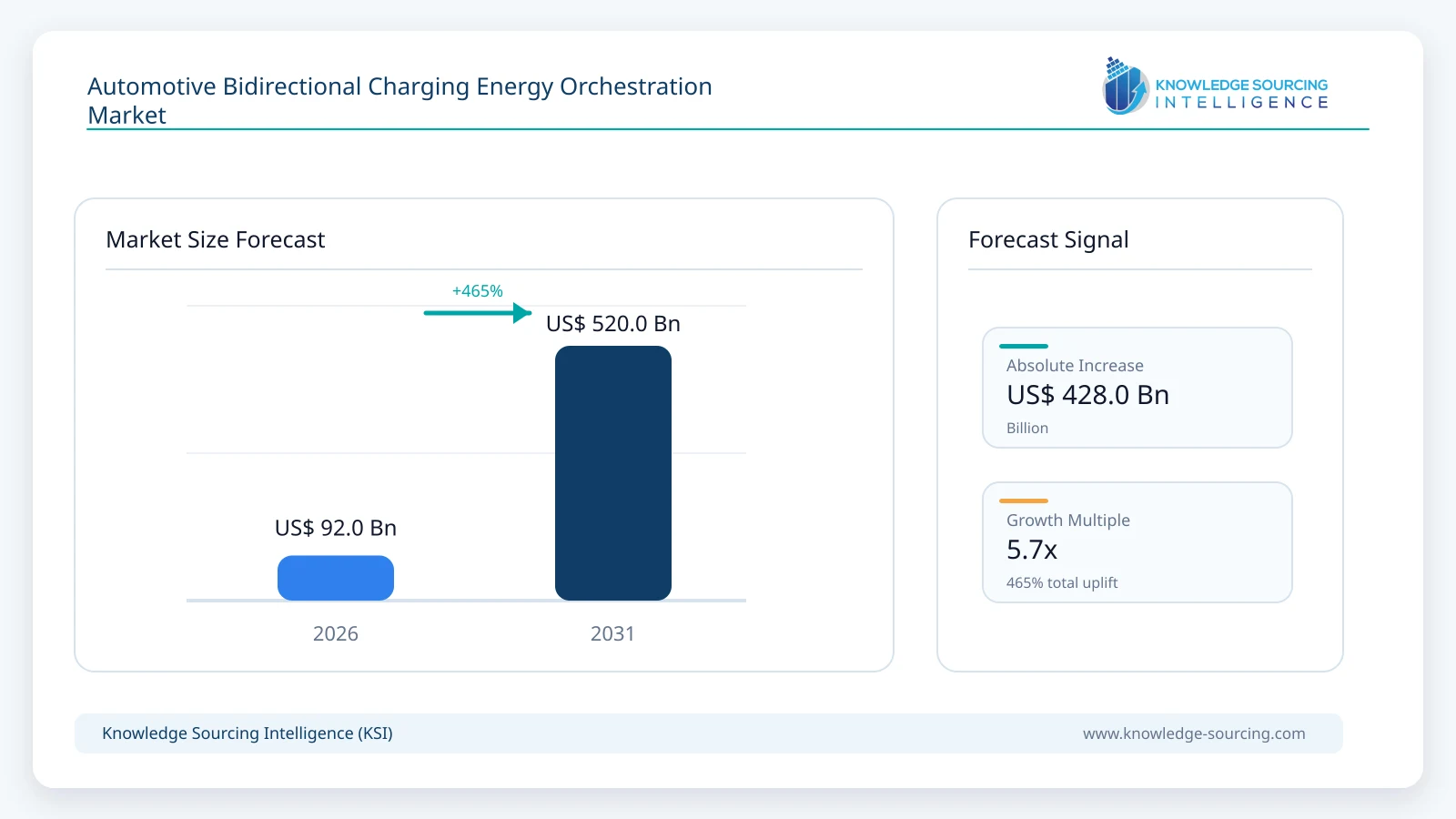
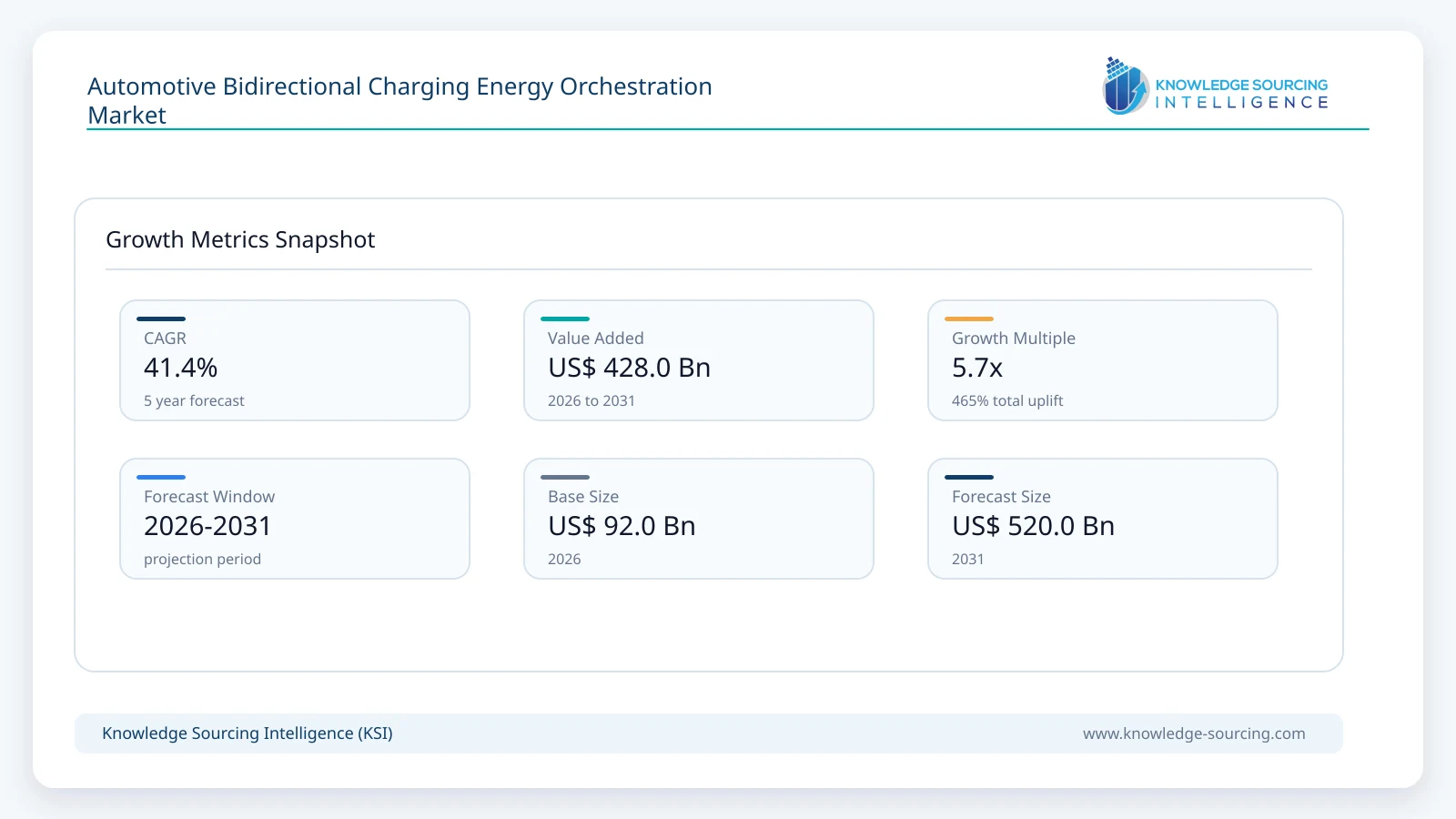
The Automotive Bidirectional Charging Energy Orchestration Market is forecast to grow at a CAGR of 41.4%, reaching USD 520.0 million in 2031 from USD 92.0 million in 2026.
Highlights:
- 1Vehicle-embedded orchestration software accounts for approximately 57% of 2026 market revenue, before separately charged services and integration.
- 2V2H is the largest 2026 energy-export application, while grid-facing V2G gains share through 2031 as interoperability and market access improve.
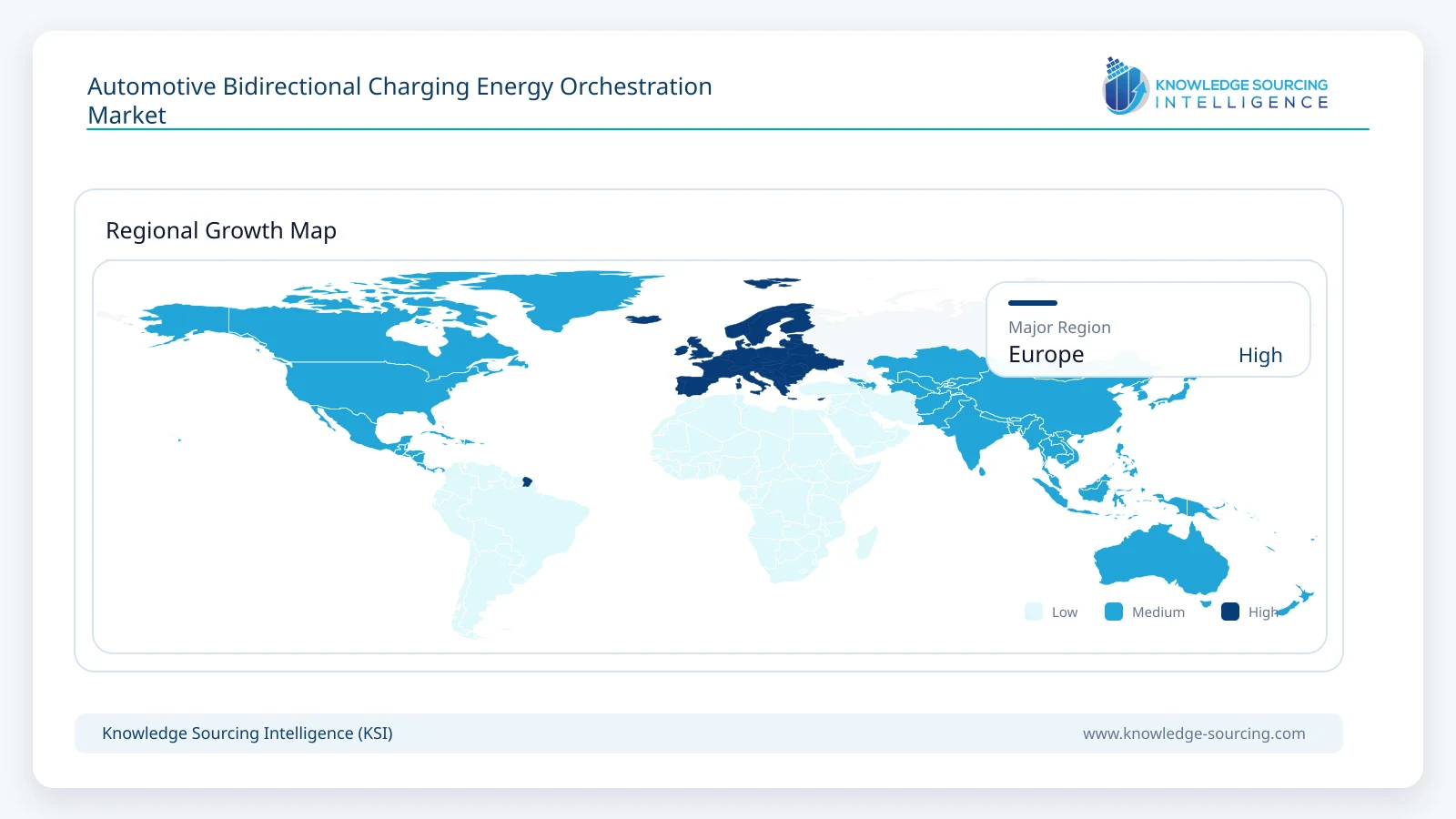
- 3Europe represents about 36% of 2026 revenue, with established French and German commercial service offers.
- 4North American V2H programs benefit from OEM backup-power platforms but still depend on compatible household equipment and utility arrangements.
- 5ISO 15118-20 enables a common communications pathway for bidirectional transfer, although vendor implementations and grid-code acceptance remain fragmented.
- 6Battery reserve, departure timing and discharge-permission controls remain critical software differentiators for both residential and fleet services.
It encompasses embedded vehicle energy-control software, connected scheduling and dispatch services, battery-reserve and export-permission logic, and directly associated system integration. The technology determines when a compatible electric vehicle should charge, discharge, or remain idle while preserving mobility and battery operating requirements. Control software works with bidirectional charging and metering equipment supplied separately.
BMW Group and E.ON introduced an orderable V2G customer package in February 2026 using a jointly developed algorithm for automatic charging and discharging of the BMW iX3. Renault similarly connects its compatible electric vehicles with the Plug Inn bidirectional powerbox and a V2G electricity service. GM Energy focuses on home backup through compatible EVs and a coordinated home energy system. These offerings illustrate different procurement models for the same underlying problem: coordinating vehicle availability, energy demand, user consent, and safe power export.
Market Overview
An electric vehicle that can export power does not automatically qualify as a controllable energy asset. Bidirectional operation requires the control system to reconcile battery state of charge, minimum departure reserve, thermal limits, charger capability, and the household or grid request before authorizing energy flow. The vehicle may also need to stop discharging when a driver changes the departure time or when charging connectivity fails. This continuous decision process creates a software function separate from the inverter and charging cable.
Renault combines an on-board bidirectional capability, a compatible powerbox, a customer electricity contract and an application that preserves the required departure charge. BMW and E.ON use an automatic charging and discharging algorithm with an associated V2G tariff, while GM Energy coordinates compatible vehicles and home equipment for backup power. Fleet-oriented platforms such as Nuvve GIVe and ChargeScape add telematics links, utility program handling and aggregate dispatch requirements. The resulting market spans OEM application software, licensed energy-control services and program-specific calibration.
Charging interoperability and local electrical rules influence how much of the function remains in the car versus in premises equipment or a connected platform. ISO 15118-20 defines communications for bidirectional power transfer, but its implementation alone does not authorize a vehicle to export into every distribution network. Automakers and energy partners must link protocol control to meter status, grid connection, user authorization, and battery availability. The value of orchestration consequently rests on verified control behavior across the entire vehicle-to-energy system rather than basic scheduling alone.
Market Trends
Vehicle and Energy-Service Algorithms Are Being Commercialized Together
BMW’s February 2026 V2G offer couples an eligible Neue Klasse vehicle with an E.ON electricity tariff, a compatible wallbox and automated bidirectional dispatch. Its joint control algorithm is designed to direct vehicle energy flows while delivering customer charging benefits. The product illustrates how energy orchestration becomes a joint automotive and utility service rather than a feature sold solely by the vehicle manufacturer.
Renault’s Plug Inn service extends a similar commercial structure by pairing the bidirectional powerbox with the driver application and electricity contract. The vehicle owner must retain the charge needed for the next journey, which requires reserve-aware dispatch instead of simply following a grid price signal. As these offers spread, OEMs will need lasting interfaces between the BMS, vehicle-cloud service and partner energy platforms.
Home Backup Is Creating an Installed Base Before Grid Export Scales
GM reported in February 2026 that it had sold more than 246,000 vehicles with V2H-capable technology during 2025, although capability does not establish how many homes have the necessary energy equipment installed. The PowerShift charger and Home Hub ecosystem can coordinate battery discharge during a blackout, illustrating a practical benefit that does not depend on wholesale electricity market participation.
Backup operation places particular importance on isolating the premises from the grid, preserving a battery reserve and restoring normal charging when electricity returns. Software providers must verify switching behavior, and driver controls even when internet connectivity or utility communications are interrupted. Those requirements support investment in local, fail-safe vehicle and premises control alongside cloud-based optimization.
Charging and Vehicle Data Are Converging with Utility Programs
Nuvve’s GIVe platform coordinates EV batteries, charging equipment and grid services, and its 2025 acquisition of Fermata Energy assets consolidated relevant bidirectional technology. ChargeScape provides an OEM-telematics-to-utility integration path, enabling participating automakers to connect vehicle data with utility programs. Both approaches depend on vehicle availability signals and controls that protect the driving function.
Fleet and residential services still differ in dispatch economics. A depot may schedule export around known vehicle shifts and contracted demand charges, whereas household participation depends on charger installation, tariffs and voluntary driver enrollment. Platforms able to handle these distinct operating constraints can reuse core scheduling software while adapting settlement and customer interfaces to each market.
Standards-Based Communication Is Advancing Beyond Proprietary Pairings
ISO 15118-20 specifies the charging messages required for bidirectional transfer, and the July 2026 amendment addresses additional AC distributed-energy service and security requirements. CharIN continues to coordinate interoperability trials because nominal standards support does not guarantee that a vehicle, charger, and energy-management platform will function together in every market.
Automakers must validate certificates, export commands, fault interruption, charger identification, and grid-specific operating limits for each combination of hardware and software. Companies that maintain validated protocol libraries and repeatable test environments can reduce OEM integration work, but approval remains location-dependent. Interoperability therefore affects both time to market and the recurring cost of maintaining orchestration software.
Predictive Dispatch Is Extending Beyond Fixed Tariff Windows
Residential energy control increasingly requires forecasting household load, available solar output, and expected vehicle departure rather than using a fixed overnight charging window. A bidirectional vehicle can shift stored energy toward a household peak or grid service event only when enough battery charge remains, and the charging equipment is available for export.
Forecast-based dispatch also has to balance the uncertain value of electricity export against battery cycling and customer mobility needs. Optimization software that can update operating decisions as prices, weather, or vehicle status change may command higher recurring service value. Vehicle manufacturers nevertheless need transparent driver overrides and dependable fallback behavior to preserve customer acceptance.
Segment Analysis
By Energy Export Service: Vehicle-to-Home
Vehicle-to-home applications represent the largest modeled 2026 energy-export segment because backup power is a readily understood customer benefit and can operate without bidding into wholesale electricity markets. GM Energy offers compatible vehicle and home equipment, while Renault and BMW tie household charging to wider energy-service arrangements. The vehicle controller must manage export limits and minimum reserve, and the premises system must protect the customer connection.
V2H accounts for approximately 44% of 2026 value and remains commercially significant through 2031 even as grid-export applications expand. Revenue opportunities include embedded dispatch logic, setup and calibration, and continuing customer energy-management services. The limiting factor is not only the availability of a compatible vehicle, but also the purchase and installation of qualified household equipment.
By Revenue Component: Vehicle-Embedded Orchestration Software
Vehicle-embedded orchestration software manages reserve logic, vehicle authorization, export availability, and responses to charging hardware commands. This function is integrated with the BMS, charging controller, and vehicle software architecture, making qualification and cybersecurity particularly important. OEMs can develop algorithms internally or commission specialist software and calibrations through their charging and energy partners.
Embedded software accounts for about USD 52.5 million of estimated 2026 revenue, reflecting the greater population of V2X-ready vehicles compared with active contracted grid-service participants. Recurring energy services gain share toward 2031 as customers enroll and fleets begin managed dispatch. Supplier contracts may bundle initial licensing with vehicle integration, requiring a clear distinction between the one-time software value and continuing services.
By Integration Architecture: Vehicle-Led Embedded Energy Control
Vehicle-led energy control retains the safety-critical decision to discharge inside the automotive electrical and software architecture, even when external platforms provide price forecasts or requested power levels. The BMS determines safe energy availability, while the charger or premises controller enforces local grid and electrical protection requirements. This division allows automakers to protect battery health and minimum mobility needs.
The architecture represents approximately 48% of estimated revenue in 2026 but loses some share as combined vehicle-premises and fleet-aggregator systems expand. OEMs retain control over energy export permissions yet increasingly rely on utilities and service providers for tariffs, measurement and settlement. Suppliers with tested APIs between vehicle and external orchestration systems should benefit from repeated program deployments.
By Optimization Strategy: Predictive Model-Based Scheduling
Predictive scheduling combines anticipated driving needs, connected-vehicle telemetry, and electricity demand to select export and recharge windows. A controller can defer discharge when a planned journey requires more battery reserve or bring charging forward when solar generation and off-peak prices are available. This function becomes more complex when the vehicle participates in several household or utility programs.
Model-based optimization is projected to rise from about 37% of estimated 2026 revenue to 47% by 2031 as export commitments become more dynamic. Advanced forecasting requires access to reliable vehicle data and resilient fallback schedules. Software suppliers can differentiate through measured performance and safe driver overrides, rather than through algorithm branding alone.
Market Drivers
Commercial V2G Tariffs Are Establishing a Paying Service Model
BMW and E.ON moved from announcing their German V2G offer in September 2025 to accepting orders for the combined tariff, wallbox and vehicle package in February 2026. Commercial contracting creates recurring requirements for authorized discharge, compensation calculation and vehicle availability reporting. The charging algorithm must work with the utility relationship as well as with the automotive hardware.
Renault’s powerbox and electricity-service arrangement likewise links customer mobility requirements with export opportunities. Where a utility or retailer can compensate an owner for vehicle flexibility, OEMs gain a reason to maintain the orchestration software through the vehicle lifecycle. Broader revenue uptake will depend on enrollment, not simply on capable EV sales.
V2H-Capable Vehicle Availability Is Expanding the Addressable Base
General Motors reported sales of more than 246,000 V2H-capable vehicles in 2025, providing a concrete example of energy export capability moving into mainstream model lines. GM’s supported home system still requires a compatible charger and energy equipment before a customer can use backup power. The difference between vehicle capability and actual activation is central to the near-term commercial opportunity.
Automakers installing bidirectional readiness across multiple models can amortize core software validation over larger production programs. As households add qualified hardware, recurring management and service revenue can follow the original embedded license. This supports growth in vehicle-linked orchestration even when the charger is sold by a different supplier.
Fleet Duty Cycles Create Controllable Energy Windows
Electric bus and commercial vehicle fleets can have more predictable parking periods than private passenger cars, allowing vehicle batteries to support depot peaks or local grid services between scheduled journeys. Nuvve’s platform experience demonstrates how vehicles, charging points, and grid-service instructions can be coordinated within a managed fleet rather than treated as isolated charging sessions.
Depot operators must protect departure state of charge and account for battery capacity across vehicles with different routes and maintenance schedules. Software that integrates dispatch forecasting with fleet operations can convert reliable parking time into contracted flexibility. Commercial growth will depend on clear utilization economics and the cost of compatible chargers.
Standards Development Is Improving the Basis for Interoperability
ISO 15118-20 defines the charging communication pathway for bidirectional power transfer, while the July 2026 amendment extends the framework for AC distributed-energy services and security. The published standard gives OEMs and charger suppliers a common vocabulary for negotiating charging parameters and energy export requirements.
CharIN interoperability testing shows that protocol implementation is still not uniform. As repeatable certification practices mature, automakers should be able to reuse software across more charger types and national markets. Lower integration duplication creates a stronger business case for dedicated orchestration products.
Solar, Tariff and Grid Flexibility Needs Favor Coordinated Control
Rising renewable penetration and time-variable electricity prices create periods when a parked EV has higher value as a flexible battery than as a passive load. The International Energy Agency identifies bidirectional charging as a potential contributor to reducing peak demand and increasing renewable integration. Vehicle software must ensure that this benefit does not undermine readiness for the next trip.
Residential systems coordinate energy export with rooftop solar and household demand, while utilities seek larger aggregated responses from many vehicles. These different use cases share a need for forecasting and reserve-aware dispatch, allowing qualified software designs to be reused across markets with localized energy-service logic.
Market Restraints
Interoperability Remains Limited Across Vehicles and Chargers
The IEA’s 2026 assessment finds that commercialized V2G models remain scarce and that vehicle-to-charger interoperability is especially limited outside validated vendor pairings. A communication standard can describe the energy-transfer sequence without guaranteeing that each OEM correctly supports every charger or grid-service command.
Bidirectional suppliers must test connection loss, unexpected power reductions, charging-session restarts and export-permission changes across combinations of vehicle and station software. These engineering requirements extend program timelines and make repeatable multi-brand integration expensive for smaller suppliers.
Battery Availability and Degradation Concerns Constrain Dispatch
Battery state of charge, temperature and expected departure time limit how much energy may safely be exported from a parked vehicle. A household savings target or wholesale market signal cannot override BMS safety limits. Customers also expect transparent accounting for any additional cycling and the impact on battery warranty conditions.
Orchestration software must preserve mobility reserves and provide controls for driver opt-outs and unexpected journeys. Algorithms with poor predictions may meet short-term export requests at the cost of customer dissatisfaction, reducing recurring program participation. These tradeoffs require substantial vehicle-level calibration.
Premises Equipment and Grid Connection Costs Slow Activation
GM Energy’s V2H offer requires a compatible vehicle, PowerShift charger and home enablement hardware, while commercial V2G arrangements may also need smart metering and grid-authorized export. The cost of equipment, electrical installation and permitting is separate from the software subscription and can outweigh near-term energy savings.
Customer uptake therefore depends on hardware economics and local export tariffs as much as on vehicle capability. Lower-cost AC equipment may widen access, but available functionality and certification vary by market. Slow equipment attachment rates can delay service revenue after OEM software has already shipped.
Utility Rules and Compensation Models Differ by Jurisdiction
Electricity export introduces grid connection, settlement and market-access rules that vary between countries and often between utility service territories. Germany’s BMW–E.ON program and Renault’s French arrangement are built around specific local partners and tariffs rather than universal cross-border contracts.
Each program may need different meter data, contractual permissions and control limits. Orchestration suppliers must maintain regional rules and integrations, making international scale less straightforward than deploying a standard automotive application. Where compensation is uncertain, households and fleets may favor simple backup operation over active grid participation.
Cybersecurity and Loss-of-Connection Safety Add Validation Burden
Bidirectional power transfer exposes a vehicle to commands from chargers, home systems and remote energy platforms. ISO 15118-20 security requirements and local electrical safety functions must be combined with protected vehicle identity, user consent and reliable command authorization. A compromised or delayed dispatch signal cannot be allowed to bypass safe operating limits.
Suppliers must demonstrate controlled fallback when cellular connectivity, a utility endpoint or a premises controller becomes unavailable. The resulting software testing, key management and maintenance burden increases the cost of deploying and sustaining compatible services across long vehicle lifetimes.
Regional Outlook
Europe
Germany and France provide the clearest early examples of commercially packaged private-customer V2G in Europe. BMW and E.ON opened orders for their Neue Klasse energy service in February 2026, while Renault offers a powerbox and electricity contract linked to compatible EV models. These programs combine vehicle authorization, grid export, metering and customer compensation rather than treating energy export as a standalone feature.
Europe is estimated to account for 36% of global revenue in 2026 and 32% in 2031. Its near-term advantage rests on service commercialization and established European automotive software suppliers, while growth depends on national grid codes and repeatable charger interoperability. Partnerships with electricity retailers are likely to remain integral to vehicle-linked software deployment.
Asia Pacific
China’s large EV production base offers substantial potential for bidirectional vehicle orchestration, but national communication and grid-market arrangements remain less mature than mass vehicle sales might suggest. The IEA describes numerous Chinese V2G pilots alongside incomplete protocol alignment, while Japanese CHAdeMO deployments and Korean demonstrations provide additional regional experience. Vehicle programs therefore span different charging architectures and market stages.
Asia Pacific is modeled at 26% of 2026 revenue, rising to 34% by 2031 as compatible vehicle and premises installations increase. Supplier opportunity will depend on separating embedded automotive software content from grid infrastructure spending and on local adaptation to export rules. The strongest growth is expected where automakers can standardize reserve-aware control across large vehicle platforms.
Competitive Landscape
BMW, Renault and GM Energy demonstrate three distinct OEM-led commercial approaches. BMW relies on a partnered electricity-service tariff with E.ON, Renault integrates its vehicle, powerbox and charging service, and GM focuses on household backup capability supported by a dedicated energy-equipment ecosystem. These models differ in customer contract ownership and the share of control hosted in vehicle electronics versus premises or connected services.
Nuvve competes through its GIVe orchestration platform for vehicles and distributed assets, while ChargeScape connects automaker telematics to utility programs and is preparing broader V2X operation. Renault’s ecosystem also uses specialist energy-service and communication partners. The key competitive distinction is not the quantity of connected vehicles alone, but the ability to deliver validated export behavior with sufficient controls for driver mobility and battery constraints.
Software contracting includes OEM engineering programs, embedded license value and recurring vehicle-linked energy services. A vendor with proprietary grid dispatch technology does not automatically own the vehicle-side energy-control function; conversely, an automaker can ship bidirectional readiness without receiving ongoing revenue from an active tariff. The most attractive programs combine predictable customer activation with transferable integrations across vehicle models and chargers.
Recent Developments
October 2026: Renault Group and EDF Group announced a partnership combining EVs, home charging and smart energy control, including bidirectional V2G technologies. The agreement broadens the potential commercial channel but does not establish installed V2G customer volumes.
July 2026: ISO published Amendment 1 to ISO 15118-20, adding AC distributed-energy-service provisions and improved security, expanding the technical standard framework for bidirectional operation.
February 2026: BMW Group and E.ON opened orders in Germany for a BMW iX3-linked V2G package including the Wallbox Professional, electricity tariff and joint automatic charging/discharging algorithm.
February 2026: General Motors reported more than 246,000 V2H-capable EVs sold during 2025, providing evidence of vehicle capability expansion rather than installed or activated home backup systems.
April 2025: Nuvve completed an acquisition of substantially all Fermata Energy assets, combining technologies relevant to connected bidirectional energy dispatch and fleet V2G.
April 2026: Renault Group consolidated its charging offers under the Plug Inn name, including the bidirectional powerbox and intelligent V2G service, strengthening customer access to the integrated energy program.
Market Outlook
Automotive bidirectional energy orchestration is expected to move from selective backup and early utility participation to a broader software feature of connected battery-electric vehicle platforms by 2031. The strongest expansion should occur where OEMs can enable a verified vehicle control layer across multiple nameplates and connect it to qualified home or depot systems. Europe is likely to retain a strong position in commercial energy-service integration, while Asia Pacific contributes increasing vehicle-platform scale.
Predictive reserve planning, interoperable session negotiation and driver-aware export scheduling should attract greater software investment as V2G programs increase. The pace of monetization will depend on household installation rates, local grid permissions and durable customer compensation models. OEMs and software suppliers able to maintain safe vehicle operation across changing energy partners are better positioned to sustain recurring services than providers relying on bidirectional-capability claims alone.
Companies Profiled
BMW Group
BMW markets V2G-capable Neue Klasse vehicles and jointly develops automatic charge/discharge optimization with E.ON. Its market role is OEM integration and the software-led vehicle authorization layer.
E.ON SE
E.ON pairs eligible BMW vehicles with V2G tariffs, energy-market access and controlled export schedules in Germany. The energy-contract orchestration layer depends on metering, grid permission and customer connection.
Renault Group
Renault offers compatible bidirectional EVs, the Plug Inn powerbox and an integrated V2G service in France. The commercial offer connects departure requirements, charging schedules and customer electricity contracts.
The Mobility House GmbH
The Mobility House acts as a technical and energy-services participant in Renault’s V2G ecosystem, helping convert bidirectional vehicle flexibility into tariff and energy-market value.
General Motors Company
GM Energy connects eligible Chevrolet, GMC and Cadillac EVs with home backup equipment and management controls. The 2026 disclosure of 246,000 V2H-capable 2025 vehicle sales establishes enabling vehicle capability, not installed home systems.
Nuvve Holding Corp.
Nuvve uses its GIVe platform to coordinate batteries, bidirectional chargers, fleet scheduling and grid services. The 2025 Fermata asset acquisition broadened its V2G technology portfolio.
ChargeScape LLC
ChargeScape connects automaker telematics to utility energy programs and develops V2X participation services. The platform is a vehicle-grid interface, although much of its live managed-charging activity remains unidirectional.
Hyundai Motor Company
Hyundai has demonstrated vehicle-linked grid flexibility with IONIQ 5 vehicles in Utrecht alongside We Drive Solar. Its role is OEM energy-interface development rather than a disclosed standalone orchestration software vendor.
IoTecha Corp.
IoTecha provides charger communication technology used in the Renault Powerbox ecosystem. Its enabling communications content is adjacent to the market and counted only when contractually at orchestration.
Automotive Bidirectional Charging Energy Orchestration Market Scope:
| Report Metric | Details |
|---|---|
| Total Market Size in 2026 | USD 92.0 million |
| Total Market Size in 2031 | USD 520.0 million |
| Forecast Unit | USD Billion |
| Growth Rate | 41.4% |
| Study Period | 2021 to 2031 |
| Historical Data | 2021 to 2024 |
| Base Year | 2025 |
| Forecast Period | 2026 – 2031 |
| Segmentation | Orchestration Function, Revenue Component, Energy Export Service, Integration Architecture |
| Companies |
|
Market Segmentation
By Orchestration Function
Charge and Discharge Dispatch Scheduling
Battery Reserve and Availability Constraints
Tariff, Solar and Building Energy Coordination
Grid Services and Export Permission Control
Fallback, Safety and User Authorization
By Revenue Component
Vehicle-Embedded Orchestration Software
Recurring Vehicle-Linked Energy Services
Calibration, Integration and Lifecycle Engineering
By Energy Export Service
Vehicle-to-Home (V2H)
Vehicle-to-Grid (V2G)
Vehicle-to-Building and Fleet Facilities (V2B)
Multi-Use V2X Energy Orchestration
By Integration Architecture
Vehicle-Led Embedded Energy Control
Vehicle and Premises Energy Management Integration
Fleet or Aggregator-Integrated Dispatch
By Vehicle Category
Passenger Battery Electric Vehicles
Light Commercial Electric Vehicles
Electric Buses
Medium and Heavy Electric Trucks
By Customer Application
Residential Backup and Energy Cost Management
Commercial Facilities and Fleet Depots
Utility and Grid Flexibility Programs
Municipal and Institutional Energy Services
By Optimization Strategy
Calibrated Rule-Based Scheduling
Predictive Model-Based Optimization
Adaptive and AI-Assisted Orchestration
By Bidirectional Charging Interface
AC Bidirectional Charging
DC Bidirectional Charging
Mixed AC/DC Compatible Platforms
By Geography
Europe
Germany
France
United Kingdom
Spain
Italy
Others
North America
United States
Canada
Mexico
Asia Pacific
China
Japan
South Korea
India
Australia
Thailand
Others
South America
Brazil
Argentina
Others
Middle East and Africa
Saudi Arabia
United Arab Emirates
South Africa
Others
Table of Contents
1. EXECUTIVE SUMMARY
1.1. Market Opportunity and Key Findings
1.2. Global Growth and Regional Outlook
2. MARKET SNAPSHOT
2.1. Market Overview
2.2. Market Definition
2.3. Scope of the Study
2.4. Market Segmentation
3. BUSINESS LANDSCAPE
3.1. Market Drivers
3.1.1. Commercial V2G Tariffs Are Establishing a Paying Service Model
3.1.2. V2H-Capable Vehicle Availability Is Expanding the Addressable Base
3.1.3. Fleet Duty Cycles Create Controllable Energy Windows
3.1.4. Standards Development Is Improving the Basis for Interoperability
3.1.5. Solar, Tariff and Grid Flexibility Needs Favor Coordinated Control
3.2. Market Restraints
3.2.1. Interoperability Remains Limited Across Vehicles and Chargers
3.2.2. Battery Availability and Degradation Concerns Constrain Dispatch
3.2.3. Premises Equipment and Grid Connection Costs Slow Activation
3.2.4. Utility Rules and Compensation Models Differ by Jurisdiction
3.2.5. Cybersecurity and Loss-of-Connection Safety Add Validation Burden
3.3. Market Opportunities
3.4. Porter’s Five Forces Analysis
3.5. Industry Value Chain Analysis
3.6. Policies and Regulations
3.7. Strategic Recommendations
4. TECHNOLOGICAL OUTLOOK
4.1. V2H, V2B and V2G Energy-Control Stack
4.2. Battery Reserve and Dispatch Algorithms
4.3. ISO 15118-20 and Cybersecure Communication
5. AUTOMOTIVE BIDIRECTIONAL CHARGING ENERGY ORCHESTRATION MARKET BY ORCHESTRATION FUNCTION
5.1. Introduction
5.2. Charge and Discharge Dispatch Scheduling
5.3. Battery Reserve and Availability Constraints
5.4. Tariff, Solar and Building Energy Coordination
5.5. Grid Services and Export Permission Control
5.6. Fallback, Safety and User Authorization
6. AUTOMOTIVE BIDIRECTIONAL CHARGING ENERGY ORCHESTRATION MARKET BY REVENUE COMPONENT
6.1. Introduction
6.2. Vehicle-Embedded Orchestration Software
6.3. Recurring Vehicle-Linked Energy Services
6.4. Calibration, Integration and Lifecycle Engineering
7. AUTOMOTIVE BIDIRECTIONAL CHARGING ENERGY ORCHESTRATION MARKET BY ENERGY EXPORT SERVICE
7.1. Introduction
7.2. Vehicle-to-Home (V2H)
7.3. Vehicle-to-Grid (V2G)
7.4. Vehicle-to-Building and Fleet Facilities (V2B)
7.5. Multi-Use V2X Energy Orchestration
8. AUTOMOTIVE BIDIRECTIONAL CHARGING ENERGY ORCHESTRATION MARKET BY INTEGRATION ARCHITECTURE
8.1. Introduction
8.2. Vehicle-Led Embedded Energy Control
8.3. Vehicle and Premises Energy Management Integration
8.4. Fleet or Aggregator-Integrated Dispatch
9. AUTOMOTIVE BIDIRECTIONAL CHARGING ENERGY ORCHESTRATION MARKET BY VEHICLE CATEGORY
9.1. Introduction
9.2. Passenger Battery Electric Vehicles
9.3. Light Commercial Electric Vehicles
9.4. Electric Buses
9.5. Medium and Heavy Electric Trucks
10. AUTOMOTIVE BIDIRECTIONAL CHARGING ENERGY ORCHESTRATION MARKET BY CUSTOMER APPLICATION
10.1. Introduction
10.2. Residential Backup and Energy Cost Management
10.3. Commercial Facilities and Fleet Depots
10.4. Utility and Grid Flexibility Programs
10.5. Municipal and Institutional Energy Services
11. AUTOMOTIVE BIDIRECTIONAL CHARGING ENERGY ORCHESTRATION MARKET BY OPTIMIZATION STRATEGY
11.1. Introduction
11.2. Calibrated Rule-Based Scheduling
11.3. Predictive Model-Based Optimization
11.4. Adaptive and AI-Assisted Orchestration
12. AUTOMOTIVE BIDIRECTIONAL CHARGING ENERGY ORCHESTRATION MARKET BY BIDIRECTIONAL CHARGING INTERFACE
12.1. Introduction
12.2. AC Bidirectional Charging
12.3. DC Bidirectional Charging
12.4. Mixed AC/DC Compatible Platforms
13. AUTOMOTIVE BIDIRECTIONAL CHARGING ENERGY ORCHESTRATION MARKET BY GEOGRAPHY
13.1. Introduction
13.2. Europe Breakdown
13.2.1. Germany
13.2.2. France
13.2.3. United Kingdom
13.2.4. Spain
13.2.5. Italy
13.2.6. Others
13.3. North America Breakdown
13.3.1. United States
13.3.2. Canada
13.3.3. Mexico
13.4. Asia Pacific Breakdown
13.4.1. China
13.4.2. Japan
13.4.3. South Korea
13.4.4. India
13.4.5. Australia
13.4.6. Thailand
13.4.7. Others
13.5. South America Breakdown
13.5.1. Brazil
13.5.2. Argentina
13.5.3. Others
13.6. Middle East and Africa Breakdown
13.6.1. Saudi Arabia
13.6.2. United Arab Emirates
13.6.3. South Africa
13.6.4. Others
14. COMPETITIVE ENVIRONMENT AND ANALYSIS
14.1. Major Players and Strategy Analysis
14.2. Market Share Analysis
14.3. Mergers, Acquisitions, Agreements and Collaborations
14.4. Competitive Dashboard
15. COMPANY PROFILES
15.1. BMW Group
15.2. E.ON SE
15.3. Renault Group
15.4. The Mobility House GmbH
15.5. General Motors Company
15.6. Nuvve Holding Corp.
15.7. ChargeScape LLC
15.8. Hyundai Motor Company
15.9. IoTecha Corp.
16. APPENDIX
16.1. Currency
16.2. Assumptions
16.3. Base and Forecast Years Timeline
16.4. Key Benefits for Stakeholders
16.5. Research Methodology
16.6. Abbreviations
Navigate
Trusted by the world's leading organizations











