
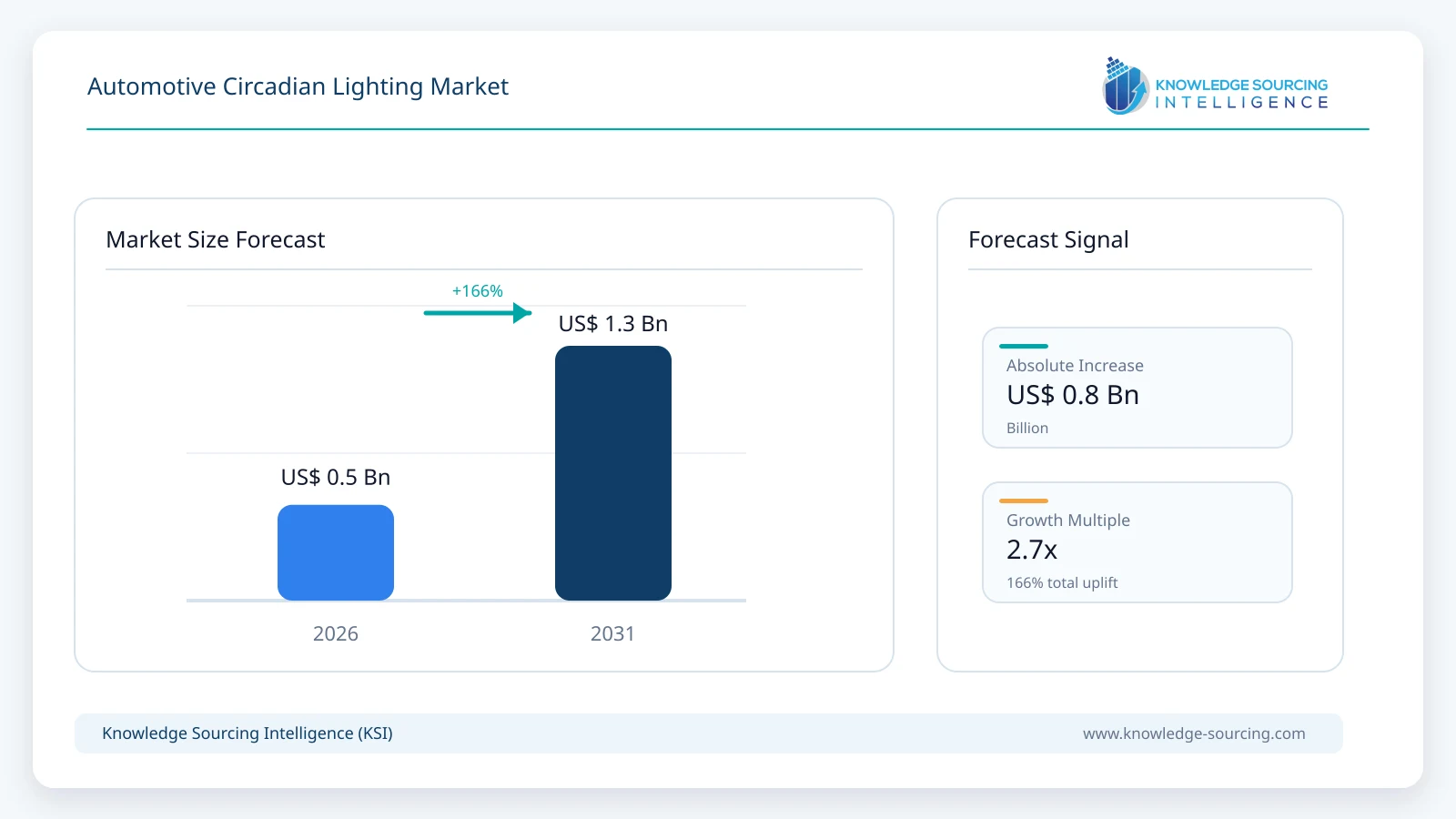
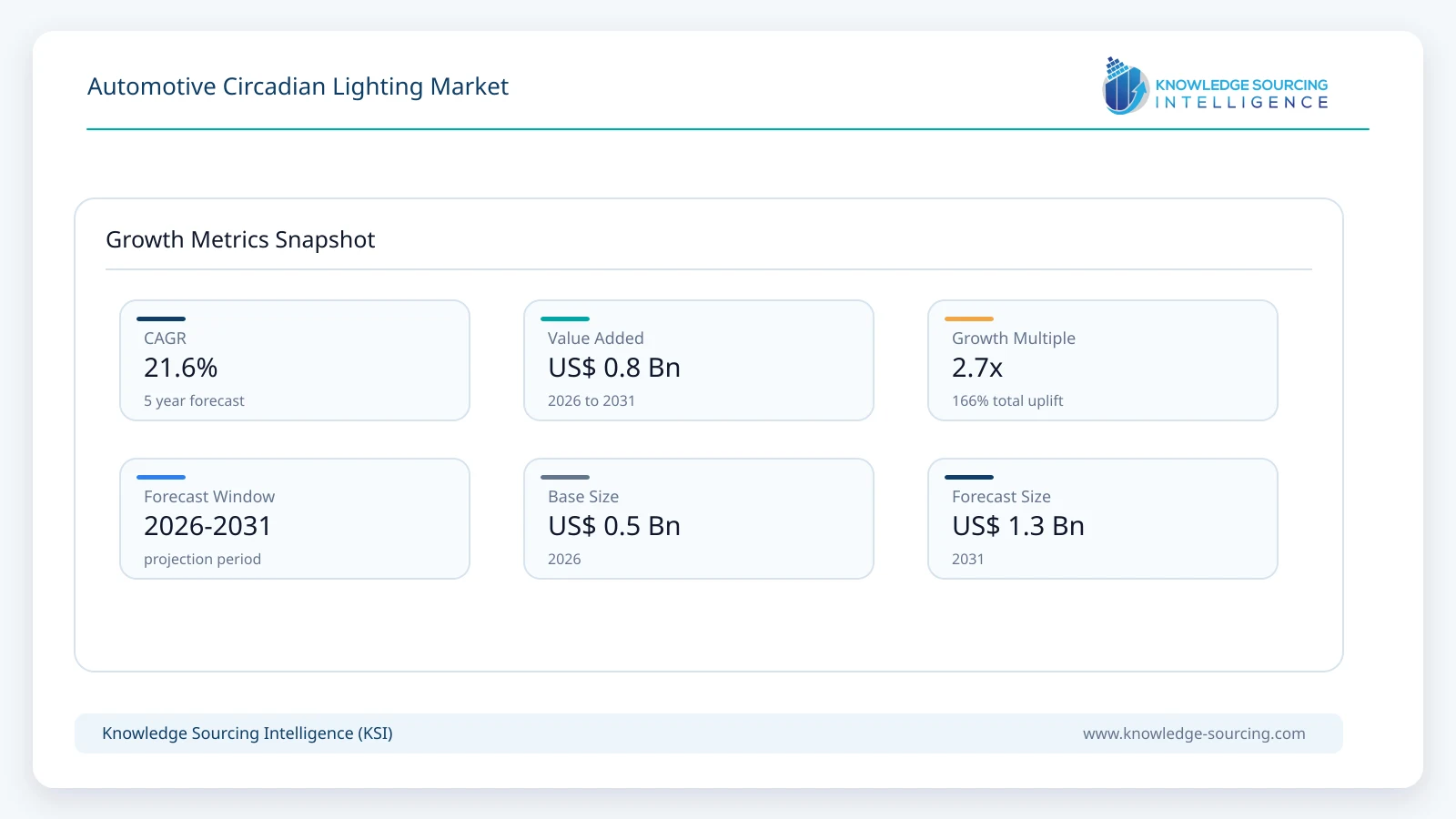
The Automotive Circadian Lighting Market is projected to expand at a CAGR of 21.6%, increasing from USD 0.47 billion in 2026 to USD 1.25 billion by 2031.
Highlights:
- 1Tunable-white and spectrum-controlled lighting hardware accounts for approximately 70% of global market value in 2026 because LEDs, optical modules and controllable luminous surfaces provide the direct actuator for biologically informed light exposure.
- 2Tunable-white lighting represents approximately 46% of 2026 market value by lighting type, supported by its ability to move between warm and cool white without relying on decorative colour effects.
- 3Alertness and activation functions account for approximately 43% of market value in 2026 as fatigue reduction, morning stimulation and post-rest wake-up provide the clearest initial use cases.
- 4Sensor- and context-adaptive architectures represent approximately 55% of 2026 market value because time, ambient light, driver state, vehicle context and user inputs increasingly determine the lighting response.
- 5Premium and luxury vehicles account for approximately 53% of global market value in 2026 because advanced tunable lighting and wellness software remain concentrated in high-content cabins.
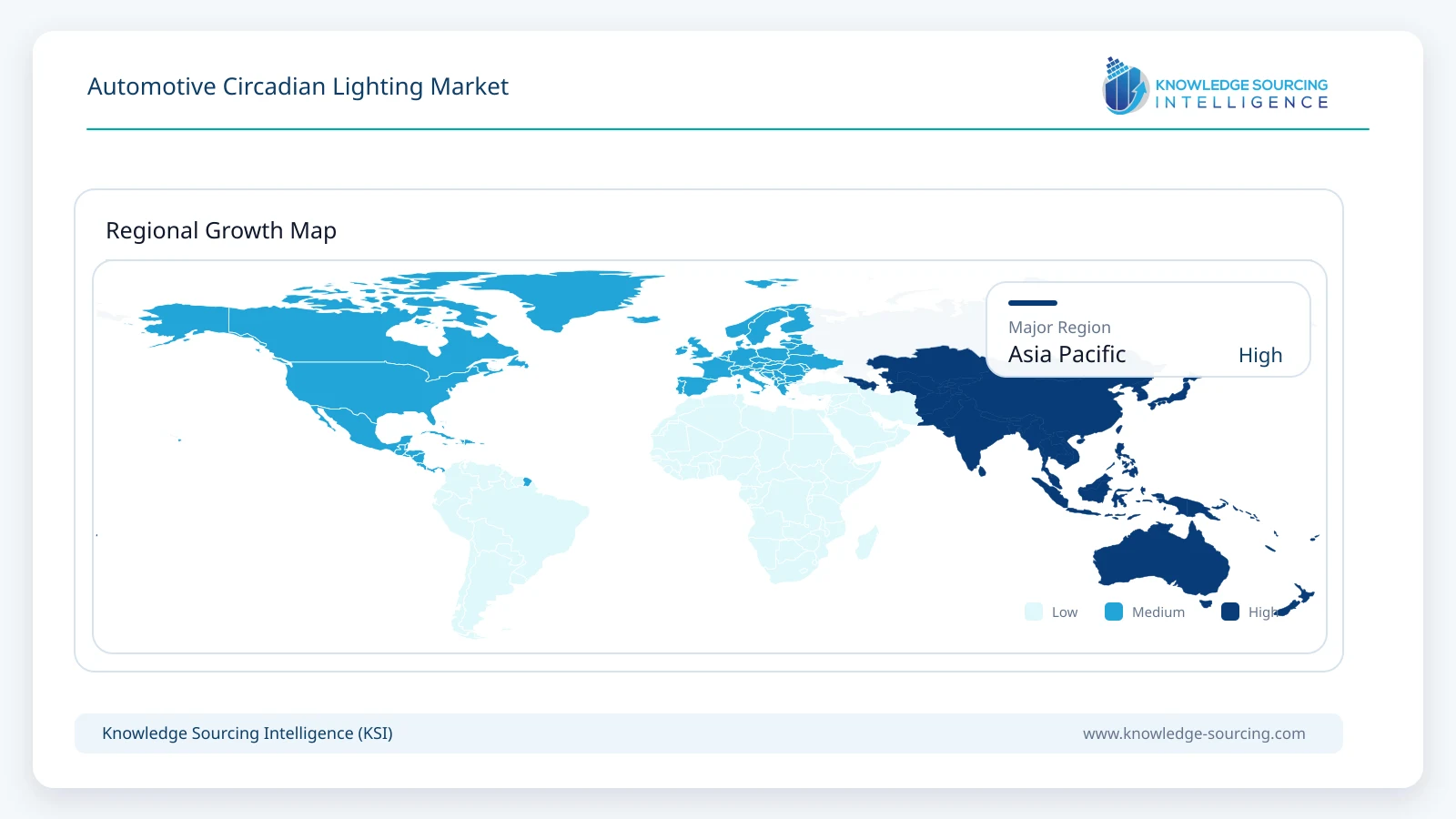
- 6Asia Pacific represents approximately 42% of global market value in 2026, supported by fast smart-cabin development in China, direct human-centric lighting innovation in South Korea and a large regional electronics supply base.
The market is moving beyond static ambient illumination toward lighting systems that intentionally vary spectral output, colour temperature, brightness and timing to influence visual comfort, perceived alertness and readiness for rest.
Tunable-white lighting remains the core hardware layer because it can shift from cooler, more activating white light to warmer, lower-intensity illumination for evening travel or relaxation. More advanced architectures combine RGBW or multi-channel emitters with ambient-light sensing, driver-state monitoring, wearable inputs and software that selects lighting scenes according to time, fatigue, activity or user preference.
Commercial deployment is still concentrated in premium vehicles and technology-led smart cabins. Hyundai Mobis has demonstrated human-centric lighting linked to physical and mental state, FORVIA HELLA offers adjustable-colour-temperature and circadian-aligned Tunable White interior lighting, ams OSRAM supplies automotive-qualified warm-to-cool white LEDs, and Mercedes-Benz integrates activating light into broader wellness programmes. The market excludes conventional ambient lighting, ordinary dome lamps and decorative RGB systems that do not perform a circadian or human-centric function.
Market Overview
Circadian lighting applies principles from human-centric illumination to the vehicle cabin. Instead of treating interior light only as a styling or visibility feature, the system manages colour temperature, intensity and timing to create different physiological and perceptual conditions across the day. Cooler, brighter scenes can support a sense of activation, while warmer and lower-intensity scenes are better suited to evening travel, relaxation and preparation for rest.
The technical architecture typically combines tunable-white or multi-channel LEDs with light guides, overhead modules or luminous trim surfaces, then adds electronic drivers and software control. Ambient-light sensors, clocks, navigation context, driver-monitoring cameras, wearable data, or user-selected profiles can refine the scene so the lighting response depends on actual cabin conditions rather than a fixed schedule.
Automotive use introduces constraints that differ from building-based human-centric lighting. The available luminous area is smaller, the occupant changes head position, glare and windshield reflections must be tightly controlled, and driver-facing stimulation cannot interfere with dark adaptation. Commercial systems therefore increasingly use zoned, indirect and software-controlled illumination rather than simply increasing brightness.
Market Trends
Tunable White Is Becoming the Preferred Circadian Lighting Architecture
Warm-to-cool white control is increasingly important because biological-rhythm applications depend more on spectral balance and intensity than on decorative colour selection. Automotive-qualified LEDs now support wide colour-temperature ranges with high colour-rendering performance.
The same hardware can serve reading, task, ambient and circadian functions, improving the economics of adoption because OEMs do not need a completely separate lighting network for wellness features.
Driver-State Inputs Are Turning Lighting into a Closed-Loop Intervention
Circadian lighting is becoming more adaptive as driver-monitoring systems provide fatigue, gaze and behavioural context. Hyundai Mobis has already demonstrated human-centric lighting responses linked to occupant physical and mental condition rather than only user-selected colours.
The longer-term value lies in activating stimulation only when appropriate, reducing unnecessary brightness and giving the lighting system a measurable trigger for alertness or recovery scenes.
Power-Nap and Charging-Dwell Use Cases Are Creating a Distinct EV Opportunity
Battery-electric vehicles create predictable stationary periods in which occupants may work, relax, or sleep while charging. Lighting can support the sequence by lowering intensity and colour temperature before rest, maintaining a low-disturbance environment, and then providing brighter activation during wake-up.
This use case is especially attractive in premium EVs because seat, climate, audio and lighting systems are already connected through centralized cabin software.
Software-Defined Lighting Is Moving Circadian Value from Hardware to Algorithms
Centralized cockpit and body controllers allow lighting scenes to be updated without changing the physical LEDs. OEMs can therefore refine timing, spectral balance and zonal behaviour over the vehicle lifecycle or link circadian scenes with driver profiles and wearables.
The value mix is expected to shift gradually toward software, calibration and personalization as tunable LED hardware becomes more standardized.
Large Luminous Surfaces Are Improving Biological and Visual Comfort
Small point sources can create glare before they deliver meaningful occupant-facing light. Suppliers are therefore expanding indirect overhead illumination, light guides, smart surfaces and broad ambient zones that distribute light more evenly across the cabin.
This architecture also allows separate driver and passenger scenes, reducing the need to expose every occupant to the same brightness or colour temperature.
Segment Analysis
By System Component: Tunable White and Spectrum-Controlled Lighting Hardware
Lighting hardware is the largest component segment because circadian functionality still depends on automotive-grade emitters, optics, light guides, and modules capable of changing intensity and spectral output. Tunable-white overhead and reading lights are particularly important because they can deliver higher-quality white illumination than conventional RGB ambient strips.
The segment accounts for approximately USD 0.329 billion in 2026 and could approach USD 0.825 billion by 2031. Its share is expected to decline modestly as control software, sensing and personalization grow faster, although the absolute hardware value continues to rise strongly.
By Lighting Type: Tunable White Lighting
Tunable-white lighting leads because it can provide warm evening illumination, neutral task lighting, and cooler activating scenes from one compact automotive module. High colour rendering also supports reading, makeup-mirror, and premium overhead-lighting functions.
The category represents approximately USD 0.216 billion in 2026 and is expected to remain the largest lighting type through 2031 even as RGBW and multi-channel spectral systems gain share in more immersive cabins.
By Comfort Function: Alertness and Activation
Alertness and activation is the largest functional value pool because fatigue, early-morning travel, and monotonous driving create immediate use cases for brighter or cooler lighting. Driver-state sensing can make these interventions more targeted than continuous high-intensity illumination.
The function accounts for approximately USD 0.202 billion in 2026. Growth will increasingly come from integration with drowsiness detection and post-nap wake-up routines rather than from manually selected “energizing” themes alone.
By Control Architecture: Sensor- and Context-Adaptive Systems
Sensor- and context-adaptive systems lead because circadian response depends on more than clock time. Ambient daylight, trip duration, driver fatigue, cabin occupancy and user preference can all influence whether the appropriate scene should stimulate, maintain neutral comfort or prepare for rest.
The architecture accounts for approximately USD 0.259 billion in 2026 and is expected to gain further share through 2031 as driver monitoring, cabin sensing and software-defined lighting become more widely integrated.
By Vehicle Class: Premium and Luxury Vehicles
Premium and luxury vehicles dominate current demand because they already carry dense ambient-light networks, high-content overhead consoles, wellness software and advanced cabin sensing. These vehicles also use interior experience as a visible point of differentiation.
The segment represents approximately USD 0.249 billion in 2026. Mid-range vehicles are expected to grow faster as tunable-white modules and centralized lighting control migrate into shared global platforms.
Market Drivers
Growing Focus on Driver Alertness and Fatigue Management
Interior lighting can complement drowsiness detection by providing a non-contact intervention when the driver is tired or travelling at biologically adverse times. The opportunity is strongest when the vehicle can target the response using driver-state information instead of relying on a fixed scene.
This links circadian lighting directly with the broader safety and wellness stack rather than leaving it as a decorative feature.
Premiumization of Wellness-Oriented Vehicle Interiors
Automakers increasingly differentiate premium cabins through massage, climate, fragrance, audio, lighting and personalized software programmes. Circadian lighting fits naturally into this trend because it can be demonstrated visually while also supporting a broader wellbeing narrative.
Competition among premium EVs and technology-led Chinese brands is accelerating investment in programmable cabin environments.
Expansion of Software-Defined Vehicle Architectures
Centralized and zonal architectures allow lighting, displays, climate, seating and driver monitoring to share the same contextual information. This makes circadian scenes easier to coordinate and update than in vehicles built around isolated lighting ECUs.
Software-defined control also enables persistent user profiles, regional scene calibration and future integration with wearables or sleep data.
EV Charging Dwell and Longer In-Cabin Occupancy
Charging stops and increasingly multifunctional cabins create more periods in which occupants read, work or rest while stationary. These activities require different lighting conditions and improve the commercial case for dynamic rather than fixed illumination.
The same hardware can support driving, relaxation and wake-up scenes, improving utilization across the journey.
Advances in Automotive Tunable LEDs and Optical Integration
Automotive-qualified LEDs now support warm-to-cool white tuning, high colour rendering and compact packaging suitable for overhead modules, reading lights and integrated smart surfaces. Optical design is also improving uniformity across larger luminous areas.
These improvements reduce the hardware barrier to adding circadian logic through software and calibration rather than through a separate lighting system.
Market Restraints
Limited Standardization of Automotive Circadian Performance
The industry does not yet have a widely adopted automotive standard defining the required circadian-effective light level, exposure duration or spectral profile for specific driving and rest scenarios. Supplier claims can therefore be difficult to compare.
OEMs must validate comfort benefits while also meeting distraction, glare, thermal and power constraints, which slows broad standardization.
Glare, Reflection and Night-Time Distraction Risk
Lighting intended to increase alertness can become visually intrusive at night if brightness, direction or spectral content is poorly controlled. Reflections on glazing and displays can also degrade visibility.
Driver-facing systems therefore require conservative luminance, indirect optics and careful zoning, limiting the usable biological stimulus during active night driving.
Individual Differences in Chronotype and Light Sensitivity
The same light scene does not affect every occupant equally. Chronotype, age, recent sleep, shift-work patterns and individual sensitivity can change the appropriate timing and intensity.
Meaningful personalization may require profile data or physiological inputs, adding software complexity and privacy considerations.
Restricted Cabin Geometry and Limited Exposure Area
Vehicle cabins provide far less luminous surface area and viewing distance than buildings designed for human-centric lighting. Achieving useful occupant-facing exposure without harsh point sources can therefore be difficult.
Suppliers need efficient indirect optics, larger luminous surfaces and multiple zones to improve coverage without excessive power or glare.
High Incremental Cost in Mass-Market Vehicles
Advanced circadian lighting can require tunable-white emitters, more capable LED drivers, sensing inputs, software and validation. In value vehicles, ordinary ambient lighting may already satisfy styling expectations at lower cost.
Scaling will depend on sharing hardware across reading, ambient, functional, and circadian roles so most additional value can be delivered through software.
Regional Outlook
Asia Pacific
Asia Pacific is the largest regional market in 2026, supported by rapid smart-cabin innovation in China and direct human-centric lighting development in South Korea. Hyundai Mobis has demonstrated one of the clearest circadian-related automotive concepts, linking lighting with passenger condition and biological-rhythm support across more than 32 scenarios.
China adds strong commercial momentum through premium EVs and software-defined interiors, while Japan contributes established lighting, electronics and optical-component suppliers. Growth through 2031 will increasingly come from upper-mid vehicles as tunable lighting becomes more modular and affordable.
Europe
Europe remains a major high-value market because premium OEMs and suppliers are already integrating tunable lighting into broader comfort programmes. Mercedes-Benz uses activating light within ENERGIZING COMFORT, while FORVIA HELLA offers adjustable-colour-temperature interior lighting and circadian-aligned Tunable White reading light.
The region also has a strong enabling ecosystem through ams OSRAM, Valeo, Marelli and other lighting suppliers. Adoption will depend on proving useful human-factors outcomes while maintaining low glare, efficient power use and compatibility with software-defined cabin architectures.
Competitive Landscape
The automotive circadian lighting market combines interior-lighting Tier 1 suppliers, LED and optical-component companies, smart-surface specialists and OEM wellness platforms. Hyundai Mobis is differentiated by its explicit human-centric lighting concept, while FORVIA HELLA combines tunable-white capability with integrated overhead and ambient-lighting systems. ams OSRAM provides the semiconductor and LED layer required for high-CRI warm-to-cool white tuning.
Valeo and Marelli bring scalable interior-lighting electronics, smart-surface integration and software-defined control. Mercedes-Benz demonstrates the OEM integration model by coordinating activating light with massage, audio and rest programmes, while Toyoda Gosei contributes advanced interior-light projection and dynamic illumination technology.
Competitive advantage is moving toward systems that can provide high-quality white light, low-glare optical distribution, context-aware software and seamless integration with cabin sensing. Suppliers that can reuse the same hardware for reading, ambient, warning and circadian functions are better positioned to scale beyond premium vehicles.
Recent Developments
3 September 2026: FORVIA HELLA presented adaptive RGB interior lighting for commercial vehicles at IAA Transportation 2026, combining comfort, dynamic visual communication and software-controlled lighting scenarios in scalable cabin surfaces.
20 April 2026: Mercedes-Benz introduced the all-new electric C-Class with updated ENERGIZING COMFORT programmes using activating light, massage, sound and a 15-minute Power Nap mode.
20 January 2026: Valeo announced a major premium-automaker programme for high-volume interior lighting using TactoTek in-mould structural electronics, expanding the hardware base for integrated software-controlled cabin lighting.
8 January 2026: Toyoda Gosei announced Dynamic Shadowy Illumination for the Lexus RZ, using controlled interior light projection to create moving patterns and a more relaxing cabin environment.
21 February 2025: Hyundai Motor Group detailed Hyundai Mobis Human-Centric Lighting, describing lighting that changes colour, brightness and behaviour according to passenger state and environmental context, including biological-rhythm support.
Market Outlook
The automotive circadian lighting market is supported by growing interest in driver comfort, alertness, and personalized in-vehicle environments. Tunable-white and spectrum-controlled hardware remains a key component, while lighting software, sensing integration, and personalization are gaining importance as physical LED architectures become more standardized. These developments are encouraging automakers and suppliers to integrate adaptive lighting systems that adjust colour temperature and illumination according to user preferences, cabin conditions, and driving requirements.
The largest structural change will be the move from preset “energizing” or “relaxing” scenes toward context-aware lighting that considers time, ambient daylight, fatigue, journey purpose and user preference. This should increase the value of control algorithms without requiring a separate lighting system for every circadian use case.
Asia Pacific is expected to retain the largest regional share, while Europe remains a major premium engineering and commercialization market. Supplier success will depend on tunable-light quality, low-glare optical design, validated human-factors performance, sensor integration and the ability to scale circadian functions through software-defined interior-lighting platforms.
Automotive Circadian Lighting Market Scope:
| Report Metric | Details |
|---|---|
| Total Market Size in 2026 | USD 0.47 billion |
| Total Market Size in 2031 | USD 1.25 billion |
| Forecast Unit | USD Billion |
| Growth Rate | 21.6% |
| Study Period | 2021 to 2031 |
| Historical Data | 2021 to 2024 |
| Base Year | 2025 |
| Forecast Period | 2026 – 2031 |
| Segmentation | System Component, Lighting Type, Comfort Function, Control Architecture |
| Companies |
|
Market Segmentation
By System Component
Tunable White and Spectrum-Controlled Lighting Hardware
Lighting Controllers and LED Drivers
Sensors and Context Inputs
Circadian Lighting Software and Algorithms
By Lighting Type
Tunable White Lighting
RGBW and Multi-Channel Spectrum-Controlled Lighting
Large-Area and Smart-Surface Circadian Lighting
Other Integrated Circadian Lighting
By Comfort Function
Alertness and Activation
Relaxation and Sleep Readiness
Day and Night Visual Comfort
Stress and Mood Regulation
Shift-Work and Time-Zone Adaptation
By Control Architecture
Sensor- and Context-Adaptive Systems
Scheduled and Time-Aware Systems
User-Selected Preset Systems
By Vehicle Class
Premium and Luxury Vehicles
Mid-Range Vehicles
Mass-Market and Economy Vehicles
By Geography
North America
United States
Canada
Mexico
South America
Brazil
Argentina
Others
Europe
Germany
United Kingdom
France
Italy
Spain
Others
Middle East and Africa
Saudi Arabia
UAE
South Africa
Others
Asia Pacific
China
Japan
South Korea
India
Indonesia
Thailand
Others
Table of Contents
1. INTRODUCTION
1.1. Market Overview
1.2. Market Definition
1.3. Scope of the Study
1.4. Market Segmentation
1.5. Currency
1.6. Assumptions
1.7. Base and Forecast Years
1.8. Key Benefits to Stakeholders
2. RESEARCH METHODOLOGY
2.1. Research Design
2.2. Secondary Research
2.3. Primary Research
2.4. Market Estimation
2.5. Segment Modelling
2.6. Data Triangulation and Validation
3. EXECUTIVE SUMMARY
3.1. Key Findings
3.2. Automotive Circadian Lighting Market Size, 2026-2031
3.3. System Component Outlook
3.4. Lighting Type Outlook
3.5. Comfort Function Outlook
3.6. Control Architecture Outlook
3.7. Vehicle Class Outlook
3.8. Regional Opportunity Summary
4. MARKET DYNAMICS
4.1. Market Drivers
4.1.1. Growing Focus on Driver Alertness and Fatigue Management
4.1.2. Premiumization of Wellness-Oriented Vehicle Interiors
4.1.3. Expansion of Software-Defined Vehicle Architectures
4.1.4. EV Charging Dwell and Longer In-Cabin Occupancy
4.1.5. Advances in Automotive Tunable LEDs and Optical Integration
4.2. Market Restraints
4.2.1. Limited Standardization of Automotive Circadian Performance
4.2.2. Glare, Reflection and Night-Time Distraction Risk
4.2.3. Individual Differences in Chronotype and Light Sensitivity
4.2.4. Restricted Cabin Geometry and Limited Exposure Area
4.2.5. High Incremental Cost in Mass-Market Vehicles
4.3. Market Opportunities
4.4. Porter's Five Forces Analysis
4.5. Industry Value Chain Analysis
4.6. Circadian Lighting Hardware, Software and Integration Economics
4.7. Human-Factors, Glare and Functional-Safety Considerations
5. TECHNOLOGY OUTLOOK
5.1. Tunable White LED Technology
5.2. RGBW and Multi-Channel Spectrum-Controlled Lighting
5.3. High-CRI Automotive White LEDs
5.4. Light Guides, Indirect Optics and Large Luminous Surfaces
5.5. Overhead and Reading-Light Circadian Modules
5.6. Ambient and Perimeter Circadian Lighting Zones
5.7. Ambient-Light and Time-of-Day Inputs
5.8. Driver and Occupant State Integration
5.9. Circadian Scene Algorithms and Personalization
5.10. Lighting-Zone Coordination and Occupant-Specific Control
5.11. Software-Defined Lighting and OTA Scene Management
5.12. Optical Validation, Glare Control and Human-Factors Testing
6. AUTOMOTIVE CIRCADIAN LIGHTING MARKET BY SYSTEM COMPONENT
6.1. Introduction
6.2. Tunable White and Spectrum-Controlled Lighting Hardware
6.3. Lighting Controllers and LED Drivers
6.4. Sensors and Context Inputs
6.5. Circadian Lighting Software and Algorithms
7. AUTOMOTIVE CIRCADIAN LIGHTING MARKET BY LIGHTING TYPE
7.1. Introduction
7.2. Tunable White Lighting
7.3. RGBW and Multi-Channel Spectrum-Controlled Lighting
7.4. Large-Area and Smart-Surface Circadian Lighting
7.5. Other Integrated Circadian Lighting
8. AUTOMOTIVE CIRCADIAN LIGHTING MARKET BY COMFORT FUNCTION
8.1. Introduction
8.2. Alertness and Activation
8.3. Relaxation and Sleep Readiness
8.4. Day and Night Visual Comfort
8.5. Stress and Mood Regulation
8.6. Shift-Work and Time-Zone Adaptation
9. AUTOMOTIVE CIRCADIAN LIGHTING MARKET BY CONTROL ARCHITECTURE
9.1. Introduction
9.2. Sensor- and Context-Adaptive Systems
9.3. Scheduled and Time-Aware Systems
9.4. User-Selected Preset Systems
10. AUTOMOTIVE CIRCADIAN LIGHTING MARKET BY VEHICLE CLASS
10.1. Introduction
10.2. Premium and Luxury Vehicles
10.3. Mid-Range Vehicles
10.4. Mass-Market and Economy Vehicles
11. AUTOMOTIVE CIRCADIAN LIGHTING MARKET BY GEOGRAPHY
11.1. North America
11.1.1. United States
11.1.2. Canada
11.1.3. Mexico
11.2. South America
11.2.1. Brazil
11.2.2. Argentina
11.2.3. Others
11.3. Europe
11.3.1. Germany
11.3.2. United Kingdom
11.3.3. France
11.3.4. Italy
11.3.5. Spain
11.3.6. Others
11.4. Middle East and Africa
11.4.1. Saudi Arabia
11.4.2. UAE
11.4.3. South Africa
11.4.4. Others
11.5. Asia Pacific
11.5.1. China
11.5.2. Japan
11.5.3. South Korea
11.5.4. India
11.5.5. Indonesia
11.5.6. Thailand
11.5.7. Others
12. COMPETITIVE ENVIRONMENT AND ANALYSIS
12.1. Major Players and Strategy Analysis
12.2. Market Share Analysis
12.3. Tunable White and Spectrum-Controlled Lighting Benchmarking
12.4. Circadian Function and Scene Benchmarking
12.5. Sensor and Context Integration Benchmarking
12.6. Human-Factors and Glare Performance Benchmarking
12.7. OEM Program and Production Readiness
12.8. Competitive Dashboard
13. COMPANY PROFILES
13.1. Hyundai Mobis
13.2. FORVIA HELLA
13.3. Valeo
13.4. ams OSRAM
13.5. Marelli
13.6. Mercedes-Benz Group AG
13.7. Toyoda Gosei Co., Ltd.
13.8. AUMOVIO SE
13.9. Antolin
14. APPENDIX
14.1. Currency
14.2. Assumptions
14.3. Base and Forecast Years Timeline
14.4. Key Benefits for Stakeholders
14.5. Research Methodology
14.6. Abbreviations
14.7. Data Sources
Navigate
Trusted by the world's leading organizations











