
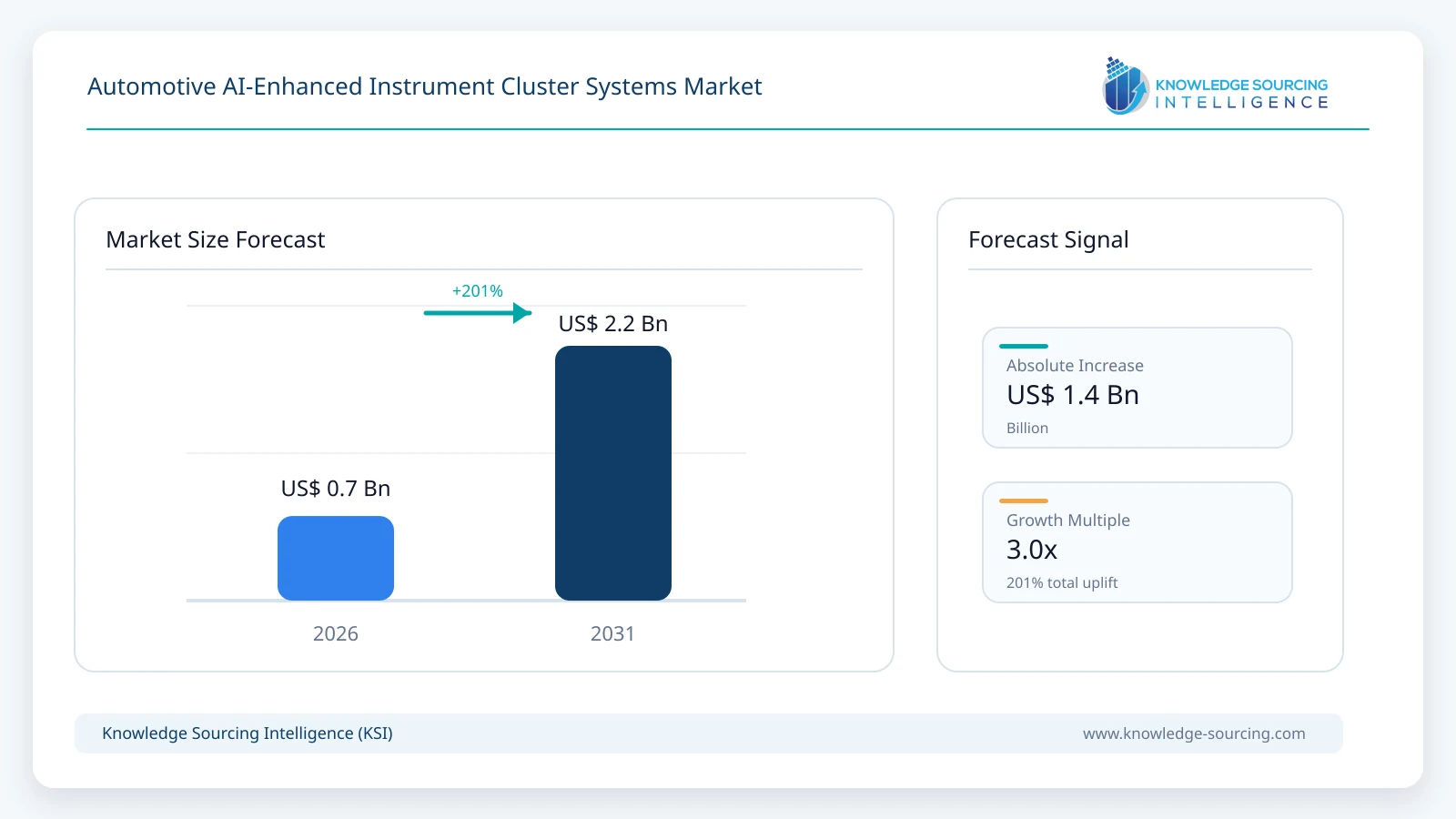
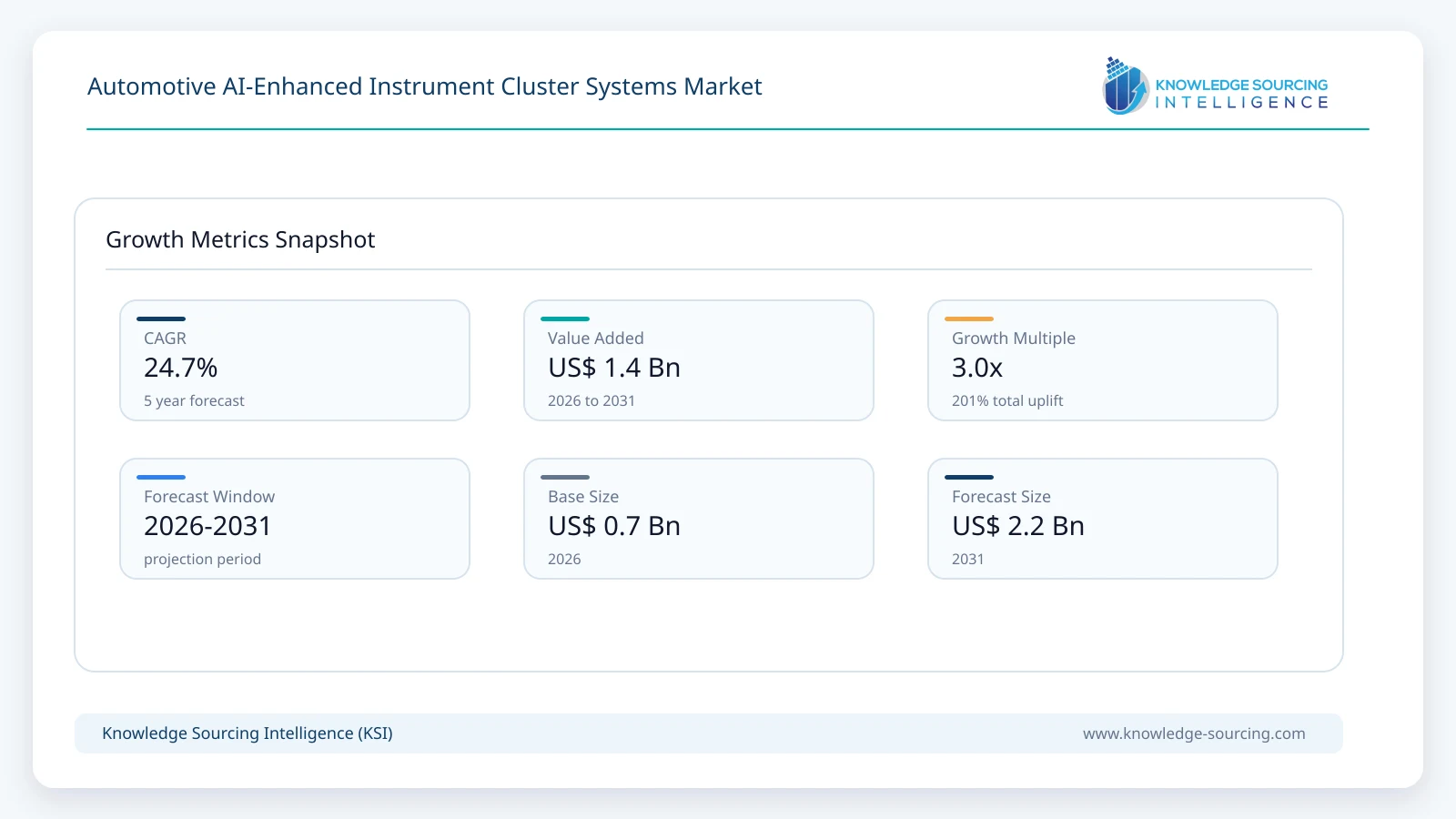
The Automotive AI-Enhanced Instrument Cluster Systems Market is projected to grow from USD 0.72 billion in 2026 to USD 2.17 billion by 2031, at a CAGR of approximately 24.7% across the forecast period.
Highlights:
- 1Market value is estimated at USD 0.72 billion in 2026 and USD 2.17 billion in 2031, a CAGR of 24.7%.
- 2Driver-awareness and contextual alert functions lead 2026 application value, while ADAS scene visualization gains share toward 2031.
- 3Cockpit domain-controlled implementations represent about 53% of 2026 AI-enhanced cluster value.
- 4Passenger vehicles account for approximately 95% of 2026 value; commercial vehicles increase from a smaller base.
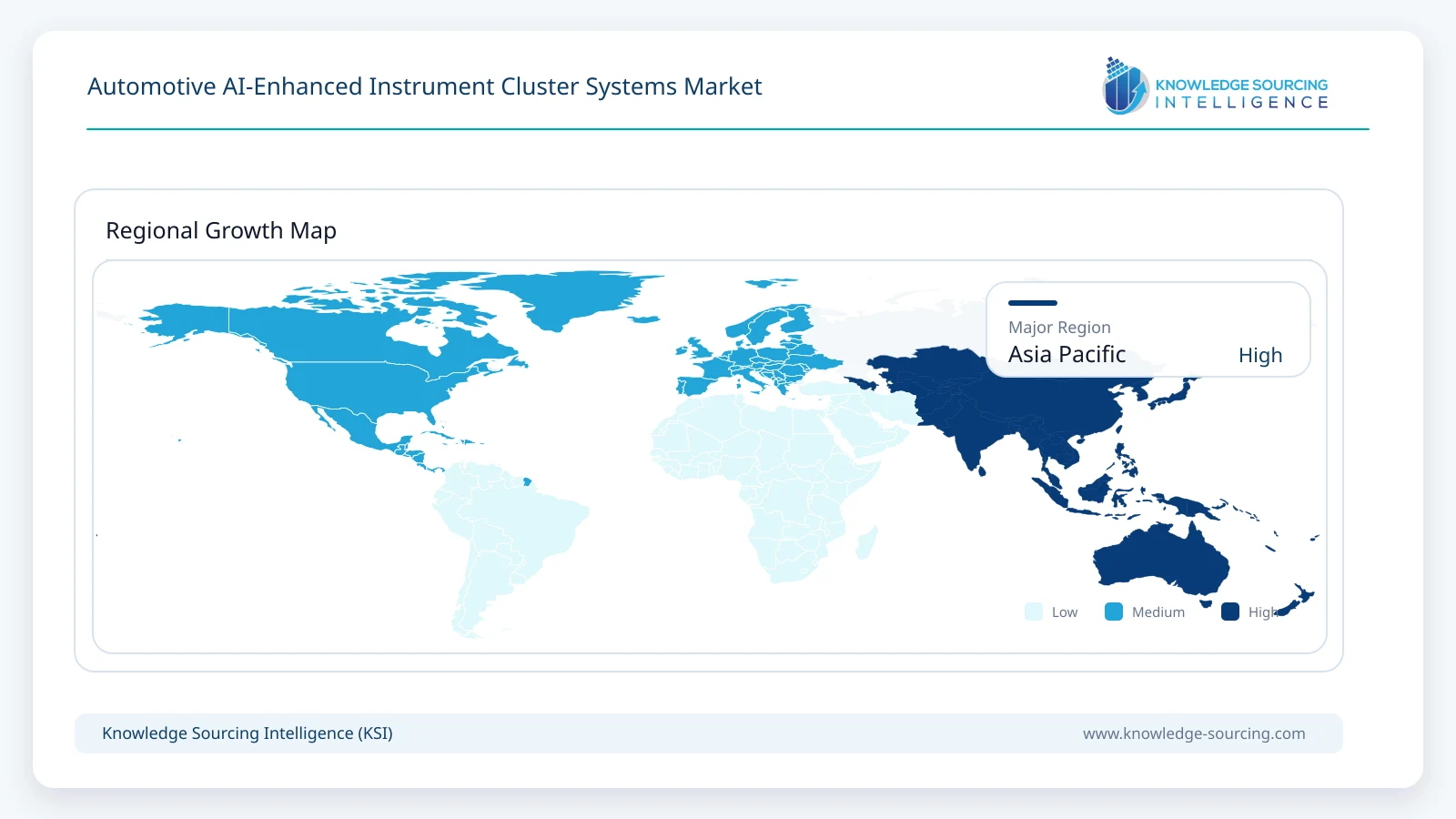
- 5Asia Pacific is the largest regional market, with Europe remaining important in premium displays and safety integration.
- 6Production validation and driver-information fallback remain core supplier-selection requirements.
AI-enhanced instrument clusters extend a conventional digital speedometer and warning display by making selected information responsive to the current driving situation. Software can interpret assistance-system states, route guidance, vehicle energy conditions and, where available, driver-attention signals before choosing how supporting information appears. The core display remains a safety-relevant interface, so speed and mandatory telltales must retain predictable placement and readability. The commercial benefit is not the number of animations on screen, but the ability to communicate complex vehicle functions with less driver effort.
Production development is moving toward tighter links between the cluster and the rest of the cockpit. Panasonic Automotive Systems’ controller for the Mazda CX-5 brings together instrumentation, infotainment and head-up display functions, with real-time graphics presenting vehicle and surrounding-environment information. Visteon’s cluster programs and integrated cockpit computing also show how suppliers can combine dedicated instrumentation knowledge with shared processing. Camera-equipped driver displays from AUMOVIO and Visteon with Smart Eye add another potential input for attention-sensitive information, although these developments represent different stages of commercialization.
Cluster suppliers, cockpit integrators and semiconductor-platform providers share responsibility for the finished system. OEMs determine which visual states may change, which alerts take priority and how the cluster responds when data is unavailable. Supplier differentiation therefore depends on graphics quality, interface compatibility, software assurance and stable operation over the vehicle life, not simply on access to a larger AI model. Regulations governing speedometer visibility and assisted-driving communication shape this engineering work in the markets where they apply.
Market Trends
ADAS information is moving into the driver display
Instrument clusters are being asked to explain the vehicle’s interpretation of its surroundings instead of simply reporting speed, fuel and warning lamps. Lane markings, detected vehicles, following distance and assistance-system status can be presented in a single scene when the information supports a driving decision. The commercial value sits in trustworthy graphics, relevant prioritization and a reliable link between perception software and the driver display.
Panasonic’s Mazda CX-5 cockpit controller uses real-time graphics for vehicle and surrounding-environment information, while LG and aiMotive describe an ADAS Confidence View that combines detected surroundings with assistance functions. These examples point to richer instrument information, although the entire ADAS perception stack is not attributable to the cluster.
Driver-state signals are influencing alert presentation
Combining attention signals with vehicle status makes it possible to adjust how and when warnings appear. An instrument cluster can make an assistance-system state or urgent alert more prominent when the driver may have missed it, while leaving speed and legally required warnings readable. Such adaptation must follow validated rules; the system cannot simply use an unconstrained model to alter safety-critical telltales.
AUMOVIO obtained a 2026 production order for an OLED driver display with an under-display camera, while Visteon and Smart Eye jointly demonstrated a camera-equipped LCD cluster. These developments improve the placement of driver monitoring next to the information display, but camera integration alone does not prove that every vehicle uses AI-controlled warning layouts.
Shared cockpit computers are changing cluster software
Instrument rendering is increasingly managed by a cockpit domain computer instead of a dedicated cluster ECU. This arrangement can share navigation, graphics and selected context inference across the driver display, center screen and head-up display. It also raises the importance of isolation and immediate startup, because a slow infotainment service must not delay critical driver information.
Qualcomm and Hyundai Mobis have outlined mixed-criticality cockpit and ADAS architectures, while Panasonic and LG have announced integrated cluster-and-infotainment controls on named vehicle programs. Reusable software may support several vehicle models, but OEM-specific safety evidence and display calibration still require engineering work.
Navigation and energy information are becoming context-sensitive
EV range, charging availability, junction guidance and active driver assistance create competing demands on the same cluster area. AI-enhanced display software can use the current route, energy state and assistance mode to choose which supporting information appears, with the driver retaining access to speed and core vehicle status. This favors compact, relevant prompts over permanently crowded screens.
BMW has described coordinated navigation and automated-driving graphics across Panoramic Vision and its head-up display, alongside a later merged navigation/assistance view. These are evidence of coordinated driver information; not all displayed graphics are AI generated or exclusive to the instrument cluster.
Design validation is shifting toward scenario-based displays
As cluster layouts react to more operating states, automakers need to verify the ordering, timing and failure behavior of visual information across many more scenarios. Testing must cover rapid mode changes, conflicting alerts, weak sensor data, low light and processor recovery rather than only static screen layouts. This makes software qualification and human-factors evaluation a larger part of program budgets.
UNECE speedometer requirements establish a legibility baseline, and driver-control assistance rules emphasize mode clarity and engagement warnings. Suppliers able to demonstrate predictable information behavior, even when AI inference is unavailable, should have an advantage in production sourcing.
Automotive AI-Enhanced Instrument Cluster Systems Market Segment Analysis
By Primary Application
ADAS Scene and Assistance Visualization
ADAS scene and assistance visualization accounts for about 30% of modeled market value in 2026, rising to 37% by 2031. The category includes cluster-specific rendering and interpretation of surrounding vehicles, active assistance modes and relevant driving cues. It does not include the full camera, radar or automated-driving algorithm value. Growth reflects wider availability of assisted-driving features on mid-range vehicles and the need to explain what they are doing.
Production programs that combine cluster graphics with cockpit-domain computers should generate recurring display-integration work as vehicle configurations and assistance functions evolve. Reliability and mode clarity matter more than graphics sophistication alone.
By Primary Application
Driver Awareness and Contextual Alerts
Driver-awareness and contextual alert functions are estimated to represent 34% of 2026 value, making them the largest application group initially. These systems use driver state, vehicle warnings or situational signals to select the timing and emphasis of information shown in the cluster. This value includes validated display behavior and related integration, not the entire driver-monitoring camera or sensing system.
Under-display camera programs from AUMOVIO and Visteon with Smart Eye show the direction of system packaging, while regulatory constraints preserve the priority of mandatory telltales and unambiguous warnings.
By Compute Architecture
Cockpit Domain-Controlled Systems
Cockpit domain-controlled systems contribute an estimated 53% of the 2026 AI-enhanced cluster market and reach 64% by 2031. Shared compute supports richer graphics, context data and coordinated navigation, while dedicated cluster functions retain controlled execution and a defined fallback path. Panasonic’s Mazda CX-5 cockpit controller demonstrates how cluster, HUD and infotainment functions can be supported by one platform.
The commercial shift favors software, reusable graphics and integration work, although the absence of a standalone cluster ECU does not justify counting the entire cockpit controller in the cluster market.
By Vehicle Class
Premium and Upper-Mid-Range Vehicles
Premium and upper-mid-range vehicles account for approximately 60% of 2026 value because these programs adopt advanced sensing, navigation visualization and domain-integrated driver displays earlier. Larger development budgets support extensive validation and higher attributable AI display content even when annual program volumes are comparatively modest.
By 2031, the share is modeled at 45% as context-aware driver information expands into mid-range vehicles. Premium programs will continue to lead in OLED integration and advanced visualization, but the main growth in installations is expected to come from better-costed software stacks in higher-volume models.
Market Drivers
Increasing ADAS complexity and the need for clear driver information
Advanced driver-assistance features are creating more situations in which the cluster must explain vehicle behavior without distracting the driver. A simple icon is often insufficient when lane keeping, adaptive cruise control, warning escalation and temporary feature unavailability change rapidly. AI-assisted context selection can make the most relevant state easier to understand, provided it follows a tested information hierarchy.
Vector-rich and 3D views shown by cockpit suppliers support the shift, but commercial value is concentrated in qualified display software and vehicle integration rather than the total automated-driving system.
Growth in integrated cockpit computing architectures
Cockpit domain controllers provide the processing and connectivity needed to combine navigation, driver state and assistance information across several displays. Shared graphics pipelines can reduce duplicated computing hardware and allow consistent cluster and head-up display behavior. Panasonic’s Mazda CX-5 controller and LG’s Renault commercial-SDV cockpit program indicate that combined control is moving into named OEM platforms.
These architectures create additional demand for cluster-specific AI functions, software partitioning and safety validation, although infotainment and display hardware revenue should not be attributed twice.
Higher adoption of digital instrumentation in mid-range vehicles
Full digital instrument clusters are no longer limited to luxury vehicles. Wider fitment provides a larger addressable base for advanced warning priorities, contextual navigation and intelligent energy information without the need to redesign every display module. The established KSI digital-cluster forecast indicates growing penetration even as conventional TFT-LCD remains dominant.
AI enhancements can be delivered as incremental software and integration content on existing screen technologies, making deployment more practical where OLED or panoramic displays would be too costly.
Regulatory and OEM emphasis on predictable assistance warnings
European vehicle safety requirements and UNECE rules are increasing attention to warning clarity, driver engagement and the distinction between assistance states. UN Regulation No. 39 also maintains clear speedometer legibility expectations. A driver-information system that brings context-aware warnings together with stable mandatory information can help engineering teams meet this growing validation burden.
Regulations do not require generative AI instrument clusters. Their market effect is to encourage verified display priorities, traceable warning behavior and robust fallback logic.
Vehicle differentiation through graphics and personalization
Driver displays influence the perceived quality of a vehicle every time it is used. Context-aware route prompts, assistance-state graphics and controlled layout adaptation can differentiate software-defined models without changing the entire instrument assembly. Suppliers such as Visteon, LG and Panasonic are developing integrated cockpit software that supports more customized information presentation.
OEMs still need to balance this flexibility with consistent brand design and driver familiarity, creating opportunities for automotive-qualified graphics frameworks and release support.
Market Restraints
Functional-safety and fallback requirements
Speed, telltales and important system warnings must remain readable even if AI inference, a sensor stream or an infotainment service fails. This restricts the extent to which adaptive models can control the primary cluster and adds safety architecture, testing and fallback implementation costs. Shared cockpit compute makes the problem more demanding because a failure in one workload can affect several displays if isolation is weak.
Automakers may therefore keep intelligent graphics as a supervised supporting layer rather than allow it to replace deterministic presentation logic for safety-critical content.
Uncertain customer value for incremental AI display features
Digital clusters already provide maps, configurable layouts and ADAS warning graphics using conventional software. Suppliers must demonstrate an improvement in comprehension, response or engineering reuse before an OEM will pay more for AI-specific content. Some branded AI demonstrations are visually impressive but do not establish a repeatable production price premium.
This limits near-term content value, particularly in economy vehicles where display sourcing remains focused on cost, legibility and standard equipment compliance.
Sensor-data quality and interface fragmentation
Context-aware cluster functions depend on accurate vehicle status, assistance-mode messages and, in some designs, driver-monitoring information. Different OEM networks and ADAS suppliers expose these data through different interfaces, creating extensive integration and testing work. Missing, delayed or contradictory signals can cause misleading graphics if the interface is not designed conservatively.
Supplier software reuse is therefore lower than the similarity of finished screens might suggest, and vehicle-specific validation remains important even on common cockpit platforms.
Display readability and distraction risk
More detailed scenes can compete with the driver’s attention rather than improve understanding. Small icons, moving 3D objects and frequent layout changes may be hard to interpret quickly, especially in poor light or demanding traffic. Human-factors evaluation must examine glance duration, visual load and driver expectations across age groups and operating situations.
These constraints can slow feature approval and favor simpler, well-timed presentations rather than the most elaborate AI-generated graphics.
Lifecycle costs for software and graphics validation
Cluster software must remain dependable across processor revisions, vehicle variants, regional rules and years of updates. Introducing AI models or data-dependent display behavior expands the release test matrix and requires a robust method for reproducing failures. Suppliers may incur additional costs for validation environments, software updates and compatibility support long after launch.
Platform reuse can offset some spending, but automakers are reluctant to accept frequent display changes when users rely on consistent speed and warning presentation.
Regional Outlook
Asia Pacific
Asia Pacific is estimated to represent 45% of AI-enhanced instrument-cluster value in 2026 and 49% by 2031. China combines a high volume of digital-cockpit launches with rapid adoption of driver-assistance graphics, while Japan and South Korea contribute established instrument suppliers and software integration capabilities. The strongest volume opportunity lies in bringing reliable contextual driver information from premium launches into higher-volume passenger vehicles.
Panasonic, LG, Hyundai Mobis, Desay SV and Nippon Seiki operate in different portions of this value chain, from displays and cockpit integration to instrument specialization. Regional share growth depends on qualified software fitment and content per platform, rather than vehicle production alone.
Europe
Europe is modeled at 31% of market value in 2026 and 28% in 2031, reflecting a strong premium and safety-engineering mix even as Asia Pacific expands more quickly. Cluster development is influenced by regulations governing readable speed information and assisted-driving warnings, and by automakers investing in integrated cockpit displays and driver-state technologies.
AUMOVIO’s OLED display order and BMW’s coordinated driver-information design illustrate the region’s emphasis on high-quality presentation and integration. Greater engineering content per vehicle supports value, but stringent release requirements and premium-platform concentration can limit the pace of broader adoption.
Competitive Landscape
Instrument-cluster procurement combines specialist instrument engineering, display technology, cockpit software and vehicle-level functional safety. Nippon Seiki, Visteon, AUMOVIO and Panasonic Automotive Systems are established cluster or driver-display participants, while DENSO, Hyundai Mobis, Bosch, Marelli, LG Vehicle Solution and Desay SV contribute cockpit integration and electronic systems. The companies do not supply an identical AI software product, and participation should be evaluated at the relevant program level.
Visteon reported USD 1.4 billion of cluster new-business awards in 2025, illustrating the scale of its wider cluster pipeline, not revenue attributable to AI enhancements. AUMOVIO has confirmed an OLED driver-display production order, and Panasonic has disclosed adoption of its cockpit controller in Mazda’s CX-5. Suppliers compete on the ability to combine graphics, safety constraints and reusable software without adding unnecessary complexity or obscuring the economic boundary between cluster electronics and broader cockpit platforms.
Recent Developments
January 2026: Qualcomm detailed an automotive software collaboration with Google that supports vehicle instrumentation alongside infotainment under a multi-domain architecture. It illustrates a software platform route to connected cluster functions, not an independent AI cluster shipment figure.
January 2026: Visteon demonstrated production-specification high-performance cockpit computing on Snapdragon Cockpit Elite with edge AI capability, indicating development capacity for context-aware interfaces without disclosing AI-specific cluster volumes.
April 2026: AUMOVIO announced a production order for an OLED driver display with a discreet under-screen camera, creating a closer physical link between the driver display and attention monitoring.
July 2026: Panasonic Automotive Systems disclosed adoption of its cockpit domain controller in Mazda’s new CX-5, combining cluster, HUD and infotainment control with 3D vehicle-information graphics.
October 2026: LG announced an integrated cluster and infotainment control solution for Renault’s New Trafic E-Tech Electric commercial SDV, reinforcing centralized software control of driver displays.
Market Outlook
AI-enhanced instrument clusters are expected to expand through 2031 as vehicle manufacturers present more sophisticated driver-assistance states and connected navigation information in the primary driver display. Progress will depend on adapting useful information to operating context while preserving speed, warnings and clear controls. Shared cockpit processing should increase the importance of reusable graphics software and system validation even where standalone cluster-controller hardware declines.
Asia Pacific is likely to remain the largest source of deployments, with Europe generating significant value from premium displays and tightly validated driver-information features. A clear commercial advantage will come from reliable contextual information and reduced engineering effort across platforms, rather than unrestricted generative graphics. Supplier programs that manage degraded operation, regulation and long-term updates should be better placed to reach volume production.
Automotive AI-Enhanced Instrument Cluster Systems Market Scope:
| Report Metric | Details |
|---|---|
| Total Market Size in 2026 | USD 0.72 billion |
| Total Market Size in 2031 | USD 2.17 billion |
| Forecast Unit | USD Billion |
| Growth Rate | 24.7% |
| Study Period | 2021 to 2031 |
| Historical Data | 2021 to 2024 |
| Base Year | 2025 |
| Forecast Period | 2026 – 2031 |
| Segmentation | Primary AI Application, Compute Architecture, Vehicle Class, Vehicle Type, Revenue Component, Geography |
| Companies |
|
Market Segmentation
By Primary AI Application
Driver Awareness and Contextual Alerts
ADAS Scene and Assistance Visualization
Predictive Navigation and Energy Information
Adaptive Display Hierarchy and Personalization
By Compute Architecture
Standalone AI-Enhanced Cluster Controller
Cockpit Domain-Controlled Cluster
Integrated or Panoramic Driver-Display System
By Vehicle Class
Premium and Upper-Mid-Range Vehicles
Mid-Range Vehicles
Mass-Market and Economy Vehicles
By Vehicle Type
Passenger Vehicles
Light Commercial Vehicles
Medium and Heavy Commercial Vehicles
By Revenue Component
Embedded AI and Driver-Visualization Software
Incremental Processing and Display Interface Content
Integration, Qualification and Lifecycle Engineering
By Geography
North America
United States
Canada
Mexico
South America
Brazil
Argentina
Others
Europe
Germany
United Kingdom
France
Italy
Spain
Others
Middle East and Africa
Saudi Arabia
United Arab Emirates
Israel
South Africa
Others
Asia Pacific
China
India
Japan
South Korea
Australia
Indonesia
Thailand
Taiwan
Others
Table of Contents
1. EXECUTIVE SUMMARY
2. MARKET SNAPSHOT
2.1. Market Overview
2.2. Market Definition
2.3. Market Scope
2.4. Market Segmentation
3. BUSINESS LANDSCAPE
3.1. Market Drivers
3.1.1. Increasing ADAS complexity and the need for clear driver information
3.1.2. Growth in integrated cockpit computing architectures
3.1.3. Higher adoption of digital instrumentation in mid-range vehicles
3.1.4. Regulatory and OEM emphasis on predictable assistance warnings
3.1.5. Vehicle differentiation through graphics and personalization
3.2. Market Restraints
3.2.1. Functional-safety and fallback requirements
3.2.2. Uncertain customer value for incremental AI display features
3.2.3. Sensor-data quality and interface fragmentation
3.2.4. Display readability and distraction risk
3.2.5. Lifecycle costs for software and graphics validation
3.3. Market Opportunities
3.4. Porter’s Five Forces Analysis
3.5. Industry Value Chain Analysis
3.6. Policies and Regulations
3.7. Strategic Recommendations
4. TECHNOLOGICAL OUTLOOK
4.1. Context-Aware Driver Information and Alert Logic
4.2. ADAS Scene Rendering and Driver-State Interfaces
4.3. Cluster Functional Safety and Fallback Architecture
4.4. Domain-Controlled Graphics and AI Acceleration
4.5. Lifecycle Updates and Display Validation
5. AUTOMOTIVE AI-ENHANCED INSTRUMENT CLUSTER SYSTEMS MARKET BY PRIMARY AI APPLICATION
5.1. Driver Awareness and Contextual Alerts
5.2. ADAS Scene and Assistance Visualization
5.3. Predictive Navigation and Energy Information
5.4. Adaptive Display Hierarchy and Personalization
6. AUTOMOTIVE AI-ENHANCED INSTRUMENT CLUSTER SYSTEMS MARKET BY COMPUTE ARCHITECTURE
6.1. Standalone AI-Enhanced Cluster Controller
6.2. Cockpit Domain-Controlled Cluster
6.3. Integrated or Panoramic Driver-Display System
7. AUTOMOTIVE AI-ENHANCED INSTRUMENT CLUSTER SYSTEMS MARKET BY VEHICLE CLASS
7.1. Premium and Upper-Mid-Range Vehicles
7.2. Mid-Range Vehicles
7.3. Mass-Market and Economy Vehicles
8. AUTOMOTIVE AI-ENHANCED INSTRUMENT CLUSTER SYSTEMS MARKET BY VEHICLE TYPE
8.1. Passenger Vehicles
8.2. Light Commercial Vehicles
8.3. Medium and Heavy Commercial Vehicles
9. AUTOMOTIVE AI-ENHANCED INSTRUMENT CLUSTER SYSTEMS MARKET BY REVENUE COMPONENT
9.1. Embedded AI and Driver-Visualization Software
9.2. Incremental Processing and Display Interface Content
9.3. Integration, Qualification and Lifecycle Engineering
10. AUTOMOTIVE AI-ENHANCED INSTRUMENT CLUSTER SYSTEMS MARKET BY GEOGRAPHY
10.1. North America
10.1.1. United States
10.1.2. Canada
10.1.3. Mexico
10.2. South America
10.2.1. Brazil
10.2.2. Argentina
10.2.3. Others
10.3. Europe
10.3.1. Germany
10.3.2. United Kingdom
10.3.3. France
10.3.4. Italy
10.3.5. Spain
10.3.6. Others
10.4. Middle East and Africa
10.4.1. Saudi Arabia
10.4.2. United Arab Emirates
10.4.3. Israel
10.4.4. South Africa
10.4.5. Others
10.5. Asia Pacific
10.5.1. China
10.5.2. India
10.5.3. Japan
10.5.4. South Korea
10.5.5. Australia
10.5.6. Indonesia
10.5.7. Thailand
10.5.8. Taiwan
10.5.9. Others
11. COMPETITIVE ENVIRONMENT AND ANALYSIS
11.1. Major Players and Strategy
11.2. Market Share Analysis
11.3. Mergers, Collaborations and Partnerships
11.4. Competitive Dashboard
12. COMPANY PROFILES
12.1. Visteon Corporation
12.2. AUMOVIO
12.3. Panasonic Automotive Systems Co., Ltd.
12.4. Nippon Seiki Co., Ltd.
12.5. DENSO Corporation
12.6. Hyundai Mobis
12.7. LG Electronics Vehicle Solution Company
12.8. Robert Bosch GmbH
12.9. Marelli
12.10. Desay SV
13. APPENDIX
13.1. Currency
13.2. Assumptions
13.3. Base and Forecast Years
13.4. Key Benefits for Stakeholders
13.5. Research Methodology
13.6. Abbreviations and Definitions
13.7. Data Sources
Navigate
Trusted by the world's leading organizations











