
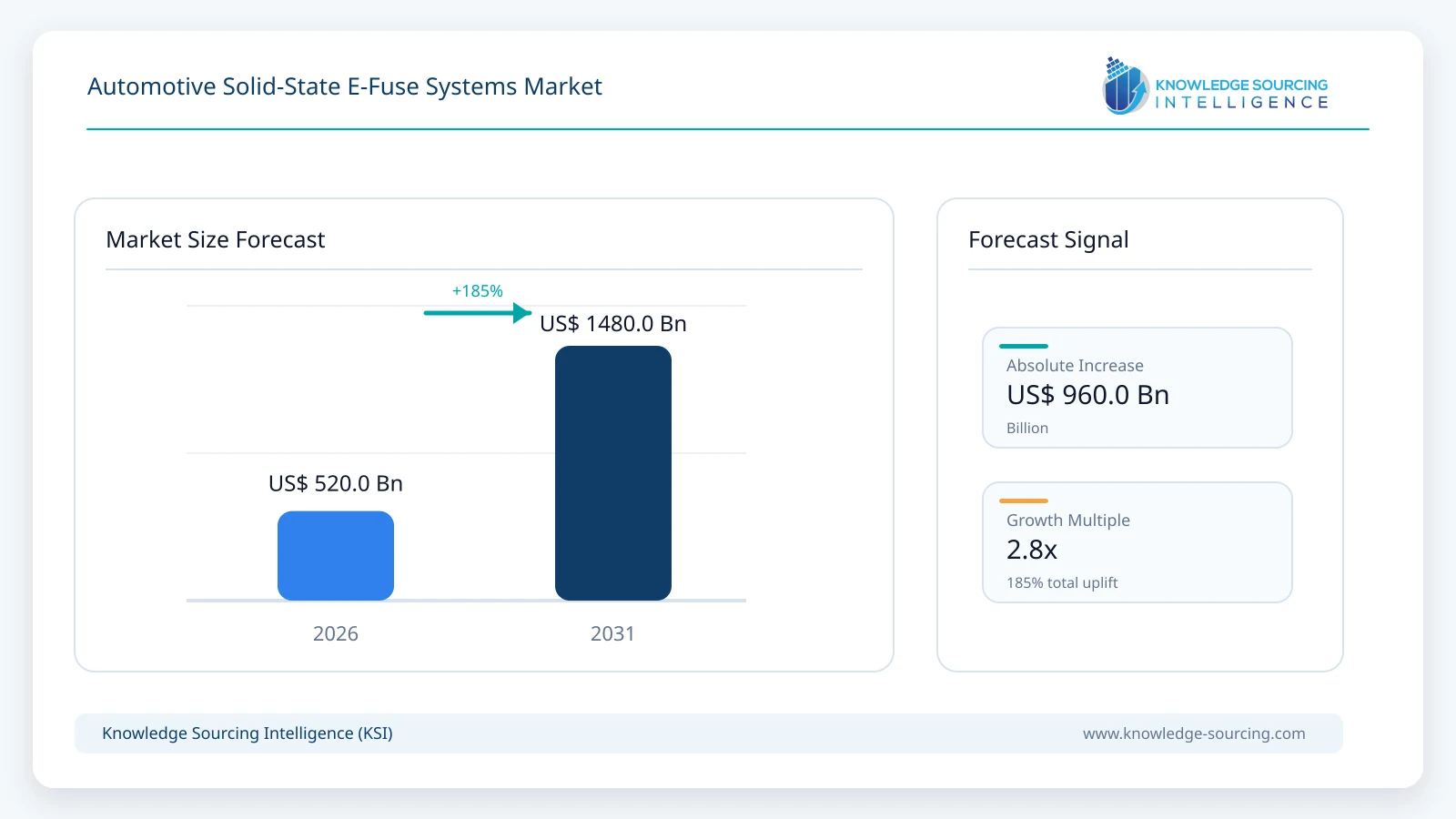
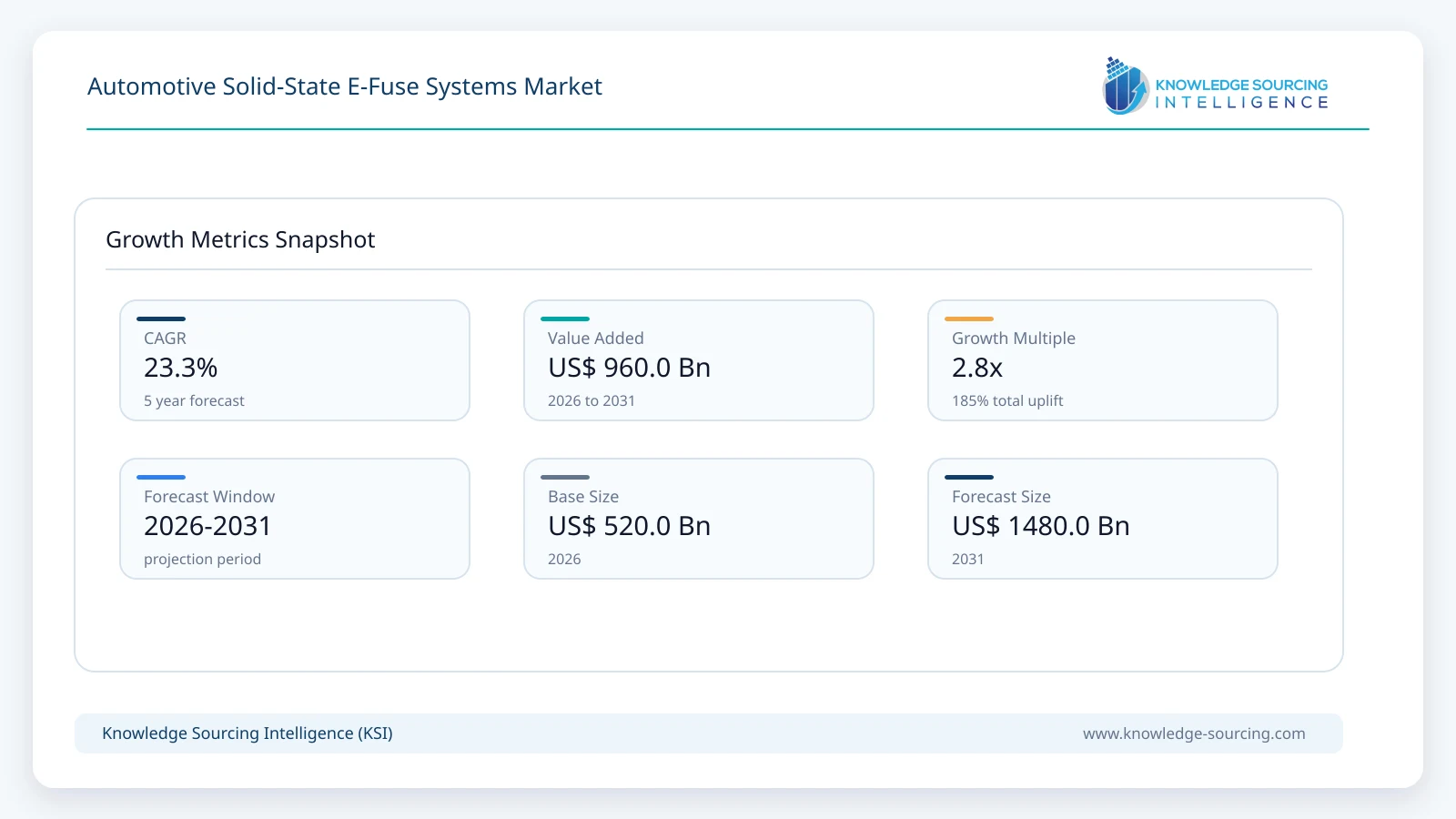
The automotive solid-state e-fuse systems market is forecast to grow at a CAGR of 23.3%, reaching USD 1,480.0 million in 2031 from USD 520.0 million in 2026.
Highlights:
- 1Single-channel integrated eFuse devices account for approximately 48% of modeled 2026 market value, while multichannel and external-MOSFET options gain relative share through 2031.
- 212 V powernet applications represent approximately 80% of the 2026 market, with 48 V and mixed-voltage fuse designs expanding in newer architectures.
- 3Zonal controller-integrated eFuse protection is forecast to increase from approximately 28% of 2026 revenue to 48% in 2031.
- 4Safety-critical and chassis supply is projected to grow from 25% of market value in 2026 to 32% by 2031.
- 5Asia Pacific represents an estimated 44% of the 2026 market and is projected to account for 49% by 2031.
- 6Production proof points include FORVIA HELLA’s iPDM and BMW’s Neue Klasse; the full fuse-containing module is not counted as eFuse system revenue.
Conventional melting fuses, generic smart switches without fuse-equivalent wire protection, complete zone computers, traction high-voltage disconnect devices and unrelated low-voltage controllers are outside the measured category.
FORVIA HELLA introduced its intelligent Power Distribution Module into series production in 2025, using eFuses to monitor electrical supply and isolate developing faults. Infineon confirmed that its PROFET smart eFuses are used in BMW Group’s Neue Klasse, where electronic protection supports configurable power states. Texas Instruments, STMicroelectronics and Renesas offer alternative device-level implementations that allow automakers to purchase dedicated eFuse semiconductor content or integrate the protection function into broader modules.
Market Overview
Automotive eFuses replace the one-time melting response of a wire-protection fuse with a semiconductor switch that senses current and disconnects an overloaded circuit under defined conditions. The operating curve must distinguish harmless motor starts and capacitor charging from sustained fault energy capable of overheating a wire. Hardware-based protection, programmable I²t characteristics and reliable restart behavior are therefore central design considerations, particularly where failure of a supply line can interrupt a safety-related function.
Infineon’s PROFET Wire Guard devices provide integrated I²t wire protection and selectable trip characteristics, while Texas Instruments combines software-programmable fuse curves with SPI diagnostics in its smart high-side devices. STMicroelectronics targets high-current 12 V, 24 V and 48 V networks through the VNF1248F controller and external MOSFET arrangement. Renesas takes a board-level approach with intelligent power devices and microcontroller-directed fuse behavior. The implementation differs by circuit current, voltage, channel density, and the fault response required from the wider power network.
Electronic fuses can be installed within a conventional power distribution box, a body controller, a dedicated intelligent power module or an individual vehicle zone. Their placement influences harness routing and the extent to which load-current information can be used for diagnostics or energy management. Dedicated primary protection remains important when continuity-critical supply lines must be isolated independently, while zonal consolidation supports larger groups of individually monitored consumers with fewer long cable runs.
Market Trends
Fuse Protection Is Becoming Programmable
Infineon expanded its eFuse range in July 2026 with the SPI-configurable SPOC Wire Guard BTS80009, combining high-side switching with embedded I²t wire protection and fault diagnostics. Device-level protection can respond locally without waiting for commands from a central processor, while selected fuse profiles can be stored or configured to suit a vehicle program. This division between deterministic hardware shutdown and software configuration is important for automotive electrical fault management.
Texas Instruments’ TPS2HCS10-Q1 supports programmable fuse curves, current monitoring, and low-power modes through SPI, allowing the same hardware platform to serve different low-voltage loads. Vehicle manufacturers can standardize electronic protection parts across multiple circuits while changing trip characteristics for different harness designs. Qualification still has to account for surge currents, cable temperature, short-circuit energy, and the response of upstream supply stages.
Zonal Integration Is Changing Protection Placement
BMW’s Neue Klasse applies digitally controlled fuses to manage electrical consumers according to charging, driving and parked states. Infineon describes smart eFuse devices replacing up to 150 conventional fuse positions on that vehicle architecture; this is a platform-specific engineering example rather than a global average. Moving protection closer to the load can improve fault visibility and permit shorter harness branches where module integration and packaging allow it.
Aptiv’s zone-controller design places intelligent power distribution and smart fusing alongside local I/O handling. The use of a common zone module concentrates more protected channels into a single electronic assembly, changing requirements for thermal design, redundant power routing, PCB area and service diagnostics. Hardware value can rise with channel count even when the cost of each semiconductor protection function declines.
Safety-Oriented Power Supply Requires Selective Isolation
FORVIA HELLA’s production iPDM uses electronic fuses to detect abnormal conditions and preserve supply to functions such as steering, braking and driver assistance. Bosch’s powernet guardian similarly focuses on electrical isolation between safety-critical and other low-voltage loads. These architectures depend on fault selectivity: a failure in one branch should not automatically remove power from unrelated loads sharing an upstream source.
Electric actuators, camera systems and central computing increase the consequences of electrical disturbances when multiple functions depend on the same low-voltage network. Protection systems must coordinate fuse thresholds, supply monitoring, redundant paths and recoverable shutdown actions. In this environment, the commercial value of an eFuse comes from verified system behavior, not simply replacing a fuse element with a transistor.
Mixed 12 V and 48 V Designs Are Broadening Fuse-Controller Requirements
STMicroelectronics’ VNF1248F supports power path designs for 12 V, 24 V and 48 V applications using external MOSFETs, reflecting the different voltage and current requirements of modern vehicles. Higher-power loads can require separate gate-drive, thermal sensing and short-circuit designs beyond an integrated low-current switch. Integrated multichannel solutions remain suitable for smaller auxiliary circuits, while external-MOSFET protection is useful when current capacity and heat dissipation become limiting factors.
Commercial vehicle equipment and more heavily electrified passenger platforms create additional opportunities for configurable fuse protection, but higher operating voltage does not automatically justify an electronic fuse on every line. Manufacturers continue to compare fault protection performance, component losses, redundancy and whole-system cost against mechanical alternatives.
Segment Analysis
By Electronic Fuse Architecture: Single-Channel Integrated Devices
Single-channel integrated eFuse devices account for an estimated 48% of the 2026 market because individual protected branches remain common in body electronics, auxiliary distribution and locally powered ECUs. Integrated MOSFET and protection logic can reduce board complexity where current requirements fit the device’s thermal limits. The segment is projected to reach approximately USD 533 million by 2031, although its share declines as multichannel and external-MOSFET configurations expand.
Infineon’s PROFET Wire Guard family represents a qualified integrated approach, with selectable wire protection and low-power operation. The economics depend on how many channels a vehicle uses, the achievable harness savings, and whether a controller needs a separate gate driver for higher-current circuits. Each design decision affects the relative mix of discrete devices and integrated board solutions.
By Operating Voltage: 12 V Distribution
12 V electronic protection accounts for approximately 80% of modeled 2026 revenue because conventional low-voltage consumer loads and legacy body networks still dominate vehicle electrical distribution. Battery-fed lighting, infotainment, thermal auxiliaries and control electronics provide numerous candidate circuits for resettable fuse behavior. The segment is projected to represent 59% in 2031 as mixed 12 V/48 V and higher-voltage applications gain share.
Low quiescent current is especially important for 12 V always-on and parked-vehicle functions. Integrating current and fault sensing can reduce separate monitoring components, but protection must retain predictable behavior during supply transients and reverse-battery events. A 48 V-capable family does not eliminate these 12 V qualification constraints.
By Vehicle Integration Architecture: Zonal Controller-Integrated Protection
Zonal controller-integrated eFuse content is projected to increase from 28% of the market in 2026 to 48% in 2031, reaching approximately USD 710 million. Locating fuse channels near groups of loads allows the zone computer to monitor branch currents and apply power-state policies while the protection device maintains immediate electrical fault response.
Vehicle platforms rarely adopt a fully zonal electrical system in one model refresh. Mixed domain and zonal architectures are likely to retain primary distribution and some centrally protected circuits, so the zonal share gain represents a gradual shift in component location rather than elimination of other fuse architectures.
By Protected Load Application: Active Safety and Chassis Supply
Active safety, chassis and other critical low-voltage loads represent an estimated 25% of revenue in 2026 and are projected to reach 32% by 2031. Brake and steering auxiliaries, sensing systems and certain electronic control loads place a premium on preventing a short circuit in one branch from removing supply from unrelated safety functions. Higher protection selectivity and diagnostic integrity can justify additional semiconductor and engineering content.
FORVIA HELLA’s iPDM and Bosch’s guardian approach demonstrate demand for engineered supply continuity, although their complete module selling prices extend beyond eFuse content. Safety-related applications require system-level analysis of fault detection, isolation time, and restart behavior rather than assuming that an eFuse device alone provides fail-operational performance.
Market Drivers
Replacement of Melting Fuses in Software-Defined Electrical Systems
New body, domain and zonal electrical designs can incorporate resettable electronic protection instead of maintaining service-accessible melting-fuse banks. Infineon’s BMW Neue Klasse deployment provides a production example of a vehicle platform that combines digital fusing with selectable power states. Reusable protection and program-specific trip curves are valuable when a manufacturer serves several electrical load configurations with common controller hardware.
Electronic replacement is not universal. Fuse selection remains dependent on power losses, current levels, harness length and the cost of the entire protection channel. The strongest adoption cases are where diagnostics and flexible power control have value beyond the fuse itself.
Fault Isolation for Safety-Critical Electrical Loads
Electrical power faults can disable steering, braking support or sensing systems when protection is insufficiently selective across shared low-voltage networks. FORVIA HELLA’s iPDM series deployment demonstrates how eFuses can monitor power paths and isolate selected faults within a larger system designed for supply continuity. A verified ability to preserve critical functions increases the value of coordinated eFuse protection relative to a purely passive fuse layout.
Reduced Harness Complexity and Service Requirements
Precise electronic wire protection can permit selected wiring segments to be specified more closely to actual load demand and improve installation flexibility when fuse replacement access is no longer necessary. Aptiv identifies smart fusing as part of the zonal architecture approach to reducing cable requirements; BMW and Infineon have documented platform-specific wiring reductions. Those benefits depend on the vehicle architecture and cannot be applied as one universal weight-saving ratio.
Programmable Monitoring and Power-State Control
Digital current sensing and fault reports allow the vehicle to distinguish overloaded wiring, disconnected loads, thermal events and abnormal operating states. TI’s SPI-controlled fuse portfolio and Infineon’s smart eFuse families support configurable protection, while zonal controllers can use the resulting feedback for nonessential load shedding in parking or low-voltage conditions. This functionality improves troubleshooting and enables more coordinated energy management.
Expansion of Electrified and Mixed-Voltage Platforms
Electrified vehicle programs contain additional electrically powered auxiliaries, cooling functions and compute systems whose availability and energy consumption need to be managed across low-voltage rails. STMicroelectronics offers external-MOSFET eFuse controllers compatible with 12 V, 24 V and 48 V applications. The growth opportunity comes from more independently monitored power paths and higher control requirements, not from counting traction-battery high-voltage contactors as eFuses.
Market Restraints
Cost and Conduction Losses on Lower-Value Circuits
Melting fuses and mechanical relays remain economical for many simple automotive circuits. Semiconductor protection adds device cost, control-board area and power dissipation, which can outweigh service or diagnostic benefits on low-risk loads. Automotive engineers must assess channel current, temperature rise and resistance losses before replacing established fuse solutions across high-volume vehicle platforms.
Protection Coordination and Functional Safety Validation
Fault isolation across primary distribution, secondary fuse stages and redundant supply paths requires coordination of protection curves and failure responses. Current-limiting electronics must handle brief inrush currents without nuisance disconnection while still protecting wires from sustained overload. Additional hardware-software integration testing and safety documentation can extend qualification cycles for new electrical architectures.
Thermal and High-Current Design Requirements
High-current channels can exceed the thermal capacity of an integrated eFuse switch and require external MOSFETs, shunts or additional cooling. Switching losses and PCB conduction paths must be assessed against packaging constraints in compact power modules. Those engineering requirements can reduce the value of replacing mechanical protection on the highest-current branches.
Slow Vehicle Platform Replacement Cycles
Automakers usually approve power distribution architecture, wire gauges and fuse placement early in a vehicle program. Converting an existing fuse and relay box into electronically monitored protection may require substantial electrical validation and harness redesign. The transition therefore follows vehicle launches and mid-cycle architecture decisions rather than immediate replacement across the in-service fleet.
Bundled Component Procurement and Price Pressure
Automotive eFuse semiconductors are frequently integrated into a Tier 1 power module or zone controller rather than purchased by the automaker as a separately priced protection system. OEMs may own configuration software while chip suppliers compete to meet functional and automotive qualification requirements. This purchasing structure places pressure on separately monetized fuse software and engineering, despite growing installed protection content.
Regional Outlook
Asia Pacific
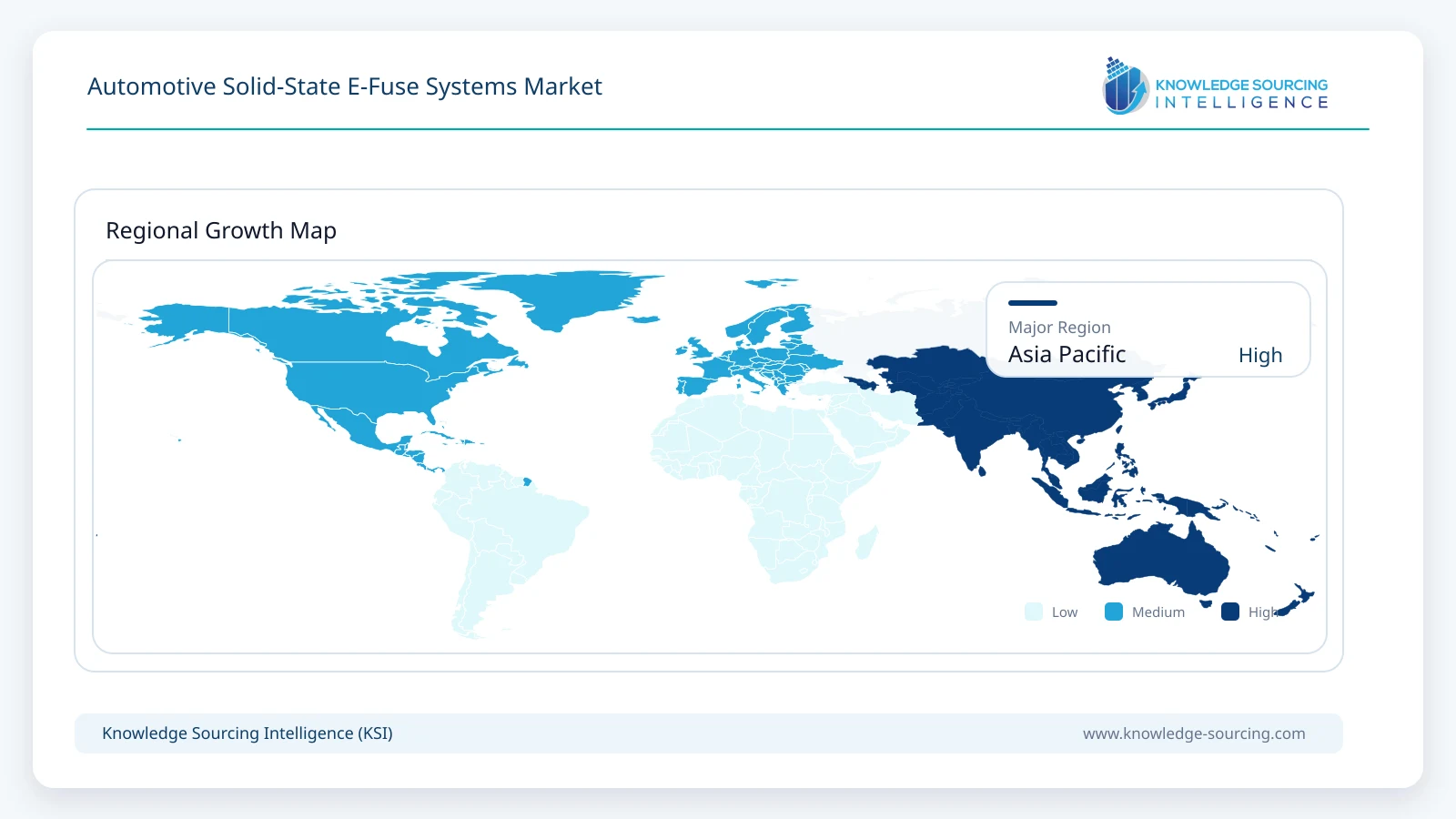
Asia Pacific holds the largest modeled market position in 2026, supported by China’s automotive manufacturing scale and extensive production of electrified vehicle platforms. Japan and South Korea add semiconductor and electrical-system engineering capacity, while India provides a growing manufacturing base for high-volume body and safety electronics. The region accounts for an estimated 44% of global eFuse revenue in 2026.
By 2031, Asia Pacific is projected to reach approximately USD 725 million as zonal and domain electrical upgrades increase the number of electronically protected supply branches. The expansion is expected to be strongest where manufacturers can integrate multichannel devices into cost-effective power modules while maintaining the automotive qualification and diagnostic performance required by OEMs.
Europe
European vehicle platforms emphasize electrical availability, system validation and packaging optimization in premium and advanced driver-assistance applications. FORVIA HELLA’s production iPDM and Infineon’s deployment with BMW provide concrete examples of electronic fuse technology moving beyond reference boards into production architectures. European engineering suppliers also support integration of fuse devices with powernet redundancy and functional-safety processes.
Europe is projected to reach approximately USD 370 million in 2031, representing 25% of the market. Growth will depend on how quickly electronic protection expands into mid-volume vehicle categories and how much protection value remains in dedicated modules compared with zone controllers that combine power, networking and local control.
Competitive Landscape
Infineon Technologies, Texas Instruments, STMicroelectronics, Renesas and onsemi compete through electronic fuse devices, controller silicon and automotive-qualified design support. FORVIA HELLA and Aptiv integrate smart-fusing capabilities into vehicle modules and zonal architectures; Analog Devices participates in the development of FORVIA HELLA’s configurable-fuse technology, while Bosch addresses safety-oriented electrical isolation. Hardware device suppliers and module integrators compete at different stages of one power-distribution value chain.
Semiconductor suppliers differentiate through current sensing, programmable wire curves, fault-response speed, standby power, external MOSFET support and automotive validation resources. Tier 1 system suppliers compete through packaging, protection selectivity, software integration and the ability to deliver qualified solutions on a vehicle production program. The market should not be interpreted as a ranking of complete distribution-module revenue because that value includes processors, network interfaces and other functions outside eFuse protection.
Recent Developments
September 2026: FORVIA HELLA presented the iPDM within an energy-management portfolio for commercial vehicles. The announcement demonstrates planned addressability beyond passenger cars but does not establish commercial-vehicle iPDM production deliveries.
July 2026: Infineon Technologies introduced the SPOC Wire Guard BTS80009 automotive eFuse with SPI configurability, integrated I²t wire protection and diagnostic capability.
February 2026: Infineon Technologies and BMW Group Confirmed PROFET smart eFuses in the BMW Neue Klasse architecture, demonstrating digital protection and software-managed power states on a production vehicle platform.
January 2026: FORVIA HELLA and Analog Devices announced the iConF configurable-fuse development program, with a targeted 2028 series production start rather than established 2026 commercial shipments.
September 2025: FORVIA HELLA announced the series-production launch of its intelligent Power Distribution Module incorporating electronic fuses for a premium automotive manufacturer.
September 2025: STMicroelectronics held its STi2Fuse automotive design session describing digitally resettable 12 V, 24 V and 48 V fuse-controller architectures and VNF1248F integration.
Market Outlook
The automotive solid-state e-fuse systems market is gaining traction as electronic protection replaces selected conventional fuses and expands across configurable low-voltage distribution networks. Growth is supported by increasingly monitored circuits and the need for protection systems that can distinguish wiring faults from normal transient loads. Solid-state e-fuses enable faster fault detection, precise current control, and electronic reset capabilities, supporting improved electrical system reliability. Their adoption is further encouraged by growing vehicle electronic content, increasing power distribution complexity and the integration of advanced driver assistance systems. As automotive electrical architectures evolve, these devices offer manufacturers greater flexibility in circuit protection, diagnostics and power management across modern vehicles.
Multichannel configurable devices and external-MOSFET controllers are projected to increase their combined share as zonal architectures concentrate protected electrical branches and mixed 12 V/48 V applications expand. Conventional melting fuses will remain economically useful in circuits where reset capability, remote diagnostics and selective load management provide limited additional value.
Asia Pacific is expected to retain the largest market position, while Europe remains important for premium production programs and safety-oriented system engineering. Product competitiveness will increasingly depend on integration cost, demonstrated fault selectivity, temperature performance, and reliable coordination between independent hardware protection and vehicle power-state software.
Automotive Solid-State E-Fuse Systems Market Scope:
| Report Metric | Details |
|---|---|
| Total Market Size in 2026 | USD 520.0 million |
| Total Market Size in 2031 | USD 1,480.0 million |
| Forecast Unit | USD Billion |
| Growth Rate | 23.3% |
| Study Period | 2021 to 2031 |
| Historical Data | 2021 to 2024 |
| Base Year | 2025 |
| Forecast Period | 2026 – 2031 |
| Segmentation | Electronic Fuse Architecture, Protection Function, Revenue Component, Operating Voltage |
| Companies |
|
Market Segmentation
By Electronic Fuse Architecture
Single-Channel Integrated eFuse Devices
Multi-Channel Configurable eFuse Devices
External-MOSFET eFuse Controllers
Integrated eFuse Protection Modules
By Protection Function
Overcurrent and Wire Protection
Selective Fault Isolation and Supply Continuity
Programmable Current Limiting and Inrush Management
Current and Thermal Diagnostics
Reset, Self-Test and Power-State Management
By Revenue Component
Integrated eFuse Semiconductor Devices
External-FET Controllers and Power-Path Protection
Protection Boards and Diagnostic Hardware
Embedded Fuse Configuration Software
Integration and Engineering Services
By Operating Voltage
12 V
Mixed 12 V and 48 V
24 V Commercial Powernet
48 V-Focused Powernet
By Vehicle Integration Architecture
Centralized Primary Distribution
Body and Domain Distribution Modules
Zonal Controller-Integrated Protection
Dedicated Local Auxiliary Protection
By Protected Load Application
Body, Lighting and Comfort Loads
Active Safety, Chassis and Critical Supply
Computing, Connectivity and Infotainment
Energy Management and Thermal Auxiliaries
Other Low-Voltage Circuits
By Vehicle Type
Passenger Vehicles
Light Commercial Vehicles
Medium and Heavy Commercial Vehicles
By Propulsion
Internal Combustion and Mild Hybrid
Full Hybrid and Plug-in Hybrid
Battery Electric Vehicles
By Geography
North America
United States
Canada
Mexico
South America
Brazil
Argentina
Others
Europe
Germany
United Kingdom
France
Italy
Spain
Others
Middle East and Africa
Saudi Arabia
United Arab Emirates
South Africa
Israel
Others
Asia Pacific
China
Japan
South Korea
India
Thailand
Indonesia
Others
Table of Contents
1. EXECUTIVE SUMMARY
2. MARKET SNAPSHOT
2.1. Market Overview
2.2. Market Definition
2.3. Scope of the Study
2.4. Market Segmentation
3. BUSINESS LANDSCAPE
3.1. Market Drivers
3.1.1. Replacement of Melting Fuses in Software-Defined Electrical Systems
3.1.2. Fault Isolation for Safety-Critical Electrical Loads
3.1.3. Reduced Harness Complexity and Service Requirements
3.1.4. Programmable Monitoring and Power-State Control
3.1.5. Expansion of Electrified and Mixed-Voltage Platforms
3.2. Market Restraints
3.2.1. Cost and Conduction Losses on Lower-Value Circuits
3.2.2. Protection Coordination and Functional Safety Validation
3.2.3. Thermal and High-Current Design Requirements
3.2.4. Slow Vehicle Platform Replacement Cycles
3.2.5. Bundled Component Procurement and Price Pressure
3.3. Market Opportunities
3.4. Porter’s Five Forces Analysis
3.5. Industry Value Chain Analysis
3.6. Policies and Regulations
3.7. Strategic Recommendations
4. TECHNOLOGICAL OUTLOOK
4.1. Programmable Electronic-Fuse Protection
4.2. Current Monitoring and Fault Isolation
4.3. 12 V and 48 V Power Distribution
4.4. Software-Defined Load Prioritization
4.5. Functional Safety and Electrical Resilience
5. AUTOMOTIVE SOLID-STATE E-FUSE SYSTEMS MARKET BY ELECTRONIC FUSE ARCHITECTURE
5.1. Single-Channel Integrated eFuse Devices
5.2. Multi-Channel Configurable eFuse Devices
5.3. External-MOSFET eFuse Controllers
5.4. Integrated eFuse Protection Modules
6. AUTOMOTIVE SOLID-STATE E-FUSE SYSTEMS MARKET BY PROTECTION FUNCTION
6.1. Overcurrent and Wire Protection
6.2. Selective Fault Isolation and Supply Continuity
6.3. Programmable Current Limiting and Inrush Management
6.4. Current and Thermal Diagnostics
6.5. Reset, Self-Test and Power-State Management
7. AUTOMOTIVE SOLID-STATE E-FUSE SYSTEMS MARKET BY REVENUE COMPONENT
7.1. Integrated eFuse Semiconductor Devices
7.2. External-FET Controllers and Power-Path Protection
7.3. Protection Boards and Diagnostic Hardware
7.4. Embedded Fuse Configuration Software
7.5. Integration and Engineering Services
8. AUTOMOTIVE SOLID-STATE E-FUSE SYSTEMS MARKET BY OPERATING VOLTAGE
8.1. 12 V
8.2. Mixed 12 V and 48 V
8.3. 24 V Commercial Powernet
8.4. 48 V-Focused Powernet
9. AUTOMOTIVE SOLID-STATE E-FUSE SYSTEMS MARKET BY VEHICLE INTEGRATION ARCHITECTURE
9.1. Centralized Primary Distribution
9.2. Body and Domain Distribution Modules
9.3. Zonal Controller-Integrated Protection
9.4. Dedicated Local Auxiliary Protection
10. AUTOMOTIVE SOLID-STATE E-FUSE SYSTEMS MARKET BY PROTECTED LOAD APPLICATION
10.1. Body, Lighting and Comfort Loads
10.2. Active Safety, Chassis and Critical Supply
10.3. Computing, Connectivity and Infotainment
10.4. Energy Management and Thermal Auxiliaries
10.5. Other Low-Voltage Circuits
11. AUTOMOTIVE SOLID-STATE E-FUSE SYSTEMS MARKET BY VEHICLE TYPE
11.1. Passenger Vehicles
11.2. Light Commercial Vehicles
11.3. Medium and Heavy Commercial Vehicles
12. AUTOMOTIVE SOLID-STATE E-FUSE SYSTEMS MARKET BY PROPULSION
12.1. Internal Combustion and Mild Hybrid
12.2. Full Hybrid and Plug-in Hybrid
12.3. Battery Electric Vehicles
13. AUTOMOTIVE SOLID-STATE E-FUSE SYSTEMS MARKET BY GEOGRAPHY
13.1. North America
13.1.1. United States
13.1.2. Canada
13.1.3. Mexico
13.2. South America
13.2.1. Brazil
13.2.2. Argentina
13.2.3. Others
13.3. Europe
13.3.1. Germany
13.3.2. United Kingdom
13.3.3. France
13.3.4. Italy
13.3.5. Spain
13.3.6. Others
13.4. Middle East and Africa
13.4.1. Saudi Arabia
13.4.2. United Arab Emirates
13.4.3. South Africa
13.4.4. Israel
13.4.5. Others
13.5. Asia Pacific
13.5.1. China
13.5.2. Japan
13.5.3. South Korea
13.5.4. India
13.5.5. Thailand
13.5.6. Indonesia
13.5.7. Others
14. COMPETITIVE ENVIRONMENT AND ANALYSIS
14.1. Major Players and Strategy Analysis
14.2. Market Share Analysis
14.3. Mergers, Acquisitions, Agreements and Collaborations
14.4. Competitive Dashboard
15. COMPANY PROFILES
15.1. Infineon Technologies AG
15.2. Texas Instruments Incorporated
15.3. STMicroelectronics N.V.
15.4. Renesas Electronics Corporation
15.5. onsemi
15.6. FORVIA HELLA
15.7. Aptiv PLC
15.8. Analog Devices, Inc.
15.9. Robert Bosch GmbH
16. APPENDIX
16.1. Currency
16.2. Assumptions
16.3. Base and Forecast Years Timeline
16.4. Key Benefits for Stakeholders
16.5. Research Methodology
16.6. Abbreviations
Navigate
Trusted by the world's leading organizations











