
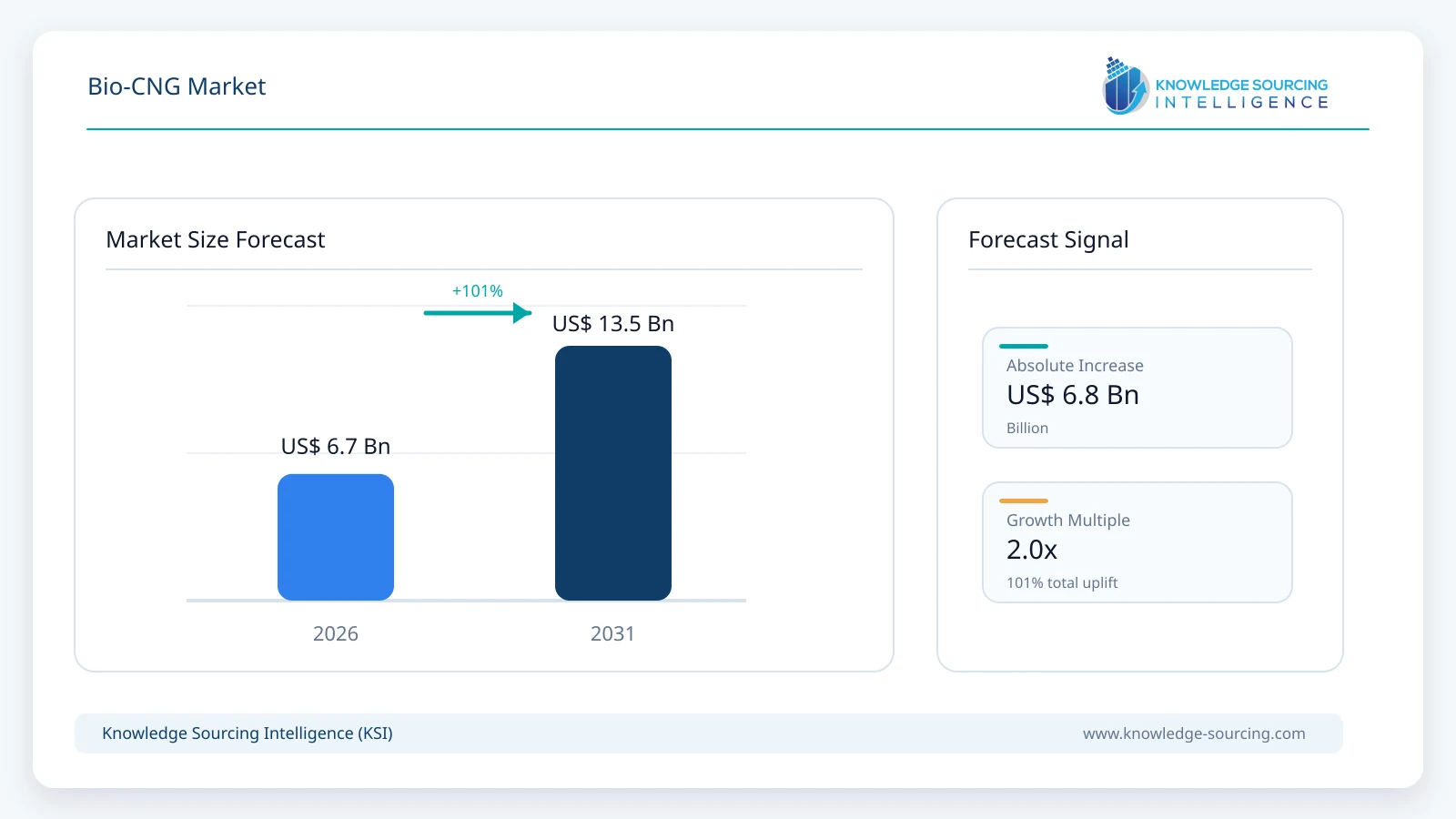
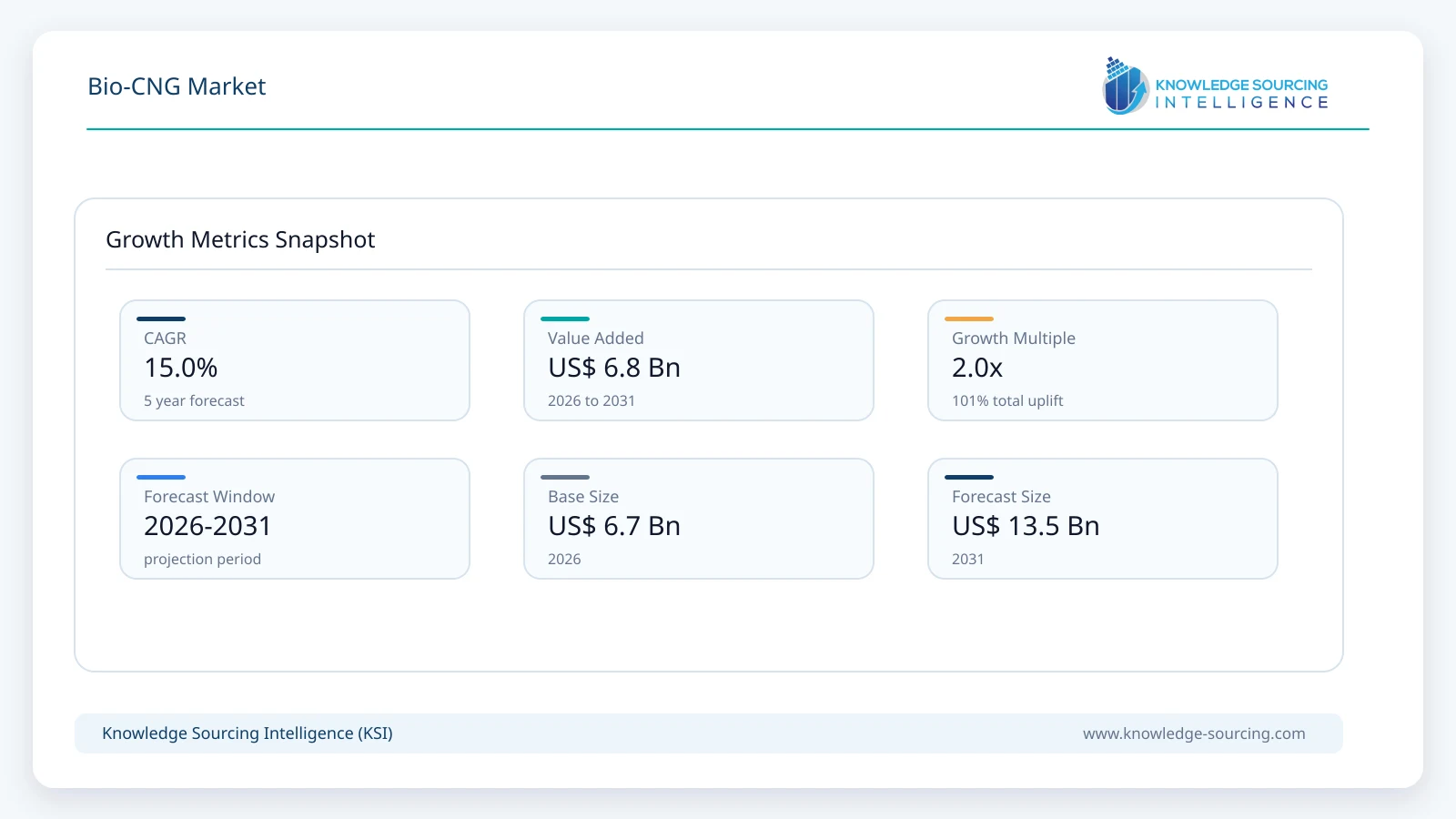
The Bio-CNG Market is projected to increase from USD 6.71 billion in 2026 to USD 13.5 billion by 2031, growing at a CAGR of 15.0% over the forecast period.
Highlights:
- 1The use of Bio-CNG is compatible with fossil CNG, and can be used in existing vehicles, stations and pipelines without fleet retrofits.
- 2The biggest application is transport fuel, where commercial fleets and public transport are driving the uptake.
- 3Rapid Asia-Pacific growth is being witnessed due to India's policies to use agricultural-waste feedstocks and policies for blending city gas and bio-CNG, with the latter being the future technology for the Indian CNG market.
- 4In a few procurement areas, the gap between delivered cost of conventional CNG versus Bio-CNG are reduced to less than 10 per cent.
The main sources are agricultural residues, animal manure, municipal solid waste, food waste and sewage sludge, the most important feedstock varying by region: in India, agricultural residues and manure are the most important feedstocks, whereas in North America and Europe landfill gas, food waste and manure are significant. The largest application is transport fuel, followed by the use of injection into CNG and NG grids, and industrial heating and power generation, by application.
Europe remains a key market, supported by early adoption of renewable gas mandates, carbon pricing mechanisms, and public procurement initiatives promoting gas-powered buses and trucks. Asia-Pacific is a high growth market, where the blending requirement and policies of the agriculture sector in India has also contributed to a rise in production and in certain procurement regions, due to the reduced cost of delivered Bio-CNG as compared to CNG, the gap has come down to less than ten per cent.
The increased infrastructure for CNG, the shift towards cleaner public transportation and corporate & municipal decarbonisation initiatives are strengthening demand. Issues pertain to feedstock aggregation, plant capital costs, interconnections with the grid and pipelines, and reliance on policy support and carbon pricing mechanisms.
Market Dynamics
Market Drivers
The growing carbon reduction regulations and net zero initiatives in developed and emerging nations are driving persistent demand for low-carbon fuels to replace fossil-based CNG.
Fleet, transit and gas utility switching costs are reduced through compatibility with current CNG vehicles and infrastructure.
Agricultural-waste feed stocks are being promoted by government programs and plant development and blending requirements are increasing production, particularly in India.
The increasing CNG refueling stations and the demand for cleaner public transportation systems are expanding the market address.
Market Restraints & Opportunities
Investments risks due to high capital cost of digesters, upgrading and compression equipment, feedstock collection and logistics, and reliance on subsidies, carbon pricing and offtake agreements delay project development.
However, as membrane and other technologies to upgrade the system become more affordable, carbon-credit and renewable-certificate income, digestate sales, and demand from heavy-duty fleets are providing significant opportunities for system producers and technology suppliers.
Key Developments
May 2026: VA TECH WABAG LIMITED and PEAK Sustainability Ventures announced the development of their first Bio-CNG plant in Ghaziabad, Uttar Pradesh.
Bio-CNG Market Segmentation
The market is segmented by feedstock, application, end user, and geography.
By Feedstock
Agricultural Residues and Manure
Agricultural residues and animal manure are significant feed stocks, particularly in India, where there is a huge amount of crop residue and this helps to curb the issue of residue burning in the field.
Verbio SE is a biomethane producer based on agricultural residues and is growing in Europe and India.
Praj Industries Ltd. is a supplier of Bioenergy technology and Bio-CNG plant solutions.
By Application
Transport Fuel
The most important area is transport fuel, where Bio-CNG can be used as a substitute for diesel and fossil CNG in vehicles without modifications, including buses, trucks, taxis and municipal vehicles.
Clean Energy Fuels Corp. is a North America-based provider of natural gas and renewable natural gas fueling networks to fleet customers.
Gasum Oy is a producer and provider of gas from renewable sources, namely biogas and biomethane, for transport in the Nordic region.
By End User
Gas Utilities and Industry
Buyers in the form of city gas distributors, gas utilities and industrial users are increasing.
GAIL (India) Ltd and Indian Oil Corporation Ltd are entering into Bio-CNG supply and integration with gas network.
Air Liquide S.A. provides biogas upgrading technology and biomethane technology.
Regional Analysis
North America
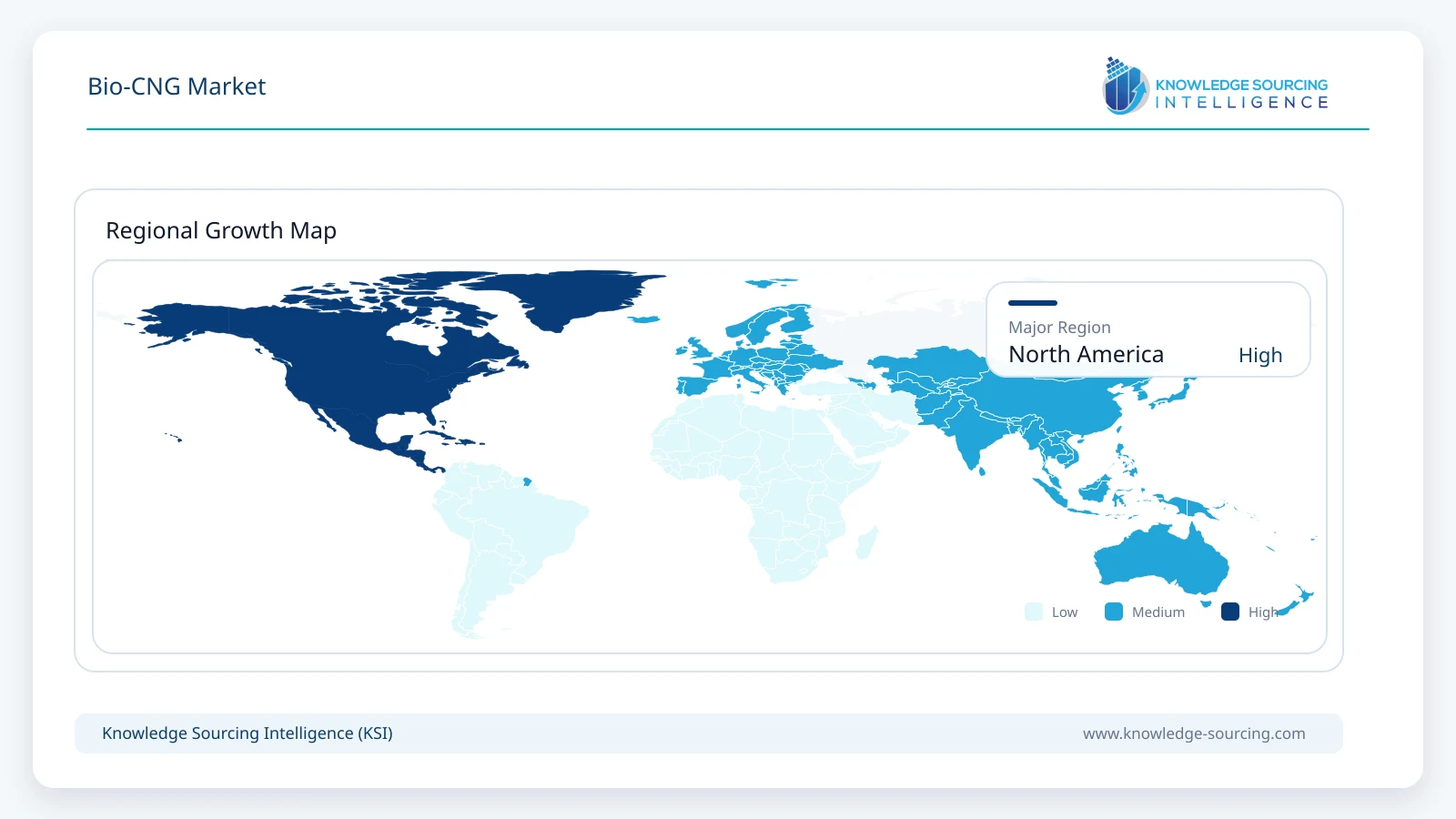
North America has a growing renewable natural gas industry built on landfill, dairy and wastewater projects, supported by low-carbon fuel credits and renewable fuel standards that reward transport use.
Europe
Europe held about 38.6% of the market in 2025, led by Germany, Sweden, Italy and France, with mature supply chains, public CNG refueling networks and strong renewable-gas policy.
Asia-Pacific
Asia-Pacific is a leading growth region, driven by India's national program for agricultural-waste-based production and city gas blending, and by municipal waste and rural biogas initiatives in China and Southeast Asia.
Middle East and Africa
The Middle East and Africa are early-stage, with interest focused on municipal waste-to-energy projects and fleet fuel pilots.
South America
South America offers growing potential from sugarcane, livestock and landfill resources, with Brazil advancing biomethane policy and projects.
List of Companies
Verbio SE
Air Liquide S.A.
Gasum Oy
Clean Energy Fuels Corp.
Reliance Bio Energy
Indian Oil Corporation Ltd.
GAIL (India) Ltd.
Adani TotalEnergies Biomass Ltd.
Praj Industries Ltd.
EverEnviro Resource Management
Competitive Landscape
Verbio SE
Verbio produces biomethane and biofuels from agricultural residues, operating integrated biogas-to-CNG infrastructure in Europe and expanding into India.
Air Liquide S.A.
Air Liquide supplies biogas purification and upgrading technology and distributes biomethane for mobility and industry as part of its renewable gas strategy.
Indian Oil Corporation Ltd.
IndianOil is developing Bio-CNG supply, offtake and retail outlets under India's national program, alongside peers such as GAIL, BPCL and Adani TotalEnergies Biomass.
Analyst View
The Bio-CNG market is growing at a double-digit pace because it offers a drop-in, low-carbon replacement for fossil CNG that works with existing vehicles and infrastructure. Estimates differ widely by scope, so figures should be read against definition. Europe is the most mature market, India the most dynamic, and North America a major renewable natural gas producer. The key success factors are secure feedstock aggregation, low-cost upgrading and compression, and long-term offtake with fleets and gas distributors. Integrated players that combine feedstock, upgrading technology and fuel distribution are best positioned.
Bio-CNG Market Scope:
| Report Metric | Details |
|---|---|
| Total Market Size in 2026 | 6.71 billion |
| Total Market Size in 2031 | USD 13.5 billion |
| Forecast Unit | USD Billion |
| Growth Rate | 15.0% |
| Study Period | 2021 to 2031 |
| Historical Data | 2021 to 2024 |
| Base Year | 2025 |
| Forecast Period | 2026 – 2031 |
| Segmentation | Feedstock, Application, End User, Geography |
| Companies |
|
Market Segmentation
By Feedstock
Agricultural Residues
Animal Manure
Municipal Solid Waste
Food Waste
Sewage & Others
By Application
Transport Fuel
City Gas / Grid Injection
Industrial Heating
Power Generation
By End User
Transportation & Fleets
Gas Utilities
Industrial
Residential & Commercial
By Geography
North America
USA
Canada
Mexico
South America
Brazil
Others
Europe
Germany
France
United Kingdom
Others
Middle East and Africa
UAE
Saudi Arabia
Others
Asia Pacific
China
India
Japan
Others
Table of Contents
1. EXECUTIVE SUMMARY
2. MARKET SNAPSHOT
2.1. Market Overview
2.2. Market Definition
2.3. Scope of the Study
2.4. Market Segmentation
3. BUSINESS LANDSCAPE
3.1. Market Drivers
3.2. Market Restraints
3.3. Market Opportunities
3.4. Porter's Five Forces Analysis
3.5. Industry Value Chain Analysis
3.6. Policies and Regulations (Renewable Gas Mandates, Blending Obligations, Low-Carbon Fuel Standards)
3.7. Strategic Recommendations
4. TECHNOLOGICAL OUTLOOK
4.1. Biogas Purification & Upgrading
4.2. Compression & Cascade Storage
4.3. Gas Grid Injection
4.4. Fleet Fueling Infrastructure
5. BIO-CNG MARKET BY FEEDSTOCK
5.1. Introduction
5.2. Agricultural Residues
5.3. Animal Manure
5.4. Municipal Solid Waste
5.5. Food Waste
5.6. Sewage & Others
6. BIO-CNG MARKET BY APPLICATION
6.1. Introduction
6.2. Transport Fuel
6.3. City Gas / Grid Injection
6.4. Industrial Heating
6.5. Power Generation
7. BIO-CNG MARKET BY END USER
7.1. Introduction
7.2. Transportation & Fleets
7.3. Gas Utilities
7.4. Industrial
7.5. Residential & Commercial
8. BIO-CNG MARKET BY GEOGRAPHY
8.1. Introduction
8.2. North America
8.2.1. USA
8.2.2. Canada
8.2.3. Mexico
8.3. South America
8.3.1. Brazil
8.3.2. Others
8.4. Europe
8.4.1. Germany
8.4.2. France
8.4.3. United Kingdom
8.4.4. Others
8.5. Middle East and Africa
8.5.1. UAE
8.5.2. Saudi Arabia
8.5.3. Others
8.6. Asia Pacific
8.6.1. China
8.6.2. India
8.6.3. Japan
8.6.4. Others
9. COMPETITIVE ENVIRONMENT AND ANALYSIS
9.1. Major Players and Strategy Analysis
9.2. Market Share Analysis
9.3. Mergers, Acquisitions, Agreements, and Collaborations
9.4. Competitive Dashboard
10. COMPANY PROFILES
10.1. Verbio SE
10.2. Air Liquide S.A.
10.3. Gasum Oy
10.4. Clean Energy Fuels Corp.
10.5. Reliance Bio Energy
10.6. Indian Oil Corporation Ltd.
10.7. GAIL (India) Ltd.
10.8. Adani TotalEnergies Biomass Ltd.
10.9. Praj Industries Ltd.
10.10. EverEnviro Resource Management
11. APPENDIX
11.1. Currency
11.2. Assumptions
11.3. Base and Forecast Years Timeline
11.4. Key Benefits for the Stakeholders
11.5. Research Methodology
11.6. Abbreviations
Navigate
Trusted by the world's leading organizations











