
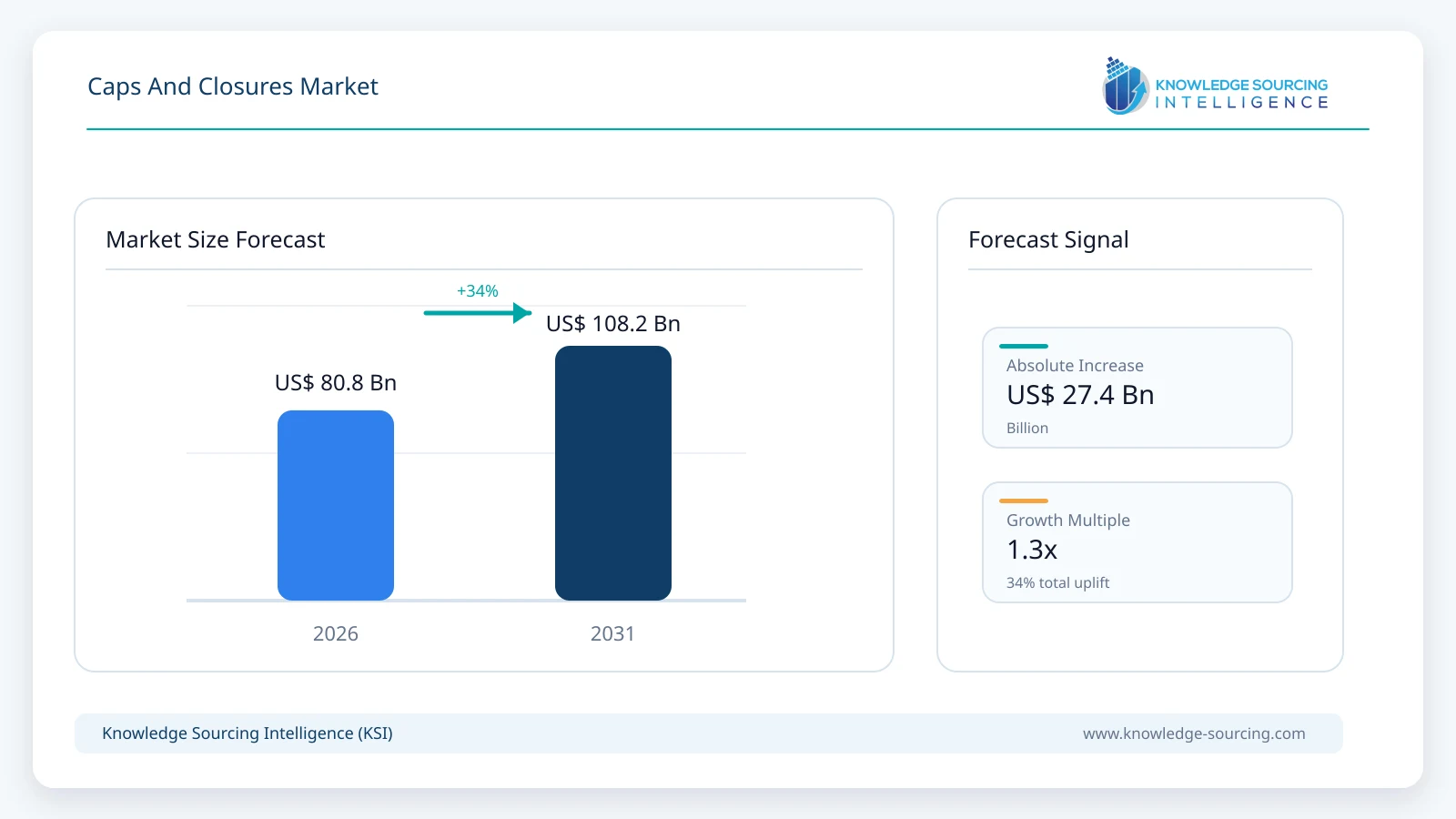
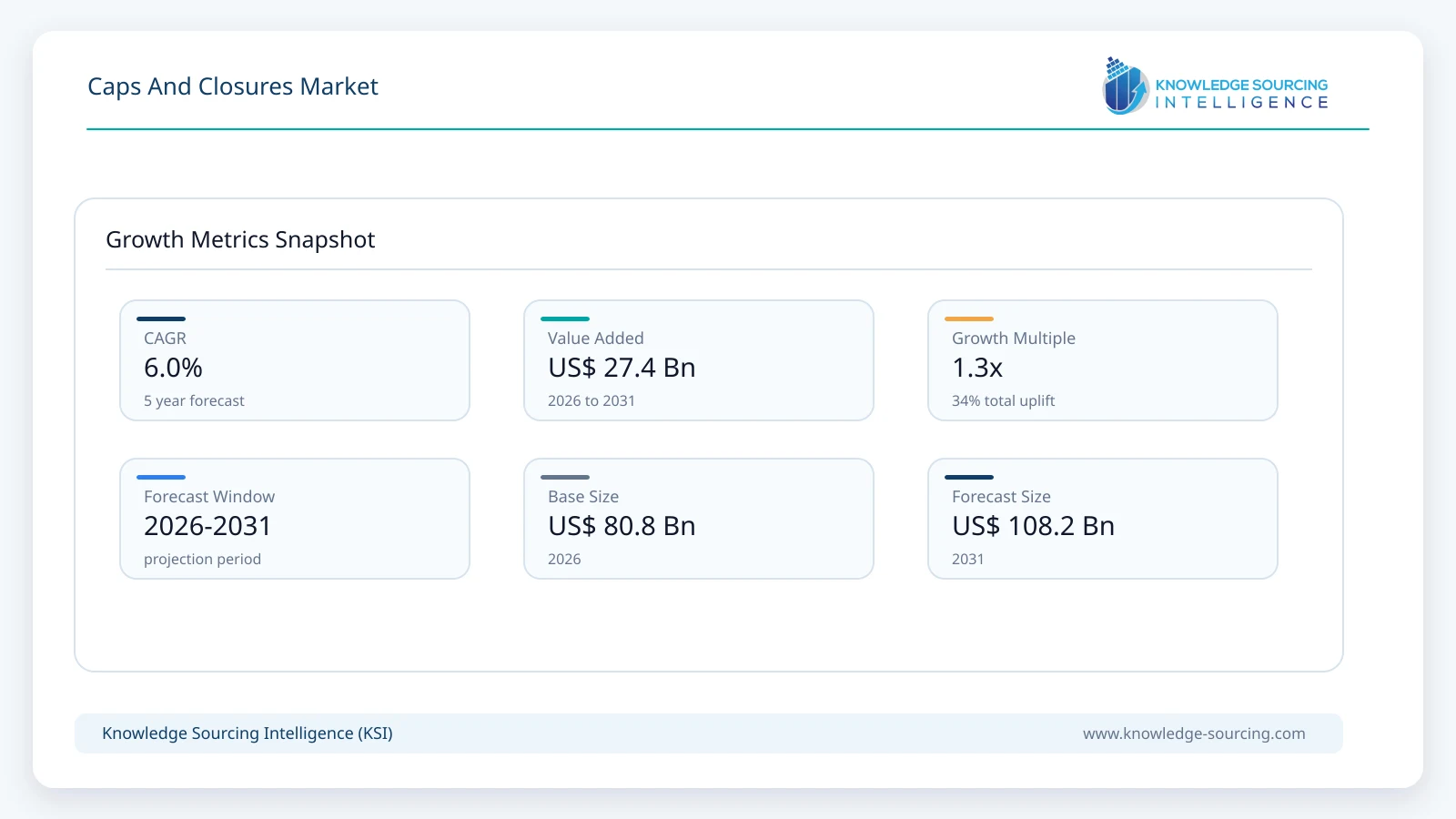
The Caps & Closures Market is expected to grow at a rate of 6.0% CAGR, reaching a market size of USD 108.2 billion in 2031 from USD 80.8 billion in 2026.
Highlights:
- 1Screw and continuous-thread closures account for an estimated 46.8% of market revenue in 2026, supported by their widespread compatibility with beverage, food, pharmaceutical, household and personal-care containers.
- 2Plastic represents approximately 69.2% of market revenue in 2026, reflecting the scale of HDPE and polypropylene closures used with PET and other rigid containers.
- 3Beverages account for an estimated 51.8% of market demand in 2026, led by bottled water, carbonated beverages, dairy, juices and alcoholic drinks.
- 4Asia Pacific represents approximately 36.7% of global market revenue in 2026, supported by large packaged beverage and food industries and expanding consumer-goods manufacturing.
- 5EU beverage containers of up to three litres with plastic caps are required to use closures that remain attached during intended use, making tethered-cap design an established production requirement rather than a future trend.
- 612 August 2026The EU Packaging and Packaging Waste Regulation began applying from , increasing the importance of recyclability, recycled content, lightweighting and simpler material structures.
- 7Dispensing closures are gaining value faster than basic commodity caps as beauty, personal care, sauces, sports beverages and home-care products increasingly compete through dosing convenience and user experience.
- 8Lightweighting remains commercially important, but it also limits revenue growth per closure by reducing resin and metal consumption even as unit volumes increase.
The market covers plastic, metal and other caps and closures used to seal, dispense and protect products across rigid and selected semi-rigid packaging formats. It includes continuous-thread and screw closures, dispensing closures, snap-on closures, crown closures, roll-on pilfer-proof closures and other specialty systems. The scope covers closures supplied with or independently of containers but excludes pumps and aerosol valves where the dispensing mechanism, rather than the closure, constitutes the primary packaging system.
Market Overview
Caps and closures are essential components of rigid packaging because they maintain seal integrity, limit leakage and contamination, provide tamper evidence and increasingly control the way a product is dispensed. Although basic screw caps remain a high-volume commodity product, the market has become technically more differentiated. Beverage manufacturers need closures that operate reliably on high-speed filling lines and withstand internal pressure, food producers require leak resistance and convenient dispensing, pharmaceutical manufacturers require tamper-evident or child-resistant systems, while personal-care brands use dispensing performance and appearance as part of product differentiation.
The current market also needs to be viewed through the interaction between regulation and material efficiency. Europe’s tethered-cap requirement has already forced changes in cap geometry, hinges, tamper-evidence systems and filling-line compatibility. The next stage is less about first-time conversion and more about reducing weight, improving opening behavior and ensuring reliable high-speed production. The PPWR adds another layer by pushing packaging toward recyclability and recycled-content requirements. As a result, closure manufacturers are competing not merely on unit price but on grams of material used, line efficiency, seal performance and compatibility with the package’s intended recycling stream.
Current manufacturer results support a market that is expanding in value but is not experiencing the double-digit growth seen in some newer packaging technologies. Silgan’s Dispensing and Specialty Closures business generated USD 2.7 billion of sales in 2025, up more than 17% from 2024, although part of that increase reflected the Weener Packaging acquisition. The company also reported higher organic dispensing volumes while North American beverage closure volumes were affected by weaker consumption conditions. This combination is representative of the broader market: specialty and dispensing systems are gaining value faster, while traditional beverage closures remain strongly linked to packaged-beverage volumes.
Market Drivers
Lightweighting and regulatory redesign are creating recurring replacement cycles
Closure manufacturers historically competed by reducing resin use without sacrificing seal integrity or capping-line speed. Regulatory changes have made redesign more frequent. The EU requirement for plastic caps and lids to remain attached to beverage containers of up to three litres required manufacturers to modify hinges, tamper bands and opening geometry while maintaining strength and consumer usability. With this transition now implemented at industrial scale, suppliers are focusing on reducing material consumption within tethered systems and improving performance on existing bottling equipment. UNITED CAPS’ 2026 S-SPRING sports closure and BERICAP’s tethered dairy and carton systems illustrate how regulatory compliance is evolving into continuing optimization rather than one-time conversion.
Dispensing functionality is increasing closure value per package
Brands in sauces, personal care, home care and sports beverages increasingly use closures to control flow, minimize mess and differentiate consumer experience. This raises the value of the closure even when the container itself changes little. Amcor’s April 2026 Flava flip-top sauce closure reduced closure weight by 18.7% while retaining dispensing functionality, demonstrating how performance and material efficiency are being developed simultaneously. Aptar’s 2026 portfolio expansions similarly target e-commerce durability, one-handed dispensing and hot-fill beverage applications. These are more technically differentiated products than commodity bottle caps and should support faster value growth in dispensing closures through 2031.
E-commerce increases the importance of leak resistance and secure reclosing
Retail packaging designed primarily for store shelves may experience different stresses when shipped individually through parcel networks. Products can be inverted, dropped, or subjected to repeated vibration, increasing the commercial importance of closures that remain sealed without requiring additional protective components. Beauty, home-care and personal-care brands are therefore evaluating closure performance as part of e-commerce packaging qualification. Aptar’s July 2026 e-commerce-ready closure portfolio specifically targets product protection through online fulfilment while maintaining dispensing convenience. This creates incremental demand for engineered closures in categories where basic flip-top or disc-top designs may be insufficient.
Pharmaceutical and healthcare packaging sustains demand for safety-oriented closures
Pharmaceuticals and nutraceuticals require closures that can combine barrier integrity with tamper evidence, child resistance and senior accessibility. Unlike many beverage closures, these products compete primarily on safety and compliance rather than minimum resin weight. Comar’s current closure portfolio includes continuous-thread, child-resistant, tamper-evident and pharmaceutical dispensing systems, including configurations designed around regulated container-integrity requirements. This creates a comparatively stable higher-value segment and supports closure demand as pharmaceutical packaging volumes expand.
Packaged beverages remain the principal volume engine
Beverages continue to consume extremely large quantities of plastic and metal closures across bottled water, carbonated soft drinks, juices, dairy products, sports drinks, beer, wine and spirits. The segment is mature in North America and Western Europe but continues to expand through packaged-beverage consumption and modern retail growth across Asia Pacific, Latin America, the Middle East and Africa. Large-scale closure manufacturing benefits from standardized neck finishes and high-speed production, while premium beverages and functional drinks support additional demand for sports caps, dispensing systems and tamper-evident formats.
Market Restraints and Challenges
Lightweighting reduces material revenue per unit
Closure manufacturers continuously reduce cap weight to lower resin cost and improve sustainability performance. This is commercially necessary but creates a structural offset to market-value growth because billions of units can be produced using progressively less material. Amcor’s 2026 Flava closure, for example, reduced cap weight by 1.9 grams relative to the previous generation while maintaining functionality. The market can therefore record healthy unit-volume growth without an equivalent increase in revenue, particularly in high-volume beverage applications.
Reuse and refill models can reduce disposable closure consumption per litre
The PPWR is designed partly to encourage reuse and refill where appropriate. Greater use of reusable beverage bottles, refillable household products and concentrated formulations could reduce the number of single-use packages and closures required for a given quantity of product. This effect is unlikely to eliminate closure demand because reusable containers still require durable closing systems, but it can shift value from high-volume disposable caps toward longer-life closures and refill-compatible dispensing systems.
Alternative packaging formats compete with conventional rigid containers
Flexible pouches, sachets, easy-open cans and some carton formats can reduce or eliminate the need for conventional bottle and jar closures. Spouted pouches still use fitments and closures, but many flexible packages require considerably less closure material than rigid bottles. Manufacturers therefore face substitution risk in categories such as sauces, household products, baby food and personal care where brand owners can redesign the complete package rather than only the cap.
Resin and metal price movements affect producer margins
Polypropylene and HDPE dominate plastic closures, while aluminum and steel are important for beverage, food and premium-product closures. Producers frequently negotiate raw-material pass-through mechanisms with large customers, but timing differences can still affect margins and reported sales. Silgan’s 2026 results demonstrate that higher raw-material costs can increase reported revenue even without corresponding volume growth, making value-market analysis sensitive to material pricing as well as underlying unit demand.
Regulatory requirements increase qualification and tooling costs
Tethered closures, food-contact requirements, recycled-content rules and recyclability criteria require manufacturers to continually adapt tooling and materials. For large global suppliers these changes create opportunities to differentiate through engineering capability, but smaller closure manufacturers may face higher testing and capital requirements. Each redesign also needs to operate reliably with existing filling and capping equipment, creating qualification cycles that can slow adoption even when the sustainability or regulatory case is clear.
Major Segment Analysis
By Closure Type
Screw and continuous-thread closures remain the largest format because they can serve beverages, food, pharmaceuticals, personal care and household products using highly standardized manufacturing processes. Their growth is comparatively steady, with competition centered on lightweighting, seal integrity and line compatibility.
Dispensing closures are projected to grow at approximately 7.6% annually through 2031, faster than the overall market. Flip-top, disc-top, sports, directional and controlled-flow systems allow packaging to provide functional differentiation and tend to generate greater value per unit than conventional screw caps. Aptar, Amcor, Silgan and UNITED CAPS are all introducing closure systems that emphasize dispensing performance alongside material reduction.
Crown and conventional metal beverage closures grow more slowly because beer and soft-drink packaging increasingly competes with cans and other container formats. Roll-on pilfer-proof closures remain important across spirits, wine, pharmaceuticals and premium beverages, where tamper evidence and decoration add value beyond simple sealing.
By Raw Material
Plastic remains the largest material because polypropylene and HDPE provide the combination of low weight, high-speed processability, seal performance and cost required for mass-market beverage and consumer packaging. Material innovation is increasingly focused on lighter designs, recycled content and simplified mono-material packaging rather than replacing plastic across every application.
Fiber and other alternative materials are projected to grow from a small base at approximately 10.1% annually through 2031, but they remain a niche part of the market. Paper- and fiber-based closure concepts face technical challenges involving moisture resistance, opening cycles, sealing and line-speed compatibility. Metal remains commercially important in spirits, wine, beer, sauces, food jars and specialty packaging and benefits from established recycling infrastructure.
By Application
Beverages remain the principal application and are projected to reach approximately USD 55.8 billion by 2031. The segment includes very high-volume commodity closures for bottled water and soft drinks alongside higher-value sports caps, tethered systems and metal or ROPP closures for alcoholic beverages. Continued packaged-beverage growth in developing economies offsets slower consumption growth in mature markets.
Food represents another substantial market, particularly for sauces, edible oils, condiments, spreads and jarred products. Personal care and cosmetics grow faster as brands use dispensing closures to improve dosing, convenience and premium positioning. Pharmaceutical and healthcare closures similarly expand above the overall market as child-resistant and tamper-evident formats increase the value per package.
By Geography
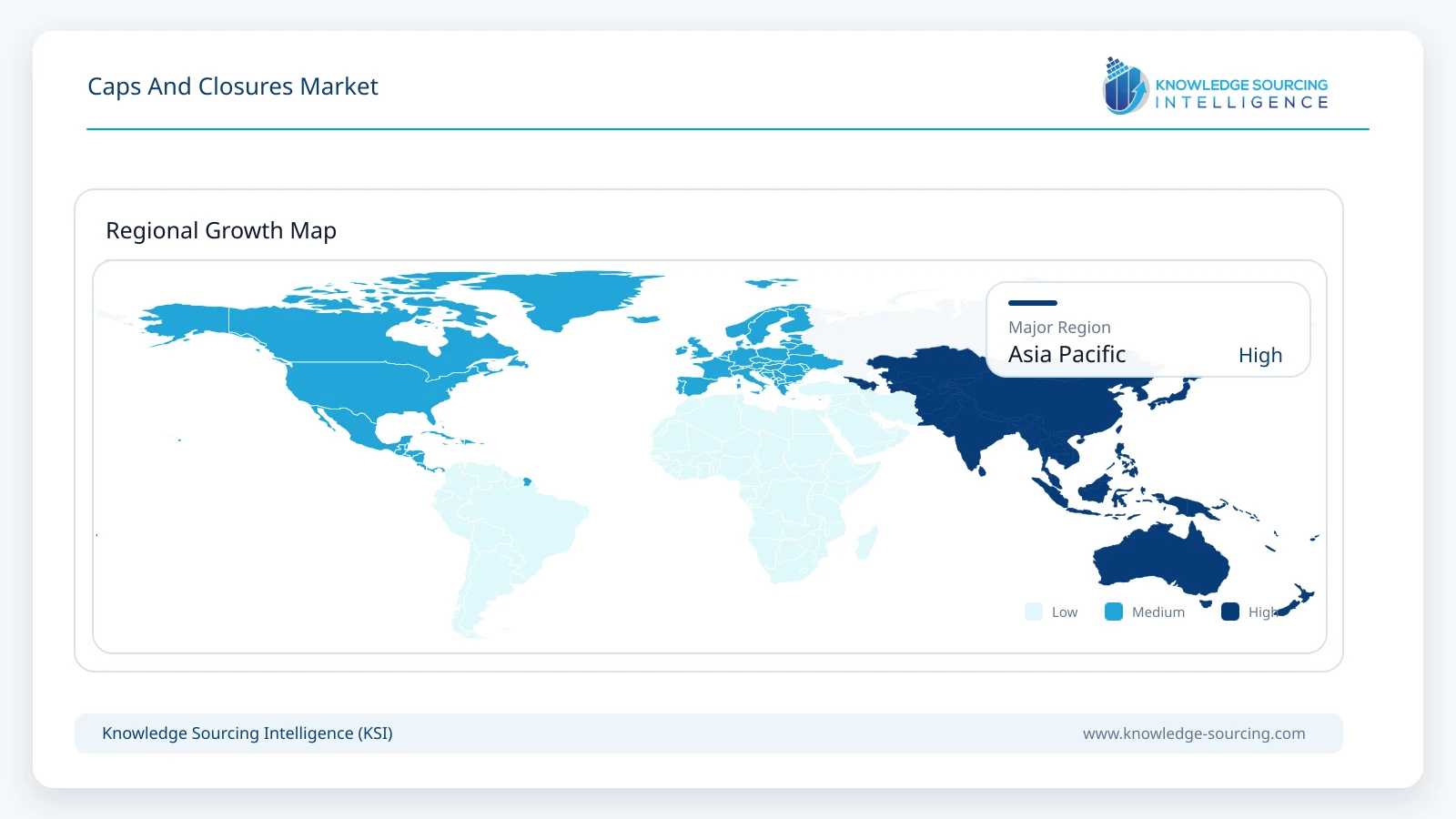
Asia Pacific is projected to reach approximately USD 42.0 billion by 2031, maintaining its position as the largest regional market. China provides extensive beverage, food and consumer-goods packaging production, while India, Indonesia and other emerging markets benefit from packaged-product penetration and expanding modern retail. Japan maintains an advanced domestic closure industry across beverage, food and pharmaceutical applications.
North America remains a high-value market because of large beverage consumption, sophisticated personal-care packaging and substantial pharmaceutical demand. Europe grows more moderately but acts as an important technology and regulatory market, particularly for tethered closures, material lightweighting and recyclable designs. Latin America and the Middle East and Africa expand from smaller bases through beverage, food and personal-care packaging demand.
Technology Outlook
Lightweight and Tethered Closure Engineering
The first phase of tethered-cap conversion has largely been completed across Europe. The technology focus is now shifting toward reduced weight, consistent opening angles, improved consumer ergonomics and reliable application at high line speeds. Future designs are likely to use fewer grams of polymer while preserving hinge durability and tamper evidence.
Mono-Material and Recycled-Content Closures
Regulatory and recycling objectives are increasing interest in closures that align more closely with the container’s material stream. Conventional PET bottles generally use HDPE or PP caps, while newer concepts are exploring PET closures and greater incorporation of recycled polymers. Commercial success will depend not only on recyclability but also on production economics, high-speed capping performance and customer qualification.
Digitally Enabled Closures
Caps can increasingly serve as digital touchpoints in addition to sealing the package. Pelliconi’s 2026 Sagres project used serialized QR codes integrated with bottle caps to create individual digital identities and support loyalty and consumer-engagement programs. Similar technologies can ultimately support authentication, promotions and traceability without changing the primary container structure.
Recent Developments
July 2026: Aptar Closures expanded its portfolio with the Harmonic linerless hot-fill sport cap, adding a closure designed for beverage applications requiring both hot-fill compatibility and dispensing convenience.
July 2026: Pelliconi and Portuguese beer brand Sagres deployed P-Code serialized cap technology, turning individual bottle closures into digitally connected consumer touchpoints.
May 2026: UNITED CAPS introduced the 26/22 S-SPRING sports closure and 27 H-PAK carton closure, focusing on lightweight construction, compatibility and material efficiency across beverage applications.
April 2026: Amcor launched the Flava 55 mm flip-top sauce closure, reducing closure weight by 18.7% compared with the previous generation while maintaining mono-material construction and dispensing functionality.
March 2026: BERICAP presented expanded closure systems for beverage, dairy, food and healthcare applications, including weight-optimized edible-oil closures and tethered carton formats.
March 2026: Guala Closures announced expansion of its manufacturing footprint in Mexico to support demand from the U.S. wine and spirits market, strengthening its North American premium-closure capacity.
Competitive Landscape
Competition ranges from very large diversified packaging suppliers to companies specializing almost entirely in closures. Silgan holds a substantial international position in dispensing and specialty closures and has expanded the business through the integration of Weener Packaging. Amcor combines the former Berry Global closure portfolio with a broader rigid and flexible packaging platform, while Aptar competes strongly through dispensing and flow-control technologies.
BERICAP, UNITED CAPS, Guala Closures, ALPLA, Closure Systems International, Pelliconi and RETAL maintain significant positions across beverage, food and specialty closure markets. Guala has particular strength in wine and spirits, while Pelliconi combines conventional metal closures with increasing digital functionality. Nippon Closures serves both metal and plastic packaging across beverage, food and healthcare markets in Asia, while Tecnocap maintains an international metal-closure manufacturing network.
Competition is moving away from purely minimizing cost per cap. Customers increasingly evaluate total material weight, recyclability, filling-line efficiency, opening performance, tamper evidence and the ability to support global neck-finish standards. Suppliers able to offer molding expertise, closure design, capping-line support and sustainable-material development together are consequently gaining an advantage over commodity-only manufacturers.
Analyst View
The caps and closures market should be viewed as a mature, very high-volume packaging market undergoing value migration rather than fundamental product replacement. Conventional screw caps remain indispensable across beverages, food, pharmaceuticals and household products, but their value growth is constrained by continuous lightweighting. Incremental growth increasingly comes from dispensing functionality, premium applications, child resistance, tamper evidence and technically more complex sustainable formats.
European regulation is likely to have a disproportionate influence on global closure engineering even though Europe is not the largest region. Tethered caps forced global suppliers to redesign major beverage platforms, and PPWR requirements are now increasing pressure around recyclability and material use. Multinational beverage and consumer-goods companies often prefer closure platforms that can operate across several geographies, meaning designs developed for European compliance can subsequently influence products sold elsewhere.
Dispensing closures provide the clearest value-growth opportunity. Consumers increasingly expect packaging to control flow, avoid leakage and operate conveniently with one hand, while e-commerce adds additional transport requirements. This allows closure manufacturers to sell engineering and functionality rather than only molded plastic. Personal care, sauces, household products and sports beverages should therefore increase their contribution to supplier profitability faster than basic bottled-water caps.
The largest strategic risk is that sustainability should not be interpreted as automatically increasing market value. Lightweighting removes resin from every unit, refill systems reduce the number of disposable packages, and simplified flexible packaging can eliminate conventional closures entirely. Suppliers need to gain value through better functionality and manufacturing efficiency faster than these trends reduce material consumption.
Caps and Closures Market Scope:
| Report Metric | Details |
|---|---|
| Total Market Size in 2026 | USD 80.8 billion |
| Total Market Size in 2031 | USD 108.2 billion |
| Forecast Unit | Billion |
| Growth Rate | 6.0% |
| Study Period | 2021 to 2031 |
| Historical Data | 2021 to 2024 |
| Base Year | 2025 |
| Forecast Period | 2026 – 2031 |
| Segmentation | Closure Type, Raw Material, Application, Geography |
| Companies |
|
Market Segmentation
By Closure Type
· Screw & Continuous-Thread Closures
· Dispensing Closures
· Snap-On & Press-On Closures
· Crown Closures
· Roll-On Pilfer-Proof Closures
· Other Specialty Closures
By Raw Material
· Plastic
o Polypropylene
o High-Density Polyethylene
o PET & Other Plastics
· Metal
o Aluminum
o Steel & Tinplate
· Fiber & Other Materials
By Application
· Beverages
o Bottled Water
o Carbonated Soft Drinks
o Juice, Dairy & Functional Beverages
o Alcoholic Beverages
o Others
· Food
· Pharmaceuticals & Healthcare
· Cosmetics & Personal Care
· Household & Industrial Products
· Others
By Geography
North America
· United States
· Canada
· Mexico
South America
· Brazil
· Argentina
· Others
Europe
· Germany
· United Kingdom
· France
· Italy
· Spain
· Others
Middle East and Africa
· Saudi Arabia
· UAE
· South Africa
· Others
Asia Pacific
· China
· Japan
· India
· South Korea
· Indonesia
· Others
Table of Contents
1. EXECUTIVE SUMMARY
2. MARKET SNAPSHOT
2.1. Market Overview
2.2. Market Definition and Scope
2.3. Market Segmentation
2.4. Key Market Indicators
2.5. Market Estimation and Forecast Assumptions
3. BUSINESS LANDSCAPE
3.1. Market Drivers
3.2. Market Restraints and Challenges
3.3. Market Opportunities
3.4. Raw Material and Pricing Analysis
3.5. Packaging and Closure Value Chain
3.6. Regulatory Environment
3.7. Porter’s Five Forces Analysis
3.8. Strategic Recommendations
4. TECHNOLOGY OUTLOOK
4.1. Lightweight and Tethered Closure Engineering
4.2. Mono-Material and Recycled-Content Closures
4.3. Digitally Enabled Closures
5. CAPS AND CLOSURES MARKET BY CLOSURE TYPE
5.1. Introduction
5.2. Screw & Continuous-Thread Closures
5.3. Dispensing Closures
5.4. Snap-On & Press-On Closures
5.5. Crown Closures
5.6. Roll-On Pilfer-Proof Closures
5.7. Other Specialty Closures
6. CAPS AND CLOSURES MARKET BY RAW MATERIAL
6.1. Introduction
6.2. Plastic
6.2.1. Polypropylene
6.2.2. High-Density Polyethylene
6.2.3. PET & Other Plastics
6.3. Metal
6.3.1. Aluminum
6.3.2. Steel & Tinplate
6.4. Fiber & Other Materials
7. CAPS AND CLOSURES MARKET BY APPLICATION
7.1. Introduction
7.2. Beverages
7.2.1. Bottled Water
7.2.2. Carbonated Soft Drinks
7.2.3. Juice, Dairy & Functional Beverages
7.2.4. Alcoholic Beverages
7.2.5. Others
7.3. Food
7.4. Pharmaceuticals & Healthcare
7.5. Cosmetics & Personal Care
7.6. Household & Industrial Products
7.7. Others
8. CAPS AND CLOSURES MARKET BY GEOGRAPHY
8.1. Introduction
8.2. North America
8.2.1. United States
8.2.2. Canada
8.2.3. Mexico
8.3. South America
8.3.1. Brazil
8.3.2. Argentina
8.3.3. Others
8.4. Europe
8.4.1. Germany
8.4.2. United Kingdom
8.4.3. France
8.4.4. Italy
8.4.5. Spain
8.4.6. Others
8.5. Middle East and Africa
8.5.1. Saudi Arabia
8.5.2. UAE
8.5.3. South Africa
8.5.4. Others
8.6. Asia Pacific
8.6.1. China
8.6.2. Japan
8.6.3. India
8.6.4. South Korea
8.6.5. Indonesia
8.6.6. Others
9. COMPETITIVE ENVIRONMENT AND ANALYSIS
9.1. Competitive Positioning
9.2. Closure Technology and Product Portfolio Benchmarking
9.3. Material and Sustainability Capability Analysis
9.4. Market Share Analysis
9.5. Strategic Developments
9.6. Competitive Dashboard
10. COMPANY PROFILES
10.1. Silgan Holdings Inc.
10.2. Amcor plc
10.3. AptarGroup, Inc.
10.4. BERICAP Holding GmbH
10.5. UNITED CAPS
10.6. Guala Closures S.p.A.
10.7. ALPLA Group
10.8. Closure Systems International
10.9. Pelliconi & C. S.p.A.
10.10. Tecnocap Group
10.11. Nippon Closures Co., Ltd.
10.12. RETAL Industries Ltd.
10.13. SIG Group AG
10.14. Tetra Pak International S.A.
10.15. Comar, LLC
10.16. Pano Cap Canada Ltd.
10.17. Massilly Group
10.18. TriMas Packaging / Rieke
10.19. Plastipak Packaging, Inc.
10.20. Pretium Packaging / Mold-Rite
11. ANALYST VIEW
12. APPENDIX
12.1. Research Methodology
12.2. Market Estimation and Assumptions
12.3. Definitions and Abbreviations
Navigate
Trusted by the world's leading organizations











