
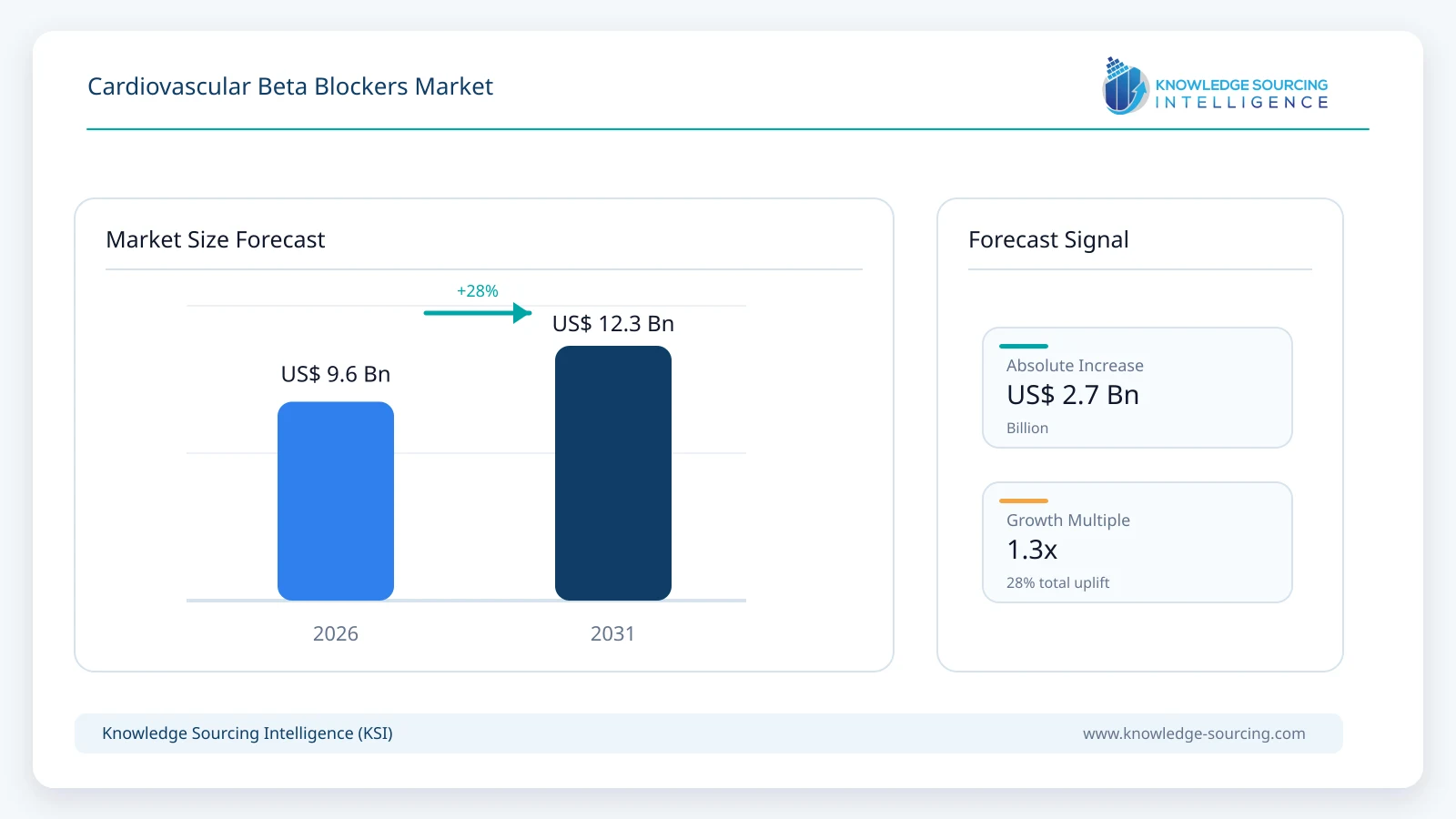
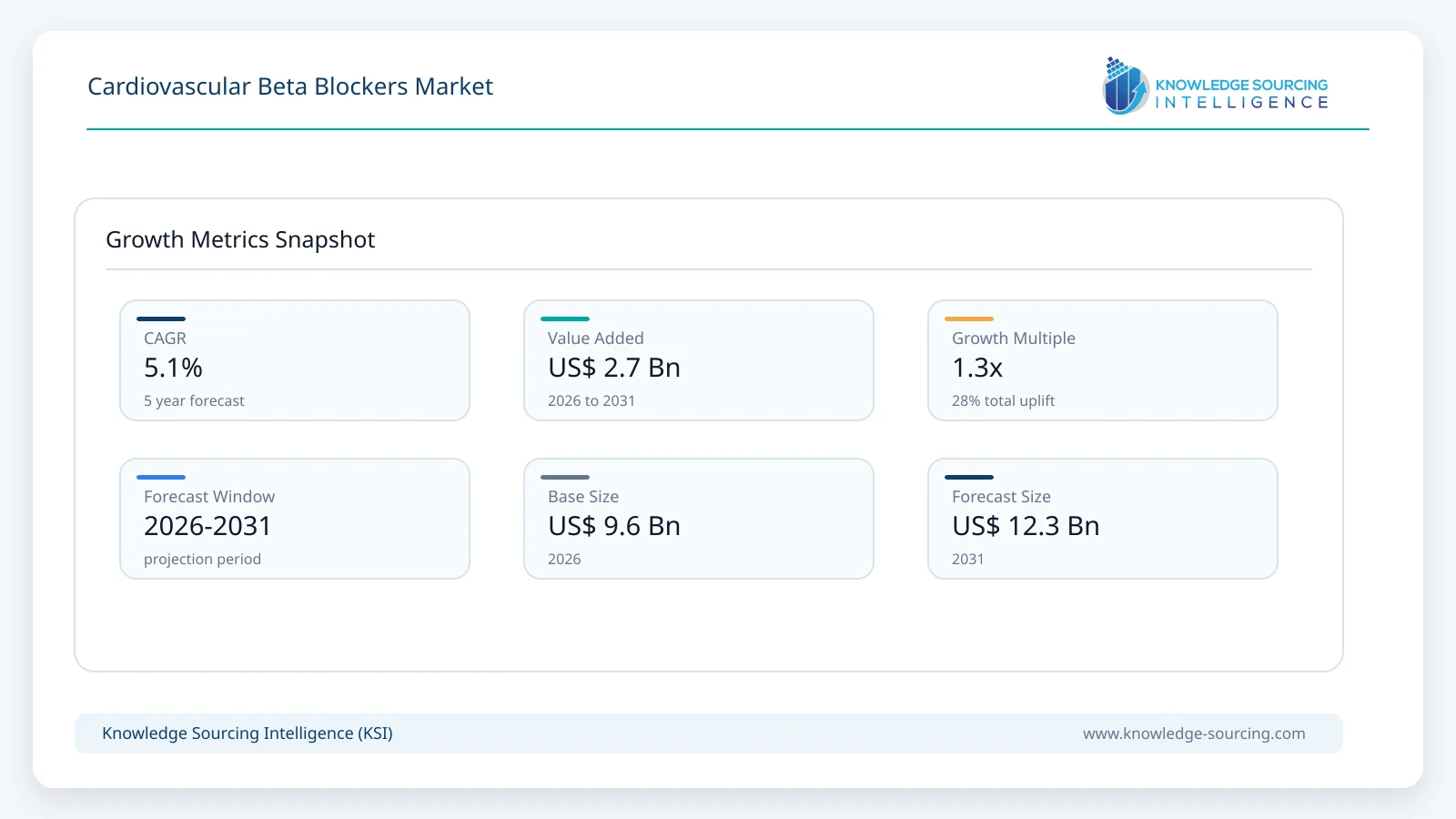
The Cardiovascular Beta Blockers Market is set to reach USD 12.35 billion in 2031, growing at a CAGR of 5.08% from USD 9.64 billion in 2026.
Highlights:
- 1Beta blockers remain foundational cardiovascular therapies with extensive use in hypertension, heart failure, coronary artery disease, arrhythmias, and angina.
- 2Cardioselective beta-1 blockers such as metoprolol, bisoprolol, and nebivolol account for a substantial share of prescriptions due to favorable tolerability.
- 3Carvedilol maintains strong demand in heart failure because of its combined beta- and alpha-blocking properties.
- 4Global cardiovascular disease prevalence and aging populations continue to support stable long-term prescription volumes.
Beta blockers are a class of adrenergic receptor antagonists that inhibit the effects of catecholamines such as epinephrine and norepinephrine on Beta-adrenergic receptors in the heart and vascular system. By reducing heart rate, myocardial contractility, and renin secretion, these agents lower blood pressure, decrease myocardial oxygen consumption, and improve cardiac efficiency. Metoprolol, Bisoprolol, Carvedilol, Atenolol, Propranolol, and Nebivolol are among the most commonly prescribed molecules across global cardiovascular markets.
The therapeutic importance of beta blockers stems from decades of clinical evidence demonstrating reductions in mortality and hospitalization, particularly in heart failure and post-myocardial infarction management. Demand is increasing in regions with rising rates of hypertension, coronary artery disease, obesity, and diabetes. Generic commoditization constrains revenue expansion despite high prescription volumes. Manufacturers are focusing on extended-release formulations, fixed-dose combinations, and broader penetration in emerging markets. This combination of strong clinical utility, low cost, and guideline support continues to make beta blockers a cornerstone of cardiovascular therapy.
Market Dynamics
Market Drivers
Rising Global Burden of Cardiovascular Disease
Cardiovascular disorders remain the leading cause of mortality worldwide, creating sustained demand for effective and affordable therapies such as beta blockers. World Health Organization estimates that cardiovascular disease causes nearly 18 million deaths annually. Increasing prevalence of hypertension, coronary artery disease, heart failure, obesity, and diabetes is expanding the treated patient population. While newer drug classes have changed some treatment paradigms, beta blockers remain essential in many core indications. This large and growing disease burden continues to support stable prescription volumes across all major regions.
Strong Guideline Support in Heart Failure and Ischemic Heart Disease
Clinical guidelines from organizations such as the American Heart Association and the European Society of Cardiology continue to recommend evidence-based beta blockers for heart failure with reduced ejection fraction, post-myocardial infarction management, and selected arrhythmias. Demand remains particularly strong for carvedilol, metoprolol succinate, and bisoprolol due to demonstrated mortality benefits. Established standards of care ensure that these agents maintain high utilization even as new cardiovascular therapies emerge.
Broad Generic Availability and Low Treatment Cost
The widespread availability of generic formulations from global manufacturers has made beta blockers among the most accessible cardiovascular medicines. Low pricing supports use in both developed and emerging healthcare systems. Although generic competition constrains revenue growth for individual products, it increases overall market penetration and prescription volume. This affordability is a major factor sustaining the long-term relevance of the therapeutic class.
Aging Populations and Expanding Healthcare Access
Population aging and improved diagnosis of chronic cardiovascular disease are increasing the number of patients requiring long-term treatment. Emerging economies in Asia Pacific, Latin America, and Middle East are expanding access to essential medicines, including generic beta blockers. Greater healthcare coverage and local manufacturing capacity are further supporting market growth through 2031.
Market Restraints
Generic commoditization significantly limits pricing power and revenue growth despite consistently high prescription volumes.
Newer antihypertensive and heart failure therapies, including SGLT2 inhibitors and ARNI combinations, are reshaping treatment algorithms in some indications.
Adverse effects such as fatigue, bradycardia, hypotension, sexual dysfunction, and bronchospasm may reduce patient adherence.
Contraindications in certain patients with severe asthma, advanced conduction disorders, or acute decompensated heart failure can limit use.
Mature clinical adoption reduces opportunities for breakthrough innovation within the class.
Market Opportunities
Expansion in Emerging Markets
Increasing diagnosis and treatment of hypertension and heart disease in emerging economies are creating substantial growth opportunities for low-cost beta blockers. Demand is rising in countries such as India, China, Brazil, and Indonesia, where cardiovascular disease prevalence is increasing and healthcare access is improving. Domestic manufacturers and government procurement programs are expanding market penetration.
Fixed-Dose Combination Products
Combining beta blockers with antihypertensives such as ACE inhibitors, diuretics, and calcium channel blockers offers opportunities to improve adherence and simplify treatment. Demand is increasing for combination products that reduce pill burden in patients requiring long-term cardiovascular management. This strategy provides lifecycle extension opportunities for manufacturers while addressing practical clinical needs.
Extended-Release and Differentiated Formulations
Controlled-release formulations such as metoprolol succinate and propranolol extended-release continue to offer advantages in convenience and tolerability. Manufacturers can use formulation improvements and branded generics to maintain differentiation in a mature market. These incremental innovations support value creation despite intense price competition.
Growing Use in Arrhythmia Management
Beta blockers remain central to rate control and prevention of recurrent arrhythmias, including atrial fibrillation and ventricular ectopy. Rising diagnosis of rhythm disorders and greater use of ambulatory cardiac monitoring are increasing treatment opportunities. This expanding application area supports continued prescription growth globally.
Disease & Epidemiology Analysis
Cardiovascular disease remains the largest contributor to global mortality and is the principal epidemiological driver of beta blocker demand. World Health Organization estimates that cardiovascular disease is responsible for approximately 17.9 million deaths each year, representing nearly one-third of all global deaths. Hypertension affects more than one billion adults worldwide and serves as a major risk factor for heart failure, coronary artery disease, and stroke. These trends continue to sustain substantial long-term demand for affordable cardiovascular therapies.
Heart Failure affects tens of millions of patients globally, and beta blockers such as metoprolol succinate, bisoprolol, and carvedilol are core evidence-based therapies that reduce mortality and hospitalization in patients with reduced ejection fraction. Coronary Artery Disease and post-myocardial infarction populations also represent major treatment segments due to the ability of beta blockers to reduce ischemic burden and recurrent cardiovascular events. Increasing survival after acute cardiac events is expanding the population requiring chronic secondary prevention.
Cardiac Arrhythmias, particularly Atrial Fibrillation, are becoming more prevalent as populations age and diagnostic monitoring improves. Demand is increasing for beta blockers to provide rate control and suppress symptomatic tachyarrhythmias. Rising rates of obesity, diabetes, and sedentary lifestyles further increase the incidence of cardiovascular disease. These epidemiological trends are expected to support stable and broad-based market demand for beta blockers through 2031.
Treatment Guidelines Landscape
Beta Blocker Category | Representative Molecules | Primary Clinical Applications | Guideline Significance |
Cardioselective Beta-1 Blockers | Metoprolol, Bisoprolol, Atenolol, Nebivolol | Hypertension, heart failure, coronary artery disease, arrhythmias | Widely recommended due to strong efficacy and favorable tolerability |
Non-Selective Beta Blockers | Propranolol and related agents | Angina, arrhythmias, selected cardiovascular applications | Established role with extensive long-term clinical experience |
Beta Blockers with Alpha-Blocking Activity | Carvedilol | Heart failure, hypertension, post-myocardial infarction | Strong mortality benefit in heart failure with reduced ejection fraction |
Agents with Intrinsic Sympathomimetic Activity | Acebutolol and related molecules | Selected patients requiring reduced resting bradycardia | More limited but clinically relevant niche use |
Extended-Release Formulations | Metoprolol succinate, propranolol ER | Chronic cardiovascular management requiring simplified dosing | Improve adherence and support long-term treatment persistence |
Market Segmentation
By Drug Type – Cardioselective Beta-1 Blockers
Cardioselective beta-1 blockers account for the largest share of the cardiovascular beta blockers market because they provide effective control of heart rate and blood pressure with reduced bronchial beta-2 receptor blockade compared with non-selective agents. Demand remains strong for Metoprolol, Bisoprolol, Atenolol, and Nebivolol due to broad use in hypertension, heart failure, ischemic heart disease, and arrhythmias. Their established efficacy, generic availability, and favorable tolerability sustain this segment’s leadership.
By Indication – Hypertension
Hypertension represents the largest indication segment because of its very high global prevalence and frequent need for long-term pharmacologic management. Although treatment algorithms increasingly incorporate multiple antihypertensive classes, beta blockers remain widely prescribed, especially in patients with concomitant coronary artery disease, arrhythmias, and heart failure. The large patient population and chronic nature of therapy continue to generate substantial prescription volume.
By Molecule – Metoprolol
Metoprolol is the leading molecule segment due to its extensive use in both immediate-release and extended-release formulations across hypertension, heart failure, post-myocardial infarction care, and arrhythmia management. Strong guideline support, broad generic availability, and familiarity among clinicians have established metoprolol as one of the most widely prescribed beta blockers globally.
REGIONAL ANALYSIS
North America
North America represents a major market for beta blockers due to high prevalence of hypertension, coronary artery disease, heart failure, and cardiac arrhythmias, coupled with broad healthcare access and strong adherence to evidence-based treatment guidelines. The United States accounts for the largest share of regional demand because of extensive prescription volumes and well-established generic drug distribution networks. Demand remains stable as beta blockers continue to be widely used in heart failure, post-myocardial infarction management, and rate control. Mature generic competition constrains pricing but ensures broad patient access.
Europe
Europe maintains a substantial market driven by aging populations, universal healthcare coverage, and widespread implementation of guidelines from the European Society of Cardiology. Countries such as Germany, France, United Kingdom, Italy, and Spain generate strong and consistent demand for low-cost generic beta blockers. Cost-containment policies favor established molecules with proven outcomes.
Asia Pacific
Asia Pacific is expected to experience the fastest growth due to increasing cardiovascular disease prevalence, expanding healthcare access, and strong local manufacturing capabilities. India, China, Japan, and South Korea are key markets. Domestic pharmaceutical companies and government procurement programs are improving availability and affordability of essential cardiovascular medicines.
Rest of the World
Latin America, the Middle East, and Africa are seeing growing use of beta blockers as diagnosis and treatment of chronic cardiovascular disease improve. Public health initiatives, generic competition, and broader insurance coverage are increasing access to these therapies in developing healthcare systems.
Regulatory Landscape
Beta blockers are among the most established and extensively regulated cardiovascular drug classes, with well-defined approval pathways and longstanding pharmacovigilance frameworks across global markets. Regulatory oversight is led by agencies such as the U.S. Food and Drug Administration, European Medicines Agency, Pharmaceuticals and Medical Devices Agency, National Medical Products Administration, and Central Drugs Standard Control Organisation. Because most beta blockers are off-patent, regulatory activity is concentrated on generic approvals, manufacturing inspections, formulation updates, and lifecycle management rather than novel molecular entities.
Generic manufacturers must demonstrate bioequivalence, manufacturing consistency, and compliance with current Good Manufacturing Practices to obtain market authorization. Demand remains strong for high-quality, low-cost formulations that can meet public procurement and hospital formulary requirements. Manufacturing observations, supply disruptions, and quality remediation can constrain product availability and lead to temporary shortages. Companies are investing in global quality systems, data integrity programs, and multi-site production networks to strengthen regulatory compliance and supply resilience.
Post-marketing surveillance continues to focus on known class effects such as bradycardia, hypotension, fatigue, and bronchospasm, as well as product-specific labeling updates. Regulatory harmonization through international standards has simplified multi-country filings, although local requirements still influence approval timelines and packaging. This mature and predictable regulatory environment supports stable market participation and facilitates ongoing expansion of generic beta blocker availability worldwide.
Pipeline Analysis
The beta blockers market is characterized by a mature and highly established development landscape rather than an extensive innovative pipeline. Most research and commercial activity centers on generic approvals, modified-release formulations, fixed-dose combinations, and manufacturing expansion rather than discovery of novel beta-adrenergic antagonists. Demand remains strong for differentiated delivery systems that improve adherence and for combination products that simplify long-term cardiovascular management. Patent expirations and intense generic competition constrain incentives for breakthrough innovation. Manufacturers are focusing on regulatory filings, cost optimization, and broader geographic reach to maintain market relevance.
Development efforts increasingly emphasize fixed-dose combinations with antihypertensives such as ACE inhibitors, angiotensin receptor blockers, calcium channel blockers, and diuretics. Demand is rising for therapies that reduce pill burden and improve treatment persistence in patients with multiple cardiovascular risk factors. Formulation complexity and regional regulatory requirements can constrain development timelines. Pharmaceutical companies are leveraging existing molecules such as Metoprolol, Bisoprolol, and Carvedilol to create value-added products and branded generics.
The most significant pipeline activity is concentrated in emerging markets where manufacturers are expanding production capacity and obtaining new registrations to meet rising cardiovascular demand. Digital adherence tools, improved packaging, and extended-release technologies provide incremental opportunities for product differentiation. While scientific innovation is limited compared with novel cardiovascular drug classes, the development landscape remains commercially important because of the enormous and persistent global burden of hypertension, heart failure, ischemic heart disease, and arrhythmias.
Reimbursement Landscape
Reimbursement for beta blockers is highly favorable across most healthcare systems because these medicines are well-established, cost-effective, and supported by decades of clinical evidence. Public and private payers routinely include beta blockers on essential medicine lists, hospital formularies, and chronic disease reimbursement programs for hypertension, heart failure, ischemic heart disease, and arrhythmias. World Health Organization includes several beta blockers on its Model List of Essential Medicines, reinforcing their importance in global cardiovascular care.
Because most molecules are available as low-cost generics, reimbursement decisions are generally straightforward and subject to minimal utilization restrictions. Tender-based procurement and reference pricing are common in many countries, particularly for hospital and government supply channels. While these mechanisms constrain manufacturer margins, they substantially expand patient access and support consistently high prescription volumes. Markets with universal healthcare systems, such as those in Europe and parts of Asia Pacific, demonstrate especially broad coverage.
Fixed-dose combinations and differentiated extended-release formulations may command modest pricing premiums when they offer adherence or convenience benefits, but reimbursement remains closely tied to comparative cost and clinical utility. In emerging markets, national insurance expansion and public health initiatives are improving affordability and availability of essential cardiovascular medicines. This stable reimbursement environment is expected to sustain broad global use of beta blockers throughout the forecast period.
Strategic Competitive Landscape
AstraZeneca PLC
AstraZeneca PLC is a global biopharmaceutical company with a strong cardiovascular, renal, and metabolic franchise and extensive international commercialization capabilities. While beta blockers are not a core growth area, the company maintains broad expertise in cardiovascular medicine and global regulatory operations. AstraZeneca generated revenue exceeding USD 58 billion in 2025 and continues investing heavily in cardiometabolic innovation. Recent developments include expansion of its cardiovascular and chronic disease portfolio and ongoing global market access initiatives.
Viatris Inc.
Viatris Inc. is one of the world's largest suppliers of generic and branded medicines, with a substantial cardiovascular portfolio that includes multiple beta blocker formulations. The company benefits from global manufacturing scale, diversified regulatory approvals, and broad distribution across developed and emerging markets. Viatris generated revenue exceeding USD 15 billion in 2025. Recent developments include optimization of manufacturing networks and continued expansion of complex and high-volume generic products.
Teva Pharmaceutical Industries Ltd.
Teva Pharmaceutical Industries Ltd. is a leading global generic pharmaceutical manufacturer with a broad cardiovascular product portfolio, including beta blockers in numerous dosage forms. The company leverages strong regulatory expertise and extensive geographic reach. Teva generated revenue exceeding USD 16 billion in 2025. Recent developments include supply chain strengthening, manufacturing modernization, and portfolio rationalization focused on key therapeutic categories.
Sun Pharmaceutical Industries Ltd.
Sun Pharmaceutical Industries Ltd. is the largest pharmaceutical company in India and a major global supplier of generic cardiovascular medicines. The company markets multiple beta blocker formulations and benefits from extensive manufacturing capacity and a growing international presence. Sun Pharma generated revenue exceeding USD 6 billion in fiscal 2025. Recent developments include capacity expansion and continued penetration of regulated markets.
Dr. Reddy's Laboratories Ltd.
Dr. Reddy's Laboratories Ltd. is a leading Indian pharmaceutical manufacturer with a diversified generic portfolio that includes key beta blocker molecules. The company has strong capabilities in formulation development, regulatory filings, and global distribution. Dr. Reddy’s generated revenue exceeding USD 3 billion in fiscal 2025. Recent developments include expansion of international registrations and manufacturing investments for chronic therapies.
Lupin Limited
Lupin Limited is a major global pharmaceutical company with a strong presence in cardiovascular therapeutics and a diversified portfolio of generic formulations, including multiple beta blockers. The company benefits from vertically integrated manufacturing, robust regulatory expertise, and a broad footprint across India, the United States, Europe, and emerging markets. Lupin generated revenue exceeding USD 2.5 billion in fiscal 2025. Recent developments include expansion of chronic therapy offerings and continued investment in quality and compliance systems.
Sanofi S.A.
Sanofi S.A. is a leading multinational healthcare company with extensive global commercial infrastructure and longstanding capabilities in cardiovascular medicine. Although beta blockers are not a primary strategic focus, the company’s broad market access and pharmaceutical expertise support participation in mature therapeutic categories. Sanofi generated revenue exceeding EUR 45 billion in 2025. Recent developments include continued investment in specialty medicines, vaccines, and strategic portfolio optimization.
Pfizer Inc.
Pfizer Inc. is one of the world’s largest pharmaceutical companies, with a diversified portfolio spanning cardiovascular, oncology, vaccines, and specialty medicines. The company has longstanding experience in global regulatory affairs and commercial operations that support mature cardiovascular products. Pfizer generated revenue exceeding USD 60 billion in 2025. Recent developments include strategic acquisitions, pipeline expansion, and ongoing investment in innovative and established medicines.
Novartis AG
Novartis AG is a global innovative medicines company with strong capabilities in cardiovascular and renal therapeutics. While beta blockers represent a mature and relatively small segment of its activities, Novartis maintains significant scientific, regulatory, and market access expertise. The company generated revenue exceeding USD 50 billion in 2025. Recent developments include continued growth in cardiovascular and radioligand portfolios and strategic operational streamlining.
Zydus Lifesciences Limited
Zydus Lifesciences Limited is a prominent Indian pharmaceutical company with an expanding global footprint and a broad portfolio of generic chronic disease medicines, including beta blockers. The company benefits from integrated manufacturing and strong presence in both domestic and export markets. Zydus generated revenue exceeding USD 2 billion in fiscal 2025. Recent developments include international product launches, capacity expansion, and continued investment in regulated market approvals.
Key Developments
March 2026 – Viatris Inc. Expanded Global Generic Cardiovascular Portfolio
Viatris continued strengthening its global supply and commercialization of widely prescribed beta blockers, including metoprolol, carvedilol, and propranolol formulations. Demand is increasing for dependable, low-cost cardiovascular medicines in both developed and emerging markets. This initiative reinforced the company’s leadership in complex and large-volume generic therapeutics.
February 2026 – Sun Pharmaceutical Industries Ltd. Increased Cardiovascular Manufacturing Capacity
Sun Pharmaceutical expanded production and international distribution of essential cardiovascular medicines, including multiple beta blocker formulations. Demand is increasing as healthcare systems seek affordable chronic therapies. This development enhanced the company’s ability to serve high-growth markets.
January 2026 – Teva Pharmaceutical Industries Ltd. Strengthened Generic Cardiology Supply Chain
Teva advanced initiatives to improve supply reliability and global availability of mature cardiovascular medicines. Demand is increasing for high-volume generic products with consistent regulatory compliance. This effort supported the company’s broad international cardiovascular portfolio.
December 2025 – Dr. Reddy's Laboratories Ltd. Expanded International Cardiovascular Product Reach
Dr. Reddy’s continued broadening its generic cardiovascular offerings across regulated and emerging markets. Demand is increasing for cost-effective therapies for hypertension and heart disease. This strategy strengthened the company’s position in global generic pharmaceuticals.
Strategic Insights and Future Market Outlook
The global beta blockers market is expected to remain stable and resilient through 2031, supported by the persistent burden of hypertension, heart failure, ischemic heart disease, and cardiac arrhythmias. Despite the maturity of the therapeutic class, beta blockers continue to hold a central role in evidence-based cardiovascular care because of their proven mortality benefits, low treatment cost, and universal availability. Demand is increasing in both developed and emerging markets as aging populations and rising rates of obesity, diabetes, and sedentary lifestyles expand the number of patients requiring long-term cardiovascular management.
Future growth will be driven primarily by volume expansion rather than significant price increases. Generic competition will continue to constrain margins, favoring manufacturers with large-scale production, strong regulatory compliance, and efficient tender participation. Asia Pacific is expected to generate the strongest incremental growth due to increasing healthcare access and robust local manufacturing capabilities in India and China. Fixed-dose combinations, extended-release formulations, and branded generics will provide limited but meaningful opportunities for product differentiation.
Long-term competitive advantage will depend on supply reliability, cost leadership, and the ability to secure approvals and reimbursement across diverse healthcare systems. Although novel innovation within the class is limited, beta blockers will remain indispensable cardiovascular medicines and a substantial global pharmaceutical market through the forecast period.
Cardiovascular Beta Blockers Market Scope:
| Report Metric | Details |
|---|---|
| Total Market Size in 2026 | USD 9.64 billion |
| Total Market Size in 2031 | USD 12.35 billion |
| Forecast Unit | USD Billion |
| Growth Rate | 5.08% |
| Study Period | 2021 to 2031 |
| Historical Data | 2021 to 2024 |
| Base Year | 2025 |
| Forecast Period | 2026 – 2031 |
| Segmentation | Drug Type , Indication, Molecule, Geography |
| Companies |
|
Market Segmentation
By Drug Type
- Non-Selective Beta Blockers
- Cardioselective Beta-1 Blockers
- Beta Blockers with Alpha-Blocking Activity
- Intrinsic Sympathomimetic Activity Agents
By Indication
- Hypertension
- Heart Failure
- Coronary Artery Disease and Post-Myocardial Infarction
- Cardiac Arrhythmias
- Angina Pectoris
By Molecule
- Metoprolol
- Bisoprolol
- Carvedilol
- Atenolol
- Propranolol
- Nebivolol
- Others
By Route of Administration
- Oral
- Intravenous
By Distribution Channel
- Hospital Pharmacies
- Retail Pharmacies
- Online Pharmacies
By Geography
- North America
- Europe
- Asia-Pacific
- Latin America
- Middle East & Africa
Table of Contents
1. EXECUTIVE SUMMARY
1.1 Cardiovascular Beta Blockers Market Scope and Objectives
1.2 Key Market Insights and Strategic Highlights
1.3 Therapeutic Utilization Snapshot Across Cardiovascular Indications
1.4 Market Growth Outlook and Revenue Forecast
1.5 Strategic Conclusions
2. CARDIOVASCULAR BETA BLOCKERS MARKET OVERVIEW
2.1 Definition and Scope of Cardiovascular Beta Blockers Market
2.2 Cardiovascular Beta Blockers Market Size Analysis 2018–2024
2.3 Cardiovascular Beta Blockers Market Size Forecast 2025–2035
2.4 Market Drivers
2.4.1 Rising Prevalence of Hypertension and Heart Failure
2.4.2 Increasing Incidence of Arrhythmias and Ischemic Heart Disease
2.4.3 Expanding Use in Secondary Prevention Following Myocardial Infarction
2.4.4 Growth in Generic Availability and Cost-Effective Treatment Adoption
2.5 Market Restraints
2.5.1 Adverse Effects and Tolerability Concerns
2.5.2 Contraindications in Asthma and Severe Bradycardia
2.5.3 Competition from Alternative Cardiovascular Drug Classes
2.6 Market Opportunities
2.6.1 Increased Diagnosis and Treatment in Emerging Markets
2.6.2 Adoption of Evidence-Based Heart Failure Therapies
2.6.3 Fixed-Dose Combination Development
2.7 Cardiovascular Beta Blockers Market Segmentation
2.7.1 By Drug Type
2.7.1.1 Non-Selective Beta Blockers
2.7.1.2 Cardioselective Beta-1 Blockers
2.7.1.3 Beta Blockers with Alpha-Blocking Activity
2.7.1.4 Intrinsic Sympathomimetic Activity Agents
2.7.2 By Indication
2.7.2.1 Hypertension
2.7.2.2 Heart Failure
2.7.2.3 Coronary Artery Disease and Post-Myocardial Infarction
2.7.2.4 Cardiac Arrhythmias
2.7.2.5 Angina Pectoris
2.7.3 By Molecule
2.7.3.1 Metoprolol
2.7.3.2 Bisoprolol
2.7.3.3 Carvedilol
2.7.3.4 Atenolol
2.7.3.5 Propranolol
2.7.3.6 Nebivolol
2.7.3.7 Others
2.7.4 By Route of Administration
2.7.4.1 Oral
2.7.4.2 Intravenous
2.7.5 By Distribution Channel
2.7.5.1 Hospital Pharmacies
2.7.5.2 Retail Pharmacies
2.7.5.3 Online Pharmacies
3. CARDIOVASCULAR DISEASE EPIDEMIOLOGY AND TREATMENT BURDEN
3.1 Global Prevalence of Cardiovascular Diseases
3.2 Hypertension Epidemiology
3.3 Heart Failure Epidemiology
3.4 Ischemic Heart Disease and Post-Myocardial Infarction Burden
3.5 Arrhythmia Prevalence and Treatment Demand
3.6 Forecast of Treatable Patient Population
4. DISEASE AND UNMET NEED ANALYSIS
4.1 Need for Long-Term Blood Pressure Control
4.2 Residual Risk in Heart Failure and Coronary Disease
4.3 Treatment Adherence Challenges
4.4 Need for Better Tolerability and Personalized Therapy
4.5 Unmet Need in Low- and Middle-Income Countries
5. MECHANISM OF ACTION AND PHARMACOLOGY LANDSCAPE
5.1 Beta-Adrenergic Receptor Biology
5.2 Beta-1 Selectivity and Cardioselective Benefits
5.3 Combined Beta and Alpha Blockade
5.4 Vasodilatory Beta Blockers
5.5 Pharmacokinetics and Dosing Considerations
5.6 Comparative Safety and Tolerability Profiles
6. CLINICAL AND COMMERCIAL INTELLIGENCE
6.1 Clinical Guideline Positioning
6.2 Utilization by Cardiovascular Indication
6.3 Prescription Volume Trends
6.4 Comparative Effectiveness Benchmarking
6.5 Generic Competition Analysis
6.6 Pricing Trends and Reimbursement Dynamics
6.7 Market Share Analysis by Molecule
6.8 Lifecycle Management Strategies
7. PRODUCT BENCHMARKING
7.1 Established Standard-of-Care Molecules
7.2 Guideline-Preferred Heart Failure Beta Blockers
7.3 Extended-Release Formulations
7.4 Fixed-Dose Combination Products
7.5 Emerging Reformulations and Differentiated Products
7.6 Competitive Differentiation Analysis
8. MARKET FORECAST AND RISK ANALYSIS
8.1 Revenue Forecast Modeling
8.2 Demand Forecast by Indication
8.3 Generic Erosion Assessment
8.4 Pricing Pressure Analysis
8.5 Key Risk Factors
8.5.1 Guideline Evolution Risks
8.5.2 Competitive Class Substitution
8.5.3 Supply Chain Disruptions
8.5.4 Reimbursement Changes
8.6 Sensitivity and Scenario Analysis
9. COMPETITIVE LANDSCAPE
9.1 Branded vs Generic Market Structure
9.2 Market Share by Manufacturer
9.3 Regional Competitive Positioning
9.4 Portfolio Breadth Analysis
9.5 Strategic Positioning of Leading Suppliers
9.6 Mergers, Acquisitions, and Licensing Activity
10.GEOGRAPHIC ANALYSIS
10.1 North America
10.2 Europe
10.3 Asia-Pacific
10.4 Latin America
10.5 Middle East and Africa
11. KEY COUNTRIES ANALYSIS
11.1 United States
11.2 Canada
11.3 Germany
11.4 United Kingdom
11.5 France
11.6 Italy
11.7 Spain
11.8 China
11.9 Japan
11.10 India
11.11 South Korea
11.12 Australia
11.13 Brazil
11.14 Mexico
11.15 Saudi Arabia
11.16 South Africa
12. COMPANY PROFILES
12.1 AstraZeneca PLC
12.1.1 Overview
12.1.2 Financials
12.1.3 Product Portfolio
12.1.4 Recent Developments
12.2 Viatris Inc.
12.2.1 Overview
12.2.2 Financials
12.2.3 Product Portfolio
12.2.4 Recent Developments
12.3 Teva Pharmaceutical Industries Ltd.
12.3.1 Overview
12.3.2 Financials
12.3.3 Product Portfolio
12.3.4 Recent Developments
12.4 Sun Pharmaceutical Industries Ltd.
12.4.1 Overview
12.4.2 Financials
12.4.3 Product Portfolio
12.4.4 Recent Developments
12.5 Dr. Reddy's Laboratories Ltd.
12.5.1 Overview
12.5.2 Financials
12.5.3 Product Portfolio
12.5.4 Recent Developments
12.6 Lupin Limited
12.6.1 Overview
12.6.2 Financials
12.6.3 Product Portfolio
12.6.4 Recent Developments
12.7 Sanofi S.A.
12.7.1 Overview
12.7.2 Financials
12.7.3 Product Portfolio
12.7.4 Recent Developments
12.8 Pfizer Inc.
12.8.1 Overview
12.8.2 Financials
12.8.3 Product Portfolio
12.8.4 Recent Developments
12.9 Novartis AG
12.9.1 Overview
12.9.2 Financials
12.9.3 Product Portfolio
12.9.4 Recent Developments
12.10 Zydus Lifesciences Limited
12.10.1 Overview
12.10.2 Financials
12.10.3 Product Portfolio
12.10.4 Recent Developments
13.FUTURE OUTLOOK AND STRATEGIC INSIGHTS
13.1 Growth Prospects in Emerging Markets
13.2 Expansion of Guideline-Directed Heart Failure Therapy
13.3 Increasing Generic Penetration and Price Competition
13.4 Opportunities for Combination Products and Differentiated Formulations
13.5 Strategic Recommendations
14. METHODOLOGY AND DATA FRAMEWORK
14.1 Data Sources
14.2 Epidemiology Modeling Approach
14.3 Market Sizing and Forecasting Methodology
14.4 Competitive Benchmarking Framework
14.5 Assumptions and Limitations
Navigate
Trusted by the world's leading organizations











