
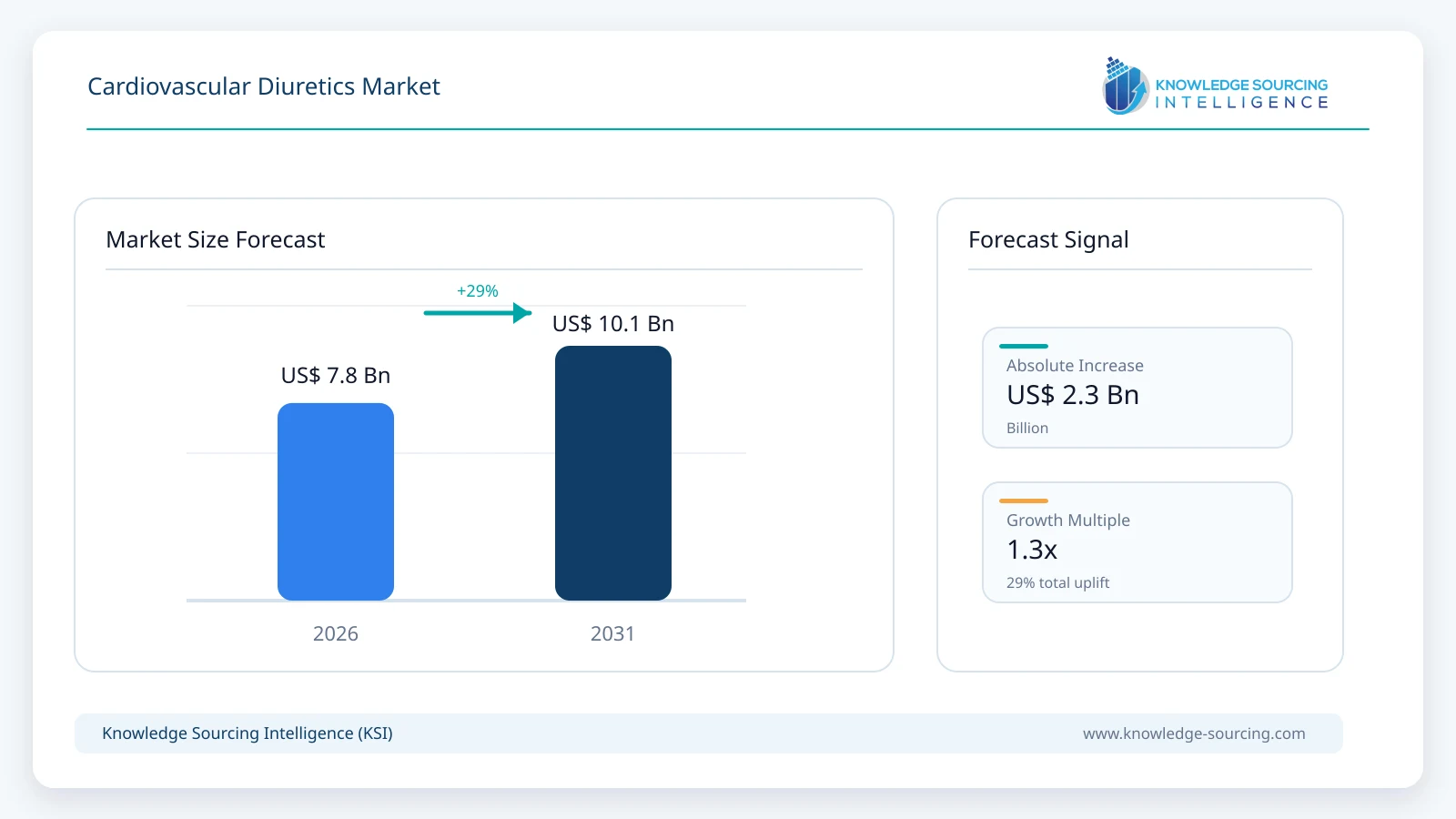
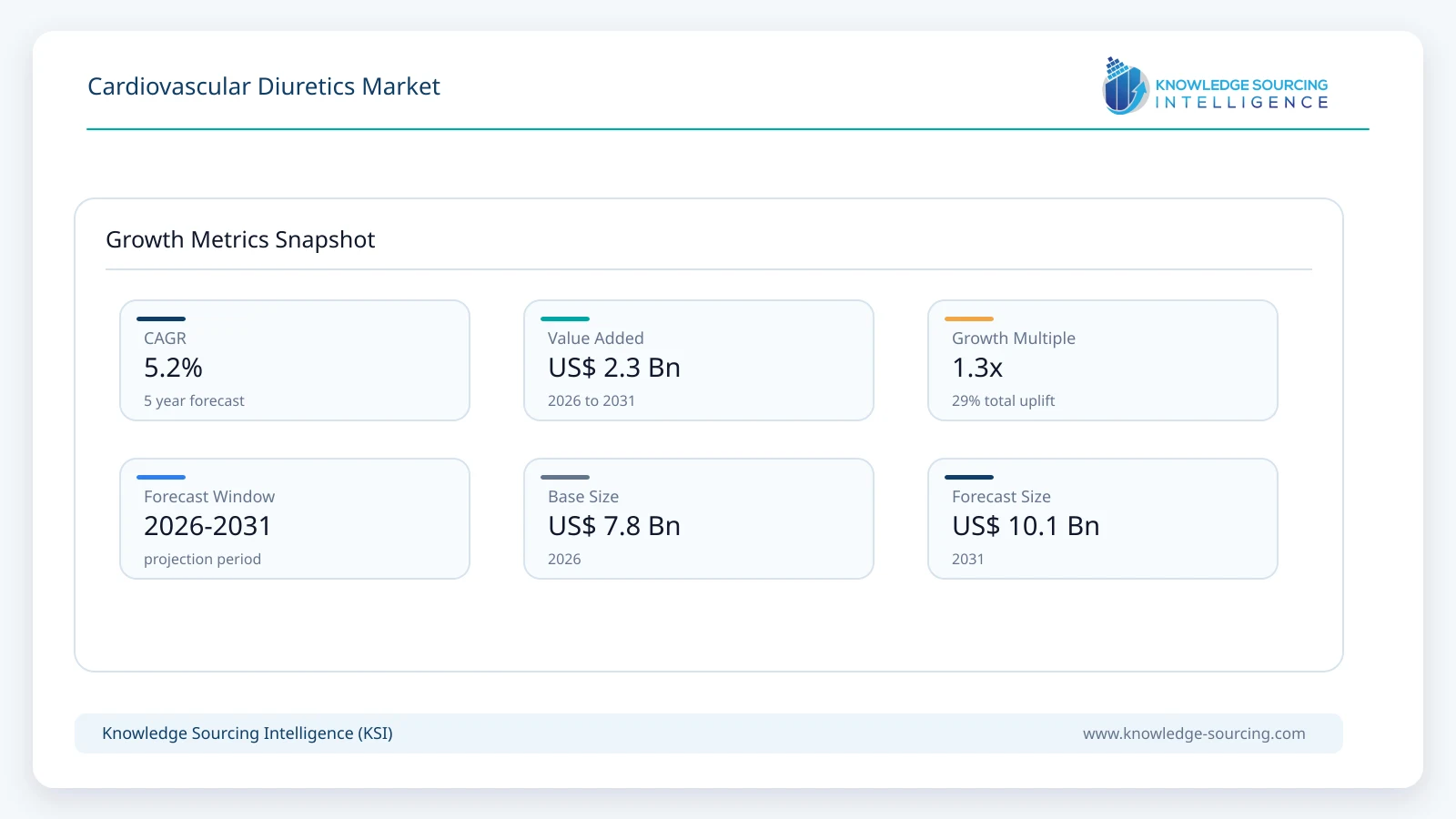
The Cardiovascular Diuretics Market is set to reach USD 10.11 billion in 2031, growing at a CAGR of 5.2 % from USD 7.84 billion in 2026.
Highlights:
- 1Diuretics remain among the most prescribed cardiovascular therapies globally.
- 2Thiazide diuretics dominate hypertension treatment because of strong efficacy and low cost.
- 3Loop diuretics are widely utilized in heart failure and edema management.
- 4Aldosterone antagonists such as spironolactone are increasingly important in resistant hypertension and heart failure therapy.
Diuretics are a foundational class of cardiovascular medicines widely used in the management of hypertension, heart failure, edema, and fluid retention disorders. These medicines increase renal excretion of sodium and water, helping reduce circulating blood volume, vascular pressure, and cardiac workload. Diuretics are frequently used alone or in combination with ACE inhibitors, ARBs, beta blockers, and calcium channel blockers for comprehensive cardiovascular disease management.
Major molecules including Hydrochlorothiazide, Furosemide, Spironolactone, Torsemide, Bumetanide, and Chlorthalidone are extensively prescribed worldwide. Thiazide diuretics dominate hypertension management, while loop diuretics and aldosterone antagonists play critical roles in heart failure and edema treatment. Extensive generic availability and strong inclusion in cardiovascular treatment guidelines continue supporting large-scale global utilization.
Market Dynamics
Market Drivers
Increasing Global Prevalence of Hypertension
Hypertension remains one of the largest chronic disease burdens worldwide and is a primary driver of diuretic demand. Diuretics are extensively recommended as first-line or combination antihypertensive therapies because of their proven efficacy, affordability, and strong clinical evidence.
Rising Heart Failure and Edema Burden
Heart Failure prevalence continues increasing globally due to aging populations and improved survival from cardiovascular disease. Loop diuretics and aldosterone antagonists are essential in fluid management and symptom control in heart failure patients.
Strong Generic Availability
Most major diuretic molecules are available as inexpensive generics from multinational and regional pharmaceutical manufacturers. Broad affordability and inclusion in national essential medicines lists support extensive utilization globally.
Growing Combination Therapy Use
Diuretics are increasingly used in fixed-dose combinations with ARBs, ACE inhibitors, and beta blockers to improve blood pressure control and patient adherence in chronic cardiovascular disease management.
Market Restraints
Intense generic competition limits pricing growth and manufacturer profitability.
Electrolyte disturbances including hypokalemia, hyponatremia, and dehydration may limit therapy in certain patients.
Long-term diuretic therapy requires clinical monitoring in high-risk populations.
Newer cardiovascular drug classes are increasing competition in heart failure management.
Adverse effects such as dizziness, renal dysfunction, and metabolic disturbances may reduce adherence.
Market Opportunities
Expansion in Emerging Markets
Growing diagnosis and treatment of hypertension and cardiovascular disease in India, China, Brazil, and Indonesia are supporting increasing demand for affordable diuretic therapies.
Increasing Resistant Hypertension Management
Growing focus on resistant hypertension treatment is expanding utilization of aldosterone antagonists such as spironolactone in combination antihypertensive regimens.
Growth in Chronic Disease Programs
Government healthcare initiatives focused on cardiovascular disease management are increasing access to essential medicines, including diuretics, through reimbursement and procurement programs globally.
Disease & Epidemiology Analysis
Cardiovascular disease remains the leading cause of mortality worldwide and is the major epidemiological driver of diuretic utilization. World Health Organization estimates that cardiovascular disease causes approximately 17.9 million deaths annually worldwide. Hypertension affects more than one billion adults globally and significantly increases the risk of stroke, heart failure, coronary artery disease, and kidney disease.
Heart Failure prevalence continues increasing globally due to aging populations and rising cardiometabolic disease burden. Loop diuretics, including furosemide and torsemide, are essential for managing fluid overload and pulmonary edema. Aldosterone antagonists such as spironolactone are increasingly utilized in resistant hypertension and advanced heart failure management. Rising obesity, diabetes, chronic kidney disease, and sedentary lifestyles continue to support long-term growth in cardiovascular medicine utilization worldwide.
Treatment Guidelines Landscape
Diuretic Category | Representative Molecules | Primary Clinical Applications | Guideline Significance |
Thiazide Diuretics | Hydrochlorothiazide, Chlorthalidone | Hypertension | Strong first-line antihypertensive recommendation |
Loop Diuretics | Furosemide, Torsemide, Bumetanide | Heart failure and edema | Essential for fluid management |
Potassium-Sparing Diuretics | Spironolactone | Resistant hypertension | Important adjunctive therapy |
Aldosterone Antagonists | Spironolactone | Heart failure and resistant hypertension | Strong evidence in heart failure outcomes |
Osmotic Diuretics | Mannitol | Specialized acute care use | Limited cardiovascular niche applications |
Market Segmentation
By Drug Class
Thiazide diuretics represent the largest drug class segment in the global diuretics market because of their widespread use as first-line therapies for hypertension management. Hydrochlorothiazide and Chlorthalidone are extensively prescribed because of their strong efficacy, affordability, and broad clinical evidence. Loop diuretics such as Furosemide and Torsemide maintain essential roles in heart failure and edema management. Aldosterone antagonists including Spironolactone are increasingly utilized in resistant hypertension and advanced heart failure therapy. Strong generic availability and guideline support continue sustaining long-term global prescription demand across all major diuretic categories.
By Molecule
Hydrochlorothiazide dominates the molecule segment because it is one of the most widely prescribed antihypertensive medicines globally and is commonly incorporated into fixed-dose cardiovascular combination therapies. Other important molecules including Furosemide, Spironolactone, Torsemide, Bumetanide, and Chlorthalidone maintain strong prescription demand in heart failure, edema, and resistant hypertension management. Generic competition dominates the segment, supporting broad patient access and high-volume utilization across developed and emerging healthcare markets worldwide.
By Indication
Hypertension represents the largest indication segment within the global diuretics market because of its exceptionally high prevalence and lifelong treatment requirements. Diuretics are widely recommended as first-line or adjunctive therapies due to their effectiveness, low cost, and strong clinical evidence. Additional demand comes from heart failure, edema associated with cardiovascular disease, resistant hypertension, and acute pulmonary edema management. Rising prevalence of obesity, diabetes, chronic kidney disease, and aging populations continues to increase cardiovascular risk globally. Strong inclusion in treatment guidelines and broad generic availability continue supporting stable long-term prescription growth across both outpatient and hospital cardiovascular care settings.
REGIONAL ANALYSIS
North America
North America represents one of the largest diuretics markets globally due to high prevalence of hypertension, heart failure, obesity, diabetes, and chronic cardiovascular disease. The United States accounts for the majority of regional demand supported by advanced healthcare infrastructure, strong insurance coverage, and widespread cardiovascular disease screening programs. Generic diuretics are extensively utilized because of favorable reimbursement policies and strong physician familiarity. Increasing elderly population and rising chronic disease burden continue supporting long-term prescription growth. Combination antihypertensive therapies incorporating diuretics are also increasingly prescribed to improve blood pressure control and long-term cardiovascular risk management throughout the region.
Europe
Europe represents a mature and highly regulated diuretics market supported by universal healthcare systems, strong generic medicine utilization, and aging populations. Major markets including Germany, France, United Kingdom, Italy, and Spain maintain high prescription volumes for hypertension and heart failure management. Cost-containment policies strongly encourage generic substitution, improving patient access to low-cost cardiovascular therapies. Rising prevalence of obesity, cardiovascular disease, and chronic kidney disease continues supporting stable demand for diuretics across European healthcare systems and hospital treatment programs.
Asia Pacific
Asia Pacific is expected to witness the fastest growth in the global diuretics market due to rapidly increasing hypertension prevalence, urbanization, aging populations, and expanding healthcare access. India and China are major contributors because of their very large patient populations and improving chronic disease diagnosis rates. Domestic pharmaceutical manufacturers including Sun Pharmaceutical, Dr. Reddy’s, Lupin, Aurobindo, and Zydus are strengthening affordable generic medicine supply. Government healthcare initiatives, growing insurance coverage, and increasing awareness regarding cardiovascular disease management continue supporting strong long-term market expansion across the region.
Rest of the World
Latin America, the Middle East, and Africa are experiencing gradual growth in diuretic utilization due to improving healthcare infrastructure and increasing diagnosis of cardiovascular disease. Public procurement initiatives and expansion of generic medicine availability are improving access to affordable hypertension and heart failure therapies. Rising urbanization, obesity prevalence, sedentary lifestyles, and aging populations are contributing to increasing cardiovascular risk across developing economies. Although healthcare funding limitations remain a challenge in certain regions, expanding chronic disease management programs and improving healthcare access are expected to support steady long-term market growth.
Regulatory Landscape
Diuretics operate within highly standardized global regulatory frameworks overseen by agencies including the U.S. Food and Drug Administration, European Medicines Agency, and Central Drugs Standard Control Organisation. Regulatory activity primarily focuses on generic approvals, bioequivalence studies, manufacturing inspections, and post-marketing safety monitoring because most diuretics are off-patent.
Manufacturers must maintain Good Manufacturing Practice compliance, strong quality systems, and supply reliability to sustain regulatory approvals. Increasing regulatory scrutiny of pharmaceutical manufacturing quality and supply chain integrity continues influencing global cardiovascular generic markets.
Pipeline Analysis
The diuretics market is characterized by limited novel molecular innovation and strong focus on generic expansion, lifecycle management, and fixed-dose combination development. Pharmaceutical companies continue investing in combination therapies pairing diuretics with ARBs, ACE inhibitors, and calcium channel blockers to improve adherence and optimize blood pressure management.
Development efforts are also focused on strengthening heart failure management strategies and improving fluid overload treatment in chronic cardiovascular disease patients. Although scientific innovation is limited compared with newer cardiovascular drug classes, diuretics remain commercially important because of their large global patient base and essential role in long-term cardiovascular disease treatment.
Reimbursement Landscape
Diuretics benefit from highly favorable reimbursement globally because they are inexpensive, clinically established, and strongly recommended in cardiovascular treatment guidelines. Most products are available as low-cost generics and are included in public formularies, hospital procurement systems, and insurance reimbursement programs worldwide.
Government healthcare programs, generic substitution policies, and national procurement initiatives support broad patient access while maintaining low treatment costs. Expanding healthcare coverage and chronic disease management initiatives in emerging markets continue supporting reimbursement-driven utilization growth for cardiovascular medicines including diuretics.
Strategic Competitive Landscape
Company Profiles
Pfizer Inc.
Pfizer Inc. is one of the world’s largest pharmaceutical companies with diversified operations spanning cardiovascular medicine, oncology, vaccines, and specialty therapeutics. The company maintains strong global manufacturing and commercialization infrastructure supporting mature cardiovascular medicine markets including diuretics. Pfizer generated revenue exceeding USD 60 billion in 2025. Recent developments include strategic acquisitions, expansion of innovative medicine portfolios, and strengthening of international commercial operations.
Novartis AG
Novartis AG is a major global pharmaceutical company with extensive cardiovascular expertise and strong international regulatory capabilities. The company generated revenue exceeding USD 50 billion in 2025. Recent developments include operational optimization initiatives, continued investment in innovative therapeutics, and expansion of advanced medicine commercialization strategies supporting long-term pharmaceutical growth.
Viatris Inc.
Viatris Inc. is one of the world’s largest suppliers of generic and branded medicines with extensive cardiovascular product offerings including diuretics. The company benefits from broad manufacturing infrastructure, diversified supply chains, and extensive international distribution capabilities. Viatris generated revenue exceeding USD 15 billion in 2025.
Teva Pharmaceutical Industries Ltd.
Teva Pharmaceutical Industries Ltd. is a leading global generic pharmaceutical manufacturer with significant cardiovascular medicine operations. The company generated revenue exceeding USD 16 billion in 2025 and continues strengthening manufacturing modernization and supply chain optimization initiatives supporting global generic medicine supply.
Sun Pharmaceutical Industries Ltd.
Sun Pharmaceutical Industries Ltd. is India’s largest pharmaceutical company and a major supplier of cardiovascular medicines globally. The company generated revenue exceeding USD 6 billion in fiscal 2025 and continues expanding chronic therapy portfolios and regulated market penetration.
Dr. Reddy's Laboratories Ltd.
Dr. Reddy's Laboratories Ltd. is a major Indian pharmaceutical manufacturer with strong formulation development and global commercialization capabilities supporting cardiovascular medicine supply. The company generated revenue exceeding USD 3 billion in fiscal 2025.
Lupin Limited
Lupin Limited is a leading pharmaceutical company with broad expertise in chronic disease therapeutics including cardiovascular medicines. The company generated revenue exceeding USD 2.5 billion in fiscal 2025 and maintains strong international commercialization operations.
Sanofi S.A.
Sanofi S.A. is a multinational healthcare company with diversified pharmaceutical and specialty therapeutic operations. The company generated revenue exceeding EUR 45 billion in 2025 and maintains broad international market access infrastructure supporting participation in cardiovascular medicine markets.
Aurobindo Pharma Limited
Aurobindo Pharma Limited is a major Indian pharmaceutical manufacturer with strong active pharmaceutical ingredient and finished dosage production capabilities supporting global generic medicine commercialization. The company generated revenue exceeding USD 3.5 billion in fiscal 2025.
Zydus Lifesciences Limited
Zydus Lifesciences Limited is a prominent Indian pharmaceutical company with expanding international operations and broad generic medicine offerings including cardiovascular therapies. The company generated revenue exceeding USD 2 billion in fiscal 2025 and continues strengthening regulated market presence globally.
Key Developments
March 2026 – Viatris Inc. Expanded Cardiovascular Generic Manufacturing : Viatris strengthened manufacturing and international distribution capabilities for high-volume cardiovascular medicines including major diuretic formulations.
February 2026 – Sun Pharmaceutical Industries Ltd. Expanded Chronic Therapy Portfolio :Sun Pharmaceutical expanded commercialization of cardiovascular generics including diuretic combinations across regulated and emerging markets.
January 2026 – Dr. Reddy's Laboratories Ltd. Increased International Product Approvals: Dr. Reddy’s strengthened global approvals and commercialization of cardiovascular generics including loop and thiazide diuretics.
December 2025 – Aurobindo Pharma Limited Expanded Cardiovascular Production Capacity: Aurobindo increased manufacturing capabilities for chronic cardiovascular medicines to support growing global demand for affordable generics.
Strategic Insights and Future Market Outlook
The global diuretics market is expected to maintain stable long-term growth through 2031 driven by increasing prevalence of hypertension, heart failure, chronic kidney disease, obesity, and aging populations worldwide. Thiazide diuretics will continue dominating hypertension management, while loop diuretics and aldosterone antagonists remain essential in heart failure and fluid overload treatment.
Future market growth will be primarily volume-driven because of intense generic competition and widespread low-cost availability. Manufacturers with efficient production capabilities, regulatory compliance strength, and broad international supply networks are expected to maintain competitive advantages. Asia Pacific is projected to generate the strongest growth due to expanding healthcare access and increasing chronic disease burden in emerging economies.
Cardiovascular Diuretics Market Scope:
| Report Metric | Details |
|---|---|
| Total Market Size in 2026 | USD 7.84 billion |
| Total Market Size in 2031 | USD 10.11 billion |
| Forecast Unit | USD Billion |
| Growth Rate | 5.2% |
| Study Period | 2021 to 2031 |
| Historical Data | 2021 to 2024 |
| Base Year | 2025 |
| Forecast Period | 2026 – 2031 |
| Segmentation | Drug Class, Molecule, Indication, Geography |
| Companies |
|
Market Segmentation
By Drug Class
- Thiazide Diuretics
- Loop Diuretics
- Potassium-Sparing Diuretics
- Aldosterone Antagonists
- Osmotic Diuretics
By Molecule
- Hydrochlorothiazide
- Furosemide
- Spironolactone
- Torsemide
- Bumetanide
- Chlorthalidone
- Others
By Indication
- Hypertension
- Heart Failure
- Edema Associated with Cardiovascular Disease
- Resistant Hypertension
- Acute Pulmonary Edema
By Route of Administration
- Oral
- Intravenous
By Distribution Channel
- Hospital Pharmacies
- Retail Pharmacies
- Online Pharmacies
By Geography
- North America
- Europe
- Asia-Pacific
- Latin America
- Middle East & Africa
Table of Contents
Executive Summary
1.1 Cardiovascular Diuretics Market Scope and Objectives
1.2 Key Market Insights and Strategic Highlights
1.3 Therapeutic Utilization Snapshot Across Cardiovascular Indications
1.4 Market Growth Outlook and Revenue Forecast
1.5 Strategic Conclusions
2. Cardiovascular Diuretics Market Overview
2.1 Definition and Scope of Cardiovascular Diuretics Market
2.2 Cardiovascular Diuretics Market Size Analysis 2018–2024
2. Cardiovascular Diuretics Market Size Forecast 2025–2035
2.4 Market Drivers
2.4.1 Rising Prevalence of Hypertension and Heart Failure
2.4.2 Increasing Burden of Fluid Retention Disorders in Cardiovascular Disease
2.4.3 Broad Generic Availability and Cost-Effective Therapy Adoption
2.4.4 Growing Elderly Population with Cardiovascular Comorbidities
2.5 Market Restraints
2.5.1 Electrolyte Imbalance and Renal Safety Concerns
2.5.2 Poor Treatment Adherence Due to Frequent Urination Effects
2.5.3 Competition from Newer Cardiovascular Therapeutics
2.6 Market Opportunities
2.6.1 Expansion in Emerging Markets
2.6.2 Fixed-Dose Combination Product Development
2.6.3 Increased Use in Comprehensive Heart Failure Management
2.7 Cardiovascular Diuretics Market Segmentation
2.7.1 By Drug Class
2.7.1.1 Thiazide Diuretics
2.7.1.2 Loop Diuretics
2.7.1.3 Potassium-Sparing Diuretics
2.7.1.4 Aldosterone Antagonists
2.7.1.5 Osmotic Diuretics
2.7.2 By Molecule
2.7.2.1 Hydrochlorothiazide
2.7.2.2 Furosemide
2.7.2.3 Spironolactone
2.7.2.4 Torsemide
2.7.2.5 Bumetanide
2.7.2.6 Chlorthalidone
2.7.2.7 Others
2.7.3 By Indication
2.7.3.1 Hypertension
2.7.3.2 Heart Failure
2.7.3.3 Edema Associated with Cardiovascular Disease
2.7.3.4 Resistant Hypertension
2.7.3.5 Acute Pulmonary Edema
2.7.4 By Route of Administration
2.7.4.1 Oral
2.7.4.2 Intravenous
2.7.5 By Distribution Channel
2.7.5.1 Hospital Pharmacies
2.7.5.2 Retail Pharmacies
2.7.5.3 Online Pharmacies
Cardiovascular Disease Epidemiology and Treatment Burden
3.1 Global Prevalence of Cardiovascular Diseases
3.2 Hypertension Epidemiology
3.3 Heart Failure Epidemiology
3.4 Fluid Retention and Edema Burden
3.5 Resistant Hypertension Burden
3.6 Forecast of Treatable Patient Population
Disease and Unmet Need Analysis
4.1 Need for Effective Volume Management in Cardiovascular Disease
4.2 Residual Congestion in Heart Failure Patients
4.3 Treatment Adherence Challenges
4.4 Need for Better Electrolyte and Renal Safety Profiles
4.5 Unmet Need in Low- and Middle-Income Countries
Mechanism of Action and Pharmacology Landscape
5.1 Renal Sodium and Water Regulation Physiology
5.2 Mechanism of Thiazide Diuretics
5.3 Mechanism of Loop Diuretics
5.4 Mechanism of Potassium-Sparing Diuretics
5.5 Aldosterone Antagonism in Heart Failure
5.6 Pharmacokinetic and Pharmacodynamic Considerations
5.7 Comparative Safety and Tolerability Profiles
Clinical and Commercial Intelligence
6.1 Clinical Guideline Positioning
6.2 Utilization by Cardiovascular Indication
6.3 Prescription Volume Trends
6.4 Comparative Effectiveness Benchmarking
6.5 Generic Competition Analysis
6.6 Pricing Trends and Reimbursement Dynamics
6.7 Market Share Analysis by Molecule
6.8 Lifecycle Management Strategies
Product Benchmarking
7.1 Established Standard-of-Care Molecules
7.2 Guideline-Preferred Diuretics
7.3 Extended-Release and Reformulated Products
7.4 Fixed-Dose Combination Products
7.5 Emerging Differentiated Formulations
7.6 Competitive Differentiation Analysis
Market Forecast and Risk Analysis
8.1 Revenue Forecast Modeling
8.2 Demand Forecast by Indication
8.3 Generic Erosion Assessment
8.4 Pricing Pressure Analysis
8.5 Key Risk Factors
8.5.1 Guideline Evolution Risks
8.5.2 Competitive Class Substitution
8.5.3 Supply Chain Disruptions
8.5.4 Reimbursement Changes
8.6 Sensitivity and Scenario Analysis
Competitive Landscape
9.1 Branded vs Generic Market Structure
9.2 Market Share by Manufacturer
9.3 Regional Competitive Positioning
9.4 Portfolio Breadth Analysis
9.5 Strategic Positioning of Leading Suppliers
9.6 Mergers, Acquisitions, and Licensing Activity
Geographic Analysis
10.1 North America
10.2 Europe
10.3 Asia-Pacific
10.4 Latin America
10.5 Middle East and Africa
Key Countries Analysis
11.1 United States
11.2 Canada
11.3 Germany
11.4 United Kingdom
11.5 France
11.6 Italy
11.7 Spain
11.8 China
11.9 Japan
11.10 India
11.11 South Korea
11.12 Australia
11.13 Brazil
11.14 Mexico
11.15 Saudi Arabia
11.16 South Africa
Company Profiles
12.1 Pfizer Inc.
12.1.1 Overview
12.1.2 Financials
12.1.3 Product Portfolio
12.1.4 Recent Developments
12.2 Novartis AG
12.2.1 Overview
12.2.2 Financials
12.2.3 Product Portfolio
12.2.4 Recent Developments
12.3 Viatris Inc.
12.3.1 Overview
12.3.2 Financials
12.3.3 Product Portfolio
12.3.4 Recent Developments
12.4 Teva Pharmaceutical Industries Ltd.
12.4.1 Overview
12.4.2 Financials
12.4.3 Product Portfolio
12.4.4 Recent Developments
12.5 Sun Pharmaceutical Industries Ltd.
12.5.1 Overview
12.5.2 Financials
12.5.3 Product Portfolio
12.5.4 Recent Developments
12.6 Dr. Reddy's Laboratories Ltd.
12.6.1 Overview
12.6.2 Financials
12.6.3 Product Portfolio
12.6.4 Recent Developments
12.7 Lupin Limited
12.7.1 Overview
12.7.2 Financials
12.7.3 Product Portfolio
12.7.4 Recent Developments
12.8 Sanofi S.A.
12.8.1 Overview
12.8.2 Financials
12.8.3 Product Portfolio
12.8.4 Recent Developments
12.9 Aurobindo Pharma Limited
12.9.1 Overview
12.9.2 Financials
12.9.3 Product Portfolio
12.9.4 Recent Developments
12.10 Zydus Lifesciences Limited
12.10.1 Overview
12.10.2 Financials
12.10.3 Product Portfolio
12.10.4 Recent Developments
Future Outlook and Strategic Insights
13.1 Expansion in Heart Failure and Resistant Hypertension Management
13.2 Growth of Combination Therapies and Guideline-Directed Care
13.3 Intensifying Generic Competition
13.4 Opportunities in Emerging Markets and Aging Populations
13.5 Strategic Recommendations
Methodology and Data Framework
14.1 Data Sources
14.2 Epidemiology Modeling Approach
14.3 Market Sizing and Forecasting Methodology
14.4 Competitive Benchmarking Framework
14.5 Assumptions and Limitations
Navigate
Trusted by the world's leading organizations











