
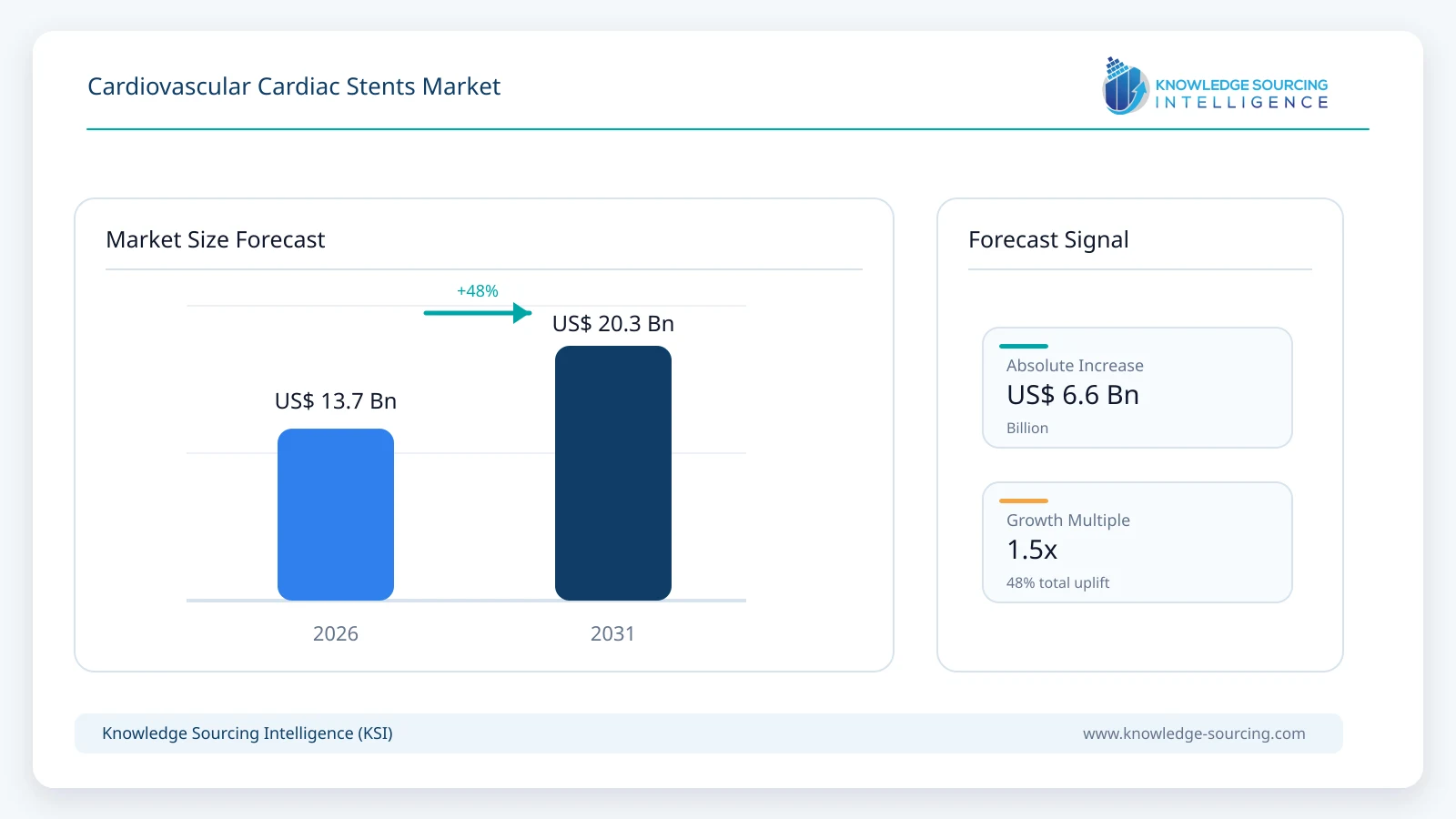
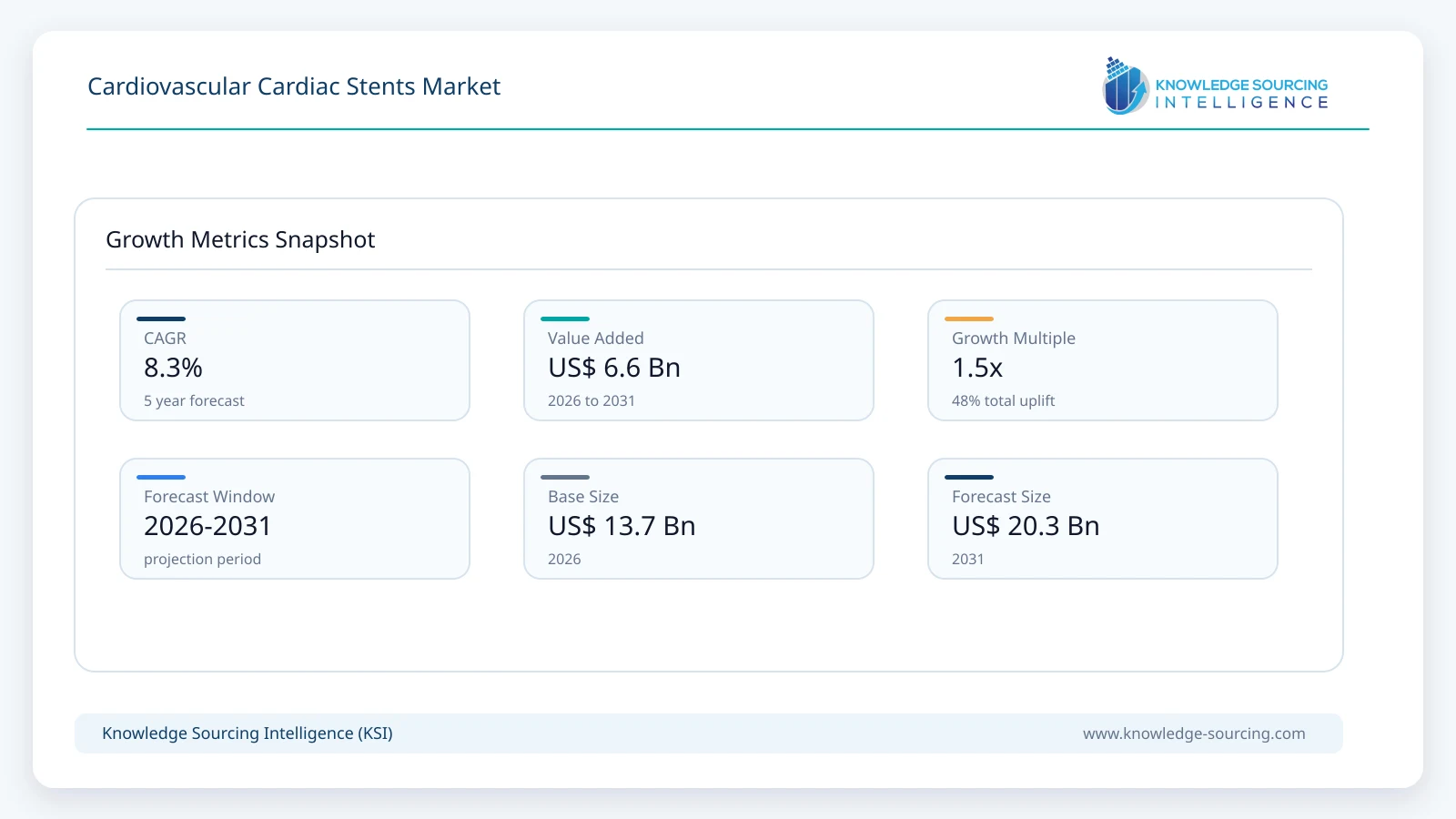
The Cardiovascular Cardiac Stents Market is set to reach USD 20.3 billion in 2031, growing at a CAGR of 8.3 % from USD 13.7 billion in 2026.
Highlights:
- 1Drug-eluting stents dominate global cardiac stent utilization due to reduced restenosis rates.
- 2Rising prevalence of coronary artery disease continues driving demand for interventional cardiology procedures.
- 3Minimally invasive cardiovascular procedures are increasingly preferred over open surgical interventions.
- 4Advanced biomaterials and thinner stent platforms are improving procedural outcomes.
Cardiac stents are minimally invasive cardiovascular devices implanted within narrowed or blocked coronary arteries to restore blood flow and prevent vessel re-occlusion. These devices play a central role in percutaneous coronary intervention procedures for treatment of coronary artery disease, acute myocardial infarction, chronic total occlusion, and complex coronary lesions. Cardiac stents improve myocardial perfusion, reduce angina symptoms, and significantly lower the risk of major adverse cardiovascular events.
The market includes advanced device categories such as drug-eluting stents, bare-metal stents, bioresorbable vascular scaffolds, and covered stents. Drug-eluting stents currently dominate the market because of superior restenosis prevention and improved long-term clinical outcomes. Technological advancements in stent materials, polymer coatings, vessel healing optimization, and minimally invasive interventional cardiology procedures continue driving innovation within the cardiac stents market. Increasing prevalence of cardiovascular disease, rising rates of obesity and diabetes, aging populations, and expansion of catheterization laboratory infrastructure globally are supporting strong market growth.
Market Dynamics
Market Drivers
Increasing Prevalence of Coronary Artery Disease
The growing incidence of coronary artery disease driven by aging populations, diabetes, obesity, smoking, and sedentary lifestyles continues increasing demand for coronary intervention procedures globally.
Rising Adoption of Minimally Invasive Procedures
Percutaneous coronary intervention procedures are increasingly preferred due to shorter recovery times, reduced hospitalization, and improved procedural efficiency compared with surgical alternatives.
Technological Advancements in Stent Design
Continuous innovation in drug coatings, biodegradable polymers, thin-strut platforms, and vascular healing technologies is improving clinical outcomes and reducing complications.
Expansion of Cardiac Care Infrastructure
Increasing availability of catheterization laboratories, interventional cardiology centers, and emergency cardiac care facilities is supporting broader procedural access globally.
Market Restraints
High procedural costs may limit accessibility in low-resource healthcare systems.
Risk of stent thrombosis and restenosis remains an important clinical concern.
Competition from coronary artery bypass grafting and medical management strategies may affect procedural volumes.
Regulatory requirements for cardiovascular devices remain stringent.
Device recalls and long-term safety concerns may impact market confidence.
Market Opportunities
Growth in Emerging Healthcare Markets
Rapid healthcare infrastructure expansion in developing economies is creating significant opportunities for coronary intervention device manufacturers.
Development of Next-Generation Bioresorbable Technologies
Research into fully bioresorbable vascular scaffolds and polymer-free stent technologies is expected to support long-term innovation.
Integration of Precision Interventional Cardiology
Advances in intravascular imaging, artificial intelligence-assisted procedures, and personalized device selection are improving interventional outcomes.
Disease & Epidemiology Analysis
Coronary Artery Disease remains one of the leading causes of mortality worldwide. Increasing prevalence of hypertension, diabetes, obesity, smoking, dyslipidemia, and sedentary lifestyles continues to drive rising incidence of coronary artery obstruction and acute coronary syndromes globally.
Acute Myocardial Infarction remains a major indication for emergency coronary stenting procedures. Growing awareness regarding early cardiovascular intervention and improvements in emergency cardiac care systems are increasing procedural treatment rates. Chronic total occlusion and left main coronary artery disease also represent important high-complexity intervention segments supporting demand for advanced stent technologies and interventional expertise worldwide.
Treatment Landscape
Product Type | Key Characteristics | Primary Applications | Market Importance |
Drug-Eluting Stents | Drug-coated restenosis prevention | Coronary artery disease | Dominant global segment |
Bare-Metal Stents | Metallic scaffolding support | Select cardiovascular cases | Mature market segment |
Bioresorbable Vascular Scaffolds | Temporary vascular support | Emerging advanced interventions | Innovation-focused segment |
Covered Stents | Specialized lesion treatment | Complex vascular procedures | Niche specialty segment |
Market Segmentation
By Product Type
Drug-eluting stents dominate the cardiac stents market because of superior efficacy in preventing restenosis and reducing repeat revascularization procedures. Advanced drug-polymer coatings improve long-term vessel healing and significantly reduce adverse cardiovascular outcomes compared with traditional bare-metal stents. Bioresorbable vascular scaffolds represent a growing innovation segment focused on temporary vessel support followed by gradual scaffold resorption. Covered stents continue serving specialized applications including perforation repair and complex vascular lesion management. Increasing physician preference for advanced minimally invasive coronary interventions continues supporting strong adoption of next-generation drug-eluting stent technologies globally.
By Material
Cobalt chromium stents dominate the market because of excellent radial strength, thin-strut design capability, and improved flexibility during complex coronary interventions. Platinum chromium materials are increasingly utilized because of enhanced radiopacity and procedural visualization advantages during stent deployment. Stainless steel remains important within cost-sensitive healthcare markets due to affordability and established manufacturing familiarity. Polymer-based materials are gaining increasing research attention because of their role in bioresorbable scaffold technologies and next-generation vascular healing applications. Continuous material science innovation remains critical for improving durability, flexibility, biocompatibility, and long-term clinical outcomes in coronary intervention procedures.
By Indication
Coronary Artery Disease represents the largest indication segment within the cardiac stents market because of its high global prevalence and widespread utilization of percutaneous coronary intervention procedures. Acute Myocardial Infarction remains a major emergency intervention segment requiring rapid coronary revascularization and stent placement. Chronic total occlusion and left main coronary artery disease continue supporting demand for highly specialized interventional techniques and advanced device technologies. Restenosis management also remains clinically important despite improvements in drug-eluting stent efficacy. Increasing prevalence of cardiovascular risk factors globally continues supporting sustained procedural growth across both developed and emerging healthcare markets.
Regional Analysis
North America
North America dominates the cardiac stents market due to advanced interventional cardiology infrastructure, high procedural volumes, favorable reimbursement systems, and strong adoption of innovative cardiovascular devices. The United States remains the largest regional market.
Europe
Europe represents a major cardiac stents market supported by established cardiovascular treatment networks, aging populations, and strong interventional cardiology expertise. Major markets include Germany, France, and United Kingdom.
Asia Pacific
Asia Pacific is expected to witness the fastest growth driven by increasing cardiovascular disease prevalence, expanding healthcare infrastructure, rising medical tourism, and improving access to catheter-based interventions.
Rest of the World
Latin America, the Middle East, and Africa are gradually expanding interventional cardiology capabilities through healthcare modernization initiatives and improved emergency cardiac care systems.
Regulatory Landscape
The cardiac stents market is regulated by agencies including the U.S. Food and Drug Administration and European Medicines Agency alongside medical device regulatory authorities overseeing cardiovascular device approvals, manufacturing standards, post-market surveillance, and long-term safety monitoring. Coronary stents undergo rigorous clinical evaluation due to their high-risk implantable device classification.
Pipeline Analysis
The cardiac stents pipeline focuses on next-generation bioresorbable vascular scaffolds, polymer-free drug-eluting systems, thinner stent platforms, and enhanced vascular healing technologies. Companies are increasingly investing in precision interventional cardiology solutions integrating imaging guidance, artificial intelligence, and personalized stent selection strategies.
Reimbursement Landscape
Cardiac stenting procedures generally receive strong reimbursement support across developed healthcare systems because of their established role in acute coronary syndrome management and coronary artery disease treatment. However, reimbursement variations exist depending on healthcare infrastructure, procedural complexity, and adoption of premium next-generation device technologies.
Strategic Competitive Landscape
Company Profiles
Abbott Laboratories
Abbott Laboratories is a leading global healthcare and medical device company with strong expertise in cardiovascular technologies, diagnostics, nutrition, and diabetes care. The company maintains a dominant position in the cardiac stents market through its advanced drug-eluting stent portfolio and minimally invasive coronary intervention solutions. Abbott continues investing heavily in next-generation vascular technologies, imaging-guided interventions, and structural heart innovations. Recent developments include expansion of interventional cardiology product lines, enhancement of catheter-based therapy platforms, and strengthening of global cardiovascular device manufacturing infrastructure. Abbott’s broad international commercial network and strong physician adoption continue supporting its leadership within coronary intervention markets.
Boston Scientific Corporation
Boston Scientific Corporation is a multinational medical technology company specializing in cardiovascular intervention, electrophysiology, structural heart disease, and minimally invasive therapies. The company maintains a strong market presence in coronary stents and advanced catheter-based intervention technologies. Boston Scientific continues expanding drug-eluting stent innovation, imaging integration capabilities, and precision cardiovascular treatment platforms globally. Recent developments include advancement of interventional cardiology research programs, expansion of coronary procedure technologies, and strengthening of global commercialization capabilities. The company’s focus on minimally invasive cardiovascular care and procedural innovation supports its strong competitive position within the cardiac stents market.
Medtronic plc
Medtronic plc is one of the world’s largest medical device companies with diversified operations across cardiovascular technologies, surgical robotics, neuroscience, and diabetes management. The company maintains significant expertise in coronary intervention systems, catheter technologies, and minimally invasive cardiovascular procedures. Medtronic continues investing in next-generation stent systems, advanced vascular access technologies, and integrated interventional cardiology platforms. Recent developments include expansion of cardiovascular device manufacturing capabilities, strengthening of digital procedural guidance technologies, and increased investment in precision cardiac care infrastructure. Medtronic’s global scale and broad cardiovascular portfolio position it strongly within the evolving interventional cardiology market.
Terumo Corporation
Terumo Corporation is a global medical technology company specializing in cardiovascular intervention, vascular access systems, blood management, and catheter-based therapies. The company maintains strong expertise in coronary intervention devices and minimally invasive cardiovascular treatment technologies. Terumo continues strengthening interventional cardiology research capabilities and expanding catheter laboratory procedural solutions internationally. Recent developments include advancement of coronary stent delivery systems, expansion of cardiovascular procedure support technologies, and increased investment in emerging healthcare markets. The company’s strong interventional cardiology focus and global hospital partnerships continue supporting growth within the cardiac stents industry.
B. Braun SE
B. Braun SE is a global healthcare and medical technology company with operations spanning cardiovascular intervention, infusion therapy, surgical technologies, and hospital care solutions. The company participates in coronary intervention markets through vascular access products and interventional cardiology device technologies. B. Braun continues investing in minimally invasive treatment systems, hospital-based cardiovascular care solutions, and procedural safety technologies. Recent developments include expansion of catheter-based therapeutic infrastructure, enhancement of interventional device manufacturing capabilities, and strengthening of healthcare partnerships globally. The company’s integrated hospital care expertise supports its presence within cardiovascular device markets.
Biotronik SE & Co. KG
Biotronik SE & Co. KG is a privately held medical device company specializing in cardiovascular rhythm management, vascular intervention, and implantable cardiac technologies. The company maintains strong expertise in coronary stents, drug-eluting technologies, and advanced vascular healing solutions. Biotronik continues investing in next-generation coronary intervention platforms and minimally invasive cardiovascular procedure innovation. Recent developments include expansion of bioresorbable technology research, advancement of thin-strut stent platforms, and strengthening of cardiovascular clinical research capabilities. The company’s dedicated cardiovascular specialization supports its strong positioning within interventional cardiology and coronary artery disease management markets.
MicroPort Scientific Corporation
MicroPort Scientific Corporation is a global medical device company focused on cardiovascular intervention, orthopedics, electrophysiology, and surgical robotics. The company maintains growing international presence within coronary stent technologies and minimally invasive cardiovascular procedures. MicroPort continues expanding drug-eluting stent manufacturing capabilities and strengthening interventional cardiology commercialization infrastructure across emerging healthcare markets. Recent developments include advancement of polymer-based stent technologies, expansion of cardiovascular clinical programs, and increased investment in international market penetration strategies. The company’s cost-competitive innovation model supports strong growth potential within global coronary intervention markets.
Meril Life Sciences Pvt. Ltd.
Meril Life Sciences Pvt. Ltd. is an Indian medical technology company specializing in cardiovascular intervention, structural heart therapies, orthopedics, and surgical devices. The company has emerged as an important regional player in drug-eluting stent manufacturing and coronary intervention technologies. Meril continues investing in advanced biomaterials, vascular healing technologies, and expansion of international cardiovascular device distribution networks. Recent developments include enhancement of drug-eluting stent production infrastructure, expansion into global healthcare markets, and increased participation in interventional cardiology clinical research. The company’s expanding manufacturing capabilities support growing competitiveness within the cardiac stents market.
Translumina Therapeutics LLP
Translumina Therapeutics LLP is a cardiovascular medical device company specializing in coronary stents, balloon catheters, and interventional cardiology technologies. The company focuses strongly on affordable coronary intervention solutions designed for emerging healthcare systems. Translumina continues expanding drug-eluting stent product offerings and strengthening cardiovascular device manufacturing operations internationally. Recent developments include advancement of next-generation stent platforms, expansion of physician training initiatives, and increased investment in emerging cardiovascular treatment markets. The company’s focus on accessible coronary intervention technologies supports its growing role within developing healthcare economies.
Cook Medical LLC
Cook Medical LLC is a global medical device company specializing in minimally invasive vascular intervention, diagnostic technologies, and hospital procedural devices. The company participates in cardiovascular intervention markets through vascular access systems and specialized catheter-based technologies. Cook Medical continues investing in advanced minimally invasive procedural innovation and interventional therapy development globally. Recent developments include expansion of vascular intervention product capabilities, enhancement of catheter-based procedural technologies, and strengthening of hospital-focused cardiovascular solutions. The company’s expertise in minimally invasive device engineering supports continued participation within the broader cardiovascular intervention market.
Key Developments
March 2026 – Abbott Laboratories Expanded Coronary Intervention Portfolio : Abbott strengthened advanced drug-eluting stent technologies and expanded minimally invasive cardiovascular device commercialization globally.
February 2026 – Boston Scientific Corporation Advanced Interventional Cardiology Innovation : Boston Scientific expanded coronary intervention research initiatives and enhanced imaging-guided cardiovascular procedure capabilities.
January 2026 – Medtronic plc Strengthened Cardiovascular Device Operations : Medtronic increased investment in minimally invasive cardiovascular technologies and advanced coronary intervention systems.
December 2025 – Terumo Corporation Expanded Catheter-Based Therapy Programs : Terumo strengthened interventional cardiology infrastructure and expanded advanced coronary procedure technologies internationally.
Strategic Insights and Future Market Outlook
The global cardiac stents market is expected to witness sustained growth through 2032 driven by the rising prevalence of Coronary Artery Disease, increasing rates of obesity and diabetes, aging populations, and expanding adoption of minimally invasive cardiovascular procedures worldwide. Rapid growth in interventional cardiology procedures and increasing healthcare investment in advanced cardiovascular infrastructure continue supporting strong long-term market expansion across both developed and emerging economies.
Drug-eluting stents are expected to maintain dominant market share because of superior restenosis prevention, reduced repeat intervention rates, and strong long-term clinical outcomes. Continued advancements in polymer coatings, thin-strut platforms, vessel healing technologies, and anti-inflammatory drug delivery systems are further improving stent performance and procedural safety. Manufacturers are increasingly focused on optimizing flexibility, deliverability, and long-term vascular compatibility to support treatment of increasingly complex coronary lesions.
Cardiovascular Cardiac Stents Market Scope:
| Report Metric | Details |
|---|---|
| Total Market Size in 2026 | USD 13.7 billion |
| Total Market Size in 2031 | USD 20.3 billion |
| Forecast Unit | USD Billion |
| Growth Rate | 8.3% |
| Study Period | 2021 to 2031 |
| Historical Data | 2021 to 2024 |
| Base Year | 2025 |
| Forecast Period | 2026 – 2031 |
| Segmentation | Product Type, Material, Indication, Geography |
| Companies |
|
Market Segmentation
By Product Type
- Drug-Eluting Stents
- Bare-Metal Stents
- Bioresorbable Vascular Scaffolds
- Covered Stents
By Material
- Cobalt Chromium
- Platinum Chromium
- Stainless Steel
- Polymer-Based Materials
By Indication
- Coronary Artery Disease
- Acute Myocardial Infarction
- Chronic Total Occlusion
- Left Main Coronary Artery Disease
- Restenosis Management
By End User
- Hospitals
- Cardiac Catheterization Laboratories
- Specialty Cardiac Centers
By Geography
- North America
- Europe
- Asia-Pacific
- Latin America
- Middle East & Africa
Table of Contents
1. EXECUTIVE SUMMARY
1.1 Cardiovascular Cardiac Stents Market Scope and Objectives
1.2 Key Market Insights and Strategic Highlights
1.3 Procedure Volume and Adoption Trends
1.4 Market Growth Outlook and Revenue Forecast
1.5 Strategic Conclusions
2. CARDIOVASCULAR CARDIAC STENTS MARKET OVERVIEW
2.1 Definition and Scope of Cardiovascular Cardiac Stents Market
2.2 Cardiovascular Cardiac Stents Market Size Analysis 2018–2024
2.3 Cardiovascular Cardiac Stents Market Size Forecast 2025–2035
2.4 Market Drivers
2.4.1 Rising Prevalence of Coronary Artery Disease
2.4.2 Increasing Percutaneous Coronary Intervention Procedure Volumes
2.4.3 Technological Advancements in Drug-Eluting Stents
2.4.4 Growing Aging Population with Cardiovascular Disorders
2.5 Market Restraints
2.5.1 Risk of In-Stent Restenosis and Thrombosis
2.5.2 High Procedure and Device Costs
2.5.3 Competition from Coronary Artery Bypass Grafting Procedures
2.6 Market Opportunities
2.6.1 Development of Bioresorbable and Next-Generation Stents
2.6.2 Expansion in Emerging Markets
2.6.3 Increasing Adoption of Minimally Invasive Cardiac Procedures
2.7 Cardiovascular Cardiac Stents Market Segmentation
2.7.1 By Product Type
2.7.1.1 Drug-Eluting Stents
2.7.1.2 Bare-Metal Stents
2.7.1.3 Bioresorbable Vascular Scaffolds
2.7.1.4 Covered Stents
2.7.2 By Material
2.7.2.1 Cobalt Chromium
2.7.2.2 Platinum Chromium
2.7.2.3 Stainless Steel
2.7.2.4 Polymer-Based Materials
2.7.3 By Indication
2.7.3.1 Coronary Artery Disease
2.7.3.2 Acute Myocardial Infarction
2.7.3.3 Chronic Total Occlusion
2.7.3.4 Left Main Coronary Artery Disease
2.7.3.5 Restenosis Management
2.7.4 By End User
2.7.4.1 Hospitals
2.7.4.2 Cardiac Catheterization Laboratories
2.7.4.3 Specialty Cardiac Centers
3. CARDIOVASCULAR DISEASE EPIDEMIOLOGY AND PROCEDURE BURDEN
3.1 Global Prevalence of Cardiovascular Diseases
3.2 Coronary Artery Disease Epidemiology
3.3 Acute Coronary Syndrome Burden
3.4 Percutaneous Coronary Intervention Procedure Trends
3.5 Mortality and Disability Burden from Ischemic Heart Disease
3.6 Forecast of Treatable Patient Population
4. DISEASE AND UNMET NEED ANALYSIS
4.1 Need for Durable Coronary Revascularization
4.2 Residual Risk of Restenosis and Thrombosis
4.3 Complex Coronary Lesion Management Challenges
4.4 Need for Improved Long-Term Safety and Biocompatibility
4.5 Unmet Need in Emerging Healthcare Systems
5. TECHNOLOGY AND PRODUCT LANDSCAPE
5.1 Evolution of Coronary Stent Technologies
5.2 Drug-Eluting Stent Technology Analysis
5.3 Bioresorbable Scaffold Development Trends
5.4 Polymer-Free and Biocompatible Coating Innovations
5.5 Imaging-Guided and Precision Stenting Technologies
5.6 Comparative Performance and Safety Profiles
6. CLINICAL AND COMMERCIAL INTELLIGENCE
6.1 Clinical Guideline Positioning
6.2 Procedure Utilization Trends
6.3 Comparative Effectiveness Benchmarking
6.4 Pricing Trends and Reimbursement Dynamics
6.5 Market Share Analysis by Product Type
6.6 Hospital Procurement and Purchasing Trends
6.7 Lifecycle Management Strategies
6.8 Regulatory Approval and Compliance Analysis
7. PRODUCT BENCHMARKING
7.1 Established Standard-of-Care Drug-Eluting Stents
7.2 Thin-Strut and Next-Generation Stent Benchmarking
7.3 Bioresorbable Scaffold Benchmarking
7.4 High-Risk Lesion Stent Benchmarking
7.5 Emerging Differentiated Technologies
7.6 Competitive Differentiation Analysis
8. MARKET FORECAST AND RISK ANALYSIS
8.1 Revenue Forecast Modeling
8.2 Procedure Volume Forecast
8.3 Pricing and Reimbursement Sensitivity Analysis
8.4 Technology Adoption Forecast
8.5 Key Risk Factors
8.5.1 Restenosis and Device Failure Risks
8.5.2 Regulatory and Product Recall Risks
8.5.3 Competition from Surgical Revascularization
8.5.4 Supply Chain and Manufacturing Risks
8.6 Sensitivity and Scenario Analysis
9. COMPETITIVE LANDSCAPE
9.1 Market Share by Manufacturer
9.2 Competitive Positioning of Leading Cardiac Stent Products
9.3 Innovation and Patent Landscape Analysis
9.4 Portfolio Breadth Analysis
9.5 Strategic Collaborations and Distribution Agreements
9.6 Mergers, Acquisitions, and Investment Activity
10. GEOGRAPHIC ANALYSIS
10.1 North America
10.2 Europe
10.3 Asia-Pacific
10.4 Latin America
10.5 Middle East and Africa
11. KEY COUNTRIES ANALYSIS
11.1 United States
11.2 Canada
11.3 Germany
11.4 United Kingdom
11.5 France
11.6 Italy
11.7 Spain
11.8 China
11.9 Japan
11.10 India
11.11 South Korea
11.12 Australia
11.13 Brazil
11.14 Mexico
11.15 Saudi Arabia
11.16 South Africa
12. COMPANY PROFILES
12.1 Abbott Laboratories
12.1.1 Overview
12.1.2 Financials
12.1.3 Product Portfolio
12.1.4 Recent Developments
12.2 Boston Scientific Corporation
12.2.1 Overview
12.2.2 Financials
12.2.3 Product Portfolio
12.2.4 Recent Developments
12.3 Medtronic plc
12.3.1 Overview
12.3.2 Financials
12.3.3 Product Portfolio
12.3.4 Recent Developments
12.4 Terumo Corporation
12.4.1 Overview
12.4.2 Financials
12.4.3 Product Portfolio
12.4.4 Recent Developments
12.5 B. Braun SE
12.5.1 Overview
12.5.2 Financials
12.5.3 Product Portfolio
12.5.4 Recent Developments
12.6 Biotronik SE & Co. KG
12.6.1 Overview
12.6.2 Financials
12.6.3 Product Portfolio
12.6.4 Recent Developments
12.7 MicroPort Scientific Corporation
12.7.1 Overview
12.7.2 Financials
12.7.3 Product Portfolio
12.7.4 Recent Developments
12.8 Meril Life Sciences Pvt. Ltd.
12.8.1 Overview
12.8.2 Financials
12.8.3 Product Portfolio
12.8.4 Recent Developments
12.9 Translumina Therapeutics LLP
12.9.1 Overview
12.9.2 Financials
12.9.3 Product Portfolio
12.9.4 Recent Developments
12.10 Cook Medical LLC
12.10.1 Overview
12.10.2 Financials
12.10.3 Product Portfolio
12.10.4 Recent Developments
13. FUTURE OUTLOOK AND STRATEGIC INSIGHTS
13.1 Expansion of Minimally Invasive Coronary Interventions
13.2 Growth of Bioresorbable and Next-Generation Stent Technologies
13.3 Increasing Integration of Imaging and Precision Cardiology
13.4 Opportunities in Emerging Markets and High-Risk Patient Populations
13.5 Strategic Recommendations
14. METHODOLOGY AND DATA FRAMEWORK
14.1 Data Sources
14.2 Epidemiology and Procedure Volume Modeling Approach
14.3 Market Sizing and Forecasting Methodology
14.4 Competitive Benchmarking Framework
14.5 Assumptions and Limitations
Navigate
Trusted by the world's leading organizations











