
Cashews Market Size:
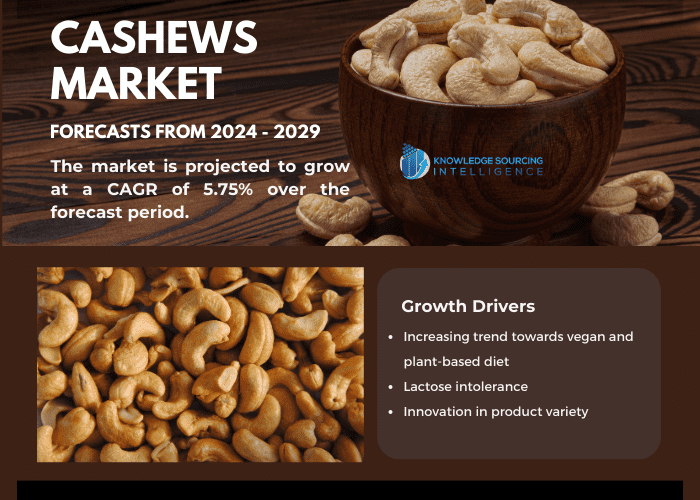
The cashews market is projected to grow at a CAGR of 5.75% during the forecast period thereby reaching a market size of US$17.834 billion in 2029 from US$12.057 billion in 2022.
Highlights:
- 1May 2025:Burkina Faso inaugurated an $11.5M cashew processing factory, reducing raw exports and boosting local value addition for global markets.
- 2June 2023Invest India, a division of the Department of Promotion of Industry and Internal Trade under the Union Ministry of Commerce and Industry in India, launched a series of initiatives that are aimed at promoting local products and uplifting the cashew and feni industries in Goa, India. These measures are taken for support by the Government of Goa during the One District One Product (ODOP) Sampark program held in Panaji, Goa.
- 3May 2023The makers of the Planters snack nuts brand introduced three creative twists on a classic American favourite. These fresh cashew flavours are currently accessible for purchase in retail outlets, enhancing the product portfolio of the globally recognized Planters brand.
Cashews Market Overview:
The global cashew market is shaped by dynamic cashew price trends, driven by fluctuating raw material costs and rising consumer demand for healthy snacks. Cashew market’s volatility persists due to climatic uncertainties and geopolitical trade disruptions, impacting supply stability. The cashew supply chain faces challenges like high transportation costs and regulatory shifts in key producing nations like Côte d'Ivoire and Vietnam. Its production forecasts indicate robust output in West Africa, though weather risks loom. Nonetheless, the global cashew trade is thriving, with Asia-Pacific leading consumption and exports.
The increasing trend towards vegan and plant-based diets is one of the major reasons pushing the market for cashews in the projected period. An increasing number of cashew-infused products are available in the market, which is attracting the younger generation and health-conscious people to give them a try. Furthermore, growing government initiatives are propelling the market.
Cashews Market Trends:
The cashew market is flourishing, fueled by rising demand for plant-based snacks and the expanding vegan food sector. Consumers increasingly prioritize sustainable and ethical food choices, driving the popularity of cashews as a nutrient-dense option. Rich in protein, fiber, and healthy fats, cashews align with the growing trend of healthy snacking, appealing to health-conscious buyers worldwide.
The shift toward clean-label products is reshaping the nut industry, with consumers favoring minimally processed cashews free from artificial additives. This has spurred innovation, with manufacturers introducing organic cashews, flavored cashew varieties, and premium snack products to cater to evolving preferences. The rise of plant-based diets and veganism further boosts demand, as cashews are a versatile ingredient in dairy alternatives like cashew milk and vegan cheese.
Despite challenges such as supply chain disruptions and fluctuating raw material costs, the cashew market remains resilient. Key producing countries, including India, Vietnam, and Côte d'Ivoire, continue to drive global supply, with Vietnam leading as the largest exporter. The market is projected to see robust growth, particularly in premium and health-focused segments, as consumers seek sustainable snacks with high nutritional value.
The global cashew market is expected to expand steadily, supported by rising awareness of cashews’ health benefits and their role in plant-based nutrition. With ongoing innovations and a focus on ethical sourcing, cashews are set to remain a cornerstone of the snack industry worldwide.
Cashews Market Growth Drivers:
- The growing production of cashews and increased imports propel the cashew market.
The demand for cashews is growing in developed countries. For instance, according to the International Nut and Dried Fruit Council, in the crop year 2022/23, almonds and walnuts production accounted for 27% and 22% of the global production, followed by cashews, which accounted for 20% of the global nuts production. Furthermore, the market is anticipated to witness further growth due to various agreements and initiatives aimed at boosting cashew production. For instance, in November 2022, Solidaridad West Africa entered a 2.4 million Euro partnership with the European Union in Sierra Leone to implement the Agro-Tech Development Support program. Running from 2022 to 2026, this four-year initiative aims to advance technology in the cashew value chain, support rural livelihoods, and mitigate natural resource and biodiversity degradation. As per the INC Nuts & Dried Fruits Statistical Yearbook 2022/23, global cashew production has been consistently on the rise. In the 2020/21 period, cashew production, measured on a kernel basis, stood at 8,46,810 metric tons, experiencing an increase to 10,86,270 metric tons.
Furthermore, in 2022/23, the overall production reached 1,095,030 metric tons. The escalating demand for cashews can be attributed to their high nutritional value, digestive health benefits, and the growing popularity of cashew-based snacks. Additionally, the increasing consumption of lactose-free, ready-to-drink cashew milk, serving as an alternative for those with lactose allergies, contributes to the upward trend in cashew production.
Cashews Market Geographical Outlook:
- It is projected that the cashew market in the Asia Pacific will grow steadily.
The cashew market is poised for steady growth, with the Asia-Pacific region leading due to rising demand for cashew-based snacks, health benefits, and robust production capabilities. Cashews, valued for their high fiber, protein content, and versatile applications, are driving market expansion in food and beverage, confectionery, and dairy industries. The market is segmented geographically into North America, South America, Europe, the Middle East and Africa, and Asia-Pacific, with Asia-Pacific dominating due to agricultural production and consumer trends.
India is a global leader in cashew production, accounting for approximately 25.52% of global output, as reported by the International Society for Horticultural Science (ISHS, 2023). In 2021, India produced 729.80 thousand tonnes of cashews, a 4.8% increase from 696.10 thousand tonnes in 2020 (National Horticulture Board, 2021). The country’s rapid population growth and urbanization fuel demand for cashew snacks, consumed raw or roasted, and used in confections like ice cream and candies. For instance, in June 2023, Hershey India Pvt. Ltd., a subsidiary of The Hershey Company, launched the ‘Slurp Up the Fun’ campaign, introducing a cashew butterscotch ice cream milkshake, blending nutrient-rich cashews with consumer-preferred flavors (Hershey India, 2023).
India’s market growth is further supported by innovative cashew varieties and major players like Western India Cashew Company. In September 2021, the Directorate of Cashew Research introduced Nethra Jumbo-1, a hybrid cashew variety enhancing yield and quality (Directorate of Cashew Research, 2021). Additionally, in September 2022, the Kerala State Cooperative Consumer’s Federation (Supplyco) partnered with KSCDC to distribute cashew products through retail outlets, boosting market reach (KSCDC, 2022).
As a leading cashew exporter, India recorded $40 million in cashew exports in March 2022, a 19% increase from February 2022, driven by global demand (India Trade Portal, Ministry of Commerce & Industry, 2022). Events like National Cashew Day on November 23, 2023, organized by APEDA across Tamil Nadu, Karnataka, Kerala, Odisha, Maharashtra, Andhra Pradesh, and Meghalaya, highlight Indian cashews as a significant agricultural export (APEDA, 2023).
Globally, North America and Europe are key markets, driven by health-conscious consumers and demand for plant-based foods. South America, and Middle East and Africa are emerging due to rising disposable incomes. Challenges like supply chain disruptions persist, but sustainable farming and technological advancements in cashew processing mitigate these issues. The cashew market thrives on healthy snacking, export growth, product innovation, and regional agricultural strength, with Asia-Pacific leading the charge.
Cashews Market Developments:
List of Top Cashews Companies:
- Delicious Cashew Co
- Wonderland Foods
- Royal Dry Fruits Pvt Ltd.
- Nutty Yogi
- Haldirams
Cashews Market Scope:
| Report Metric | Details |
|---|---|
| Study Period | 2021 to 2031 |
| Historical Data | 2021 to 2024 |
| Base Year | 2025 |
| Forecast Period | 2026 – 2031 |
| Report Metric | Details |
| Cashews Market Size in 2022 | US$12.057 billion |
| Cashews Market Size in 2029 | US$17.834 billion |
| Growth Rate | CAGR of 5.75% |
| Base Year | 2022 |
| Forecast Period | 2024 – 2029 |
| Forecast Unit (Value) | USD Billion |
| Segmentation |
|
| Geographical Segmentation | North America, South America, Europe, Middle East and Africa, Asia Pacific |
| List of Major Companies in Cashews Market |
|
| Customization Scope | Free report customization with purchase |
Cashews Market Segmentation:
- By Distribution Channel:
- Online
- Offline
- By End-User Industry:
- Bakery and Confectionery
- Breakfast Cereals
- Dairy Products and Flavored Drinks
- Snacks
- By Geography
- North America
- By Distribution Channel
- By End-User Industry
- By Country
- USA
- Canada
- Mexico
- South America
- By Distribution Channel
- By End-User Industry
- By Country
- Brazil
- Argentina
- Others
- Europe
- By Distribution Channel
- By End-User Industry
- By Country
- United Kingdom
- Germany
- France
- Spain
- Italy
- Others
- Middle East and Africa
- By Distribution Channel
- By End-User Industry
- By Country
- Saudi Arabia
- UAE
- Others
- Asia Pacific
- By Distribution Channel
- By End-User Industry
- By Country
- China
- Japan
- India
- South Korea
- Taiwan
- Indonesia
- Thailand
- Others
- North America
Our Best-Performing Industry Reports:
Navigation
- Cashews Market Size:
- Cashews Market Overview:
- Cashews Market Trends:
- Cashews Market Growth Drivers:
- Cashews Market Geographical Outlook:
- Cashews Market Developments:
- List of Top Cashews Companies:
- Cashews Market Scope:
- Our Best-Performing Industry Reports:
Page last updated on: September 17, 2025
Table of Contents
1. INTRODUCTION
1.1. Market Overview
1.2. Market Definition
1.3. Scope of the Study
1.4. Market Segmentation
1.5. Currency
1.6. Assumptions
1.7. Base, and Forecast Years Timeline
2. RESEARCH METHODOLOGY
2.1. Research Data
2.2. Research Process
3. EXECUTIVE SUMMARY
3.1. Key Findings
4. MARKET DYNAMICS
4.1. Market Drivers
4.2. Market Restraints
4.3. Porter’s Five Forces Analysis
4.3.1. Bargaining Power of Suppliers
4.3.2. Bargaining Power of Buyers
4.3.3. Threat of New Entrants
4.3.4. Threat of Substitutes
4.3.5. Competitive Rivalry in the Industry
4.4. Industry Value Chain Analysis
5. CASHEWS MARKET BY DISTRIBUTION CHANNEL
5.1. Introduction
5.2. Online
5.3. Offline
6. CASHEWS MARKET BY END-USER INDUSTRY
6.1. Introduction
6.2. Bakery and Confectionary
6.3. Breakfast Cereals
6.4. Dairy Products and Flavored Drinks
6.5. Snacks
7. CASHEWS MARKET BY GEOGRAPHY
7.1. Introduction
7.2. North America
7.2.1. By Distribution Channel
7.2.2. By End-User Industry
7.2.3. By Country
7.2.3.1. USA
7.2.3.2. Canada
7.2.3.3. Mexico
7.3. South America
7.3.1. By Distribution Channel
7.3.2. By End-User Industry
7.3.3. By Country
7.3.3.1. Brazil
7.3.3.2. Argentina
7.3.3.3. Others
7.4. Europe
7.4.1. By Distribution Channel
7.4.2. By End-User Industry
7.4.3. By Country
7.4.3.1. United Kingdom
7.4.3.2. Germany
7.4.3.3. France
7.4.3.4. Spain
7.4.3.5. Italy
7.4.3.6. Others
7.5. Middle East and Africa
7.5.1. By Distribution Channel
7.5.2. By End-User Industry
7.5.3. By Country
7.5.3.1. Saudi Arabia
7.5.3.2. UAE
7.5.3.3. Others
7.6. Asia Pacific
7.6.1. By Distribution Channel
7.6.2. By End-User Industry
7.6.3. By Country
7.6.3.1. China
7.6.3.2. Japan
7.6.3.3. India
7.6.3.4. South Korea
7.6.3.5. Taiwan
7.6.3.6. Indonesia
7.6.3.7. Thailand
7.6.3.8. Others
8. COMPETITIVE ENVIRONMENT AND ANALYSIS
8.1. Major Players and Strategy Analysis
8.2. Market Share Analysis
8.3. Mergers, Acquisition, Agreements, and Collaborations
9. GUINEA CASHEW EXPORT STATISTICS
10. DISTRIBUTION COST ANALYSIS
11. CASHEW MARKET IN MAJOR EUROPEAN EXPORTING PARTNER
12. KEY CASHEW CUSTOMERS
13. COMPANY PROFILES
13.1. Western India Cashew Company
13.2. Olam International Limited
13.3. Bismi Cashew Company
13.4. Siva Foods Impex Private Limited
13.5. PT. Ruby Privatindo
13.6. Delicious Cashew Co
13.7. Wonderland Foods
13.8. Royal Dry Fruits Pvt Ltd.
13.9. Nutty Yogi
13.10. Haldirams
13.11. Aryan International
13.12. Aurora Products Inc.
13.13. CBL Natural Foods
13.14. Delphi Organic GmbH
13.15. Divine Foods LLC
13.16. Kalbavi Cashews
13.17. Lafooco
Navigate
Trusted by the world's leading organizations











