
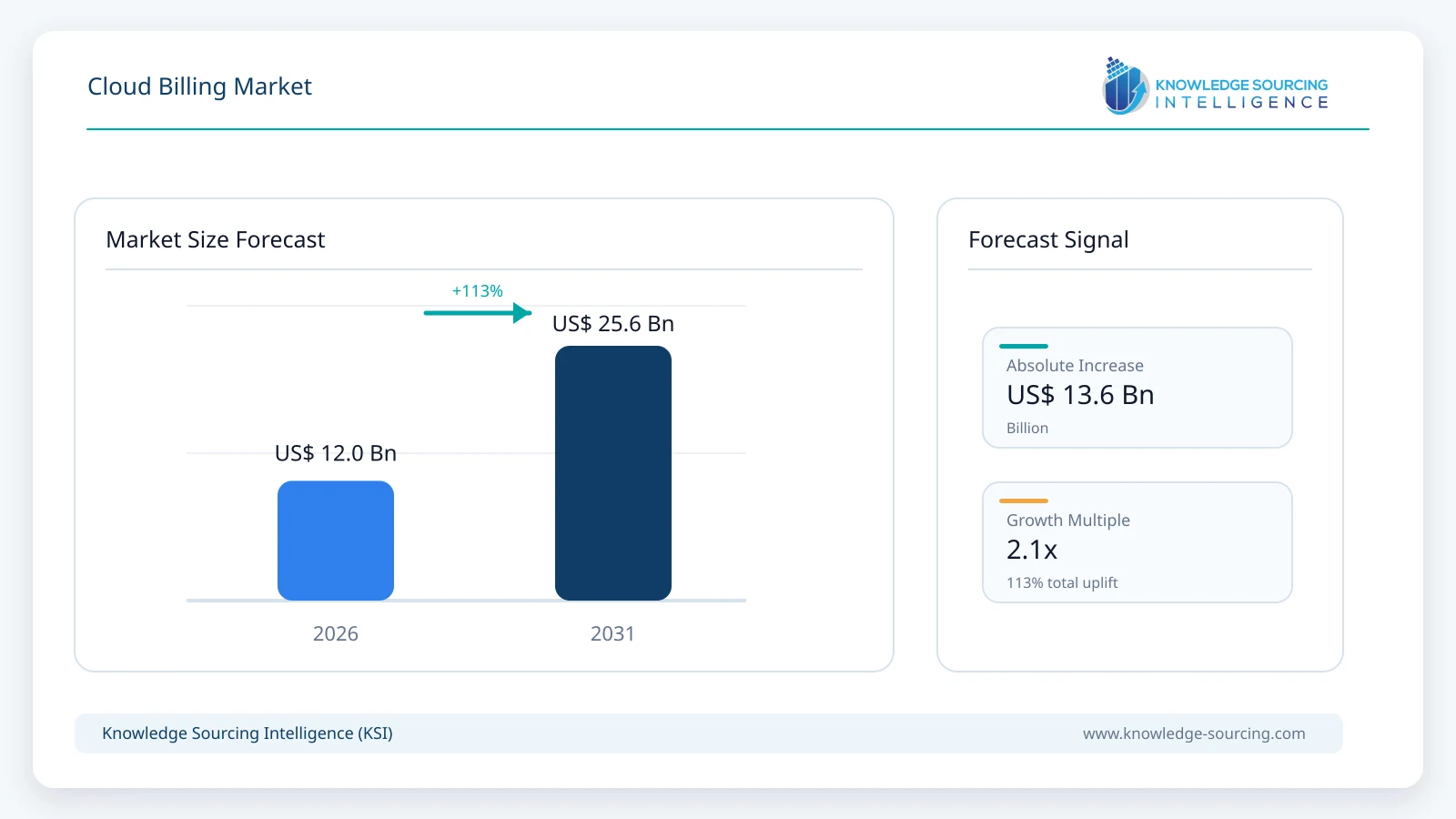
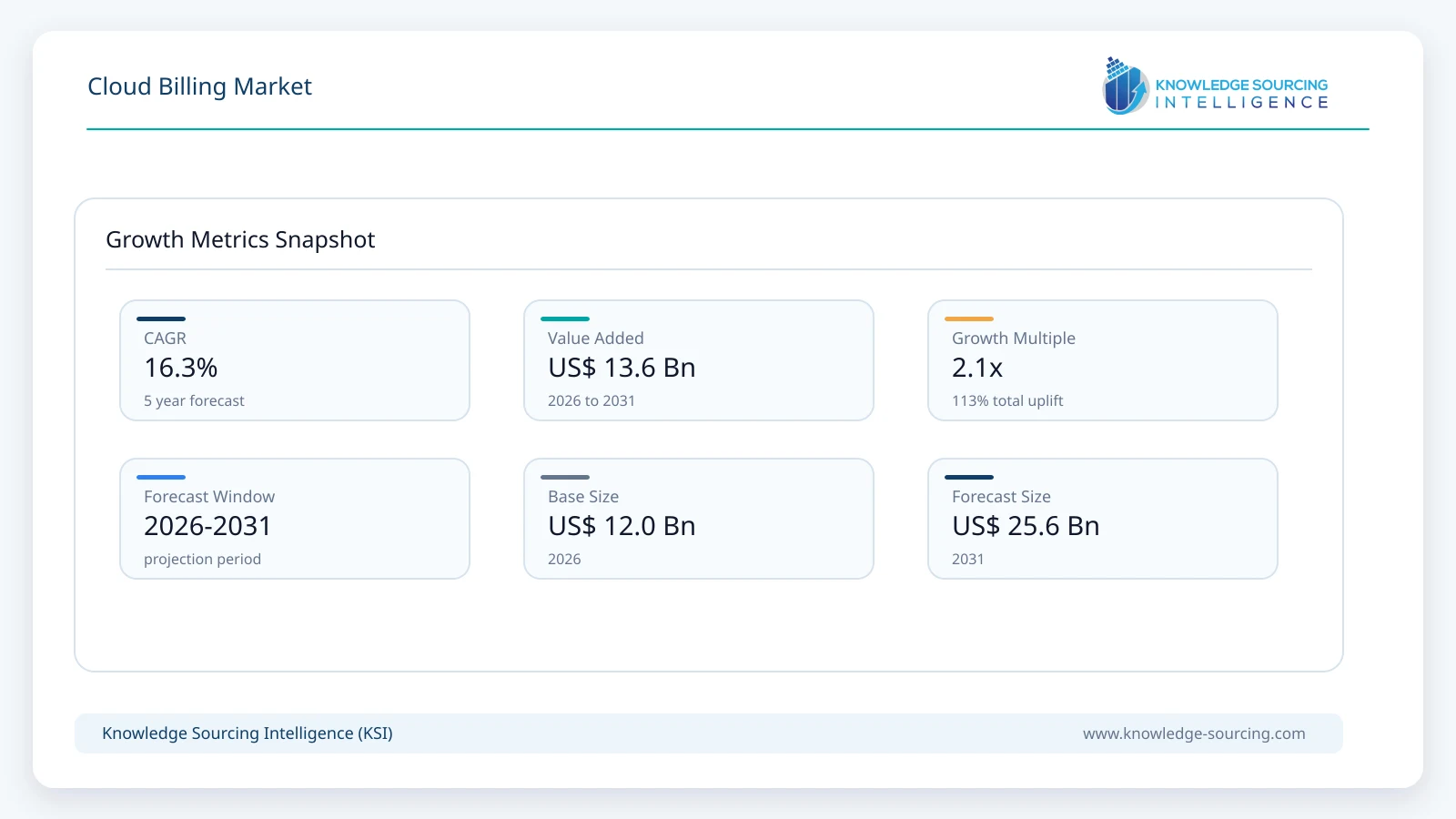
The Cloud Billing Market is forecast to grow at a CAGR of 16.29%, reaching USD 25.59 billion in 2031 from USD 12.03 billion in 2026.
Highlights:
- 1Rising adoption of recurring revenue and usage-based commercial models remains the primary demand catalyst.
- 2Subscription-based billing represents a commercially important billing approach due to predictable revenue generation and customer retention advantages.
- 3Asia Pacific presents considerable expansion opportunities as cloud adoption accelerates among enterprises and digital service providers.
- 4Artificial intelligence-assisted billing analytics and automated revenue operations are improving invoice accuracy and operational efficiency.
- 5Financial reporting standards, indirect tax regulations, and digital invoicing requirements continue to influence platform procurement decisions.
- 6Competition increasingly centres on pricing flexibility, ecosystem integration, compliance automation, and global deployment capabilities.
The cloud billing market comprises software platforms and related services that automate subscription management, usage metering, pricing, invoicing, taxation, payment collection, revenue recognition, and customer lifecycle billing across cloud-delivered products and services. These platforms enable organisations to support recurring revenue models while maintaining compliance with financial reporting standards and tax regulations across multiple jurisdictions. Cloud billing has become a strategic operational system for enterprises transitioning from one-time software licensing to recurring and consumption-based commercial models.
Demand is being shaped by the continued expansion of cloud-native business models across software, telecommunications, financial services, digital media, manufacturing, and healthcare. Enterprises are introducing flexible pricing structures that combine subscription plans, pay-per-use services, bundled offerings, and outcome-based contracts. As pricing complexity increases, finance teams require automated billing systems capable of processing large transaction volumes with minimal manual intervention while integrating with enterprise resource planning (ERP), customer relationship management (CRM), and payment ecosystems.
Buyer priorities have shifted beyond invoice generation. Organisations increasingly evaluate billing platforms based on scalability, pricing flexibility, revenue recognition capabilities, tax automation, API availability, analytics, and interoperability with cloud infrastructure. Procurement decisions are commonly led by finance executives, revenue operations teams, chief information officers, and commercial operations departments seeking to reduce billing errors, accelerate cash collection, and improve customer retention.
The industry structure includes enterprise software vendors, specialised subscription management providers, cloud platform partners, payment technology vendors, and managed service providers. Suppliers compete by expanding automation capabilities, supporting international tax compliance, enabling configurable pricing engines, and providing integration with broader financial software ecosystems. Long-term contracts, implementation expertise, and recurring software revenues contribute substantially to supplier profitability.
Growth in software-as-a-service (SaaS), infrastructure consumption, digital subscriptions, and platform-based commerce continues to broaden the addressable customer base. Organisations increasingly consider cloud billing systems as revenue infrastructure rather than back-office accounting tools, making investment decisions closely aligned with broader commercial and customer experience strategies.
Market Drivers
Expansion of Subscription and Consumption-Based Business Models
Software vendors, telecommunications providers, streaming platforms, and managed service providers increasingly generate recurring revenue through subscription and usage-based pricing. These commercial models require billing systems capable of handling frequent contract modifications, usage calculations, renewals, promotional pricing, and revenue allocation. Buyers therefore prioritise platforms that support multiple monetisation strategies without requiring extensive custom development. Vendors continue investing in configurable pricing engines and automated contract management to address these requirements.
Rising Enterprise Cloud Adoption
Public, private, and hybrid cloud deployments continue to expand enterprise IT infrastructure. As organisations migrate workloads to cloud environments, billing processes become more complex due to multiple service providers, variable resource consumption, and distributed procurement. Enterprises seek unified billing platforms capable of consolidating financial data across cloud environments while improving financial visibility and operational control. Suppliers increasingly provide integrations with leading cloud platforms and enterprise software suites to simplify deployment.
Increasing Financial Compliance Requirements
Accounting standards governing revenue recognition, together with expanding electronic invoicing regulations and indirect tax obligations, have increased demand for automated compliance capabilities. Organisations operating internationally require billing platforms that can calculate jurisdiction-specific taxes, generate compliant invoices, and support financial audits. Suppliers differentiate themselves by embedding regulatory updates into their software and reducing compliance-related administrative workloads.
Growth in Digital Commerce Ecosystems
Digital marketplaces, application platforms, online media providers, and connected device manufacturers increasingly depend on automated recurring billing infrastructure. Businesses require rapid product launches, flexible pricing experimentation, and support for global payment methods. Cloud billing vendors respond by strengthening API ecosystems, payment integrations, and customer self-service capabilities that enable faster commercial deployment while reducing operating costs.
Market Restraints and Challenges
Complex Integration with Enterprise Systems
Many organisations operate legacy ERP platforms, customer databases, payment gateways, and financial reporting systems developed over several years. Integrating cloud billing software with these environments often requires extensive implementation effort and specialist expertise. Extended deployment timelines increase project costs and delay operational benefits. Vendors increasingly offer pre-built connectors and implementation services to reduce integration complexity.
Data Security and Privacy Requirements
Cloud billing platforms process highly sensitive financial, customer, and payment information. Organisations operating within regulated industries require strong encryption, identity management, audit capabilities, and regional data residency controls. Compliance with privacy legislation increases implementation complexity and infrastructure costs. Suppliers continue investing in security certifications and governance capabilities to strengthen buyer confidence.
Pricing Complexity During Business Expansion
Organisations frequently modify pricing structures when entering new markets or launching additional digital services. Supporting bundled subscriptions, promotional discounts, partner revenue sharing, and usage-based charging simultaneously creates operational challenges. Buyers require flexible configuration rather than software customisation, placing pressure on vendors to maintain adaptable pricing engines without increasing system complexity.
Shortage of Billing Operations Expertise
Successful implementation requires coordination between finance, information technology, legal, tax, and commercial operations teams. Organisations lacking specialised billing expertise often encounter delays in deployment, configuration, and ongoing optimisation. Managed service providers and implementation partners have expanded consulting capabilities to address this skills gap.
Major Segment Analysis
Subscription-Based Billing
Subscription-based billing represents one of the most commercially significant segments because it supports predictable recurring revenue and long-term customer relationships across software, telecommunications, media, healthcare technology, education technology, and professional services.
Demand remains strong as organisations continue replacing perpetual licensing models with recurring subscription offerings. Buyers increasingly require automated renewals, customer lifecycle management, flexible pricing tiers, contract amendments, usage add-ons, promotional campaigns, and integrated payment processing. Enterprise customers also expect detailed revenue analytics, customer retention metrics, and automated revenue recognition aligned with accounting standards.
Competition within this segment extends beyond invoice generation. Suppliers differentiate through configurable pricing models, automated customer communications, integrated payment ecosystems, contract lifecycle management, self-service customer portals, and analytics supporting revenue optimisation. Integration with CRM and ERP platforms has become an important procurement criterion because organisations seek consistent customer and financial data across departments.
Revenue opportunities continue expanding as businesses adopt hybrid monetisation strategies combining recurring subscriptions with consumption-based services. Vendors capable of supporting evolving commercial models while maintaining financial accuracy are expected to secure stronger long-term customer relationships and higher recurring software revenues.
Regional Analysis
North America
North America remains a leading regional market due to extensive adoption of SaaS, cloud infrastructure, and digital subscription services. Large technology companies, telecommunications providers, financial institutions, and digital media organisations continue investing in automated revenue operations. Buyers prioritise regulatory compliance, enterprise integration, cybersecurity, and advanced analytics. Mature cloud infrastructure supports widespread deployment, although increasing data governance requirements continue influencing procurement decisions.
Europe
European demand is supported by enterprise cloud adoption, recurring software revenues, and expanding electronic invoicing requirements. Organisations place considerable emphasis on regulatory compliance, data privacy, taxation, and financial reporting. Multi-country operations create demand for billing platforms capable of supporting multiple currencies, languages, and tax jurisdictions. Economic uncertainty occasionally extends software purchasing cycles but does not materially reduce long-term investment.
Asia Pacific
Asia Pacific represents an important growth region owing to expanding digital economies, increasing enterprise cloud migration, and rising software exports. Technology companies, telecommunications operators, financial institutions, and online commerce platforms continue investing in scalable billing infrastructure. Government programmes supporting digital infrastructure and cloud adoption encourage enterprise software investment, although implementation capabilities vary across markets.
Middle East & Africa
Demand continues to strengthen as governments encourage cloud adoption, digital public services, financial technology development, and economic diversification. Organisations increasingly modernise enterprise systems to improve operational efficiency. Regulatory evolution and varying digital maturity across countries create implementation differences, although investment momentum remains positive.
South America
Brazil and Argentina account for a substantial share of regional demand as businesses modernise financial operations and expand digital service offerings. Organisations increasingly seek automated billing solutions capable of supporting evolving tax regulations and subscription-based business models. Currency volatility and uneven technology investment remain practical constraints for some buyers.
Competitive Landscape
The cloud billing market remains moderately concentrated, combining large enterprise software providers with specialised recurring revenue platform vendors. Competition focuses on functional breadth, implementation capability, regulatory compliance, pricing flexibility, scalability, and ecosystem integration rather than price alone.
Suppliers including Oracle Corporation, SAP SE, Salesforce, Inc., Zuora, Inc., Aria Systems, Inc., BillingPlatform, Recurly, Inc., Chargebee, Inc., Cerillion PLC, and AppDirect, Inc. continue strengthening product portfolios through artificial intelligence-enabled automation, expanded API capabilities, strategic partnerships, payment ecosystem integration, and broader international compliance support. Cloud-native deployment models, configurable pricing engines, industry-specific functionality, and partner ecosystems remain important competitive differentiators across enterprise procurement processes.
Recent Developments
April 2026: Oracle Corporation expanded artificial intelligence capabilities across its Fusion Cloud Applications portfolio, enhancing finance automation that supports enterprise billing and revenue management workflows. Commercial relevance: Improved automation strengthens operational efficiency for enterprise customers.
February 2026: SAP SE introduced additional Joule AI capabilities across business applications, extending intelligent financial process automation and enterprise workflow support. Commercial relevance: Enhanced automation improves billing accuracy and operational productivity.
September 2025: Salesforce, Inc. announced expanded Revenue Cloud innovations supporting subscription management and revenue lifecycle automation. Commercial relevance: The enhancements strengthen integrated quote-to-cash capabilities for recurring revenue businesses.
Regulatory and Policy Environment
The cloud billing market operates within an extensive regulatory framework covering financial reporting, taxation, privacy, cybersecurity, and electronic invoicing. Revenue recognition standards, including IFRS 15 and ASC 606, require organisations to allocate revenue accurately across contractual obligations, making automated billing platforms increasingly valuable.
Electronic invoicing mandates introduced across multiple jurisdictions require businesses to generate compliant digital invoices and maintain secure transaction records. Indirect tax regulations, including value-added tax (VAT) and goods and services tax (GST) requirements, also influence software functionality, particularly for multinational enterprises.
Privacy regulations, including the General Data Protection Regulation (GDPR) in Europe and similar national frameworks, require secure processing of customer information. Security certifications, audit trails, encryption, and identity management capabilities have therefore become standard procurement considerations for enterprise buyers.
Outlook and Strategic Implications
Commercial investment over the next five years is expected to concentrate on flexible monetisation platforms capable of supporting subscription, consumption-based, and hybrid pricing models simultaneously. Procurement decisions will increasingly evaluate automation capabilities alongside financial governance, customer experience, and operational scalability.
Artificial intelligence is expected to improve billing validation, payment forecasting, anomaly detection, and customer lifecycle analytics rather than replace existing financial controls. Integration with enterprise finance platforms, cloud infrastructure, payment providers, and customer engagement systems will remain central to supplier competitiveness.
Organisations operating internationally will continue prioritising compliance automation, configurable taxation, and localisation capabilities as regulatory requirements become more complex. Vendors capable of combining financial accuracy, implementation efficiency, configurable commercial models, and broad ecosystem integration are expected to strengthen competitive positioning.
Despite implementation complexity, cybersecurity requirements, and integration challenges, cloud billing platforms are becoming an essential operational component for enterprises adopting recurring digital revenue models. Suppliers that continue investing in automation, interoperability, and regulatory compliance are likely to benefit from sustained enterprise software spending over the forecast period.
Cloud Billing Market Scope
| Report Metric | Details |
|---|---|
| Total Market Size in 2026 | USD 12.03 billion |
| Total Market Size in 2031 | USD 25.59 billion |
| Forecast Unit | Billion |
| Growth Rate | 16.29% |
| Study Period | 2021 to 2031 |
| Historical Data | 2021 to 2024 |
| Base Year | 2025 |
| Forecast Period | 2026 – 2031 |
| Segmentation | Component, Billing Type, Deployment Model, Service Model End-User Industry, Geography |
| Companies |
|
Market Segmentation
By Component
By Billing Type
By Deployment Model
By Service Model
By End-user Industry
By Geography
Table of Contents
1. EXECUTIVE SUMMARY
2. MARKET SNAPSHOT
2.1. Market Overview
2.2. Market Definition
2.3. Scope of the Study
2.4. Market Segmentation
3. BUSINESS LANDSCAPE
3.1. Market Drivers
3.2. Market Restraints
3.3. Market Opportunities
3.4. Porter's Five Forces Analysis
3.5. Industry Value Chain Analysis
3.6. Policies and Regulations
3.7. Strategic Recommendations
4. TECHNOLOGICAL OUTLOOK
5. CLOUD BILLING MARKET BY COMPONENT
5.1. Introduction
5.2. Solutions
5.2.1. Subscription Billing Software
5.2.2. Revenue Management
5.2.3. Invoice and Payment Management
5.2.4. Usage Metering and Rating
5.2.5. Tax and Compliance Management
5.3. Services
5.3.1. Professional Services
5.3.2. Managed Services
6. CLOUD BILLING MARKET BY BILLING TYPE
6.1. Introduction
6.2. Subscription-Based Billing
6.3. Usage-Based Billing
6.4. One-Time Billing
6.5. Hybrid Billing
6.6. Others
7. CLOUD BILLING MARKET BY DEPLOYMENT MODEL
7.1. Introduction
7.2. Public Cloud
7.3. Private Cloud
7.4. Hybrid Cloud
8. CLOUD BILLING MARKET BY SERVICE MODEL
8.1. Introduction
8.2. Infrastructure as a Service (IaaS)
8.3. Platform as a Service (PaaS)
8.4. Software as a Service (SaaS)
9. CLOUD BILLING MARKET BY END-USER INDUSTRY
9.1. Introduction
9.2. Banking, Financial Services, and Insurance (BFSI)
9.3. IT & Telecom
9.4. Retail & Consumer Goods
9.5. Healthcare
9.6. Manufacturing
9.7. Media & Entertainment
9.8. Others
10. CLOUD BILLING MARKET BY GEOGRAPHY
10.1. Introduction
10.2. North America
10.2.1. USA
10.2.2. Canada
10.2.3. Mexico
10.3. South America
10.3.1. Brazil
10.3.2. Argentina
10.3.3. Others
10.4. Europe
10.4.1. United Kingdom
10.4.2. Germany
10.4.3. France
10.4.4. Italy
10.4.5. Spain
10.4.6. Others
10.5. Middle East and Africa
10.5.1. Saudi Arabia
10.5.2. UAE
10.5.3. Others
10.6. Asia Pacific
10.6.1. China
10.6.2. Japan
10.6.3. India
10.6.4. South Korea
10.6.5. Taiwan
10.6.6. Thailand
10.6.7. Indonesia
10.6.8. Others
11. COMPETITIVE ENVIRONMENT AND ANALYSIS
11.1. Major Players and Strategic Analysis
11.2. Market Share Analysis
11.3. Mergers, Acquisitions, Agreements, and Collaborations
11.4. Competitive Dashboard
12. COMPANY PROFILES
12.1. Oracle Corporation
12.2. SAP SE
12.3. Salesforce, Inc.
12.4. Zuora, Inc.
12.5. Aria Systems, Inc.
12.6. BillingPlatform
12.7. Recurly, Inc.
12.8. Chargebee, Inc.
12.9. Cerillion PLC
12.10. AppDirect, Inc.
13. APPENDIX
13.1. Currency
13.2. Assumptions
13.3. Base and Forecast Years Timeline
13.4. Key Benefits for Stakeholders
13.5. Research Methodology
13.6. Abbreviations
LIST OF FIGURES
LIST OF TABLES
Navigate
Trusted by the world's leading organizations











