
The Cognitive AI Systems Market is anticipated to grow significantly over the forecast period.
Highlights:
- 1Rising enterprise investment in generative AI and knowledge automation is strengthening demand for cognitive AI platforms.
- 2Natural Language Processing (NLP) represents one of the most commercially important technologies due to broad enterprise adoption.
- 3North America maintains the strongest commercial position through cloud infrastructure, enterprise software spending, and AI investment.
- 4Retrieval-augmented generation, multimodal AI, and domain-specific foundation models are becoming important procurement criteria.
- 5Government initiatives supporting trustworthy AI, cybersecurity, and responsible AI governance are influencing enterprise purchasing decisions.
- 6Competition increasingly centres on ecosystem integration, enterprise-grade security, reasoning capability, and deployment flexibility.
The Cognitive AI Systems Market comprises software platforms, foundation models, reasoning engines, and supporting infrastructure that enable machines to interpret information, learn from structured and unstructured data, understand natural language, generate responses, support decision-making, and automate knowledge-intensive business processes. Unlike conventional automation software, cognitive AI systems combine machine learning, natural language processing, reasoning capabilities, and contextual understanding to assist or augment human decision-making across enterprise and public-sector environments.
Commercial demand is expanding as enterprises seek measurable improvements in operational efficiency, customer engagement, regulatory compliance, and workforce productivity. Organisations are moving beyond experimental artificial intelligence projects towards enterprise-wide deployments that integrate cognitive AI into core business workflows. Procurement decisions increasingly prioritise accuracy, explainability, security, governance, interoperability with existing enterprise software, and the availability of domain-specific models rather than simply model size or computing performance.
Enterprise buyers represent the largest source of demand, particularly within healthcare, banking, financial services, insurance (BFSI), manufacturing, telecommunications, and government agencies. Healthcare providers are adopting cognitive AI to assist clinicians with diagnostics, medical imaging interpretation, treatment planning, and administrative documentation. Financial institutions employ cognitive AI for fraud detection, risk modelling, customer support, and regulatory reporting. Manufacturers utilise AI-driven knowledge systems for predictive maintenance, engineering documentation, and production optimisation.
The market structure includes hyperscale cloud providers, enterprise software vendors, AI model developers, consulting firms, and systems integrators. Revenue generation increasingly comes from subscription-based software, cloud consumption services, application programming interfaces (APIs), managed AI platforms, implementation services, and industry-specific AI solutions. The growing preference for consumption-based pricing allows organisations to expand deployments while managing capital expenditure.
Cloud deployment remains the preferred implementation model because organisations require scalable computing resources, continuous model updates, and simplified integration with enterprise applications. Nevertheless, highly regulated sectors continue investing in on-premises and hybrid deployments where data residency, security, and compliance requirements remain critical purchasing considerations.
Market Drivers
Enterprise adoption of generative AI for knowledge-intensive work
Large enterprises increasingly require AI systems capable of interpreting contracts, technical documentation, customer communications, financial reports, and regulatory materials. Cognitive AI reduces manual analysis while improving response times across customer support, legal operations, finance, and human resources.
Enterprise buyers seek platforms capable of integrating with existing productivity suites, enterprise resource planning systems, and customer relationship management platforms. Software suppliers therefore compete through application ecosystems, enterprise APIs, and governance capabilities that simplify deployment across multiple business functions. This purchasing behaviour expands recurring software revenue and long-term service contracts.
Expansion of healthcare decision support
Healthcare providers face growing clinical workloads, ageing populations, and persistent shortages of medical professionals. Cognitive AI assists physicians by analysing medical records, diagnostic images, laboratory results, and clinical literature to support treatment recommendations.
Hospitals and healthcare networks increasingly evaluate AI systems based on clinical validation, explainability, regulatory compliance, cybersecurity, and interoperability with electronic health record systems. Vendors investing in healthcare-specific models and regulatory compliance gain stronger commercial positioning in procurement processes.
Financial institutions strengthen fraud prevention and risk management
Banks, insurers, and payment providers process enormous transaction volumes while facing increasingly sophisticated financial crime. Cognitive AI enables continuous transaction monitoring, behavioural analysis, anomaly detection, and customer verification across multiple digital channels.
Purchasing decisions increasingly favour platforms capable of producing transparent decision trails for regulators while reducing false positives that increase operational costs. This creates opportunities for suppliers combining predictive analytics with explainable AI capabilities.
Growing enterprise investment in cloud AI infrastructure
Cloud computing providers continue expanding AI infrastructure, specialised processors, managed AI services, and enterprise development environments. Organisations prefer cloud-based deployments because implementation times are shorter and computing resources can scale according to workload requirements.
Software vendors increasingly package cognitive AI as subscription services, allowing customers to expand usage without substantial infrastructure investments. This commercial model encourages broader adoption among mid-sized enterprises alongside large multinational organisations.
Market Restraints and Challenges
Data governance and regulatory compliance
Organisations processing sensitive financial, healthcare, or government information face strict regulatory obligations regarding privacy, data handling, and cross-border information transfers. Buyers therefore require detailed governance frameworks before approving enterprise-scale AI deployments.
Compliance requirements increase implementation costs and lengthen procurement cycles, particularly in highly regulated industries. Vendors respond by expanding encryption capabilities, audit trails, data residency options, and responsible AI governance features.
High implementation and infrastructure costs
Training and operating advanced cognitive AI systems require specialised computing hardware, substantial cloud infrastructure, skilled personnel, and continuous model optimisation. Smaller enterprises often struggle to justify large implementation budgets despite recognising productivity benefits.
Suppliers increasingly mitigate this challenge through managed services, modular deployments, and consumption-based pricing models that reduce upfront investment requirements.
Shortage of AI specialists
Successful deployment requires expertise in machine learning engineering, cybersecurity, data engineering, model governance, and business integration. Many organisations face recruitment challenges that delay implementation schedules.
Systems integrators and consulting firms therefore play an increasingly important role in deployment, customisation, and operational support, creating additional service revenue opportunities across the value chain.
Trust, explainability, and model accuracy
Enterprise buyers remain cautious about deploying AI systems in high-value decision-making processes where inaccurate recommendations could create financial, legal, or clinical risks. Concerns regarding hallucinations, bias, and inconsistent reasoning continue influencing procurement decisions.
Technology providers increasingly differentiate themselves through explainable AI, validation frameworks, retrieval-based architectures, and human oversight mechanisms that improve confidence in enterprise deployments.
Major Segment Analysis
Natural Language Processing (NLP)
Natural Language Processing represents one of the most commercially important technology segments because language remains the primary interface between organisations and information. Enterprises generate vast quantities of documents, emails, contracts, customer conversations, research publications, and technical manuals that cannot be analysed efficiently through manual processes.
Demand extends across customer service, legal operations, healthcare documentation, software development, financial reporting, and enterprise search. Buyers increasingly seek multilingual capabilities, contextual understanding, document summarisation, conversational interfaces, and integration with internal knowledge repositories.
Competitive differentiation depends less on basic language generation and more on domain expertise, factual reliability, reasoning quality, enterprise security, and workflow integration. Vendors capable of combining proprietary enterprise data with foundation models while maintaining governance and compliance gain stronger commercial advantages.
The revenue potential remains substantial because NLP capabilities frequently serve as the entry point for wider enterprise AI adoption. Once organisations establish secure language platforms, additional cognitive AI applications, including reasoning engines, predictive analytics, and intelligent automation, can be deployed more efficiently across business units.
Regional Analysis
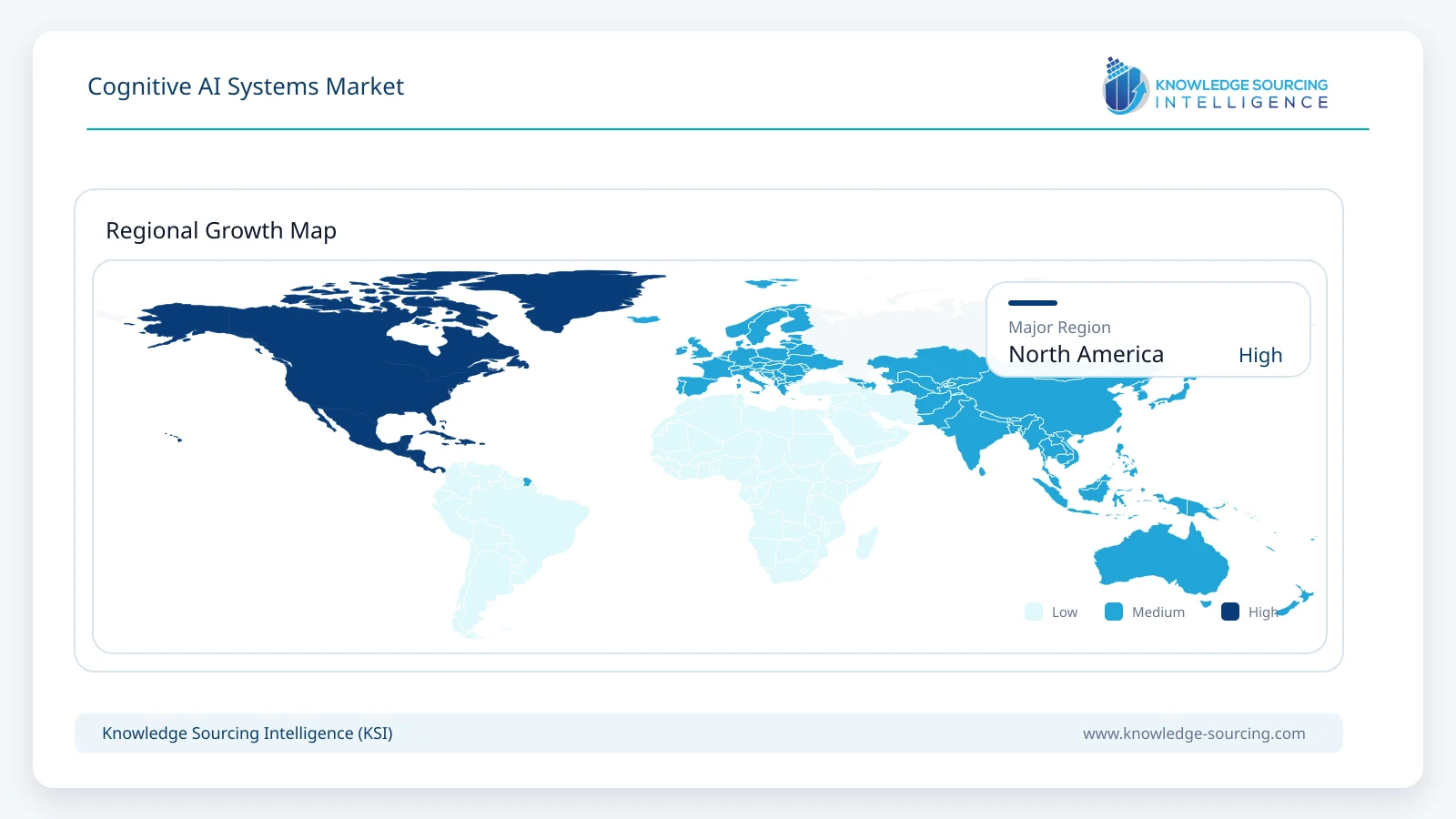
North America maintains the largest commercial opportunity owing to strong enterprise software spending, mature cloud infrastructure, extensive AI research investment, and early adoption across healthcare, financial services, manufacturing, and government agencies. Large technology providers, venture capital investment, and enterprise procurement budgets continue supporting market expansion.
Europe benefits from advanced industrial automation, healthcare digitisation, financial technology investment, and public-sector digital initiatives. Organisations place considerable emphasis on responsible AI, data protection, and regulatory compliance, encouraging suppliers to prioritise governance and transparency alongside technical performance.
Asia Pacific represents the fastest-expanding demand base due to accelerating enterprise digitalisation, manufacturing automation, expanding cloud infrastructure, and government support for artificial intelligence research. China, Japan, India, South Korea, Australia, and Taiwan continue investing in AI capabilities across industrial production, financial services, healthcare, and education. Cost efficiency and localisation remain important procurement considerations.
Middle East & Africa continues expanding through national digital economy programmes, smart government initiatives, healthcare modernisation, and financial sector investment. Adoption remains concentrated among larger enterprises and government institutions, while infrastructure availability and specialist workforce capacity influence implementation speed.
South America demonstrates growing adoption within financial services, telecommunications, retail, and public administration. Organisations increasingly evaluate cognitive AI for customer engagement, fraud prevention, and operational efficiency. Economic volatility and technology investment cycles continue influencing purchasing behaviour across several markets.
Competitive Landscape
Competition combines foundation model developers, hyperscale cloud providers, enterprise software vendors, and systems integration specialists. Vendors compete through AI model quality, enterprise integration capabilities, deployment flexibility, security architecture, pricing structures, and industry-specific solutions.
Strategic partnerships have become an important competitive approach, allowing software providers to integrate advanced language models into productivity platforms, cloud environments, and enterprise applications. Industry-specific AI offerings for healthcare, financial services, manufacturing, and telecommunications continue strengthening commercial differentiation.
The competitive environment includes Microsoft Corporation, Alphabet Inc. (Google), OpenAI, Anthropic PBC, IBM Corporation, Amazon Web Services, Inc., Oracle Corporation, and Tata Consultancy Services Limited, all of which continue expanding enterprise AI ecosystems through platform development, cloud infrastructure, consulting services, strategic alliances, and industry-focused solutions.
Recent Developments
July 2026: NVIDIA, Microsoft, IBM, and other technology leaders launched the Open Secure AI Alliance, an open initiative focused on developing shared AI security tools and strengthening the safety and governance of advanced cognitive AI systems.
July 2026: Oracle expanded Oracle Cloud Infrastructure (OCI) AI with new model import capabilities, private endpoints, and enhanced AI guardrails, enabling enterprises to build more secure, governed, and workload-specific cognitive AI applications.
June 2026: Microsoft unveiled major Microsoft Foundry enhancements at Build 2026, adding new capabilities for deploying, managing, and scaling AI agents, strengthening enterprise cognitive AI application development and orchestration.
March 2026: IBM announced the general availability of IBM Bob 1.0, its enterprise AI software development assistant supporting multi-model orchestration, code generation, testing, security, and deployment across complex software engineering environments.
Regulatory and Policy Environment
The regulatory framework surrounding cognitive AI increasingly focuses on transparency, accountability, cybersecurity, privacy protection, and risk management. The European Union's AI Act establishes risk-based obligations for AI systems, influencing procurement standards well beyond Europe because multinational organisations seek consistent compliance frameworks.
Data protection legislation, including the General Data Protection Regulation (GDPR), continues shaping enterprise deployment strategies by requiring lawful processing, privacy safeguards, and clear governance of personal information. Similar privacy frameworks across multiple jurisdictions reinforce demand for secure AI architectures and comprehensive audit capabilities.
Government agencies in the United States, Asia Pacific, and several Middle Eastern economies continue supporting AI innovation through national strategies, research funding, public-sector pilot programmes, semiconductor investment, and workforce development initiatives. Industry standards developed by organisations such as the International Organization for Standardization (ISO) and the National Institute of Standards and Technology (NIST) increasingly influence enterprise procurement requirements for trustworthy and secure AI implementation.
Outlook and Strategic Implications
Over the next five years, enterprise investment will increasingly prioritise cognitive AI platforms capable of supporting autonomous workflows, multimodal information processing, enterprise reasoning, and domain-specific decision support. Buyers are expected to favour solutions that combine foundation models with proprietary enterprise knowledge while maintaining strong governance and regulatory compliance.
Procurement strategies will increasingly evaluate total cost of ownership, security certification, integration capability, and long-term vendor support rather than model performance alone. Cloud-based deployment is expected to remain the preferred commercial model, although hybrid architectures will continue serving regulated industries with strict data sovereignty requirements.
Competition is expected to intensify through ecosystem expansion, specialised industry solutions, enterprise partnerships, and AI infrastructure investment. Organisations capable of demonstrating measurable productivity improvements, operational reliability, explainable outputs, and secure enterprise deployment will strengthen their competitive position. At the same time, evolving regulatory requirements, computing infrastructure costs, cybersecurity risks, and talent availability will remain important considerations influencing purchasing decisions, investment planning, and long-term market development.
Cognitive AI Systems Market Scope
| Report Metric | Details |
|---|---|
| Forecast Unit | Billion |
| Study Period | 2021 to 2031 |
| Historical Data | 2021 to 2024 |
| Base Year | 2025 |
| Forecast Period | 2026 – 2031 |
| Segmentation | Technology, Deployment Type, Application, End User, Geography |
| Companies |
|
Market Segmentation
By Technology
By Deployment Type
By Application
By End User
By Geography
Table of Contents
1. EXECUTIVE SUMMARY
2. MARKET SNAPSHOT
2.1. Market Overview
2.2. Market Definition
2.3. Scope of the Study
2.4. Market Segmentation
3. BUSINESS LANDSCAPE
3.1. Market Drivers
3.2. Market Restraints
3.3. Market Opportunities
3.4. Porter's Five Forces Analysis
3.5. Industry Value Chain Analysis
3.6. Policies and Regulations
3.7. Strategic Recommendations
4. TECHNOLOGICAL OUTLOOK
5. COGNITIVE AI SYSTEMS MARKET BY TECHNOLOGY
5.1. Introduction
5.2. Natural Language Processing (NLP)
5.3. Machine Learning
5.4. Deep Learning
5.5. Automated Reasoning
5.6. Others
6. COGNITIVE AI SYSTEMS MARKET BY DEPLOYMENT TYPE
6.1. Introduction
6.2. Cloud-Based
6.3. On-Premises
7. COGNITIVE AI SYSTEMS MARKET BY APPLICATION
7.1. Introduction
7.2. Healthcare Diagnostics and Treatment Planning
7.3. Financial Analysis and Fraud Detection
7.4. Customer Service and Virtual Assistants
7.5. Risk Assessment
7.6. Educational Systems and Personalized Learning
7.7. Others
8. COGNITIVE AI SYSTEMS MARKET BY END USER
8.1. Introduction
8.2. Healthcare
8.3. BFSI
8.4. IT & Telecommunications
8.5. Manufacturing
8.6. Education
8.7. Automotive
8.8. Others
9. COGNITIVE AI SYSTEMS MARKET BY GEOGRAPHY
9.1. Introduction
9.2. North America
9.2.1. United States
9.2.2. Canada
9.2.3. Mexico
9.3. South America
9.3.1. Brazil
9.3.2. Argentina
9.3.3. Others
9.4. Europe
9.4.1. United Kingdom
9.4.2. Germany
9.4.3. France
9.4.4. Italy
9.4.5. Spain
9.4.6. Others
9.5. Middle East & Africa
9.5.1. Saudi Arabia
9.5.2. UAE
9.5.3. South Africa
9.5.4. Others
9.6. Asia Pacific
9.6.1. China
9.6.2. Japan
9.6.3. India
9.6.4. South Korea
9.6.5. Australia
9.6.6. Taiwan
9.6.7. Others
10. COMPETITIVE ENVIRONMENT AND ANALYSIS
10.1. Major Players and Strategy Analysis
10.2. Market Share Analysis
10.3. Mergers, Acquisitions, Agreements, and Collaborations
10.4. Competitive Dashboard
11. COMPANY PROFILES
11.1. Microsoft Corporation
11.2. Alphabet Inc. (Google)
11.3. OpenAI
11.4. Anthropic PBC
11.5. IBM Corporation
11.6. Amazon Web Services, Inc.
11.7. Oracle Corporation
11.8. Tata Consultancy Services Limited
12. APPENDIX
12.1. Currency
12.2. Assumptions
12.3. Base and Forecast Years Timeline
12.4. Key Benefits for Stakeholders
12.5. Research Methodology
12.6. Abbreviations
Navigate
Trusted by the world's leading organizations











