
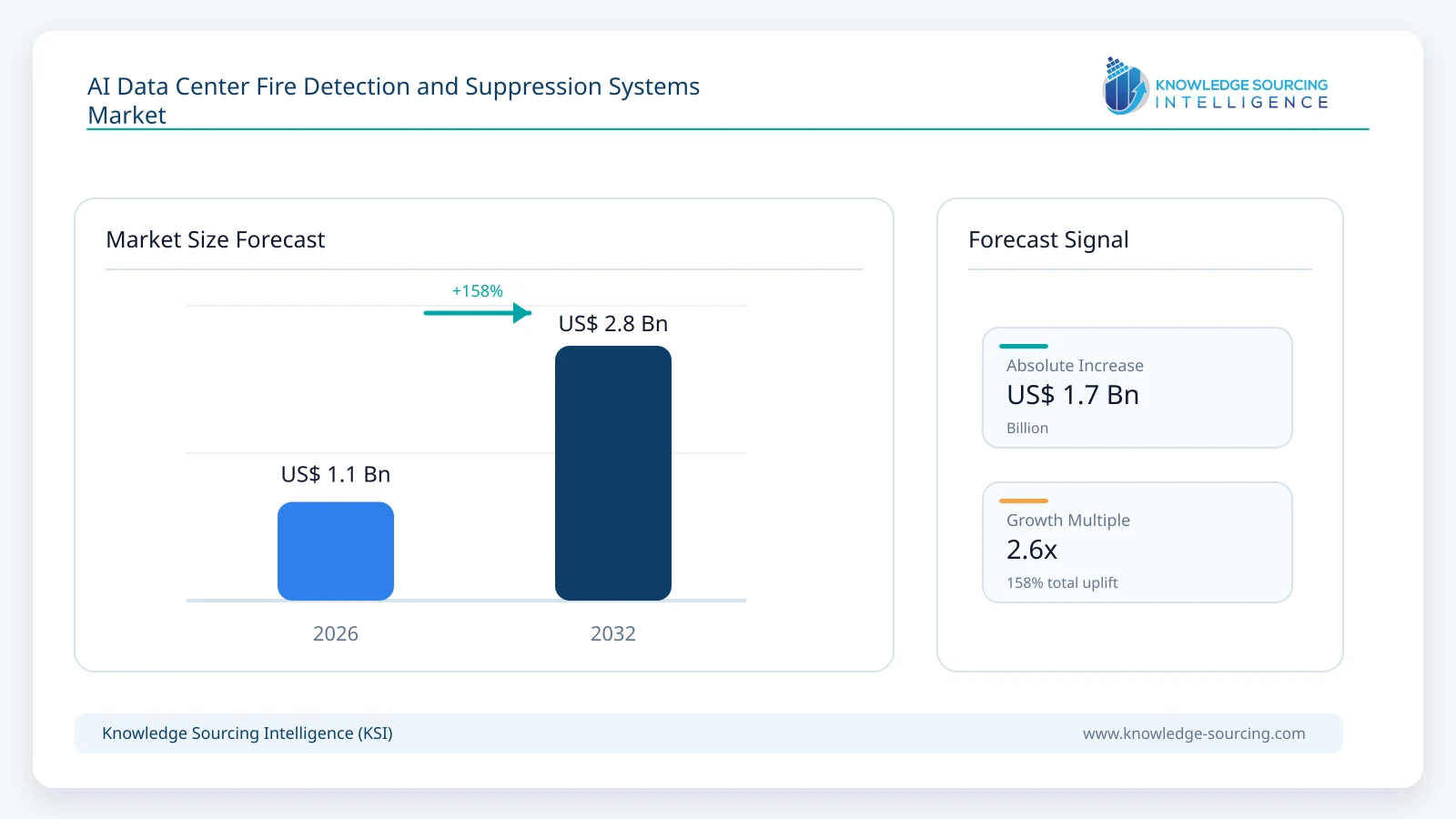
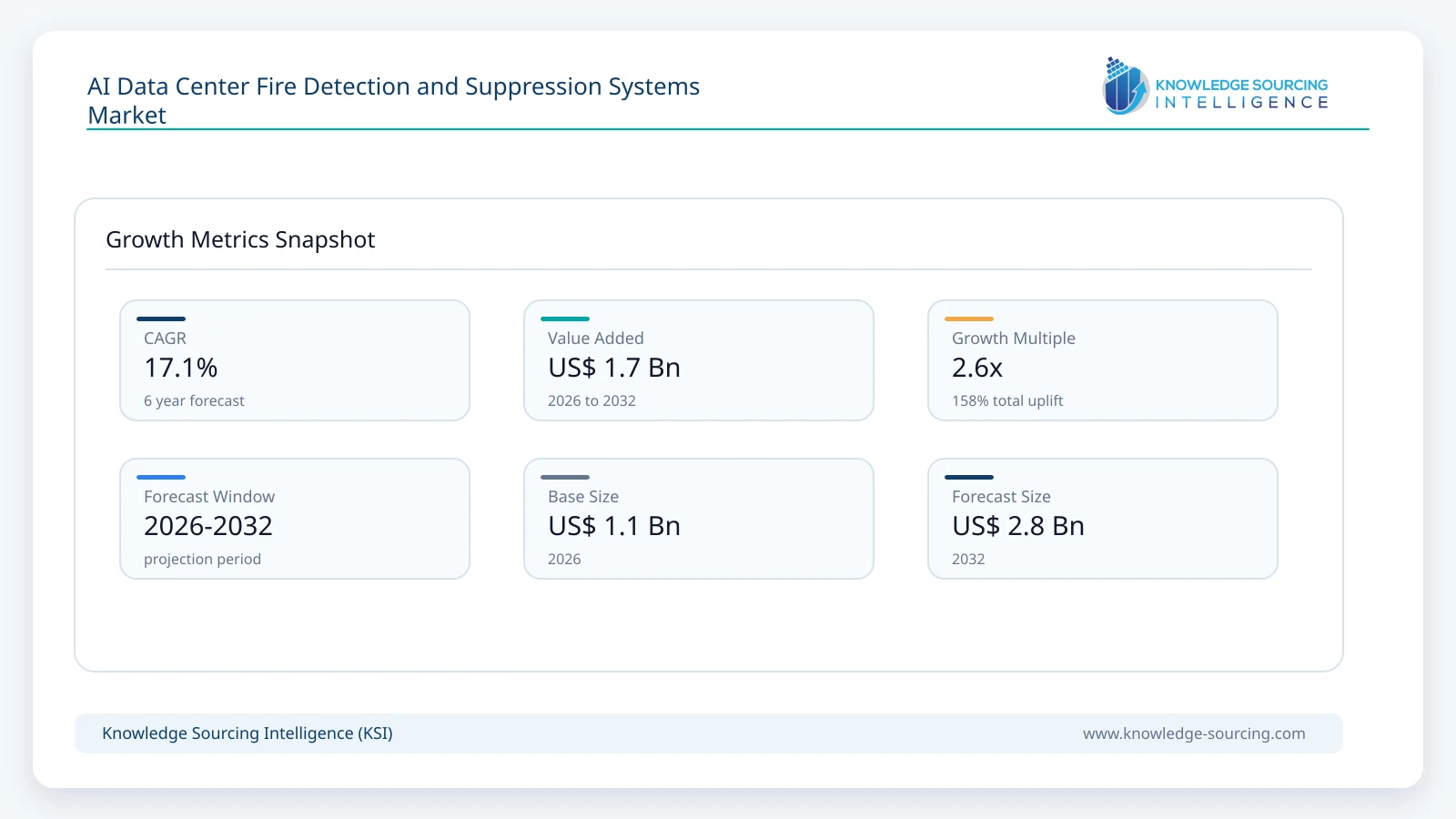
The AI Data Center Fire detection and Suppression Systems Market is estimated at USD 1.10 billion in 2026 and is projected to reach USD 2.84 billion by 2032, representing a CAGR of 17.1% during the forecast period.
Key Highlights
· Very-early-warning detection gains importance as high airflow can dilute conventional smoke signatures.
· Suppression systems remain the largest 2026 revenue pool across critical data-center spaces.
· Battery off-gas detection is the fastest-growing detection layer through 2032 worldwide.
· Water mist is expanding where operators seek lower water use and equipment damage.
· AI rack density increases the financial consequence of delayed detection and prolonged downtime.
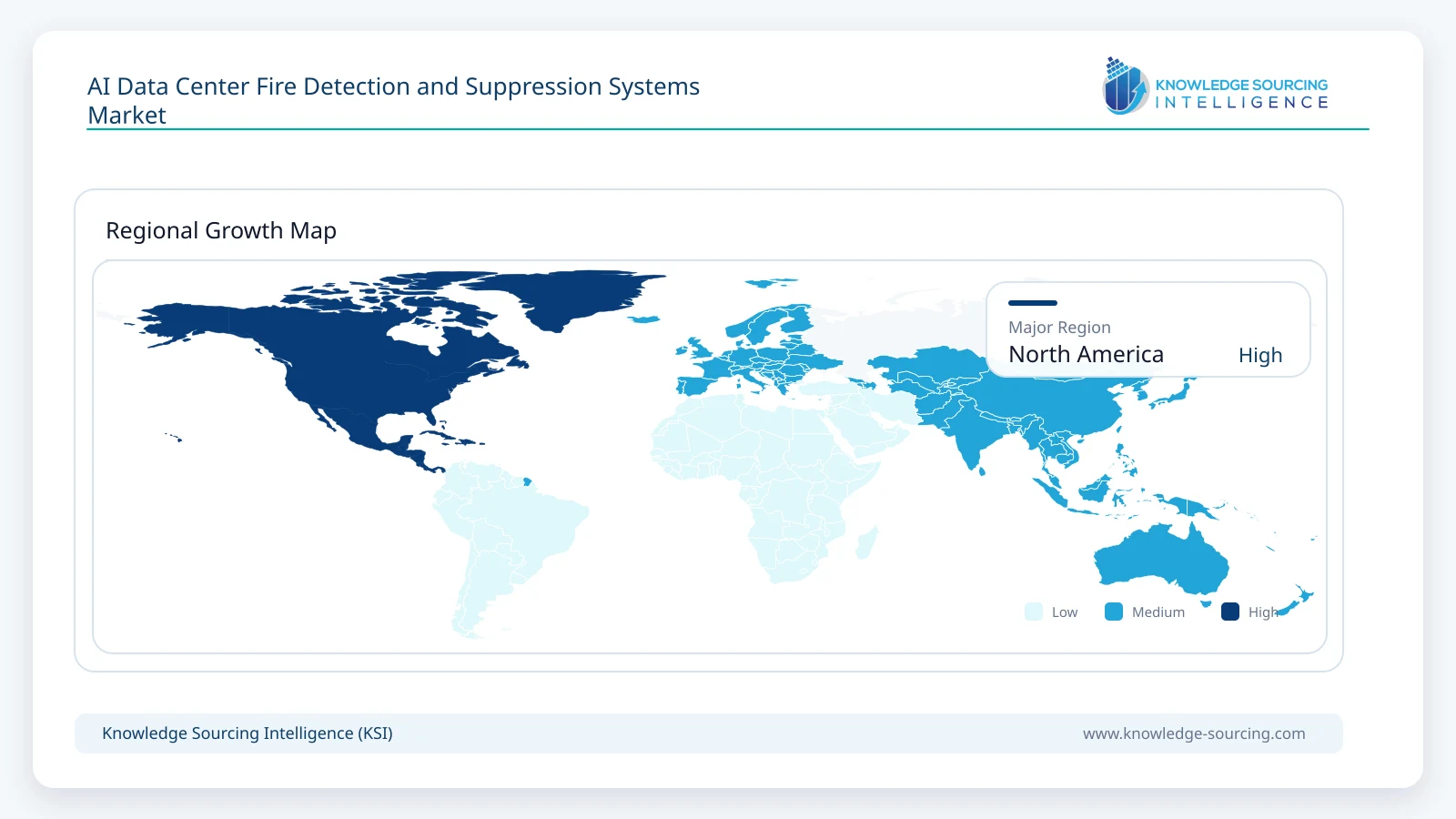
· North America leads spending through hyperscale, neocloud and high-density retrofit activity.
· PFAS supply changes are accelerating reassessment of clean-agent portfolios and system design.
· Retrofit demand grows as existing facilities add batteries, liquid cooling and higher-density AI clusters.
Market Overview
Conventional data-center Fire protection has long combined building-wide sprinklers with specialized detection and suppression for critical rooms. AI infrastructure increases the value of that layered approach because modern facilities contain more electrical power, denser cabling and a larger concentration of high-value equipment per square metre. High airflow can also make smoke harder to detect at conventional ceiling locations because particles are rapidly diluted and carried toward return-air paths. Aspirating Smoke Detection (ASD) addresses this problem by actively sampling air through a pipe network and can provide warning at a much earlier stage than ordinary passive detection.
The protection architecture differs by room and hazard. Data halls and server rooms commonly combine very-early-warning detection with gaseous suppression, pre-action sprinklers or water mist. Electrical rooms, uninterruptible power supply (UPS) rooms and battery spaces require additional attention because faults may involve arcing, cable insulation, power electronics or lithium-ion thermal runaway. Battery off-gas monitoring can identify abnormal cell behaviour before visible smoke or open flame, allowing operators to isolate equipment, adjust ventilation or trigger prevention-oriented controls before a full thermal event develops. Generator and transformer areas may require flame detection or water-based systems suited to fuel and oil hazards.
Suppression-agent selection is becoming more strategic. Gaseous systems remain attractive where residue-free extinguishment and rapid return to service matter, but operators increasingly evaluate agent environmental profile, supply continuity, enclosure requirements and refilling logistics. 3M's completed PFAS-manufacturing exit has reinforced this reassessment for systems historically associated with FK-5-1-12 supply. Inert gases, alternative halocarbon agents and water-mist technologies provide different combinations of space requirement, environmental profile, discharge performance and equipment impact. Large operators are therefore moving toward room-specific protection strategies rather than one suppression technology across the entire campus.
Market Drivers
Higher asset concentration increases the value of early intervention
AI facilities concentrate expensive accelerators, networking and memory in dense rack-scale systems, increasing the financial consequence of even a localized fire event. The International Energy Agency (IEA) reports that electricity consumption from AI-focused data centers increased 50% in 2025 and is projected to triple between 2025 and 2030. Fire-system revenue does not rise directly with electricity consumption, but the same capacity expansion creates more protected white space, power rooms, battery rooms and ancillary infrastructure. The value of avoiding prolonged outages also supports higher protection intensity in the most critical parts of the facility.
Lithium-ion UPS and BESS deployment creates a separate prevention requirement
Battery systems are becoming more important as AI data centers use lithium-ion UPS platforms and larger battery energy storage systems (BESS) for backup, load smoothing and grid interaction. IEA analysis indicates that 20 to 25 gigawatts of battery storage could be installed in data centers globally by 2030. Battery thermal runaway behaves differently from ordinary electrical fires because cells can release flammable gases before ignition and may propagate heat between modules. This increases demand for off-gas detection, thermal monitoring, compartmentalization, suppression controls and protection strategies aligned with energy-storage fire testing and installation requirements.
High-airflow data halls strengthen the case for aspirating smoke detection
AI data halls move very large volumes of air even as liquid cooling takes a larger share of heat removal. Traditional point detectors can be less effective where smoke is diluted or redirected by strong airflow and containment systems. Siemens identifies aspirating smoke detection as essential for early and reliable warning in data centers, and Honeywell's VESDA platforms are designed around continuous air sampling for business-critical environments. As facilities become larger and airflow patterns more complex, owners increasingly deploy multiple sampling zones, return-air monitoring and localized cabinet or electrical-room detection to reduce the time between incipient combustion and operator response.
Environmental and supply-chain changes are reshaping suppression-agent selection
Fire suppression is entering a portfolio transition rather than a simple volume expansion. 3M completed its exit from PFAS manufacturing at the end of 2025, forcing operators and system designers to consider future clean-agent availability, replacement strategy and regulatory direction more carefully. Inert-gas systems, water mist and alternative chemical agents each have different footprint, discharge and lifecycle implications. This creates retrofit and redesign demand even where the protected data-center space itself has not expanded, particularly for global operators seeking standardized systems that remain serviceable across multiple jurisdictions.
Restraints and Adoption Challenges
Fire protection remains highly dependent on local code, insurer requirements, Authority Having Jurisdiction interpretation and facility-specific risk tolerance. This limits standardization across global campuses. Total-flooding gaseous systems require suitable enclosure integrity and storage space, while water-based systems can introduce concerns around electronics damage and post-event recovery. Battery protection remains technically difficult because suppression may control flames without immediately stopping cell-level thermal runaway. Operators also face a changing suppression-agent landscape, which can complicate long-term service planning. These factors favor layered solutions but also make design, qualification and commissioning more complex than a simple equipment-per-megawatt relationship.
Segment Analysis
By System Type
Suppression systems represent the largest revenue pool in 2026 because cylinders, agent storage, piping, valves, sprinkler or water-mist hardware, releasing controls and installation create substantial system value per protected area. Clean-agent and inert-gas systems are particularly important in server, electrical and control rooms where residue and recovery time matter. Pre-action sprinkler systems remain widely used for building-level protection, while water mist provides a lower-water alternative for selected spaces and fire scenarios.
Very-early-warning and battery off-gas detection form the fastest-growing system layer through 2032. Aspirating systems already have an established data-center role, but higher-density AI facilities and battery rooms increase the number of protected zones and the value of pre-ignition information. Battery off-gas sensing remains smaller in 2026 but can grow rapidly as lithium-ion UPS and facility-level storage become more common. Integrated fire-control platforms increasingly combine detection, suppression release, alarms, shutdown sequences and remote monitoring into one operational layer.
System / Technology | Revenue Contribution | Growth Direction | Primary AI Data Center Application |
Clean-agent and inert-gas suppression | Largest high-value suppression category | Strong | Server rooms, electrical rooms, control spaces |
Pre-action sprinkler systems | Large installed base | Steady | Building-wide fire control with reduced accidental discharge risk |
Water-mist systems | Growing | Above average | Data halls, machinery and selected electrical areas |
Aspirating smoke detection | Established critical detection layer | Strong | Very-early warning in high-airflow spaces |
Battery off-gas / thermal monitoring | Small 2026 base | Fastest-growing | UPS and BESS rooms, pre-thermal-runaway intervention |
Fire alarm and releasing controls | Core integration layer | Strong | Coordinate alarms, suppression, shutdown and facility response |
Market and Adoption Indicators
Indicator | Latest Development | Market Impact |
AI-focused electricity demand | IEA says AI-focused data-center electricity use rose 50% in 2025 and is projected to triple by 2030. | Expands protected AI capacity and the number of high-value electrical and IT zones. |
Data-center battery deployment | IEA estimates 20-25 GW of battery storage could be installed in data centers globally by 2030. | Supports off-gas detection, battery-room protection and thermal-runaway mitigation. |
Aspirating detection expansion | Siemens introduced UL-certified ASD+ in the U.S. in 2026 for demanding areas including data centers and lithium-ion storage. | Confirms continued product investment in very-early-warning detection. |
High-airflow fire detection | Siemens identifies ASD as essential for early detection where data-center airflow can hinder conventional sensing. | Supports higher detection content per large AI data hall. |
Data-center suppression strategy | Johnson Controls' 2026 guidance emphasizes gaseous systems, pre-action sprinklers, water mist and very-early warning. | Shows layered protection becoming standard for mission-critical environments. |
PFAS manufacturing exit | 3M completed its PFAS manufacturing exit at the end of 2025. | Accelerates agent substitution, retrofit planning and supplier diversification. |
Regional Opportunity
North America
North America is the largest market for AI data-center Fire Detection and Suppression systems because the United States combines the world's largest concentration of hyperscale and neocloud investment with rapid expansion of lithium-ion UPS, battery storage and high-density electrical infrastructure. The region also has mature fire-code, insurer and commissioning practices that generally require layered protection rather than a single technology. As AI campuses scale into hundreds of megawatts, fire protection increasingly extends across multiple data halls, electrical buildings, battery rooms, substations, generator zones and modular infrastructure blocks.
The supplier ecosystem is broad. Johnson Controls provides pre-action sprinklers, water mist and clean-agent solutions; Honeywell supplies VESDA aspirating smoke detection and integrated fire controls; Siemens is expanding ASD+ and Sinorix suppression portfolios; Fike, Kidde Global Solutions and Minimax provide special-hazard suppression and detection; and specialist integrators such as ORR Protection design, install and service multi-technology systems for hyperscale operators. ORR states that it supports more than 80% of top hyperscale and enterprise data-center providers in the United States across more than 74 million square feet of protected data-center space, illustrating the scale of specialist service demand.
Retrofit demand is important alongside greenfield construction. Many existing facilities are replacing valve-regulated lead-acid batteries with lithium-ion systems, adding higher-density power rooms, deploying liquid-cooled AI clusters and changing airflow patterns. These changes can require detector relocation, new aspirating zones, revised suppression-release logic, battery off-gas monitoring or requalification of enclosure integrity. Through 2032, North American demand is therefore expected to come from both new AI campuses and repeated safety upgrades within the installed data-center base.
Europe remains a significant market with strong emphasis on environmental performance, suppression-agent selection and high-quality engineered systems. Asia Pacific combines rapid capacity growth with substantial data-center construction in China, Japan, South Korea, Singapore, Malaysia, India and Australia. The Middle East is developing large greenfield AI campuses where integrated fire protection can be specified early in design, allowing advanced detection, inert-gas protection and centralized monitoring to be incorporated from the outset.
Competitive Landscape
The competitive landscape combines global building-technology groups, special-hazard fire-protection manufacturers and specialist data-center integrators. Johnson Controls, Siemens and Honeywell offer broad portfolios spanning detection, alarm controls, suppression and lifecycle services. Minimax and Fike compete strongly in special-hazard environments through gaseous suppression, water mist and data-center-specific protection designs. Kidde Global Solutions operates as a standalone fire-and-life-safety platform following the sale of Carrier's commercial and residential fire business to Lone Star Funds, bringing together Kidde, Edwards and related brands.
Specialist providers differentiate through technology depth and project execution. ORR Protection focuses heavily on data centers and combines design, installation, upgrades, inspection and remote monitoring. Securiton, Bosch, Hochiki and Apollo Fire Detectors compete in advanced fire detection and aspirating or point-sensing ecosystems. Marioff and Viking participate in water-mist and sprinkler protection, while WAGNER Group provides oxygen-reduction and fire-prevention systems for selected critical environments. Fireaway's Stat-X condensed-aerosol technology participates in localized and special-hazard applications. Competitive advantage increasingly depends on early detection performance, battery-risk capability, suppression-agent availability, commissioning expertise and the ability to support globally standardized hyperscale designs.
Major companies and ecosystem participants covered: Johnson Controls, Siemens, Honeywell, Minimax, Fike, Kidde Global Solutions, Viking Group, ORR Protection, Marioff, Securiton, Bosch Building Technologies, Hochiki, Nohmi Bosai, Halma / Apollo Fire Detectors, WAGNER Group, Fireaway / Stat-X, Firetrace International and Rotarex Firetec.
Recent Developments
· August 2026: Siemens highlighted the shift toward earlier, more targeted fire detection and suppression for environments including data centers and lithium-ion battery installations.
· June 2026: Johnson Controls published updated data-center fire-protection guidance covering acceptable damage thresholds, water mist, gaseous extinguishing and layered resilience planning.
· June 2026: Siemens showcased ASD+ in the United States at NFPA 2026, targeting demanding applications including data centers and lithium-ion battery energy storage.
· March 2026: Siemens published AI-data-center fire-protection guidance describing aspirating detection, total-flooding suppression and battery off-gas-driven prevention strategies.
· March 2026: Johnson Controls published updated guidance on data-center fire protection, emphasizing very-early warning, clean-agent systems, pre-action sprinklers, water mist and lithium-ion thermal-runaway risk.
· February 2026: Johnson Controls introduced its Five Ss framework for data-center fire suppression, balancing safety, space, speed, spend and sustainability.
· End-2025: 3M completed its exit from PFAS manufacturing, reinforcing industry evaluation of alternative clean agents, inert gases and water-mist strategies.
AI Data Center Fire Detection and Suppression Systems Market Scope:
| Report Metric | Details |
|---|---|
| Total Market Size in 2026 | USD 1.10 billion |
| Total Market Size in 2032 | USD 2.84 billion |
| Forecast Unit | USD Billion |
| Growth Rate | 17.1% |
| Study Period | 2021 to 2032 |
| Historical Data | 2021 to 2024 |
| Base Year | 2025 |
| Forecast Period | 2026 – 2032 |
| Segmentation | System Type, Detection Technology, Suppression Technology, Protected Area, Project Type, Geography |
| Companies |
|
Market Segmentation
By System Type
Fire Detection Systems
Fire Suppression Systems
Fire Alarm and Releasing Controls
Engineering, Installation and Lifecycle Services
By Detection Technology
Aspirating Smoke Detection
Point Smoke and Heat Detection
Flame and Thermal Detection
Battery Off-Gas and Thermal-Runaway Monitoring
By Suppression Technology
Clean-Agent Chemical Suppression
Inert-Gas Suppression
Pre-Action Sprinkler Systems
Low- and High-Pressure Water Mist
Localized Cabinet and Equipment Suppression
Other Special-Hazard Systems
By Protected Area
Data Halls and Server Rooms
UPS and Battery Rooms
Electrical and Switchgear Rooms
Generator and Fuel Areas
Mechanical and Cooling Infrastructure
Modular and Containerized AI Infrastructure
By Project Type
Greenfield AI Factories
Hyperscale and Colocation Expansions
AI-Readiness Retrofits
Sovereign and Enterprise AI Facilities
By Geography
North America
United States
Canada
Europe
Asia Pacific
Middle East and Rest of World
Table of Contents
1. EXECUTIVE SUMMARY
1.1. Market Opportunity and Key Findings
1.2. Fire-Risk Evolution in AI Data Centers
1.3. Principal Revenue Pools
2. MARKET OVERVIEW
2.1. Fire Risk across AI Data Center Infrastructure
2.2. High-Airflow Detection Challenges
2.3. Lithium-Ion UPS and BESS Fire Risk
2.4. Layered Fire Protection Architecture
2.5. Suppression-Agent Transition and Sustainability
3. MARKET SIZE AND FORECAST, 2026-2032
3.1. Global Market Revenue
3.2. Annual Growth Analysis
3.3. New-Build versus Retrofit Demand
3.4. Protection Content per Data Center Site
4. MARKET BY SYSTEM TYPE
4.1. Fire Detection Systems
4.2. Fire Suppression Systems
4.3. Fire Alarm and Releasing Controls
4.4. Engineering, Installation and Lifecycle Services
5. MARKET BY DETECTION TECHNOLOGY
5.1. Aspirating Smoke Detection
5.2. Point Smoke and Heat Detection
5.3. Flame and Thermal Detection
5.4. Battery Off-Gas and Thermal-Runaway Monitoring
6. MARKET BY SUPPRESSION TECHNOLOGY
6.1. Clean-Agent Chemical Suppression
6.2. Inert-Gas Suppression
6.3. Pre-Action Sprinkler Systems
6.4. Low- and High-Pressure Water Mist
6.5. Localized Cabinet and Equipment Suppression
6.6. Other Special-Hazard Systems
7. MARKET BY PROTECTED AREA
7.1. Data Halls and Server Rooms
7.2. UPS and Battery Rooms
7.3. Electrical and Switchgear Rooms
7.4. Generator and Fuel Areas
7.5. Mechanical and Cooling Infrastructure
7.6. Modular and Containerized AI Infrastructure
8. MARKET BY PROJECT TYPE
8.1. Greenfield AI Factories
8.2. Hyperscale and Colocation Expansions
8.3. AI-Readiness Retrofits
8.4. Sovereign and Enterprise AI Facilities
9. REGIONAL MARKET
9.1. North America
9.1.1. United States
9.1.2. Canada
9.2. Europe
9.3. Asia Pacific
9.4. Middle East and Rest of World
10. MARKET DYNAMICS
10.1. Drivers
10.1.1. Higher Asset Concentration and Downtime Cost
10.1.2. Expansion of Lithium-Ion UPS and BESS
10.1.3. High-Airflow Detection Requirements
10.1.4. Suppression-Agent and Sustainability Transition
10.2. Restraints
10.2.1. Local Code and AHJ Variability
10.2.2. Suppression-Agent Supply and Regulatory Uncertainty
10.2.3. Battery Thermal-Runaway Complexity
10.2.4. Retrofit and Enclosure Constraints
11. COMPETITIVE LANDSCAPE
11.1. Value Chain
11.2. Detection and Alarm Platforms
11.3. Gaseous and Clean-Agent Suppression
11.4. Water-Mist and Pre-Action Systems
11.5. Data Center Fire-Protection Integrators
11.6. Lifecycle Service and Remote Monitoring
12. COMPANY PROFILES
12.1. Johnson Controls
12.2. Siemens
12.3. Honeywell
12.4. Minimax
12.5. Fike
12.6. Kidde Global Solutions
12.7. Viking Group
12.8. ORR Protection
12.9. Marioff
12.10. Securiton
12.11. Bosch Building Technologies
12.12. Hochiki
12.13. Nohmi Bosai
12.14. Halma / Apollo Fire Detectors
12.15. WAGNER Group
12.16. Fireaway / Stat-X
12.17. Firetrace International
12.18. Rotarex Firetec
13. RECENT DEVELOPMENTS
14. APPENDIX
14.1. Definitions and Abbreviations
14.2. Data Center Fire-Protection Architecture
14.3. Detection and Suppression Technology Classification
14.4. Source and Data Notes
Navigate
Trusted by the world's leading organizations











