
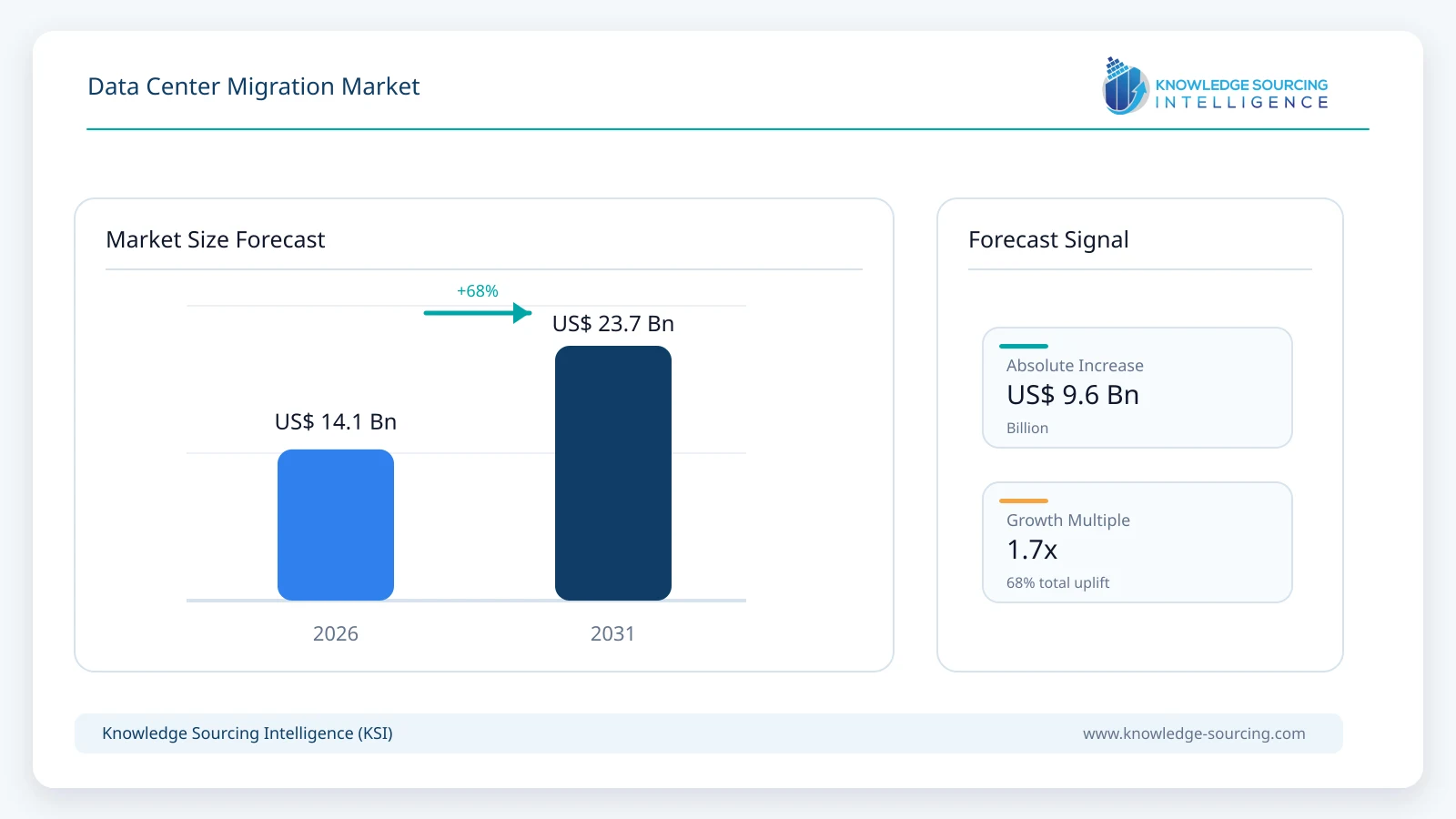
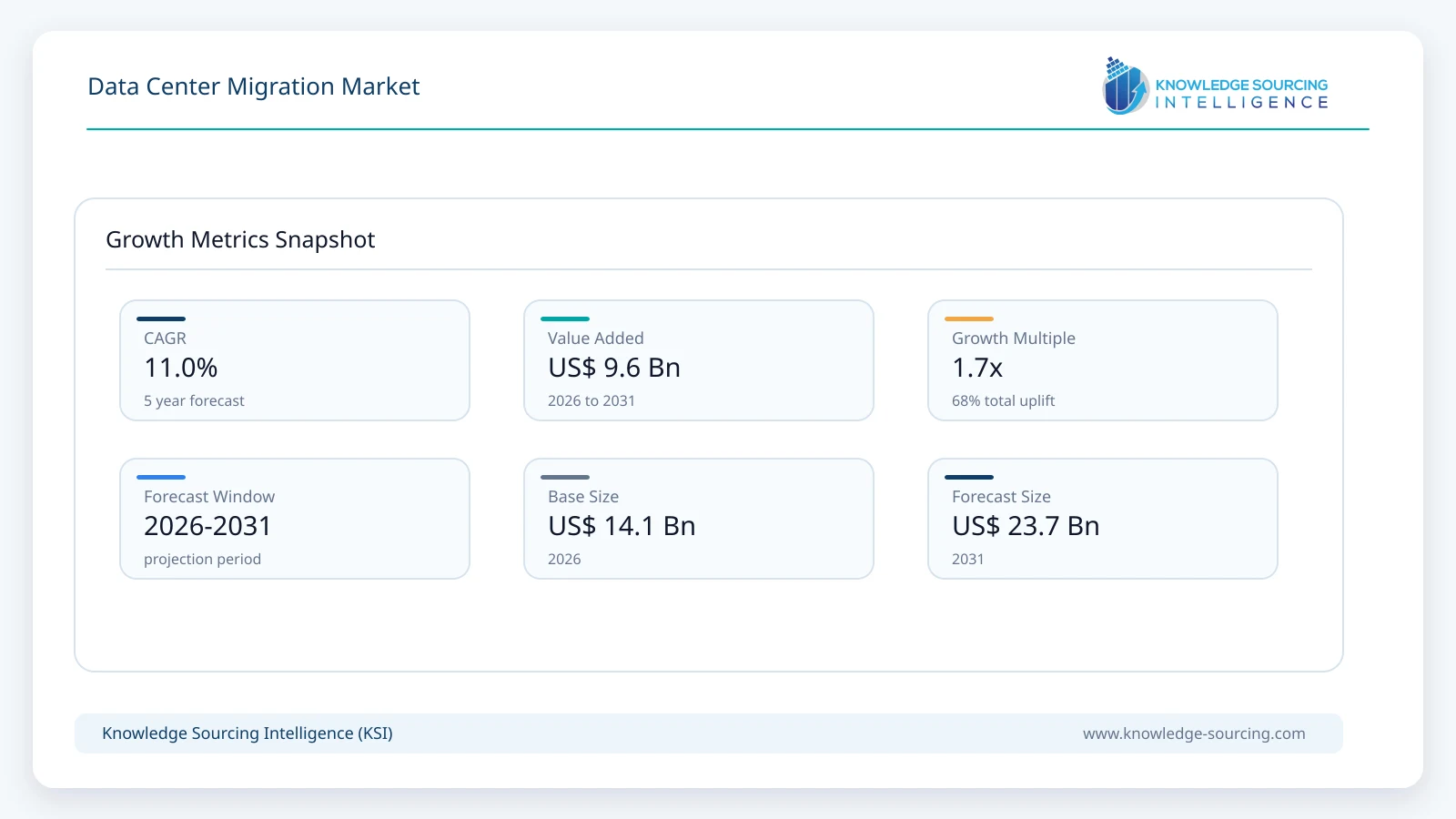
The Data Center Migration Market is forecast to grow at a CAGR of 11.0%, reaching USD 23.67 billion in 2031 from USD 14.05 billion in 2026.
Highlights:
- 1Cloud migration remains the largest source of project demand as organisations modernise legacy infrastructure and adopt scalable computing environments.
- 2Large enterprises account for the majority of migration spending due to complex application portfolios and multi-site infrastructure estates.
- 3Asia Pacific presents strong investment opportunities as enterprises expand digital infrastructure and cloud adoption across emerging economies.
- 4Automation, workload discovery, dependency mapping, and AI-assisted migration planning are improving project efficiency and reducing implementation risks.
- 5Data sovereignty regulations and cybersecurity requirements continue to influence migration architecture and destination selection.
- 6Competition increasingly centres on end-to-end migration capabilities, managed services, cloud partnerships, and industry-specific implementation expertise.
The data center migration market comprises consulting, planning, software, infrastructure, and managed services used to transfer applications, workloads, databases, storage, and network environments from one computing environment to another. Migration projects include transitions from on-premises facilities to public cloud platforms, hybrid deployments, colocation facilities, and newly constructed enterprise data centers, as well as consolidation of legacy infrastructure. The market serves organizations seeking to modernise IT estates, improve operational resilience, optimise infrastructure utilisation, strengthen cybersecurity, and comply with changing regulatory requirements.
Demand is being shaped by the growing mismatch between ageing enterprise infrastructure and modern computing requirements. Many organisations continue to operate legacy servers, storage systems, and applications that consume high levels of power, require specialised maintenance, and limit the deployment of cloud-native software. At the same time, enterprise workloads supporting artificial intelligence, advanced analytics, digital commerce, remote collaboration, and real-time customer services require scalable computing environments with improved availability and lower latency. These factors are increasing investment in structured migration programmes rather than incremental infrastructure upgrades.
Buyer priorities have shifted beyond simple infrastructure relocation. Procurement teams increasingly evaluate migration partners based on business continuity planning, application dependency mapping, security validation, workload optimisation, regulatory compliance, automation capabilities, and post-migration operational support. Migration projects frequently involve multiple technology vendors, cloud service providers, systems integrators, cybersecurity specialists, and managed service providers, making programme governance a critical purchasing consideration.
The market structure combines global cloud platform providers, IT consulting firms, enterprise infrastructure vendors, and specialist migration service companies. Cloud providers contribute migration tools and platform services, while consulting firms provide assessment, architecture design, execution, testing, and optimisation services. Hardware and virtualisation vendors also participate by enabling workload portability across physical and virtual environments.
Revenue generation extends beyond one-time migration engagements. Suppliers increasingly secure recurring income through managed cloud operations, disaster recovery services, infrastructure monitoring, application modernisation, security management, and optimisation contracts following successful migration projects. This commercial model encourages long-term customer relationships rather than project-based engagements.
Migration activity is expanding across industries with large application portfolios, strict uptime requirements, and complex regulatory obligations. Financial institutions, healthcare organisations, government agencies, telecommunications operators, retailers, and manufacturers continue to migrate critical workloads while balancing operational risk, compliance obligations, and budget constraints. Demand is also supported by enterprise strategies to reduce technical debt, improve disaster recovery capabilities, and prepare infrastructure for future computing requirements.
Market Drivers
Enterprise infrastructure modernisation
Many enterprise data centres contain infrastructure approaching end-of-life, resulting in higher maintenance costs, reduced energy efficiency, and limited compatibility with modern software platforms. Organisations increasingly determine that migrating workloads provides greater long-term economic value than extending legacy infrastructure. Buyers seek migration partners capable of minimising operational disruption while improving infrastructure performance. Service providers respond by combining migration planning with application modernisation and operational optimisation, creating broader revenue opportunities.
Expansion of cloud-native business applications
Business software vendors continue introducing applications optimised for cloud deployment, containerisation, and distributed computing. Enterprises adopting these platforms often require migration of existing databases, middleware, and application environments before implementation. Procurement decisions therefore extend beyond cloud infrastructure selection to include migration expertise, workload assessment, security validation, and interoperability services. This expands demand for specialised migration consulting across multiple industries.
Rising cybersecurity and resilience requirements
Cybersecurity incidents have increased board-level attention toward infrastructure resilience and disaster recovery planning. Migration programmes frequently incorporate network segmentation, identity management improvements, backup modernisation, and zero-trust security architectures. Organisations view migration as an opportunity to strengthen operational resilience while replacing unsupported infrastructure. Vendors capable of integrating security throughout migration planning gain competitive advantages in regulated industries.
Growth in mergers, acquisitions, and organisational restructuring
Corporate mergers frequently result in duplicate infrastructure, incompatible applications, and fragmented data environments. Consolidating multiple data centres reduces operational costs and simplifies governance. Migration specialists therefore benefit from corporate restructuring activity, where integration timelines, regulatory compliance, and uninterrupted business operations become major procurement priorities.
Market Restraints and Challenges
Complexity of legacy application environments
Many organisations operate applications with undocumented dependencies, proprietary software, and customised configurations developed over decades. These environments increase migration complexity, extend project timelines, and elevate implementation risks. Buyers often invest heavily in application discovery and dependency analysis before migration begins. Automation and workload assessment tools partially reduce these challenges but cannot eliminate technical uncertainty.
Operational disruption risks
Data centre migration directly affects mission-critical applications supporting finance, healthcare, manufacturing, telecommunications, and government operations. Even short periods of downtime can create substantial operational and financial consequences. Organisations therefore conduct extensive testing, phased migration schedules, and fallback planning, increasing project costs and procurement requirements.
Skills shortages
Large migration programmes require expertise spanning cloud architecture, cybersecurity, networking, storage, virtualisation, databases, and application engineering. Many enterprises lack sufficient internal resources to manage complex migrations independently, increasing reliance on external service providers. Limited availability of experienced specialists can delay project execution and increase implementation costs.
Regulatory and data sovereignty requirements
Cross-border migration of regulated information remains subject to complex legal obligations. Financial institutions, healthcare providers, and public-sector organisations must satisfy requirements governing data residency, encryption, access control, and auditability. Compliance obligations influence migration architecture, cloud selection, and geographic deployment decisions, increasing planning complexity.
Major Segment Analysis
Cloud Migration
Cloud migration represents the most commercially important segment because it combines infrastructure replacement with broader business modernisation initiatives. Organisations are not simply relocating workloads; they are redesigning computing environments to improve scalability, resilience, automation, and operational efficiency. Demand originates primarily from enterprises seeking flexible infrastructure capable of supporting fluctuating computing requirements without major capital expenditure.
Purchasing decisions increasingly depend on workload compatibility, migration automation, application dependency analysis, cybersecurity controls, regulatory compliance, and post-migration optimisation capabilities. Buyers favour providers offering structured migration frameworks supported by assessment tools, workload prioritisation, testing methodologies, and continuous operational support.
Competition within this segment extends beyond migration execution. Suppliers differentiate themselves through cloud partnerships, proprietary migration software, automation capabilities, managed services, and industry-specific expertise. Successful providers combine technical execution with governance, compliance management, and application optimisation, creating higher-value customer engagements and recurring service revenue after migration completion.
Regional Analysis
North America
North America remains the leading regional market due to extensive enterprise cloud adoption, mature digital infrastructure, and high concentration of hyperscale cloud providers. Financial institutions, healthcare systems, technology companies, retailers, and public-sector organisations continue investing in infrastructure modernisation. Strict cybersecurity expectations and strong enterprise IT spending sustain demand for advanced migration services.
Europe
European demand is influenced by regulatory compliance, sustainability objectives, and digital sovereignty considerations. Organisations increasingly evaluate migration strategies that support energy-efficient infrastructure while satisfying data protection obligations. Enterprises often adopt hybrid architectures to balance operational flexibility with regulatory requirements, supporting demand for specialised consulting and managed migration services.
Asia Pacific
Asia Pacific continues expanding through enterprise digital investment, growing cloud adoption, and rapid development of regional data centre capacity. Organisations across manufacturing, financial services, telecommunications, and government sectors increasingly replace ageing infrastructure with cloud-enabled environments. Investment in domestic cloud infrastructure and digital public services further supports migration activity across several economies.
Middle East & Africa
Governments continue investing in national digital infrastructure, cloud adoption initiatives, and public-sector modernisation programmes. Financial institutions, telecommunications providers, and energy companies increasingly migrate workloads to improve operational resilience. Infrastructure maturity varies considerably across countries, creating different adoption rates and implementation priorities.
South America
Migration demand is driven by enterprise infrastructure modernisation, cloud adoption, and operational cost optimisation. Organisations increasingly migrate selected workloads while maintaining hybrid environments to address connectivity, compliance, and operational continuity considerations. Budget constraints and skills availability remain important factors influencing project scale and implementation timelines.
Competitive Landscape
Competition is characterised by integrated service delivery rather than infrastructure products alone. Cloud providers, systems integrators, infrastructure vendors, and managed service companies compete by offering complete migration programmes covering assessment, planning, execution, optimisation, security, and long-term operations.
Suppliers strengthen competitive positioning through strategic alliances with hyperscale cloud providers, investments in migration automation, industry-specific consulting capabilities, and global delivery networks. Technology differentiation increasingly depends on workload discovery platforms, dependency mapping, orchestration software, AI-assisted migration planning, and operational monitoring capabilities. Geographic presence, certified technical talent, regulatory expertise, and proven execution experience remain important evaluation criteria for enterprise buyers.
Major participants include Amazon Web Services, Inc. (AWS), Google Cloud, Microsoft Corporation, IBM Corporation, Accenture plc, Dell Technologies Inc., VMware by Broadcom, Infosys Limited, NTT DATA Group Corporation, and Trianz Holdings, Inc.
Recent Developments
July 2026: AWS announced enhanced AWS Transform capabilities, adding multilingual support for migration projects across 13 languages to streamline large-scale application and infrastructure migrations while improving collaboration for global data centre modernisation programmes.
May 2026: Google Cloud expanded capabilities within its migration and modernisation portfolio by introducing additional automation features supporting application assessment and workload transition. The enhancements improve migration efficiency and reduce implementation complexity for enterprise customers.
April 2026: Nutanix introduced new cloud capabilities and migration programmes for service providers, including incentives to accelerate customer migrations from VMware environments and new multitenant infrastructure designed to simplify enterprise data centre modernisation.
Regulatory and Policy Environment
Regulatory compliance has become an integral component of enterprise migration planning. Data protection regulations require organisations to implement appropriate controls for processing, storing, and transferring sensitive information across computing environments. Compliance obligations frequently influence cloud region selection, encryption standards, identity management, and audit capabilities.
Industry standards relating to information security, business continuity, and operational resilience continue guiding procurement decisions. Financial institutions, healthcare providers, telecommunications operators, and government agencies often require migration providers to demonstrate compliance with recognised security frameworks before project approval.
Governments are also encouraging domestic digital infrastructure investment through cloud adoption strategies, public-sector modernisation programmes, cybersecurity initiatives, and national digital economy policies. These programmes stimulate demand for migration services while encouraging deployment of secure and compliant infrastructure environments.
Outlook and Strategic Implications
Over the forecast period, enterprise migration strategies are expected to become more selective, prioritising workloads that provide measurable operational, financial, and resilience benefits. Organisations will increasingly integrate migration with application modernisation, cybersecurity enhancement, infrastructure optimisation, and AI-ready computing architectures rather than treating migration as an isolated infrastructure project.
Procurement activity is expected to place greater emphasis on automation, governance, workload visibility, compliance assurance, and measurable business outcomes. Suppliers capable of combining consulting expertise, migration software, managed operations, and long-term optimisation services will be better positioned to secure multi-year customer relationships.
Investment priorities are likely to include hybrid cloud management, workload portability, observability platforms, infrastructure automation, and cybersecurity integration. Organisations will continue balancing performance, regulatory compliance, sustainability objectives, and operational resilience when selecting migration strategies.
Competitive differentiation will depend less on infrastructure ownership and more on execution quality, technical expertise, ecosystem partnerships, industry knowledge, and recurring managed service capabilities. Vendors that reduce migration risk, shorten implementation timelines, and demonstrate measurable operational improvements are expected to strengthen their market positions over the next five years.
Data Center Migration Market Scope
| Report Metric | Details |
|---|---|
| Total Market Size in 2026 | USD 14.05 billion |
| Total Market Size in 2031 | USD 23.67 billion |
| Forecast Unit | Billion |
| Growth Rate | 11.0% |
| Study Period | 2021 to 2031 |
| Historical Data | 2021 to 2024 |
| Base Year | 2025 |
| Forecast Period | 2026 – 2031 |
| Segmentation | Migration Type, Organization Size, End-User Industry, Geography |
| Companies |
|
Market Segmentation
By Migration Type
By Organization Size
By End-user Industry
By Geography
Table of Contents
1. EXECUTIVE SUMMARY
2. MARKET SNAPSHOT
2.1. Market Overview
2.2. Market Definition
2.3. Scope of the Study
2.4. Market Segmentation
3. BUSINESS LANDSCAPE
3.1. Market Drivers
3.2. Market Restraints
3.3. Market Opportunities
3.4. Porter's Five Forces Analysis
3.5. Industry Value Chain Analysis
3.6. Policies and Regulations
3.7. Strategic Recommendations
4. TECHNOLOGICAL OUTLOOK
5. DATA CENTER MIGRATION MARKET BY MIGRATION TYPE
5.1. Introduction
5.2. Cloud Migration
5.3. Hybrid Migration
5.4. Data Center Consolidation
5.5. Colocation Migration
5.6. Data Center Relocation
6. DATA CENTER MIGRATION MARKET BY ORGANIZATION SIZE
6.1. Introduction
6.2. Small and Medium-sized Enterprises (SMEs)
6.3. Large Enterprises
7. DATA CENTER MIGRATION MARKET BY END-USER INDUSTRY
7.1. Introduction
7.2. BFSI
7.3. IT and Telecommunications
7.4. Healthcare
7.5. Manufacturing
7.6. Government and Public Sector
7.7. Retail and E-commerce
7.8. Others
8. DATA CENTER MIGRATION MARKET BY GEOGRAPHY
8.1. Introduction
8.2. North America
8.2.1. United States
8.2.2. Canada
8.2.3. Mexico
8.3. South America
8.3.1. Brazil
8.3.2. Argentina
8.3.3. Others
8.4. Europe
8.4.1. Germany
8.4.2. United Kingdom
8.4.3. France
8.4.4. Italy
8.4.5. Spain
8.4.6. Others
8.5. Middle East and Africa
8.5.1. Saudi Arabia
8.5.2. United Arab Emirates
8.5.3. South Africa
8.5.4. Others
8.6. Asia Pacific
8.6.1. China
8.6.2. India
8.6.3. Japan
8.6.4. South Korea
8.6.5. Australia
8.6.6. Indonesia
8.6.7. Thailand
8.6.8. Others
9. COMPETITIVE ENVIRONMENT AND ANALYSIS
9.1. Major Players and Strategy Analysis
9.2. Market Share Analysis
9.3. Mergers, Acquisitions, Agreements, and Collaborations
9.4. Competitive Dashboard
10. COMPANY PROFILES
10.1. Amazon Web Services, Inc. (AWS)
10.2. Google Cloud
10.3. Microsoft Corporation
10.4. IBM Corporation
10.5. Accenture plc
10.6. Dell Technologies Inc.
10.7. VMware by Broadcom
10.8. Infosys Limited
10.9. NTT DATA Group Corporation
10.10. Trianz Holdings, Inc.
11. APPENDIX
11.1. Currency
11.2. Assumptions
11.3. Base and Forecast Years Timeline
11.4. Key Benefits for Stakeholders
11.5. Research Methodology
11.6. Abbreviations
LIST OF FIGURES
LIST OF TABLES
Navigate
Trusted by the world's leading organizations











