
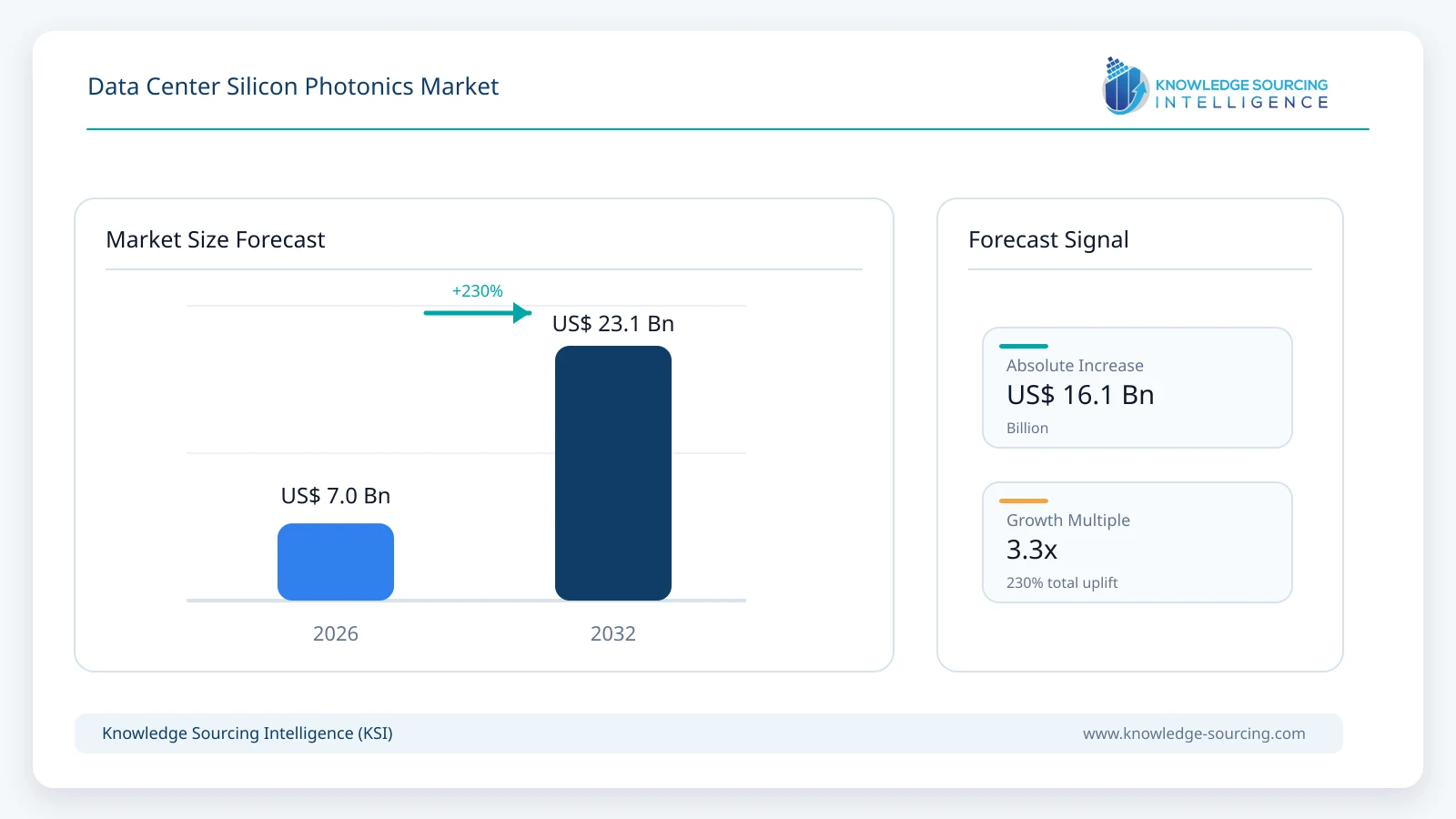
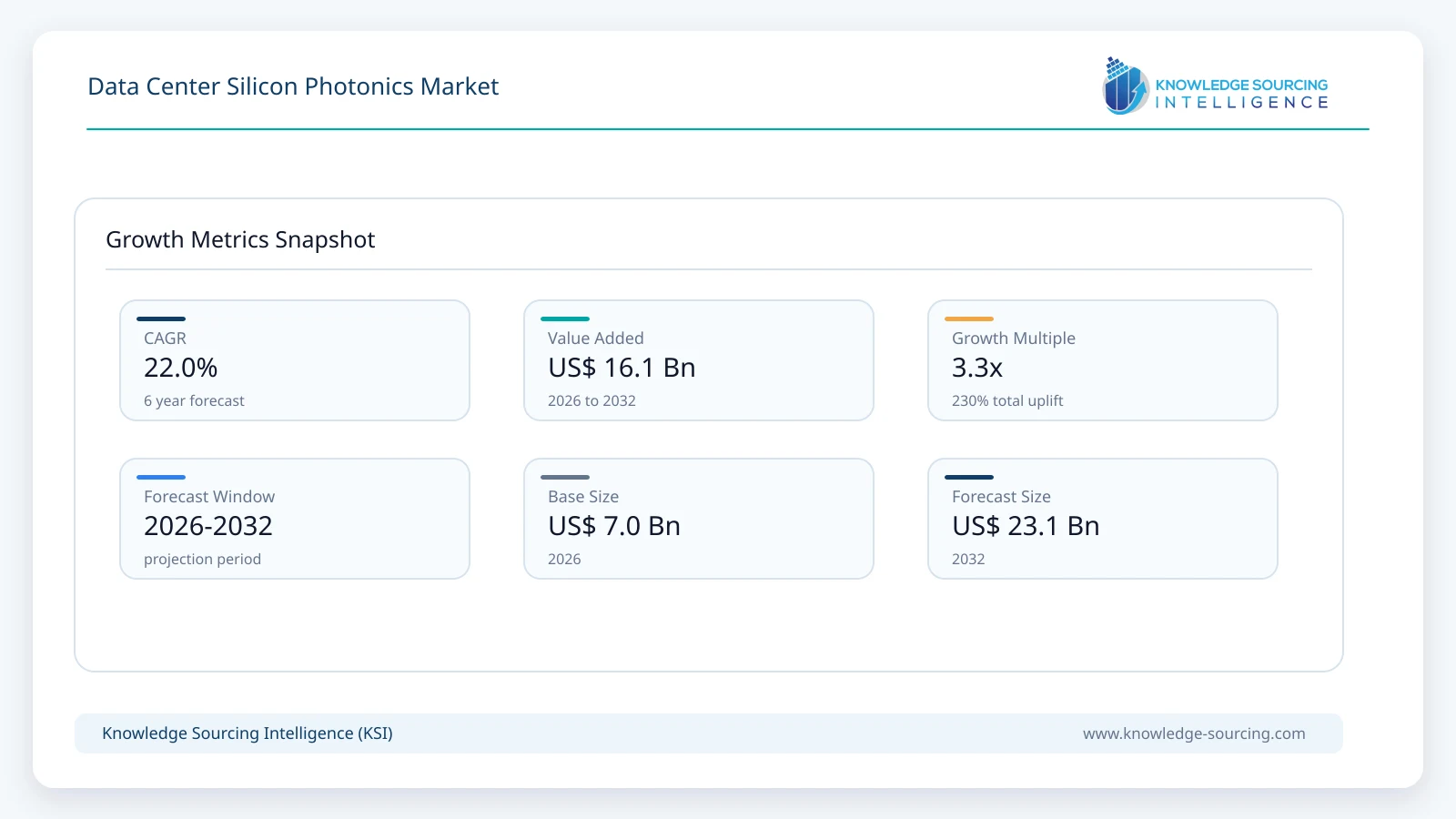
The Data Center Silicon Photonics Market is estimated at USD 7.0 billion in 2026 and is projected to reach USD 23.1 billion by 2032, representing a CAGR of 22.0% during the forecast period.
Key Highlights
• Silicon photonics expands from pluggable transceivers into near-package, on-board and co-packaged optical architectures.
• Cisco is introducing 1.6T pluggable optics using its silicon-photonics technology for AI networks.
• NVIDIA Spectrum-X ethernet Photonics entered production during 2026 for Vera Rubin AI factories.
• GlobalFoundries expects silicon-photonics revenue to more than double during calendar year 2026.
• Coherent is demonstrating silicon-photonics implementations across 1.6T, 3.2T and future optical modules.
• Pluggable transceivers remain the largest 2026 revenue pool despite growing integrated-optics adoption.
• Optical engines and processor-adjacent photonics are the fastest-growing silicon-photonics revenue category.
• AI scale-out remains the largest networking use case while optical scale-up expands rapidly.
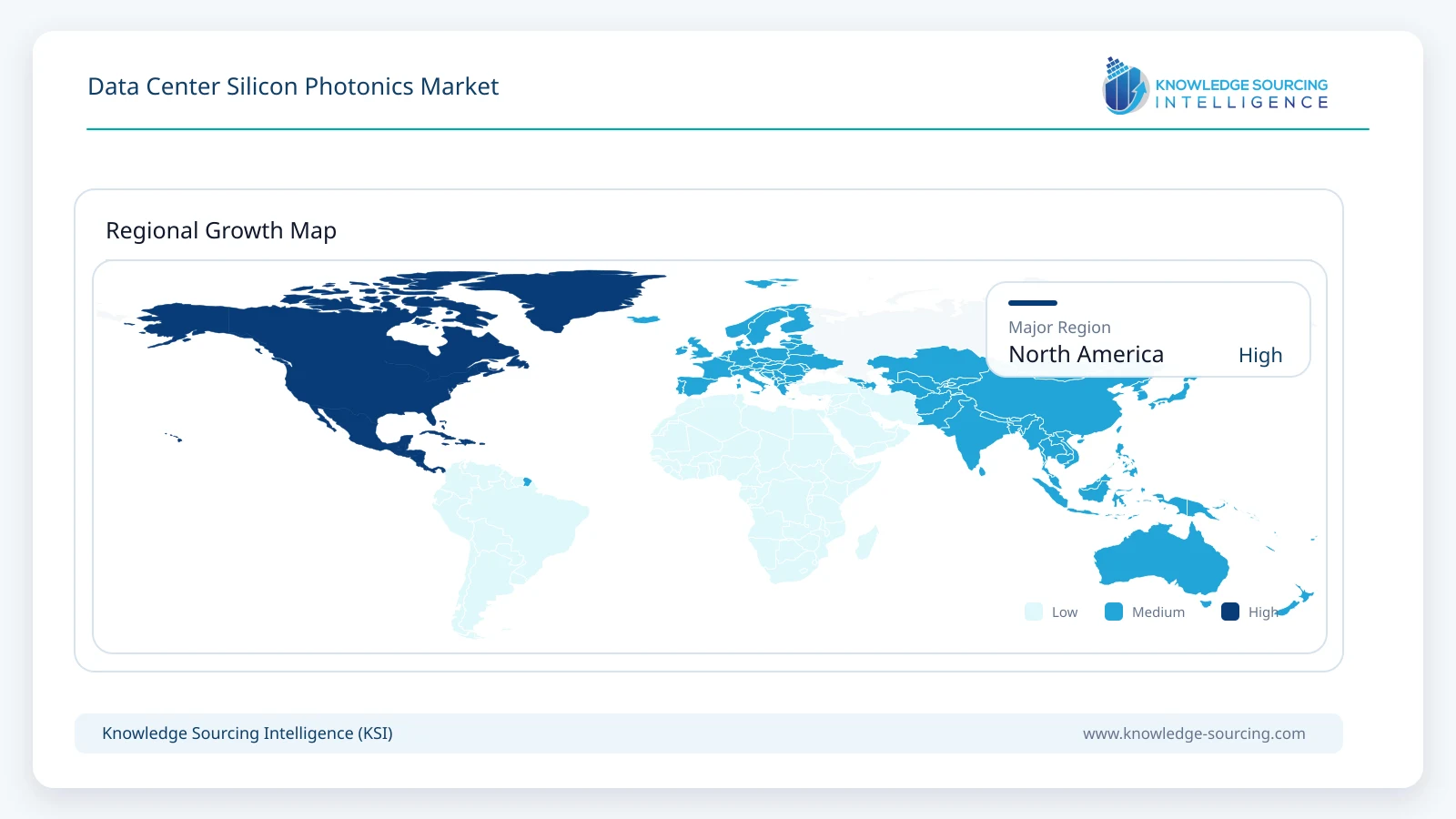
• North America leads design and early deployment through hyperscalers and photonics-platform suppliers.
• Integrated lasers, external laser sources and fiber attachment remain key architectural differentiation points.
Market Overview
Data-center optical connectivity is moving through two transitions simultaneously. The first is the speed transition from 400G and 800G links toward 1.6T and later 3.2T pluggable optics. The second is an architectural transition that moves the optical conversion closer to switch and compute silicon. Silicon photonics participates in both. In pluggable modules, a silicon PIC can integrate multiple modulators, detectors and optical routing functions into a compact transceiver. In near-package, on-board and co-packaged implementations, the same integration principle allows optical engines to shorten high-speed electrical paths and move more bandwidth onto fiber before electrical loss and retiming power become excessive.
The technology is therefore broader than co-packaged optics. Cisco is using silicon photonics in 400G to 1.6T pluggable data-center optics, while Coherent is developing silicon-photonics PIC implementations for both current 1.6T and future 3.2T modules. GlobalFoundries positions its silicon-photonics process technologies across pluggable, linear-drive pluggable, near-package and co-packaged form factors. Intel has already shipped more than eight million silicon-photonics PICs with more than 32 million on-chip lasers in data-center transceivers and is extending the platform into a 4 Tbps bidirectional optical compute interconnect chiplet. This installed manufacturing base matters because the next phase of adoption requires semiconductor-like yield, test automation and packaging repeatability rather than bespoke optical assembly.
AI changes the economics of optical links because bandwidth demand is increasing faster than general server traffic. Large GPU clusters require scale-out links between switches, racks and data halls, while larger scale-up domains increasingly require optical connectivity between accelerator trays and racks. The rise of multi-building AI campuses also creates demand for lower-cost coherent-lite optical connections across distances beyond conventional data-center reach. Silicon photonics can address each of these layers with different products: front-panel modules for scale-out, optical engines for scale-up, coherent silicon-photonics modules for campus connectivity, and CPO for the highest switch bandwidth density. The result is a market that grows through both higher optical port volumes and increasing photonic content per switch or accelerator system.
Market Drivers
Transition from 800G to 1.6T and 3.2T optics increases integrated photonic content
The near-term volume driver remains the rapid speed upgrade in AI scale-out networks. Cisco launched a 1.6T OSFP platform in 2026 using Cisco Silicon Photonics, while Broadcom and Marvell introduced 400G-per-lane and 1.6T optical silicon intended for the next generation of modules. Coherent is demonstrating both silicon-photonics and indium-phosphide implementations for 1.6T and 3.2T, showing that the market will remain multi-technology but that silicon photonics is increasingly competitive where high lane count, integration density and manufacturability matter. Each speed transition raises the number of high-speed optical lanes and strengthens the value of integrating optical functions on a common PIC.
Electrical I/O limits are pushing optics closer to switches and accelerators
Front-panel pluggable modules remain practical across a large portion of the network, but their electrical path from the switch or accelerator ASIC becomes harder to maintain as SerDes speeds rise. Retimers and long printed-circuit-board traces add power and latency. NVIDIA is addressing this constraint through Spectrum-X Ethernet Photonics, which places silicon-photonics engines beside the switch ASIC and entered production in 2026. Lightmatter is targeting a different integration point through Passage L20 near-package and on-board optical engines. Intel OCI similarly moves optical I/O to the processor package. These architectures expand silicon-photonics revenue beyond conventional transceiver replacement and create new optical content inside compute systems.
AI scale-up and multi-building campuses add new optical addressable markets
AI networking is no longer limited to Ethernet leaf-spine links inside one data hall. Scale-up fabrics increasingly connect larger accelerator domains across trays and racks, while hyperscale campuses span multiple buildings. Marvell is developing silicon-photonics light engines for AI scale-up and coherent-lite solutions for 2 to 20 kilometre campus links. Lightmatter is positioning multi-terabit optical engines for both scale-up and scale-out. These use cases add optical links in places that were previously served by copper, electrical backplanes or more expensive coherent transport systems, raising the silicon-photonics content per megawatt of AI compute.
Foundry and manufacturing ecosystems are becoming production ready
Silicon photonics benefits when manufacturing moves from custom optical assembly toward reusable foundry and packaging platforms. GlobalFoundries states that its production-proven silicon-photonics processes support pluggable, near-package and co-packaged form factors and expects its silicon-photonics revenue to more than double in 2026. The company also announced a potential USD 300 million CHIPS Research and Development award to accelerate next-generation silicon-photonics materials, wafers and packaging. NVIDIA is using TSMC, SPIL and Foxconn in a production silicon-photonics supply chain for Spectrum-X Photonics. These investments increase qualified capacity and reduce one of the principal barriers to broad adoption.
Restraints and Adoption Challenges
Silicon photonics does not displace every competing optical technology. Indium phosphide EMLs remain strong in high-speed pluggables, particularly where direct laser and modulator performance outweigh integration advantages, while VCSEL-based links remain cost-effective at shorter reaches. Silicon photonics also introduces manufacturing challenges around laser integration, fiber attachment, thermal control and known-good-die testing. CPO and processor-adjacent optics add serviceability concerns because optical failures can affect a larger system than a replaceable front-panel module. In addition, module average selling prices typically decline after each speed generation reaches volume production. The forecast therefore assumes strong unit and bandwidth growth but progressively slower revenue growth after 2030 as yields improve, competition increases and cost per transmitted bit falls.
Segment Analysis
By Product and Integration Form
Silicon-photonics-based pluggable transceivers represent the largest revenue pool in 2026 because 400G and 800G deployments are already at scale and 1.6T is beginning a major AI-driven ramp. These modules combine a silicon PIC with lasers, electronic drivers or DSPs, fiber interfaces and packaging in a field-replaceable form factor. Optical engines and PIC subsystems used in near-package, on-board and co-packaged architectures represent the fastest-growing category through 2032. Their starting base is smaller, but adoption expands rapidly as switch and accelerator electrical I/O approaches practical power and reach limits. Silicon-photonics foundry and specialized packaging revenue grows alongside both categories but remains a smaller direct revenue pool than finished optical subsystems.
By Data Center Interconnect Role
Scale-out networking remains the largest application because Ethernet and InfiniBand fabrics connect very large numbers of servers, switches and accelerator nodes using optical links between racks and data halls. Scale-up networking is the fastest-growing role as accelerator domains extend beyond a single rack and optical engines begin replacing copper for higher-bandwidth, longer-reach links. Data-center interconnect and scale-across applications form a separate high-value category that increasingly uses coherent silicon photonics for campus and metro distances. Processor optical I/O remains early-stage in 2026 but becomes increasingly relevant later in the forecast period as optical chiplets move from evaluation toward production systems.
Segment | Revenue Contribution | Growth Direction | Primary Demand |
Silicon-photonics pluggables | Largest revenue pool | Strong | 400G/800G installed base and 1.6T transition |
NPO/OBO optical engines | Early commercial | Very high | Shorter electrical paths for switches and XPUs |
Co-packaged optical engines | Initial production | Very high | Highest switch bandwidth density and lower electrical I/O power |
Optical compute I/O | Emerging | Accelerating after 2028 | Processor-adjacent optical links and resource disaggregation |
Scale-out networking | Largest use case | Strong | AI switch-to-switch and switch-to-NIC connectivity |
Scale-up networking | Smaller 2026 base | Fastest use-case growth | Multi-rack accelerator domains and copper-reach limits |
Technology and Adoption Indicators
Indicator | Latest Development | Market Impact |
NVIDIA production CPO | Spectrum-X Ethernet Photonics entered production with Vera Rubin in May 2026. | Moves silicon photonics into production switch infrastructure at AI-factory scale. |
Cisco 1.6T silicon photonics | Cisco announced 1.6T OSFP optics for AI scale-out using its silicon-photonics technology. | Extends silicon photonics through mainstream field-replaceable pluggables. |
GlobalFoundries revenue momentum | GF expects silicon-photonics revenue to more than double in 2026. | Shows foundry demand scaling across multiple optical form factors. |
Intel installed PIC base | Intel reports more than 8 million silicon-photonics PICs shipped historically. | Demonstrates volume manufacturing maturity before optical I/O moves closer to compute. |
Lightmatter NPO/OBO | Passage L20 provides 6.4 Tbps each direction and samples in late 2026. | Expands addressable market into multi-rack scale-up and processor-adjacent optics. |
Coherent 3.2T path | Coherent demonstrated 400G-per-lane silicon-photonics links for future 3.2T pluggables. | Supports another transceiver speed cycle beyond 1.6T. |
Regional Opportunity
North America
North America is the largest early demand and design center for data-center silicon photonics. NVIDIA, Broadcom, Marvell, Cisco, Intel, Coherent, Lumentum, GlobalFoundries, Lightmatter and Ayar Labs all operate major silicon-photonics, optical-networking or optical-I/O programs from the United States. The region also contains the largest concentration of hyperscale and AI-cloud buyers that can justify rapid adoption of new optical architectures because networking power, GPU utilization and deployment speed directly affect the economics of AI infrastructure. Cisco is moving 1.6T silicon-photonics pluggables into AI scale-out networks, NVIDIA is commercializing CPO switches, and Lightmatter is targeting optical engines for multi-rack scale-up.
Manufacturing capacity is also becoming strategically important in the region. GlobalFoundries is expanding silicon-photonics and silicon-germanium capacity in the United States and in July 2026 announced a letter of intent for a USD 300 million U.S. Department of Commerce award to advance silicon-photonics wafer technology, materials and packaging. The company reported seven new optical-networking design wins during the second quarter and expects silicon-photonics revenue to more than double in 2026. This foundry expansion complements domestic optical-module, laser and packaging investment and reduces dependence on a single manufacturing geography for critical AI interconnect components.
North American adoption is expected to remain heterogeneous. Pluggable optics continue to dominate high-volume switch-to-switch and switch-to-NIC connectivity, while CPO is introduced first where switch bandwidth density and power justify deeper integration. Near-package and on-board engines can provide an intermediate architecture where serviceability is important. Optical compute I/O represents the longer-term opportunity as accelerators, memory and disaggregated resources require more bandwidth than electrical package interfaces can provide. This mix supports broad silicon-photonics growth without assuming an abrupt replacement of pluggable transceivers.
Asia Pacific, Europe and Rest of World
Asia Pacific is critical to silicon-photonics manufacturing through foundry, outsourced semiconductor assembly and test, optical-module and server manufacturing capacity in Taiwan, China, Malaysia, Singapore, Japan and South Korea. TSMC and regional packaging partners are central to NVIDIA and other high-volume photonics programs, while Chinese optical-module suppliers represent a large share of global datacom production. Europe contributes important photonics design, equipment and research capabilities and remains a significant market for hyperscale, sovereign AI and high-performance computing infrastructure. Middle Eastern AI campuses are primarily demand centers for imported optical systems, but large greenfield deployments can adopt 1.6T, CPO and optical scale-up architectures rapidly because network designs are being built from the beginning around high-density accelerator systems.
Competitive Landscape
Competition spans four layers. Networking and accelerator-platform companies such as NVIDIA, Broadcom, Marvell and Cisco increasingly control the architecture and qualification path for silicon-photonics products. Optical-component and module companies such as Coherent and Lumentum compete across lasers, silicon-photonics PICs, transceivers and optical subsystems. Foundries and packaging companies such as GlobalFoundries and TSMC provide process technology and manufacturing scale. Specialist photonics companies such as Lightmatter and Ayar Labs target optical I/O architectures that move photonics closer to compute.
The competitive boundary between these layers is becoming less distinct. Broadcom and Marvell combine high-speed electronic silicon with optical platforms. Cisco combines switching, silicon photonics and coherent optics through the Acacia organization. GlobalFoundries is moving from wafer processing into reference optical-module solutions, while NVIDIA coordinates foundry, packaging, laser, fiber and system partners around a complete photonics switch platform. Differentiation therefore depends not only on modulator performance or optical bandwidth, but on packaging yield, laser strategy, fiber attachment, power per bit, field serviceability, interoperability and the ability to qualify an end-to-end system at hyperscale volumes.
Major companies and ecosystem participants covered: NVIDIA, Broadcom, Marvell Technology, Cisco, Coherent, Lumentum, Intel, GlobalFoundries, TSMC, Lightmatter, Ayar Labs, Tower Semiconductor, Fabrinet, ASE Technology and Amkor Technology.
Recent Developments
• September 17, 2026: Lightmatter introduced the Passage L20 CPX bidirectional optical engine for AI scale-up networks under the Open CPX MSA.
• July 29, 2026: GlobalFoundries announced a letter of intent for a USD 300 million U.S. CHIPS R&D award focused on next-generation silicon photonics and packaging.
• May 31, 2026: NVIDIA announced that Spectrum-X Ethernet Photonics had entered full production with the Vera Rubin platform.
• May 4, 2026: GlobalFoundries introduced its SCALE silicon-photonics co-packaged optical module platform for AI scale-up architectures.
• March 17, 2026: Coherent demonstrated 1.6T silicon-photonics transceivers and 400G-per-lane silicon-photonics links for future 3.2T pluggables.
• February 10, 2026: Cisco announced 1.6T OSFP and 800G linear pluggable optics using Cisco Silicon Photonics for AI data-center networking.
Data Center Silicon Photonics Market Scope:
| Report Metric | Details |
|---|---|
| Total Market Size in 2026 | USD 7.0 billion |
| Total Market Size in 2032 | USD 23.1 billion |
| Forecast Unit | USD Billion |
| Growth Rate | 22.0% |
| Study Period | 2021 to 2032 |
| Historical Data | 2021 to 2024 |
| Base Year | 2025 |
| Forecast Period | 2026 – 2032 |
| Segmentation | Product and Integration Form, Interconnect Role, Link Speed, Customer Type, Geography |
| Companies |
|
Market Segmentation
By Product and Integration Form
Silicon-Photonics Pluggable Transceivers
Photonic Integrated Circuits and Light Engines
Near-Package Optics
On-Board Optics
Co-Packaged Optical Engines
Optical Compute Interconnect Devices
Foundry and Photonic Packaging Content
By Interconnect Role
AI Scale-Out Networking
AI Scale-Up Networking
Data Center Interconnect and Scale-Across
Processor and Memory Optical I/O
By Link Speed
400G and Below
800G
1.6T
3.2T and Higher
By Customer Type
Hyperscale Cloud Providers
Neocloud and GPU-Cloud Operators
Data Center and Network OEMs
Sovereign AI and HPC
Enterprise Data Centers
By Geography
North America
United States
Canada
Asia Pacific
China
Taiwan
Japan
South Korea
Southeast Asia
Europe
Middle East and Rest of World
Table of Contents
1. EXECUTIVE SUMMARY
1.1. Market Opportunity and Key Findings
1.2. Silicon Photonics Adoption Timeline
1.3. Principal Revenue Pools
2. MARKET OVERVIEW
2.1. Evolution of Silicon Photonics in Data Centers
2.2. Pluggable, NPO, OBO and CPO Architectures
2.3. Silicon Photonics versus InP EML and VCSEL Approaches
2.4. Optical I/O and Processor-Adjacent Photonics
3. MARKET SIZE AND FORECAST, 2026-2032
3.1. Global Market Revenue
3.2. Annual Growth Analysis
3.3. Silicon Photonics Content per Optical Port
3.4. Revenue by Pluggable and Integrated Architectures
4. MARKET BY PRODUCT AND INTEGRATION FORM
4.1. Silicon-Photonics Pluggable Transceivers
4.2. Photonic Integrated Circuits and Light Engines
4.3. Near-Package Optics
4.4. On-Board Optics
4.5. Co-Packaged Optical Engines
4.6. Optical Compute Interconnect Devices
4.7. Foundry and Photonic Packaging Content
5. MARKET BY INTERCONNECT ROLE
5.1. AI Scale-Out Networking
5.2. AI Scale-Up Networking
5.3. Data Center Interconnect and Scale-Across
5.4. Processor and Memory Optical I/O
6. MARKET BY LINK SPEED
6.1. 400G and Below
6.2. 800G
6.3. 1.6T
6.4. 3.2T and Higher
7. MARKET BY CUSTOMER TYPE
7.1. Hyperscale Cloud Providers
7.2. Neocloud and GPU-Cloud Operators
7.3. Data Center and Network OEMs
7.4. Sovereign AI and HPC
7.5. Enterprise Data Centers
8. REGIONAL MARKET
8.1. North America
8.1.1. United States
8.1.2. Canada
8.2. Asia Pacific
8.2.1. China
8.2.2. Taiwan
8.2.3. Japan
8.2.4. South Korea
8.2.5. Southeast Asia
8.3. Europe
8.4. Middle East and Rest of World
9. MARKET DYNAMICS
9.1. Drivers
9.1.1. 1.6T and 3.2T Optical Transition
9.1.2. Electrical I/O Power and Reach Limits
9.1.3. Expansion of AI Scale-Up Networking
9.1.4. Foundry and Packaging Ecosystem Maturity
9.2. Restraints
9.2.1. Competition from InP EML and VCSEL Architectures
9.2.2. Laser Integration and Fiber-Attach Complexity
9.2.3. Serviceability of Integrated Optics
9.2.4. Declining Cost per Bit
10. COMPETITIVE LANDSCAPE
10.1. Networking and Accelerator Platform Vendors
10.2. Optical Component and Module Suppliers
10.3. Silicon Photonics Foundries
10.4. Optical I/O Specialists
10.5. Packaging and Manufacturing Ecosystem
11. COMPANY PROFILES
11.1. NVIDIA
11.2. Broadcom
11.3. Marvell Technology
11.4. Cisco
11.5. Coherent
11.6. Lumentum
11.7. Intel
11.8. GlobalFoundries
11.9. TSMC
11.10. Lightmatter
11.11. Ayar Labs
11.12. Tower Semiconductor
11.13. Fabrinet
11.14. ASE Technology
11.15. Amkor Technology
12. RECENT DEVELOPMENTS
13. APPENDIX
Navigate
Trusted by the world's leading organizations











