
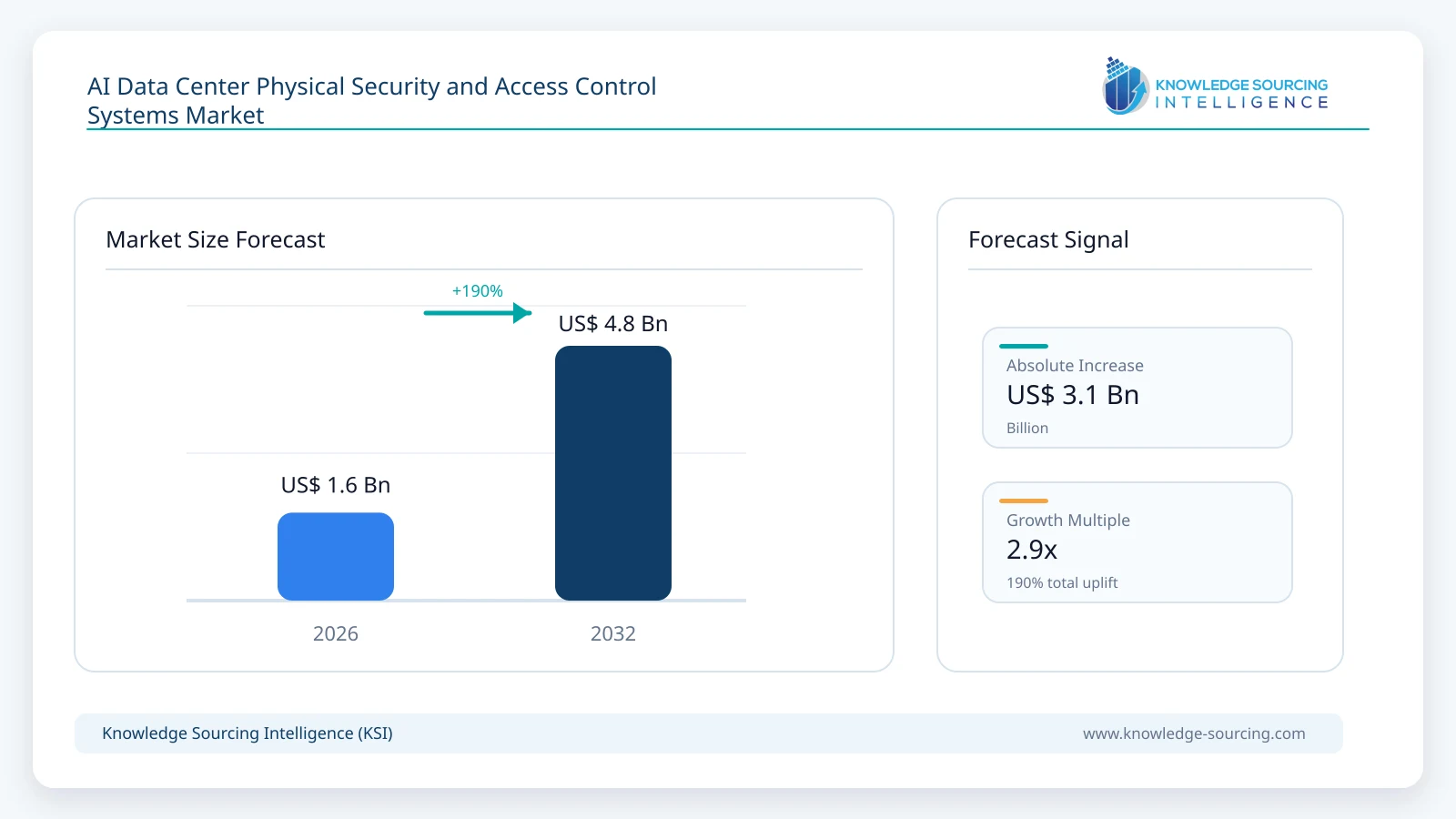
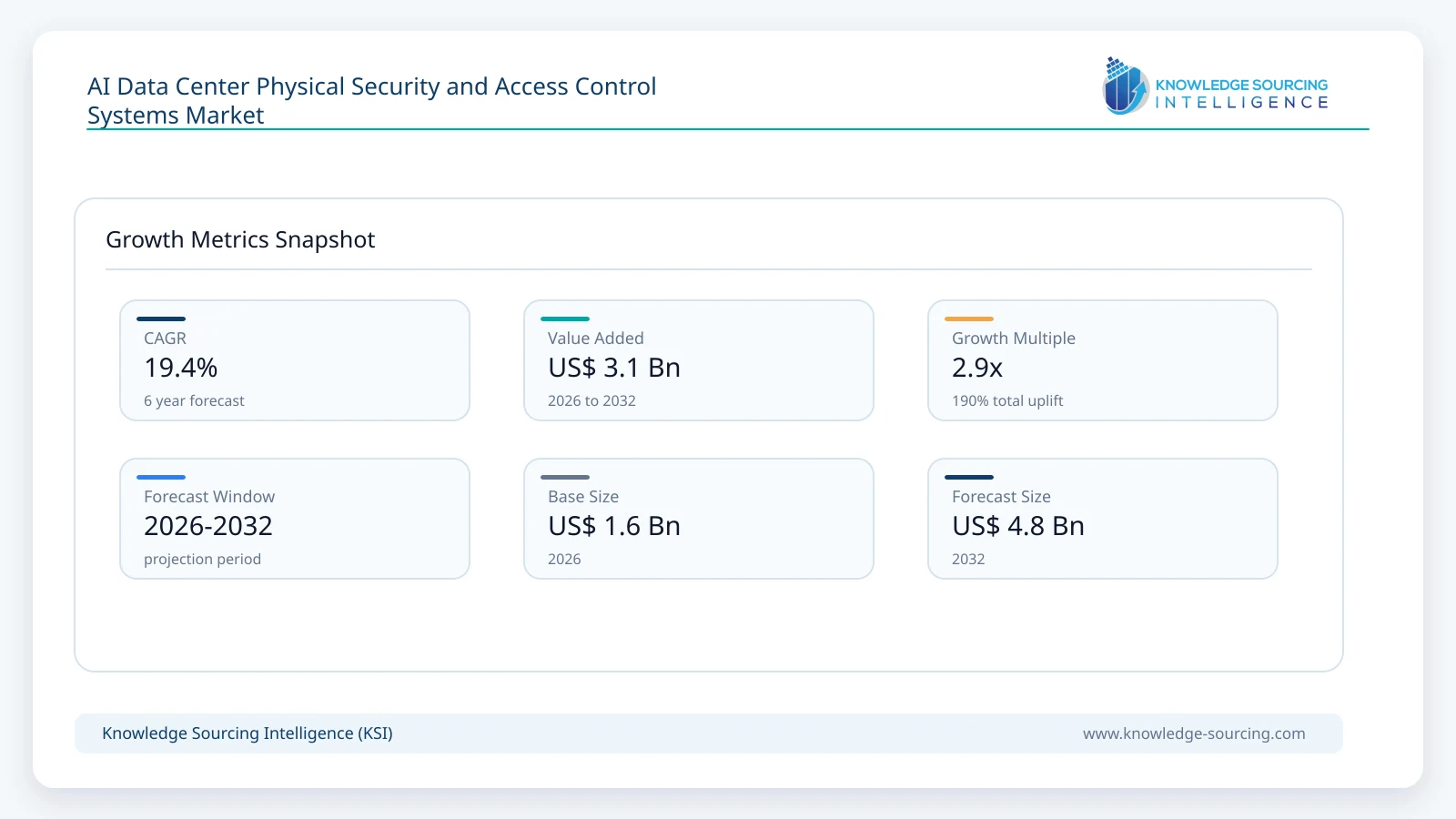
The AI Data Center Physical Security and Access Control Systems Market is estimated at USD 1.65 billion in 2026 and is projected to reach USD 4.78 billion by 2032, representing a CAGR of 19.4% during 2026-2032.
Highlights:
- 1Video surveillance and electronic access control remain the largest 2026 revenue pools.
- 2Biometric and identity-aware access are among the fastest-growing security technology layers.
- 3Multi-building AI campuses increase demand for centralized security management and federation.
- 4Cabinet and cage access control expands as colocation and shared AI infrastructure scale.
- 5North America leads spending through hyperscale, neocloud and large colocation AI campuses.
Market Overview
Modern data-center physical security is built around defense in depth. Gallagher describes a layered model extending from the property perimeter to building entry, internal restricted zones, data halls and cabinet-level access. Each layer requires independent authentication, monitoring and auditability so that failure at one boundary does not automatically expose critical compute infrastructure. AI campuses make this approach more important because they often contain several buildings, high-value accelerator clusters, extensive contractor activity and a larger number of service entrances, loading zones and utility spaces than conventional enterprise data centers.
Electronic access control forms the transactional core of the security stack. Credentials can include cards, mobile identities and biometrics, while policy engines determine which individuals can enter specific zones and when. Mantraps or interlocking vestibules reduce tailgating at high-assurance entry points, and cabinet-level locks can extend policy to individual cages or racks. HID notes that biometric adoption is increasing but that privacy concerns have also risen, making governance, consent, retention and fallback authentication part of the procurement decision rather than purely technical matters.
Video surveillance increasingly operates as an integrated detection and investigation layer rather than a separate camera system. Genetec and Johnson Controls are combining access, video, intrusion and incident management within common platforms, while AI-assisted search can reduce the time required to investigate events across large estates. Perimeter analytics identify loitering, fence-line intrusion or vehicle anomalies, while internal analytics can correlate access events with movement inside restricted areas. The commercial value therefore shifts from camera count toward integrated decision support, multi-site visibility and evidence quality.
Market Drivers
AI campuses increase the number of security zones and access events
AI data centers are increasingly built as multi-building campuses rather than single secure facilities. Each expansion adds perimeter gates, lobbies, loading docks, electrical yards, operations spaces, data halls, cages and equipment rooms that require separate access policy and monitoring. The same campus can host employees, construction contractors, equipment vendors, customers and service technicians with different time-limited permissions. This increases hardware endpoints and also raises recurring software and identity-management value as operators coordinate credentials, visitor approval and access logs across the full estate.
Higher-value compute increases the cost of a physical security failure
AI racks contain expensive accelerators, networking and memory while supporting workloads whose interruption can carry substantial opportunity cost. Physical compromise can cause theft or damage, but the more important risk can be unauthorized hardware access, service disruption or creation of a pathway into sensitive systems. Gallagher and other data-center security specialists therefore emphasize controls inside the facility as well as at the outer perimeter. Operators increasingly extend access control to cages, cabinets and specific work zones rather than relying only on building-level authentication.
Identity convergence strengthens access assurance and auditability
Physical access is moving closer to enterprise identity governance. HID reports that organizations are expanding biometric authentication and integrated identity platforms while maintaining mixed credential environments. In data centers, this enables temporary contractor access, rapid revocation, role-based zone permissions and stronger evidence for customer or compliance audits. Biometric readers and mobile credentials increase assurance at critical doors, while centralized Physical Identity and Access Management can connect onboarding, visitor approval and credential lifecycle workflows to one policy framework.
Security operations are becoming centralized across multi-site portfolios
Hyperscale and colocation operators often manage many facilities in different regions. Genetec customer deployments show access control, video, intercom and other systems being federated into centralized operations. Cloud and hybrid security platforms also allow operators to standardize investigation workflows and monitor remote locations without duplicating full security operations centers at every site. This increases software and integration revenue even where the number of cameras or readers per building grows more slowly.
Restraints and Adoption Challenges
Physical security spending is constrained by long hardware replacement cycles and the durability of installed cameras, controllers and door hardware. Large operators can standardize designs and negotiate pricing across hundreds of access points. Biometric deployments face privacy, consent and data-retention concerns, while cloud-managed security systems must satisfy data-sovereignty and cybersecurity requirements. Integration complexity remains a major challenge because data centers frequently combine equipment from several generations and vendors. Highly automated entry systems can reduce staffing but require careful fail-safe design, life-safety coordination and contingency procedures. These factors support open, modular architectures but can lengthen qualification and procurement cycles.
Segment Analysis
By Security Solution
Video surveillance and electronic access control represent the largest revenue pools in 2026. Large campuses require extensive camera coverage across perimeter, lobby, loading, utility and internal zones, while access control spans gates, building entry, security vestibules, data halls, cages and selected cabinets. The value increasingly includes management software, storage, analytics and integration rather than only cameras or card readers. Access-control hardware remains particularly important because every restricted boundary requires a reader, controller, lock interface and credential workflow.
Biometric authentication, identity-aware access and centralized security-management software are expected to grow faster through 2032. The shift is driven by stronger assurance at critical zones, contractor-heavy construction environments and the need to manage permissions across distributed campuses. AI-assisted video analytics also grows quickly from a smaller base as operators automate investigation and perimeter monitoring. Cabinet-level security expands with colocation and shared AI infrastructure, but remains a smaller equipment pool than building and campus security.
Solution Category | Revenue Contribution | Growth Direction | Primary AI Data Center Application |
Video surveillance and VMS | Largest category | Strong | Perimeter, campus, data hall and evidence monitoring |
Electronic access control | Large core category | Strong | Authenticate and authorize entry across layered security zones |
Biometrics and identity-aware access | Growing | Fastest | Higher-assurance authentication and credential lifecycle control |
Perimeter intrusion and vehicle security | Established category | Strong | Protect large campuses, utility yards and loading approaches |
Mantraps, turnstiles and secure entry | High-value niche | Above average | Anti-tailgating and controlled high-assurance ingress |
Unified security software and integration | Growing software/service layer | Very strong | Centralize access, video, intrusion, visitor and incident workflows |
Market and Technology Indicators
Indicator | Revenue Contribution | Market Impact |
Data-center layered security | Gallagher describes perimeter-to-rack controls including biometrics, mantraps and continuous monitoring. | Supports security content at multiple independent facility layers. |
Biometric adoption | HID reports 45% of end users view biometrics as strategic, with fingerprint and facial recognition leading. | Supports stronger authentication at critical data-center zones. |
High-density access I/O | Axis A9920 supports up to 128 I/Os and 64 relays and specifically targets data-center cabinet access. | Extends electronic access control deeper into dense facility environments. |
Unified access and video | Johnson Controls introduced 2026 updates strengthening connectivity between access control and video. | Raises software and integration content beyond stand-alone devices. |
Enterprise security SaaS | Genetec added visitor, intrusion and biometric access capabilities to Security Center SaaS in 2026. | Supports centralized multi-site physical security operations. |
Automated secure entry | Orion DataGuard launched in January 2026 for hyperscale and critical-infrastructure screening. | Shows automation moving into data-center entry and staffing workflows. |
Regional Opportunity
North America
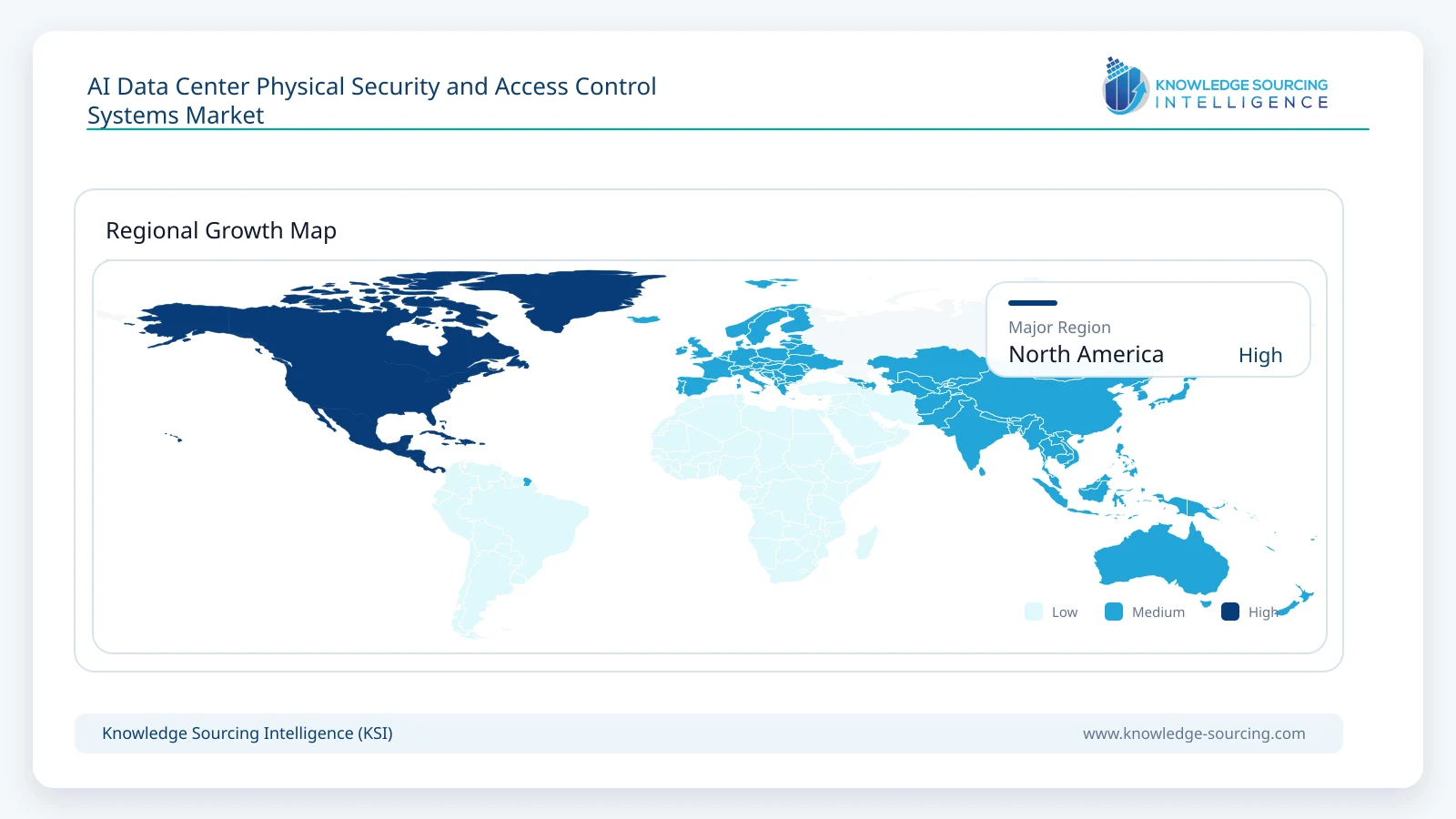
North America is the largest market for AI data-center physical security because the United States contains the highest concentration of hyperscale, neocloud and large colocation campuses. Many current projects span several buildings and large parcels of land, which increases the number of perimeter sensors, gates, vehicle controls, cameras and staffed or automated entry points. Construction schedules also create prolonged periods of elevated contractor access before facilities transition into steady-state operations, supporting visitor, credential and temporary-access management.
The region has a deep vendor and integration ecosystem. Johnson Controls, Honeywell, HID, Motorola Solutions / Avigilon, Axis Communications, Genetec, LenelS2 and Gallagher all participate across access, video, identity or integrated security. Convergint and other large integrators support multi-site rollout and lifecycle services. Data-center operators increasingly prefer repeatable security templates that can be cloned across campuses while still allowing local regulatory and tenant requirements to be applied at specific zones.
North American adoption is moving beyond perimeter and lobby controls toward finer-grained internal authorization. Colocation operators need customer-specific cage permissions, audit trails and visitor workflows. Hyperscalers require time-bound vendor access to equipment and utility spaces. AI campuses with large quantities of accelerator hardware also strengthen the case for cabinet monitoring, video analytics and correlation between credential events and camera evidence. Through 2032, growth is expected to come from both new campus construction and software-led modernization of existing physical-security estates.
Europe combines mature colocation markets with strong privacy and biometric-governance requirements, encouraging transparent identity policies and regionally hosted security platforms. Asia Pacific is expanding rapidly across Japan, South Korea, Singapore, Malaysia, India and Australia, with both hyperscale construction and domestic security-equipment suppliers contributing to demand. The Middle East is developing large greenfield AI campuses where layered perimeter, access and video systems can be designed into the site from the beginning.
Competitive Landscape
Competition spans diversified building-security companies, identity specialists, video-platform vendors, access-control manufacturers and systems integrators. Johnson Controls and Honeywell compete through broad building and security portfolios that can combine access, video, intrusion and operations platforms. Axis Communications and Motorola Solutions / Avigilon are strong in network video and analytics while extending into access control. HID, LenelS2, Gallagher, Suprema, dormakaba and Allegion participate across credentials, readers, controllers, locks and identity management.
Software platforms are increasingly important because operators want one operational view across many sites and device brands. Genetec differentiates through unified access, video, intrusion, intercom and investigation workflows, while Johnson Controls and other major vendors are similarly tightening integration across security domains. Verkada competes with a cloud-managed model that simplifies centralized operations, while Orion Entrance Control focuses on automated high-assurance entry. Security integrators remain influential because hyperscale deployments require design consistency, local implementation and long-term service across multiple geographies.
Competitive differentiation depends on assurance, openness, scalability and auditability rather than one hardware feature. Buyers value strong credential security, biometric options, anti-tailgating performance, large-scale camera management, privacy controls, edge analytics, cabinet-level expansion, multi-site federation, API integration and the ability to preserve existing hardware investments. Vendors that reduce the number of separate operator workflows while maintaining open architectures are better positioned for global AI-data-center programs.
Major companies and ecosystem participants covered: Johnson Controls, Honeywell, HID, Genetec, Axis Communications, Motorola Solutions / Avigilon, Gallagher Security, LenelS2, Verkada, Bosch Building Technologies, Suprema, ASSA ABLOY, dormakaba, Allegion, Orion Entrance Control, AMAG Technology and Convergint.
Recent Developments
September 2026: HID published updated data-centre access-control guidance emphasizing open architecture, layered access and long-life security infrastructure.
September 2026: Mercury Security introduced new S4 I/O modules to expand access-control capacity while preserving existing controller investments.
August 2026: HID, Soloinsight and CTS introduced an integrated self-service visitor check-in kiosk combining document authentication and facial recognition for enterprises and critical infrastructure.
June 2026: Axis Communications introduced the A9920 high-density I/O relay expansion module for physical security and access control, including data-center cabinet applications.
March 2026: Johnson Controls introduced next-generation enterprise access-control and video enhancements with stronger integration across physical-security functions.
March 2026: Genetec expanded Security Center SaaS with new access-control workflows, visitor capabilities, intrusion integration and optional biometric authentication.
February 2026: Genetec introduced AI-assisted multi-site investigation capabilities across video and enterprise security systems.
January 2026: Orion Entrance Control launched DataGuard, an automated secure-entry room designed for hyperscale data centers and critical infrastructure.
AI Data Center Physical Security and Access Control Systems Market Scope:
| Report Metric | Details |
|---|---|
| Total Market Size in 2026 | USD 1.65 billion |
| Total Market Size in 2032 | USD 4.78 billion |
| Forecast Unit | USD Billion |
| Growth Rate | 19.4% |
| Study Period | 2021 to 2032 |
| Historical Data | 2021 to 2024 |
| Base Year | 2025 |
| Forecast Period | 2026 – 2032 |
| Segmentation | Security Solution, Access Technology, Security Zone, Deployment Model |
| Companies |
|
Market Segmentation
By Security Solution
Video Surveillance and Video Management
Electronic Access Control
Biometric and Identity-Aware Access
Perimeter Intrusion and Vehicle Security
Mantraps, Turnstiles and Secure Entry Systems
Cabinet and Cage Access Control
Unified Security Software and Integration Services
By Access Technology
Smart Cards and Secure Credentials
Mobile Credentials
Fingerprint Biometrics
Facial Authentication
Multi-Factor Physical Access
By Security Zone
Site Perimeter and Vehicle Entry
Building Entry and Lobby
Internal Restricted and Gray-Space Zones
Data Hall and White-Space Entry
Customer Cage and Rack-Level Access
By Deployment Model
On-Premises Security Platforms
Hybrid Physical Security
Cloud-Managed Physical Security
Federated Multi-Site Security Operations
By Customer Type
Hyperscale Cloud Providers
Neocloud and GPU-Cloud Operators
Colocation Providers
Sovereign AI Infrastructure
Enterprise and High-Performance Computing
By Region
North America
United States
Canada
Europe
Asia Pacific
Middle East and Rest of World
Table of Contents
1. EXECUTIVE SUMMARY
1.1. Market Opportunity and Key Findings
1.2. Physical Security Architecture for AI Campuses
1.3. Principal Revenue Pools
2. MARKET OVERVIEW
2.1. Defense-in-Depth from Perimeter to Rack
2.2. Identity, Credentials and Access Policy
2.3. Video Surveillance and AI-Assisted Investigation
2.4. Mantraps, Anti-Tailgating and Secure Entry
2.5. Cabinet, Cage and Tenant-Level Security
3. MARKET SIZE AND FORECAST, 2026-2032
3.1. Global Market Revenue
3.2. Annual Growth Analysis
3.3. Hardware, Software and Integration Revenue
3.4. Greenfield versus Retrofit Demand
4. MARKET BY SECURITY SOLUTION
4.1. Video Surveillance and Video Management
4.2. Electronic Access Control
4.3. Biometric and Identity-Aware Access
4.4. Perimeter Intrusion and Vehicle Security
4.5. Mantraps, Turnstiles and Secure Entry Systems
4.6. Cabinet and Cage Access Control
4.7. Unified Security Software and Integration Services
5. MARKET BY ACCESS TECHNOLOGY
5.1. Smart Cards and Secure Credentials
5.2. Mobile Credentials
5.3. Fingerprint Biometrics
5.4. Facial Authentication
5.5. Multi-Factor Physical Access
6. MARKET BY SECURITY ZONE
6.1. Site Perimeter and Vehicle Entry
6.2. Building Entry and Lobby
6.3. Internal Restricted and Gray-Space Zones
6.4. Data Hall and White-Space Entry
6.5. Customer Cage and Rack-Level Access
7. MARKET BY DEPLOYMENT MODEL
7.1. On-Premises Security Platforms
7.2. Hybrid Physical Security
7.3. Cloud-Managed Physical Security
7.4. Federated Multi-Site Security Operations
8. MARKET BY CUSTOMER TYPE
8.1. Hyperscale Cloud Providers
8.2. Neocloud and GPU-Cloud Operators
8.3. Colocation Providers
8.4. Sovereign AI Infrastructure
8.5. Enterprise and High-Performance Computing
9. REGIONAL MARKET
9.1. North America
9.1.1. United States
9.1.2. Canada
9.2. Europe
9.3. Asia Pacific
9.4. Middle East and Rest of World
10. MARKET DYNAMICS
10.1. Drivers
10.1.1. Multi-Building AI Campus Expansion
10.1.2. Higher Asset Concentration and Insider-Risk Exposure
10.1.3. Identity Convergence and Stronger Auditability
10.1.4. Centralized Multi-Site Security Operations
10.2. Restraints
10.2.1. Long Hardware Replacement Cycles
10.2.2. Biometric Privacy and Governance Requirements
10.2.3. Legacy Integration and Device Fragmentation
10.2.4. Cloud Security and Data-Sovereignty Requirements
11. COMPETITIVE LANDSCAPE
11.1. Market Structure and Competitive Intensity
11.2. Access Control and Identity Platform Positioning
11.3. Video, Analytics and Perimeter Security Positioning
11.4. Hyperscale Campus and Multi-Site Security Integration
11.5. Data Center Operator and Integrator Partnerships
12. COMPANY PROFILES
12.1. Johnson Controls
12.2. Honeywell
12.3. HID
12.4. Genetec
12.5. Axis Communications
12.6. Motorola Solutions
12.7. Gallagher Security
12.8. LenelS2
12.9. Verkada
12.10. Bosch Building Technologies
12.11. Suprema
12.12. ASSA ABLOY
12.13. dormakaba
12.14. Allegion
12.15. Orion Entrance Control
12.16. AMAG Technology
12.17. Convergint
13. RECENT DEVELOPMENTS
14. APPENDIX
Navigate
Trusted by the world's leading organizations











