
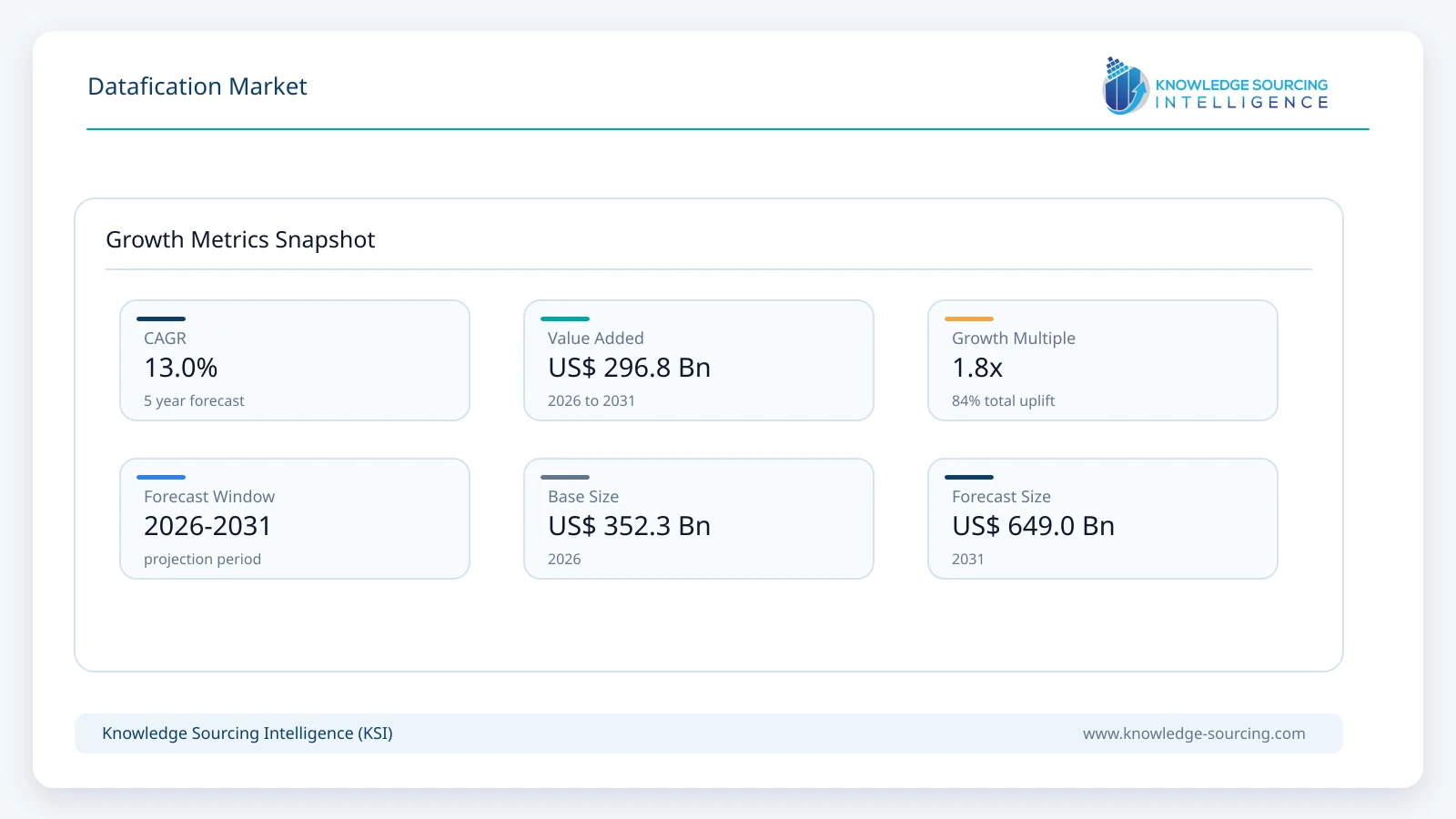
The Datafication Market is forecast to grow at a CAGR of 13.0%, reaching USD 649.01 billion in 2031 from USD 352.25 billion in 2026.
Highlights:
- 1Growing enterprise adoption of AI applications is increasing demand for integrated data management and governance platforms capable of delivering high-quality, trusted data.
- 2Cloud deployment represents the leading implementation approach as organizations seek scalable infrastructure for analytics, AI model development, and enterprise-wide data integration.
- 3Large enterprises remain the primary buyers because of their complex data environments, extensive regulatory obligations, and substantial investments in enterprise digital infrastructure.
- 4North America maintains a leading position due to advanced cloud infrastructure, strong enterprise software adoption, and substantial investments in AI and data engineering.
- 5Regulatory requirements governing privacy, cybersecurity, financial reporting, and data protection continue to encourage investment in enterprise data governance capabilities.
- 6Competition increasingly centers on platform integration, AI-enabled automation, hybrid cloud interoperability, and industry-specific solution development rather than standalone analytics functionality.
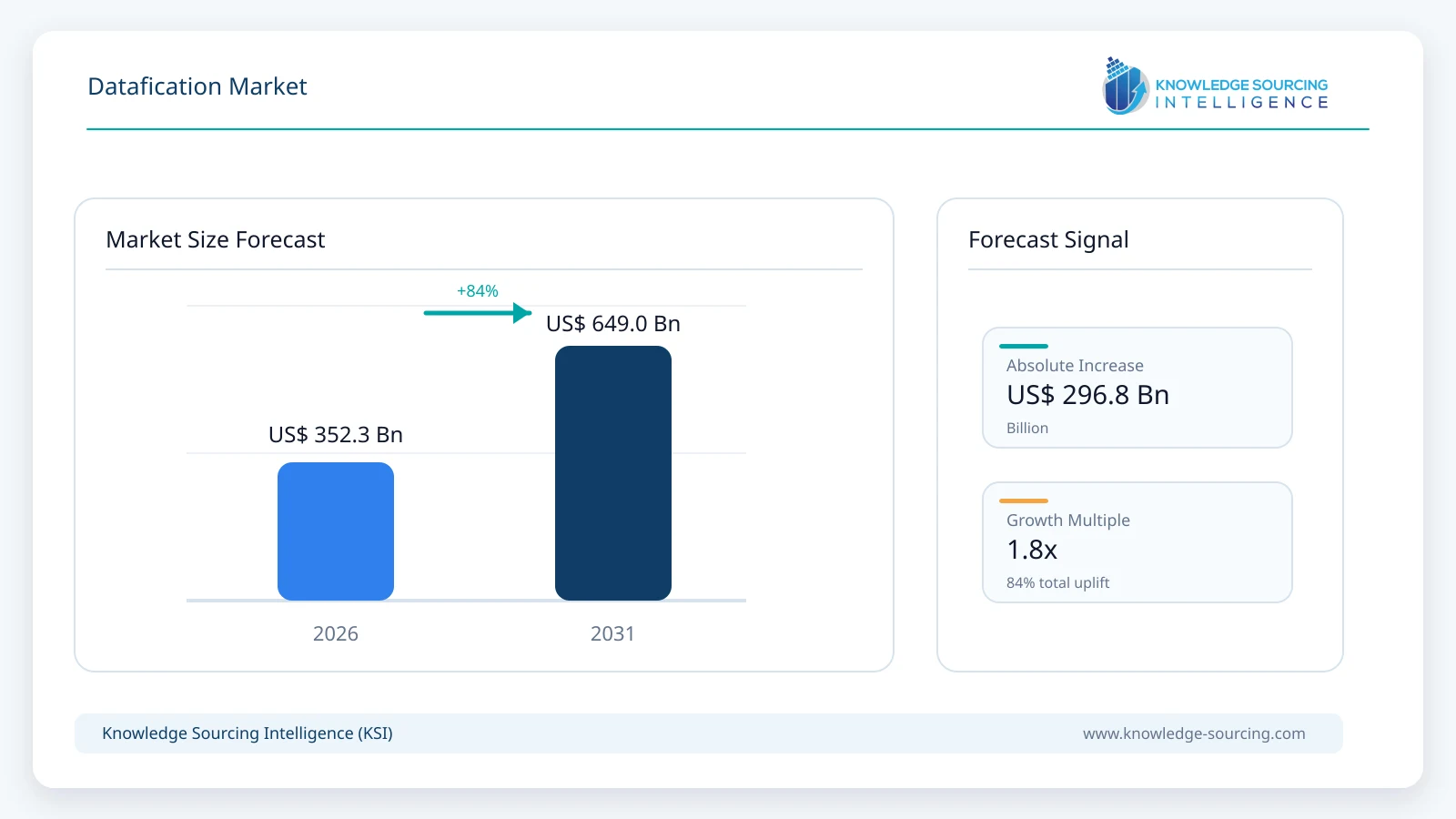
The datafication market encompasses software platforms, analytics engines, cloud-based data management solutions, and associated services that convert operational, transactional, behavioral, and machine-generated information into structured digital assets for business decision-making. Organizations across industries are treating data as a strategic business resource rather than a by-product of operations. This shift is changing enterprise investment priorities, with spending directed toward technologies that improve data accessibility, governance, integration, quality, and real-time analysis.
Demand is being driven by the growing volume of structured and unstructured data generated from enterprise applications, connected devices, digital transactions, industrial equipment, customer interactions, and public digital infrastructure. Organizations increasingly require unified data environments capable of supporting artificial intelligence (AI), predictive analytics, automation, regulatory reporting, and operational optimization. As enterprises expand cloud adoption while retaining mission-critical on-premises systems, buyers seek platforms capable of integrating distributed data assets without disrupting existing business processes.
Procurement decisions within the datafication market increasingly involve multiple stakeholders, including chief information officers, chief data officers, business unit leaders, cybersecurity teams, and compliance departments. Purchasing criteria extend beyond technical functionality to include data governance capabilities, interoperability with existing enterprise software, scalability, security architecture, regulatory compliance, implementation complexity, and total cost of ownership. Buyers also evaluate vendor capabilities in supporting hybrid deployment models that accommodate legacy infrastructure alongside cloud-native workloads.
Industry economics favor vendors capable of delivering integrated platforms instead of isolated data management tools. Enterprises are reducing the number of independent software products used across data integration, analytics, governance, metadata management, and AI development to lower operational complexity and licensing costs. Consequently, platform-based offerings supported by professional services and managed services continue to gain commercial acceptance among large organizations managing diverse data environments.
Technology adoption patterns vary across industries. Financial institutions prioritize regulatory reporting, fraud detection, and customer intelligence. Healthcare organizations emphasize secure clinical data integration and research analytics. Manufacturers focus on production monitoring, predictive maintenance, and supply chain visibility. Retail and e-commerce enterprises invest in customer behavior analysis, demand forecasting, and inventory optimization, while public sector organizations increasingly deploy integrated data platforms to improve service delivery, infrastructure management, and evidence-based policymaking.
Cloud deployment continues to influence purchasing behavior because organizations require flexible computing resources for large-scale analytics and AI workloads. However, regulated industries continue to maintain significant investments in on-premises infrastructure to satisfy data residency, cybersecurity, and operational continuity requirements. As a result, hybrid architectures remain commercially important, creating sustained demand for technologies capable of managing data across multiple environments while maintaining governance consistency.
The competitive environment is characterized by global enterprise software providers, cloud platform operators, consulting firms, and specialized analytics vendors offering integrated ecosystems rather than standalone applications. Commercial differentiation increasingly depends on AI-enabled automation, metadata intelligence, low-code integration capabilities, industry-specific data models, and comprehensive governance frameworks that reduce implementation risk and accelerate business value realization.
Market Drivers
Rising Enterprise AI Adoption Requires Trusted and Governed Data
Artificial intelligence deployment has shifted enterprise priorities from simply collecting information to establishing reliable, well-governed data ecosystems. AI models depend on accurate, standardized, and continuously updated datasets for training and inference. Poor-quality or fragmented information reduces model reliability, increases operational risks, and limits business adoption.
Organizations therefore invest in data integration, metadata management, lineage tracking, and automated quality monitoring before expanding AI initiatives. Buyers increasingly procure comprehensive platforms capable of supporting data preparation alongside AI lifecycle management. Software providers respond by embedding AI-assisted data discovery, cataloging, and governance capabilities into broader enterprise platforms, creating additional revenue opportunities through integrated software subscriptions and professional implementation services.
Expansion of Connected Devices and Digital Operations
Industrial automation, connected manufacturing equipment, smart infrastructure, mobile applications, and digital customer engagement generate unprecedented volumes of operational data. Enterprises recognize that converting these continuous data streams into actionable intelligence improves operational efficiency, equipment utilization, customer experience, and resource planning.
Manufacturing companies increasingly deploy IoT-enabled monitoring systems to reduce equipment downtime, while logistics operators utilize real-time shipment tracking to optimize transportation networks. These operational requirements stimulate sustained demand for scalable data processing platforms capable of managing high-frequency information generated across distributed enterprise environments.
Regulatory Compliance Strengthens Investment in Data Governance
Governments continue introducing regulations governing data privacy, cybersecurity, financial reporting, healthcare information management, and operational resilience. Compliance increasingly requires organizations to demonstrate data traceability, audit readiness, access controls, retention policies, and reporting accuracy.
Rather than treating compliance as a standalone legal obligation, enterprises integrate governance capabilities into broader data management strategies. Vendors offering automated policy enforcement, data lineage, metadata management, and compliance reporting gain commercial advantages because these capabilities reduce manual administrative effort while improving regulatory readiness.
Cloud Modernization Expands Enterprise Data Integration Requirements
Organizations migrating enterprise workloads to cloud infrastructure rarely replace existing systems entirely. Instead, they operate hybrid environments combining public cloud services, private infrastructure, SaaS applications, and legacy business systems. This distributed architecture creates demand for platforms capable of integrating diverse data sources while maintaining consistent governance and security policies.
Investment therefore extends beyond cloud migration itself to include integration technologies, API management, master data management, and centralized metadata services. Vendors supporting multi-cloud interoperability strengthen their competitive positioning among enterprises seeking flexibility without creating additional technology silos.
Market Restraints and Challenges
Data Silos Continue to Limit Enterprise Integration
Many organizations operate independent business applications developed over decades across finance, manufacturing, human resources, customer relationship management, and supply chain operations. These systems frequently use incompatible data structures, making enterprise-wide integration technically complex and resource intensive.
The resulting implementation costs delay purchasing decisions, particularly among organizations with extensive legacy infrastructure. Vendors increasingly mitigate this challenge through automated connectors, metadata-driven integration tools, and preconfigured industry templates that reduce deployment complexity.
Shortage of Skilled Data Professionals
Successful datafication initiatives require expertise across data engineering, architecture, governance, cybersecurity, analytics, and AI. Many organizations struggle to recruit professionals capable of designing and maintaining enterprise-scale data ecosystems.
Limited technical resources increase dependence on consulting services and managed service providers, extending implementation timelines and raising project costs. Vendors increasingly respond by incorporating low-code development environments, automated data preparation, and AI-assisted administration to reduce reliance on specialized technical expertise.
Cybersecurity and Privacy Risks
Enterprise data platforms frequently consolidate highly sensitive financial records, intellectual property, healthcare information, and customer data into centralized environments. These repositories become attractive targets for cyberattacks while simultaneously increasing regulatory exposure in the event of unauthorized access.
Consequently, buyers prioritize encryption, identity management, continuous monitoring, zero-trust security architecture, and compliance certifications during procurement. Vendors unable to demonstrate mature cybersecurity capabilities may experience longer sales cycles and reduced competitiveness in highly regulated industries.
Uncertain Return on Investment for Complex Deployments
Although organizations recognize the strategic importance of enterprise data management, quantifying financial returns remains challenging, particularly for large, multi-year implementation programs. Benefits such as improved decision quality, regulatory readiness, and operational efficiency may materialize gradually rather than immediately.
Procurement teams increasingly require phased implementation strategies with measurable business outcomes before approving enterprise-wide investments. Suppliers therefore emphasize modular deployment approaches, predefined industry use cases, and value-based implementation methodologies to accelerate measurable returns while reducing project risk.
Major Segment Analysis:
Cloud Deployment
Cloud deployment represents the most commercially significant segment within the datafication market because it provides enterprises with scalable computing capacity, flexible storage resources, and rapid access to advanced analytics and AI capabilities without substantial upfront infrastructure investment. Organizations increasingly view cloud-based data platforms as strategic assets supporting continuous innovation, faster application development, and enterprise-wide collaboration.
Buyer demand is particularly strong among multinational enterprises managing geographically distributed operations. Cloud platforms enable centralized governance while allowing business units to access standardized datasets across multiple regions. This capability improves reporting consistency, accelerates analytics deployment, and supports AI model development using shared enterprise data resources. The subscription-based commercial model also aligns technology spending with operational budgets, making procurement more predictable.
Customers increasingly expect cloud data platforms to integrate seamlessly with existing enterprise resource planning systems, customer relationship management software, industrial IoT environments, and third-party applications. Purchasing decisions therefore depend heavily on interoperability, API availability, workload portability, cybersecurity capabilities, disaster recovery functionality, and compliance with regional data protection regulations. Multi-cloud compatibility has become an important evaluation criterion as organizations seek to avoid dependence on a single infrastructure provider.
Competition within the cloud deployment segment extends beyond infrastructure performance. Vendors differentiate through integrated AI capabilities, automated data governance, metadata management, real-time analytics, and industry-specific solution frameworks that reduce deployment time and implementation complexity. Consulting services, migration support, and managed operations further influence purchasing decisions, particularly among enterprises modernizing legacy information systems.
Commercially, the cloud segment generates recurring subscription revenue while creating opportunities for higher-value professional services, AI platform adoption, and ongoing managed data operations. As enterprises continue expanding AI initiatives and hybrid cloud architectures, cloud-based datafication solutions are expected to remain the primary revenue contributor across the forecast period.
Regional Analysis
North America
North America represents the most mature regional market for datafication solutions due to extensive enterprise cloud adoption, advanced digital infrastructure, and sustained investment in artificial intelligence, cybersecurity, and enterprise analytics. Large organizations across banking, healthcare, retail, manufacturing, and telecommunications increasingly treat data management as a strategic business capability rather than an IT function. Regulatory requirements related to privacy, financial reporting, and cyber resilience further strengthen demand for governed data environments.
Enterprise buyers in the United States increasingly prioritize unified platforms capable of integrating operational technology, cloud applications, and legacy enterprise systems while supporting AI deployment. Procurement decisions typically favor vendors offering hybrid cloud interoperability, advanced governance, and industry-specific implementation expertise. Canada continues to invest in digital public services and AI commercialization, supporting enterprise demand for scalable data platforms, while Mexico's expanding manufacturing and logistics sectors are creating new opportunities for industrial data integration.
Europe
European demand is strongly influenced by regulatory compliance, industrial modernization, and sustainability initiatives. Organizations operating across multiple jurisdictions require comprehensive data governance capabilities to satisfy data protection, cross-border information management, and sector-specific compliance obligations. Consequently, buyers often prioritize governance, metadata management, auditability, and data lineage alongside analytical functionality.
Germany, France, and the United Kingdom remain major enterprise markets because of their large industrial bases and mature financial sectors. Manufacturing organizations increasingly integrate production, supply chain, and quality management data to improve operational efficiency, while financial institutions continue investing in enterprise-wide data architectures supporting risk management and regulatory reporting. Adoption remains moderated by complex legacy infrastructures and varying national regulatory interpretations, increasing implementation complexity for multinational deployments.
Asia Pacific
Asia Pacific is expected to register the strongest long-term expansion as enterprises accelerate cloud adoption, industrial automation, digital payments, e-commerce, and smart manufacturing initiatives. Government-supported digital economy programs, expanding hyperscale cloud infrastructure, and growing enterprise AI investment contribute to sustained demand for enterprise data platforms.
China, India, Japan, South Korea, and Australia account for the largest commercial opportunities. Large enterprises increasingly invest in centralized data platforms supporting predictive analytics, customer intelligence, and operational optimization. Small and medium enterprises are also adopting cloud-native solutions due to lower infrastructure costs and subscription-based commercial models. Despite favorable investment conditions, organizations continue to address challenges associated with workforce capability, cybersecurity preparedness, and integration with legacy business systems.
Middle East & Africa
The Middle East is witnessing increased enterprise investment in datafication technologies as governments pursue economic diversification, smart city initiatives, and digital government programs. Financial services, energy, telecommunications, and public sector organizations represent the primary enterprise buyers.
Saudi Arabia and the United Arab Emirates continue investing in national AI strategies, cloud infrastructure, and digital public services, encouraging organizations to modernize enterprise data architectures. Buyers increasingly emphasize secure cloud deployment, regulatory compliance, and sovereign data capabilities. Across much of Africa, adoption remains concentrated among financial institutions, telecommunications operators, and government modernization projects, with infrastructure limitations and skilled workforce shortages constraining broader implementation.
South America
South American demand is primarily supported by financial services, retail, manufacturing, and public administration modernization initiatives. Organizations increasingly recognize the commercial value of integrating customer, operational, and supply chain information to improve business performance while strengthening regulatory reporting capabilities.
Brazil remains the largest regional market because of its diversified industrial economy and expanding enterprise cloud adoption. Argentina and neighboring countries continue adopting cloud-based analytics platforms, although investment decisions are influenced by macroeconomic uncertainty, technology budgets, and currency volatility. Buyers generally prefer scalable subscription-based deployment models that minimize upfront capital expenditure while providing flexibility for future expansion.
Competitive Landscape
The datafication market exhibits moderate-to-high concentration, with global enterprise software providers, hyperscale cloud vendors, analytics specialists, and consulting organizations competing across integrated platform capabilities rather than individual software products. Competition increasingly centers on delivering end-to-end enterprise ecosystems encompassing data integration, governance, analytics, AI development, metadata management, and cloud interoperability.
Suppliers differentiate through AI-enabled automation, industry-specific solution frameworks, low-code integration capabilities, and hybrid deployment support. Enterprises increasingly evaluate vendors according to their ability to reduce implementation complexity, improve data quality, accelerate AI adoption, and maintain compliance across distributed data environments. Platform interoperability with existing enterprise applications, including ERP, CRM, industrial IoT, and cybersecurity solutions, has become an important procurement criterion.
Strategic partnerships between cloud infrastructure providers and enterprise software companies continue reshaping competitive positioning. Joint solution development enables suppliers to combine cloud scalability with enterprise data management capabilities, reducing deployment risk for customers. Professional services and consulting organizations also play an influential role by providing migration planning, governance frameworks, integration services, and managed operations that support long-term customer relationships.
Competition among IBM, Oracle Corporation, Amazon Web Services, Inc., Microsoft Corporation, Google LLC, SAP SE, SAS Institute Inc., Hewlett Packard Enterprise Development LP, Accenture plc, and Alteryx, Inc. increasingly emphasizes AI-ready data platforms, multi-cloud compatibility, enterprise governance, and industry-specific implementation expertise rather than infrastructure capacity alone.
Recent Developments
May 2026: IBM and Oracle announced additional collaboration marking four decades of partnership, expanding joint consulting capabilities and integrated AI and hybrid cloud services to help enterprises modernize complex data environments. This broadens implementation opportunities for large organizations pursuing enterprise-wide datafication initiatives.
May 2026: IBM and Yotta Data Services announced plans to deploy an Agentic AI platform on Yotta's Shakti Cloud for Indian enterprises, supporting trusted AI deployment and sovereign cloud capabilities. The initiative strengthens enterprise demand for governed data platforms across regulated industries.
May 2025: IBM and Oracle expanded their strategic partnership to make IBM watsonx AI offerings available on Oracle Cloud Infrastructure (OCI), enabling multi-agent AI workflows and broader hybrid cloud deployment. The collaboration strengthens enterprise demand for integrated data management and AI platforms.
Regulatory and Policy Environment
The regulatory environment surrounding datafication increasingly focuses on privacy protection, cybersecurity, data governance, and responsible AI deployment. Organizations investing in enterprise data platforms must comply with multiple jurisdiction-specific regulations governing data collection, processing, storage, retention, and cross-border information transfers.
Within Europe, the General Data Protection Regulation (GDPR) continues influencing enterprise data architecture by requiring stronger governance, consent management, auditability, and data protection controls. These requirements encourage organizations to invest in metadata management, automated compliance monitoring, and secure data lifecycle management.
In the United States, sector-specific regulations affecting financial services, healthcare, and critical infrastructure encourage organizations to strengthen enterprise data governance and cybersecurity capabilities. Increasing regulatory attention toward operational resilience further supports investments in integrated enterprise data platforms capable of improving visibility across business operations.
Several Asia-Pacific governments continue introducing national AI frameworks, cloud strategies, cybersecurity legislation, and digital economy initiatives supporting enterprise modernization. Organizations operating across multiple jurisdictions increasingly require centralized governance capabilities capable of satisfying regional compliance obligations while supporting enterprise-wide analytics and AI deployment.
International standards published by organizations such as ISO and the National Institute of Standards and Technology (NIST) continue influencing enterprise procurement by establishing widely recognized frameworks for information security, AI risk management, cybersecurity governance, and data management practices. Compliance with these standards increasingly forms part of enterprise vendor evaluation processes.
Outlook and Strategic Implications
The commercial outlook for the datafication market remains supported by sustained enterprise investment in AI, cloud modernization, automation, and data governance. Organizations increasingly recognize that successful AI deployment depends upon trusted, accessible, and well-governed enterprise information rather than computational resources alone. Consequently, spending is expected to shift toward integrated platforms capable of supporting the complete enterprise data lifecycle.
Procurement priorities will increasingly favor solutions that reduce implementation complexity, automate governance activities, improve interoperability, and enable secure data sharing across hybrid and multi-cloud environments. Buyers are expected to emphasize measurable business outcomes, including operational efficiency, regulatory compliance, faster AI deployment, and improved decision-making rather than isolated technology capabilities.
Technology development is expected to focus on AI-assisted data engineering, automated metadata discovery, intelligent data quality monitoring, real-time streaming analytics, and policy-driven governance. These capabilities will reduce manual administrative effort while improving enterprise confidence in business-critical information assets.
Competition is likely to intensify around ecosystem development rather than standalone product innovation. Strategic alliances between cloud providers, enterprise software companies, systems integrators, and consulting organizations will continue expanding integrated offerings capable of supporting complex enterprise transformation programs. Vendors with strong professional services capabilities, broad partner ecosystems, and industry-specific implementation expertise are expected to strengthen their competitive position.
Despite favorable demand conditions, organizations must continue addressing cybersecurity risks, workforce capability gaps, implementation costs, and evolving regulatory requirements. Enterprises that establish scalable governance frameworks and invest in interoperable data architectures will be better positioned to expand AI adoption, improve operational resilience, and generate sustainable business value from enterprise-wide data assets over the coming years.
Datafication Market Scope:
| Report Metric | Details |
|---|---|
| Total Market Size in 2026 | USD 352.25 billion |
| Total Market Size in 2031 | USD 649.01 billion |
| Forecast Unit | Billion |
| Growth Rate | 13.0% |
| Study Period | 2021 to 2031 |
| Historical Data | 2021 to 2024 |
| Base Year | 2025 |
| Forecast Period | 2026 – 2031 |
| Segmentation | Component, Deployment, Technology, Enterprise Size, End-User, Geography |
| Companies |
|
Market Segmentation
By Component
By Deployment
By Technology
By Enterprise Size
By End-user
By Geography
Table of Contents
1. EXECUTIVE SUMMARY
2. MARKET SNAPSHOT
2.1. Market Overview
2.2. Market Definition
2.3. Scope of the Study
2.4. Market Segmentation
3. BUSINESS LANDSCAPE
3.1. Market Drivers
3.2. Market Restraints
3.3. Market Opportunities
3.4. Porter’s Five Forces Analysis
3.5. Industry Value Chain Analysis
3.6. Policies and Regulations
3.7. Strategic Recommendations
4. TECHNOLOGICAL OUTLOOK
5. DATAFICATION MARKET BY COMPONENT
5.1. Introduction
5.2. Solutions
5.3. Services
6. DATAFICATION MARKET BY DEPLOYMENT
6.1. Introduction
6.2. Cloud
6.3. On-Premises
7. DATAFICATION MARKET BY TECHNOLOGY
7.1. Introduction
7.2. Artificial Intelligence (AI)
7.3. Big Data Analytics
7.4. Internet of Things (IoT)
7.5. Cloud Computing
7.6. Others
8. DATAFICATION MARKET BY ENTERPRISE SIZE
8.1. Introduction
8.2. Small and Medium Enterprises (SMEs)
8.3. Large Enterprises
9. DATAFICATION MARKET BY END-USER
9.1. Introduction
9.2. BFSI
9.3. Healthcare
9.4. IT & Telecommunications
9.5. Manufacturing
9.6. Retail & E-commerce
9.7. Government & Public Sector
9.8. Others
10. DATAFICATION MARKET BY GEOGRAPHY
10.1. Introduction
10.2. North America
10.2.1. By Component
10.2.2. By Deployment
10.2.3. By Technology
10.2.4. By Enterprise Size
10.2.5. By End-User
10.2.6. By Country
10.2.6.1. USA
10.2.6.2. Canada
10.2.6.3. Mexico
10.3. South America
10.3.1. By Component
10.3.2. By Deployment
10.3.3. By Technology
10.3.4. By Enterprise Size
10.3.5. By End-User
10.3.6. By Country
10.3.6.1. Brazil
10.3.6.2. Argentina
10.3.6.3. Others
10.4. Europe
10.4.1. By Component
10.4.2. By Deployment
10.4.3. By Technology
10.4.4. By Enterprise Size
10.4.5. By End-User
10.4.6. By Country
10.4.6.1. Germany
10.4.6.2. France
10.4.6.3. United Kingdom
10.4.6.4. Spain
10.4.6.5. Italy
10.4.6.6. Others
10.5. Middle East and Africa
10.5.1. By Component
10.5.2. By Deployment
10.5.3. By Technology
10.5.4. By Enterprise Size
10.5.5. By End-User
10.5.6. By Country
10.5.6.1. Saudi Arabia
10.5.6.2. UAE
10.5.6.3. Others
10.6. Asia Pacific
10.6.1. By Component
10.6.2. By Deployment
10.6.3. By Technology
10.6.4. By Enterprise Size
10.6.5. By End-User
10.6.6. By Country
10.6.6.1. China
10.6.6.2. India
10.6.6.3. Japan
10.6.6.4. South Korea
10.6.6.5. Australia
10.6.6.6. Indonesia
10.6.6.7. Thailand
10.6.6.8. Others
11. COMPETITIVE ENVIRONMENT AND ANALYSIS
11.1. Major Players and Strategy Analysis
11.2. Market Share Analysis
11.3. Mergers, Acquisitions, Agreements, and Collaborations
11.4. Competitive Dashboard
12. COMPANY PROFILES
12.1. IBM
12.2. Oracle Corporation
12.3. Amazon Web Services, Inc.
12.4. Microsoft Corporation
12.5. Google LLC
12.6. SAP SE
12.7. SAS Institute Inc.
12.8. Hewlett Packard Enterprise Development LP
12.9. Accenture plc
12.10. Alteryx, Inc.
13. APPENDIX
13.1. Currency
13.2. Assumptions
13.3. Base and Forecast Years Timeline
13.4. Key Benefits for Stakeholders
13.5. Research Methodology
13.6. Abbreviations
LIST OF FIGURES
LIST OF TABLES
Navigate
Trusted by the world's leading organizations











