Data Center Rack Server Market - Strategic Insights and Forecasts (2026-2031)
Data Center Rack Server Market Share, Growth, Forecasts and Industry Trends By Rack Server Type (1U Rack Servers, 2U Rack Servers, 4U Rack Servers, High-Density Rack Servers), Organization Size (Small Enterprises, Medium Enterprises, Large Enterprises), End-User Industry (IT and Telecommunications, Banking, Financial Services, and Insurance (BFSI), Healthcare, Government and Public Sector, Retail and E-commerce, Media and Entertainment, Manufacturing, Others), and Geography
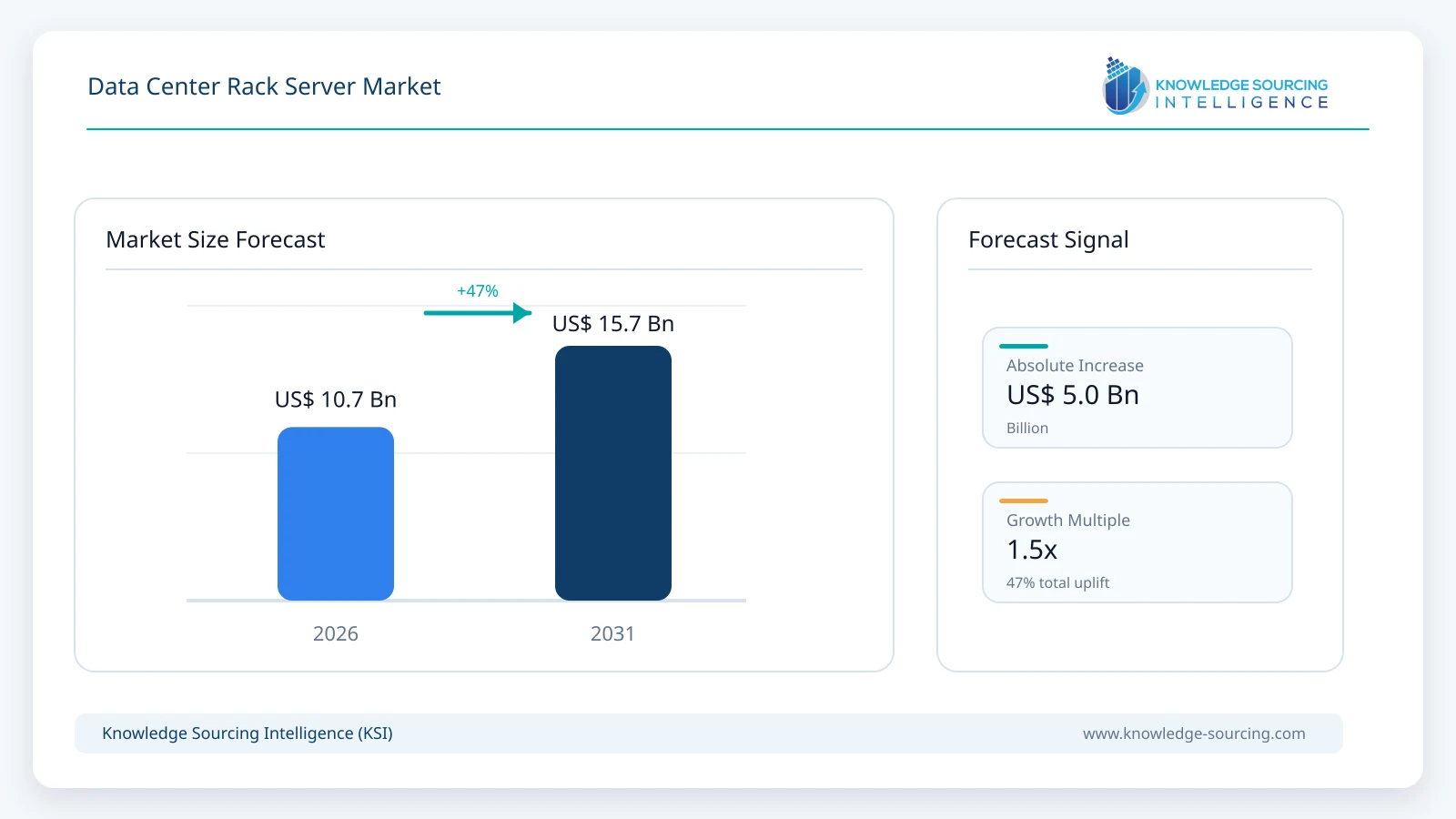
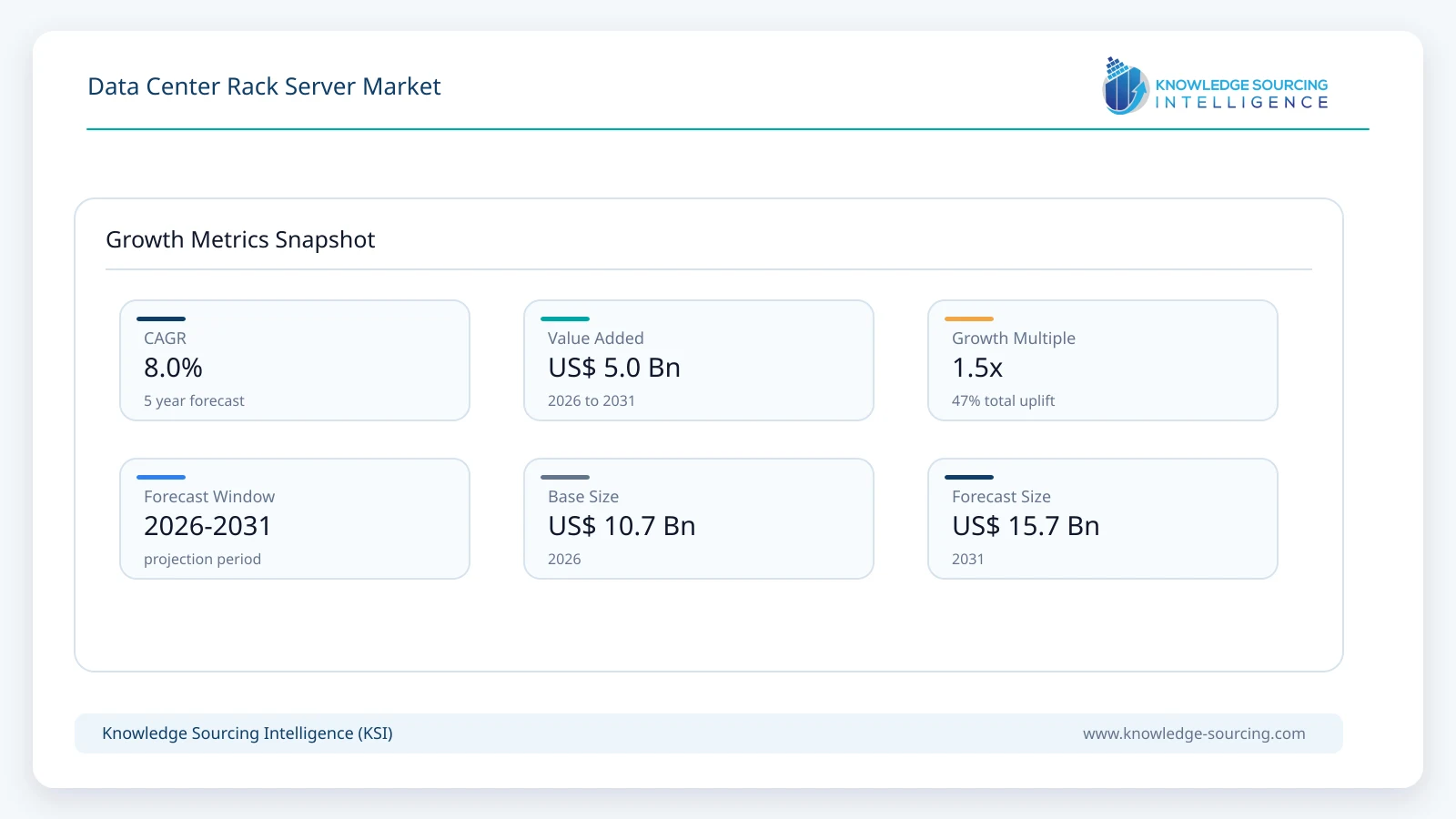
The Data Center Rack Server Market is forecast to grow at a CAGR of 7.99%, reaching USD 15.70 billion in 2031 from USD 10.69 billion in 2026.
Highlights:
1
Expansion of AI, virtualization, and cloud computing workloads continues to strengthen demand for high-performance rack server infrastructure.
2
High-density rack servers represent an important commercial segment due to increasing computing requirements within limited data center footprints.
3
Asia Pacific offers substantial investment opportunities supported by hyperscale data center construction, enterprise digitalization, and government technology initiatives.
4
Integration of advanced processors, GPU acceleration, DDR5 memory, PCIe Gen5 connectivity, and liquid-cooling compatibility is influencing purchasing decisions.
5
Energy efficiency regulations and sustainability commitments encourage procurement of servers with improved power utilization and thermal performance.
6
Competition increasingly depends on platform flexibility, lifecycle services, supply-chain resilience, and integrated infrastructure management software.
The data center rack server market comprises standardized server systems designed to be mounted within equipment racks to deliver computing, storage, networking, and virtualization capabilities across enterprise, cloud, colocation, telecommunications, and government data centers. Rack servers remain the preferred infrastructure choice for organizations requiring scalable computing density, simplified maintenance, standardized deployment, and compatibility with existing power and cooling architectures. Their modular design allows operators to optimize floor space while supporting a broad range of workloads, including virtualization, enterprise applications, artificial intelligence (AI) analytics, database management, high-performance computing (HPC), and cloud-native services.
Demand for rack servers continues to be shaped by sustained investment in digital infrastructure rather than short-term hardware refresh cycles alone. Cloud service providers, hyperscale operators, telecommunications companies, financial institutions, healthcare organizations, and public-sector agencies continue expanding computing capacity to accommodate growing data volumes, AI training and inference workloads, cybersecurity requirements, and latency-sensitive applications. Enterprise buyers are simultaneously replacing aging infrastructure to improve energy efficiency, reduce operating costs, and support increasingly processor-intensive applications.
Procurement decisions have become more strategic as buyers evaluate complete lifecycle costs instead of acquisition prices alone. Organizations increasingly assess processor compatibility, memory scalability, power consumption, remote management capabilities, workload optimization, warranty support, and supply continuity before selecting rack server platforms. Sustainability objectives are also influencing purchasing behavior, with many organizations preferring systems designed for lower power consumption, higher operating temperatures, and improved utilization rates.
Industry structure reflects a combination of global infrastructure vendors, original design manufacturers, component suppliers, and system integrators. Processor innovation, GPU integration, memory expansion, liquid cooling compatibility, and security features have become important differentiators. Server manufacturers also compete through software management platforms, service offerings, global support capabilities, and long-term customer relationships rather than relying solely on hardware specifications.
Revenue generation is increasingly associated with higher-value server configurations capable of supporting virtualization, AI acceleration, edge computing, and software-defined infrastructure. Organizations are deploying mixed rack environments combining conventional CPU-based systems with GPU-enabled platforms to accommodate diverse workload requirements. This trend has increased average system values while encouraging suppliers to offer configurable architectures tailored to enterprise-specific computing requirements.
Adoption patterns vary across industries. Large cloud operators prioritize high-density deployments and standardized hardware platforms for operational efficiency. Financial institutions emphasize security, reliability, and regulatory compliance. Healthcare organizations invest in computing infrastructure supporting medical imaging, electronic health records, and AI-assisted diagnostics. Manufacturing companies require rack servers capable of supporting industrial automation, digital twins, and factory analytics, while governments continue modernizing digital public services and national computing infrastructure.
Market Drivers
Expansion of AI and High-Performance Computing Infrastructure
Artificial intelligence adoption has substantially increased demand for rack servers capable of supporting accelerated computing workloads. Enterprises, research institutions, financial organizations, and cloud providers require systems accommodating multiple GPUs, high-bandwidth memory, and advanced interconnect technologies. Buyers increasingly prioritize scalable server platforms capable of supporting future processor generations without requiring extensive infrastructure redesign. Vendors continue introducing architectures optimized for AI clusters, creating higher-value deployment opportunities across enterprise and cloud environments.
Continued Investment in Cloud and Colocation Data Centers
Cloud service providers and colocation operators remain among the largest purchasers of rack servers due to sustained capacity expansion. Growing enterprise migration toward hybrid and multi-cloud environments has increased demand for standardized computing platforms that simplify deployment, maintenance, and infrastructure automation. Procurement increasingly emphasizes operational efficiency, high availability, and serviceability, encouraging suppliers to develop modular server platforms supporting rapid installation and simplified maintenance.
Enterprise Infrastructure Modernization
Many organizations continue replacing legacy server environments approaching end-of-support periods. Hardware modernization improves workload consolidation, energy efficiency, cybersecurity capabilities, and virtualization density. Procurement teams increasingly evaluate long-term operating expenses, making newer processor architectures attractive because they deliver higher computational output per watt. This replacement cycle supports recurring demand across healthcare, banking, manufacturing, retail, and government sectors.
Growth in Edge Computing Deployments
Distributed computing requirements have expanded beyond centralized hyperscale facilities. Telecommunications operators, manufacturers, retailers, and utilities increasingly deploy edge data centers requiring compact rack server infrastructure capable of reliable operation in remote environments. These deployments support real-time analytics, industrial automation, autonomous systems, and low-latency applications. Suppliers respond by introducing ruggedized systems with enhanced remote management capabilities and flexible configuration options.
Market Restraints and Challenges
High Capital Investment Requirements
Modern rack server deployments frequently require complementary investments in networking, storage, cooling, power distribution, and software licensing. Budget limitations can delay infrastructure upgrades, particularly among smaller enterprises. Organizations increasingly adopt phased procurement strategies, infrastructure leasing, or consumption-based financing to reduce upfront capital requirements while maintaining technology competitiveness.
Supply Chain Volatility for Critical Components
Advanced processors, GPUs, memory modules, and semiconductor components remain subject to fluctuating supply conditions. Extended lead times complicate procurement planning for hyperscale operators and enterprise customers. Manufacturers mitigate these risks through diversified sourcing strategies, inventory management improvements, and closer collaboration with semiconductor suppliers.
Rising Energy Consumption
Increasing computing density has elevated power and cooling requirements within modern data centers. Operators must balance performance objectives with electricity costs and sustainability commitments. This challenge encourages adoption of energy-efficient processors, advanced thermal management technologies, liquid cooling solutions, and intelligent workload optimization platforms.
Cybersecurity and Firmware Integrity Risks
Servers represent foundational infrastructure supporting critical business applications, making firmware security, hardware integrity, and lifecycle management important procurement considerations. Buyers increasingly require secure boot capabilities, silicon root of trust technologies, encryption support, and automated firmware management. Vendors continue investing in embedded security architectures and lifecycle management software to strengthen customer confidence.
Major Segment Analysis
High-Density Rack Servers
High-density rack servers represent one of the most commercially important segments because organizations increasingly seek greater computing performance without proportional expansion of physical data center space. Hyperscale cloud providers, AI infrastructure operators, financial institutions, and research organizations are major purchasers due to intensive computational requirements.
Buyer priorities extend beyond processor performance alone. Customers evaluate thermal efficiency, GPU compatibility, memory scalability, networking throughput, serviceability, and compatibility with existing rack infrastructure. High-density deployments also require advanced airflow management, liquid cooling readiness, and sophisticated monitoring software to maintain operational reliability under sustained workloads.
Competition within this segment centers on workload optimization rather than standardized hardware specifications. Manufacturers differentiate products through modular architectures, flexible expansion capabilities, integrated management software, security features, and lifecycle services. Higher system values associated with AI-ready configurations generate stronger revenue opportunities compared with conventional enterprise server deployments, making this segment strategically important for leading suppliers.
Regional Analysis
North America
North America maintains a substantial share of rack server demand due to continued investment by hyperscale cloud providers, enterprise data center operators, financial institutions, and telecommunications companies. AI infrastructure expansion, federal cybersecurity initiatives, and enterprise modernization programs continue supporting procurement activity. Buyers typically prioritize performance, lifecycle support, security, and energy efficiency.
Europe
European demand is influenced by enterprise digital infrastructure investment, industrial automation, financial services modernization, and data sovereignty requirements. Energy efficiency regulations encourage adoption of newer server architectures with improved power performance. Organizations also evaluate suppliers based on compliance capabilities, sustainability commitments, and long-term support services.
Asia Pacific
Asia Pacific represents one of the fastest-expanding regions due to rapid cloud infrastructure deployment, manufacturing digitization, government technology investments, and expanding digital economies. China, India, Japan, and Australia continue witnessing substantial investment in hyperscale facilities and enterprise modernization. Local manufacturing capabilities and regional supply chains further strengthen procurement activity.
Middle East & Africa
Government digital transformation programs, smart city initiatives, financial sector modernization, and telecommunications expansion continue supporting demand across the Middle East and Africa. Although infrastructure maturity varies between countries, investment in national data centers and cloud services is creating opportunities for enterprise-grade rack server deployments.
South America
South American demand is supported by banking modernization, telecommunications investment, retail digitalization, and expansion of regional cloud infrastructure. Economic uncertainty influences procurement timing, encouraging phased infrastructure investments and hybrid deployment strategies. Brazil remains the largest regional market due to comparatively stronger enterprise technology investment.
Competitive Landscape
The competitive environment consists of established global infrastructure manufacturers competing through product performance, workload optimization, lifecycle services, and ecosystem integration. Suppliers differentiate offerings by supporting diverse processor platforms, AI acceleration technologies, advanced management software, and scalable server architectures compatible with evolving enterprise requirements.
Competition increasingly extends beyond hardware. Infrastructure management platforms, firmware security, predictive maintenance, global technical support, financing options, and supply-chain reliability significantly influence procurement decisions. Strategic partnerships with semiconductor manufacturers, cloud providers, software developers, and systems integrators strengthen product ecosystems while expanding customer reach. Geographic manufacturing diversity and regional service capabilities also provide competitive advantages during periods of component supply volatility.
Recent Developments
June 2026: Hewlett Packard Enterprise introduced expanded AI infrastructure solutions integrating next-generation server platforms with enhanced liquid-cooling capabilities. Commercial relevance: Supports enterprise AI deployments while improving data center energy efficiency.
June 2026: Apryse announced Smart Data Extraction received the "IDP SDK of the Year" award in the 2026 AI Breakthrough Awards, recognizing its enterprise document processing engine for enabling AI-ready structured data extraction across complex documents.
May 2026: Dell Technologies announced new PowerEdge rack server systems supporting the latest Intel Xeon processors with improved security and management capabilities. Commercial relevance: Addresses enterprise demand for higher performance and simplified infrastructure management.
April 2026: Hyperscience announced the Spring 2026 release of its Hypercell platform, introducing inference layering optimization, an open model-agnostic visual language model framework, and enhanced AI orchestration to improve enterprise intelligent document processing performance.
March 2025: Lenovo expanded its Neptune liquid-cooling portfolio for enterprise and AI server deployments through new infrastructure announcements. Commercial relevance: Supports higher computing density while helping operators reduce cooling-related operating costs.
Regulatory and Policy Environment
The regulatory framework affecting the data center rack server market continues expanding as governments emphasize cybersecurity, energy efficiency, digital resilience, and environmental sustainability. Data center operators increasingly comply with internationally recognized information security standards such as ISO/IEC 27001 while implementing hardware security capabilities that support secure infrastructure management.
Energy efficiency policies across multiple jurisdictions encourage deployment of lower-power server architectures and improved cooling technologies. Environmental reporting requirements also influence procurement by encouraging organizations to evaluate lifecycle emissions, equipment recyclability, and operational efficiency.
Government investment programs supporting semiconductor manufacturing, cloud infrastructure, digital public services, and AI research indirectly stimulate rack server demand by encouraging expansion of national computing capacity. Public-sector procurement increasingly includes security certification, trusted supply-chain requirements, and compliance with national cybersecurity frameworks, influencing vendor qualification processes and purchasing decisions.
Outlook and Strategic Implications
The commercial outlook for the data center rack server market will be shaped by AI infrastructure expansion, enterprise modernization, cloud investment, and increasing demand for energy-efficient computing platforms. Organizations are expected to prioritize server platforms supporting heterogeneous computing environments combining CPUs, GPUs, accelerators, and high-speed networking within standardized rack architectures.
Procurement strategies will continue emphasizing lifecycle economics, operational efficiency, supply-chain resilience, and infrastructure flexibility. Buyers are expected to favor configurable platforms capable of accommodating future processor generations and evolving workload requirements without extensive facility modifications.
Technology development is likely to focus on liquid-cooling readiness, advanced remote management, firmware security, workload optimization software, and AI-enabled infrastructure monitoring. Competitive differentiation will increasingly depend on integrated hardware-software ecosystems, long-term service capabilities, and regional manufacturing resilience.
Risks include semiconductor supply constraints, electricity availability, cybersecurity threats, and macroeconomic uncertainty affecting capital expenditure. Nevertheless, sustained investment in cloud services, AI computing, enterprise digital infrastructure, and edge deployments is expected to maintain healthy procurement activity across multiple industries. Suppliers capable of combining high-performance computing, energy efficiency, operational reliability, and comprehensive lifecycle support are expected to strengthen their competitive position over the forecast period.
Data Center Rack Server Market Scope
Report Metric
Details
Total Market Size in 2026
USD 10.69 billion
Total Market Size in 2031
USD 15.70 billion
Forecast Unit
Billion
Growth Rate
7.99%
Study Period
2021 to 2031
Historical Data
2021 to 2024
Base Year
2025
Forecast Period
2026 – 2031
Segmentation
Rack Server Type, Organization Size, End-User Industry, Geography
Companies
Hewlett Packard Enterprise (HPE)
Dell Technologies Inc.
Lenovo Group Limited
Fujitsu Limited
Super Micro Computer Inc.
Market Segmentation
By Rack Server Type
1U Rack Servers
2U Rack Servers
4U Rack Servers
High-Density Rack Servers
By Organization Size
Small Enterprises
Medium Enterprises
Large Enterprises
By End-User Industry
IT and Telecommunications
Banking, Financial Services, and Insurance (BFSI)
Healthcare
Government and Public Sector
Retail and E-commerce
Media and Entertainment
Manufacturing
Others
By Geography
Americas
- United States
- Canada
- Brazil
- Mexico
- Others
Europe, Middle East and Africa
- Germany
- United Kingdom
- France
- Saudi Arabia
- Others
Asia Pacific
- China
- Japan
- India
- Australia
- Others
Table of Contents
1. INTRODUCTION
2. RESEARCH METHODOLOGY
3. EXECUTIVE SUMMARY
4. MARKET DYNAMICS
4.1. Market Overview
4.2. Segmentation
4.3. Drivers
4.4. Restraints
4.5. Opportunities
4.6. Supplier Outlook
4.7. Industry Outlook
4.8. Porter's Five Forces Analysis
4.9. Industry Value Chain Analysis
4.10. Scenario Analysis
5. DATA CENTER RACK SERVER MARKET FORECAST BY RACK SERVER TYPE
5.1. 1U Rack Servers
5.2. 2U Rack Servers
5.3. 4U Rack Servers
5.4. High-Density Rack Servers
6. DATA CENTER RACK SERVER MARKET FORECAST BY ORGANIZATION SIZE
6.1. Small Enterprises
6.2. Medium Enterprises
6.3. Large Enterprises
7. DATA CENTER RACK SERVER MARKET FORECAST BY END-USER INDUSTRY
7.1. IT and Telecommunications
7.2. Banking, Financial Services, and Insurance (BFSI)
7.3. Healthcare
7.4. Government and Public Sector
7.5. Retail and E-commerce
7.6. Media and Entertainment
7.7. Manufacturing
7.8. Others
8. DATA CENTER RACK SERVER MARKET FORECAST BY GEOGRAPHY
8.1. Americas
8.1.1. United States
8.1.2. Canada
8.1.3. Brazil
8.1.4. Mexico
8.1.5. Others
8.2. Europe, Middle East and Africa
8.2.1. Germany
8.2.2. United Kingdom
8.2.3. France
8.2.4. Saudi Arabia
8.2.5. Others
8.3. Asia Pacific
8.3.1. China
8.3.2. Japan
8.3.3. India
8.3.4. Australia
8.3.5. Others
9. COMPETITIVE INTELLIGENCE
9.1. Market Share Analysis
9.2. Investment Analysis
9.3. Recent Developments
9.4. Strategies of Key Players
10. COMPANY PROFILES
10.1. Hewlett Packard Enterprise (HPE)
10.2. Dell Technologies Inc.
10.3. Lenovo Group Limited
10.4. Fujitsu Limited
10.5. Super Micro Computer, Inc.
10.6. Cisco Systems, Inc.
10.7. Inspur Electronic Information Industry Co., Ltd.
The Data Center Rack Server Market is forecast to grow at a Compound Annual Growth Rate (CAGR) of 7.99%. It is projected to expand from USD 10.69 billion in 2026 to USD 15.70 billion by 2031, indicating significant growth over the forecast period.
The report provides an outline of the various segmentations that have been covered as part of the research process. It details the methodology for calculating market size and forecasts, along with the primary and secondary data sources used for validation across these segments.
Asia Pacific is expected to be the biggest regional market in the coming years, primarily due to a robust environment for digitization and technological upgradation. India and China are specifically highlighted as the fastest-growing markets within this region.
Key industry players identified in the market include HP, Dell, Lenovo, and Fujitsu, among others. The report dedicates a section to these major players, providing insights into their market shares, products, growth strategies, financials, and recent investments.
Key drivers include the increasing demand for virtualization, overall growth in the data centers market, and rising demand for server security. Opportunities also stem from energy efficiency reducing operating costs, and RAM scalability supporting cloud computing expansion.
The report discusses market dynamics through a detailed analysis of drivers, restraints, current trends, and opportunities. It utilizes Porter’s Five Forces model for market analysis and includes sub-sections on supplier outlook, industry outlook, and the industry value chain.