
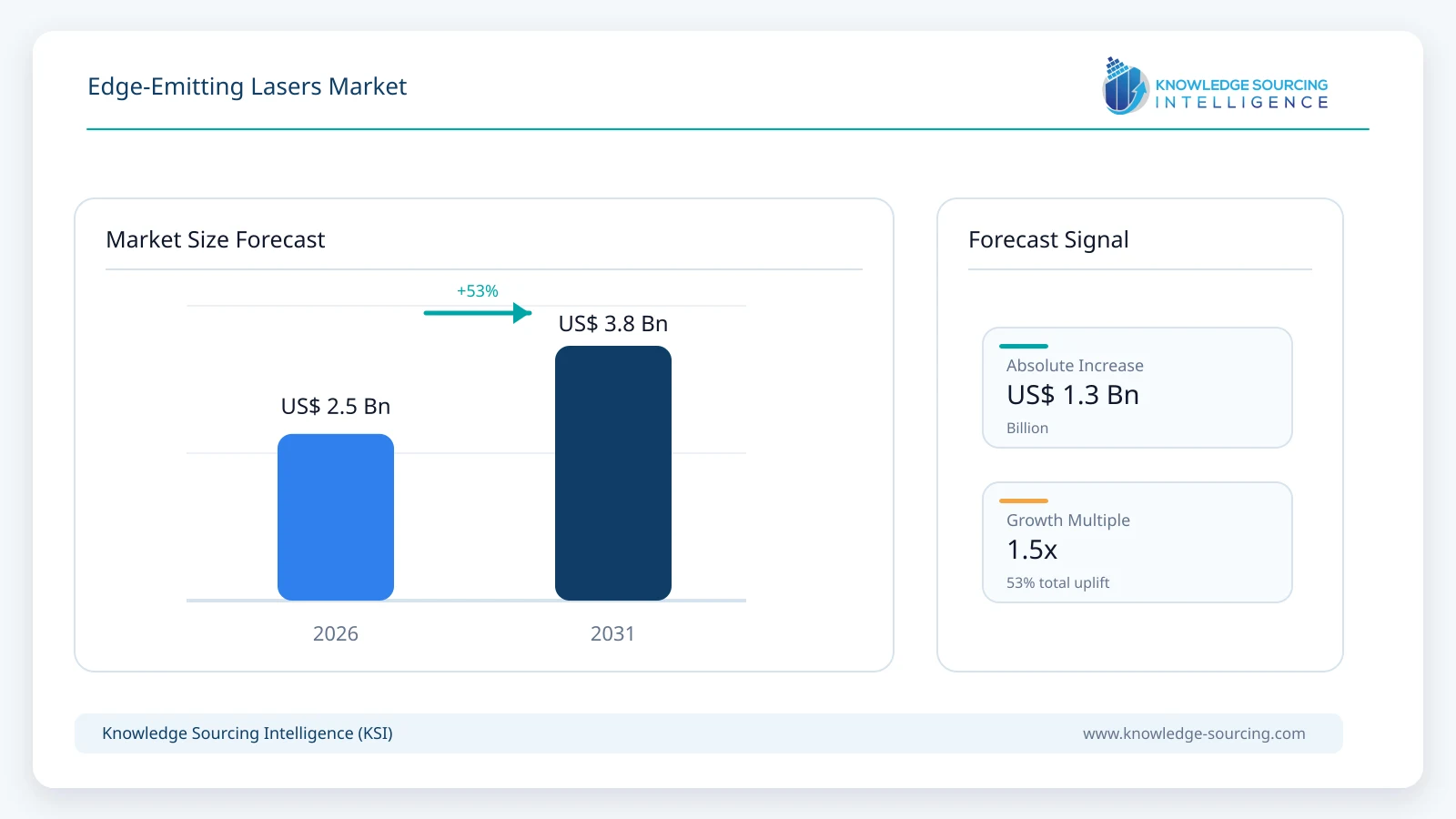
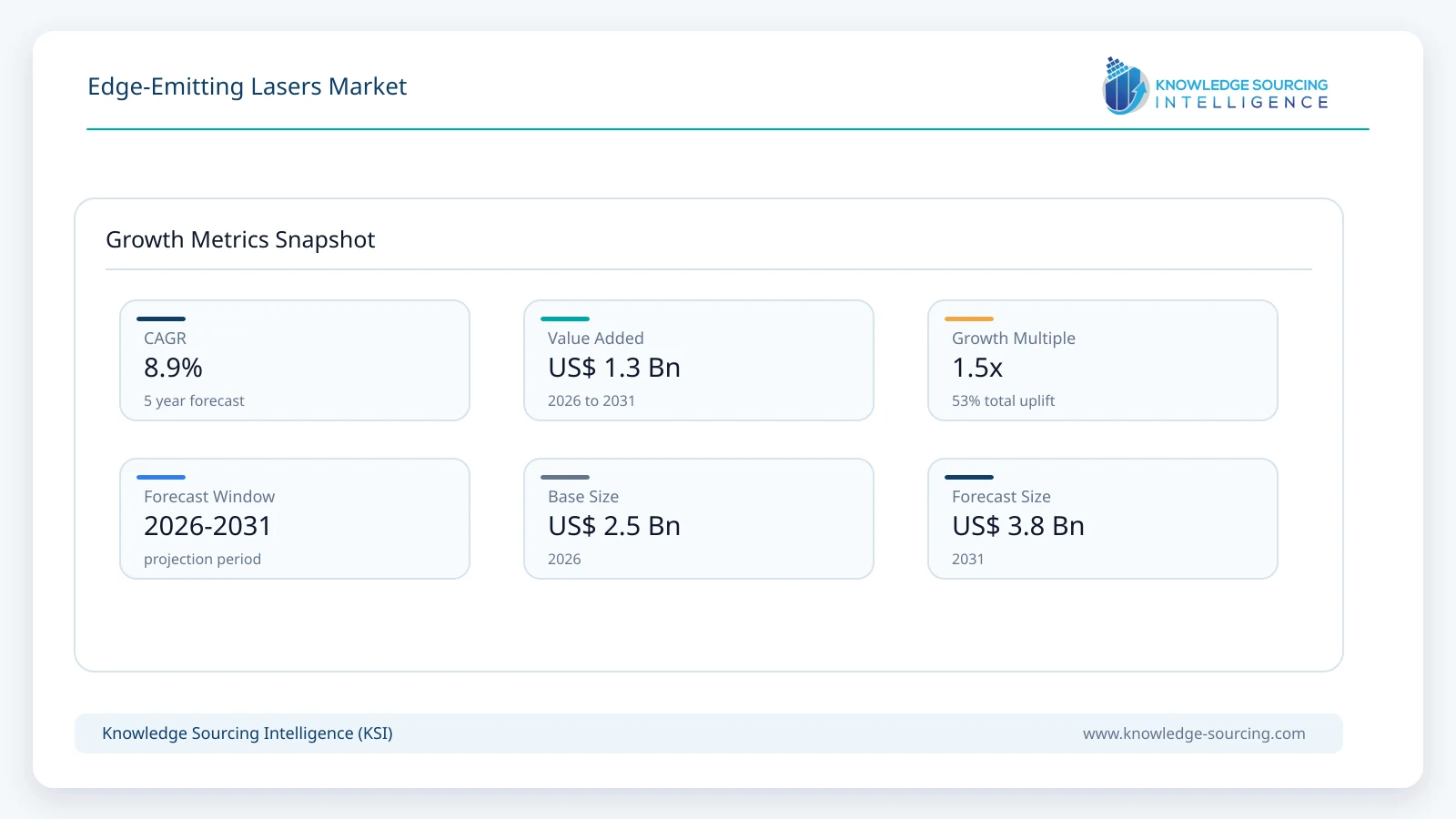
The Edge-Emitting Lasers Market is projected to expand at a CAGR of 8.9%, reaching USD 3.76 billion by 2031, up from USD 2.46 billion in 2026.
Highlights:
- 1Distributed Feedback lasers account for approximately 38% of market value in 2026 and gain share through 2031 as high-speed optical communications expand.
- 2Optical Communications remains the largest application, with a 2026 value of approximately USD 1.13 billion.
- 3Sensing and LiDAR is projected to record a low-double-digit CAGR through 2031, supported by automotive, industrial robotics and distance-measurement applications.
- 4Telecommunications and Data Centers remain the largest end-user segment, while Automotive records one of the strongest forecast growth rates from a smaller base.
- 5Asia Pacific accounts for approximately 47% of the market in 2026, supported by compound semiconductor manufacturing, telecom infrastructure, electronics production and strong photonics capabilities.
- 6Lumentum and Coherent are materially increasing InP manufacturing capacity as AI infrastructure increases demand for high-power and high-speed optical laser sources.
Edge-emitting lasers generate optical output through the side of a semiconductor structure and remain important where applications require high optical power, controlled wavelength, efficient fiber coupling, fast modulation or tightly directed beams. Their commercial use spans optical communications, AI data-center connectivity, industrial material processing, LiDAR and sensing, medical systems, displays and scientific instrumentation, giving the market several independent sources of demand rather than tying growth to a single photonics application.
Optical Communications represents the largest application and is estimated at approximately USD 1.13 billion in 2026. The market is being reshaped by the rapid increase in data exchanged between processors, switches, racks and data-center facilities as artificial intelligence infrastructure scales. Coherent’s 2026 InP portfolio includes high-power continuous-wave lasers for co-packaged optics, 200G electro-absorption modulated lasers for 1.6T transceivers and next-generation technologies targeting 3.2T and higher data rates. Lumentum is similarly expanding InP manufacturing capacity specifically for AI-scale optical infrastructure, illustrating the direct relationship between computing architecture and semiconductor-laser demand.
Distributed Feedback lasers account for the largest product share at approximately 38% in 2026. Their ability to deliver relatively narrow spectral output and controlled wavelength makes them particularly important in optical communications, where high-speed networks require stable laser sources that can couple efficiently into fiber and maintain performance across demanding temperature ranges. Mitsubishi Electric, MACOM, Broadcom, Coherent and other suppliers maintain DFB-based devices across telecom and data-center applications, while newer InP manufacturing investments are increasing the strategic importance of high-performance edge-emitting devices in AI infrastructure.
The second growth layer comes from high-power and sensing applications. ams OSRAM describes edge-emitting lasers as the preferred architecture for several long-range LiDAR, visualization, illumination and material-processing applications because stacked-junction designs can deliver high power from a compact area. In November 2025, the company introduced a five-junction EEL for automotive LiDAR that increases optical peak power while reducing current requirements compared with its earlier three-junction architecture. Hamamatsu Photonics extended the high-power boundary further in June 2026 with a 2.0 kW laser diode bar aimed at industrial laser processing and advanced laser systems.
Market Growth Drivers and Trends
AI Data Centers Are Increasing Demand for High-Speed Optical Sources
AI infrastructure is changing the scale and architecture of data-center connectivity. Conventional cloud networks primarily transport traffic between servers, storage and external networks, while AI training and inference clusters require extremely high data movement between accelerators, switches and memory systems inside and across computing racks. Electrical interconnects become increasingly difficult to scale at longer distances and higher bandwidths because of power consumption and signal-integrity constraints, increasing the role of optical interconnects closer to computing hardware.
The resulting demand is visible directly in semiconductor-laser investment. Coherent stated in March 2026 that its InP portfolio includes 400 mW continuous-wave lasers for co-packaged optics and silicon-photonics transceivers, 200G EML solutions for 1.6T products and technologies targeting 400G-per-lane operation. The company is doubling InP production during 2026 and continuing to increase capacity through 2027. Lumentum announced a new 240,000-square-foot U.S. facility using six-inch InP wafers and expects the site to ramp production during 2028, while NVIDIA committed USD 2 billion to Lumentum and secured future access to advanced optical capacity.
This creates above-market growth for DFB, EML and high-power continuous-wave laser technologies serving data centers and communications infrastructure. The opportunity is not limited to transceiver unit growth; higher data rates also increase laser-performance requirements, supporting greater component value per optical lane.
Global Data Traffic Continues to Expand the Optical Network Base
The longer-term telecommunications market remains supported by continued increases in connectivity and data consumption. The International Telecommunication Union estimates that approximately 6 billion people, or 74% of the global population, were using the Internet in 2025. Fixed broadband carried approximately 7.3 zettabytes of end-user Internet traffic during the year, nearly five times mobile broadband traffic, reinforcing the continuing role of fixed and fiber-based networks in transporting data-intensive workloads.
Emerging markets add a second layer of network expansion. India’s broadband subscriber base reached approximately 1.066 billion in March 2026, including 46.5 million fixed wired connections, while total Internet subscriptions exceeded 1.09 billion. Growth in fiber access, metro networks, mobile backhaul and data-center interconnects therefore creates continued demand for optical transmitters even outside the AI infrastructure segment.
Edge-emitting lasers benefit because InP DFB and related devices remain established sources for single-mode fiber communication. The communications market is increasingly shifting from basic connectivity expansion toward higher transmission speed, wavelength density and energy efficiency, allowing laser value to grow faster than the number of network endpoints.
LiDAR and Industrial Sensing Are Creating High-Growth EEL Applications
Edge-emitting lasers are well suited to long-range LiDAR because they can deliver high optical peak power within compact packages. ams OSRAM provides multi-channel 905 nm EELs for automotive and industrial LiDAR, while ROHM offers high-power edge-emitting products for automotive ADAS, drones, automated guided vehicles and service robots.
Technology development is increasing achievable range and efficiency. ams OSRAM’s five-junction EEL stacks five emitting layers vertically and is designed to deliver higher optical peak power with lower current and reduced heat generation. ROHM has developed multi-channel EEL arrays reaching the kilowatt-class peak-output range to improve long-distance detection and spatial resolution.
The application extends beyond automotive autonomy. Industrial robots, warehouse systems, surveying equipment, drones and service robots use distance measurement and environmental mapping, allowing sensing demand to diversify beyond the timing of fully autonomous passenger vehicles. Sensing and LiDAR is therefore modelled materially above the total-market growth rate through 2031.
Industrial Laser Processing Is Driving Higher-Power Semiconductor Devices
High-power edge-emitting laser diodes are used directly in material-processing equipment and as pump sources for fiber and solid-state lasers. Applications include welding, cutting, engraving, marking, heat treatment and advanced manufacturing processes where optical efficiency and beam quality directly influence operating economics. ams OSRAM’s high-power CW EEL portfolio is designed for both direct diode-laser systems and pumping applications, while Innolume and Lumics provide broad-area and fiber-coupled semiconductor-laser products across industrial power levels.
Hamamatsu Photonics’ June 2026 development of a 2.0 kW output laser diode bar demonstrates how semiconductor-laser power density continues to increase. The company expects the technology to support industrial laser processing and solid-state laser pumping and potentially extend into advanced high-energy laser applications.
These developments allow industrial users to increase processing speed while improving electrical-to-optical efficiency. Material Processing grows more moderately than AI communications and LiDAR because industrial capital spending remains cyclical, but high-power technology raises average component value and supports continued demand.
Miniaturisation and Wavelength Control Are Expanding Specialty Applications
Edge-emitting lasers cover a wide wavelength range and can be engineered for specific optical power, beam quality and spectral requirements. Ushio currently supplies laser diodes from violet through infrared for medical, life-science, sensing, lithography and display applications, while Innolume offers FP, DFB and broad-area devices across wavelengths from approximately 780 nm to 1,350 nm. Lumics extends semiconductor-laser products up to approximately 1,940 nm for medical, sensing, communications and pumping applications.
This wavelength flexibility broadens the market beyond large-volume communications. Spectroscopy, particle detection, medical diagnostics, laser levelling, printing, projection, life sciences and security systems each require different wavelength and power combinations. These markets generally have lower volumes than telecom, but qualification requirements and application-specific packaging can support higher selling prices and improve portfolio diversification for laser manufacturers.
Market Restraints
Compound-Semiconductor Manufacturing Remains Complex and Capital Intensive
Edge-emitting lasers depend on compound-semiconductor platforms including indium phosphide and gallium arsenide rather than conventional silicon alone. Production requires precise epitaxial growth, lithography, cavity fabrication, facet processing, coating, metallization, die separation, packaging and testing. Small process variations can affect output power, wavelength, efficiency and lifetime, making manufacturing yield an important determinant of cost.
The current capacity expansion by Coherent and Lumentum illustrates the capital requirements associated with scaled InP production. Coherent is expanding six-inch InP manufacturing across multiple facilities, while Lumentum plans hundreds of millions of dollars of investment in its new U.S. fab. This creates a barrier to entry and increases the strategic importance of manufacturing yield, process intellectual property and experienced engineering teams.
Thermal Management Becomes More Difficult as Optical Power Increases
Increasing optical output does not translate directly into useful system performance unless heat can be removed efficiently. Higher junction temperatures can reduce conversion efficiency, shift wavelength and shorten device life, making packaging and thermal design critical to high-power lasers.
This becomes particularly important in LiDAR, industrial processing and high-density optical interconnects where designers seek greater optical output from smaller footprints. ams OSRAM’s multi-junction LiDAR development specifically targets lower current and reduced ohmic losses to simplify thermal management, illustrating the continuing engineering trade-off between output power and heat generation.
Thermal requirements can therefore increase packaging cost and limit the speed at which new device architectures are adopted in volume applications.
VCSELs and Other Laser Architectures Compete in Several Applications
Edge-emitting lasers do not have a structural advantage in every optical application. VCSELs offer wafer-level manufacturing, two-dimensional arrays and favourable reliability characteristics and are widely used in short-range 3D sensing and datacom. ams OSRAM supplies both architectures and explicitly positions VCSEL and EEL technologies according to different sensing and LiDAR system requirements.
The same competitive overlap exists in data-center optics, where silicon-photonics external laser architectures, directly modulated lasers, electro-absorption modulated lasers and VCSELs compete according to distance, bandwidth, power consumption and cost. Coherent’s OFC 2026 demonstrations included InP, silicon-photonics and VCSEL solutions across different data-center architectures rather than relying on a single laser platform.
EEL growth therefore depends on maintaining performance advantages in applications requiring high power, single-mode output, longer range or specific wavelength control.
Telecom and Data-Center Investment Cycles Can Create Capacity Imbalances
Optical component demand can shift quickly when cloud providers, telecom operators and equipment manufacturers change capital-expenditure plans. The supply chain has historically experienced periods of component shortage followed by overcapacity, creating pricing pressure and underutilised manufacturing assets.
The current AI infrastructure cycle is driving substantial InP investment, but this also raises execution risk. Manufacturers must add capacity several years before all end-market demand is known, while customers simultaneously seek lower power consumption and component cost. Suppliers that expand too aggressively can face reduced fab utilisation if architecture choices or data-center build schedules change.
This cyclicality is particularly important because Communications and Data Centers represent the largest end-user segment in the KSI market model.
Qualification and Reliability Requirements Slow Commercialisation
Edge-emitting laser components often operate inside systems where failure can disable expensive equipment or create safety risks. Telecom products require long operating life and network qualification, automotive LiDAR components need wide-temperature reliability, while medical and aerospace systems require additional traceability and validation.
Broadcom’s DFB products, for example, are designed around Telcordia qualification requirements, while ams OSRAM offers automotive EEL products qualified to AEC-Q102. These requirements favour established suppliers but can lengthen product-development and customer-qualification cycles.
The restraint is particularly significant for newer materials and packaging approaches. A technically superior laser does not automatically gain market share until customers establish long-term reliability at the system level.
Edge-Emitting Lasers Market Segmentation Analysis
By Type
Distributed Feedback Lasers account for approximately 38% of market value in 2026 and remain the largest type through the forecast period. DFB devices integrate a wavelength-selective grating into the laser cavity, enabling controlled single-mode operation and making them particularly suitable for optical communications, sensing and spectroscopy. Demand increases as data centers move toward 1.6T, 3.2T and higher-capacity optical architectures and network operators increase wavelength density. The segment is estimated to reach roughly 43% of the market by 2031.
Fabry-Pérot Lasers are projected to grow at approximately 3.5-4.0% annually through 2031. Their comparatively simple resonator architecture supports cost-effective production across communications, sensing and industrial applications where narrow single-frequency output is not essential. FP devices remain commercially relevant, but their market share gradually declines as high-speed optical communications favour DFB and related wavelength-controlled architectures.
Distributed Bragg Reflector Lasers are projected to approach USD 0.5 billion by 2031. Their ability to separate the gain region from wavelength-selective reflector structures supports applications requiring strong wavelength control and tunability. The segment remains substantially smaller than DFB lasers but records above-market growth from communications, spectroscopy and specialty sensing applications.
Broad-Area Laser Diodes remain the principal high-power architecture within the KSI type segmentation. They are used directly or in arrays and bars for industrial material processing, pumping and high-power illumination. Hamamatsu’s 2.0 kW diode-bar development demonstrates the continuing performance expansion of this category, while Innolume offers broad-area devices across multiple wavelengths.
By Application
Optical Communications represents approximately USD 1.13 billion in 2026 and remains the largest application through 2031. The segment benefits from AI data-center connectivity, telecom network upgrades, coherent transmission, optical amplification and higher-speed transceivers. DFB, EML and external continuous-wave laser architectures all contribute to this demand, with Coherent and Lumentum materially increasing InP manufacturing capacity.
Material Processing accounts for approximately 22% of market value in 2026. High-power semiconductor lasers are used directly for selected welding and processing tasks and as pump sources in fiber and solid-state laser systems. The segment grows steadily rather than leading the market because industrial equipment demand remains linked to manufacturing capital expenditure.
Sensing and LiDAR is projected to grow at a low-double-digit CAGR through 2031, making it one of the fastest-expanding applications. Automotive ADAS, industrial robotics, drones, logistics automation and mobile distance measurement require compact sources capable of generating high optical peak power. Multi-junction edge-emitting architectures are increasing achievable range while reducing current and thermal requirements.
Medical applications remain a smaller but relatively high-value market. Laser diodes are used in diagnostic, therapeutic, surgical and life-science systems where precise wavelength and controlled output are important. Ushio and Lumics both maintain semiconductor-laser portfolios addressing medical and life-science applications.
Display and Lighting represents a mid-single-digit share of market value. Visible blue, green and red laser diodes are used in projection, high-luminance lighting and specialized visualization applications, while other applications include printing, spectroscopy and scientific instrumentation.
By End-User
Telecommunications and Data Centers are projected to grow at approximately 11.2% annually through 2031 and remain the largest end-user group. Optical transceivers, coherent systems, external laser sources and amplifiers all require semiconductor laser components, while the AI infrastructure buildout is increasing both device volumes and optical power requirements.
Industrial and Manufacturing represents an estimated USD 0.59 billion market in 2026. Semiconductor lasers are used in laser processing, metrology, machine vision, pumping and automation systems. The segment grows below the telecom market but benefits from higher-power devices and increasing adoption of laser-based manufacturing.
Healthcare and Medical accounts for approximately 9% of 2026 market value. The segment includes medical treatment, diagnostics, imaging support, analytical equipment and life-science instruments and provides a relatively stable demand base because component volumes are less directly tied to telecom investment cycles.
Automotive is projected to record a low-to-mid double-digit CAGR through 2031, driven principally by LiDAR and advanced sensing. Its current value remains considerably below Telecommunications and Industrial markets, but wider deployment of driver-assistance and autonomous systems gives it one of the strongest growth trajectories.
Consumer Electronics uses edge-emitting lasers in projection, printing, sensing and specialized optical products, although VCSELs compete strongly in short-range 3D sensing. Aerospace, Defense and Security represents a smaller share but supports high-value applications in ranging, targeting, communications and sensing where reliability requirements are comparatively demanding.
Geographical Outlook
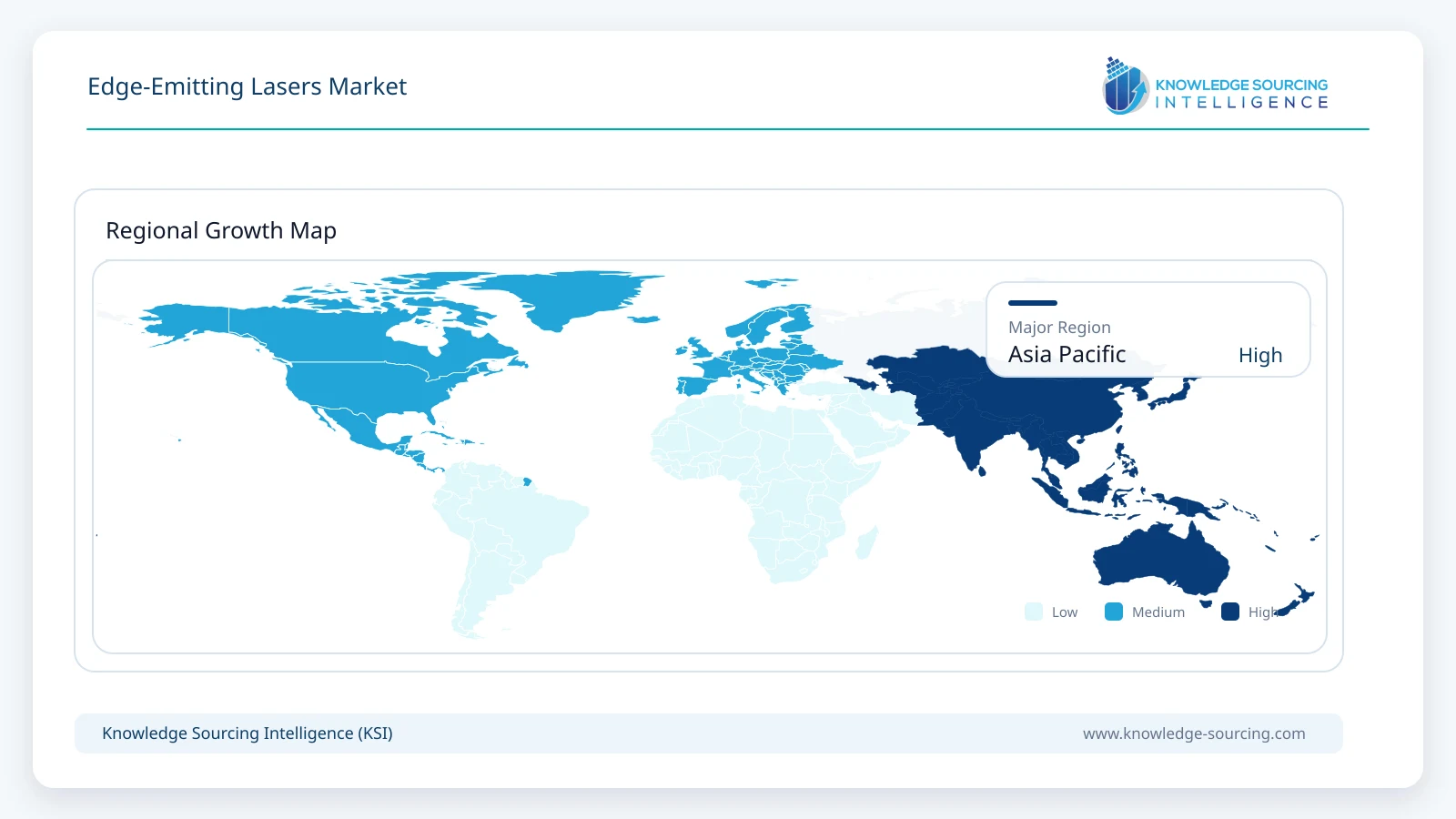
Asia Pacific accounts for approximately 47% of global market value in 2026 and remains the largest regional market through 2031. The region combines semiconductor and electronics manufacturing in China, Japan and South Korea with substantial telecom infrastructure, industrial automation and photonics capabilities. Japan also hosts major laser manufacturers including Hamamatsu Photonics, Mitsubishi Electric, Nichia, Ushio, ROHM, Sharp and QD Laser, giving the region a significant supply-side position.
North America represents approximately USD 0.62 billion in 2026. The United States benefits from AI data-center investment, cloud infrastructure, defense and aerospace demand, industrial lasers and a strengthening domestic photonics supply chain. Lumentum’s planned North Carolina InP fab is particularly significant because it increases U.S. production capacity for advanced optical laser components.
Europe is projected to grow at approximately 7.5-8.0% annually through 2031. Germany provides an important industrial and laser-manufacturing base, while the United Kingdom, France and other European markets support telecom, industrial, medical and scientific photonics applications. Innolume and Lumics are among the specialized European semiconductor-laser suppliers serving international markets.
Middle East and Africa remain smaller markets, with demand concentrated in telecom infrastructure, advanced industrial applications, healthcare and selected defense projects. South America similarly represents a relatively small share, led by Brazil’s communications, industrial and medical-technology markets.
Recent Developments
June 2026, Hamamatsu Photonics announced development of a 2.0 kW laser diode bar using a one-centimetre-wide device. The company is targeting industrial laser processing, solid-state laser pumping and other advanced high-energy applications.
March 2026, Lumentum announced a new 240,000-square-foot manufacturing facility in Greensboro, North Carolina, focused on six-inch InP production for advanced AI optical infrastructure. Production is planned to ramp during 2028.
March 2026, NVIDIA and Lumentum entered a strategic optics partnership that includes a multibillion-dollar purchase commitment, capacity access and a USD 2 billion investment by NVIDIA to support manufacturing and R&D.
March 2026, Coherent introduced an expanded InP portfolio including a 400 mW high-power CW laser for co-packaged optics, 200G EML solutions for 1.6T transceivers and technologies supporting future 3.2T and higher architectures.
March 2026, Coherent launched uncooled 980 nm micro-pump lasers delivering up to 700 mW per fiber for high-density optical amplifiers and next-generation coherent transmission systems.
Competitive Environment
The Edge-Emitting Lasers Market combines large vertically integrated photonics companies with highly specialized semiconductor-laser manufacturers. Coherent and Lumentum hold particularly important positions in high-speed InP communications technology and are materially increasing manufacturing capacity as AI data centers expand. Both companies compete not only at the laser-device level but across transceivers, photonic components and advanced optical architectures, allowing them to participate in a larger portion of the optical value chain.
ams OSRAM holds a strong position in visible and infrared EELs for LiDAR, sensing, visualization and industrial applications, while Hamamatsu Photonics is expanding the performance envelope for high-power laser bars. Mitsubishi Electric, MACOM and Broadcom maintain DFB and related optical-device portfolios for fiber communications, while Applied Optoelectronics participates across optical networking components.
The market also includes a substantial specialist manufacturer base. Innolume offers FP, DFB and broad-area devices across a wide wavelength range, Lumics focuses on fiber-coupled high-power diode lasers, Sheaumann develops GaAs and InP FP and multimode devices, while Ushio and ROHM maintain extensive visible and infrared laser-diode portfolios across sensing, medical and industrial applications.
Competition through 2031 is expected to centre on optical power, modulation speed, electrical efficiency, wavelength stability, thermal performance, manufacturing yield and customer qualification. Manufacturing capacity is becoming strategically important in AI communications, while automotive and industrial markets place greater emphasis on reliability and high peak power. Suppliers that control epitaxy, device fabrication, packaging and testing therefore hold an advantage in applications where performance and supply continuity matter more than component price alone.
Analyst View
The Edge-Emitting Lasers Market is projected to increase, with growth becoming increasingly concentrated in high-performance communications and sensing applications. The market remains diversified enough to benefit from industrial, medical and specialty demand, but AI data-center optics now represent the most important change in the commercial outlook.
Distributed Feedback lasers strengthen their market position because wavelength-controlled InP technologies are becoming more important as optical lane speeds increase. At the same time, the high-power side of the industry is advancing rapidly. Multi-junction LiDAR emitters and kilowatt-class diode bars demonstrate that EEL technology continues to expand its addressable performance range rather than being displaced by VCSELs or other semiconductor-laser architectures.
The strongest suppliers through 2031 are likely to be those capable of combining device performance with manufacturing scale. AI customers increasingly require assured access to InP capacity, while automotive and industrial users demand repeatable performance across harsh operating conditions. This shifts competitive advantage from isolated component design toward control of the broader manufacturing process, including epitaxy, wafer fabrication, packaging, qualification and long-term supply.
Edge-Emitting Lasers Market Scope:
| Report Metric | Details |
|---|---|
| Total Market Size in 2026 | USD 2.46 billion |
| Total Market Size in 2031 | USD 3.76 billion |
| Forecast Unit | Billion |
| Growth Rate | 8.9% |
| Study Period | 2021 to 2031 |
| Historical Data | 2021 to 2024 |
| Base Year | 2025 |
| Forecast Period | 2026 – 2031 |
| Segmentation | Type, Application, End-User, Geography |
| Companies |
|
Market Segmentation
By Type
Fabry-Pérot (FP) Lasers
Distributed Bragg Reflector (DBR) Lasers
Distributed Feedback (DFB) Lasers
Broad-Area Laser Diodes (BALDs)
By Application
Optical Communications
Material Processing
Sensing and LiDAR
Medical
Display and Lighting
Others
By End-User
Telecommunications and Data Centers
Industrial and Manufacturing
Healthcare and Medical
Consumer Electronics
Automotive
Aerospace, Defense, and Security
Others
By Geography
North America
United States
Canada
Mexico
South America
Brazil
Argentina
Others
Europe
United Kingdom
Germany
France
Spain
Others
Middle East and Africa
Saudi Arabia
UAE
Others
Asia Pacific
China
India
Japan
South Korea
Others
Table of Contents
1. EXECUTIVE SUMMARY
2. MARKET SNAPSHOT
2.1. Market Overview
2.2. Market Definition
2.3. Scope of the Study
2.4. Market Segmentation
3. BUSINESS LANDSCAPE
3.1. Market Drivers
3.2. Market Restraints
3.3. Market Opportunities
3.4. Porter’s Five Forces Analysis
3.5. Industry Value Chain Analysis
3.6. Policies and Regulations
3.7. Strategic Recommendations
4. TECHNOLOGICAL OUTLOOK
5. EDGE-EMITTING LASERS MARKET BY TYPE
5.1. Introduction
5.2. Fabry-Pérot (FP) Lasers
5.3. Distributed Bragg Reflector (DBR) Lasers
5.4. Distributed Feedback (DFB) Lasers
5.5. Broad-Area Laser Diodes (BALDs)
6. EDGE-EMITTING LASERS MARKET BY APPLICATION
6.1. Introduction
6.2. Optical Communications
6.3. Material Processing
6.4. Sensing and LiDAR
6.5. Medical
6.6. Display and Lighting
6.7. Others
7. EDGE-EMITTING LASERS MARKET BY END-USER
7.1. Introduction
7.2. Telecommunications and Data Centers
7.3. Industrial and Manufacturing
7.4. Healthcare and Medical
7.5. Consumer Electronics
7.6. Automotive
7.7. Aerospace, Defense, and Security
7.8. Others
8. EDGE-EMITTING LASERS MARKET BY GEOGRAPHY
8.1. Introduction
8.2. North America
8.2.1. United States
8.2.2. Canada
8.2.3. Mexico
8.3. South America
8.3.1. Brazil
8.3.2. Argentina
8.3.3. Others
8.4. Europe
8.4.1. United Kingdom
8.4.2. Germany
8.4.3. France
8.4.4. Spain
8.4.5. Others
8.5. Middle East and Africa
8.5.1. Saudi Arabia
8.5.2. UAE
8.5.3. Others
8.6. Asia Pacific
8.6.1. China
8.6.2. India
8.6.3. Japan
8.6.4. South Korea
8.6.5. Others
9. COMPETITIVE ENVIRONMENT AND ANALYSIS
9.1. Major Players and Strategy Analysis
9.2. Market Share Analysis
9.3. Mergers, Acquisitions, Agreements and Collaborations
9.4. Competitive Dashboard
10. COMPANY PROFILES
10.1. Coherent Corp.
10.2. Lumentum Holdings Inc.
10.3. ams OSRAM AG
10.4. Hamamatsu Photonics K.K.
10.5. Mitsubishi Electric Corporation
10.6. MACOM Technology Solutions Holdings, Inc.
10.7. Broadcom Inc.
10.8. Applied Optoelectronics, Inc.
10.9. Nichia Corporation
10.10. Ushio Inc.
10.11. ROHM Co., Ltd.
10.12. Innolume GmbH
10.13. Lumics GmbH
10.14. Sheaumann Laser, Inc.
10.15. QD Laser, Inc.
10.16. Sharp Corporation
10.17. Laser Components GmbH
10.18. nLIGHT, Inc.
11. APPENDIX
11.1. Currency
11.2. Assumptions
11.3. Base and Forecast Years Timeline
11.4. Key Benefits for Stakeholders
11.5. Research Methodology
11.6. Abbreviations
Navigate
Trusted by the world's leading organizations











