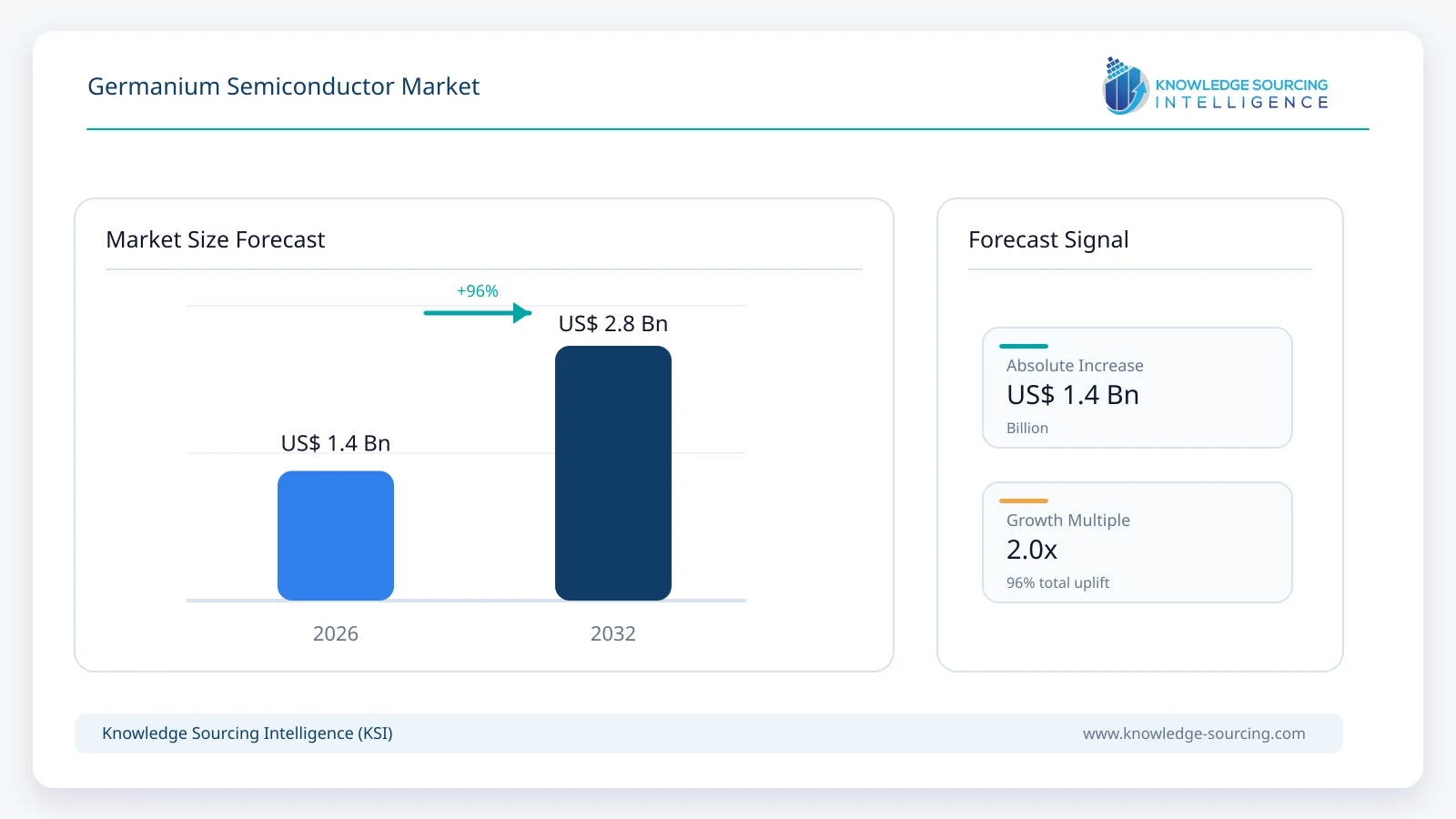
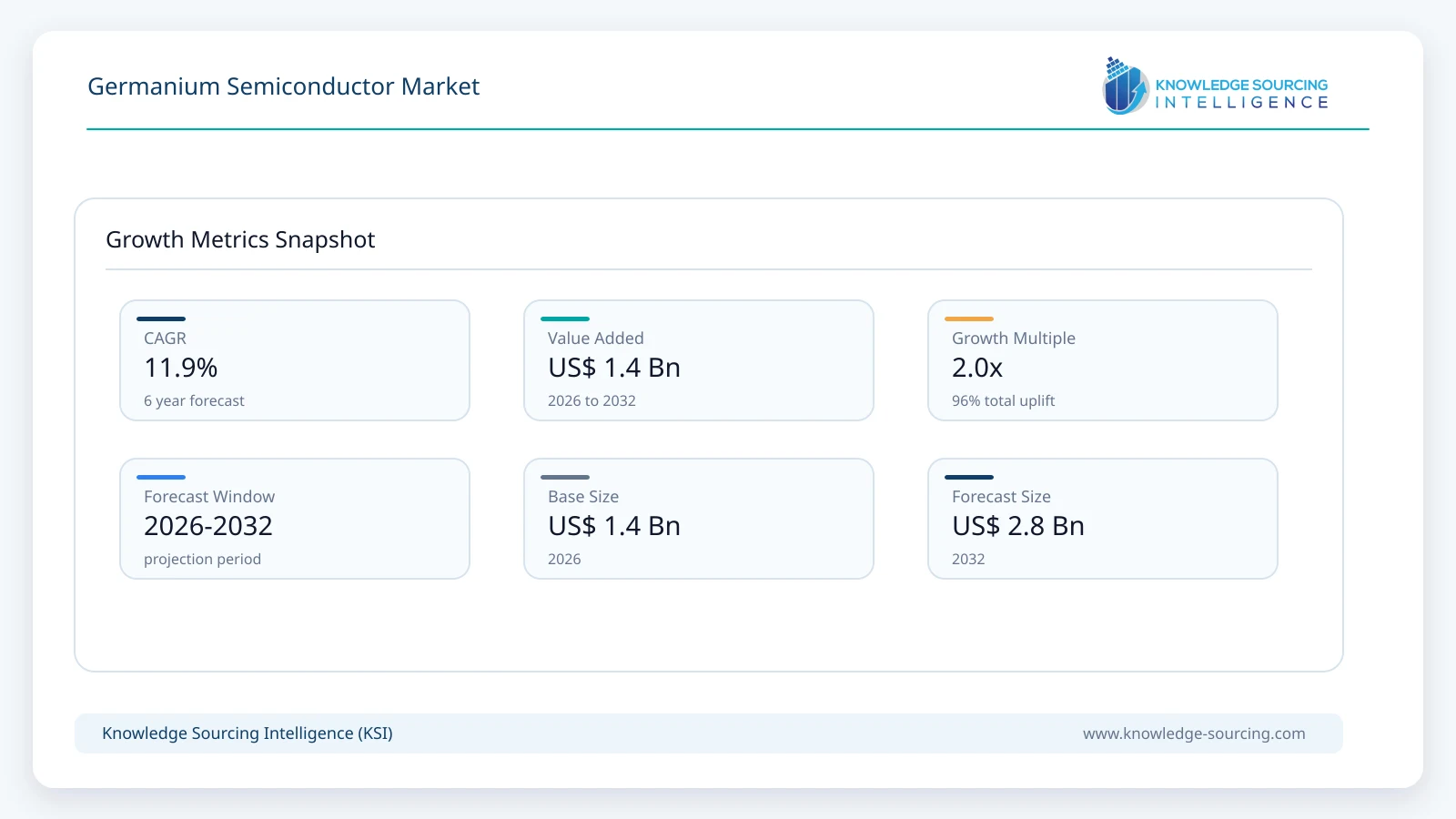
The Germanium Semiconductor Market is estimated at USD 1.40 billion in 2026 and is projected to reach USD 2.75 billion by 2032, representing a CAGR of 11.9% during the forecast period.
Highlights:
- 1Germanium substrates and wafers account for about 44% of 2026 market revenue.
- 2Integrated germanium photonics grows fastest, with revenue expanding at roughly 16.5% CAGR.
- 3AI optical interconnects increase demand for high-speed germanium-on-silicon photodetectors and SiGe electronics.
- 4Space solar cells sustain premium demand for high-purity, epi-ready germanium substrates globally.
- 5Export controls and concentrated refining capacity keep germanium supply security strategically important.
Market Overview
Germanium occupies a distinctive position between elemental silicon and III-V compound semiconductors. Its electron and hole mobility are higher than silicon, and its optical absorption extends into wavelengths important for telecommunications and short-wave infrared sensing. This makes germanium especially valuable where high-speed electronics and photonics need to coexist with silicon manufacturing. In silicon photonics, germanium is commonly introduced selectively into a silicon process to form photodiodes that convert optical signals into electrical signals without requiring an entirely separate detector platform.
Bulk germanium remains commercially important as a semiconductor substrate. Germanium is closely lattice-matched to gallium arsenide, which allows III-V multi-junction solar-cell stacks to be grown on a mechanically robust and electrically active base. Epi-ready germanium wafers therefore retain a critical role in high-efficiency space photovoltaics. Umicore and AXT are among the established suppliers of germanium substrates, while downstream users span space solar-cell manufacturers, photonics companies, detector suppliers and specialty foundries.
Supply conditions add strategic value to processing efficiency, recycling and geographic diversification. China remains the dominant source of refined germanium and has used export licensing and controls as part of its critical-material policy. At the same time, Canada and Europe are supporting alternative production and recycling pathways. For semiconductor customers, supply resilience matters because the value of a qualified wafer or active germanium structure is determined as much by purity, defect control and process consistency as by the underlying metal content.
Market Drivers
AI data-center optical interconnects expand germanium photodetector demand
Artificial intelligence clusters require rapidly increasing optical bandwidth between accelerators, switches and racks. Silicon photonics offers a manufacturing-compatible platform for scaling optical links, but silicon itself is inefficient for direct detection at the main telecommunication wavelengths. Germanium solves this problem by providing strong absorption while remaining compatible with silicon-based integration. Imec's September 2026 demonstration of a 100 GHz Ge/Si avalanche photodiode and a net 400 Gbps link shows how germanium is moving deeper into the receiver path for next-generation optical interconnects.
Space solar-cell manufacturing sustains premium substrate demand
High-efficiency multi-junction solar cells used on satellites require substrates that support III-V epitaxial growth while surviving radiation, thermal cycling and long mission durations. Germanium remains a proven platform because it is closely lattice-matched to gallium arsenide and can also function as the bottom junction in the cell architecture. The European Space Agency's ongoing IMaGer VI program focuses on 150 mm epi-ready germanium wafers for next-generation four-junction cells, showing that substrate quality and production scale remain active investment priorities rather than mature, static requirements.
High-speed SiGe electronics remain important in networking and automotive systems
Silicon-germanium heterojunction bipolar transistor and BiCMOS technologies combine silicon manufacturing with higher-frequency transistor performance. These platforms are used in optical-network drivers and transimpedance amplifiers, millimeter-wave communication, automotive radar and other high-speed analog applications. Demand is reinforced by higher lane speeds in data-center optics and by increasingly complex radar systems. Foundries continue to invest in high-performance SiGe capacity because these functions are difficult to replace economically with standard CMOS at the same combination of speed, noise and analog performance.
Supply diversification and recycling increase the value of qualified material
Germanium is produced in relatively small volumes and often recovered as a by-product, which limits how quickly supply can respond to demand. China's dominant position and export restrictions have increased the strategic importance of alternative refining, recycling and substrate reuse. Canada announced a potential investment framework in 2026 supporting Teck's strategic-metals production, including germanium, while Umicore continues closed-loop germanium refining and substrate-reuse programs. These investments support a more resilient supply base for semiconductor and photonics customers.
Restraints and Adoption Challenges
The market is constrained by limited upstream supply, volatile raw-material pricing and the cost of maintaining semiconductor-grade purity. Germanium devices also face competition from silicon, indium phosphide, gallium arsenide and emerging detector materials depending on wavelength, power and integration requirements. Integrating germanium on silicon introduces strain, defect and thermal-budget challenges, while bulk germanium substrates remain more expensive than mainstream silicon wafers. In space photovoltaics, reusable-substrate approaches and thinner wafers can reduce material intensity per cell, improving supply efficiency but moderating raw wafer-volume growth.
Segment Analysis
By Product and Semiconductor Platform
Germanium substrates and wafers represent the largest revenue contribution in 2026. Their estimated market value is approximately USD 0.62 billion, supported by space photovoltaics, specialty optoelectronics, compound-semiconductor epitaxy and selected sensing applications. Value per wafer remains high because crystal purity, zero-dislocation growth, surface preparation and epitaxial readiness directly affect downstream yield. Larger diameters and substrate-reuse programs can improve manufacturing economics while preserving premium pricing for qualified material.
Integrated germanium photonics is expected to expand fastest through 2032, reaching approximately USD 0.70 billion by the end of the forecast period. The category includes germanium-on-silicon photodetectors, avalanche photodiodes and related active structures integrated into silicon-photonics platforms. Growth is strongest where data-center optical links move toward higher lane rates, lower receiver power and denser integration. SiGe RF and high-speed analog devices remain another substantial revenue pool, while high-purity germanium detector applications provide a smaller but technically defensible specialty market.
Market and Technology Indicators
Indicator | Current Evidence | Market Impact |
Ge/Si photodetector performance | Imec demonstrated a 100 GHz Ge/Si avalanche photodiode at 5 V and a net 400 Gbps optical link in September 2026. | Supports germanium content growth in next-generation AI data-center optical receivers. |
150 mm space-grade wafer scale-up | ESA reported 25% throughput gains in polishing and cleaning within the IMaGer VI germanium-wafer program. | Improves manufacturing economics for next-generation four-junction space solar cells. |
Larger-diameter germanium substrates | Umicore highlights 8-inch germanium capability as a route to lower processing cost for photonic devices. | Creates a scaling pathway beyond traditional smaller-diameter specialty wafers. |
Germanium supply concentration | Recent reporting places China at roughly two-thirds of global germanium production. | Keeps export licensing, recycling and alternative refining capacity strategically important. |
North American supply investment | Canada announced a potential C$400 million investment framework tied to Teck strategic-metals output, including germanium. | Supports diversification of non-Chinese refined germanium supply. |
Specialty substrate commercialization | AXT manufactures germanium alongside InP and GaAs wafers for space solar, sensing and optoelectronic applications. | Confirms continuing merchant-wafer demand across multiple semiconductor end markets. |
Application and Commercialization Indicators
Application | Germanium Role | Commercial Direction |
AI and cloud optical interconnects | Ge-on-Si photodetectors and SiGe analog front-end electronics | Fast commercialization as lane speeds and optical link density increase. |
Space solar cells | Epi-ready Ge substrate and bottom-junction platform for III-V multi-junction cells | Established premium market with continuing qualification for four-junction architectures. |
Automotive and industrial sensing | SWIR detectors, LiDAR-related photonics and SiGe high-frequency electronics | Broadening adoption as sensing performance requirements increase. |
Telecom and RF electronics | SiGe HBT/BiCMOS devices, optical drivers and receiver electronics | Sustained demand from higher-frequency and higher-bandwidth communication systems. |
Radiation and scientific detection | High-purity germanium detector crystals and semiconductor detectors | Specialty demand supported by spectroscopy, nuclear monitoring and research applications. |
Regional Opportunity
Asia Pacific
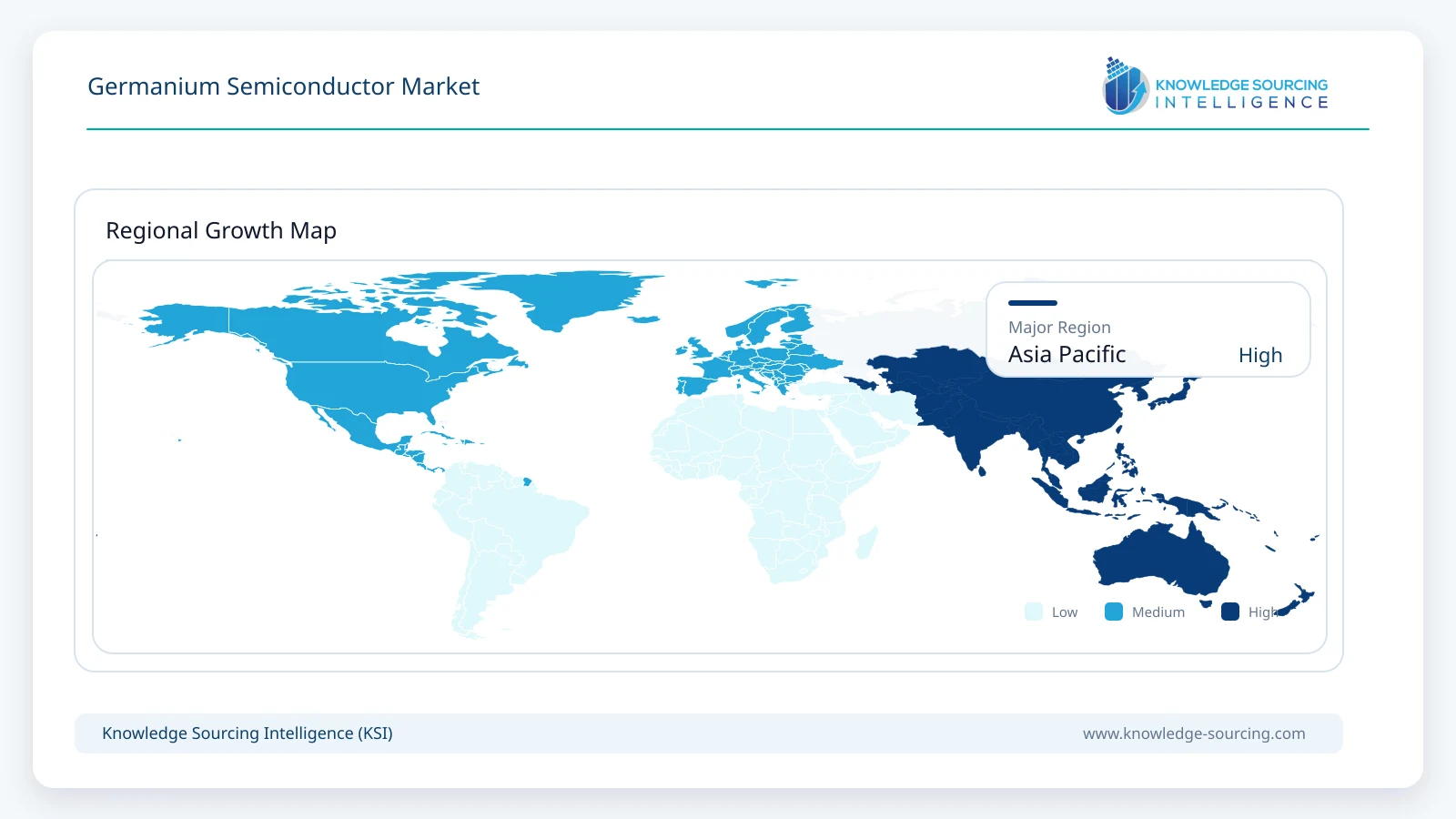
Asia Pacific is the largest regional market because it combines upstream germanium supply with major semiconductor, photonics, electronics and compound-semiconductor manufacturing ecosystems. China is the dominant upstream producer and also hosts substrate and compound-semiconductor manufacturing, making export licensing and domestic allocation important to global availability. AXT's manufacturing footprint in China and Yunnan-based germanium producers illustrate the region's position across both raw material and wafer processing.
Taiwan, South Korea and Japan contribute more through semiconductor manufacturing, photonics, automotive electronics and advanced materials than through primary germanium production. As silicon photonics scales in artificial intelligence data centers, foundry and packaging ecosystems in the region can capture downstream value from germanium integrated into silicon-compatible detector structures. Japan also remains important in high-purity materials, sensors and specialty optoelectronics.
The region also has significant demand exposure to consumer sensing, telecom infrastructure and optical networking. Germanium content does not necessarily appear as a stand-alone wafer in these systems; it is increasingly embedded within silicon-germanium processes and germanium-on-silicon photonic devices. This shifts value from raw material volume toward epitaxy, device integration, process intellectual property and qualified manufacturing.
Europe remains strategically important through Umicore's integrated germanium refining, recycling and wafer capability and through research programs such as imec and the European Space Agency's substrate qualification work. North America contributes strong demand from artificial intelligence infrastructure, aerospace, defense and optical networking, alongside alternative upstream supply from Canada and specialized SiGe and silicon-photonics foundry capacity in the United States.
Competitive Landscape
Competition spans three layers: high-purity germanium and crystal supply, specialty substrates and wafers, and germanium-enabled semiconductor devices. Umicore is differentiated by its integrated refining, recycling, crystal growth and wafer capability. AXT supplies germanium wafers alongside other compound-semiconductor substrates and serves space solar, sensing and optoelectronic markets. Yunnan Germanium and Teck Resources contribute upstream material supply, while smaller specialist crystal and wafer companies serve regional or defense-oriented demand.
Downstream competition is broader because germanium is often integrated into a silicon or III-V process rather than sold as a stand-alone semiconductor. GlobalFoundries and Tower Semiconductor compete in high-performance SiGe foundry platforms. Broadcom, Lumentum, Coherent and other optical-component suppliers participate in device ecosystems where germanium photodetectors and SiGe electronics support high-speed links. Hamamatsu Photonics participates in detector markets, while NXP and Infineon use high-frequency semiconductor platforms across automotive and communication applications.
Space photovoltaics form another specialized competitive arena. 5N Plus participates through AZUR SPACE, while Rocket Lab operates a vertically integrated space-solar business. Competitive advantage depends on cell efficiency, radiation performance, wafer and epitaxy yield, substrate reuse and long-duration qualification. Across the wider market, suppliers able to secure germanium feedstock while lowering material consumption per device are positioned to benefit most from supply constraints.
Major companies and ecosystem participants covered: Umicore, AXT, Yunnan Germanium, Teck Resources, 5N Plus / AZUR SPACE, GlobalFoundries, Tower Semiconductor, Broadcom, Lumentum, Coherent, Hamamatsu Photonics, NXP Semiconductors, Infineon Technologies, Rocket Lab, and Wafer Technology.
Recent Developments
September 2026: Imec demonstrated a 100 GHz germanium-on-silicon avalanche photodiode operating at 5 V and a net 400 Gbps optical link for next-generation data-center interconnects.
September 2026: Global germanium supply remained tight as buyers responded to continued Chinese export controls and elevated demand from semiconductors, fiber optics and defense applications.
August 2026: AXT reiterated germanium as part of its specialty semiconductor substrate portfolio serving satellite solar cells, sensors and optoelectronic applications.
July 2026: The European Space Agency reported 25% throughput gains in polishing and cleaning within Umicore's 150 mm germanium-wafer manufacturing flow under the IMaGer VI program.
July 2026: Canada announced a potential C$400 million investment framework supporting Teck's strategic-metals production, including germanium.
April 2026: Umicore highlighted germanium as a strategic material for photonics and compound semiconductors at the AngelTech Innovate Summit.
Germanium Semiconductor Market Scope:
| Report Metric | Details |
|---|---|
| Total Market Size in 2026 | USD 1.40 billion |
| Total Market Size in 2032 | USD 2.75 billion |
| Forecast Unit | USD Billion |
| Growth Rate | 11.9% |
| Study Period | 2021 to 2032 |
| Historical Data | 2021 to 2024 |
| Base Year | 2025 |
| Forecast Period | 2026 – 2032 |
| Segmentation | Product Type, Semiconductor Platform, Device Type, Application, Supply Chain Stage, Geography |
| Companies |
|
Market Segmentation
By Product Type
High-Purity Germanium Crystals and Ingots
Germanium Substrates and Wafers
SiGe and Ge Epitaxial Materials
Germanium Photodetectors and Optoelectronic Devices
High-Purity Germanium Detector Devices
Other Germanium Semiconductor Products
By Semiconductor Platform
Bulk Germanium
Germanium-on-Silicon
Silicon-Germanium (SiGe)
Germanium-Tin (GeSn)
III-V-on-Germanium Structures
By Device Type
Photodiodes and Avalanche Photodiodes
SiGe HBT and BiCMOS Devices
Infrared and SWIR Detectors
Space Photovoltaic Structures
Radiation and Gamma-Ray Detectors
Emerging Photonic Emitters and Quantum Devices
By Application
AI Data Centers and Optical Interconnects
Telecom and High-Speed Networking
Space Solar Cells and Satellite Power
Automotive Radar, LiDAR and Sensing
Consumer and Industrial Photonics
Aerospace, Defense and Security
Nuclear, Scientific and Medical Detection
By Supply Chain Stage
Germanium Refining and High-Purity Material
Crystal Growth and Wafer Manufacturing
Epitaxy and Material Integration
Semiconductor Fabrication and Foundry
Device Packaging and System Integration
By Geography
Asia Pacific
China
Japan
Taiwan
South Korea
Southeast Asia and India
North America
United States
Canada
Europe
Belgium
Germany
France
United Kingdom
Rest of World
Table of Contents
1. EXECUTIVE SUMMARY
1.1. Market Opportunity and Key Findings
1.2. Germanium Semiconductor Technology Outlook
1.3. Principal Revenue Pools
2. MARKET OVERVIEW
2.1. Germanium Semiconductor Value Chain
2.2. Bulk Germanium Substrates and Wafers
2.3. Germanium-on-Silicon Integration
2.4. Silicon-Germanium Semiconductor Platforms
2.5. Germanium-Tin and Emerging Group-IV Materials
3. MARKET SIZE AND FORECAST, 2026-2032
3.1. Global Market Revenue
3.2. Annual Growth Analysis
3.3. Revenue by Product and Semiconductor Platform
4. MARKET BY PRODUCT TYPE
4.1. High-Purity Germanium Crystals and Ingots
4.2. Germanium Substrates and Wafers
4.3. SiGe and Ge Epitaxial Materials
4.4. Germanium Photodetectors and Optoelectronic Devices
4.5. High-Purity Germanium Detector Devices
4.6. Other Germanium Semiconductor Products
5. MARKET BY SEMICONDUCTOR PLATFORM
5.1. Bulk Germanium
5.2. Germanium-on-Silicon
5.3. Silicon-Germanium (SiGe)
5.4. Germanium-Tin (GeSn)
5.5. III-V-on-Germanium Structures
6. MARKET BY DEVICE TYPE
6.1. Photodiodes and Avalanche Photodiodes
6.2. SiGe HBT and BiCMOS Devices
6.3. Infrared and SWIR Detectors
6.4. Space Photovoltaic Structures
6.5. Radiation and Gamma-Ray Detectors
6.6. Emerging Photonic Emitters and Quantum Devices
7. MARKET BY APPLICATION
7.1. AI Data Centers and Optical Interconnects
7.2. Telecom and High-Speed Networking
7.3. Space Solar Cells and Satellite Power
7.4. Automotive Radar, LiDAR and Sensing
7.5. Consumer and Industrial Photonics
7.6. Aerospace, Defense and Security
7.7. Nuclear, Scientific and Medical Detection
8. MARKET BY SUPPLY CHAIN STAGE
8.1. Germanium Refining and High-Purity Material
8.2. Crystal Growth and Wafer Manufacturing
8.3. Epitaxy and Material Integration
8.4. Semiconductor Fabrication and Foundry
8.5. Device Packaging and System Integration
9. REGIONAL MARKET
9.1. Asia Pacific
9.1.1. China
9.1.2. Japan
9.1.3. Taiwan
9.1.4. South Korea
9.1.5. Southeast Asia and India
9.2. North America
9.2.1. United States
9.2.2. Canada
9.3. Europe
9.3.1. Belgium
9.3.2. Germany
9.3.3. France
9.3.4. United Kingdom
9.4. Rest of World
10. MARKET DYNAMICS
10.1. Drivers
10.1.1. AI Data-Center Optical Interconnect Demand
10.1.2. Space Solar-Cell Substrate Requirements
10.1.3. High-Speed SiGe Electronics
10.1.4. Supply Diversification and Recycling Investment
10.2. Restraints
10.2.1. Concentrated Upstream Supply and Export Controls
10.2.2. Competition from Silicon and III-V Alternatives
10.2.3. Integration, Yield and Thermal-Budget Challenges
10.2.4. Substrate Reuse and Lower Material Intensity
11. COMPETITIVE LANDSCAPE
11.1. Market Structure and Competitive Intensity
11.2. High-Purity Germanium and Crystal Supply
11.3. Substrate and Wafer Supplier Positioning
11.4. SiGe and Germanium Photonics Foundry Strategies
11.5. Space Solar and Detector Ecosystem Positioning
12. COMPANY PROFILES
12.1. Umicore
12.2. AXT
12.3. Yunnan Germanium
12.4. Teck Resources
12.5. 5N Plus / AZUR SPACE
12.6. GlobalFoundries
12.7. Tower Semiconductor
12.8. Broadcom
12.9. Lumentum
12.10. Coherent
12.11. Hamamatsu Photonics
12.12. NXP Semiconductors
12.13. Infineon Technologies
12.14. Rocket Lab
12.15. Wafer Technology
13. RECENT DEVELOPMENTS
14. APPENDIX
Navigate
Trusted by the world's leading organizations