
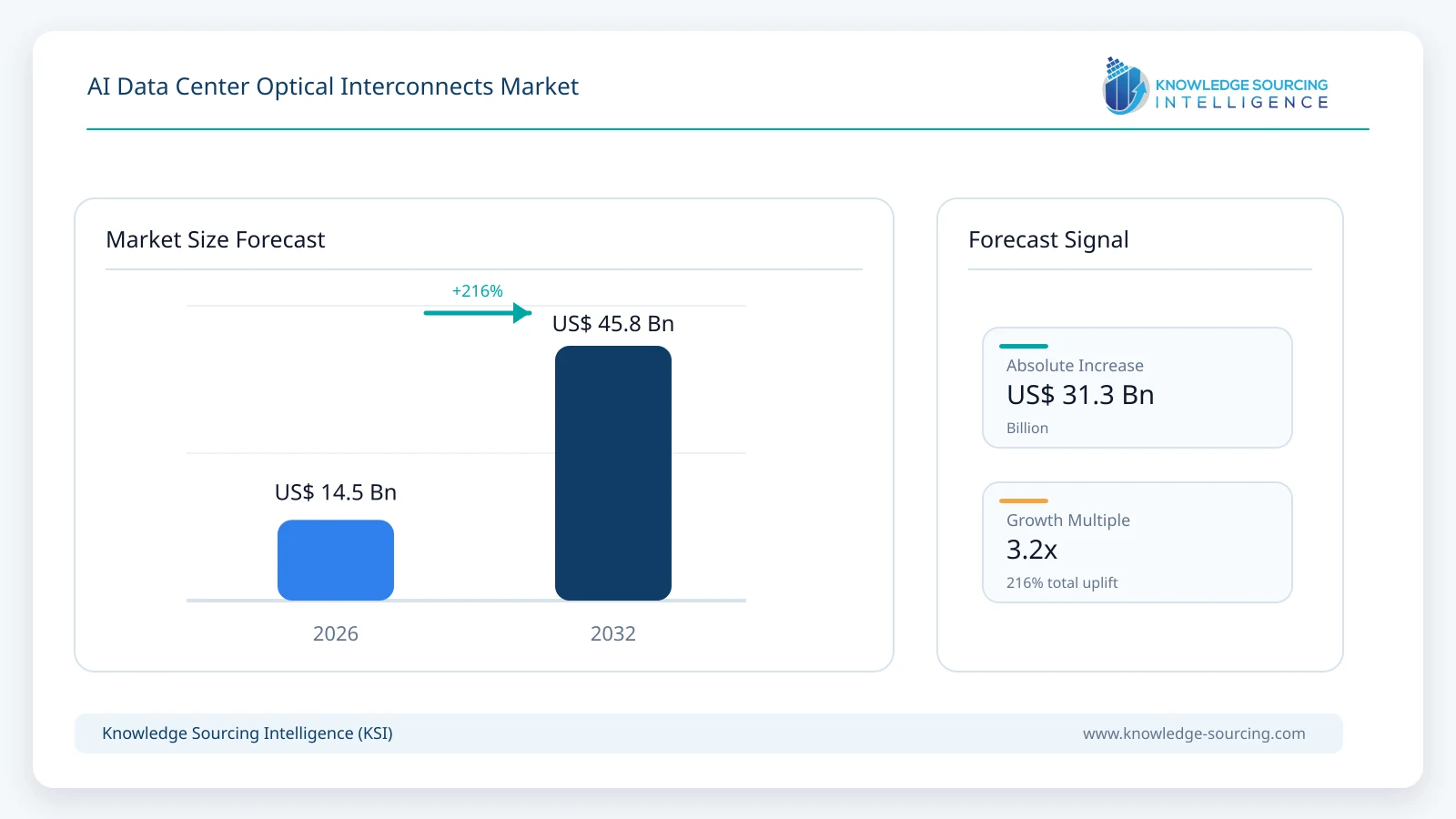
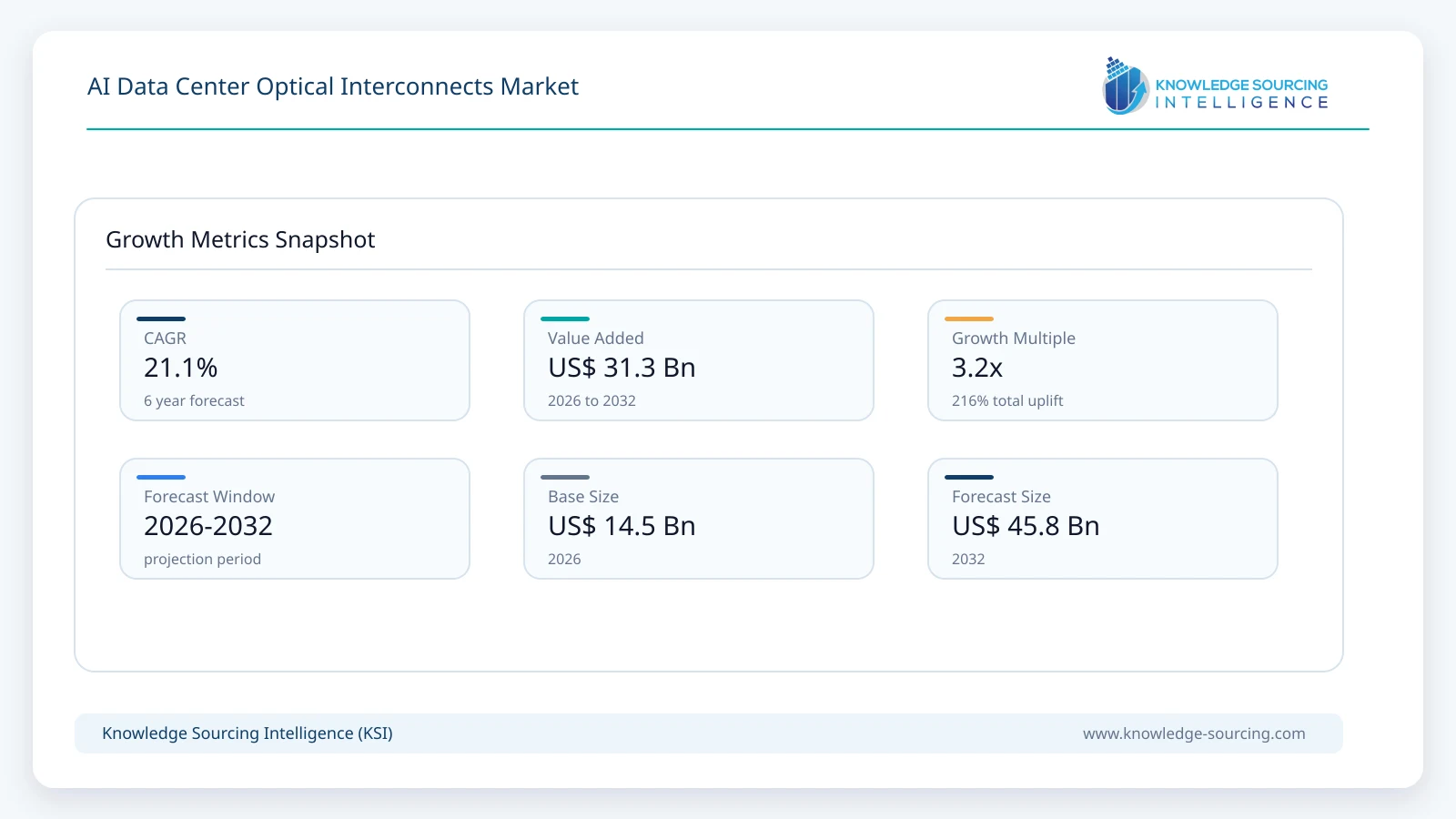
The AI Data Center Optical Interconnects Market is estimated at USD 14.5 billion in 2026 and is projected to reach USD 45.8 billion by 2032, representing a CAGR of 21.1% during 2026-2032.
Key Highlights
· 800G remains the largest 2026 optical interconnect speed across AI scale-out networks.
· 1.6T modules are entering broad deployment as 102.4T switching platforms scale globally.
· 3.2T optical links move from demonstrations toward commercialization after 2028.
· Linear and transmit-retimed optics reduce module power across dense AI fabrics.
· Coherent-lite creates a new optical tier for two-to-twenty-kilometre campus links.
· Scale-out networking remains the largest revenue pool across accelerator clusters worldwide.
· Scale-up optical links grow fastest as copper reach shortens at higher speeds.
· North America leads demand through hyperscaler, neocloud and sovereign AI investment.
· Asian suppliers remain critical to transceiver assembly, lasers and module manufacturing capacity.
· Broadcom and Marvell are moving optical DSPs toward 400G-per-lane architectures.
· Cisco is commercializing 1.6T OSFP and lower-power 800G linear pluggable optics.
· NVIDIA Spectrum-X Photonics production signals deeper optical integration inside AI factories.
Market Overview
Optical connectivity has become one of the main physical limits on AI cluster scale. Accelerators exchange gradients, parameters, activations, checkpoint data and inference traffic across networks that must preserve high throughput with predictable latency. As the number of accelerators increases, the aggregate bandwidth attached to each switch rises faster than conventional electrical channels can extend across boards, racks and buildings. Fiber therefore moves progressively closer to compute, while link speeds transition from 400G and 800G toward 1.6T and later 3.2T. The result is not a single optical architecture but a hierarchy of interconnect products optimized around distance, power, serviceability and bandwidth density.
Pluggable transceivers remain the commercial center of the market in 2026 because they combine field replaceability, multi-vendor procurement and established operational practices. Cisco's February 2026 portfolio illustrates this transition: 1.6T OSFP optics are positioned for switch-to-network-interface-card and switch-to-server links, while 800G Linear Pluggable Optics (LPO) target lower power consumption in AI scale-out fabrics. Lumentum is commercializing 1.6T 2xDR4 OSFP modules with reaches up to 500 metres, and Marvell's Ara and Nova platforms support 1.6T module ecosystems across Ethernet and InfiniBand architectures.
The market is also extending beyond ordinary intra-building pluggables. Coherent-lite architectures address roughly 2 to 20 kilometre links between buildings on large AI campuses, creating an intermediate class between short-reach PAM4 modules and conventional coherent data center interconnect. Ciena and Marvell are both developing this layer around 800G and 1.6T. Longer scale-across connections increasingly use 800G and 1.6T coherent pluggables to connect multiple AI sites as one distributed computing environment. This broadening of optical reach increases optical content per AI campus even as cost per transmitted bit declines.
Market Drivers
AI fabrics are moving from 800G toward 1.6T and 3.2T
AI scale-out networks are entering a major bandwidth transition. Broadcom's 400G-per-lane Taurus optical DSP is designed to support 1.6T pluggables while establishing the physical layer for future 3.2T modules. Marvell is similarly extending from 200G-per-lane 1.6T products toward 400G-per-lane technologies, while Coherent has demonstrated 3.2T pluggable architectures using eight 425G PAM4 optical lanes. Higher bandwidth increases optical revenue through new module generations, denser switch configurations and replacement of lower-speed links, although improving semiconductor integration and manufacturing yields gradually reduce cost per bit.
Optical links are expanding into scale-up and campus networks
Scale-out Ethernet and InfiniBand remain the largest optical link domains, but AI architectures are adding optical connectivity in new locations. Copper becomes increasingly difficult to use as tightly coupled accelerator domains span more racks and lane speeds rise. At the same time, large AI campuses require high-capacity links between buildings that are too long for ordinary short-reach direct-detect optics but do not always need metro-class coherent systems. Coherent-lite and emerging near-package optical approaches expand the addressable market by moving fiber into both shorter and longer portions of the AI network.
Power per bit is driving new pluggable architectures
Networking power is becoming economically important because every watt consumed by transceivers and switching infrastructure reduces the facility power available for accelerators. Cisco states that its 800G LPO architecture can reduce optical-module power by 50% compared with retimed optics, while Marvell's transmit-retimed approach removes selected receive-side DSP functions to lower module power. These architectures do not displace retimed pluggables in every application because link margin, diagnostics and interoperability still matter, but they create an additional revenue pool where operators prioritize power efficiency.
Manufacturing capacity is scaling with AI optical demand
Optical supply chains are expanding to support much larger AI deployments. NVIDIA and Corning announced a multiyear partnership in May 2026 under which Corning plans to increase U.S. optical-connectivity manufacturing capacity tenfold and fiber production capacity by more than 50%. Component and module suppliers are also adding capacity across lasers, photonic devices, packaging and transceiver assembly. These investments improve availability for hyperscale deployments and reduce one of the principal constraints that limited rapid transitions to earlier optical generations.
Restraints and Adoption Challenges
Rapid product transitions create both technical and commercial risk. Operators must qualify 800G, 1.6T and later 3.2T modules across different switch ASICs, network-interface cards, fiber plants and thermal environments while maintaining multi-vendor interoperability. Higher-speed optics can also introduce tighter link budgets, thermal constraints and connector-cleanliness requirements. Average selling prices decline as each generation scales, limiting revenue growth even when shipped bandwidth rises faster. A second structural challenge is architectural substitution: linear pluggables, transmit-retimed optics, co-packaged optics and optical I/O compete for selected link classes, making it difficult for suppliers to assume that every high-speed connection will retain the same module architecture through 2032.
Segment Analysis
By Data Rate
800G represents the largest revenue pool in 2026 because it is widely deployed across current AI scale-out fabrics and is supported by a mature supplier ecosystem. 1.6T is the fastest-growing speed class through the first half of the forecast period. Cisco, Marvell, Broadcom, Coherent and Lumentum all have 1.6T product roadmaps or commercial products, while 102.4-terabit-per-second switch platforms increase the number of 1.6T ports available per system. 3.2T remains an emerging category in 2026 but becomes increasingly relevant after 2028 as 400G-per-lane electrical and optical interfaces mature.
By Network Role
AI scale-out remains the largest network role because every accelerator cluster requires high-bandwidth switch-to-switch and switch-to-network-interface connectivity. Scale-up optical interconnect is expected to record the fastest growth from a smaller base as tightly coupled compute domains extend beyond copper's practical reach. Scale-across connectivity also expands as operators distribute AI capacity across multiple campus buildings or separate sites and need coherent or coherent-lite links that preserve bandwidth and operational simplicity.
Segment | 2026 Position | Growth Direction | Primary Demand Logic |
800G pluggable optics | Largest speed class | Strong | Current AI scale-out deployments and broad switch support |
1.6T pluggable optics | Early volume ramp | Fastest through 2030 | 102.4T switches, 200G-per-lane electrical interfaces |
3.2T optics | Pre-commercial / demonstration | Accelerates after 2028 | 400G-per-lane interfaces and 204.8T switching |
Scale-out links | Largest network role | Strong | Switch-to-switch and switch-to-NIC accelerator fabrics |
Scale-up optical links | Smaller 2026 base | Fastest network role | Copper reach limitations across larger accelerator domains |
Scale-across / DCI | Established high-value niche | Expanding | Campus and multi-site AI infrastructure |
Technology and Adoption Indicators
Indicator | 2026 Evidence | Market Relevance |
Cisco 1.6T optics | 1.6T OSFP introduced for AI scale-out | Confirms transition from 800G into mainstream 1.6T deployments |
Cisco 800G LPO | LPO positioned at 50% lower module power than retimed optics | Creates lower-power pluggable alternative for dense fabrics |
Broadcom 400G/lane DSP | 3nm Taurus supports 1.6T and future 3.2T modules | Establishes physical-layer path toward 3.2T connectivity |
Marvell 1.6T portfolio | Expanded 1.6T DSP family and 2nm optical roadmap | Broadens Ethernet, InfiniBand and coherent interconnect options |
Coherent 3.2T demo | 3.2T OSFP-size architecture demonstrated at ECOC 2026 | Shows 400G-per-lane links moving toward productization |
NVIDIA Spectrum-X Photonics | CPO-based Ethernet Photonics entered production with Vera Rubin | Signals deeper optical integration at AI-factory scale |
Corning capacity expansion | NVIDIA partnership targets 10x U.S. optical-connectivity capacity | Demonstrates supply-chain investment behind AI optical growth |
Regional Opportunity
North America
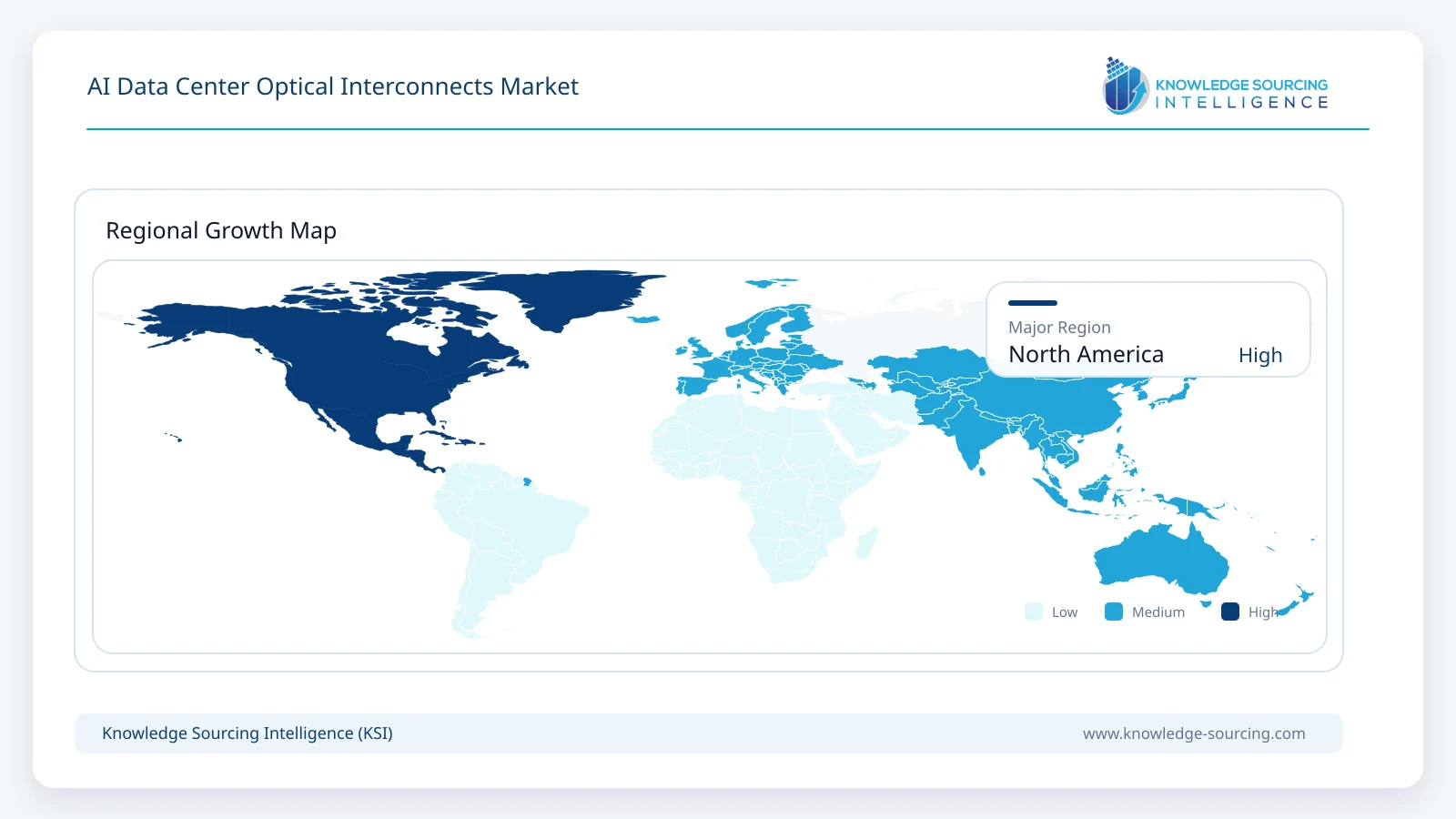
North America is the largest demand center for AI data center optical interconnects because the region contains the highest concentration of hyperscale cloud providers, neocloud operators, frontier-model developers and networking-platform suppliers. The United States is also where the transition to 1.6T is becoming commercially visible across multiple architectures. Cisco is introducing 1.6T OSFP modules and 800G LPO alongside its 102.4T switching systems, NVIDIA is ramping Spectrum-X Ethernet Photonics with Vera Rubin, and major optical suppliers including Coherent, Lumentum, Marvell and Broadcom are aligning new product generations with U.S.-led AI infrastructure deployments.
Demand is broadening from links inside a single data hall to campus and multi-site connectivity. Large AI campuses increasingly comprise several buildings, creating a need for coherent-lite and high-density optical links across intermediate reaches. Separately, distributed AI infrastructure and capacity constraints encourage scale-across networking between sites. This supports both short-reach PAM4 optics and higher-value coherent pluggables within the same customer base. The region therefore has unusually high optical content per deployed megawatt because AI clusters require dense east-west connectivity in addition to conventional front-end networking.
Supply-chain localization is also becoming important. NVIDIA and Corning's 2026 agreement includes a tenfold expansion of U.S. optical-connectivity manufacturing capacity and more than 50% additional U.S. fiber-production capacity. This does not eliminate Asia's central role in module assembly and photonic-device manufacturing, but it reduces regional supply risk for some hyperscale programs. Through 2032, North American market growth is expected to be led by 1.6T scale-out deployments, lower-power pluggable architectures, campus coherent-lite links and the gradual introduction of optical scale-up connectivity.
Asia Pacific remains the principal manufacturing ecosystem for many transceivers, lasers, packaging operations and electronics assembly, with China, Taiwan, Japan, Malaysia and other regional hubs contributing to global supply. Europe participates through optical equipment, coherent transport and sovereign or hyperscale data-center demand. The Middle East is becoming an important deployment region for large greenfield AI campuses, where new facilities can adopt 1.6T and later optical architectures without a large installed base of older network equipment.
Competitive Landscape
Competition spans networking-system companies, optical-component specialists, photonic-device suppliers and module manufacturers. Cisco, NVIDIA and Broadcom influence optical architecture through switching platforms and tightly integrated AI networking systems. Marvell supplies optical DSPs, drivers, transimpedance amplifiers and coherent technology used by a broad module ecosystem. Coherent and Lumentum participate across lasers, photonic devices and complete datacom transceivers, while Ciena has a strong position in coherent and scale-across connectivity. Arista Networks remains an important system-level buyer and integrator of pluggable optics across large Ethernet fabrics.
Manufacturing and component depth also matter. Innolight and Eoptolink are major high-speed optical-module suppliers, Fabrinet provides advanced optical manufacturing services, Corning supplies fiber and high-density connectivity, and Intel participates through silicon photonics and optical compute interconnect technology. TSMC is increasingly relevant through advanced photonics and packaging platforms that support integrated optics. Competitive advantage depends on power per bit, qualification with leading switch and accelerator platforms, manufacturing yield, thermal performance, module availability and the ability to support multiple architectural paths as retimed, linear, coherent-lite and integrated optics coexist.
Major companies and ecosystem participants covered: Cisco, NVIDIA, Broadcom, Marvell Technology, Coherent, Lumentum, Ciena, Arista Networks, Innolight, Eoptolink Technology, Fabrinet, Corning, Intel, TSMC and Accelink Technologies.
Recent Developments
· September 2026: Marvell demonstrated 2nm 400G-per-lane optical technology designed to enable 3.2T data-center connectivity.
· September 2026: Coherent demonstrated a 3.2T OSFP-size transceiver architecture and a 6.4T near-packaged optical engine.
· May 2026: NVIDIA announced Spectrum-X Ethernet Photonics had entered production with the Vera Rubin AI platform.
· May 2026: NVIDIA and Corning announced a multiyear partnership targeting a tenfold increase in U.S. optical-connectivity manufacturing capacity.
· March 2026: Lumentum demonstrated 1.6T DR4 optics using 400G electro-absorption-modulated lasers for next-generation AI data centers.
· March 2026: Marvell expanded its 1.6T optical DSP portfolio for scale-out, front-end and campus AI connectivity.
· March 2026: Broadcom introduced a 400G-per-lane optical DSP supporting 1.6T modules and future 3.2T transceivers.
· February 2026: Cisco introduced 1.6T OSFP optics and 800G Linear Pluggable Optics for high-density AI scale-out networks.
AI Data Center Optical Interconnects Market Scope:
| Report Metric | Details |
|---|---|
| Total Market Size in 2026 | USD 14.5 billion |
| Total Market Size in 2032 | USD 45.8 billion |
| Forecast Unit | USD Billion |
| Growth Rate | 21.1% |
| Study Period | 2021 to 2032 |
| Historical Data | 2021 to 2024 |
| Base Year | 2025 |
| Forecast Period | 2026 – 2032 |
| Segmentation | Interconnect Product, Data Rate, Network Role, Reach, Customer Type, Geography |
| Companies |
|
Market Segmentation
By Interconnect Product
Retimed Pluggable Transceivers
Linear Pluggable Optics
Transmit-Retimed Optical Modules
Active Optical Cables and Specialized Short-Reach Links
Coherent-Lite Pluggable Optics
Coherent Data Center Interconnect Modules
By Data Rate
400G
800G
1.6T
3.2T and Higher
By Network Role
AI Scale-Out Networking
AI Scale-Up Networking
Campus / Scale-Across Connectivity
Data Center Interconnect
By Reach
Under 100 Metres
100-500 Metres
500 Metres-2 Kilometres
2-20 Kilometres
Above 20 Kilometres
By Customer Type
Hyperscale Cloud Providers
Neocloud and GPU-Cloud Operators
Colocation Providers
Sovereign AI Infrastructure
Enterprise and High-Performance Computing
By Geography
North America
United States
Canada
Europe
Asia Pacific
Middle East and Rest of World
Table of Contents
1. EXECUTIVE SUMMARY
1.1. Market Opportunity and Key Findings
1.2. Optical Interconnect Transition Timeline
1.3. Principal Revenue Pools
2. MARKET OVERVIEW
2.1. AI Data Movement and Network Bandwidth Requirements
2.2. Evolution from 400G and 800G to 1.6T and 3.2T
2.3. Pluggable, Linear and Coherent Optical Architectures
2.4. Scale-Up, Scale-Out and Scale-Across Connectivity
3. MARKET SIZE AND FORECAST, 2026-2032
3.1. Global Market Revenue
3.2. Annual Growth Analysis
3.3. Revenue by Link Bandwidth
3.4. Revenue by Network Role
4. MARKET BY INTERCONNECT PRODUCT
4.1. Retimed Pluggable Transceivers
4.2. Linear Pluggable Optics
4.3. Transmit-Retimed Optical Modules
4.4. Active Optical Cables and Specialized Short-Reach Links
4.5. Coherent-Lite Pluggable Optics
4.6. Coherent Data Center Interconnect Modules
5. MARKET BY DATA RATE
5.1. 400G
5.2. 800G
5.3. 1.6T
5.4. 3.2T and Higher
6. MARKET BY NETWORK ROLE
6.1. AI Scale-Out Networking
6.2. AI Scale-Up Networking
6.3. Campus / Scale-Across Connectivity
6.4. Data Center Interconnect
7. MARKET BY REACH
7.1. Under 100 Metres
7.2. 100-500 Metres
7.3. 500 Metres-2 Kilometres
7.4. 2-20 Kilometres
7.5. Above 20 Kilometres
8. MARKET BY CUSTOMER TYPE
8.1. Hyperscale Cloud Providers
8.2. Neocloud and GPU-Cloud Operators
8.3. Colocation Providers
8.4. Sovereign AI Infrastructure
8.5. Enterprise and High-Performance Computing
9. REGIONAL MARKET
9.1. North America
9.1.1. United States
9.1.2. Canada
9.2. Europe
9.3. Asia Pacific
9.4. Middle East and Rest of World
10. MARKET DYNAMICS
10.1. Drivers
10.1.1. 800G-to-1.6T Network Transition
10.1.2. Optical Expansion into Scale-Up and Campus Networks
10.1.3. Power-per-Bit Reduction
10.1.4. AI Optical Manufacturing Expansion
10.2. Restraints
10.2.1. Rapid Generation Transitions and Qualification Risk
10.2.2. Falling Cost per Bit and ASP Pressure
10.2.3. Interoperability and Link-Budget Complexity
10.2.4. Architectural Competition from Integrated Optics
11. COMPETITIVE LANDSCAPE
11.1. Value Chain
11.2. Networking and Switching Platforms
11.3. Optical DSP and Semiconductor Suppliers
11.4. Transceiver and Module Manufacturers
11.5. Coherent and Campus Interconnect Suppliers
11.6. Fiber, Connectivity and Manufacturing Ecosystem
12. COMPANY PROFILES
12.1. Cisco
12.2. NVIDIA
12.3. Broadcom
12.4. Marvell Technology
12.5. Coherent
12.6. Lumentum
12.7. Ciena
12.8. Arista Networks
12.9. Innolight
12.10. Eoptolink Technology
12.11. Fabrinet
12.12. Corning
12.13. Intel
12.14. TSMC
12.15. Accelink Technologies
13. RECENT DEVELOPMENTS
14. APPENDIX
14.1. Definitions and Abbreviations
14.2. Optical Interconnect Architecture Classification
14.3. Link-Speed and Reach Classification
14.4. Source and Data Notes
Navigate
Trusted by the world's leading organizations











