
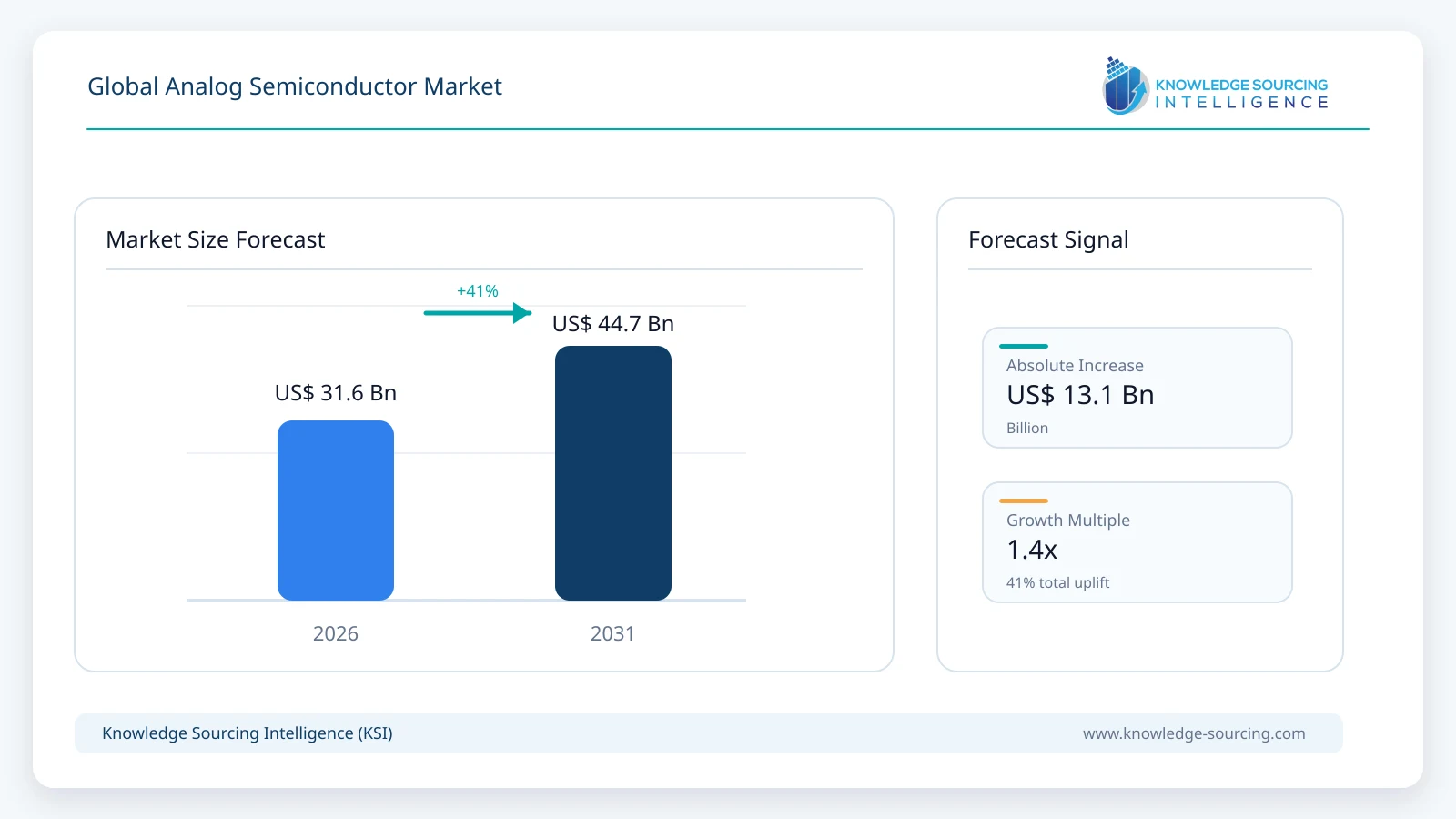
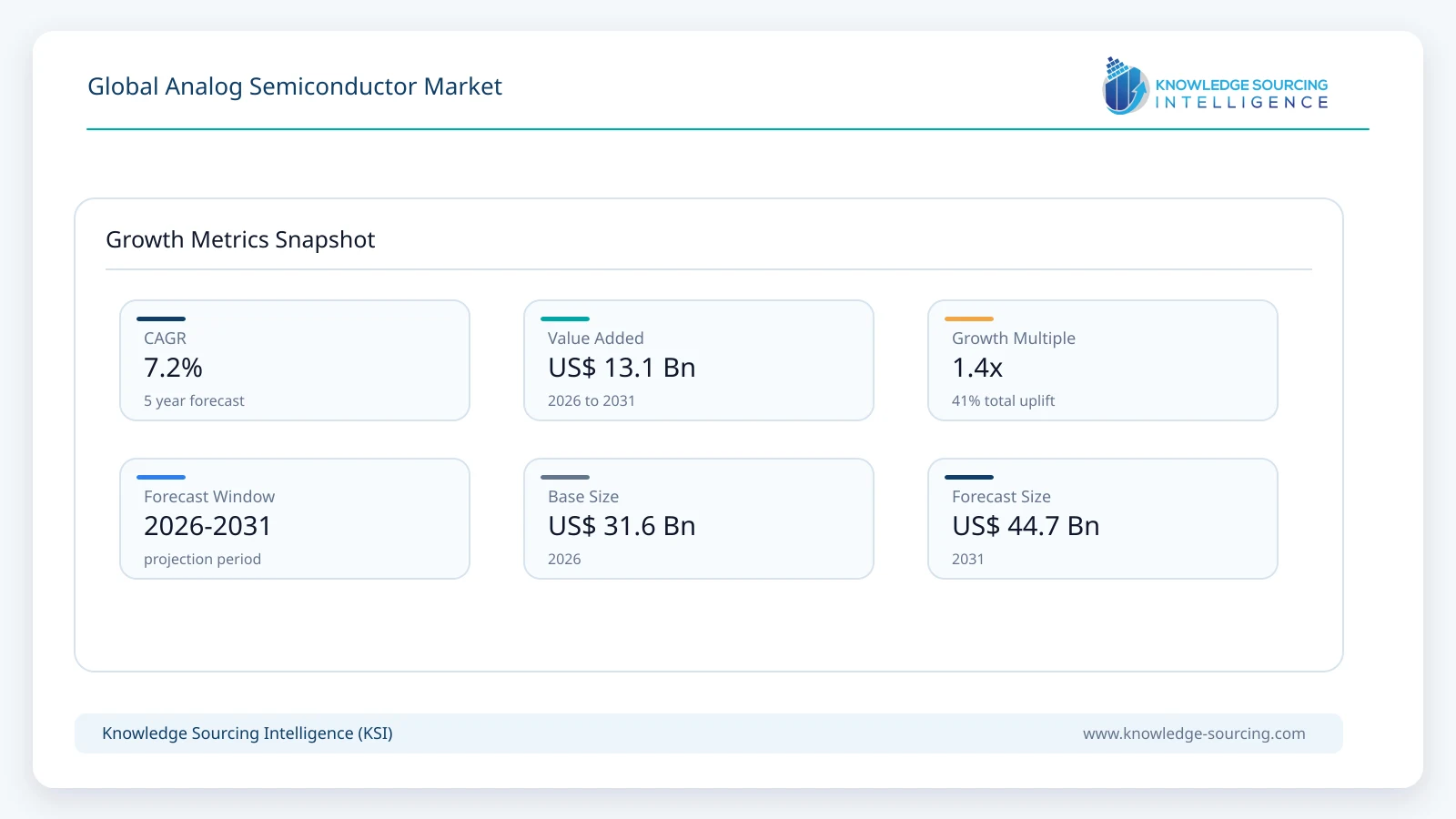
Global Analog Semiconductor Market for Communication Industry is forecast to grow at a CAGR of 7.2%, reaching USD 44.7 billion in 2031 from USD 31.6 billion in 2026.
Highlights:
- 1Power-efficient analog ICs remain essential for next-generation wired and wireless communication infrastructure.
- 25G expansion, fiber-optic networks, and satellite connectivity continue to diversify analog semiconductor demand.
- 3Buyers increasingly prioritize signal integrity, power efficiency, RF performance, and long product lifecycles.
- 4Manufacturing resilience, advanced process technologies, and supply security influence supplier selection decisions.
- 5Communications equipment manufacturers increasingly require highly integrated analog solutions to reduce system complexity.
Power management devices, RF front-end components, signal chain ICs, data converters, and interface circuits enable wireless transmission, optical networking, satellite communications, enterprise networking, and broadband infrastructure. While digital processors receive considerable market attention, communication equipment performance continues to depend heavily on analog precision, noise reduction, power efficiency, and radio-frequency performance.
Demand is increasingly linked to network modernization rather than simple expansion. Telecommunications operators, hyperscale data center operators, broadband providers, defense communication agencies, and satellite network developers are investing in equipment capable of supporting higher bandwidth, lower latency, improved energy efficiency, and longer operational lifecycles. These purchasing decisions increasingly favor analog semiconductor suppliers capable of delivering integrated platforms rather than individual components. Company disclosures from Analog Devices, Texas Instruments, and Infineon consistently emphasize long product life, industrial-grade reliability, and broad product portfolios as important customer requirements.
Commercial value is distributed across multiple equipment layers. Base stations, optical transport equipment, routers, switches, customer premises equipment, satellite ground infrastructure, and data center networking each require specialized analog architectures with different performance priorities. Procurement decisions increasingly balance performance, power consumption, lifecycle support, software compatibility, and supply continuity rather than focusing exclusively on component pricing.
Supply conditions have become equally important. Semiconductor manufacturers continue investing in manufacturing resilience, diversified wafer sourcing, advanced packaging, and regional production capacity to address geopolitical uncertainty, export controls, and customer expectations for secure long-term supply. Communications customers increasingly incorporate supplier resilience into qualification processes alongside technical performance.
Key Market Indicators
Indicator | Latest Evidence | Commercial Meaning |
Analog Devices FY2025 revenue | US$11.0 billion | Demonstrates continued investment across analog semiconductor applications. |
Communications revenue exposure (Analog Devices FY2025) | Approximately 13% of company revenue | Communications remains an important end market despite diversification. |
Global mobile technology transition | Continued commercial 5G deployment and early 6G research | Sustains demand for higher-performance RF and signal-chain devices. |
Product portfolio breadth | Power management, RF ICs, data converters, amplifiers and signal-chain solutions | Broad portfolios improve supplier competitiveness in communication infrastructure. |
Market Drivers
Expansion of advanced wireless network infrastructure. Mobile network operators continue upgrading macro base stations, small cells, and Open RAN deployments to increase spectrum efficiency and network capacity. These upgrades require higher-performance RF analog components, precision clocking, power management ICs, and high-speed data converters capable of supporting complex radio architectures. Semiconductor suppliers have responded by expanding integrated RF and mixed-signal portfolios that simplify radio design while improving power efficiency. Communications infrastructure therefore continues to generate sustained replacement demand rather than depending solely on new network construction.
Growing deployment of optical networking and hyperscale data center connectivity. Cloud providers and telecommunications carriers continue expanding fiber transport capacity to accommodate increasing traffic volumes generated by AI workloads, enterprise connectivity, and content delivery. Optical modules, coherent optical systems, network switches, and routing platforms require precision analog front ends, clock synchronization, interface ICs, and power management solutions to maintain signal quality at higher transmission speeds. Equipment manufacturers increasingly prefer integrated analog solutions that reduce board space, thermal load, and overall system complexity while supporting higher bandwidth requirements.
Increasing investment in satellite communications and resilient network infrastructure. Low Earth orbit satellite constellations, government communications modernization programs, and defense networking initiatives are expanding demand for RF analog components capable of operating under demanding environmental conditions. Satellite payloads, gateway stations, phased-array antennas, and ground communication systems require highly reliable power management, signal conditioning, and frequency conversion technologies. Long qualification cycles and stringent reliability standards also favor suppliers with established engineering support, manufacturing consistency, and proven product lifecycles, strengthening competitive positions for experienced analog semiconductor manufacturers.
Market Restraints and Challenges
Complex qualification requirements extend commercialization timelines. Communications infrastructure equipment typically remains operational for many years, making component qualification considerably more demanding than in consumer electronics. Equipment manufacturers require extensive reliability validation, electromagnetic compatibility testing, thermal characterization, and interoperability verification before approving new analog components. Multiple semiconductor suppliers acknowledge that communications customers prioritize long-term availability and product stability, extending design cycles and delaying revenue realization despite strong technology development.
Geopolitical trade restrictions and supply-chain concentration increase operational uncertainty. Export controls affecting advanced semiconductor technologies, regional manufacturing concentration, and customer requirements for supply continuity have increased procurement complexity throughout the communications equipment value chain. Large analog semiconductor manufacturers continue diversifying manufacturing locations and strengthening supply-chain resilience to reduce disruption risks. However, establishing qualified production capacity requires substantial capital investment and lengthy certification processes, limiting rapid supply adjustments when regional trade conditions change.
Advanced manufacturing requirements raise production costs and capacity planning risks. High-performance analog semiconductors for communication systems require process technologies optimized for precision, low noise, high-frequency operation, and long-term reliability rather than simple transistor scaling. Mixed-signal manufacturing also depends on specialized wafer processes, advanced packaging, and rigorous production control. Texas Instruments, STMicroelectronics, and Infineon have continued investing in additional fabrication capacity and manufacturing modernization to strengthen long-term supply, but these investments involve multi-year implementation periods and high capital commitments. As a result, suppliers must balance customer demand with capacity utilization while avoiding excess manufacturing costs during cyclical downturns.
Major Segment Analysis
RF Analog Components
RF Analog Components represent a commercially important product segment because they directly determine signal transmission quality, spectrum efficiency, receiver sensitivity, and power consumption across modern communication infrastructure. Cellular base stations, wireless networking equipment, satellite communication systems, and advanced radio architectures require highly integrated amplifiers, filters, switches, mixers, and frequency conversion devices capable of supporting increasingly complex frequency bands. Buyers generally evaluate RF components on linearity, power efficiency, thermal performance, reliability, and compatibility with evolving communication standards rather than on component cost alone.
Demand also benefits from continuing migration toward multi-band radio platforms, massive MIMO deployments, and higher-frequency wireless technologies that require more sophisticated RF signal processing. Suppliers compete through portfolio breadth, application engineering support, long product availability, and proven performance under demanding operating conditions. Product qualification remains rigorous because communication equipment manufacturers seek to minimize redesign costs throughout long infrastructure replacement cycles. Consequently, engineering capability, manufacturing consistency, and close collaboration with original equipment manufacturers (OEMs) remain important competitive differentiators within this segment.
Regional Analysis
Region | Main Demand Signal | Principal Constraint |
Americas | 5G modernization, hyperscale data center investment, defense communications | Export controls and supply-chain diversification costs |
Europe, Middle East and Africa | Industrial communications, optical networking, broadband upgrades | Regulatory complexity and higher energy costs |
Asia Pacific | Electronics manufacturing, telecom infrastructure expansion, semiconductor production ecosystem | Geopolitical tensions and supply-chain concentration |
Americas
The United States remains the largest commercial market within the Americas because it combines advanced telecommunications infrastructure, hyperscale cloud investment, defense communication programs, and a strong domestic semiconductor industry. Broadband modernization, private wireless deployments, optical networking expansion, and AI-driven data center connectivity continue supporting procurement of high-performance analog semiconductors. Canada contributes through telecommunications investment and research activities, while Brazil represents an expanding communications infrastructure market driven by mobile broadband deployment. Regional buyers increasingly emphasize long-term supply assurance alongside technical performance, encouraging suppliers to expand domestic manufacturing and strengthen regional supply chains.
Europe, Middle East and Africa
Demand across Europe, the Middle East and Africa is supported by fiber broadband expansion, industrial networking, secure communication infrastructure, and continued investment in digital connectivity. Germany, France, the United Kingdom, and Italy account for a substantial share of regional communications equipment manufacturing and deployment activity. European semiconductor policy initiatives and investment programs seek to strengthen domestic semiconductor capabilities while reducing dependence on external manufacturing. Communications equipment suppliers operating across the region also face strict product quality, environmental, and cybersecurity requirements, increasing the importance of regulatory compliance throughout component qualification and procurement.
Asia Pacific
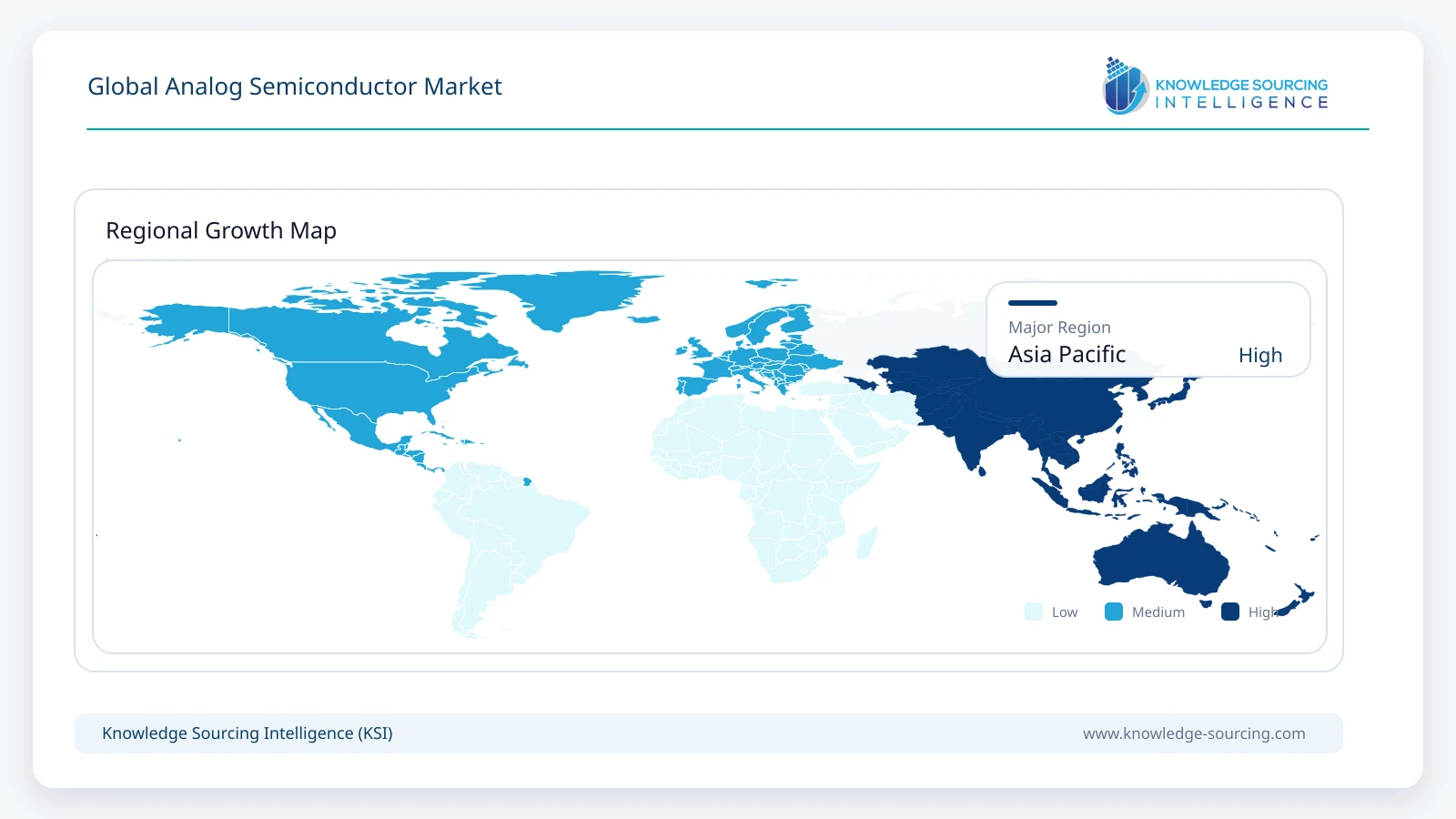
Asia Pacific represents the world's largest manufacturing ecosystem for communication equipment and semiconductor production. China, Japan, Taiwan, and India collectively support extensive telecommunications infrastructure investment, electronics manufacturing, semiconductor fabrication, and network equipment production. The region hosts a large concentration of original equipment manufacturers, contract manufacturers, foundries, and component suppliers, creating close integration between semiconductor production and communications equipment assembly. Government-backed semiconductor initiatives, continued deployment of advanced mobile networks, and expansion of optical communications infrastructure sustain long-term component demand. At the same time, geopolitical uncertainty and export restrictions continue encouraging supply-chain diversification and additional manufacturing investment across several Asia Pacific economies.
Competitive Landscape
Competition remains technology-driven and moderately concentrated, with established analog semiconductor suppliers competing through product breadth, manufacturing capability, application expertise, and long product support rather than price alone. Texas Instruments, Analog Devices, STMicroelectronics, Infineon Technologies, NXP Semiconductors, Renesas Electronics, and Microchip Technology maintain extensive analog portfolios serving multiple communication applications, allowing them to leverage engineering resources across diversified customer bases. RF-focused suppliers such as Qorvo, Skyworks Solutions, MACOM Technology Solutions, Semtech, Broadcom, and Qualcomm strengthen competition in wireless and high-frequency communication systems through specialized radio technologies and integrated connectivity solutions.
Competitive positioning increasingly depends on manufacturing resilience, secure wafer capacity, advanced packaging, and comprehensive customer support throughout lengthy equipment qualification cycles. Several suppliers continue expanding fabrication capacity, strengthening regional manufacturing footprints, increasing research and development expenditure, and broadening software and design-support ecosystems to address customer requirements for supply continuity, shorter development timelines, and higher system integration. Long product qualification periods and high switching costs also create meaningful barriers for new entrants, particularly in carrier-grade and mission-critical communications infrastructure.
Recent Developments
July 2026: Analog Devices completed its acquisition of Empower Semiconductor, adding integrated voltage regulator and silicon capacitor technologies that strengthen analog power delivery for AI networking, hyperscale infrastructure, optical communications, and telecom equipment.
July 2026: Infineon Technologies completed the acquisition of ams OSRAM's non-optical analog/mixed-signal sensor portfolio, expanding its analog sensing technologies for communications infrastructure, industrial networking, edge devices, and connected wireless systems.
July 2025: STMicroelectronics agreed to acquire part of NXP Semiconductors' MEMS sensor business for up to $950 million, strengthening its analog sensing portfolio for smartphones, wireless communication devices, IoT platforms, and industrial connectivity solutions.
March 2025: MaxLinear introduced its Keystone 1.6T PAM4 DSP family for optical transceivers, delivering advanced analog mixed-signal processing that enables next-generation AI clusters, cloud networking, and high-speed communications infrastructure.
Regulatory and Policy Environment
Government policies increasingly influence investment decisions across the communications analog semiconductor value chain. In the United States, the CHIPS and Science Act continues to support domestic semiconductor manufacturing, research, and workforce development, encouraging suppliers to expand fabrication capacity and reduce dependence on geographically concentrated production. Similar industrial policies across Europe aim to strengthen regional semiconductor capabilities through the European Chips Act, while also improving long-term supply resilience for critical communications infrastructure.
Across Asia Pacific, semiconductor strategies adopted by China, Japan, India, and Taiwan continue to support manufacturing investment, research collaboration, and supply-chain localization. Telecommunications regulations governing spectrum allocation, network security, electromagnetic compatibility, and equipment certification also shape product development priorities for analog semiconductor manufacturers. Export controls affecting advanced semiconductor technologies and manufacturing equipment have introduced additional compliance obligations for suppliers serving multinational communications equipment manufacturers. Consequently, companies increasingly incorporate regulatory planning, regional manufacturing diversification, and supply-chain risk management into long-term investment strategies.
Outlook and Strategic Implications
Demand during the 2026–2031 forecast period is expected to remain closely linked to modernization of global communications infrastructure rather than simple expansion of network coverage. Continued investment in 5G evolution, early 6G research, optical transport networks, hyperscale data center connectivity, satellite communications, and enterprise networking will sustain procurement of high-performance analog semiconductors that deliver higher bandwidth, lower power consumption, improved signal integrity, and extended operational reliability. Buyers are also expected to favor suppliers capable of supporting complete signal-chain solutions, long product lifecycles, and dependable technical support throughout equipment qualification.
Several structural factors will shape competitive performance over the forecast period:
Manufacturers will continue investing in regional production capacity, advanced packaging, and manufacturing automation to strengthen supply resilience.
Communications equipment OEMs are expected to increase demand for highly integrated analog platforms that simplify system design and reduce power consumption.
Network operators will prioritize equipment with lower operating costs, improved energy efficiency, and long-term component availability.
Technology providers and system integrators will increasingly value software-enabled design tools, reference platforms, and application engineering support alongside semiconductor performance.
Commercial success will therefore depend not only on component performance but also on manufacturing resilience, long-term supply assurance, application expertise, and the ability to support increasingly complex communication architectures across global infrastructure markets.
Market Scope:
| Report Metric | Details |
|---|---|
| Total Market Size in 2026 | USD 31.6 billion |
| Total Market Size in 2031 | USD 44.7 billion |
| Forecast Unit | Billion |
| Growth Rate | 7.2% |
| Study Period | 2021 to 2031 |
| Historical Data | 2021 to 2024 |
| Base Year | 2025 |
| Forecast Period | 2026 – 2031 |
| Segmentation | Type, Communication Technology, Application, Geography |
| Companies |
|
Market Segmentation
By Type
Power Management ICs
Signal Chain ICs
RF Analog Components
Data Converters
Interface ICs
By Communication Technology
Cellular Infrastructure
Optical Communications
Wireless Networking
Satellite Communication
By Application
Base Stations
Small Cells
Network Equipment
Optical Networking Equipment
Customer Premises Equipment (CPE)
Data Center Networking
Satellite Ground Stations
By Geography
Americas
USA
Canada
Brazil
Others
Europe Middle East and Africa
Germany
France
United Kingdom
Italy
Others
Asia Pacific
China
Japan
India
Taiwan
Others
Table of Contents
1. INTRODUCTION
1.1. Market Overview
1.2. Market Definition
1.3. Scope of the Study
1.4. Currency
1.5. Assumptions
1.6. Base and Forecast Years Timeline
2. RESEARCH METHODOLOGY
2.1. Research Design
2.2. Secondary Sources
3. EXECUTIVE SUMMARY
4. MARKET DYNAMICS
4.1. Market Segmentation
4.2. Market Drivers
4.3. Market Restraints
4.4. Market Opportunities
4.5. Porter’s Five Force Analysis
4.5.1. Bargaining Power of Suppliers
4.5.2. Bargaining Power of Buyers
4.5.3. Threat of New Entrants
4.5.4. Threat of Substitutes
4.5.5. Competitive Rivalry in the Industry
4.6. Life Cycle Analysis - Regional Snapshot
4.7. Market Attractiveness
5. GLOBAL ANALOG SEMICONDUCTOR MARKET FOR COMMUNICATIONS INDUSTRY BY TYPE
5.1. Power Management ICs
5.2. Signal Chain ICs
5.3. RF Analog Components
5.4. Data Converters
5.5. Interface ICs
6. GLOBAL ANALOG SEMICONDUCTOR MARKET FOR COMMUNICATIONS INDUSTRY BY COMMUNICATION TECHNOLOGY
6.1. Cellular Infrastructure
6.2. Optical Communications
6.3. Wireless Networking
6.4. Satellite Communication
7. GLOBAL ANALOG SEMICONDUCTOR MARKET FOR COMMUNICATIONS INDUSTRY BY APPLICATION
7.1. Base Stations
7.2. Small Cells
7.3. Network Equipment
7.4. Optical Networking Equipment
7.5. Customer Premises Equipment (CPE)
7.6. Data Center Networking
7.7. Satellite Ground Stations
8. GLOBAL ANALOG SEMICONDUCTOR MARKET FOR COMMUNICATIONS INDUSTRY BY GEOGRAPHY
8.1. Americas
8.1.1. USA
8.1.2. Canada
8.1.3. Brazil
8.1.4. Others
8.2. Europe Middle East and Africa
8.2.1. Germany
8.2.2. France
8.2.3. United Kingdom
8.2.4. Italy
8.2.5. Others
8.3. Asia Pacific
8.3.1. China
8.3.2. Japan
8.3.3. India
8.3.4. Taiwan
8.3.5. Others
9. COMPETITIVE INTELLIGENCE
9.1. Competitive Benchmarking and Analysis
9.2. Recent Investment and Deals
9.3. Strategies of Key Players
10. COMPANY PROFILES
10.1. Texas Instruments Incorporated
10.2. Analog Devices, Inc.
10.3. STMicroelectronics N.V.
10.4. Infineon Technologies AG
10.5. NXP Semiconductors N.V.
10.6. Skyworks Solutions, Inc.
10.7. onsemi
10.8. Microchip Technology Inc.
10.9. Renesas Electronics Corporation
10.10. Broadcom Inc.
10.11. Qorvo, Inc.
10.12. MACOM Technology Solutions Holdings, Inc.
10.13. Semtech Corporation
10.14. Qualcomm Technologies, Inc.
Navigate
Trusted by the world's leading organizations











