
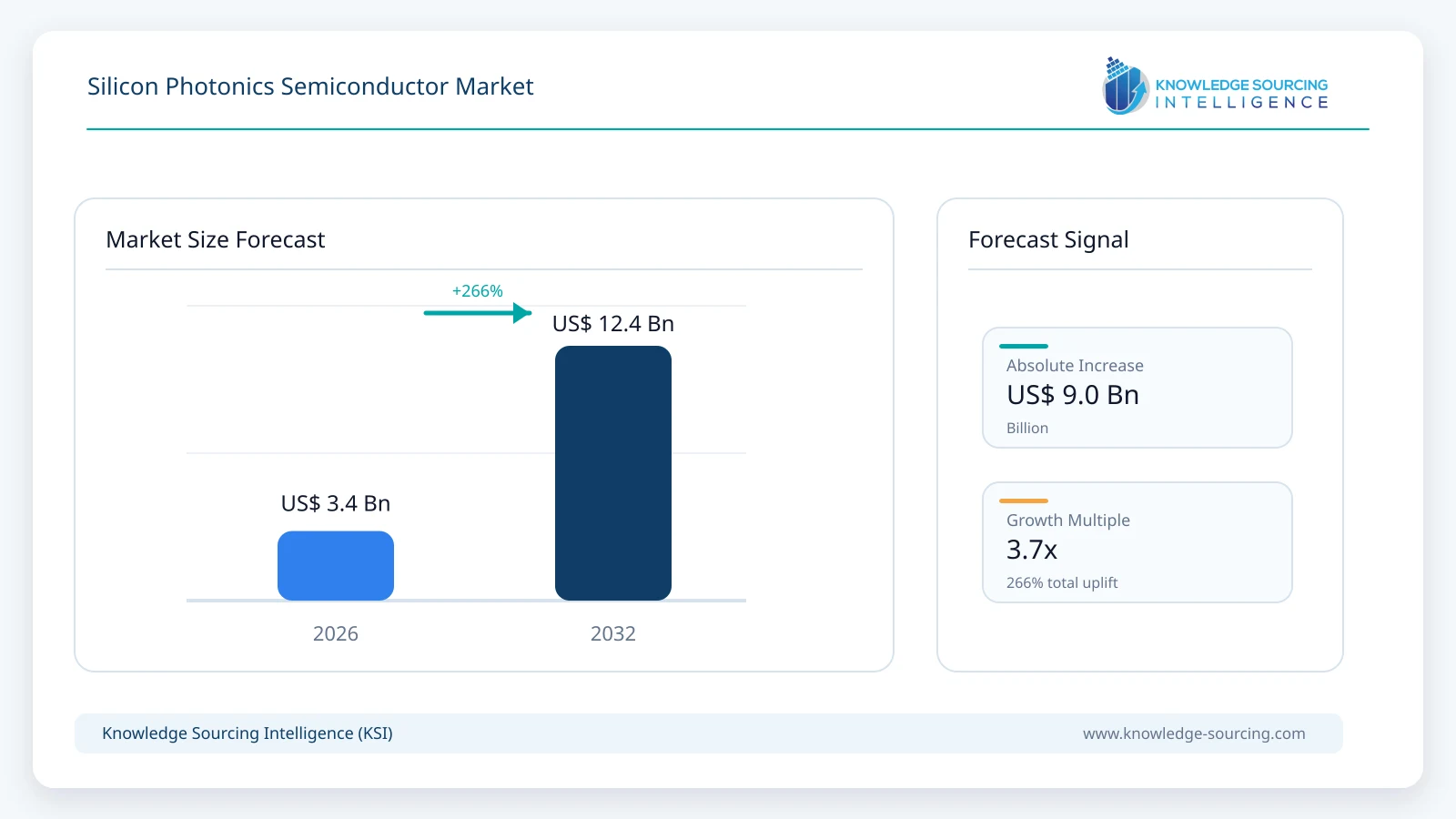
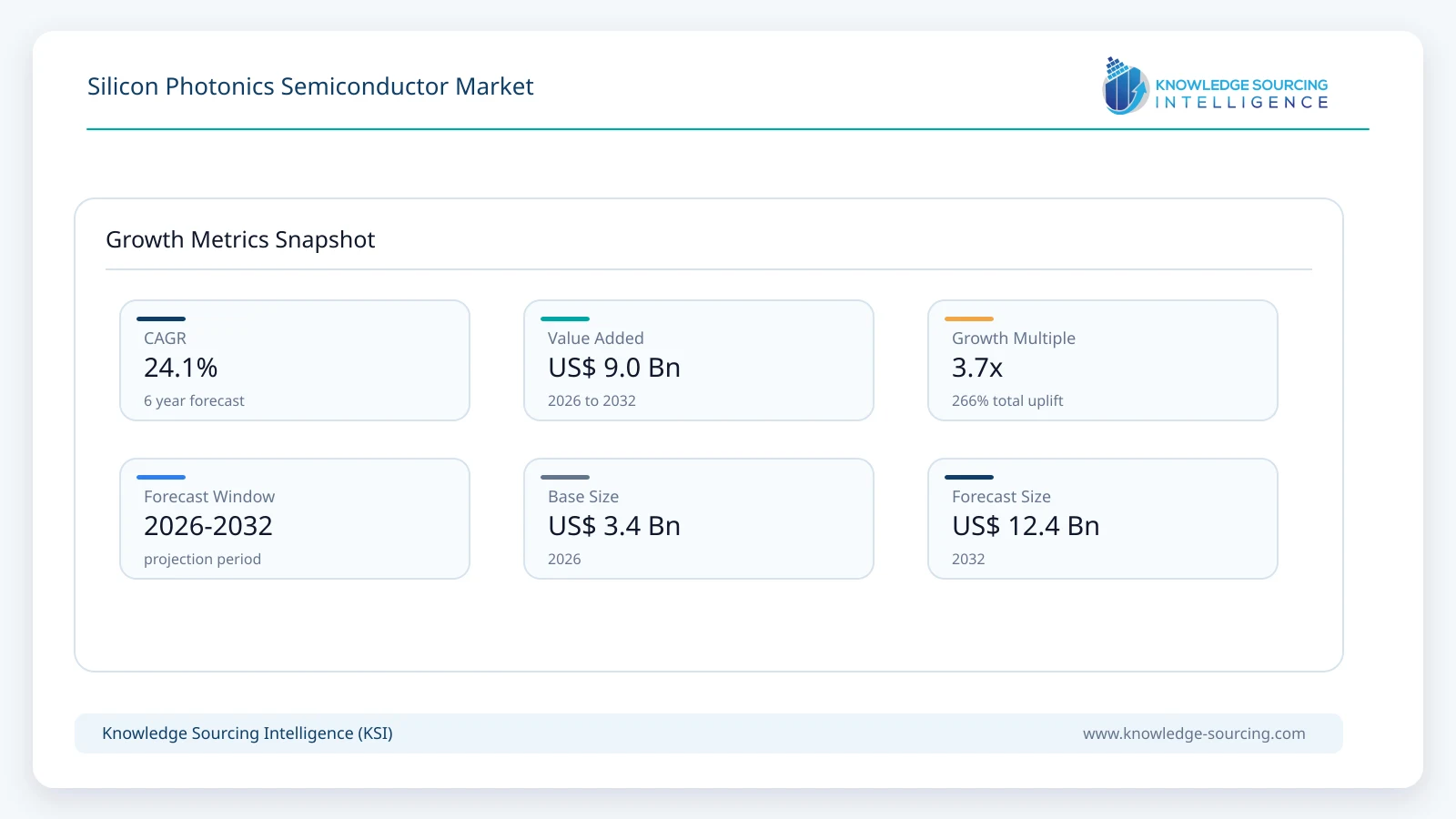
The Silicon Photonics Semiconductor Market is estimated at USD 3.40 billion in 2026 and is projected to reach USD 12.45 billion by 2032, representing a CAGR of 24.1% during 2026-2032.
Highlights:
- 1Silicon-photonics PICs for datacom and telecom represent the largest semiconductor revenue pool in 2026.
- 2Optical-I/O chiplets and co-packaged photonic engines are the fastest-growing device category through 2032.
- 3Tower Semiconductor has contracted USD 1.3 billion of silicon-photonics revenue for 2027.
- 4Intel has shipped more than eight million silicon-photonics PICs across its installed platform base.
- 5AI networking is moving photonic semiconductor content closer to switch and compute silicon.
Market Overview
Silicon photonics uses semiconductor fabrication to integrate optical functions on a silicon-compatible wafer platform. A typical PIC can include waveguides, modulators, photodiodes, multiplexers, couplers and thermal-control elements, while electronic driver and digital-signal-processing functions remain on separate or co-packaged CMOS dies. The economic advantage comes from integrating many optical functions on a wafer and leveraging mature lithography, process control and packaging infrastructure rather than assembling every optical function from discrete components.
Datacom and telecom remain the largest commercial base. Silicon-photonics PICs are embedded inside 400G, 800G and emerging 1.6T transceivers, but this study recognizes only the identifiable semiconductor-layer value rather than the entire module. The next growth phase moves the photonic die closer to the network or compute ASIC. GlobalFoundries SCALE, Intel OCI, Marvell light engines and other co-packaged or near-package architectures place the PIC beside high-bandwidth electronic silicon, reducing the length and power of electrical SerDes connections.
Foundry capability is becoming a critical competitive layer. Tower Semiconductor is reserving large blocks of 300 mm silicon-photonics capacity against signed customer commitments, GlobalFoundries offers qualified modulators and integrated photodiodes within a dedicated silicon-photonics platform, and imec continues to develop CMOS-compatible photonic integration and 3D optical-I/O architectures. This transition makes wafer yield, process design kits, known-good-die testing, laser integration and photonic packaging as important as raw modulator bandwidth.
Market Drivers
AI networking is moving optical conversion closer to compute
AI fabrics require substantially more bandwidth per accelerator generation, while high-speed electrical channels consume increasing power as reach extends across boards and racks. Silicon photonics allows optical conversion to occur closer to switch ASICs and processors, reducing long electrical traces and retiming requirements. Intel's OCI chiplet is designed to be co-packaged with CPUs, GPUs, IPUs and other systems-on-chip, while GlobalFoundries SCALE and Marvell's 1.6T light engine target AI scale-up architectures. This creates semiconductor demand beyond conventional front-panel transceiver PICs.
Foundry capacity is moving from pilot volumes into committed production
Silicon photonics is beginning to show manufacturing economics more typical of a semiconductor category than a specialist optical technology. Tower Semiconductor's USD 1.3 billion of contracted 2027 silicon-photonics revenue and higher 2028 wafer commitments provide unusually direct evidence of volume demand. The company is expanding 300 mm silicon-photonics capacity in Japan, while GlobalFoundries is also investing in photonics and advanced packaging. Greater foundry capacity reduces qualification risk and allows fabless optical-semiconductor companies to scale without building captive wafer fabs.
1.6T and 3.2T optical generations increase photonic integration density
Higher transceiver speeds require more optical lanes, faster modulators and denser wavelength-division multiplexing. Silicon photonics becomes more valuable as integration density rises because multiple modulators, detectors and routing elements can be fabricated on one PIC. Marvell's 1.6T light engine, GlobalFoundries' CWDM and DWDM SCALE architecture and Intel's integrated optical-I/O roadmap demonstrate how the same semiconductor platform can carry increasing aggregate bandwidth without proportionally increasing package area.
New end markets broaden silicon photonics beyond data communications
Datacom remains dominant, but silicon photonics is expanding into frequency-modulated continuous-wave LiDAR, photonic quantum computing, biosensing and emerging compute interconnects. Tower Semiconductor is positioning its platform across CPO, DWDM lasers, LiDAR and quantum computing, while its collaboration with Xanadu adapts high-volume silicon-photonics manufacturing to photonic quantum processors. These applications diversify foundry demand and support device-development revenue even where commercial volumes remain below datacom.
Restraints and Adoption Challenges
Silicon photonics still faces challenges in laser integration, fiber attachment, thermal control, test cost and heterogeneous packaging. Silicon is an inefficient light emitter, so many architectures require external lasers or bonded III-V materials, adding supply-chain and assembly complexity. Optical testing at wafer and die level is more difficult than conventional electrical test, while co-packaged optics can create serviceability concerns if a photonic die fails beside an expensive switch or compute ASIC. Competing indium-phosphide electro-absorption-modulated lasers and VCSELs remain strong in applications where discrete optical performance or cost is more important than integration density.
Segment Analysis
By Semiconductor Product
Datacom and telecom silicon-photonics PICs represent the largest revenue contribution in 2026 because they are already manufactured at scale for pluggable optical transceivers and coherent or short-reach optical systems. The PIC captures the integrated modulator, detector and routing value while the finished module adds lasers, drivers, DSPs, fiber interfaces and mechanical packaging that are excluded from this study.
Optical-I/O chiplets and co-packaged photonic engines are expected to grow fastest through 2032. Their 2026 base is smaller, but the category adds photonic semiconductor content directly beside network and compute silicon. Standalone modulators, photodetectors and specialized silicon-photonic dies remain important for custom platforms, while foundry wafer processing expands with every device class and provides one of the clearest indicators of true semiconductor-market growth.
Semiconductor Product | Revenue Contribution | Growth Direction | Primary Application |
Datacom / telecom silicon-photonics PICs | Largest | Strong | 400G, 800G, 1.6T and coherent optical modules |
Optical-I/O chiplets and CPO photonic engines | Growing | Fastest | AI scale-up, scale-out and processor-adjacent optical I/O |
Standalone modulators and photodetectors | Established | Strong | Custom optical modules and integrated photonic systems |
WDM and passive photonic ICs | Established | Very strong | Dense optical lane aggregation and routing |
Foundry wafer-processing value | High | Very strong | Volume manufacture of fabless and integrated photonic designs |
Semiconductor-level photonic packaging | Growing | Very fast | PIC/EIC integration, known-good-die and fiber-interface assembly |
Market and Technology Indicators
Indicator | Revenue Contribution | Market Impact |
Tower 2027 contracts | Tower Semiconductor signed USD 1.3 billion of silicon-photonics revenue contracts for 2027. | Provides direct evidence of foundry-scale commercial demand. |
Higher 2028 reservations | Tower reported 2028 customer wafer commitments substantially above 2027 levels. | Supports continued capacity expansion beyond one optical generation. |
Intel installed PIC base | Intel reports more than eight million silicon-photonics PICs shipped with more than 32 million on-chip lasers. | Demonstrates volume semiconductor manufacturing maturity. |
4 Tbps optical-I/O chiplet | Intel OCI provides 4 Tbps bidirectional optical connectivity with a roadmap to tens of Tbps. | Moves PIC value directly into processor and accelerator packaging. |
GlobalFoundries SCALE | GF launched an OCI-MSA-capable silicon-photonics CPO platform in May 2026. | Expands merchant foundry participation in AI optical I/O. |
1.6T light-engine commercialization | Marvell is commercializing a 1.6T silicon-photonics light engine for AI scale-up. | Raises PIC bandwidth density and semiconductor content per optical engine. |
Regional Opportunity
North America
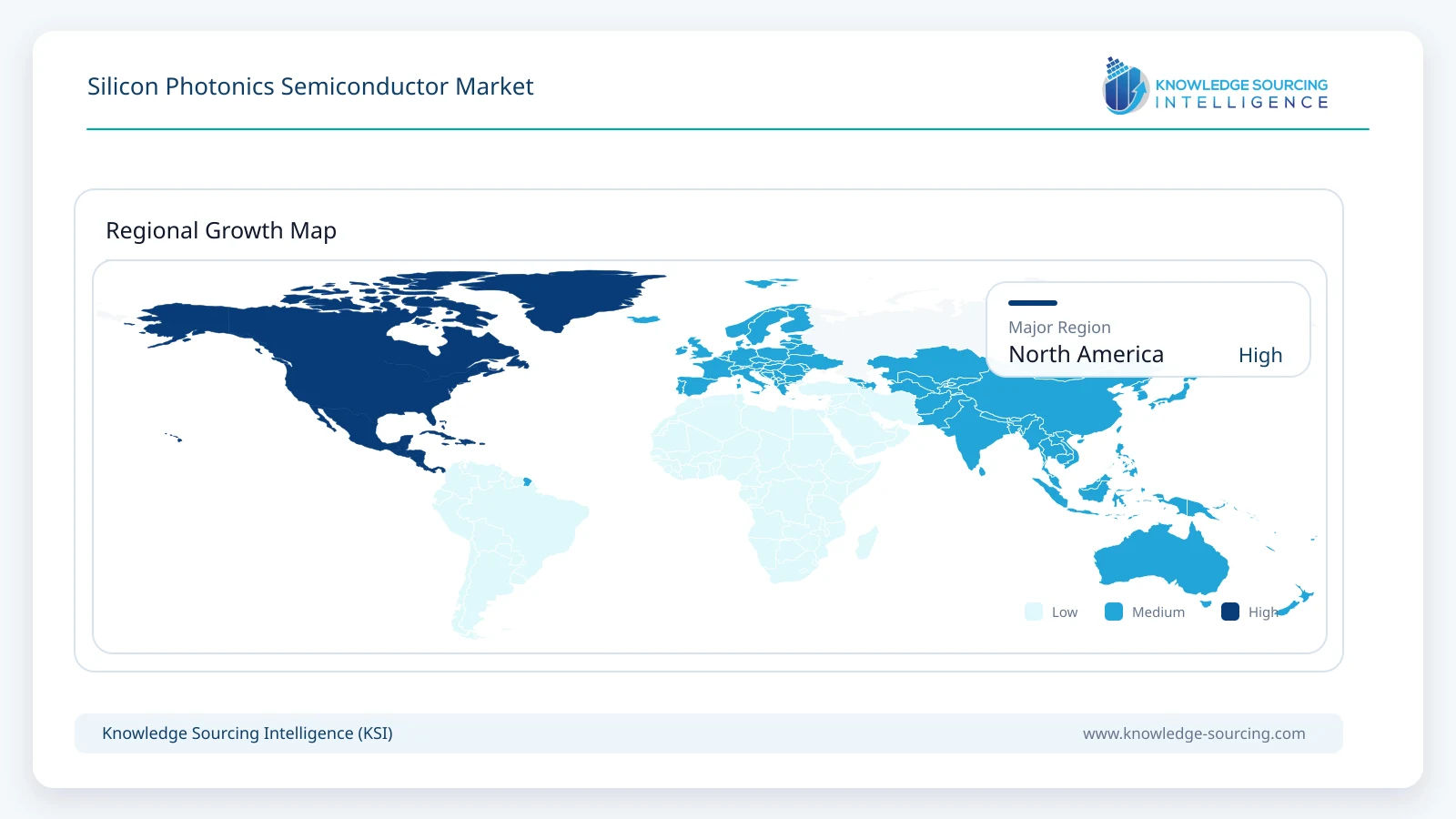
North America is the largest design and early-demand region for silicon-photonics semiconductors because the United States concentrates AI networking vendors, cloud operators, optical-semiconductor companies and leading merchant foundry activity. Intel, GlobalFoundries, Marvell, Broadcom, Cisco, Coherent, Lumentum, Lightmatter and Ayar Labs all participate in silicon-photonics or optical-I/O development, while hyperscale customers create rapid qualification paths for higher-bandwidth devices.
Foundry investment is particularly important. GlobalFoundries is expanding silicon-photonics technology, packaging and research in the United States and introduced SCALE in 2026 as a merchant co-packaged optical platform. Intel combines its own silicon-photonics manufacturing experience with more than eight million shipped PICs and is extending that platform into optical compute interconnect chiplets. These capabilities give the region a strong position in device architecture, process technology and early system integration even when portions of volume packaging occur elsewhere.
The commercial shift toward AI scale-up strengthens North American demand because photonic dies are moving from replaceable front-panel modules into higher-value network and compute packages. Marvell and Broadcom are integrating optical and electronic semiconductor roadmaps, while specialist companies such as Lightmatter and Ayar Labs are developing optical I/O for accelerator and memory architectures. This changes silicon photonics from a component inside an optical-module market into a direct semiconductor interface technology.
Asia Pacific remains critical to manufacturing and packaging through Taiwan, Japan, China, Singapore, Malaysia and South Korea. Tower Semiconductor is expanding 300 mm silicon-photonics capacity in Japan, while TSMC, ASE, SPIL and other regional companies support advanced photonic packaging. Europe contributes through imec, STMicroelectronics, Soitec and research-led photonics ecosystems, with growing emphasis on sovereign photonic semiconductor manufacturing.
Competitive Landscape
The competitive landscape spans merchant silicon-photonics foundries, vertically integrated semiconductor companies and fabless photonic-device specialists. Tower Semiconductor and GlobalFoundries compete strongly at the foundry layer, where process design kits, qualified device libraries, wafer capacity and customer portability are central. Intel combines a mature silicon-photonics platform with integrated lasers and optical-I/O development. TSMC and other advanced foundries participate through selected photonic and heterogeneous-integration programs.
At the device and platform layer, Marvell, Broadcom and Cisco combine silicon photonics with networking silicon and optical connectivity roadmaps. Coherent and Lumentum integrate photonic semiconductor technology with lasers and module expertise. Lightmatter and Ayar Labs focus on optical I/O architectures that bring the photonic die closer to processors, memory and scale-up fabrics. imec supports the ecosystem through advanced process research, prototyping and industrial affiliation programs.
Competitive advantage depends on modulator bandwidth, photodiode performance, power per bit, wavelength density, laser strategy, wafer yield, packaging repeatability and access to high-volume foundry capacity. As the market moves into co-packaged and processor-adjacent optics, known-good-die testing and electronic-photonic co-design become increasingly important because a photonic failure can affect much more valuable compute or switching silicon.
Major companies and ecosystem participants covered: Tower Semiconductor, GlobalFoundries, Intel, Marvell Technology, Broadcom, Cisco, Coherent, Lumentum, Lightmatter, Ayar Labs, TSMC, imec, STMicroelectronics, Soitec and Fabrinet.
Recent Developments
July 2026: Tower Semiconductor announced a major 300 mm silicon-photonics and SiGe capacity expansion in Japan with government support.
May 2026: Tower Semiconductor disclosed USD 1.3 billion of contracted silicon-photonics revenue for 2027 and higher customer capacity commitments for 2028.
May 2026: GlobalFoundries launched the SCALE silicon-photonics co-packaged optical platform for AI scale-up infrastructure.
March 2026: Marvell highlighted its 1.6T silicon-photonics light engine for high-bandwidth AI scale-up applications.
February 2026: Tower Semiconductor and Xanadu expanded collaboration on production-oriented silicon-photonics manufacturing for fault-tolerant quantum hardware.
2026: Intel continued development of its 4 Tbps bidirectional Optical Compute Interconnect chiplet based on a volume silicon-photonics platform with more than eight million PICs shipped.
Silicon Photonics Semiconductor Market Scope
| Report Metric | Details |
|---|---|
| Total Market Size in 2026 | USD 3.40 billion |
| Total Market Size in 2032 | USD 12.45 billion |
| Forecast Unit | Billion |
| Growth Rate | 24.1% |
| Study Period | 2021 to 2032 |
| Historical Data | 2021 to 2024 |
| Base Year | 2025 |
| Forecast Period | 2026 – 2032 |
| Segmentation | Semiconductor Product, Integration Architecture, Application, Manufacturing Model, Customer Type, Region |
| Companies |
|
Market Segmentation
By Semiconductor Product
Datacom and Telecom Silicon-Photonics PICs
Optical-I/O Chiplets and CPO Photonic Engines
Standalone Modulators and Photodetectors
WDM and Passive Photonic ICs
Foundry Wafer Processing
Semiconductor-Level Photonic Packaging
By Integration Architecture
Pluggable-Module PICs
Near-Package and On-Board Photonics
Co-Packaged Optical Engines
Processor and Accelerator Optical-I/O Chiplets
By Application
Data Center and AI Networking
Telecommunications
Optical Compute Interconnect
LiDAR and Physical AI
Photonic Quantum Computing
Sensing and Other Photonic Applications
By Manufacturing Model
Merchant Silicon-Photonics Foundries
Vertically Integrated Semiconductor Manufacturers
Fabless Photonic Semiconductor Companies
Foundry plus Advanced-Packaging Ecosystems
By Customer Type
Networking Semiconductor Vendors
Optical Component and Module Suppliers
Hyperscale and AI Platform Companies
Quantum, LiDAR and Photonic-System Developers
Research and Defense Programs
By Region
North America
United States
Canada
Asia Pacific
Taiwan
Japan
China
South Korea and Southeast Asia
Europe
Rest of World
Table of Contents
1. EXECUTIVE SUMMARY
1.1. Market Opportunity and Key Findings
1.2. Semiconductor Commercialization Outlook
1.3. Principal Revenue Pools
2. MARKET OVERVIEW
2.1. Silicon Photonics Semiconductor Architecture
2.2. PIC, EIC and Laser Integration
2.3. Foundry Manufacturing and Wafer Processing
2.4. Optical-I/O and Co-Packaged Semiconductor Integration
2.5. Silicon Photonics versus InP and VCSEL Platforms
3. MARKET SIZE AND FORECAST, 2026-2032
3.1. Global Market Revenue
3.2. Annual Growth Analysis
3.3. PIC, Foundry and Photonic-Packaging Revenue
4. MARKET BY SEMICONDUCTOR PRODUCT
4.1. Datacom and Telecom Silicon-Photonics PICs
4.2. Optical-I/O Chiplets and CPO Photonic Engines
4.3. Standalone Modulators and Photodetectors
4.4. WDM and Passive Photonic ICs
4.5. Foundry Wafer Processing
4.6. Semiconductor-Level Photonic Packaging
5. MARKET BY INTEGRATION ARCHITECTURE
5.1. Pluggable-Module PICs
5.2. Near-Package and On-Board Photonics
5.3. Co-Packaged Optical Engines
5.4. Processor and Accelerator Optical-I/O Chiplets
6. MARKET BY APPLICATION
6.1. Data Center and AI Networking
6.2. Telecommunications
6.3. Optical Compute Interconnect
6.4. LiDAR and Physical AI
6.5. Photonic Quantum Computing
6.6. Sensing and Other Photonic Applications
7. MARKET BY MANUFACTURING MODEL
7.1. Merchant Silicon-Photonics Foundries
7.2. Vertically Integrated Semiconductor Manufacturers
7.3. Fabless Photonic Semiconductor Companies
7.4. Foundry plus Advanced-Packaging Ecosystems
8. MARKET BY CUSTOMER TYPE
8.1. Networking Semiconductor Vendors
8.2. Optical Component and Module Suppliers
8.3. Hyperscale and AI Platform Companies
8.4. Quantum, LiDAR and Photonic-System Developers
8.5. Research and Defense Programs
9. REGIONAL MARKET
9.1. North America
9.1.1. United States
9.1.2. Canada
9.2. Asia Pacific
9.2.1. Taiwan
9.2.2. Japan
9.2.3. China
9.2.4. South Korea and Southeast Asia
9.3. Europe
9.4. Rest of World
10. MARKET DYNAMICS
10.1. Drivers
10.1.1. AI Optical I/O and CPO Adoption
10.1.2. Expansion of Foundry Silicon-Photonics Capacity
10.1.3. 1.6T and 3.2T Optical Integration Density
10.1.4. Growth beyond Datacom into LiDAR and Quantum
10.2. Restraints
10.2.1. Laser Integration and III-V Material Requirements
10.2.2. Fiber Attach and Photonic Test Complexity
10.2.3. Serviceability of Deeply Integrated Optics
10.2.4. Competition from InP EML and VCSEL Platforms
11. COMPETITIVE LANDSCAPE
11.1. Market Structure and Competitive Intensity
11.2. Foundry Capacity and Process-Platform Positioning
11.3. PIC and Optical-I/O Semiconductor Strategies
11.4. Electronic-Photonic Integration and Packaging Ecosystems
11.5. Hyperscale, Networking and Photonic-System Partnerships
12. COMPANY PROFILES
12.1. Tower Semiconductor
12.2. GlobalFoundries
12.3. Intel
12.4. Marvell Technology
12.5. Broadcom
12.6. Cisco
12.7. Coherent
12.8. Lumentum
12.9. Lightmatter
12.10. Ayar Labs
12.11. TSMC
12.12. imec
12.13. STMicroelectronics
12.14. Soitec
12.15. Fabrinet
13. RECENT DEVELOPMENTS
14. APPENDIX
Navigate
Trusted by the world's leading organizations











