
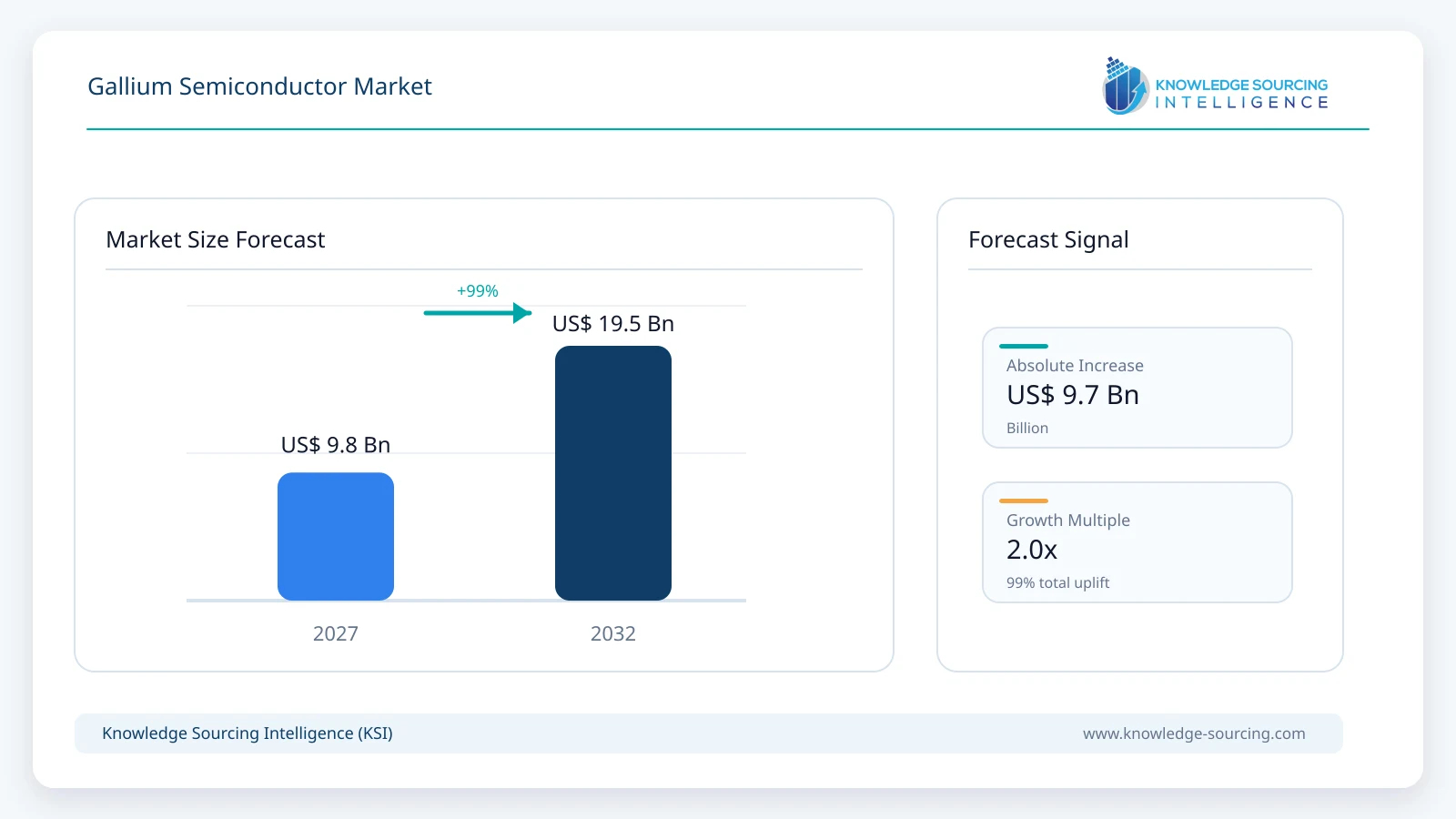
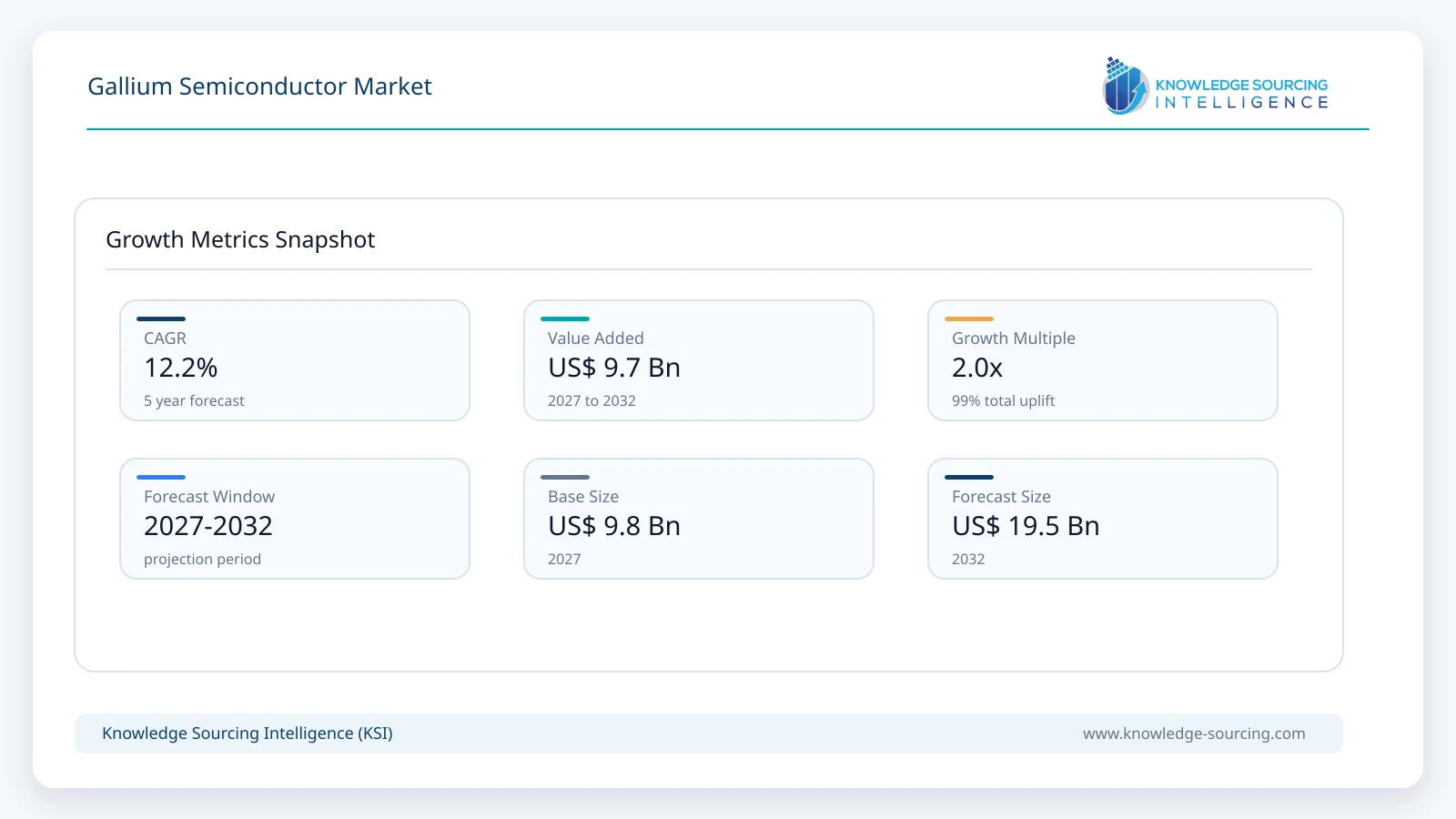
The Gallium Semiconductor Market is estimated at USD 9.80 billion in 2026 and is projected to reach USD 19.50 billion by 2032, representing a CAGR of 12.2% during 2026-2032.
Highlights:
- 1Gallium arsenide remains the largest 2026 revenue platform through radio frequency and photonic devices.
- 2Gallium nitride is the fastest-growing major platform as power conversion and high-power radio frequency demand expands.
- 3AI data-center power delivery creates a new high-volume pathway for GaN beyond chargers and telecom equipment.
- 4Defense, radar, satellite communications and 5G infrastructure sustain premium GaAs and GaN radio frequency demand.
- 5China-dominated primary gallium supply keeps material security, recycling and alternative refining capacity strategically important.
Market Overview
Gallium semiconductors are a group of compound-semiconductor technologies rather than one device category. GaAs offers high electron mobility and mature manufacturing for microwave and millimeter-wave power amplifiers, switches, low-noise devices and optoelectronics. It remains deeply embedded in smartphone radio frequency front ends, defense systems, satellite communications, industrial sensing and vertical-cavity surface-emitting laser applications. GaN operates at higher electric fields and power densities, supporting both radio frequency high-electron-mobility transistors and fast-switching power devices. This gives GaN two distinct commercial growth engines: high-power radio frequency electronics and efficient power conversion.
Upstream wafers and epitaxy are strategically important because device performance depends strongly on crystal quality, epitaxial structure and substrate choice. GaAs devices use semi-insulating or semiconducting GaAs substrates, while GaN devices can be produced on silicon carbide, silicon, sapphire or native GaN depending on power, frequency and cost requirements. IQE supplies epitaxial wafers across GaAs and GaN platforms, while companies such as AXT and Sumitomo Electric participate in compound-semiconductor substrates. Integrated device manufacturers and foundries also maintain proprietary GaAs and GaN process technologies, particularly for radio frequency and power applications.
Material availability has become a strategic constraint. The U.S. Geological Survey states that roughly 79% of U.S. gallium consumption is associated with GaAs, GaN and GaP wafers, while analog and digital integrated circuits account for the majority of end use. China remains overwhelmingly dominant in primary low-purity gallium production and introduced export licensing for gallium in 2023. This does not translate directly into a shortage of every gallium semiconductor, because high-purity refining, recycling and inventories occur in multiple countries, but it increases the strategic value of diversified refining, reclaimed gallium and efficient wafer utilization.
Market Drivers
AI infrastructure expands GaN power-conversion demand
Artificial intelligence infrastructure is opening a larger addressable market for GaN because rack power is moving from conventional server architectures toward higher-voltage distribution and much denser point-of-load conversion. Infineon introduced 800-volt direct-current reference designs in March 2026 using 650 V GaN devices for high-voltage intermediate-bus conversion. Innoscience is developing an all-GaN path from 800 VDC distribution through 48 V, 12 V and near-core power stages for the NVIDIA MGX ecosystem. The commercial significance is broader than one reference design: AI servers reward switching frequency, efficiency and power density because smaller magnetic components and lower conversion losses free space and thermal budget for compute hardware.
RF complexity sustains GaAs and high-power GaN demand
Radio frequency systems increasingly require wide bandwidth, higher output power and operation across more frequency bands. GaAs remains highly competitive in mobile power amplifiers and selected front-end functions, while GaN gains share where higher power density and thermal robustness justify a higher device cost. Qorvo manufactures both GaAs and GaN technologies and continues to develop GaN for defense, radar and communications. Its September 2026 Defense Advanced Research Projects Agency milestone demonstrated more than a fourfold increase in X-band GaN transistor radio frequency power density, indicating further performance headroom for radar and electronic-warfare systems. Satellite and low-Earth-orbit communication systems add another premium demand pool for high-frequency compound semiconductors.
Photonics and sensing keep GaAs relevant outside mobile RF
GaAs is not limited to wireless power amplifiers. The material supports vertical-cavity surface-emitting lasers, infrared emitters, photodetectors and other optoelectronic structures used in three-dimensional sensing, industrial sensing, short-reach optical links and selected data-center technologies. IQE reported new GaAs-based optical-interconnect qualifications for artificial intelligence and data-center applications in September 2026, alongside next-generation vertical-cavity surface-emitting laser programs for consumer sensing. This broadens the GaAs opportunity beyond smartphone unit volumes and supports specialized epitaxy suppliers that can serve multiple photonic device architectures.
300 mm GaN manufacturing improves the cost roadmap
Manufacturing scale is critical to GaN adoption because silicon remains the benchmark for device cost and ecosystem depth. Infineon is implementing GaN manufacturing on 300-millimeter wafers and stated in May 2026 that first customer samples were already shipping. The company highlights the ability to obtain substantially more chips per wafer than on 200-millimeter production. Larger-diameter manufacturing does not eliminate epitaxy, yield or packaging challenges, but it improves the route toward higher volume and lower unit cost. GaN-on-silicon suppliers such as Innoscience are pursuing a parallel scale advantage through high-volume 200-millimeter manufacturing.
Restraints and Adoption Challenges
The market faces four main constraints. First, gallium supply is unusually concentrated upstream, exposing refiners and wafer suppliers to export licensing, price volatility and inventory risk. Second, silicon and silicon carbide remain strong alternatives in many power applications, while silicon germanium and other compound semiconductors compete in radio frequency and photonics. Third, GaN device cost and qualification requirements can slow adoption where silicon already meets system targets. Finally, next-generation platforms such as Ga2O3 still face material and device limitations, including thermal conductivity, p-type doping and defect control. Gallium semiconductor growth therefore depends on application-level performance advantages rather than material properties alone.
Segment Analysis
By Gallium Semiconductor Platform
Gallium arsenide represents the largest revenue contribution in 2026 because of its established use across mobile radio frequency front ends, aerospace and defense microwave devices, satellite communications and optoelectronics. The installed manufacturing base is mature, and device suppliers have decades of process and packaging experience. Growth is steadier than for GaN because several large GaAs applications are already mature and face continued integration pressure from silicon-based radio frequency technologies.
Gallium nitride is expected to grow fastest among commercially scaled platforms through 2032. Radio frequency GaN already serves base stations, radar and defense electronics, while power GaN is expanding into adapters, renewable-energy electronics, industrial power, automotive subsystems and artificial intelligence data-center conversion. GaP remains a smaller optoelectronic platform. Ga2O3 has strong long-term high-voltage potential, but commercial revenue remains limited relative to GaAs and GaN during the forecast period.
Gallium Platform | 2026 Revenue Position | Growth Direction | Primary Commercial Roles |
Gallium arsenide (GaAs) | Largest | Moderate to strong | Mobile RF, microwave, satellite communications, VCSELs and sensing |
Gallium nitride (GaN) | High | Fastest | Power conversion, RF infrastructure, radar, defense and AI power delivery |
Gallium phosphide (GaP) | Niche | Moderate | Selected optoelectronic, indicator and specialty photonic devices |
Gallium oxide (Ga2O3) | Emerging | Very fast from small base | Future high-voltage and ultra-wide-bandgap power devices |
Other gallium compounds | Small | Application-specific | Specialty photonics, research and high-performance electronic structures |
Market and Technology Indicators
Indicator | Current Evidence | Market Impact |
Gallium use in semiconductors | USGS states about 79% of U.S. gallium consumption is in GaAs, GaN and GaP wafers. | Confirms semiconductor wafers and devices are the core economic use of gallium. |
Primary gallium concentration | China accounted for roughly 99% of world primary gallium production in recent USGS data. | Raises supply-security value of diversification, recycling and efficient material use. |
300 mm GaN manufacturing | Infineon reported first customer samples from scalable 300 mm GaN manufacturing in 2026. | Creates a route toward higher capacity and lower per-device manufacturing cost. |
AI power conversion | Infineon and Innoscience introduced GaN solutions spanning 800 VDC AI data-center power architectures. | Adds a new high-growth volume application beyond chargers and telecom power. |
RF GaN performance | Qorvo reported more than 400% higher X-band GaN RF power density under DARPA THREADS. | Supports higher-performance radar, electronic warfare and communications systems. |
Compound-semiconductor epitaxy | IQE reported GaAs optical-interconnect qualifications plus GaN power and RF programs in H1 2026. | Shows merchant epitaxy demand broadening across AI, photonics and power applications. |
Regional Opportunity
Asia Pacific
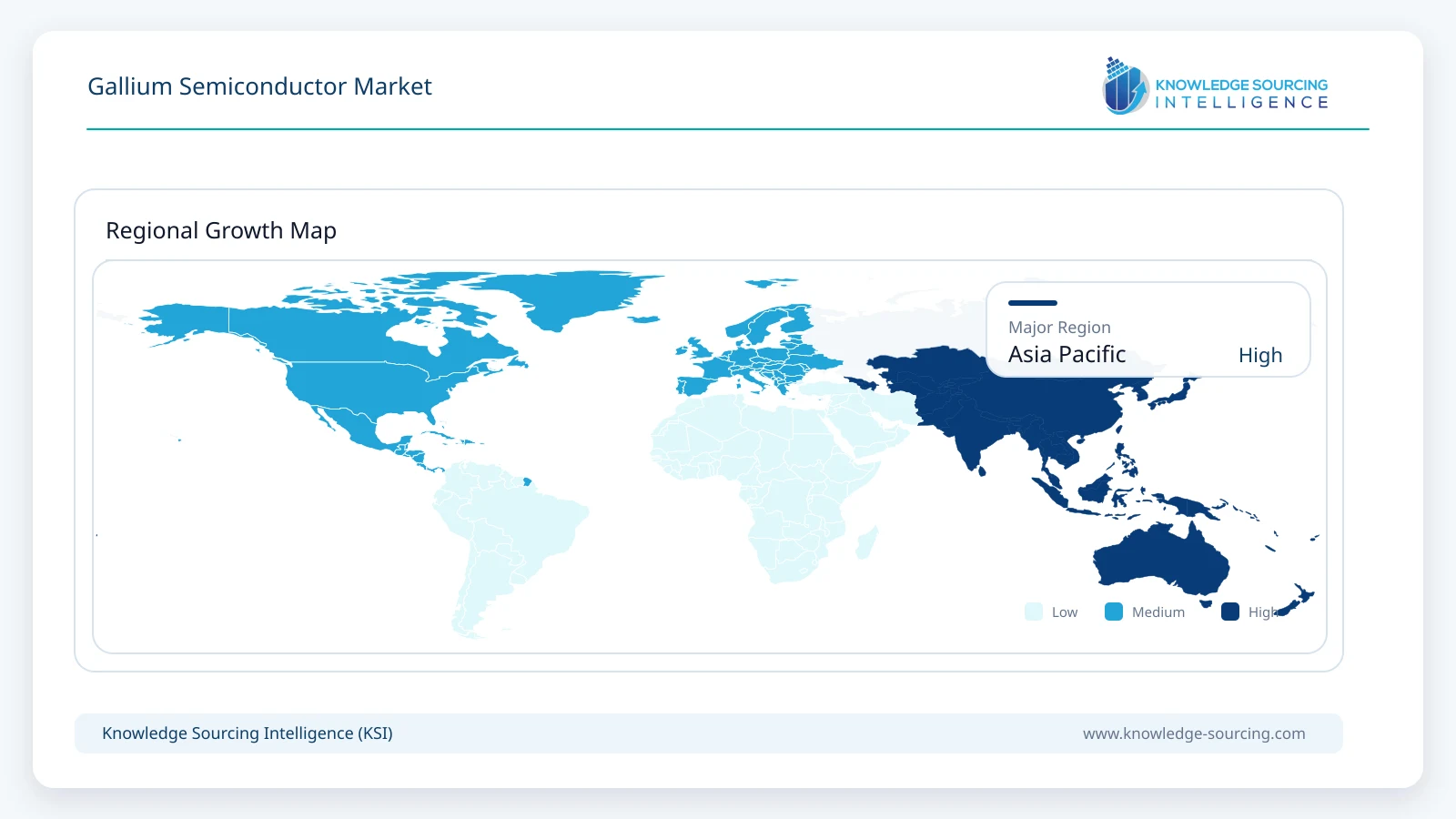
Asia Pacific is the largest regional opportunity because it combines upstream gallium refining with large compound-semiconductor wafer, epitaxy, device and electronics-manufacturing ecosystems. China dominates primary gallium production and is also scaling GaN-on-silicon power-device manufacturing. Japan has long-standing capabilities in compound-semiconductor materials, substrates and high-frequency electronics. Taiwan supports major radio frequency foundry, packaging and electronics supply chains, while South Korea and Southeast Asia contribute through communications equipment, consumer electronics and semiconductor assembly.
China has the greatest upstream influence. U.S. Geological Survey data show that the country accounts for almost all primary low-purity gallium output, giving export licensing and domestic refining economics global significance. At the device level, Innoscience has built large-scale GaN-on-silicon production and reported more than two billion GaN devices shipped by May 2026. Chinese radio frequency and power semiconductor suppliers are also expanding, creating a larger domestic market for epitaxy, substrates and packaging. However, intellectual-property disputes and export-control exposure add complexity for suppliers serving international customers.
Japan remains important through materials and device technology rather than raw gallium volume alone. Sumitomo Electric has deep compound-semiconductor substrate expertise, while Mitsubishi Electric and other Japanese suppliers participate in high-power and radio frequency semiconductor applications. Taiwan adds a strong merchant-foundry and outsourced manufacturing base, including GaAs radio frequency production. The region therefore captures value across multiple layers of the gallium semiconductor chain, from primary metal and substrates to epitaxy, device fabrication, packaging and end-system integration.
North America is a major design and premium-device region through Qorvo, Skyworks, MACOM, Broadcom and defense-oriented suppliers, with strong demand from mobile, aerospace, radar and satellite markets. Europe is particularly important in power GaN through Infineon and Nexperia and in compound-semiconductor research, while the United Kingdom contributes through IQE epitaxy.
Competitive Landscape
Competition differs by technology platform. In radio frequency GaAs, scale, process maturity, integration and customer qualification are critical. Skyworks and Qorvo remain major suppliers to mobile and broad-market radio frequency applications, while WIN Semiconductors provides merchant foundry capacity for GaAs and other compound-semiconductor technologies. Broadcom, MACOM, NXP Semiconductors, Mitsubishi Electric, United Monolithic Semiconductors and Ampleon participate across microwave, infrastructure, aerospace and defense markets. The pending Skyworks-Qorvo combination, approved by shareholders in February 2026 and still moving through regulatory processes during 2026, would create substantially greater scale in radio frequency and mixed-signal semiconductors.
Power GaN is more fragmented and is moving quickly toward larger manufacturing scale and greater integration. Infineon combines discrete and integrated GaN devices with gate drivers, controllers and 300 mm manufacturing. Innoscience competes through high-volume GaN-on-silicon production and a broad voltage portfolio. Navitas Semiconductor, Renesas Electronics through Transphorm technology, Efficient Power Conversion, Texas Instruments and Nexperia compete across consumer, industrial, automotive and data-center power applications. Competitive differentiation increasingly includes reliability data, packaging, driver integration and application reference designs rather than transistor performance alone.
The upstream market includes substrate and epitaxy specialists. IQE provides merchant epitaxial wafers for GaAs and GaN applications across wireless, photonics, defense and power. AXT supplies GaAs substrate wafers, while Sumitomo Electric and other Japanese materials companies support high-quality compound-semiconductor substrates. As device makers internalize some epitaxy and wafer processing, merchant suppliers compete on crystal quality, scale, geographic diversification and the ability to support rapidly changing device structures.
Major companies and ecosystem participants covered: Qorvo, Skyworks Solutions, Broadcom, MACOM Technology Solutions, Infineon Technologies, NXP Semiconductors, Mitsubishi Electric, WIN Semiconductors, United Monolithic Semiconductors, Ampleon, Innoscience, Navitas Semiconductor, Renesas Electronics, Efficient Power Conversion, Nexperia, IQE, AXT and Sumitomo Electric Industries.
Recent Developments
September 2026: Qorvo reported more than a 400% increase in X-band GaN transistor radio frequency power density under the DARPA THREADS program.
September 2026: IQE reported GaAs optical-interconnect qualifications, GaN-on-silicon power epitaxy qualification and continued GaN radio frequency design-in activity across defense and communications markets.
July 2026: Skyworks and Qorvo announced the expected leadership structure for their pending combination as regulatory approvals progressed.
May 2026: Infineon expanded its CoolGaN bidirectional-switch portfolio and stated that initial customer samples from its 300 mm GaN manufacturing platform were already shipping.
May 2026: Innoscience detailed an all-GaN power-conversion path for the NVIDIA MGX ecosystem, spanning 800 VDC distribution through lower-voltage graphics-processing-unit power stages.
March 2026: Infineon introduced 800 VDC artificial-intelligence data-center intermediate-bus reference designs using 650 V CoolGaN devices, with one design exceeding 98% peak efficiency.
Gallium Semiconductor Market Scope
| Report Metric | Details |
|---|---|
| Total Market Size in 2027 | USD 9.80 billion |
| Total Market Size in 2032 | USD 19.50 billion |
| Forecast Unit | Billion |
| Growth Rate | 12.2% |
| Study Period | 2022 to 2032 |
| Historical Data | 2022 to 2025 |
| Base Year | 2026 |
| Forecast Period | 2027 – 2032 |
| Segmentation | Gallium Semiconductor Platform, Product Type, Device Architecture, Application, Supply Chain Stage, Region |
| Companies |
|
Market Segmentation
By Gallium Semiconductor Platform
Gallium Arsenide (GaAs)
Gallium Nitride (GaN)
Gallium Phosphide (GaP)
Gallium Oxide (Ga2O3)
Other Gallium Compound Semiconductors
By Product Type
Substrates and Epitaxial Wafers
RF and Microwave Devices
Power Discrete Devices
Integrated Power Stages and ICs
Photonic and Sensing Devices
Other Gallium Semiconductor Components
By Device Architecture
Heterojunction Bipolar Transistors
Pseudomorphic High-Electron-Mobility Transistors
GaN High-Electron-Mobility Transistors
GaN Power FETs and Bidirectional Switches
Laser, VCSEL and Photodetector Structures
Emerging Vertical and Ultra-Wide-Bandgap Devices
By Application
Mobile RF Front Ends
Telecom and Wireless Infrastructure
Aerospace, Defense and Radar
AI Data Centers and Computing Power
Automotive and Industrial Power Electronics
Consumer Power and Fast Charging
Photonics, Sensing and Optical Interconnects
Satellite Communications and Space Electronics
By Supply Chain Stage
High-Purity Gallium and Precursor Materials
Substrate Manufacturing
Epitaxial Wafer Production
Device Fabrication and Foundry
Packaging, Modules and Semiconductor Integration
By Region
Asia Pacific
China
Japan
Taiwan
South Korea
Southeast Asia and India
North America
United States
Canada
Europe
Rest of World
Table of Contents
1. EXECUTIVE SUMMARY
1.1. Market Opportunity and Key Findings
1.2. Gallium Semiconductor Technology Outlook
1.3. Principal Revenue Pools
2. MARKET OVERVIEW
2.1. Gallium Compound-Semiconductor Value Chain
2.2. Gallium Arsenide Device Architecture and Applications
2.3. Gallium Nitride RF and Power Device Architecture
2.4. Gallium Phosphide and Other Specialty Compounds
2.5. Gallium Oxide Commercialization Path
3. MARKET SIZE AND FORECAST, 2026-2032
3.1. Global Market Revenue
3.2. Annual Growth Analysis
3.3. Revenue by Material Platform
4. MARKET BY GALLIUM SEMICONDUCTOR PLATFORM
4.1. Gallium Arsenide (GaAs)
4.2. Gallium Nitride (GaN)
4.3. Gallium Phosphide (GaP)
4.4. Gallium Oxide (Ga2O3)
4.5. Other Gallium Compound Semiconductors
5. MARKET BY PRODUCT TYPE
5.1. Substrates and Epitaxial Wafers
5.2. RF and Microwave Devices
5.3. Power Discrete Devices
5.4. Integrated Power Stages and ICs
5.5. Photonic and Sensing Devices
5.6. Other Gallium Semiconductor Components
6. MARKET BY DEVICE ARCHITECTURE
6.1. Heterojunction Bipolar Transistors
6.2. Pseudomorphic High-Electron-Mobility Transistors
6.3. GaN High-Electron-Mobility Transistors
6.4. GaN Power FETs and Bidirectional Switches
6.5. Laser, VCSEL and Photodetector Structures
6.6. Emerging Vertical and Ultra-Wide-Bandgap Devices
7. MARKET BY APPLICATION
7.1. Mobile RF Front Ends
7.2. Telecom and Wireless Infrastructure
7.3. Aerospace, Defense and Radar
7.4. AI Data Centers and Computing Power
7.5. Automotive and Industrial Power Electronics
7.6. Consumer Power and Fast Charging
7.7. Photonics, Sensing and Optical Interconnects
7.8. Satellite Communications and Space Electronics
8. MARKET BY SUPPLY CHAIN STAGE
8.1. High-Purity Gallium and Precursor Materials
8.2. Substrate Manufacturing
8.3. Epitaxial Wafer Production
8.4. Device Fabrication and Foundry
8.5. Packaging, Modules and Semiconductor Integration
9. REGIONAL MARKET
9.1. Asia Pacific
9.1.1. China
9.1.2. Japan
9.1.3. Taiwan
9.1.4. South Korea
9.1.5. Southeast Asia and India
9.2. North America
9.2.1. United States
9.2.2. Canada
9.3. Europe
9.4. Rest of World
10. MARKET DYNAMICS
10.1. Drivers
10.1.1. AI Data-Center GaN Power Conversion
10.1.2. RF Complexity, Radar and Defense Demand
10.1.3. GaAs Photonics and Sensing Applications
10.1.4. 300 mm GaN Manufacturing Scale-Up
10.2. Restraints
10.2.1. Gallium Supply Concentration and Export Controls
10.2.2. Competition from Silicon, Silicon Carbide and Other Platforms
10.2.3. Device Cost, Packaging and Qualification Requirements
10.2.4. Thermal and Material Limitations in Emerging Gallium Platforms
11. COMPETITIVE LANDSCAPE
11.1. Market Structure and Competitive Intensity
11.2. GaAs RF and Photonics Positioning
11.3. GaN Power and RF Strategies
11.4. Substrate and Epitaxy Supplier Positioning
11.5. Manufacturing Scale, IP and Customer Qualification
12. COMPANY PROFILES
12.1. Qorvo
12.2. Skyworks Solutions
12.3. Broadcom
12.4. MACOM Technology Solutions
12.5. Infineon Technologies
12.6. NXP Semiconductors
12.7. Mitsubishi Electric
12.8. WIN Semiconductors
12.9. United Monolithic Semiconductors
12.10. Ampleon
12.11. Innoscience
12.12. Navitas Semiconductor
12.13. Renesas Electronics
12.14. Efficient Power Conversion
12.15. Nexperia
12.16. IQE
12.17. AXT
12.18. Sumitomo Electric Industries
13. RECENT DEVELOPMENTS
14. APPENDIX
Navigate
Trusted by the world's leading organizations











