
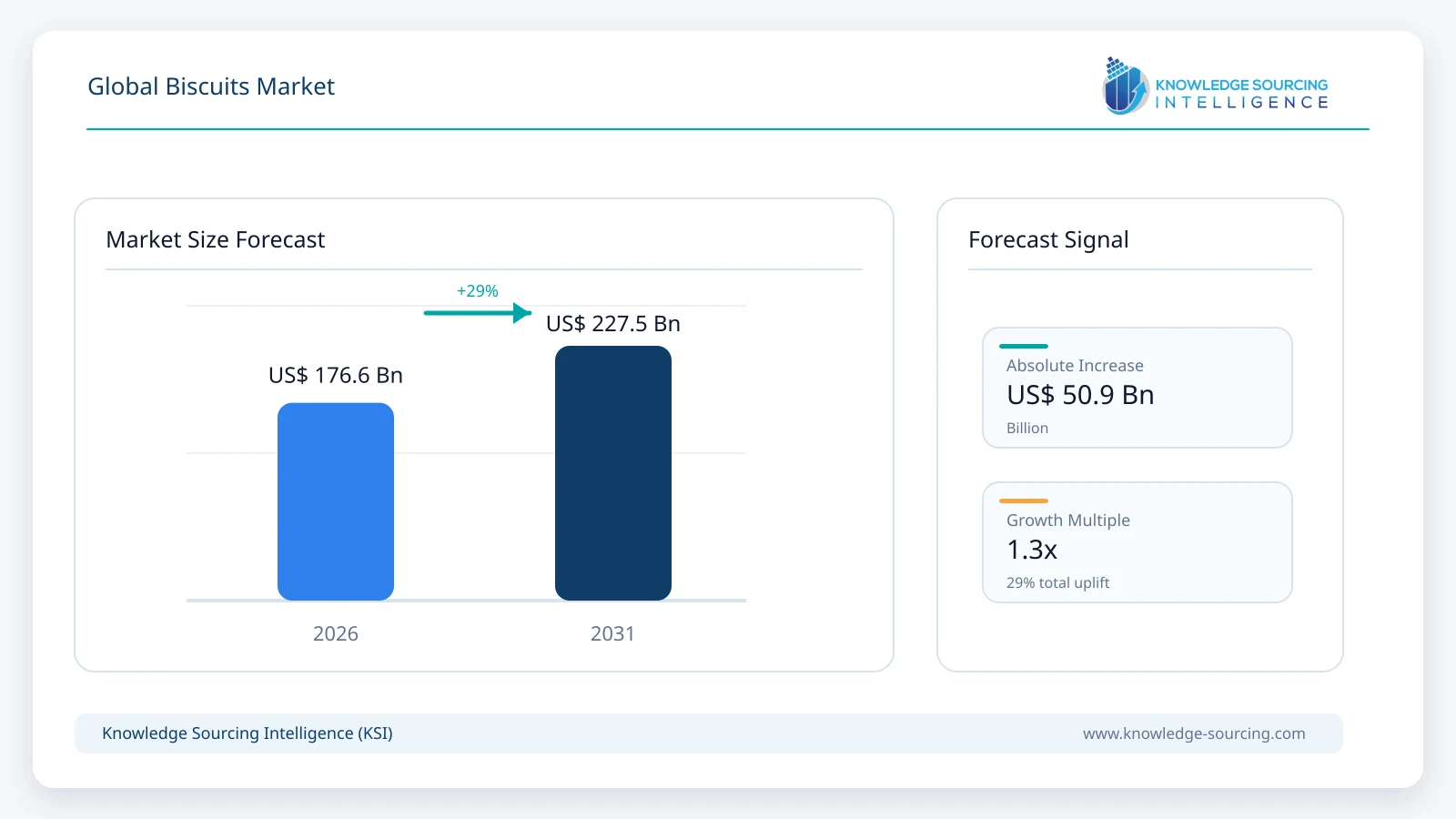
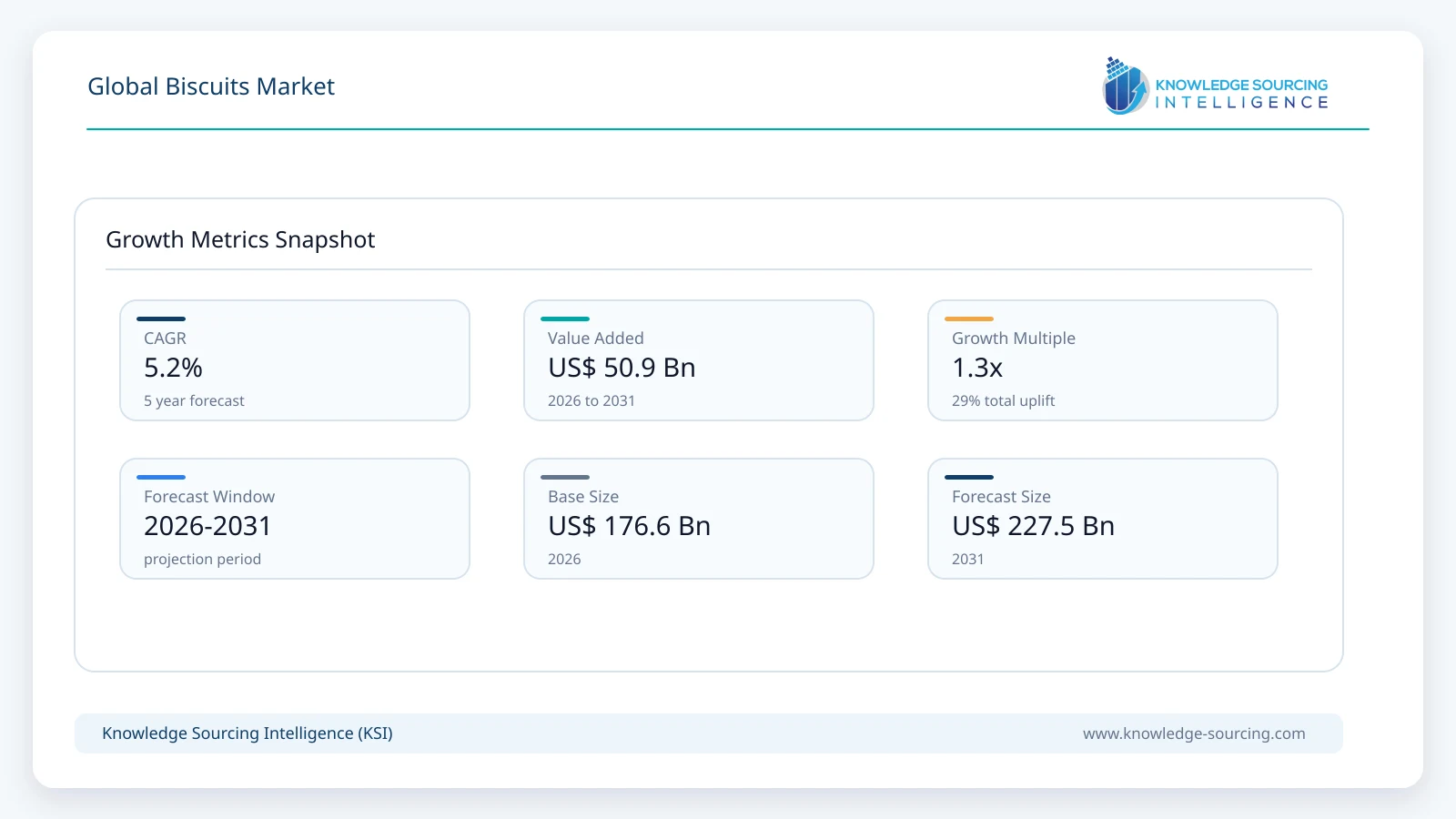
The global biscuits market is forecast to grow at a CAGR of approximately 5.2%, reaching USD 227.5 billion in 2031 from USD 176.6 billion in 2026.
Highlights:
- 1Online biscuit sales are projected to grow at approximately 12.5% annually through 2031.
- 2Savory biscuits and crackers record faster growth than the larger sweet biscuit segment.
- 3Mondelez generated USD 18.39 billion from biscuits and baked snacks in 2025.
- 4Lotus Bakeries increased 2025 revenue 10% to EUR 1.36 billion.
- 5Asia Pacific provides the largest incremental market opportunity during the forecast period.
- 6Reduced-sugar, premium and portion-controlled formats are expanding across major biscuit portfolios.
Market Overview
Biscuits are shelf-stable baked products consumed as snacks, accompaniments and desserts across household, foodservice and institutional applications. The market includes sweet biscuits, cookies, sandwich biscuits, digestives, wafers and savory crackers sold through packaged retail channels. Its broad consumer base ranges from low-priced everyday products in emerging markets to premium indulgence, gifting and functional snacking propositions in developed economies.
The market continues to benefit from its combination of convenience, affordability and long shelf life. However, growth increasingly depends on product mix rather than basic category penetration. Consumers are buying premium sandwich biscuits, coated products, filled cookies, reduced-sugar variants and savory formats alongside conventional plain biscuits. Large manufacturers are therefore investing in more differentiated products while retaining mass-market price points that drive volume.
The industry’s scale is reflected in major supplier performance. Mondelez International reported USD 18.39 billion of net revenue from biscuits and baked snacks in 2025, compared with USD 17.80 billion in 2024. The category spans Oreo, Ritz, LU, belVita, Chips Ahoy!, Tate’s Bake Shop, Triscuit and several regional brands, giving the company significant exposure across both sweet and savory formats.
Growth is also visible among specialist biscuit companies. Lotus Bakeries reported EUR 1.355 billion of revenue in 2025, increasing 10%, supported by continued Biscoff expansion and increased production capacity. Its Thailand facility added Asia-Pacific production, while the company has announced a broader multi-site investment program across Belgium, Thailand and the United States.
Major Market Drivers
Premiumization and Product Innovation Are Increasing Value per Purchase
Biscuit manufacturers are moving beyond conventional flavors and formats to create higher-value products through fillings, coatings, multiple textures, premium ingredients and brand collaborations. The strategy allows manufacturers to increase value realization without relying exclusively on higher unit volumes.
In India, ITC expanded Sunfeast through premium products including Baked Creations, Mom’s Magic Shines and differentiated Dark Fantasy cookies. Its Baked Creations range uses premium ingredients and is being distributed partly through quick-commerce channels, demonstrating how premiumization is being combined with new retail formats.
Britannia similarly expanded its portfolio through products including the 50-50 Dipped range and Doodh Marie Gold. The company reported that its biscuit business grew approximately 12% during November and December 2025, supported by media investment and product innovation.
Premiumization is particularly important in mature markets where household biscuit penetration is already high. Growth increasingly comes from encouraging consumers to trade toward coated, filled, indulgent, specialty, or functional products rather than simply increasing overall consumption frequency.
Demand for Convenient Packaged Snacking Is Supporting Emerging-Market Growth
Biscuits remain well positioned for everyday snacking because they require no refrigeration or preparation and can be sold across multiple pack sizes. This is particularly important in markets where traditional retail, convenience stores and small-format shops remain significant distribution channels.
Manufacturers can address different household budgets through single-serve packs, small family packs and larger value formats, while the same production infrastructure can support multiple flavors and price tiers. The model is particularly effective across India, Southeast Asia, Africa, Latin America and parts of the Middle East where rising packaged-food penetration is expanding the addressable market.
Digital retail adds another layer of convenience. Quick commerce and e-commerce are increasingly being used for premium launches, multipacks and niche variants that may not initially justify wide shelf distribution. ITC’s use of quick-commerce channels for premium Sunfeast Baked Creations demonstrates how manufacturers are using digital channels as both a sales and product-discovery platform.
Major Market Restraints
Wheat, Sugar, Cocoa and Edible-Fat Costs Create Margin and Pricing Pressure
Biscuit production depends heavily on wheat flour, sugar, vegetable oils, dairy ingredients, cocoa and packaging materials. Changes in commodity prices can materially affect manufacturing economics because mass-market biscuits often operate at tightly managed consumer price points.
Manufacturers may respond by adjusting pack sizes, changing product mix, reformulating recipes or selectively increasing prices. These actions become more difficult in highly price-sensitive markets where consumers can switch between competing brands or substitute biscuits with other packaged snacks.
Britannia has highlighted wheat, sugar and edible-fat costs among the commodities requiring active monitoring, while its recent results also indicate that a more stable input environment can quickly improve profitability.
Premium biscuits provide greater pricing flexibility, but they are more exposed to discretionary spending. Manufacturers therefore need to balance mass-market affordability with margin protection across different parts of their portfolios.
Competition From Alternative Snacks and Health Perceptions Limits Consumption Growth
Biscuits compete with chips, snack bars, nuts, yogurt, bakery snacks and other packaged foods for the same eating occasions. Health-conscious consumers may also reduce purchases of products perceived as high in sugar, refined flour or saturated fat.
The response is increasingly product reformulation rather than withdrawal from the category. Arnott’s has introduced Scotch Finger and Shortbread Cream variants containing 50% less sugar, reflecting consumer interest in retaining familiar biscuit formats while reducing selected ingredients.
Manufacturers are also expanding digestives, wholegrain products, smaller portions, gluten-free products and biscuits containing oats, seeds or other ingredients associated with better-for-you positioning. These products increase the category’s ability to compete with newer snack formats, although taste remains critical to repeat purchase.
Biscuits Market Trends
Reduced-Sugar and Better-for-You Formulations Are Expanding
Health-oriented innovation is moving from specialist brands into mainstream biscuit portfolios. Reduced-sugar formulations, wholegrain products, gluten-free alternatives and digestives increasingly coexist with traditional indulgent formats.
The important shift is that manufacturers are trying to preserve established taste and texture rather than creating an entirely separate health-food category. This allows brands to retain consumers who want moderation but are unwilling to sacrifice the familiar eating experience associated with established products.
Arnott’s reduced-sugar range is representative of this approach. The company states that its Scotch Finger and Shortbread Cream variants contain half the sugar of their conventional counterparts while maintaining their established product positioning.
Sweet-Savory Crossover Is Creating New Product Formats
Biscuit companies are increasingly combining sweet and savory characteristics to create distinctive products. Chocolate coatings on traditional biscuits, salted fillings, savory-inspired sweet biscuits and crossovers between established brands are widening product experimentation.
Arnott’s 2026 product activity includes Tim Tam products inspired by Jatz crackers and Wagon Wheels inspired by Chicken Crimpy Shapes, demonstrating how manufacturers can use established brand equities across previously separate sweet and savory product families.
This type of innovation helps mature brands create novelty without requiring an entirely new brand architecture.
Production Capacity Is Moving Closer to Growth Markets
Manufacturers are expanding regional production to reduce logistics costs, increase freshness and support faster market development. Lotus Bakeries began producing Biscoff in Thailand during 2025 and has subsequently expanded its long-term production investment across three continents.
Regional manufacturing also improves resilience because companies can reduce dependence on single-country supply for globally distributed brands. The strategy is particularly important for products with rapidly growing demand across Asia Pacific.
Quick Commerce Is Becoming a Launch Channel for Premium Biscuits
Quick commerce is emerging as a distinct channel for products aimed at urban consumers seeking convenience and novelty. Unlike conventional supermarkets, these platforms can support narrower assortments, rapid product testing and localised inventory.
ITC’s Sunfeast Baked Creations illustrates this shift, with premium short-shelf-life cookies and cakes supported by hyperlocal supply chains and quick-commerce availability.
This channel remains much smaller than offline grocery retail but is growing faster, particularly in major Asian cities.
Segment Analysis:
By Type
Sweet Biscuits
Sweet biscuits account for approximately 78% of global biscuit market value in 2026, making them the largest product category. The segment includes plain sweet biscuits, Marie and digestive products, sandwich and cream-filled biscuits, cookies, wafers and coated products.
Its breadth provides manufacturers with multiple price and consumption positions. Plain and Marie biscuits remain important in price-sensitive markets, while sandwich cookies, coated biscuits and premium cookies capture higher value per unit. Major brands such as Oreo, LU, McVitie’s, Britannia, Parle, Tim Tam, Biscoff and Sunfeast operate across different parts of this spectrum.
Sweet biscuits remain dominant through 2031, although their share moderates as savory crackers expand more quickly. Demand is increasingly shaped by premiumization, portion control, reduced-sugar formulations and differentiated textures rather than simple category expansion.
By Distribution Channel
Online
Online channels account for approximately 10% of global biscuit market value in 2026 and are projected to reach around 14% by 2031. Growth is being supported by e-commerce, grocery delivery and quick-commerce platforms that make large brand portfolios accessible without requiring physical shelf space.
The channel is particularly suitable for multipacks, premium launches, limited editions and products targeting narrower consumer groups. Digital retail also allows smaller brands to gain national distribution without immediately building extensive relationships with conventional supermarket chains.
Offline retail remains the dominant route to market because biscuits are frequently purchased as part of routine grocery trips and impulse transactions. However, online sales gain share throughout the forecast period as grocery delivery penetration expands and manufacturers develop channel-specific products.
By Geography
Asia Pacific
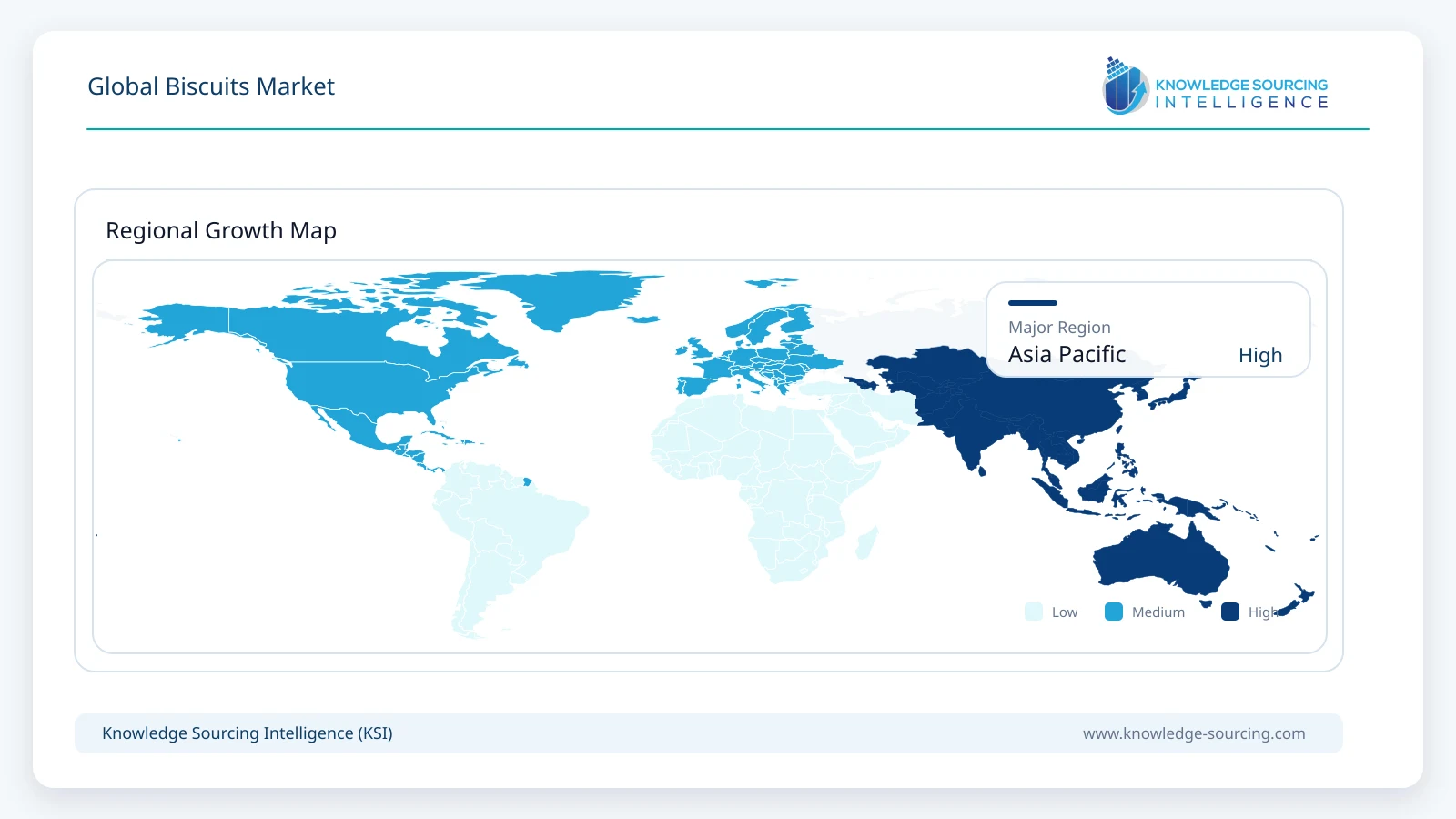
Asia Pacific accounts for approximately 35% of global biscuit market value in 2026 and is projected to reach around 38% by 2031, making it the largest regional opportunity.
The region combines mature markets such as Japan and Australia with much faster-growing packaged-food demand across India, China, Indonesia and other Southeast Asian markets. India has an especially large biscuit manufacturing ecosystem covering mass-market, premium and regional products. Britannia, Parle and ITC operate alongside multinational companies and a substantial base of local producers.
Regional manufacturing is also increasing. Lotus Bakeries’ Thailand expansion provides an Asia-Pacific manufacturing base for Biscoff, reducing reliance on imports from Europe and the United States.
Market development is increasingly differentiated by price tier. Small packs remain important for mass-market penetration, while urban consumers are driving premium cookies, international brands, and quick-commerce purchases.
Competitive Landscape
The global biscuits market combines multinational snack companies, large regional manufacturers and specialist biscuit producers. Mondelez maintains one of the broadest global portfolios through Oreo, Ritz, LU, belVita and other brands. pladis competes through McVitie’s, Ülker and related brands, while Britannia, Parle and ITC have substantial positions in India.
Lotus Bakeries has expanded rapidly through Biscoff and related branded products, while Arnott’s remains a major biscuit company across Australia and the wider Asia-Pacific region. Bahlsen retains a strong European presence, while The Campbell’s Company participates through Pepperidge Farm, Goldfish and Lance crackers in North America.
The company structure also requires updating from older competitive lists. Burton’s Biscuits and Fox’s Biscuits now operate within FBC UK after acquisitions by Ferrero-affiliated companies rather than functioning as the same independent competitive entities reflected in older industry lists.
Competition is increasingly based on portfolio breadth, distribution, price-point architecture and innovation speed. Large players benefit from manufacturing scale and shelf access, while specialist companies can grow by concentrating on premium products, distinctive recipes or underserved consumer segments.
Recent Developments
August 2026: Lotus Bakeries published its 2026 half-year results as it continued expanding global Biscoff capacity and distribution.
July 2026: ITC reported continued scaling of Sunfeast Mom’s Magic Shines and Sunfeast Baked Creations, while Dark Fantasy maintained a strong position in India’s premium biscuit segment.
July 2026: Mondelez International reported second-quarter net revenue growth of 4.1%, with positive volume/mix growth across its global snacking business.
May 2026: Lotus Bakeries began expansion of its Lembeke production site as part of its multi-year Biscoff capacity program.
May 2026: Britannia approved its audited FY2026 results following a year marked by continued investment in biscuits and adjacent food categories.
February 2026: Britannia reported 9.5% quarterly consolidated sales growth and highlighted product innovation across its biscuit portfolio.
Market Outlook
The biscuit industry is expected to maintain steady mid-single-digit growth through 2031, with a greater proportion of incremental value coming from premium products, savory formats and online channels.
Sweet biscuits remain the largest product group because of their broad consumption base, but savory crackers grow more quickly as consumers diversify snacking occasions. Better-for-you reformulation increases rather than replaces indulgent products, resulting in portfolios that increasingly contain both premium treats and reduced-sugar or wholegrain alternatives.
Offline retail remains central because biscuits retain a strong impulse and routine-grocery component. Online and quick-commerce channels gain share by improving access to premium, niche, and channel-specific products.
Asia Pacific provides the largest incremental opportunity, while Europe and North America remain important high-value markets with strong premium and branded consumption.
Biscuits Market Scope:
| Report Metric | Details |
|---|---|
| Total Market Size in 2026 | USD 176.6 billion |
| Total Market Size in 2031 | USD 227.5 billion |
| Forecast Unit | Billion |
| Growth Rate | 5.2% |
| Study Period | 2021 to 2031 |
| Historical Data | 2021 to 2024 |
| Base Year | 2025 |
| Forecast Period | 2026 – 2031 |
| Segmentation | Type, Distribution Channel, Geography |
| Companies |
|
Market Segmentation
By Type
Sweet Biscuits
· Plain, Marie and Digestive Biscuits
· Sandwich and Cream-Filled Biscuits
· Cookies
· Wafers and Coated Biscuits
· Others
Crackers and Savory Biscuits
· Plain and Salted Crackers
· Flavored and Seasoned Crackers
· Sandwich Crackers
· Others
By Distribution Channel
Online
· E-commerce
· Quick Commerce / Grocery Delivery
Offline
· Supermarkets and Hypermarkets
· Convenience Stores
· Traditional and Independent Retail
· Specialty and Other Retail
By Geography
North America
· United States
· Canada
· Mexico
South America
· Brazil
· Argentina
· Others
Europe
· United Kingdom
· Germany
· France
· Italy
· Spain
· Others
Middle East and Africa
· Saudi Arabia
· UAE
· South Africa
· Others
Asia Pacific
· China
· India
· Japan
· South Korea
· Australia
· Indonesia
· Others
Table of Contents
1. INTRODUCTION
1.1. Market Overview
1.2. Market Definition
1.3. Scope of the Study
1.4. Market Segmentation
1.5. Currency
1.6. Assumptions
1.7. Base and Forecast Years Timeline
1.8. Key Benefits for Stakeholders
2. RESEARCH METHODOLOGY
2.1. Research Design
2.2. Research Process
2.3. Primary Research Framework
2.4. Secondary Research Framework
2.5. Data Triangulation
2.6. Forecast Methodology
3. EXECUTIVE SUMMARY
3.1. Key Findings
3.2. Analyst View
4. MARKET DYNAMICS
4.1. Market Drivers
4.1.1. Premiumization and Higher-Value Biscuit Formats
4.1.2. Expansion of Convenient Packaged Snacking
4.1.3. Growth of Packaged Food Consumption Across Emerging Markets
4.1.4. Expansion of E-commerce and Quick-Commerce Distribution
4.2. Market Restraints
4.2.1. Wheat, Sugar, Cocoa and Edible-Fat Price Volatility
4.2.2. Competition From Alternative Packaged Snacks
4.2.3. Consumer Concerns Around Sugar and Refined Carbohydrates
4.2.4. Pricing Pressure Across Mass-Market Biscuit Categories
4.3. Market Opportunities
4.4. Porter’s Five Forces Analysis
4.5. Industry Value Chain Analysis
4.6. Food Safety and Labeling Regulations
4.7. Strategic Recommendations
5. PRODUCT AND INNOVATION OUTLOOK
5.1. Reduced-Sugar Biscuits
5.2. Wholegrain and High-Fiber Biscuits
5.3. Gluten-Free Formulations
5.4. Premium Filled and Coated Biscuits
5.5. Sweet-Savory Hybrid Products
5.6. Portion-Controlled Formats
5.7. Sustainable and Recyclable Packaging
5.8. Quick-Commerce Product Development
6. GLOBAL BISCUITS MARKET BY TYPE
6.1. Sweet Biscuits
6.1.1. Plain, Marie and Digestive Biscuits
6.1.2. Sandwich and Cream-Filled Biscuits
6.1.3. Cookies
6.1.4. Wafers and Coated Biscuits
6.1.5. Others
6.2. Crackers and Savory Biscuits
6.2.1. Plain and Salted Crackers
6.2.2. Flavored and Seasoned Crackers
6.2.3. Sandwich Crackers
6.2.4. Others
7. GLOBAL BISCUITS MARKET BY DISTRIBUTION CHANNEL
7.1. Online
7.1.1. E-commerce
7.1.2. Quick Commerce / Grocery Delivery
7.2. Offline
7.2.1. Supermarkets and Hypermarkets
7.2.2. Convenience Stores
7.2.3. Traditional and Independent Retail
7.2.4. Specialty and Other Retail
8. GLOBAL BISCUITS MARKET BY GEOGRAPHY
8.1. North America
8.1.1. United States
8.1.2. Canada
8.1.3. Mexico
8.2. South America
8.2.1. Brazil
8.2.2. Argentina
8.2.3. Others
8.3. Europe
8.3.1. United Kingdom
8.3.2. Germany
8.3.3. France
8.3.4. Italy
8.3.5. Spain
8.3.6. Others
8.4. Middle East and Africa
8.4.1. Saudi Arabia
8.4.2. UAE
8.4.3. South Africa
8.4.4. Others
8.5. Asia Pacific
8.5.1. China
8.5.2. India
8.5.3. Japan
8.5.4. South Korea
8.5.5. Australia
8.5.6. Indonesia
8.5.7. Others
9. COMPETITIVE ENVIRONMENT AND ANALYSIS
9.1. Major Players and Strategy Analysis
9.2. Market Share Analysis
9.3. Mergers, Acquisitions, Agreements and Collaborations
9.4. Competitive Dashboard
10. COMPANY PROFILES
10.1. Mondelez International, Inc.
10.2. pladis Global
10.3. Britannia Industries Limited
10.4. Parle Products Pvt. Ltd.
10.5. ITC Limited
10.6. The Arnott’s Group
10.7. Lotus Bakeries NV
10.8. Bahlsen GmbH & Co. KG
10.9. Ferrero-Affiliated Biscuit Businesses
10.10. The Campbell’s Company
10.11. PT Mayora Indah Tbk
10.12. Ezaki Glico Co., Ltd.
11. APPENDIX
Navigate
Trusted by the world's leading organizations











