
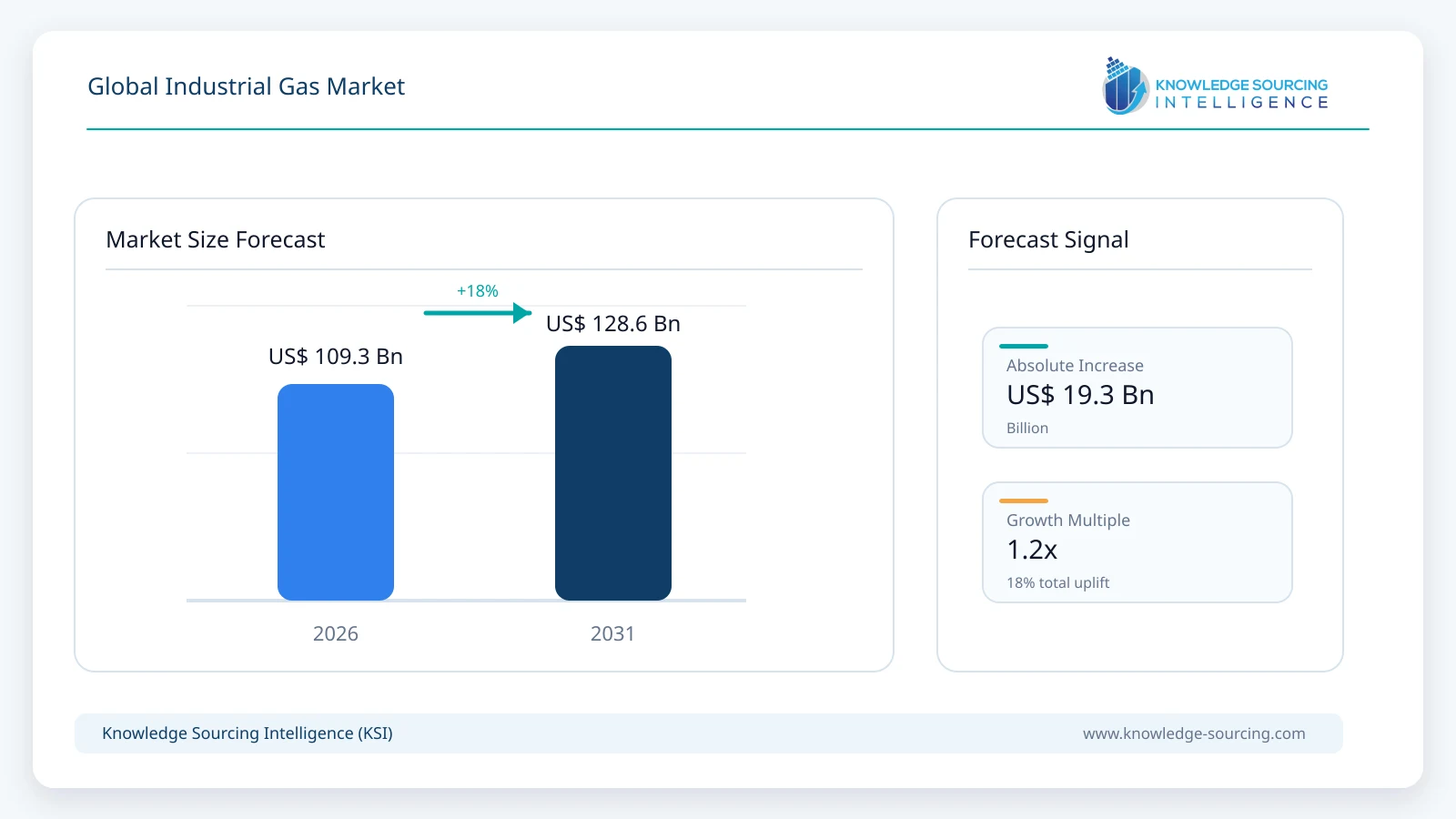
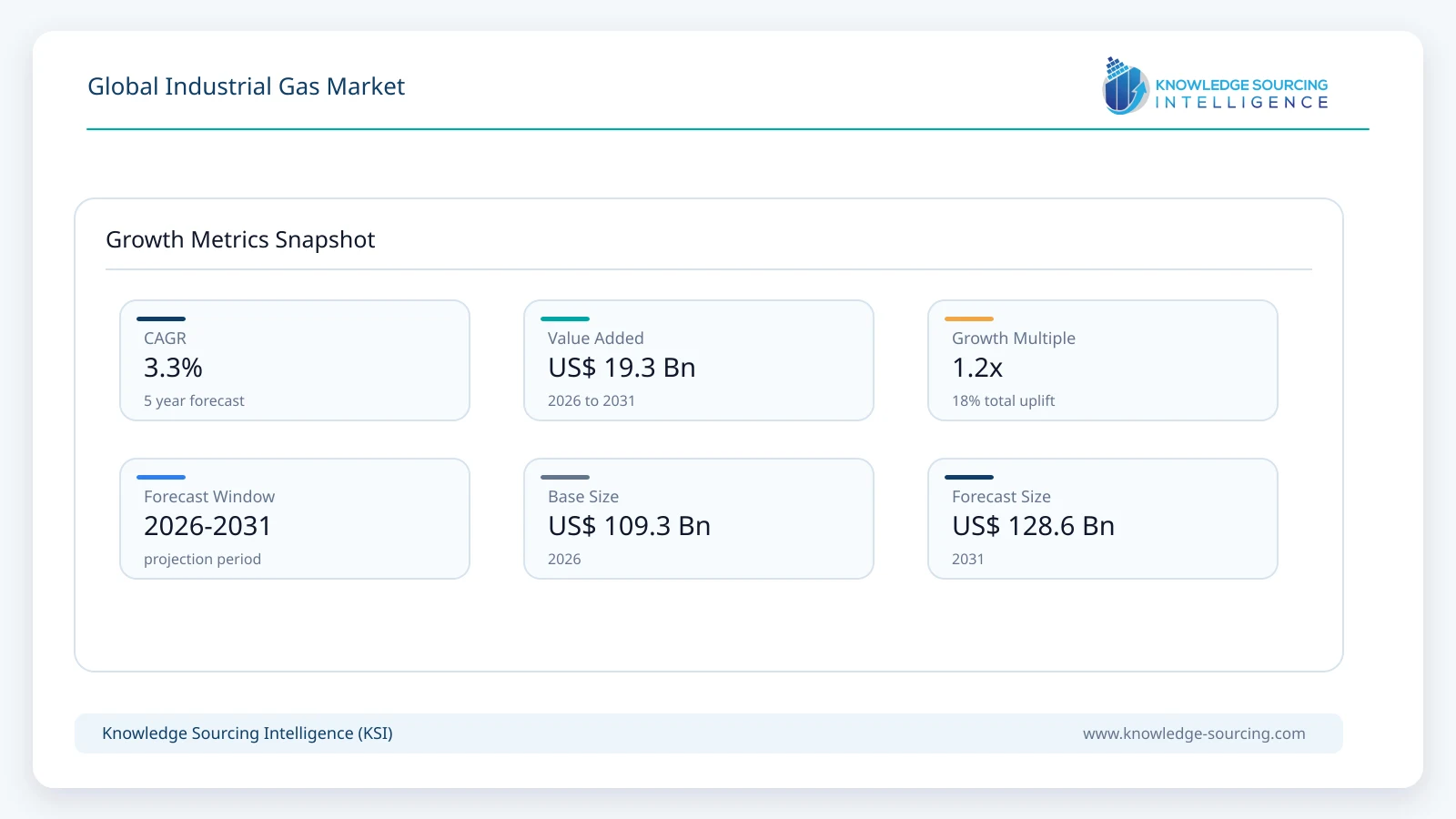
The Global Industrial Gas Market is forecast to grow at a CAGR of 3.3%, reaching USD 128.6 billion in 2031 from USD 109.3 billion in 2026.
Highlights:
- 1Oxygen maintained its dominance in the industrial gases market, and Linde and Air Liquide are installing over 20 VPSA units to produce medical oxygen in 2024, as steelmakers transition towards the DRI furnace technology.
- 2The worldwide momentum toward the decarbonization of the energy sector through green hydrogen is driving a shift in the businesses of the industrial gas companies toward energy transition infrastructure with a massive investment in announced projects for hydrogen production and hydrogen hubs across the globe.
- 3Asia-Pacific is the largest region of the global industrial gases market, owing to the region's manufacturing scale and growing investments in semiconductors manufacturing.
- 4Supply chain disruption events, such as supply chain related impacts from West Asian logistics disruption and the conditions of passage through the Strait of Hormuz, are also driving more on-site generation deployment for critical semiconductor and metals customers and expanding the regionalization of supply.
Industrial gas products come in a variety of main product types and industrial application areas. Demand for nitrogen is rising due to uses in semiconductor inerting, laser cutting applications, and modified-atmosphere packaging for high dollar food lines, with a combination of packaged cylinders for metal-fabrication shops, merchant liquid supplies for electronics clean rooms, and on-site generators at cold storage centers. As green hydrogen production investment shifts the demand for hydrogen, industrial gas majors are aligning renewables PPA with proton-exchange membrane electrolyzers to enable decarbonisation in maritime shipping and long-haul trucking, especially in Europe.
The industrial gas generator market has also seen significant investments in on-site projects in the past few years, as it becomes a growing alternative to the merchant arrangement that involved trucking of liquid nitrogen and liquid oxygen from centralized ASUs to end users, driven by delivery mode.
Market Dynamics
Market Drivers
Structural Demand from Steel, Semiconductor, and Healthcare Producers: Industrial gases are not discretionary, but rather are used as essential production inputs in heat treatment, inerting, wafer fabrication, and medical applications, and have a structurally defensive demand base bolstered by steelmakers' migration of DRI furnaces and the growth of semiconductor fabrication.
Green Hydrogen Production and Energy Transition Investment: Announced investments for proton-exchange membrane (PEM) electrolyzers and hydrogen hubs is creating an industry-wide momentum to align renewable energy purchase agreements with proton-exchange membrane (PEM) electrolyzers for decarbonizing maritime shipping and long-haul trucking.
Semiconductor Fabrication Expansion and Ultra-High-Purity Gas Demand: Demand for ultra-high-purity (UHP) nitrogen, argon and specialty gas blends at higher volumes than ever is coming from the global surge in semiconductor fabrication capacity, driving suppliers to invest in new purification technology and more resilient supply chains.
Market Restraints & Opportunities
Environmental regulation and safety compliance costs and high gas conversion and purification costs are significant constraints on industry expansion, and geopolitically driven supply chain disruptions, such as the reported impact on logistics due to shipping routes in West Asia and conditions in the Strait of Hormuz, are highlighting industry's dependence on centralized, long-distance specialty gas distribution systems.
The trend toward on-site generation and pipeline supply networks, investment in increasing helium and specialty gas recovery and recycling capacity, and continued advances in production technologies that will allow for greater gas purity, efficiency and reliability, however, create big opportunity going forward, especially as suppliers regionalize supply networks to better meet the needs of critical semiconductor and metals customers.
Key Developments
September 2026: Hitachi Energy and Daikin Industries, Ltd. announced an agreement to establish a long-term strategic supply relationship for Hitachi Energy's EconiQ® portfolio of sulfur hexafluoride (SF6)-free high-voltage technologies.
September 2026: Energy technology firm Baker Hughes signed a five-year agreement with Oil & Gas Development Company (OGDC) to provide a clear path to optimizing production from its legacy oil and gas assets.
August 2026: Air Products, the world’s largest supplier of hydrogen, announced that it has expanded the hydrogenation capabilities of its state-of-the-art Chemicals and Refinery Process Lab located at its Global Corporate Headquarters in Allentown, Pennsylvania.
April 2026: Air Products, a global leader in industrial gases and serving Samsung in all parts of the world, announced that it has been chosen by Samsung to supply industrial gases for the South Korea-based Samsung's new advanced semiconductor fabrication facility (fab) in Pyeongtaek, Gyeonggi Province.
Market Segmentation
The market is segmented by gas type, delivery mode, end-user industry, and geography.
By Gas Type: Oxygen
The gas-type market is dominated by oxygen, as the steelmakers switched to direct reduced iron furnace technology and the capacity of high flow ventilators was increased in hospitals, coupled with an ongoing investment in vacuum pressure swing adsorption capacity by major suppliers for medical oxygen production.
Linde plc delivers oxygen, nitrogen, argon and hydrogen solutions with industrial supply and on-site gas generation services, while its project backlog for the year improved to a peak, reflecting continued investment in new gas production capacities.
Air Liquide has a dominant market position, with a diversified portfolio of industrial and specialty gases worldwide, backed by a large network of production and logistics facilities across industrial, medical and healthcare applications.
By Delivery Mode: On-Site Generation
Installing on-site industrial gas generators is gaining in popularity over traditional merchant gas supply contracts, especially for large-volume manufacturing customers who want to cut transportation costs and boost supply continuity.
Air Products and Chemicals, Inc. provides key industrial gas supplies for refining, petrochemical and materials processing applications, and offers excellent service delivery across the world to support either on-site or pipeline distribution options.
By End-User Industry: Healthcare
The healthcare end-user is the largest end-user application segment in the industry with more than a quarter of the overall industry revenue, with sustained demand for medical-grade oxygen and nitrous oxide for patient care.
Nippon Sanso Holdings Corporation is involved in industrial and specialty gas business and robust service networks in the region, especially the healthcare and industrial end markets.
Regional Analysis
North America Market Analysis
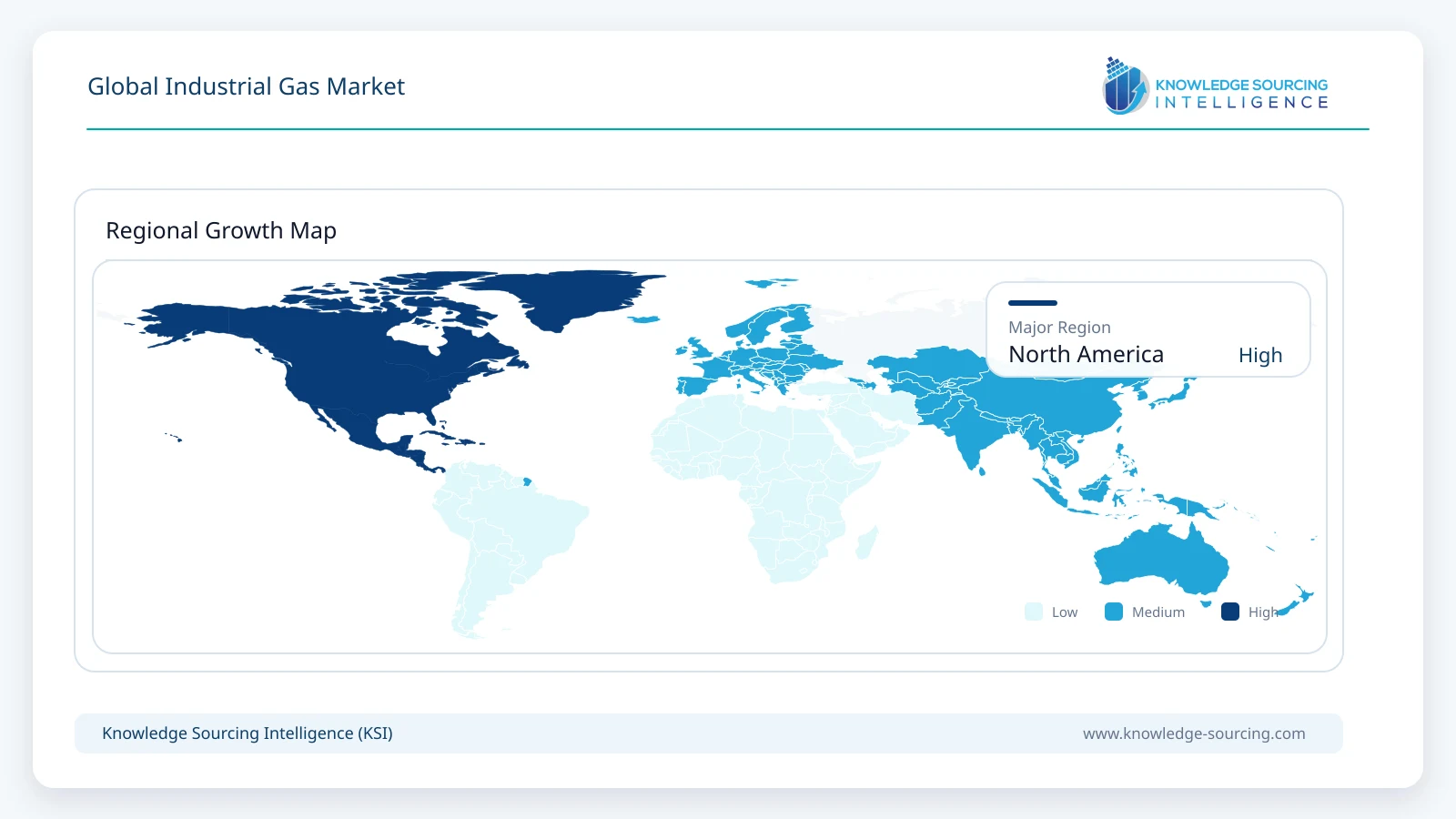
North America represents a substantial regional market, with the United States accounting for a majority share given the presence of major industrial gas suppliers including Linde, Air Liquide, Messer, and Air Products, alongside strong healthcare-sector demand growth.
Europe Market Analysis
Europe, while continuing to be a value-added epicenter for the industrial gas market, is increasingly tackling green hydrogen corridors, food-grade carbon capture, and increasingly stringent F-gas regulation and methane thresholds are driving OEMs in refrigeration to switch to natural refrigerants and diversify regional gas portfolios.
Asia-Pacific Market Analysis
Asia-Pacific is the largest industrial gases market accounting for significant global market share due to the scale of manufacturing in the region, the high level of investment in semiconductor fabrication in the region, and the rapid industrialization in China, India, Japan and south Korea.
Middle East and Africa Market Analysis
The Middle East and Africa is a strategic region for global distribution of specialty gases, as reported disruptions to the passage in the Strait of Hormuz highlight the region's critical role for the resilience of global distribution of specialty gases.
South America Market Analysis
South America is emerging as an increasingly important market for industrial gases, with ongoing growth in industrial and mining and healthcare-sector demand, supporting investment in industrial gases production and distribution within the region, particularly in Brazil.
List of Companies
Linde plc
Air Liquide S.A.
Air Products and Chemicals, Inc.
Messer SE & Co. KGaA
Nippon Sanso Holdings Corporation
Iwatani Corporation
Air Water Inc.
SOL Group
Taiyo Nippon Sanso Corporation
Gulf Cryo
Competitive Landscape
Linde plc
Linde plc supplies oxygen, nitrogen, argon, and hydrogen solutions integrated with industrial supply and on-site gas generation services, reporting a fifth consecutive year of record wins in small on-site nitrogen and oxygen projects alongside a record project backlog supporting multi-year decarbonization contracts.
Air Liquide S.A.
Air Liquide S.A. holds a leading global position through a diversified portfolio of industrial and specialty gases, supported by extensive production capacity and logistics infrastructure spanning industrial, medical, and healthcare end markets, alongside sustained investment in renewable hydrogen production.
Air Products and Chemicals, Inc.
Air Products and Chemicals, Inc. contributes critical industrial gas supply for refining, petrochemical, and materials processing applications, with strong global service delivery supporting on-site and pipeline-based distribution models across multiple end-user industries.
Analyst View
The Global Industrial Gas market continues to demonstrate the structurally defensive characteristics that have long distinguished it from more cyclical industrial categories, anchored by oxygen, nitrogen, and hydrogen demand that functions as essential production infrastructure across steel, semiconductor, chemical, and healthcare end markets rather than discretionary capital spending. The market's high consolidation, with Linde, Air Liquide, and Air Products collectively controlling over 55% of global supply, has enabled sustained multi-year investment in both green hydrogen infrastructure and on-site generation capacity even amid periodic supply-chain disruption events. The dual transformation underway — toward technology-intensive green hydrogen infrastructure on one hand, and toward regionalized, resilience-focused on-site generation on the other — is reshaping what was historically viewed as a commodity industry into a more technology- and infrastructure-intensive growth sector. Vendors that combine diversified gas portfolios, proven on-site generation capability, and credible renewable hydrogen production investment are best positioned to lead the next phase of market growth.
Global Industrial Gas Market Scope:
| Report Metric | Details |
|---|---|
| Total Market Size in 2026 | USD 109.3 billion |
| Total Market Size in 2031 | USD 128.6 billion |
| Forecast Unit | USD Billion |
| Growth Rate | 3.3% |
| Study Period | 2021 to 2031 |
| Historical Data | 2021 to 2024 |
| Base Year | 2025 |
| Forecast Period | 2026 – 2031 |
| Segmentation | Gas Type, Delivery Mode, End-User Industry, Geography |
| Companies |
|
Market Segmentation
By Gas Type
Oxygen
Nitrogen
Hydrogen
Argon
Carbon Dioxide
Others
By Delivery Mode
On-Site / Captive Generation
Merchant Liquid / Bulk
Packaged / Cylinder Gases
Pipeline Supply
By End-User Industry
Healthcare
Metals & Steel
Chemicals & Petrochemicals
Electronics & Semiconductors
Food & Beverage
Energy & Refining
Others
By Geography
North America
USA
Canada
Mexico
South America
Brazil
Others
Europe
Germany
France
United Kingdom
Others
Middle East and Africa
UAE
Saudi Arabia
Others
Asia Pacific
China
India
Japan
South Korea
Others
Table of Contents
1. EXECUTIVE SUMMARY
2. MARKET SNAPSHOT
2.1. Market Overview
2.2. Market Definition
2.3. Scope of the Study
2.4. Market Segmentation
3. BUSINESS LANDSCAPE
3.1. Market Drivers
3.2. Market Restraints
3.3. Market Opportunities
3.4. Porter's Five Forces Analysis
3.5. Industry Value Chain Analysis
3.6. Policies and Regulations
3.7. Strategic Recommendations
4. TECHNOLOGICAL OUTLOOK
4.1. Green Hydrogen & PEM Electrolyzer Integration
4.2. On-Site Generation & Pipeline Supply Networks
4.3. Ultra-High-Purity Gas Production for Semiconductors
4.4. Helium & Specialty Gas Recovery and Recycling
5. GLOBAL INDUSTRIAL GAS MARKET BY GAS TYPE
5.1. Introduction
5.2. Oxygen
5.3. Nitrogen
5.4. Hydrogen
5.5. Argon
5.6. Carbon Dioxide
5.7. Others
6. GLOBAL INDUSTRIAL GAS MARKET BY DELIVERY MODE
6.1. Introduction
6.2. On-Site / Captive Generation
6.3. Merchant Liquid / Bulk
6.4. Packaged / Cylinder Gases
6.5. Pipeline Supply
7. GLOBAL INDUSTRIAL GAS MARKET BY END-USER INDUSTRY
7.1. Introduction
7.2. Healthcare
7.3. Metals & Steel
7.4. Chemicals & Petrochemicals
7.5. Electronics & Semiconductors
7.6. Food & Beverage
7.7. Energy & Refining
7.8. Others
8. GLOBAL INDUSTRIAL GAS MARKET BY GEOGRAPHY
8.1. Introduction
8.2. North America
8.2.1. USA
8.2.2. Canada
8.2.3. Mexico
8.3. South America
8.3.1. Brazil
8.3.2. Others
8.4. Europe
8.4.1. Germany
8.4.2. France
8.4.3. United Kingdom
8.4.4. Others
8.5. Middle East and Africa
8.5.1. UAE
8.5.2. Saudi Arabia
8.5.3. Others
8.6. Asia Pacific
8.6.1. China
8.6.2. India
8.6.3. Japan
8.6.4. South Korea
8.6.5. Others
9. COMPETITIVE ENVIRONMENT AND ANALYSIS
9.1. Major Players and Strategy Analysis
9.2. Market Share Analysis
9.3. Mergers, Acquisitions, Agreements, and Collaborations
9.4. Competitive Dashboard
10. COMPANY PROFILES
10.1. Linde plc
10.2. Air Liquide S.A.
10.3. Air Products and Chemicals, Inc.
10.4. Messer SE & Co. KGaA
10.5. Nippon Sanso Holdings Corporation
10.6. Iwatani Corporation
10.7. Air Water Inc.
10.8. SOL Group
10.9. Taiyo Nippon Sanso Corporation
10.10. Gulf Cryo
11. APPENDIX
11.1. Currency
11.2. Assumptions
11.3. Base and Forecast Years Timeline
11.4. Key Benefits for the Stakeholders
11.5. Research Methodology
11.6. Abbreviations
Navigate
Trusted by the world's leading organizations











