
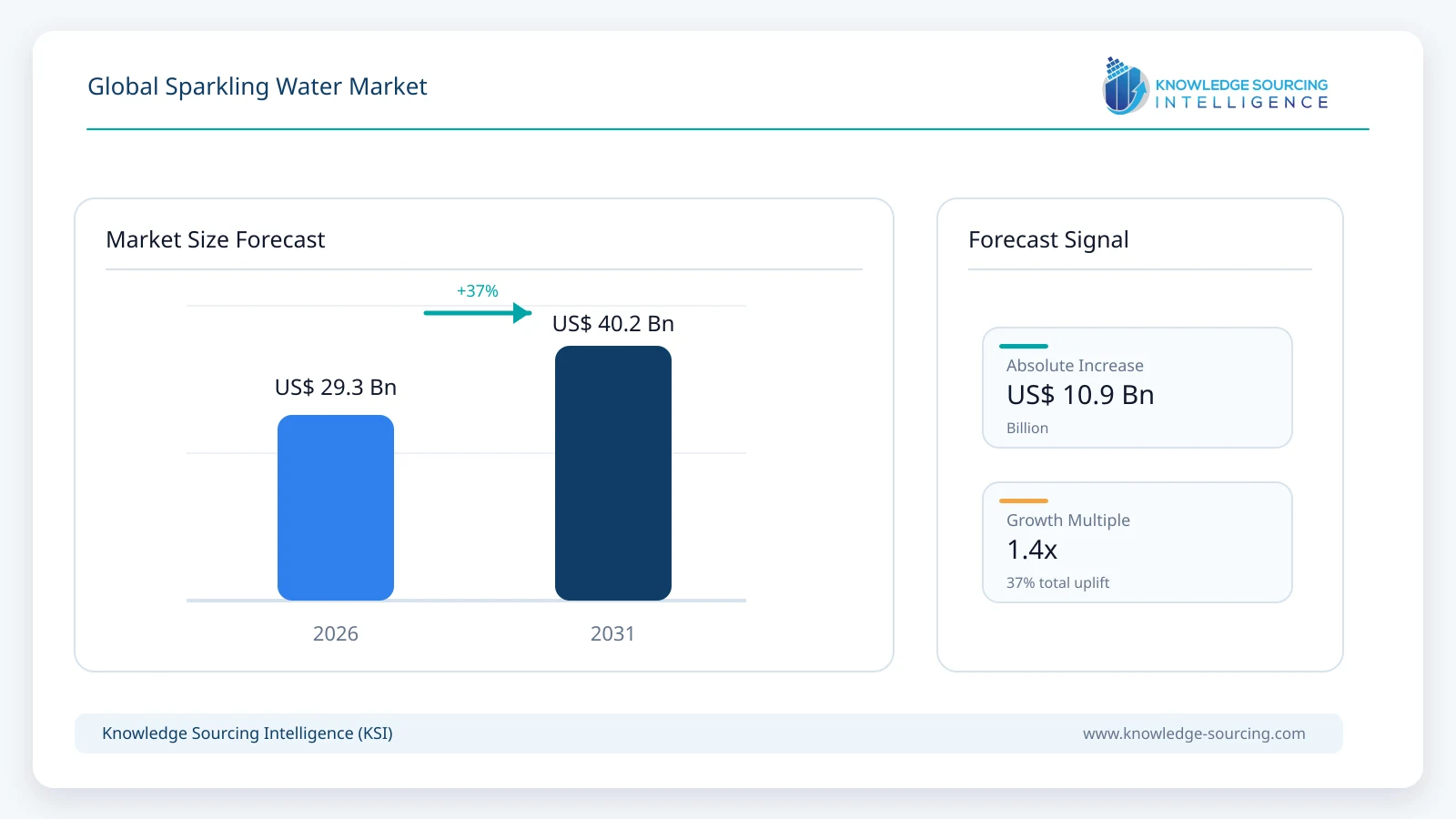
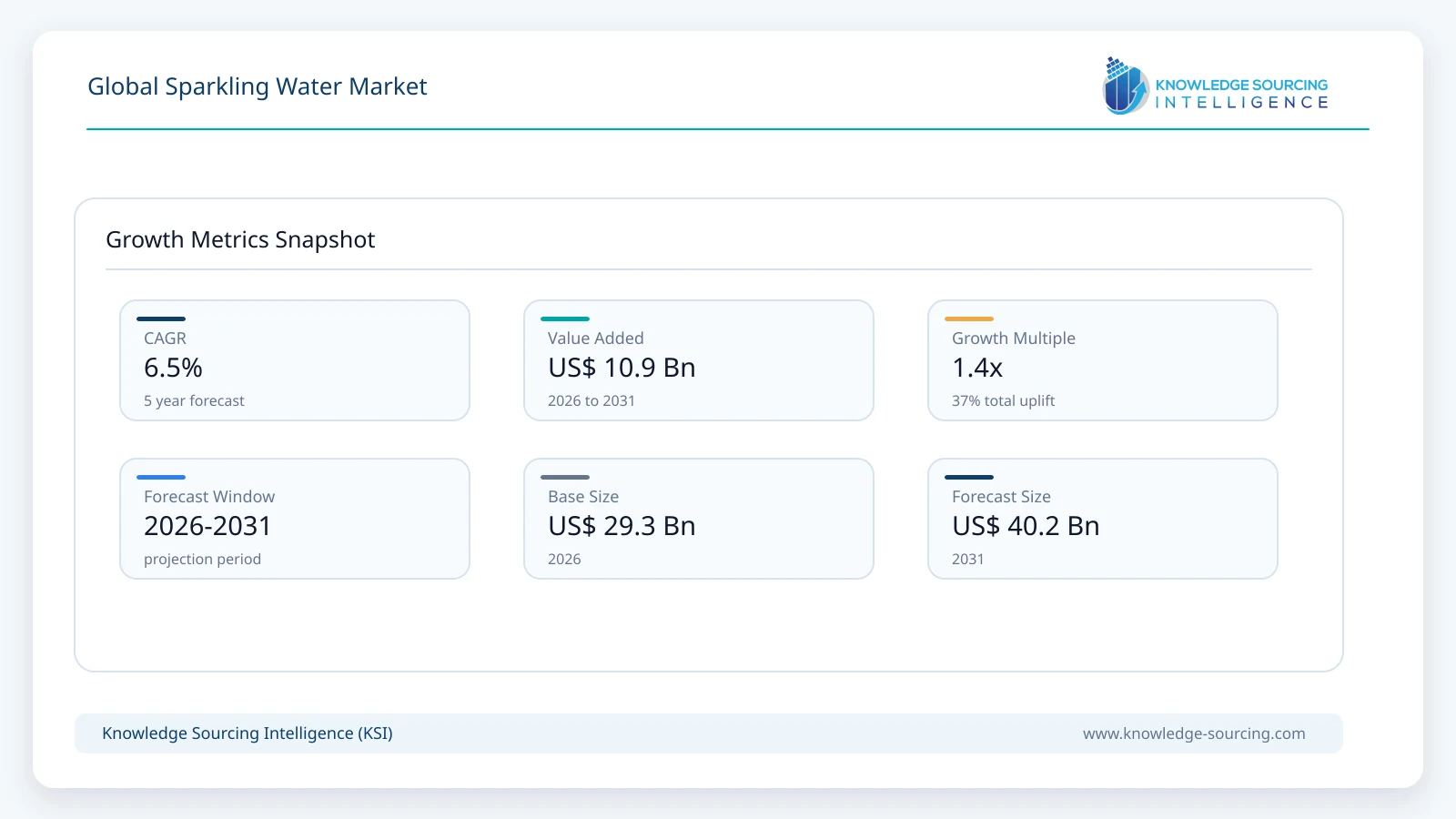
The global sparkling water market is forecast to grow at a CAGR of 6.5%, reaching USD 40.2 billion in 2031 from USD 29.3 billion in 2026.
Highlights:
- 1Rising preference for low- and zero-sugar beverages is reshaping packaged water purchasing decisions.
- 2Flavor innovation and premium positioning continue to expand consumer occasions beyond basic hydration.
- 3Retail distribution remains commercially important, although online beverage sales continue to gain traction.
- 4Packaging sustainability and recycled-material availability increasingly influence procurement and product development.
- 5Competition is driven by brand differentiation, distribution reach, flavor portfolios, and packaging innovation.
Purchasing decisions vary across consumer groups. Regular buyers generally compare taste profiles, carbonation intensity, ingredient lists, calorie content, packaging convenience, and brand reputation rather than price alone. Retailers continue allocating shelf space to premium sparkling water brands as beverage assortments shift toward products that address health-conscious consumption while maintaining attractive margins. Established beverage manufacturers are responding through flavor extensions, limited-edition offerings, functional product development, and broader distribution partnerships. Company disclosures from PepsiCo and The Coca-Cola Company also indicate continued investment in packaging innovation, omnichannel distribution, and consumer-oriented product development across beverage portfolios.
The market remains competitive because entry barriers for basic bottled water are relatively modest, while long-term commercial success depends on brand recognition, retail relationships, production efficiency, packaging capability, and distribution scale. Large multinational beverage companies compete alongside regional mineral water producers and premium sparkling water specialists. Growth in flavored variants continues to widen consumer appeal, although non-flavored sparkling water retains importance among buyers seeking products with minimal ingredients. Environmental expectations surrounding packaging materials, recycling systems, and water stewardship are also becoming more influential in purchasing decisions, product design, and corporate investment strategies.
Key Market Indicators
Indicator | Latest Evidence | Commercial Meaning |
Bottled and canned packaging collected or recycled by The Coca-Cola system | 65% (2024) | Recycling performance increasingly affects packaging strategy and regulatory preparedness. |
Recycled PET used by The Coca-Cola system | 18% (2024) | Beverage companies continue increasing recycled-content usage amid tightening packaging regulations. |
PepsiCo company-owned manufacturing sites | 285 sites (2025) | Extensive production and distribution networks support global beverage availability. |
PepsiCo consumers reached through safe water programs | Approximately 97 million people (2025) | Water stewardship has become an important component of beverage company sustainability strategies. |
Key indicator: The Coca-Cola system reported a 65% collection and refill or recycling rate for equivalent bottles and cans introduced to the market in 2024.
Commercial meaning: Packaging recovery is becoming a competitive consideration as governments strengthen extended producer responsibility and recycling requirements.
Market Drivers
Health-oriented substitution away from sugar-sweetened carbonated beverages. Consumer demand increasingly favors beverages that deliver refreshment without added sugar or high calorie content. Sparkling water benefits because it offers carbonation while avoiding many ingredients associated with conventional soft drinks. Beverage manufacturers continue broadening zero-sugar portfolios through flavored sparkling water and unsweetened products to address this shift. PepsiCo identifies consumer focus on health, wellness, product variety, and hydration as continuing factors influencing portfolio development and product innovation across its beverage business. These purchasing trends support premium pricing opportunities and encourage retailers to expand shelf allocation for sparkling water.
Flavor diversification is expanding consumption occasions. Sparkling water has evolved beyond plain mineral water into a category characterized by citrus, berry, botanical, tropical, and seasonal flavor combinations. This wider assortment encourages repeat purchases and attracts consumers seeking alternatives to traditional carbonated drinks without sacrificing variety. Companies including PepsiCo, Nestlé, Danone, and The Coca-Cola Company continue investing in product development, packaging formats, and consumer research to maintain portfolio relevance. Flavor innovation also enables suppliers to target premium retail segments where differentiation supports higher margins than conventional bottled water.
Retail and omnichannel distribution continue widening product accessibility. Hypermarkets, supermarkets, convenience stores, grocery retailers, and digital commerce platforms have expanded sparkling water visibility across mature and developing markets. Beverage suppliers increasingly invest in omnichannel capabilities because consumers expect consistent product availability across physical and digital retail environments. PepsiCo states that competition increasingly depends on distribution capability, shelf space, convenience, digital commerce, and responsiveness to changing consumer preferences. Wider distribution improves market penetration while enabling manufacturers to introduce premium product lines without relying exclusively on traditional grocery channels.
Premium positioning supports higher-value product portfolios. Consumers purchasing sparkling water frequently evaluate brand image, ingredient simplicity, natural mineral sourcing, carbonation quality, packaging appearance, and flavor authenticity rather than selecting solely on price. Premiumization has encouraged suppliers to introduce glass packaging, limited-edition flavors, naturally sourced mineral waters, and premium retail positioning. The strategy enables manufacturers to improve average selling prices while differentiating products in increasingly crowded beverage aisles. Premium positioning also strengthens foodservice opportunities where sparkling water complements restaurant, hospitality, and premium retail offerings.
Market Restraints and Challenges
Packaging regulation increases operating costs across the value chain. Beverage producers face expanding obligations related to recycled-content requirements, extended producer responsibility schemes, deposit-return systems, and packaging recovery targets across several jurisdictions. Compliance requires investment in recyclable packaging design, recycled material sourcing, labeling changes, and collaboration with recycling infrastructure. The Coca-Cola Company continues emphasizing collection systems, recycled material use, refillable packaging, and advocacy for effective recovery programs as part of its packaging strategy. These requirements increase operating complexity, particularly for suppliers with geographically diverse packaging portfolios.
Raw material and packaging cost volatility affects profitability. Sparkling water production depends heavily on PET resin, aluminum, glass, closures, labels, and transportation inputs whose prices remain exposed to commodity fluctuations. Beverage manufacturers also face varying freight, fuel, and energy costs across production regions. PepsiCo identifies packaging materials including PET, aluminum, glass, paperboard, and related commodities as important inputs whose pricing is actively managed through procurement strategies and contractual arrangements. Cost volatility can compress margins where competitive retail pricing limits the ability to pass higher costs directly to consumers.
Product differentiation remains difficult in mature retail markets. Basic sparkling water offers limited functional differentiation, making flavor innovation, branding, merchandising, and marketing essential commercial tools. Large multinational beverage companies possess broader advertising budgets, stronger retailer relationships, and more extensive distribution infrastructure than smaller regional brands. New entrants therefore face higher customer acquisition costs and limited shelf availability despite relatively straightforward manufacturing requirements. Competitive pressure also increases promotional spending, reducing profitability for suppliers unable to establish clear brand positioning.
Water resource management is receiving greater regulatory and investor attention. Beverage companies increasingly operate under scrutiny regarding water sourcing, watershed protection, and manufacturing efficiency. Water availability differs considerably across production regions, creating operational risks where facilities operate in water-stressed areas. PepsiCo continues expanding water efficiency programs and watershed replenishment initiatives across manufacturing operations, reflecting growing investor and regulatory expectations surrounding responsible water management. These requirements influence capital allocation, facility planning, and long-term production strategies rather than serving solely as sustainability commitments.
Major Segment Analysis
Flavored Sparkling Water
Flavored sparkling water represents the most commercially important segment because it broadens the category beyond traditional mineral water consumers and supports premium product positioning. Natural fruit flavors, botanical extracts, citrus blends, and seasonal variants have expanded consumer occasions from simple hydration to meal accompaniment and soft drink substitution. Buyers increasingly evaluate ingredient transparency, absence of added sugar, carbonation quality, and flavor authenticity rather than carbonation alone. Consequently, manufacturers continue investing in product formulation and flavor portfolio expansion to maintain repeat purchases and shelf differentiation.
Competition within this segment depends on balancing product innovation with operational efficiency. Flavor development must comply with regional food regulations while maintaining consistent taste across production batches. Retailers also expect regular product refreshes to sustain consumer interest, encouraging suppliers such as The Coca-Cola Company, PepsiCo, Danone, Nestlé, and Waterloo Sparkling Water Corp. to combine flavor innovation with wider retail distribution and premium packaging. Although non-flavored products retain a loyal consumer base, flavored sparkling water generates greater opportunities for product differentiation and value-added pricing.
Regional Analysis
Region | Main Demand Signal | Principal Constraint |
North America | Mature retail distribution, strong low-sugar beverage demand | Intense brand competition and promotional pricing |
Europe | Established mineral water culture and circular packaging regulation | Compliance costs and recycling obligations |
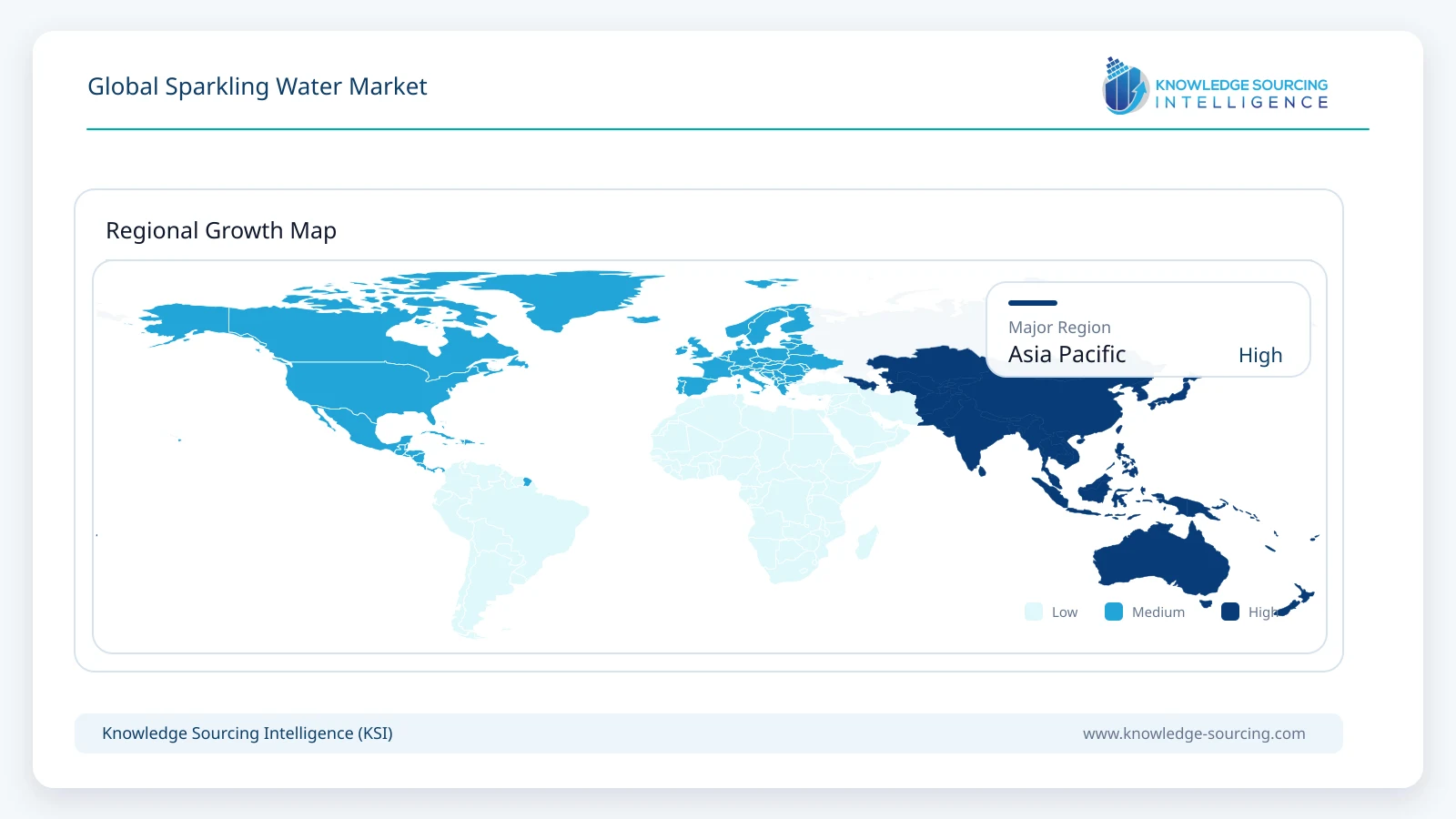
Asia Pacific | Rising packaged beverage consumption and modern retail expansion | Uneven consumer awareness and fragmented distribution |
Middle East and Africa | Expanding premium beverage retail and hospitality sectors | Water resource constraints and import dependence in several markets |
North America
North America remains an important revenue-generating region because consumers increasingly substitute sugar-sweetened carbonated beverages with low-calorie and zero-sugar alternatives. Extensive supermarket networks, convenience retail, foodservice channels, and e-commerce platforms support product availability across the United States and Canada. Product innovation is particularly active in flavored sparkling water, where manufacturers frequently introduce limited-edition varieties and multipack formats. Competition is driven by shelf positioning, marketing investment, and retailer relationships rather than manufacturing capability alone.
Europe
Europe benefits from an established tradition of bottled mineral water consumption, particularly in countries such as Germany, France, Italy, and the United Kingdom. The region also operates under progressively stricter packaging and circular economy policies, including recycled-content targets and extended producer responsibility frameworks introduced under European Union legislation. These rules encourage manufacturers to increase recycled material use, redesign packaging, and improve collection systems while raising compliance costs across the beverage value chain.
Asia Pacific
Asia Pacific continues to attract investment as disposable incomes, urban retail networks, and organized grocery formats expand across China, India, Japan, Australia, Indonesia, and Thailand. Consumer awareness of lower-sugar beverage options has increased, although purchasing behavior remains diverse between mature and developing markets. International beverage companies continue strengthening regional manufacturing, distribution partnerships, and localized flavor portfolios to improve market penetration. Pricing remains more competitive than in North America or Western Europe because consumers often compare sparkling water with conventional bottled water and other ready-to-drink beverages.
Middle East and Africa
Demand across the Middle East and Africa is concentrated in urban centers, hospitality channels, premium retail, and expatriate consumer populations. Countries including the United Arab Emirates and Saudi Arabia continue expanding modern retail infrastructure, creating broader access to imported and locally packaged sparkling water products. Market development is influenced by water resource management policies, import logistics, and relatively smaller premium beverage consumer bases compared with Europe or North America. Manufacturers increasingly evaluate local bottling partnerships to improve supply resilience and reduce transportation costs.
Competitive Landscape
The global sparkling water market exhibits moderate concentration, with multinational beverage companies competing alongside regional bottled water specialists and premium mineral water producers. Scale provides advantages in manufacturing efficiency, procurement, retail negotiations, and marketing investment, yet smaller brands remain competitive through premium positioning, natural mineral sourcing, distinctive flavor portfolios, and regional brand loyalty.
The Coca-Cola Company, PepsiCo, Danone, Nestlé, Keurig Dr Pepper, Crystal Geyser Water Company, Gerolsteiner Brunnen GmbH & Co. KG, A.G. Barr, Aava, and Waterloo Sparkling Water Corp. continue strengthening portfolios through flavor expansion, sustainable packaging initiatives, distribution investments, and product differentiation. Companies are also increasing recycled packaging content, improving manufacturing efficiency, and expanding omnichannel distribution to address retailer expectations, evolving packaging regulations, and changing consumer purchasing behavior. Strong retailer relationships and supply-chain resilience remain important barriers for new entrants.
Recent Developments
June 2026: AMASS Brands Group acquired a majority stake in HpO Sparkling Protein Water. The acquisition expanded AMASS into functional hydration, adding a fast-growing sparkling protein water brand with zero sugar and plant-based protein to strengthen its premium beverage portfolio.
April 2026: PepsiCo Canada launched bubly POP. Building on the bubly sparkling water franchise, bubly POP entered the soda category with real fruit juice, low sugar, and three flavors, broadening PepsiCo's healthier carbonated beverage offerings.
February 2026: PepsiCo introduced limited-edition Galactic-inspired bubly sparkling water flavors. Developed alongside Nintendo's The Super Mario Galaxy Movie, the launch featured three exclusive flavors in color-changing cans, reinforcing bubly's innovation-led seasonal marketing strategy.
May 2025: PepsiCo announced its acquisition of poppi. The $1.95 billion transaction expanded PepsiCo's better-for-you beverage portfolio, complementing its sparkling water business with a rapidly growing functional carbonated beverage brand targeting health-conscious consumers.
January 2025: Sparkling Ice introduced its limited-edition STARBURST-flavored Sparkling Water lineup. The collaboration brought Original, Lemon, Strawberry, and Cherry STARBURST-inspired flavors to market, leveraging nostalgic confectionery branding to attract younger consumers and drive seasonal sparkling water sales.
Regulatory and Policy Environment
Packaging regulation has become one of the most influential policy considerations affecting the sparkling water market. The European Union continues implementing measures under its Circular Economy Action Plan and Packaging and Packaging Waste Regulation, encouraging greater recycled-content use, improved packaging recovery, and reduced packaging waste. These measures influence material selection, product labeling, and investment in recycling infrastructure across beverage manufacturers.
Food labeling requirements also continue evolving across several jurisdictions. Manufacturers must comply with ingredient disclosure, nutritional labeling, food safety standards, and environmental packaging obligations before products enter commercial distribution. Water stewardship is receiving greater regulatory attention as governments strengthen resource management policies in water-stressed regions. Consequently, beverage companies increasingly integrate water-use efficiency, source protection, and sustainable packaging into long-term operational planning rather than treating them solely as environmental initiatives.
Outlook and Strategic Implications
Consumer demand is expected to remain closely linked to healthier beverage purchasing patterns, premium product positioning, and expanding retail accessibility during the 2026-2031 forecast period. Flavored sparkling water is likely to remain the primary source of product innovation because manufacturers continue introducing differentiated flavor combinations, cleaner ingredient profiles, and premium packaging formats that support higher average selling prices. Digital retail and subscription-based grocery services are also expected to strengthen repeat purchasing across mature consumer markets.
Strategic priorities across the value chain are expected to include:
Increasing recycled-content usage and improving packaging recovery systems to meet evolving environmental regulations.
Expanding localized manufacturing and distribution to improve supply resilience and reduce logistics costs.
Investing in flavor development and premium branding to strengthen product differentiation in mature retail markets.
Enhancing omnichannel retail capabilities to improve product availability across supermarkets, convenience stores, foodservice, and e-commerce platforms.
Commercial success during the forecast period will depend less on expanding production capacity alone and more on brand differentiation, sustainable packaging, distribution efficiency, and the ability to respond quickly to changing consumer purchasing patterns. Companies capable of balancing regulatory compliance with product innovation and efficient supply-chain management are expected to maintain stronger competitive positions as the global sparkling water market continues to evolve.
Sparkling Water Market Scope:
| Report Metric | Details |
|---|---|
| Total Market Size in 2026 | USD 29.3 billion |
| Total Market Size in 2031 | USD 40.2 billion |
| Forecast Unit | Billion |
| Growth Rate | 6.5% |
| Study Period | 2021 to 2031 |
| Historical Data | 2021 to 2024 |
| Base Year | 2025 |
| Forecast Period | 2026 – 2031 |
| Segmentation | Type, Distribution Channel, Packaging Type, Geography |
| Companies |
|
Market Segmentation
By Type
- Flavoured
- Non-flavored
By Distribution Channel
- Online
- Offline
- Hypermarket/Supermarket
- Convenience Store
- Grocery Store
- Others
By Packaging Type
- Glass
- Metal
- Plastic
By Geography
- North America
- USA
- Canada
- Mexico
- South America
- Brazil
- Argentina
- Others
- Europe
- UK
- Germany
- France
- Spain
- Italy
- Others
- Middle East and Africa
- Saudi Arabia
- UAE
- Others
- Asia Pacific
- Japan
- China
- India
- Australia
- Indonesia
- Thailand
- Others
Table of Contents
1. INTRODUCTION
1.1. Market Overview
1.3. Market Definition
1.4. Scope of the Study
1.5. Market Segmentation
1.6. Currency
1.7. Assumptions
1.8. Base and Forecast Years Timeline
2. RESEARCH METHODOLOGY
2.1. Research Data
2.2. Assumptions
3. EXECUTIVE SUMMARY
3.1. Research Highlights
4. MARKET DYNAMICS
4.1. Market Drivers
4.2. Market Restraints
4.3. Porter’s Five Forces Analysis
4.3.1. Bargaining Power of Suppliers
4.3.2. Bargaining Power of Buyers
4.3.3. Threat of New Entrants
4.3.4. Threat of Substitutes
4.3.5. Competitive Rivalry in the Industry
4.4. Industry Value Chain Analysis
5. GLOBAL SPARKLING WATER MARKET ANALYSIS BY TYPE
5.1. Introduction
5.2. Flavoured
5.3. Non-flavored
6. GLOBAL SPARKLING WATER MARKET ANALYSIS BY DISTRIBUTION CHANNEL
6.1. Introduction
6.2. Online
6.3. Offline
6.3.1. Hypermarket/Supermarket
6.3.2. Convenience Store
6.3.3. Grocery Store
6.3.4. Others
7. GLOBAL SPARKLING WATER MARKET ANALYSIS BY PACKAGING TYPE
7.1. Introduction
7.2. Glass
7.3. Metal
7.4. Plastic
8. GLOBAL SPARKLING WATER MARKET ANALYSIS BY GEOGRAPHY
8.1. Introduction
8.2. North America
8.2.1. By Type
8.2.2. By Distribution Channel
8.2.3. By Packaging Type
8.2.3.1. USA
8.2.3.2. Canada
8.2.3.3. Mexico
8.3. South America
8.3.1. By Type
8.3.2. By Distribution Channel
8.3.3. By Packaging Type
8.3.3.1. Brazil
8.3.3.2. Argentina
8.3.3.3. Others
8.4. Europe
8.4.1. By Type
8.4.2. By Distribution Channel
8.4.3. By Packaging Type
8.4.3.1. UK
8.4.3.2. Germany
8.4.3.3. France
8.4.3.4. Spain
8.4.3.5. Italy
8.4.3.6. Others
8.5. Middle East and Africa
8.5.1. By Type
8.5.2. By Distribution Channel
8.5.3. By Packaging Type
8.5.3.1. Saudi Arabia
8.5.3.2. UAE
8.5.3.3. Others
8.6. Asia Pacific
8.6.1. By Type
8.6.2. By Distribution Channel
8.6.3. By Packaging Type
8.6.3.1. Japan
8.6.3.2. China
8.6.3.3. India
8.6.3.4. Australia
8.6.3.5. Indonesia
8.6.3.6. Thailand
8.6.3.7. Others
9. COMPETITIVE ENVIRONMENT AND ANALYSIS
9.1. Major Players and Strategy Analysis
9.2. Market Share Analysis
9.3. Mergers, Acquisitions, Agreements, and Collaborations
10. COMPANY PROFILES
10.1. The Coca-Cola Company
10.2. Danone
10.3. Keurig Dr Pepper Inc.
10.4. Nestlé
10.5. PepsiCo
10.6. Crystal Geyser Water Company
10.7. Gerolsteiner Brunnen GMBH & CO. KG
10.8. A.G. Barr
10.9. Aava
10.10. Waterloo Sparkling Water Corp.
Navigate
Trusted by the world's leading organizations











