
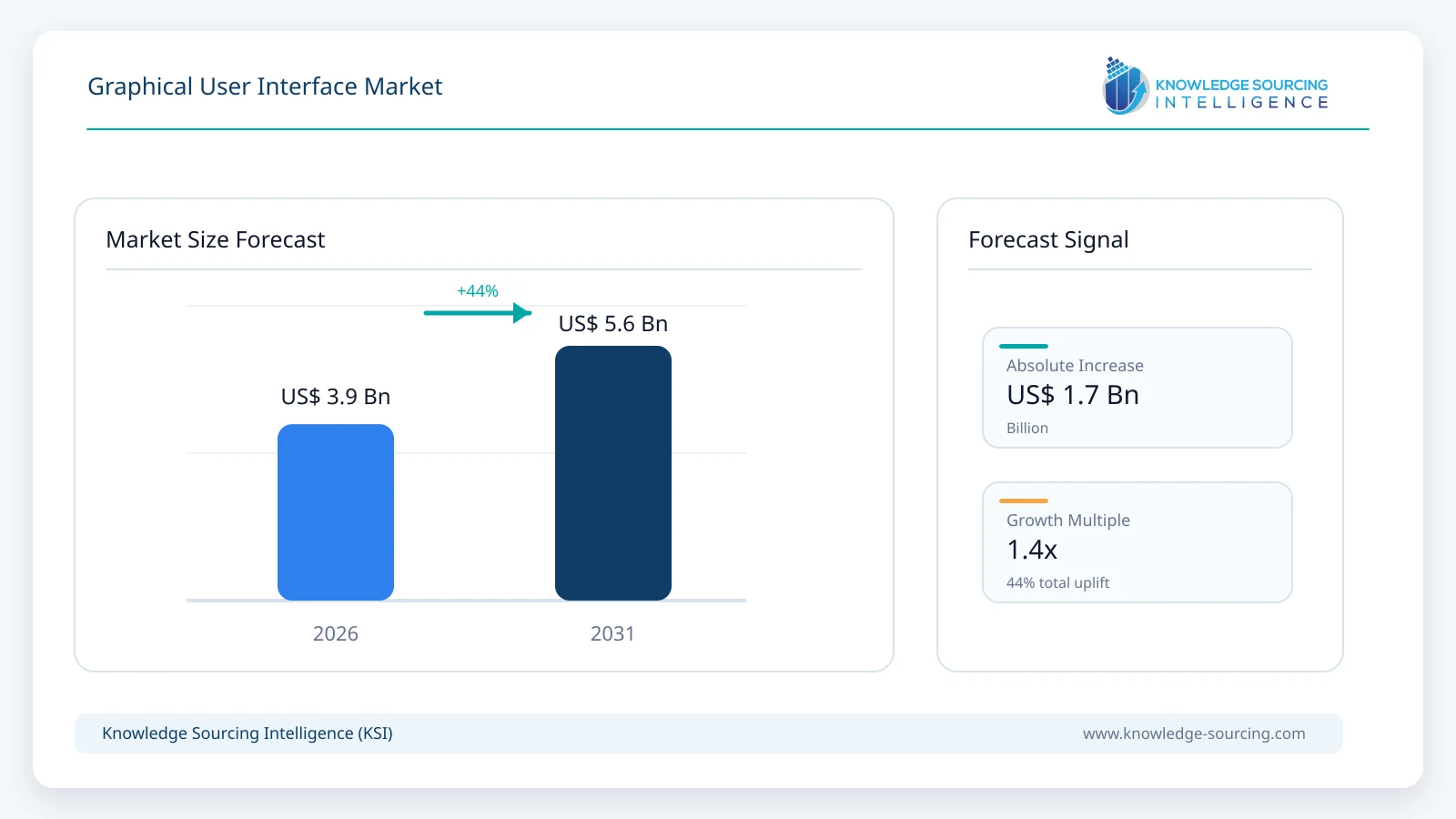
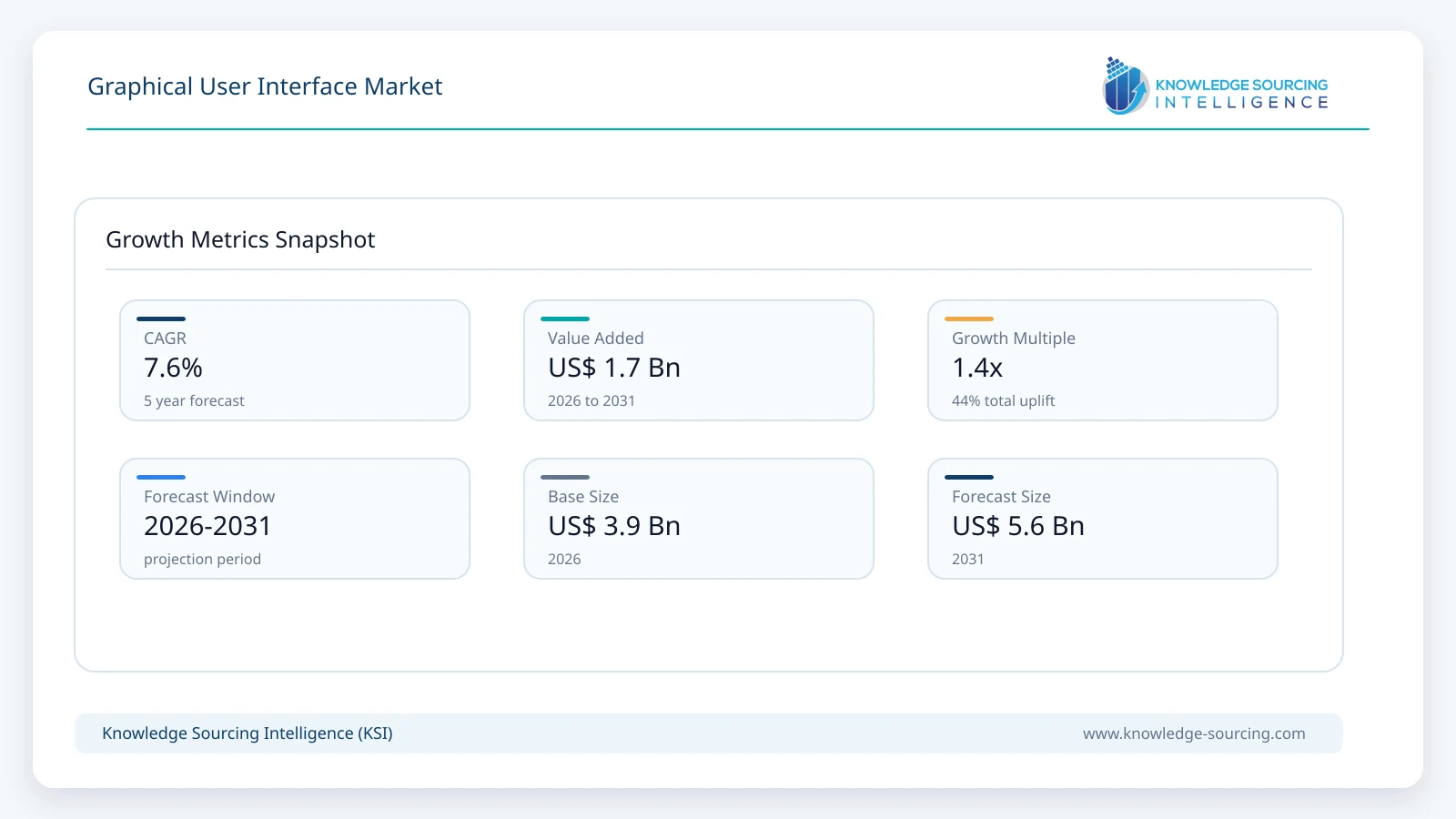
The graphical user interface market is forecast to grow at a CAGR of 7.63%, reaching USD 5.59 billion in 2031 from USD 3.87 billion in 2026.
Highlights:
- 1Software platforms and GUI frameworks account for approximately 52% of global market value in 2026, equivalent to around USD 2.01 billion.
- 2Vehicle infotainment and digital cockpit applications represent approximately 24% of market value in 2026 and record above-market growth through 2031.
- 3Automotive accounts for approximately 28% of global GUI market value in 2026 as digital displays and software-defined cockpit functions expand.
- 4North America represents approximately 37% of market value in 2026, supported by major operating-system, design-software and interface-development companies.
- 5Design and prototyping tools are projected to grow at approximately 11.1% annually through 2031 as AI and design-to-code technologies accelerate interface development.
Graphical interfaces remain the primary interaction layer across computers, smartphones, vehicles and a growing range of embedded products, while the underlying development environment is becoming considerably more sophisticated. Interface frameworks now need to accommodate touch, keyboard, mouse, voice, accessibility functions, responsive layouts, high-resolution displays and multiple device form factors while maintaining consistent application behaviour.
Major software platforms continue to invest in dedicated GUI frameworks. Microsoft recommends WinUI 3 and the Windows App SDK for new native Windows desktop applications, while supporting C#, C++ and XAML-based development across Windows 10 and Windows 11. Google announced in 2026 that future Android UI development would become Compose-first, with the older Views toolkit moving into maintenance mode. Jetpack Compose is simultaneously expanding adaptive UI capabilities for phones, watches, automotive systems, and other Android surfaces.
Embedded GUI development is advancing in parallel. STMicroelectronics maintains TouchGFX as an optimized graphical framework for STM32 microcontrollers, NXP released GUI Guider 2.0 during 2026, and Qt continues expanding design-to-code workflows across embedded devices and automotive systems.
Market Trends
AI Is Moving Directly Into Interface Design and Development
Artificial intelligence is becoming part of the interface-development workflow rather than remaining a separate productivity tool. Qt Design Studio 4.8.2 introduced an agentic AI assistant capable of reading, creating and modifying QML project files across an entire GUI project. The platform can generate interfaces from natural-language instructions, work with project structure and connect to external tools through the Model Context Protocol.
Figma is moving in the same direction from the collaborative design side. By June 2026, the company reported 15,964 paid customers generating more than USD 10,000 in annual recurring revenue, up 34% year over year, while more than 80% of these customers were using AI credits every week. Figma also introduced Code Layers, allowing static designs to become interactive code-backed prototypes and enabling teams to work more directly with production code.
The result is a shorter path between visual concept, working prototype, and deployed interface. AI is increasingly assisting with layout generation, repetitive component construction, accessibility checks, code generation, and design-system enforcement, allowing developers and designers to spend more time on interaction logic and user experience.
Design-to-Code Workflows Are Reducing Separation Between Designers and Developers
GUI development historically involved designers creating visual assets and software engineers separately reproducing those designs within an application framework. New tools increasingly preserve interface structure and design-system information as designs move into production.
Qt released Figma to Qt 1.0 in April 2026, allowing approved Figma designs to be converted into QML while preserving elements such as Auto Layout, design variables and Qt Quick controls. Qt Design Studio also supports direct interface prototyping and development within the same tool chain.
Crank Software’s Storyboard follows a similar design-centric architecture for embedded products, allowing assets from tools such as Figma and Photoshop to be imported while keeping interface presentation separated from underlying application logic. The company targets automotive, medical, industrial and connected-device interfaces where designers must validate the GUI on constrained production hardware rather than only within desktop prototypes.
This convergence increases the value of integrated GUI development platforms capable of carrying interface components from initial design through testing and deployment without repeated manual reconstruction.
Adaptive Interfaces Are Expanding Across Device Form Factors
Developers increasingly need a single design system to work across phones, tablets, desktop displays, watches, vehicle screens and other device categories. Google expanded Compose during 2026 with adaptive APIs including FlexBox, Grid, MediaQuery and Styles and announced that future Android UI development would be centered on Compose.
The same direction is visible across Windows. Microsoft’s current development guidance identifies WinUI 3 as the recommended framework for new native Windows applications while also supporting modernization of existing WPF, Windows Forms and Win32 applications. Cross-platform applications can alternatively use frameworks such as .NET MAUI.
GUI platforms therefore compete increasingly on their ability to preserve design consistency while adapting navigation, layout, density and interaction patterns to different screens and input methods. This is particularly important for products such as automotive cockpits and connected appliances, where a common design system may need to operate across several display resolutions and hardware configurations.
Market Drivers
Increasing Number of Screen-Based Embedded Products
Graphical interfaces continue moving into products that previously relied on buttons, indicator lights or simple segment displays. Appliances, industrial machines, medical devices, vehicle controls and connected consumer products increasingly use touchscreens or high-resolution displays to accommodate more functionality without adding equivalent numbers of physical controls.
Microcontroller vendors are investing directly in this transition. STMicroelectronics’ TouchGFX framework is optimized for STM32 devices and now includes emulated framebuffer technology that allows higher-resolution interfaces to operate without requiring a full external framebuffer. TouchGFX 4.26 also improved rendering performance and development workflow.
NXP’s GUI Guider provides another indication of continuing embedded-GUI investment. Version 2.0 was released during 2026, followed by version 2.0.1 in August, supporting the creation of interfaces for embedded platforms ranging from smart appliances and building systems to connected displays.
As display hardware becomes less expensive and processors provide stronger graphics capability, the commercial opportunity increasingly shifts toward software that allows manufacturers to create, test, and maintain differentiated interfaces efficiently.
Automotive Cockpits Are Becoming Software-Defined Interface Platforms
Automotive systems provide one of the clearest examples of GUI expansion. Instrument clusters, infotainment displays, climate controls, navigation, charging information, vehicle settings, and increasingly ADAS visualization are being integrated into larger digital cockpit environments.
Qt’s 2026 automotive demonstrations combine 2D interfaces, real-time 3D graphics, ADAS surround view, AI assistants, multimedia functions and vehicle controls within panoramic displays running on automotive hardware. The company states that Qt software is used by global automotive OEMs to deliver in-vehicle experiences across millions of vehicles annually.
Crank Software similarly provides embedded GUI technology for automotive clusters and infotainment, while Elektrobit, Rightware and BlackBerry QNX participate across cockpit software and HMI architectures. The move from isolated displays toward integrated software-defined cockpits increases the amount of GUI software required per vehicle and places greater importance on reusable design systems, hardware abstraction, functional reliability and rapid interface updates.
Interface Development Is Becoming a Continuous Software Process
GUI development increasingly continues after initial product design. Applications and connected products receive regular interface changes, additional functions, accessibility improvements and design-system updates throughout their operating lives.
Microsoft maintains WinUI separately from the Windows operating-system release cycle through the Windows App SDK, allowing interface capabilities to evolve more frequently. Google continues expanding Compose across Android surfaces, while commercial GUI development platforms increasingly combine version management, testing, automated code generation and reusable components.
Figma’s enterprise growth provides additional evidence that interface work has become embedded within product-development organizations rather than functioning as an occasional design activity. Paid customers generating more than USD 100,000 in annual recurring revenue increased to 1,635 by June 2026, up from 1,119 a year earlier.
This continuous development model supports recurring software subscriptions and enterprise licenses rather than one-time GUI tool purchases.
Market Restraints
Multiple Platforms and Hardware Architectures Increase Development Complexity
Interface developers must accommodate different operating systems, processors, screen dimensions, graphics accelerators, memory constraints and input mechanisms. A GUI designed for a high-performance smartphone or desktop computer cannot simply be transferred to a microcontroller-based medical or industrial device without considering memory usage, rendering performance and hardware limitations.
Embedded frameworks address these constraints through optimized rendering and reusable runtime engines, but development teams still need to test applications across target hardware. ST’s continuing work on framebuffer efficiency and graphics acceleration and Crank’s emphasis on deploying designs directly onto embedded targets illustrate the amount of engineering required below the visible interface.
Cross-platform frameworks reduce duplicated work but cannot entirely eliminate hardware-specific optimization, particularly in automotive, medical and industrial products where reliability and response time are critical.
Accessibility and Interface Quality Requirements Are Increasing
As graphical interfaces become the primary control mechanism for more products, poor interface design can directly reduce usability and accessibility. Developers must account for contrast, text scaling, control size, keyboard navigation, screen readers, voice interaction and alternative input methods across increasingly diverse users.
Apple’s 2026 accessibility updates illustrate the expanding expectations placed on modern interfaces. Apple Intelligence is being integrated with VoiceOver, Magnifier, Voice Control and Accessibility Reader, including natural-language navigation of onscreen controls. Apple’s design guidance also emphasizes adaptable interfaces and sufficiently sized controls across its platforms.
These requirements improve product usability but add testing and design complexity. Organizations developing interfaces for healthcare, transportation and regulated products face particularly high validation requirements because incorrect or unclear visual information can affect safety as well as user experience.
Segment Analysis
By Offering: Software Platforms and Frameworks
Software platforms and GUI frameworks account for approximately USD 2.01 billion in 2026 and are projected to reach around USD 2.96 billion by 2031, representing growth of approximately 8.0% annually. These products provide rendering engines, component libraries, layout systems, development environments and runtime technologies required to build production interfaces.
The segment includes desktop and mobile frameworks such as WinUI and Jetpack Compose as well as embedded technologies including Qt, Storyboard, TouchGFX, GUI Guider, Altia and LVGL. Microsoft’s decision to position WinUI 3 as its recommended native Windows development framework and Google’s move to Compose-first Android development demonstrate the strategic importance of maintained GUI frameworks within major software ecosystems.
Design and prototyping tools grow faster and reach approximately USD 1.51 billion by 2031 as Figma, Qt Design Studio and related tools add AI, interactive prototyping and design-to-code functions.
By Application: Vehicle Infotainment and Digital Cockpit
Vehicle infotainment and digital cockpit applications account for approximately USD 929 million in 2026 and are projected to reach around USD 1.56 billion by 2031, representing growth of approximately 11.0% annually. Automotive GUI systems are expanding beyond conventional central infotainment displays into instrument clusters, passenger displays, head-up interfaces, vehicle controls and panoramic cockpit environments.
Current development platforms increasingly support combinations of 2D and 3D rendering, ADAS visualization and multiple displays within one software architecture. Qt’s current automotive platform demonstrates integrated surround-view, multimedia, vehicle settings and real-time 3D functions, while Crank targets both clusters and infotainment systems through Storyboard.
Smartphones and wearables remain another major application and reach approximately USD 1.12 billion by 2031, but automotive applications grow faster because the number, size and functionality of displays per vehicle continue to increase.
By Industry Vertical: Automotive
Automotive represents approximately USD 1.08 billion of GUI market value in 2026 and is projected to reach around USD 1.79 billion by 2031 at a CAGR of approximately 10.5%. The industry requires specialised GUI development because interfaces need to operate reliably on embedded automotive hardware while supporting long vehicle development and operating cycles.
Digital cockpits increasingly consolidate information that was previously distributed among mechanical gauges, physical switches and separate entertainment systems. GUI software therefore becomes an important part of vehicle differentiation alongside the underlying electronics. Automotive suppliers including Qt, Altia, Elektrobit, Rightware, Crank Software and BlackBerry QNX provide platforms or development environments supporting these cockpit architectures.
Healthcare is smaller but grows at approximately 9.4% annually and reaches around USD 726 million by 2031 as medical-device manufacturers incorporate larger touch interfaces and more sophisticated visualization into diagnostic and monitoring equipment.
Regional Outlook
North America
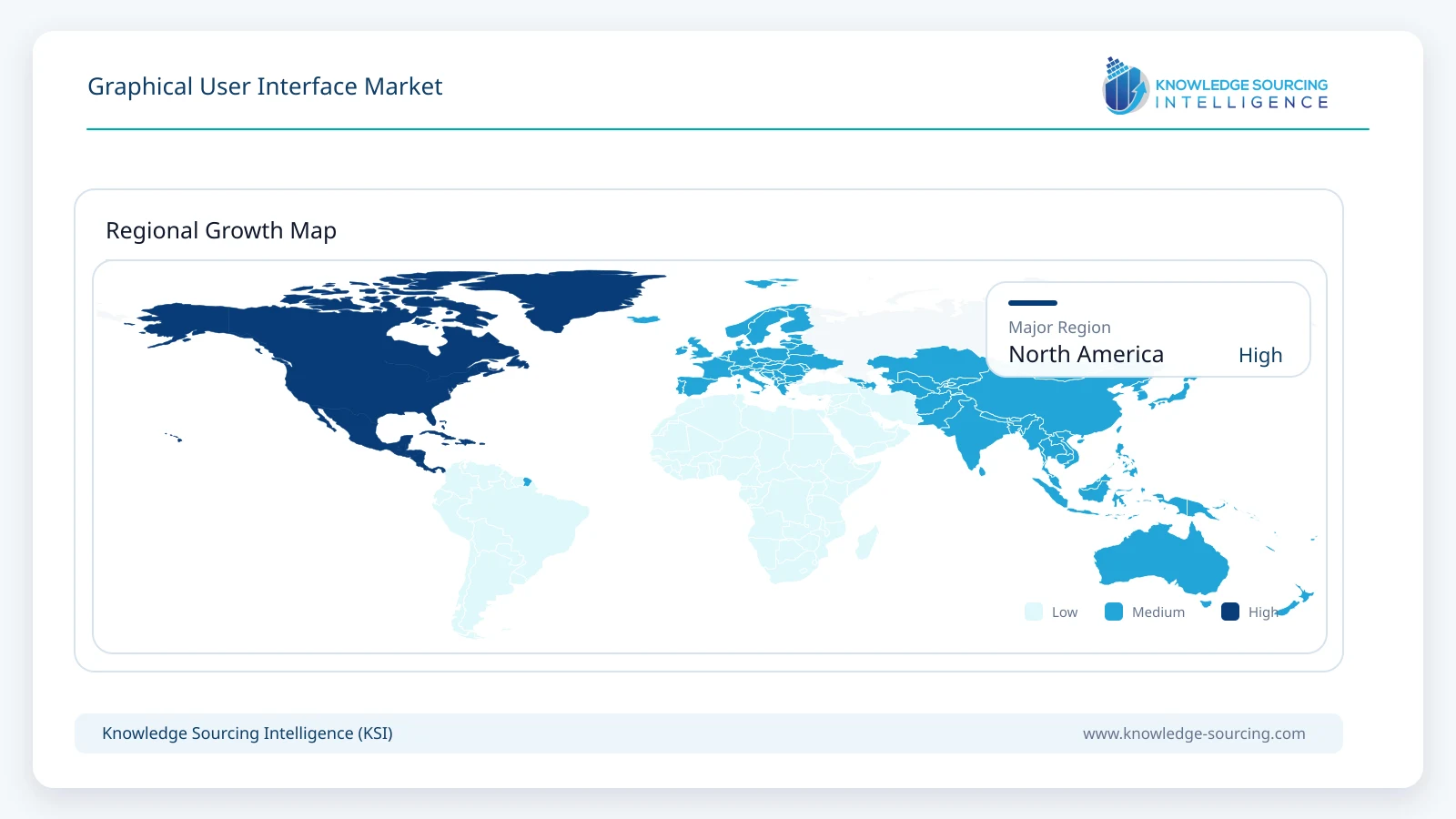
North America accounts for approximately USD 1.43 billion in 2026 and remains the largest regional GUI market, reaching around USD 1.90 billion by 2031. The region hosts major operating-system, design-software, and interface technology companies including Microsoft, Google, Apple, Adobe, Figma, Altia, and Crank Software’s AMETEK parent organization.
The commercial design ecosystem is particularly strong. Figma reported almost 16,000 paid customers generating more than USD 10,000 in annual recurring revenue by June 2026, while AI adoption among those customers had become widespread. Microsoft continues investing in WinUI and the Windows App SDK, while Apple and Google are extending GUI design principles across desktop, mobile, wearable, automotive and accessibility environments.
North America remains the largest regional market through 2031, although its share gradually declines as embedded electronics and automotive interface development expand faster in Asia.
Asia Pacific
Asia Pacific is projected to grow from approximately USD 1.20 billion in 2026 to USD 1.96 billion in 2031 at a CAGR of approximately 10.3%, overtaking North America marginally by the end of the forecast period. The region combines large automotive and consumer-electronics manufacturing industries with expanding software-development ecosystems.
China, Japan and South Korea have substantial automotive and electronics production bases, while India and Southeast Asia continue expanding software and device development. Automotive digital cockpits provide an important source of demand because regional vehicle manufacturers increasingly differentiate models through large displays, connected infotainment and software-defined functions.
Asia Pacific also benefits from the presence of semiconductor companies and embedded-tool ecosystems supporting graphical interfaces at the hardware level. NXP and STMicroelectronics maintain extensive development support across regional engineering customers, while Qt demonstrated its latest panoramic automotive cockpit technologies at the 2026 Beijing International Automotive Exhibition.
Competitive Environment and Analysis
Competition spans several layers of the GUI development ecosystem. Microsoft, Google and Apple maintain native user-interface technologies tied closely to their operating systems, while Qt Group provides cross-platform application and embedded development tools. Embedded GUI specialists including Altia and Crank Software focus on production interfaces for automotive, industrial and medical devices, while semiconductor suppliers such as STMicroelectronics and NXP provide GUI development technologies optimized around their hardware platforms.
Design and collaboration platforms form another increasingly important layer. Figma has developed from collaborative interface design into interactive prototyping and code-assisted development, while Adobe continues integrating generative and conversational AI into creative workflows. Qt is connecting design and implementation through Figma-to-QML conversion and its AI-enabled Design Studio.
Automotive creates a particularly competitive specialist ecosystem involving Qt, Altia, Elektrobit, Rightware, BlackBerry QNX and other cockpit software suppliers. Selection increasingly depends on graphics performance, hardware portability, design workflow, functional reliability and the ability to support multiple displays and operating systems.
AI is beginning to alter competition across these categories. Tools that previously differentiated on component libraries and visual editors increasingly compete on automated design generation, code conversion, interface testing and project-level AI assistance. Qt’s agentic Design Studio functionality and Figma’s code-backed prototypes illustrate how interface software is progressing from a design environment toward an automated product-development platform.
Recent Developments
September 2026: Qt released Design Studio 4.8.3 as it continued expanding its AI-assisted interface design and development environment.
August 2026: NXP released GUI Guider 2.0.1 for Windows, macOS and Ubuntu, following the introduction of GUI Guider 2.0 earlier in the year.
June 2026: Figma introduced Code Layers and expanded Figma Make integration, enabling teams to create interactive code-backed prototypes and work more directly with production codebases.
May 2026: Google confirmed a Compose-first strategy for future Android UI development, while the traditional Android Views toolkit moved into maintenance mode.
May 2026: Qt Design Studio 4.8.2 introduced an agentic AI assistant capable of working across complete QML projects using MCP-based tools.
May 2026: Apple announced Apple Newsroom updates powered by Apple Intelligence for VoiceOver, Voice Control, and Accessibility Reader, with Voice Control introducing natural-language interaction to describe and navigate onscreen buttons and controls.
March 2026: STMicroelectronics released TouchGFX 4.26.1 with updated MCU support and GUI development workflow improvements.
Market Outlook
The graphical user interface market is expanding as interface development is becoming more valuable as digital products incorporate richer graphics, more display surfaces, and a wider combination of input methods.
Software platforms and frameworks remain the largest offering and reach approximately USD 2.96 billion by 2031. Design and prototyping tools continue to grow faster as AI, collaborative development and design-to-code functionality reduce the distance between visual design and deployed software.
Vehicle infotainment and digital cockpits are becoming increasingly important, reaching approximately USD 1.56 billion by 2031. Medical interfaces segment is also expanding as touchscreen displays and visualized information become more common in diagnostic and monitoring equipment.
North America remains a major centre for interface-platform and design-software development, while Asia Pacific is growing at a faster rate compared to other regions and will reach approximately USD 1.96 billion as its automotive, electronics and software industries expand GUI development activity.
The most important change through the forecast period is the movement from GUI tools that simply draw interface elements toward integrated environments that generate, test, and maintain production interfaces. AI-assisted development, reusable design systems, adaptive layouts, and direct design-to-code workflows are reducing repetitive implementation work while increasing the importance of platform interoperability and interface quality.
Graphical User Interface Market Scope:
| Report Metric | Details |
|---|---|
| Total Market Size in 2026 | USD 3.87 billion |
| Total Market Size in 2031 | USD 5.59 billion |
| Forecast Unit | Billion |
| Growth Rate | 7.63% |
| Study Period | 2021 to 2031 |
| Historical Data | 2021 to 2024 |
| Base Year | 2025 |
| Forecast Period | 2026 – 2031 |
| Segmentation | Offering, Application, Industry Vertical, Geography |
| Companies |
|
Market Segmentation
By Offering
Software Platforms and Frameworks
Design and Prototyping Tools
Services
By Application
Vehicle Infotainment and Digital Cockpit
Smartphones and Wearables
Computers and Enterprise Applications
Consumer and Smart Appliances
Medical and Diagnostic Equipment
Industrial and Security Systems
Others
By Industry Vertical
Automotive
Consumer Electronics
Information Technology and Software
Medical and Healthcare
Industrial
Others
By Geography
North America
United States
Canada
Mexico
South America
Brazil
Argentina
Others
Europe
Germany
France
United Kingdom
Italy
Spain
Others
Middle East and Africa
Saudi Arabia
UAE
South Africa
Others
Asia Pacific
China
Japan
India
South Korea
Indonesia
Taiwan
Others
Table of Contents
1. INTRODUCTION
1.1. Market Overview
1.2. Market Definition
1.3. Scope of the Study
1.4. Market Segmentation
1.5. Currency
1.6. Assumptions
1.7. Base and Forecast Years
1.8. Key Benefits to Stakeholders
2. RESEARCH METHODOLOGY
2.1. Research Design
2.2. Secondary Research
2.3. Market Estimation
2.4. Segment Modelling
2.5. Data Triangulation and Validation
3. EXECUTIVE SUMMARY
3.1. Key Findings
3.2. Graphical User Interface Market Size, 2026-2031
3.3. Offering Outlook
3.4. Application Outlook
3.5. Industry Vertical Outlook
3.6. Regional Opportunity Summary
4. MARKET DYNAMICS
4.1. Market Drivers
4.1.1. Increasing Number of Screen-Based Embedded Products
4.1.2. Expansion of Software-Defined Automotive Cockpits
4.1.3. Continuous Interface Development and Modernization
4.2. Market Restraints
4.2.1. Platform and Hardware Fragmentation
4.2.2. Increasing Accessibility and Interface-Quality Requirements
4.3. Porter’s Five Forces Analysis
4.4. Industry Value Chain Analysis
4.5. Standards and Accessibility Environment
5. TECHNOLOGICAL OUTLOOK
5.1. AI-Assisted Interface Design
5.2. Design-to-Code Development
5.3. Adaptive and Responsive Interfaces
5.4. Embedded Graphics Acceleration
5.5. Cross-Platform UI Frameworks
5.6. Automotive 2D and 3D Cockpit Interfaces
6. GRAPHICAL USER INTERFACE MARKET BY OFFERING
6.1. Software Platforms and Frameworks
6.2. Design and Prototyping Tools
6.3. Services
7. GRAPHICAL USER INTERFACE MARKET BY APPLICATION
7.1. Vehicle Infotainment and Digital Cockpit
7.2. Smartphones and Wearables
7.3. Computers and Enterprise Applications
7.4. Consumer and Smart Appliances
7.5. Medical and Diagnostic Equipment
7.6. Industrial and Security Systems
7.7. Others
8. GRAPHICAL USER INTERFACE MARKET BY INDUSTRY VERTICAL
8.1. Automotive
8.2. Consumer Electronics
8.3. Information Technology and Software
8.4. Medical and Healthcare
8.5. Industrial
8.6. Others
9. GRAPHICAL USER INTERFACE MARKET BY GEOGRAPHY
9.1. North America
9.1.1. United States
9.1.2. Canada
9.1.3. Mexico
9.2. South America
9.2.1. Brazil
9.2.2. Argentina
9.2.3. Others
9.3. Europe
9.3.1. Germany
9.3.2. France
9.3.3. United Kingdom
9.3.4. Italy
9.3.5. Spain
9.3.6. Others
9.4. Middle East and Africa
9.4.1. Saudi Arabia
9.4.2. UAE
9.4.3. South Africa
9.4.4. Others
9.5. Asia Pacific
9.5.1. China
9.5.2. Japan
9.5.3. India
9.5.4. South Korea
9.5.5. Indonesia
9.5.6. Taiwan
9.5.7. Others
10. COMPETITIVE ENVIRONMENT AND ANALYSIS
10.1. Major Players and Strategy Analysis
10.2. Market Share Analysis
10.3. Mergers, Acquisitions, Agreements, and Collaborations
10.4. Competitive Dashboard
11. COMPANY PROFILES
11.1. Qt Group Plc
11.2. Microsoft Corporation
11.3. Google LLC
11.4. Apple Inc.
11.5. Figma, Inc.
11.6. Adobe Inc.
11.7. Altia, Inc.
11.8. AMETEK, Inc.
11.9. STMicroelectronics N.V.
11.10. NXP Semiconductors N.V.
11.11. Elektrobit Automotive GmbH
11.12. BlackBerry QNX
11.13. Rightware
11.14. Unity Technologies
11.15. LVGL Services Ltd.
12. APPENDIX
Navigate
Trusted by the world's leading organizations











