
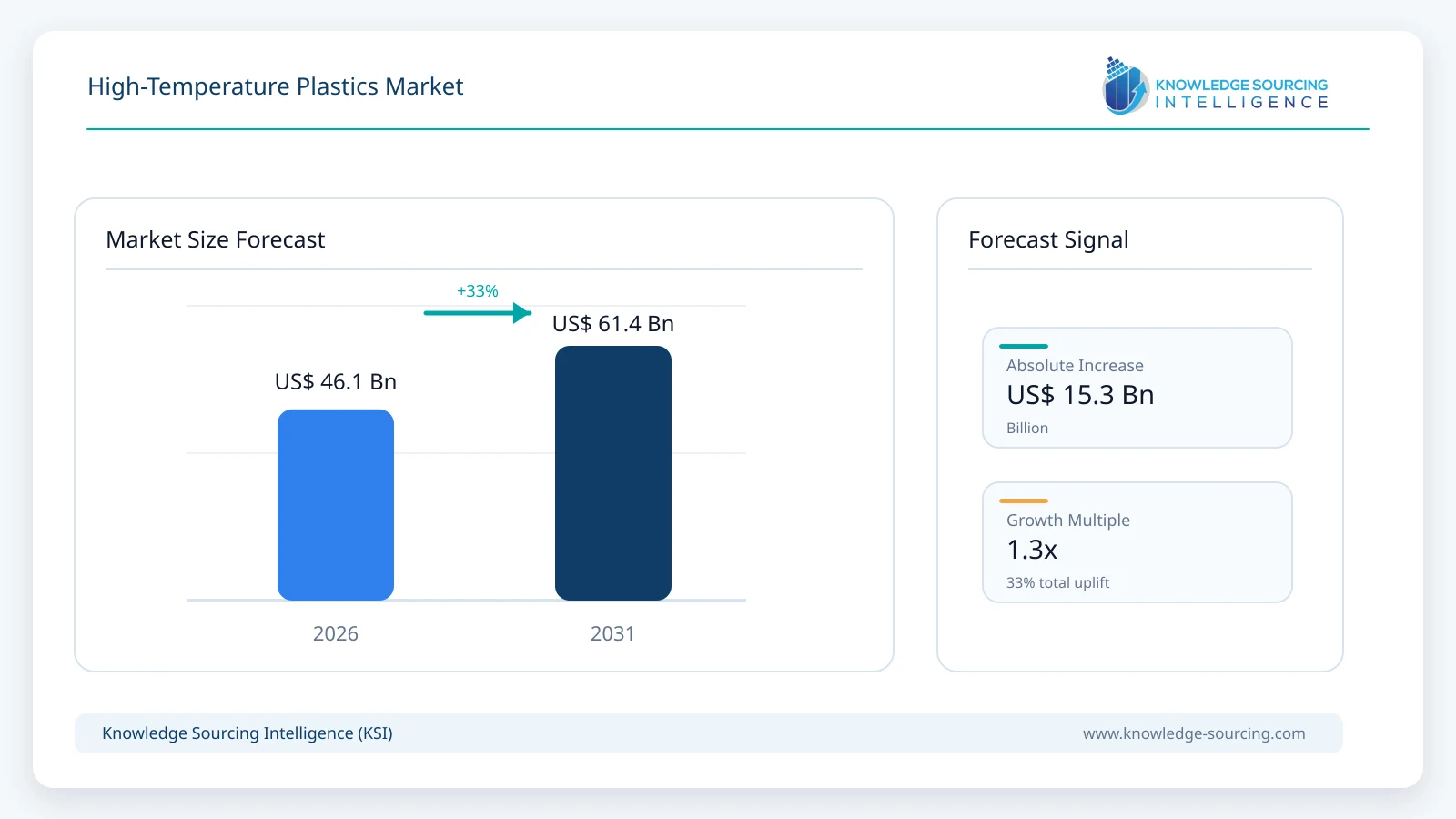
The High-Temperature Plastics market is forecast to grow at a CAGR of 5.9%, reaching USD 61.4 billion in 2031 from USD 46.1 billion in 2026.
Highlights:
- 1Electrification is increasing demand for polymers that combine thermal endurance, electrical insulation, chemical resistance, and dimensional stability.
- 2Electrical and electronics applications are creating high-value opportunities in connectors, optical components, semiconductor equipment, packaging, and power systems.
- 3Asia Pacific remains a critical manufacturing base because of its semiconductor, electronics, automotive, and industrial production concentration.
- 4PEEK, PPS, fluoropolymers, PEI, and LCPs are competing through application-specific performance rather than simple resin substitution.
- 5Environmental regulation is increasing scrutiny of material composition, recycling, chemical management, and end-of-life treatment, particularly in Europe.
- 6Suppliers are strengthening application engineering, regional technical support, supply continuity, and co-development capabilities to secure qualified applications.
The high-temperature plastics market comprises engineering and specialty thermoplastics designed to retain mechanical strength, dimensional stability, chemical resistance, electrical performance, and functional reliability under elevated operating temperatures. The market covers fluoropolymers, polyphenylene sulfide (PPS), polyimides, polyether ether ketone (PEEK), polyamide-imide (PAI), polyetherimide (PEI), polysulfones, liquid crystal polymers (LCPs), and other high-performance polymer systems used where conventional engineering plastics cannot reliably meet thermal, mechanical, chemical, or electrical requirements.
Demand is determined less by polymer volume alone and more by the value of the component being protected. A small quantity of high-temperature plastic can replace metal, enable miniaturization, reduce component weight, simplify assembly, or extend service intervals. Consequently, purchasing decisions are usually made at the component-development stage rather than through commodity resin procurement. Automotive OEMs, Tier 1 suppliers, semiconductor equipment manufacturers, electronics producers, aerospace companies, medical-device manufacturers, and industrial equipment suppliers typically qualify materials against application-specific thermal, mechanical, chemical, flammability, electrical, and processing requirements.
The commercial proposition is particularly strong where material failure creates disproportionate costs. In automotive systems, for example, polymers may be required to withstand elevated temperatures, electrical loads, aggressive fluids, vibration, and repeated thermal cycling. In electronics, material selection is influenced by dielectric performance, dimensional stability, flame resistance, moisture absorption, soldering temperatures, and the ability to support thinner and smaller components. SABIC's 2025 electronics portfolio activity illustrates this direction, with its EXTEM resin platform being positioned for optical interconnect applications involving reflow temperatures of up to 260°C.
The semiconductor industry represents another high-value demand environment because materials used in fluid handling, process equipment, connectors, insulation, and component housings must meet stringent purity and reliability requirements. Solvay's high-purity PVDF portfolio, for example, is used in ultra-pure water piping and fluid-handling applications for semiconductor manufacturing. The material's commercial value is linked not simply to temperature resistance but also to chemical inertness, low contamination risk, surface characteristics, and process reliability.
Buyer behavior therefore favors qualified material platforms over frequent resin substitution. Once a high-temperature polymer is incorporated into an engineered component and validated through testing, changing the resin can require redesign, tooling adjustments, processing validation, regulatory review, and customer approval. This creates comparatively high switching costs and supports long-term supplier relationships. However, qualification also raises the entry barrier for suppliers because a technically competitive resin is not sufficient without processing expertise, application engineering, consistent quality, and dependable supply.
The market's end-user structure is diversified, although transportation and electrical and electronics applications are particularly important. Transportation demand is being reshaped by electrification, higher under-hood temperatures, power electronics, charging infrastructure, sensor systems, and lightweighting. Electrical and electronics demand is being influenced by high-density computing, optical communications, semiconductor manufacturing, advanced packaging, and increasingly compact power systems. The U.S. Department of Commerce's January 2025 awards of $1.4 billion under the CHIPS National Advanced Packaging Manufacturing Program demonstrate the scale of public investment supporting advanced semiconductor packaging and associated material ecosystems.
The industrial segment remains relevant because high-temperature polymers can reduce maintenance requirements and enable equipment to operate in chemically aggressive or thermally demanding environments. Medical applications are smaller in volume but can generate attractive value per kilogram because material qualification, sterilization resistance, biocompatibility, dimensional stability, and long-term performance carry greater weight than resin price alone. The U.S. Food and Drug Administration evaluates medical-device biocompatibility at the finished-device level, including material composition, processing, manufacturing methods, sterilization, and potential residuals.
The market does not operate as a single homogeneous resin category. Different polymer families occupy distinct performance and price positions. Fluoropolymers are valued for chemical resistance, low friction, electrical insulation, and temperature performance. PPS combines thermal resistance, dimensional stability, chemical resistance, and electrical properties for demanding automotive and electrical applications. PEEK commands premium pricing where mechanical strength, fatigue resistance, chemical resistance, and high-temperature performance justify material substitution. Polyimides and related materials address applications where extreme thermal endurance and dimensional stability are essential, while LCPs serve highly miniaturized electrical and electronic components where flow characteristics and dimensional precision matter.
As a result, market revenue is shaped by a combination of unit demand, material grade, reinforcement level, application complexity, processing technology, and qualification status. Premium grades can command materially higher prices than standard engineering thermoplastics, while application-specific compounds can create additional value through glass or carbon reinforcement, flame retardancy, electrical modification, wear resistance, or improved processing characteristics.
Market Drivers
Electrification of Vehicles and Higher Thermal Loads
Vehicle electrification is altering the material requirements for connectors, busbars, sensors, power electronics, charging components, thermal-management systems, and battery-adjacent components. These applications require polymers that maintain insulation and mechanical integrity while exposed to elevated temperatures, electrical stresses, coolant fluids, vibration, and repeated thermal cycling.
The procurement mechanism is important. Automotive buyers do not select a high-temperature plastic solely because it has a higher continuous-use temperature. They evaluate the complete material system against electrical tracking, flame performance, chemical compatibility, dimensional stability, processing behavior, and cost at component level. Solvay's development of high-voltage PPS grades illustrates this application-specific approach, with its Ryton Supreme HV positioned around high-voltage electrical performance, thermal resistance, and flame performance for electrification applications.
Government-supported automotive manufacturing is reinforcing this demand in several regions. India's Production Linked Incentive scheme for automobiles and auto components is designed to encourage domestic production of advanced automotive technology products and deepen local supply chains. The program covers advanced components associated with zero-emission vehicles and requires qualifying manufacturers to meet domestic value-addition requirements.
For polymer suppliers, the commercial implication is a shift toward early engagement with OEMs and Tier 1 suppliers. Resin suppliers that provide material simulation, component prototyping, molding guidance, testing, and validation support can participate earlier in design decisions and improve their prospects of securing long production programs.
Semiconductor and Advanced Electronics Investment
Semiconductor manufacturing is creating applications where high-temperature plastics provide a combination of purity, chemical resistance, electrical performance, low contamination, and dimensional control. The requirement is particularly strong in wet-process equipment, piping, fittings, wafer-handling systems, connectors, packaging equipment, and specialized manufacturing tools.
Public investment is supporting domestic semiconductor ecosystems. In January 2025, the U.S. Department of Commerce announced $1.4 billion in final awards through the CHIPS National Advanced Packaging Manufacturing Program, including funding for advanced substrates and material research. Such investment expands the addressable ecosystem for suppliers of specialized polymers used in advanced packaging and related manufacturing infrastructure.
In parallel, Asian manufacturing hubs continue to attract material-development activity. Victrex reported in June 2026 that it was marking 20 years of operations in China while expanding local commercial, technical, and manufacturing capabilities around PEEK and PAEK applications. The company described Greater China as one of its fastest-growing geographic regions.
The demand mechanism extends beyond chip production itself. As fabs increase capacity, suppliers of equipment, fluid systems, connectors, packaging components, and process infrastructure also require materials capable of operating reliably in controlled manufacturing environments.
Lightweighting and Metal Replacement
High-temperature polymers can replace metals when the application benefits from lower mass, corrosion resistance, electrical insulation, reduced component count, or greater design freedom. Automotive, aerospace, industrial, and medical equipment manufacturers evaluate these substitutions when the lifecycle economics justify the higher resin cost.
The business case depends on total component economics rather than polymer price. A premium resin can remain commercially attractive if it reduces machining, assembly steps, part weight, corrosion treatment, or maintenance. Injection molding can also create complex geometries that would require multiple machining operations when manufactured from metal.
However, successful substitution requires engineering validation. Suppliers must demonstrate creep resistance, fatigue behavior, thermal aging, chemical compatibility, dimensional stability, and long-term reliability. This favors companies with established application-development teams and relationships with component manufacturers.
Miniaturization and Higher Performance Requirements in Electronics
Electronic components are becoming smaller while operating at higher power densities and processing speeds. These conditions increase the importance of thermal stability, dielectric performance, low moisture absorption, dimensional precision, and reliable processing.
LCPs, PEI, PPS, fluoropolymers, and other specialty materials can address different parts of this requirement. SABIC's 2025 OFC portfolio activity included high-performance thermoplastics for optical connectors, fiber-optic components, wire and cable applications, and data-center infrastructure. Its EXTEM RH1017UCL grade was presented for micro-molded lens arrays and 260°C reflow soldering conditions.
The commercial opportunity is therefore concentrated in technically demanding components rather than broad plastic consumption. Material suppliers must increasingly demonstrate performance at the exact processing and operating conditions used by electronics manufacturers.
Long-Life and Sterilizable Medical Components
Medical-device manufacturers use high-performance polymers where repeated sterilization, chemical exposure, dimensional stability, mechanical durability, and biocompatibility are necessary. High-temperature plastics can serve in surgical instruments, diagnostic equipment, fluid-handling components, implantable components, and other specialized devices.
The FDA's current guidance makes clear that assessment extends beyond the resin itself to the finished device, manufacturing process, sterilization method, and residual substances. This makes material qualification a multidisciplinary process involving polymer suppliers, molding companies, medical-device OEMs, sterilization providers, and regulatory teams.
The resulting procurement environment rewards consistent grades and documentation. A supplier capable of supporting traceability, regulatory documentation, processing controls, and long-term supply can command greater customer retention than one competing primarily on resin price.
Market Restraints and Challenges
High Material and Processing Costs
High-temperature polymers generally cost substantially more than commodity plastics and many conventional engineering thermoplastics. Their processing can also require specialized molding equipment, high-temperature tooling, controlled drying, or more demanding processing conditions.
This limits adoption in applications where the operating environment does not justify the performance premium. Buyers therefore conduct increasingly detailed total-cost analyses before converting from conventional polymers or metals. Suppliers can mitigate this constraint through optimized grades, reinforcement strategies, thinner-wall designs, processing support, and component-level engineering.
Complex Qualification Requirements
Qualification cycles can extend project timelines because high-performance polymers often become part of safety-critical, electrical, medical, aerospace, or automotive systems. Customers may require thermal aging, chemical exposure, flammability, electrical, fatigue, sterilization, and dimensional testing.
For suppliers, this creates a tension between innovation and qualification stability. New grades can offer improved performance but may require customers to repeat validation. Consequently, product development must balance performance gains against compatibility with existing processing and certification frameworks.
Feedstock, Energy, and Logistics Volatility
High-performance polymer production depends on specialized chemical intermediates and energy-intensive processing. Changes in raw-material costs, transportation conditions, trade rules, and regional plant economics can affect resin margins.
Celanese's 2025 pricing actions for engineered materials illustrate how raw-material conditions, product movement, inventory repositioning, plant operating expenses, and trade regulations can influence commercial pricing.
The impact is more pronounced for customers operating under annual or multi-year contracts. Suppliers therefore need regional inventories, multiple sourcing options where technically feasible, and transparent allocation policies to maintain customer confidence during supply disruptions.
Environmental and Chemical-Management Pressure
Fluoropolymers face additional scrutiny because regulatory authorities are examining PFAS substances and their environmental persistence. The U.S. Environmental Protection Agency notes that fluoropolymers provide valuable performance characteristics across industries while also addressing PFAS-related chemical management under the Toxic Substances Control Act.
This does not eliminate fluoropolymer demand, but it increases the importance of regulatory documentation, substance traceability, manufacturing controls, and alternatives assessment. Suppliers may need to demonstrate why a particular fluoropolymer is necessary for a defined application and maintain compliance as regional restrictions develop.
Recycling and End-of-Life Constraints
Many high-temperature plastics are used in technically complex components containing fillers, additives, metals, coatings, or multiple polymer systems. These combinations can make mechanical recycling more difficult than recycling simpler plastic products.
European policy is placing greater emphasis on circularity. The EU End-of-Life Vehicles Regulation entered into force in August 2026 and establishes future recycled-plastic requirements for vehicles, including a 15% target from 2032 and 25% from 2036.
For high-temperature plastics, the challenge is particularly relevant because recyclate must preserve performance suitable for demanding applications. Suppliers will therefore need to invest in collection, identification, purification, compounding, and application-specific recycling routes rather than rely solely on conventional post-consumer recycling infrastructure.
Major Segment Analysis
Electrical & Electronics End-User Industry
The electrical and electronics industry represents one of the most commercially important end-user segments because high-temperature plastics solve several problems simultaneously: thermal exposure, electrical insulation, miniaturization, dimensional precision, flame resistance, chemical resistance, and increasingly demanding assembly processes.
The buyer base includes semiconductor equipment manufacturers, electronic-component producers, connector manufacturers, data-center infrastructure suppliers, optical-networking companies, power-electronics manufacturers, and automotive-electronics suppliers. Their procurement priorities differ by application, but material reliability and processing consistency are common requirements.
In connectors and miniature components, LCPs and high-performance thermoplastics can provide precise filling of complex molds while maintaining dimensional stability. In power electronics, PPS and other thermally stable polymers are relevant where components face elevated temperatures and electrical stresses. In semiconductor equipment, fluoropolymers such as PVDF can provide chemical resistance and purity in fluid-handling systems. In advanced optical applications, PEI and other specialty thermoplastics can support high-temperature processing and tight dimensional requirements.
The segment is also benefiting from infrastructure investment. The U.S. CHIPS advanced packaging program is directing public funding toward advanced substrates and materials research, while the electronics manufacturing ecosystem in Asia continues to support high-volume production and application development.
Competition in this segment is application-led. A supplier must offer more than a resin grade. Technical teams work with customers on mold design, flow behavior, thermal simulation, electrical characteristics, material selection, and qualification. This increases customer retention because the supplier becomes embedded in the product-development process.
The commercial opportunity is particularly attractive where electronic components operate at higher temperatures or require tighter dimensional tolerances. The movement toward optical communications, advanced computing, high-speed connectivity, electric-vehicle power electronics, and high-density data infrastructure broadens the number of applications where ordinary plastics become inadequate.
Regional Analysis
North America
North America combines advanced semiconductor investment, aerospace manufacturing, automotive electrification, medical-device production, and industrial equipment demand. The United States remains particularly important because public funding is supporting semiconductor manufacturing and advanced packaging capacity.
The CHIPS National Advanced Packaging Manufacturing Program is relevant to high-temperature plastics because advanced packaging requires specialized substrates, materials, thermal-management systems, connectors, and manufacturing equipment. The January 2025 award announcement allocated $1.4 billion to support domestic advanced packaging capabilities.
Automotive demand is also moving toward higher-performance polymers as electrification changes component architecture. Buyers increasingly evaluate electrical insulation, thermal stability, chemical compatibility, and flame performance at system level. Mexico contributes to the regional manufacturing base through its automotive and electronics production networks, while Canada adds aerospace, automotive, medical, and industrial applications.
The principal constraints include high labor and manufacturing costs, qualification requirements, trade exposure, and pressure to maintain supply continuity. Suppliers with local technical support and regional inventory can reduce procurement risk for OEM customers.
Europe
Europe has a sophisticated demand base across automotive, industrial equipment, electrical systems, aerospace, medical devices, and semiconductor-related manufacturing. Automotive policy remains an important influence because vehicle manufacturers are balancing electrification, emissions requirements, cost control, and supply-chain resilience.
The European Commission's 2025 Automotive Package introduced additional flexibility around vehicle CO2 compliance while maintaining a clear policy direction toward lower-emission mobility. This supports continued investment in electrified and electronically intensive vehicle architectures, where specialized polymers can be used in power electronics, connectors, sensors, thermal systems, and charging components.
Europe is also becoming more demanding on material circularity. The End-of-Life Vehicles Regulation that entered into force in August 2026 establishes future recycled-plastic requirements and stronger producer responsibility.
Germany remains important for automotive and industrial applications, while France and the United Kingdom contribute aerospace, electronics, medical, and specialty manufacturing demand. European buyers are likely to place greater emphasis on traceability, recycled content, chemical compliance, and lifecycle documentation during the forecast period.
Asia Pacific
Asia Pacific is expected to remain the principal manufacturing center for many high-temperature plastic applications because of its concentration of electronics, semiconductors, automotive production, industrial equipment, and consumer technology manufacturing.
China has an extensive electronics and automotive manufacturing base and is also attracting localized technical development by specialty-polymer suppliers. Victrex's June 2026 disclosure on its 20-year presence in China emphasized local commercial, technical, and manufacturing capabilities for PEEK and PAEK applications.
Japan remains important for precision electronics, automotive components, semiconductor equipment, industrial machinery, and advanced materials. South Korea has strong electronics, semiconductor, battery, and automotive manufacturing capabilities. India is expanding its automotive and electronics manufacturing base through government programs, including the Electronics Component Manufacturing Scheme approved in March 2025. The scheme is intended to attract large investments, build component manufacturing capacity, and integrate Indian producers with global value chains.
Thailand and Indonesia provide additional automotive and electronics manufacturing capacity, while Australia offers more specialized industrial, mining, energy, and medical applications.
The principal regional advantage is manufacturing scale. The main constraints include feedstock volatility, supply-chain concentration, technology-transfer requirements, and uneven availability of specialized processing capabilities.
Middle East and Africa
Demand in the Middle East and Africa is concentrated in industrial equipment, energy, infrastructure, transportation, electrical systems, healthcare, and specialized manufacturing. Saudi Arabia and the UAE are particularly relevant because industrial diversification programs are expanding non-oil manufacturing and infrastructure activity.
High-temperature plastics are most commercially attractive where equipment faces heat, chemicals, corrosion, electrical loads, or difficult maintenance conditions. Applications can include fluid handling, pumps, valves, electrical components, industrial equipment, and specialized energy infrastructure.
The regional market remains smaller than Asia Pacific, Europe, or North America, but localized manufacturing investment can create opportunities for suppliers able to provide technical support and dependable logistics. Procurement decisions remain highly sensitive to imported-material availability, qualification requirements, project schedules, and lifecycle support.
South America
South America is led by Brazil, supported by its automotive, industrial, electrical, healthcare, and energy sectors. Argentina and other markets contribute smaller demand pools, with opportunities tied to industrial modernization and specialized manufacturing.
Cost remains a more important purchasing factor in South America than in many premium-material applications in North America or Europe. As a result, high-temperature plastics are most likely to penetrate where their performance produces measurable lifecycle savings or enables a design that conventional plastics cannot support.
Regional suppliers, distributors, and compounders can play an important role because customers may require smaller lot sizes, localized technical assistance, and shorter delivery times. Currency volatility and import costs remain constraints for premium resin adoption.
Competitive Landscape
The competitive environment consists of global specialty-material suppliers with differentiated polymer portfolios, technical service capabilities, application-development expertise, and established customer qualification relationships.
Solvay competes across several high-performance polymer families, including fluoropolymers, PEEK, PPS, polysulfones, and related engineered materials. Its commercial approach emphasizes application engineering and collaboration with downstream manufacturers. Its partnership activities in semiconductor and high-purity applications illustrate how technical cooperation can secure material demand beyond simple resin supply.
DuPont has a strong position in high-performance materials for electronics and mobility applications. Its March 2025 electronics activity in Shanghai highlighted advanced circuit materials addressing fine-line technology, signal integrity, and thermal-management requirements.
SABIC competes through specialty thermoplastics and application-specific grades spanning electrical, electronics, optical, automotive, and industrial uses. Its 2025 portfolio activity around high-temperature materials for optical interconnects and high-voltage applications demonstrates the emphasis on application-specific performance.
Celanese Corporation has a broad engineered-materials portfolio and competes through material breadth, global production capabilities, application development, and cost management. Its 2025 financial disclosures showed continued work on complexity reduction, inventory management, pipeline quality, design support, and processing expertise within Engineered Materials.
Victrex plc has a more focused competitive position centered on PEEK and PAEK high-performance polymers. Its China operations demonstrate a strategy based on local technical capabilities, customer collaboration, and regional application development.
Competition is therefore shaped by five factors: polymer performance, grade breadth, application engineering, qualification history, and supply reliability. Price remains relevant, but it becomes less decisive once a material is embedded in a qualified component. Suppliers are consequently competing for design wins rather than only resin volumes.
Partnerships with molders, component manufacturers, equipment suppliers, and OEM engineering teams are particularly valuable because they shorten material-selection cycles and provide visibility into future applications. Geographic expansion also tends to follow customers rather than operate independently. Local laboratories, technical centers, inventory hubs, and application engineers can therefore become important competitive assets.
Recent Developments
August 2026: SABIC introduced ULTEM™ DU762 resin, a new polyetherimide specialty thermoplastic enabling non-conductive PVD metallization for lightweight, durable smartphone middle frames.
June 2026: Victrex marked 20 years of operations in China and highlighted expanded local commercial, technical, and manufacturing capabilities for PEEK and PAEK applications. Commercial relevance: The development reinforces Asia Pacific's importance for high-performance polymer application development and strengthens local support for customers in demanding industries.
May 2026: SABIC launched ULTEM™ SU3102P reactive PEI oligomer, a high-temperature thermoplastic toughening agent for lighter, tougher aerospace thermoset composites and improved manufacturing productivity.
Regulatory and Policy Environment
Regulatory requirements influence high-temperature plastics through chemical management, electrical safety, medical-device qualification, automotive sustainability, and end-of-life treatment.
In the European Union, the Restriction of Hazardous Substances Directive establishes restrictions on specified hazardous substances in electrical and electronic equipment. The consolidated legal text remained current in July 2026. For high-temperature plastics, compliance can influence additive selection, flame-retardant systems, colorants, stabilizers, and component formulations used in electronic products.
PFAS regulation is particularly relevant to fluoropolymers. The U.S. Environmental Protection Agency identifies fluoropolymers as materials with valuable properties across aerospace, automotive, electronics, semiconductor, and other industries while separately managing PFAS risks under TSCA. This creates a regulatory requirement for manufacturers to maintain clear chemical inventories and understand the status of individual substances and manufacturing processes.
Medical applications face another layer of compliance. FDA assessment considers the finished medical device rather than simply approving a polymer in isolation. Material composition, manufacturing process, sterilization, and potential residuals can all influence the biological evaluation. FDA's recognized consensus standards also include ISO 10993 requirements covering areas such as chemical characterization, cytotoxicity, sterilization residuals, and interactions with blood.
Automotive sustainability requirements are becoming more material-intensive. The EU End-of-Life Vehicles Regulation entered into force on August 13, 2026 and will apply from September 2028. It establishes design, traceability, recovery, producer-responsibility, and recycled-content requirements, including a 15% recycled-plastic target from 2032 and 25% from 2036.
India is also using industrial policy to expand domestic automotive and electronics manufacturing. The PLI-Auto scheme supports advanced automotive technology production, while the Electronics Component Manufacturing Scheme aims to build component capacity and integrate domestic companies into global value chains. These policies can indirectly increase demand for high-performance polymers by encouraging local production of components that require specialized materials.
For suppliers, regulatory compliance is increasingly becoming part of product qualification. Documentation covering chemical composition, traceability, recycled content, manufacturing controls, and application-specific certifications can influence procurement decisions alongside technical performance.
Outlook and Strategic Implications
The 2026-2031 outlook for high-temperature plastics will be shaped by application intensity rather than plastic consumption alone. The strongest opportunities are likely to arise where operating temperatures, electrical loads, chemical exposure, miniaturization, or regulatory requirements make conventional polymers inadequate.
Electrification will remain an important demand channel. EV power electronics, charging systems, battery-adjacent components, thermal-management systems, connectors, sensors, and high-voltage architectures require materials with predictable electrical and thermal behavior. Suppliers with grades specifically engineered for high-voltage environments can therefore capture demand through component qualification rather than broad-volume substitution.
Semiconductor and advanced electronics investment will provide another high-value opportunity. The expansion of advanced packaging, optical communications, high-performance computing, and semiconductor manufacturing infrastructure is increasing the need for polymers capable of supporting high-temperature processing, dimensional precision, chemical resistance, and contamination control. Public investment in U.S. advanced packaging and continued Asian manufacturing expansion strengthen this demand environment.
Procurement will also become more technically integrated. OEMs and component manufacturers are likely to involve material suppliers earlier in product design, especially where resin selection affects mold design, thermal performance, electrical insulation, or recyclability. This favors suppliers with simulation, prototyping, testing, and application-development capabilities.
Regional manufacturing strategies will influence supply-chain decisions. Customers increasingly need dependable regional supply, technical support, and shorter response times. Asia Pacific will remain central to production, while North America and Europe will continue strengthening domestic manufacturing capabilities in strategically important sectors such as semiconductors, advanced electronics, and electric mobility.
Sustainability will create both costs and commercial opportunities. The EU's recycled-content requirements and broader plastics-circularity initiatives will require suppliers to develop credible recovery and recycling pathways. High-temperature plastics present technical challenges because maintaining high performance after recycling is more difficult than processing conventional materials. Suppliers that develop controlled recycling streams, material identification systems, and application-specific recycled grades can reduce this constraint.
Fluoropolymers will require particular regulatory attention. Their chemical and thermal properties remain valuable in semiconductor, aerospace, chemical-processing, automotive, and electrical applications, but changing PFAS policy can affect manufacturing, formulation, documentation, and customer qualification. Companies should therefore maintain alternative-material development programs without assuming that direct replacement will be technically or economically feasible in every application.
Competitive differentiation will increasingly depend on the complete material solution. Resin performance remains fundamental, but customers also value consistent quality, processing support, regulatory documentation, technical laboratories, local inventory, and application engineering. A supplier that can reduce development risk can command a stronger position even when its resin carries a premium.
Over the next five years, strategic investment should therefore prioritize high-voltage electrical grades, semiconductor-grade materials, advanced molding compounds, lightweight metal-replacement applications, medical-grade polymers, and recycling-compatible formulations. Companies should also strengthen regional technical centers near major automotive, semiconductor, electronics, and medical manufacturing clusters.
The principal risks remain raw-material volatility, high processing costs, regulatory restrictions on selected chemical families, customer qualification delays, and substitution by lower-cost engineering plastics where performance requirements are relaxed. Nevertheless, the market's structural value remains tied to applications where failure carries high economic or operational consequences.
For buyers, material selection will increasingly be evaluated through total lifecycle cost, supply continuity, regulatory exposure, and component performance rather than resin price alone. For suppliers, the strongest commercial positions will come from owning qualified applications, maintaining close engineering relationships, and providing dependable technical and supply-chain support.
Overall, the high-temperature plastics market is moving toward a more application-specific business model. Transportation electrification, advanced electronics, semiconductor investment, medical-device requirements, industrial modernization, and material circularity will determine where premium polymer demand is commercially justified between 2026 and 2031.
High-Temperature Plastics Market Scope:
| Report Metric | Details |
|---|---|
| Total Market Size in 2026 | USD 46.1 billion |
| Total Market Size in 2031 | USD 61.4 billion |
| Forecast Unit | Billion |
| Growth Rate | 5.9% |
| Study Period | 2021 to 2031 |
| Historical Data | 2021 to 2024 |
| Base Year | 2025 |
| Forecast Period | 2026 – 2031 |
| Segmentation | Type, End-User Industry, Geography |
| Companies |
|
Market Segmentation
By Type
- Fluoropolymers
- Polyphenylene Sulfide
- Polyimides
- Polyether Ether Ketone
- Polyamide-imide
- Polyetherimide
- Polysulfones
- Liquid Crystal Polymers
- Others
By End-User Industry
- Transportation
- Electrical & Electronics
- Industrial
- Medical
- Others
By Geography
- North America
- United States
- Canada
- Mexico
- South America
- Brazil
- Argentina
- Others
- Europe
- United Kingdom
- Germany
- France
- Italy
- Others
- Middle East and Africa
- Saudi Arabia
- UAE
- Israel
- Others
- Asia Pacific
- China
- Japan
- India
- South Korea
- Australia
- Indonesia
- Thailand
- Others
Table of Contents
1. INTRODUCTION
1.1. Market Overview
1.2. Market Definition
1.3. Scope of the Study
1.4. Market Segmentation
1.5. Currency
1.6. Assumptions
1.7. Base and Forecast Years Timeline
1.8. Key Benefits for Stakeholders
2. RESEARCH METHODOLOGY
2.1. Research Design
2.2. Research Process and Data Validation
3. EXECUTIVE SUMMARY
3.1. Key Findings
4. MARKET DYNAMICS
4.1. Market Drivers
4.2. Market Restraints
4.3. Porter’s Five Forces Analysis
4.3.1. Bargaining Power of Suppliers
4.3.2. Bargaining Power of Buyers
4.3.3. Threat of New Entrants
4.3.4. Threat of Substitutes
4.3.5. Competitive Rivalry
4.4. Industry Value Chain Analysis
4.5. Analyst View
5. HIGH-TEMPERATURE PLASTICS MARKET BY TYPE
5.1. Introduction
5.2. Fluoropolymers
5.3. Polyphenylene Sulfide
5.4. Polyimides
5.5. Polyether Ether Ketone
5.6. Polyamide-imide
5.7. Polyetherimide
5.8. Polysulfones
5.9. Liquid Crystal Polymers
5.10. Others
6. HIGH-TEMPERATURE PLASTICS MARKET BY END-USER INDUSTRY
6.1. Introduction
6.2. Transportation
6.3. Electrical & Electronics
6.4. Industrial
6.5. Medical
6.6. Others
7. HIGH-TEMPERATURE PLASTICS MARKET BY GEOGRAPHY
7.1. Introduction
7.2. North America
7.2.1. United States
7.2.2. Canada
7.2.3. Mexico
7.3. South America
7.3.1. Brazil
7.3.2. Argentina
7.3.3. Others
7.4. Europe
7.4.1. United Kingdom
7.4.2. Germany
7.4.3. France
7.4.4. Italy
7.4.5. Others
7.5. Middle East and Africa
7.5.1. Saudi Arabia
7.5.2. UAE
7.5.3. Israel
7.5.4. Others
7.6. Asia Pacific
7.6.1. China
7.6.2. Japan
7.6.3. India
7.6.4. South Korea
7.6.5. Australia
7.6.6. Indonesia
7.6.7. Thailand
7.6.8. Others
8. COMPETITIVE ENVIRONMENT AND ANALYSIS
8.1. Major Players and Strategy Analysis
8.2. Market Share Analysis
8.3. Mergers, Acquisitions, Agreements, and Collaborations
8.4. Competitive Dashboard
9. COMPANY PROFILES
9.1. Solvay
9.2. DuPont
9.3. SABIC Innovative Plastics
9.4. Celanese Corporation
9.5. Victrex Plc
Navigate
Trusted by the world's leading organizations











