
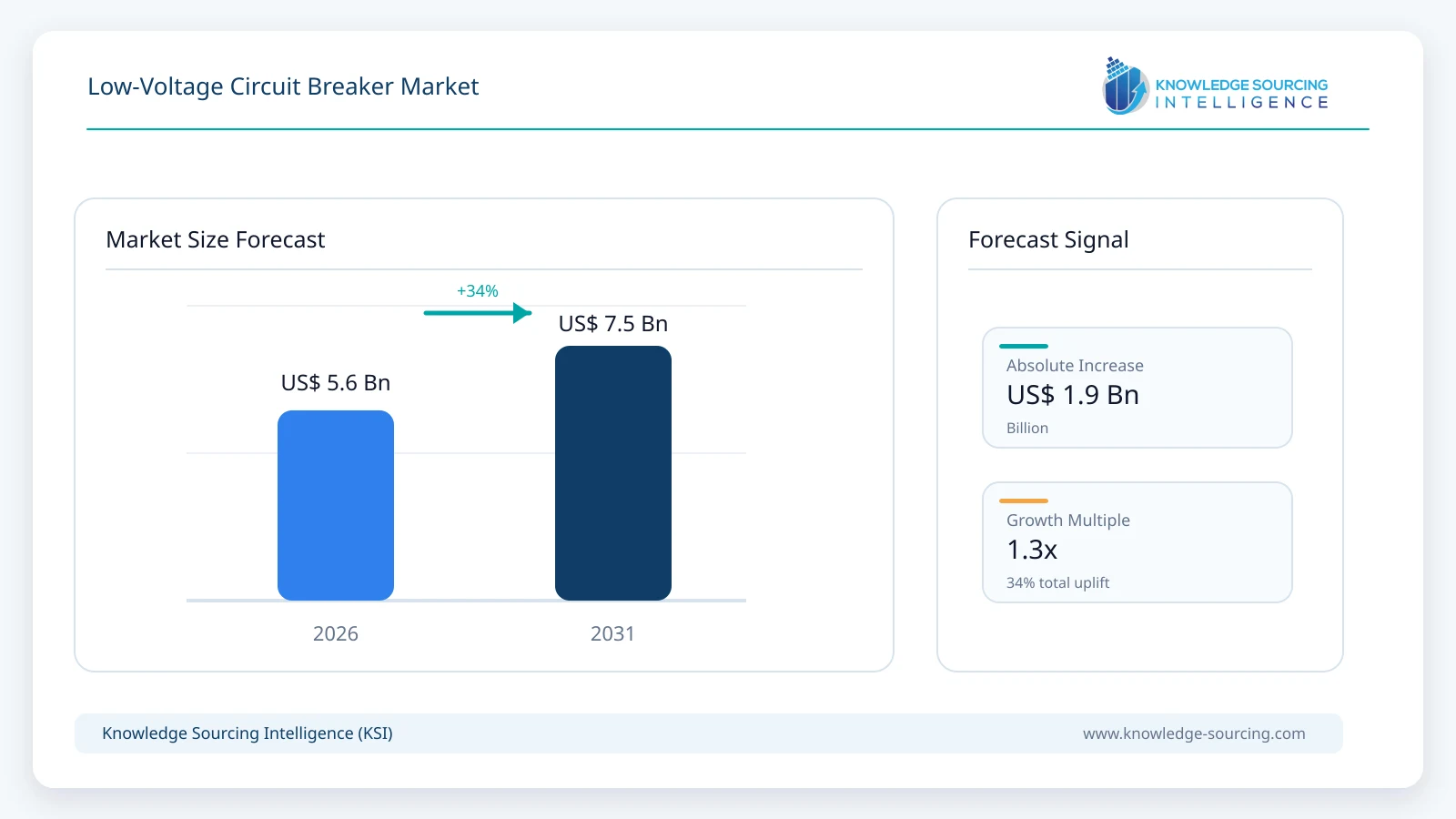
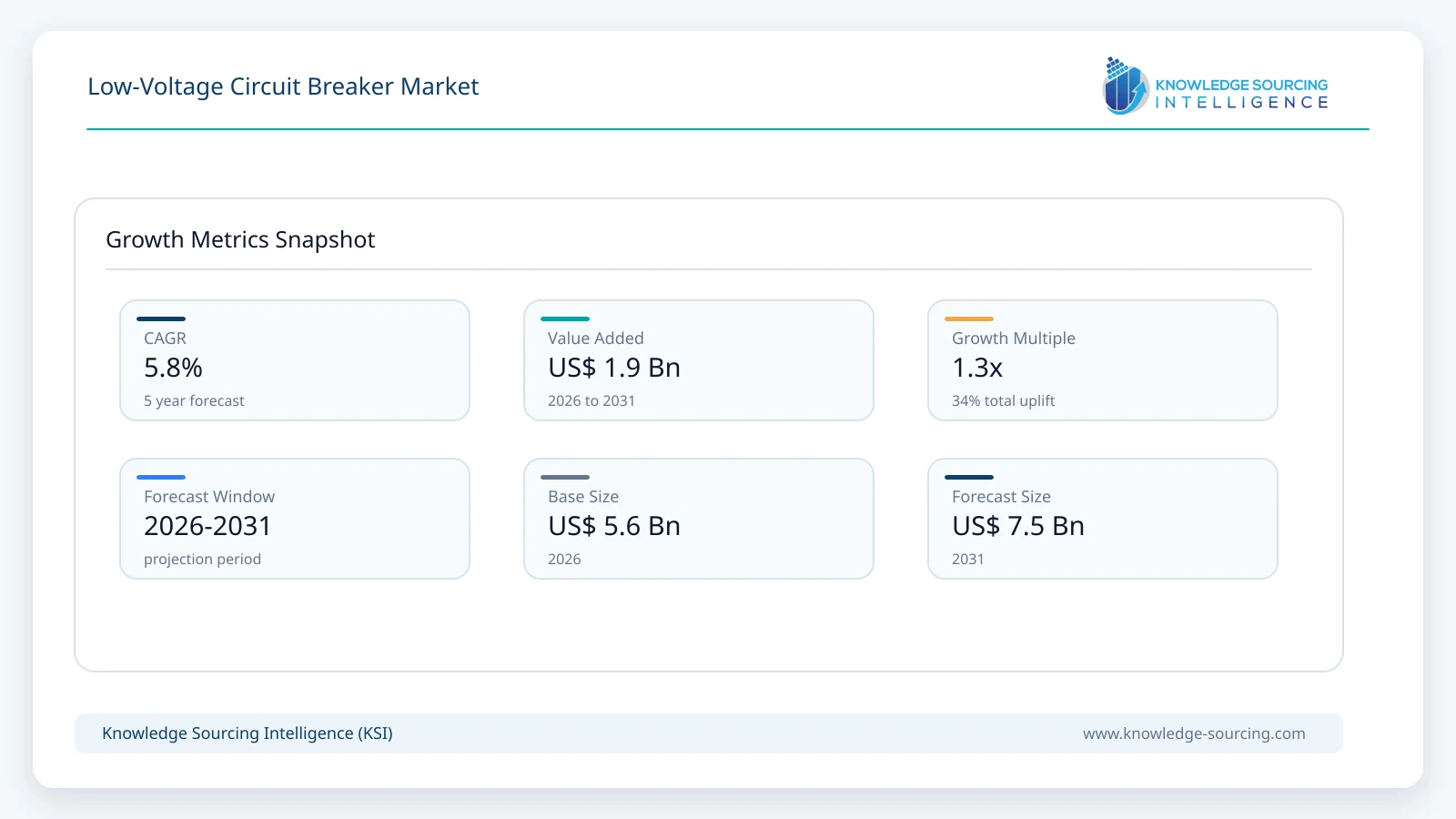
The Low Voltage Circuit Breaker Market is forecast to grow at a CAGR of 5.8%, reaching USD 7.5 billion in 2031 from USD 5.6 billion in 2026.
Highlights:
- 1The low-voltage circuit breaker market is being driven by the rapid adoption of smart grids, automation technologies, and smart metering systems, which require advanced electrical protection solutions for reliable and efficient power distribution.
- 2Rising investments in residential construction, urbanization, data centers, electric vehicle charging infrastructure, and industrial automation are significantly increasing the demand for low-voltage circuit breakers globally.
- 3Technological advancements and product innovations by companies such as Siemens, Schneider Electric, ABB Ltd, and Eaton Corporation are enhancing circuit breaker capabilities with features including cybersecurity, predictive maintenance, intelligent monitoring, and ultra-fast interruption technology.
- 4Increasing electricity consumption, stricter electrical safety standards such as EN IEC 60947-22025, and ongoing grid modernization initiatives across countries like India, the United States, China, and Germany are creating strong long-term growth opportunities for the low-voltage circuit breaker market.
Low-Voltage Circuit breakers safeguard electrical installations by automatically disconnecting the power supply during overloads or short circuits. These systems operate up to 1000V AC or 1500V DC. Their performance, safety, testing, and installation are governed by rigorous international and national standards.
The latest iteration, EN IEC 60947-2:2025, published in early 2025, supersedes the 2016 edition and subsequent amendments of IEC 60947-2, which is globally adopted. This standard defines the technical specifications for low-voltage circuit breaker design, encompassing rated voltage, current ratings, disconnection capabilities, dielectric testing, and protective functions.
India's Index of Industrial Production (IIP) growth rates for September 2025 provide a clear indication of the nation's overall industrial activity. The electrical equipment sector, a key component that includes low-voltage circuit breaker manufacturing, recorded a growth rate of 28.7%. This expansion reflects a considerable increase in manufacturing output and industrial demand.
Elevated activity within this sector points to a greater installation of electrical systems across residential, commercial, and industrial infrastructure. Monitoring IIP trends is critical for stakeholders to gauge production momentum, optimize supply chain operations, and identify market opportunities for low-voltage circuit breakers, ensuring alignment with both regulatory mandates and the escalating requirements of electricity infrastructure.
Market Dynamics
Market Drivers
Adoption of smart grids and automation
The National Smart Grid Mission (NSGM) designates smart grids and automation as strategic imperatives for India’s electrical industry. A smart grid integrates electrical frameworks with communication, automation, and monitoring technologies. These systems enable utilities to track electricity flow from generation to utilization in real-time, facilitating automatic fault detection, dynamic load management, and the reduction of technical losses across transmission and distribution networks.
Under the Revamped Distribution Sector Scheme (RDSS), the NSGM reports that 20.33 crore smart meters have been sanctioned based on proposals from individual states. Furthermore, states have deployed smart meters through their own initiatives or externally aided projects. To date, 4.76 crore smart meters have been installed nationwide under various schemes.
Smart metering and grid automation constitute the foundational elements for smart grid implementation, delivering real-time load management, improved billing accuracy, and enhanced integration of renewable energy sources under the RDSS. Government documentation outlines significant benefits from smart grid installation, including reduced transmission and distribution losses, improved reliability via automated outage detection and restoration, and enhanced asset management through data-driven service approaches. These operational efficiencies and reliability gains will consequently increase demand for low-voltage circuit breakers, which are essential components of automated protection systems within modernized power infrastructure.
Smart meter deployment in key North Indian states illustrates this trend, with 260,000 installations in Delhi and 847,467 in Haryana as of November 15, 2025. These figures underscore the ongoing integration of smart grid infrastructure through government-led power sector modernization. Higher smart meter penetration signifies expanded utilization of automated monitoring, digital control systems, and real-time data management across distribution networks. This directly reinforces the smart grids and automation driver, strengthening demand for low-voltage circuit breakers (LVCBs) essential for safeguarding digitally controlled electrical systems from faults, overloads, and operational disruptions.
Key Developments
April 2026: Siemens launched its SENTRON 3QD2 semiconductor circuit breaker as part of a new DC low-voltage portfolio, enabling ultra-fast microsecond interruption for data centers, industrial systems, and battery storage protection.
August 2025: Schneider Electric launched the FeederSeT digitally connected circuit protection range, enhancing low-voltage circuit breaker monitoring, predictive maintenance capabilities, and scalable smart distribution system performance for industrial and commercial applications.
July 2025: ABB introduced the SACE Emax 3 air circuit breaker, a cybersecurity-certified intelligent breaker designed for critical infrastructure, advanced manufacturing, and AI data centers, improving protection, diagnostics, and operational efficiency.
2025: Eaton announced that its low-voltage auxiliary power mobility solutions portfolio has expanded to aftermarket customers for adequate electrical power management in commercial vehicles. The low-voltage products, including switches and fuses, circuit breakers, junction blocks, and fuse boxes with direct wires, are also J1939 compatible.
Market Segmentation
By End-User: Residential
The low-voltage circuit breaker market is segmented by end-user into residential, commercial, and industrial applications. Rapid population growth has fundamentally altered power consumption patterns. Concurrent with regulatory standards promoting energy optimization, the residential sector demonstrates an increasing need for robust power protection and distribution solutions. This environment creates opportunities for low-voltage circuit breakers (LVCBs), which are integral to home electrical systems for preventing short-circuits and managing power overloads.
Major economies, such as China, are actively investing in residential developments to meet expanding housing demands. Under its “14th Five-Year Plan,” China constructed over 11 million affordable housing units, benefiting more than 30 million residents. Data from the National Bureau of Statistics indicates that from January to July 2025, China invested 5,358 billion Yuan in real estate development, with residential buildings alone accounting for 4,120.8 billion Yuan; the remainder was allocated to office and commercial properties. This substantial investment in residential construction will directly influence demand for low-voltage circuit breakers for fault isolation, thereby driving overall market expansion.
Urbanization further stimulates housing demand, evidenced by ongoing investments in new housing projects and building permits. For example, the German Federal Statistical Office reported 20,119 building permits issued for dwellings in Germany in November 2025, marking a 1.3% growth over the previous month. Germany also supports residential initiatives, such as the “Central Living Düsseldorf Project,” aimed at providing affordable housing. Such developments invariably increase the requirement for robust electrical protection systems.
Advancements in next-generation technologies, including the Internet of Things (IoT) and smart grids, are driving their adoption within home automation and building management systems. This integration serves as a significant accelerant for LV circuit breaker demand. Concurrently, regulatory mandates for electrical safety, such as the National Electrical Code (NEC), consistently update specifications for electrical design, installation, and inspection, propelling innovation in LVCB developments to meet evolving requirements.
Regional Analysis
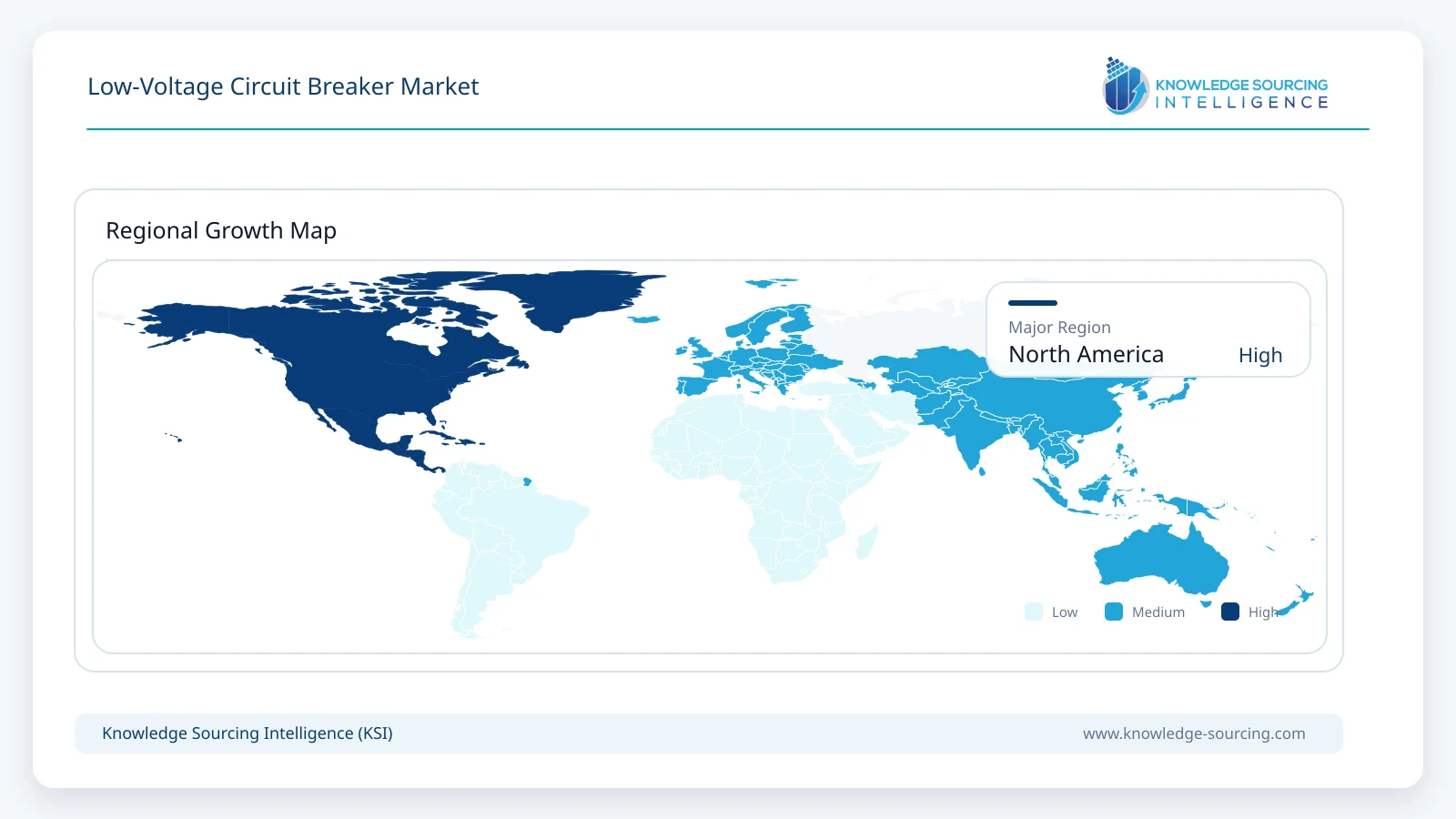
North America: the US Market Analysis
The United States' technological infrastructure emphasizes the deployment of innovations designed to optimize energy distribution. A sustained transition towards decarbonization objectives drives demand for reliable electrical distribution systems equipped with smart load management capabilities. This strategic shift is influencing market dynamics.
Grid modernization initiatives are prompting major market participants to invest in product innovations that align with evolving grid requirements. ABB Ltd’s “SACE Emax 2” circuit breaker exemplifies this trend, featuring advanced functions such as load shedding, interface protection, and synchrocheck logic, which enable sophisticated management of low-voltage distribution within a grid network.
Consistent investments in data centers, coupled with the increasing adoption of Artificial Intelligence (AI), have significantly impacted the demand for low-voltage circuit breakers. These devices are essential for optimizing power flow in server racks, UPS systems, and power distribution units (PDUs). According to the U.S. Department of Energy’s “2024 U.S. Data Center Energy Usage Report,” data center energy consumption has tripled over the past decade and is projected to account for 12% of total US electricity by 2028. This growth underscores the critical need for advanced LVCBs.
Beyond energy management innovations, foundational factors such as consistent population growth and sustained investments in residential and commercial establishments have amplified electricity consumption. The U.S. Energy Information Administration reported total electricity sales of 3,720,443 megawatt-hours from January to November 2025, a 2% increase over the preceding year's sales for the same period. This upward trajectory in electricity sales will directly influence demand for low-voltage circuit breakers for energy management applications.
As a prominent market for electric vehicles, the United States is strategically expanding its EV charging infrastructure, which will drive demand for LV DC-rated circuit breakers capable of high-current handling. Concurrently, ongoing industrial automation, including the adoption of robotics and smart machinery, is poised to create further market expansion for LVCBs.
Low Voltage Circuit Breaker Market Scope:
| Report Metric | Details |
|---|---|
| Total Market Size in 2026 | USD 5.6 billion |
| Total Market Size in 2031 | USD 7.5 billion |
| Forecast Unit | Billion |
| Growth Rate | 5.8% |
| Study Period | 2021 to 2031 |
| Historical Data | 2021 to 2024 |
| Base Year | 2025 |
| Forecast Period | 2026 – 2031 |
| Segmentation | Type, Application, End User, Geography |
| Companies |
|
Market Segmentation
By Type
Air Circuit Breaker
Miniature Circuit Breaker
Molded Case Circuit Breaker
Residential Current Circuit Breaker
By Application
Motor Control Centres
Lighting Circuits
Feeder Circuits
Others
By End User
Residential
Commercial
Industrial
By Geography
North America
United States
Canada
Mexico
South America
Brazil
Argentina
Others
Europe
Germany
France
United Kingdom
Spain
Others
Middle East and Africa
Saudi Arabia
UAE
Others
Asia Pacific
China
India
Japan
South Korea
Indonesia
Thailand
Others
Table of Contents
1. EXECUTIVE SUMMARY
2. MARKET SNAPSHOT
2.1. Market Overview
2.2. Market Definition
2.3. Scope of the Study
2.4. Market Segmentation
3. BUSINESS LANDSCAPE
3.1. Market Drivers
3.2. Market Restraints
3.3. Market Opportunities
3.4. Porter’s Five Forces Analysis
3.5. Industry Value Chain Analysis
3.6. Policies and Regulations
3.7. Strategic Recommendations
4. TECHNOLOGICAL OUTLOOK
5. LOW VOLTAGE CIRCUIT BREAKER MARKET BY TYPE
5.1. Introduction
5.2. Air Circuit Breaker
5.3. Miniature Circuit Breaker
5.4. Molded Case Circuit Breaker
5.5. Residential Current Circuit Breaker
6. LOW VOLTAGE CIRCUIT BREAKER MARKET BY APPLICATION
6.1. Introduction
6.2. Motor Control Centres
6.3. Lighting Circuits
6.4. Feeder Circuits
6.5. Others
7. LOW VOLTAGE CIRCUIT BREAKER MARKET BY END USER
7.1. Introduction
7.2. Residential
7.3. Commercial
7.4. Industrial
8. LOW VOLTAGE CIRCUIT BREAKER MARKET BY GEOGRAPHY
8.1. Introduction
8.2. North America
8.2.1. United States
8.2.2. Canada
8.2.3. Mexico
8.3. South America
8.3.1. Brazil
8.3.2. Argentina
8.3.3. Others
8.4. Europe
8.4.1. Germany
8.4.2. France
8.4.3. United Kingdom
8.4.4. Spain
8.4.5. Others
8.5. Middle East and Africa
8.5.1. Saudi Arabia
8.5.2. UAE
8.5.3. Others
8.6. Asia Pacific
8.6.1. China
8.6.2. India
8.6.3. Japan
8.6.4. South Korea
8.6.5. Indonesia
8.6.6. Thailand
8.6.7. Others
9. COMPETITIVE ENVIRONMENT AND ANALYSIS
9.1. Major Players and Strategy Analysis
9.2. Market Share Analysis
9.3. Mergers, Acquisitions, Agreements, and Collaborations
9.4. Competitive Dashboard
10. COMPANY PROFILES
10.1. ABB Ltd.
10.2. Alfanar Group
10.3. Eaton Corporation plc
10.4. Fuji Electric Co., Ltd.
10.5. LS ELECTRIC Co., Ltd.
10.6. Mitsubishi Electric Corporation
10.7. Schneider Electric SE
10.8. Siemens AG
10.9. Legrand SA
10.10. HD Hyundai Electric Inc.
10.11. Hager SE
10.12. WEG S.A.
10.13. Chint Group Co., Ltd.
10.14. Terasaki Electric Co., Ltd.
11. RESEARCH METHODOLOGY
List of Figures
List of Tables
Navigate
Trusted by the world's leading organizations











