
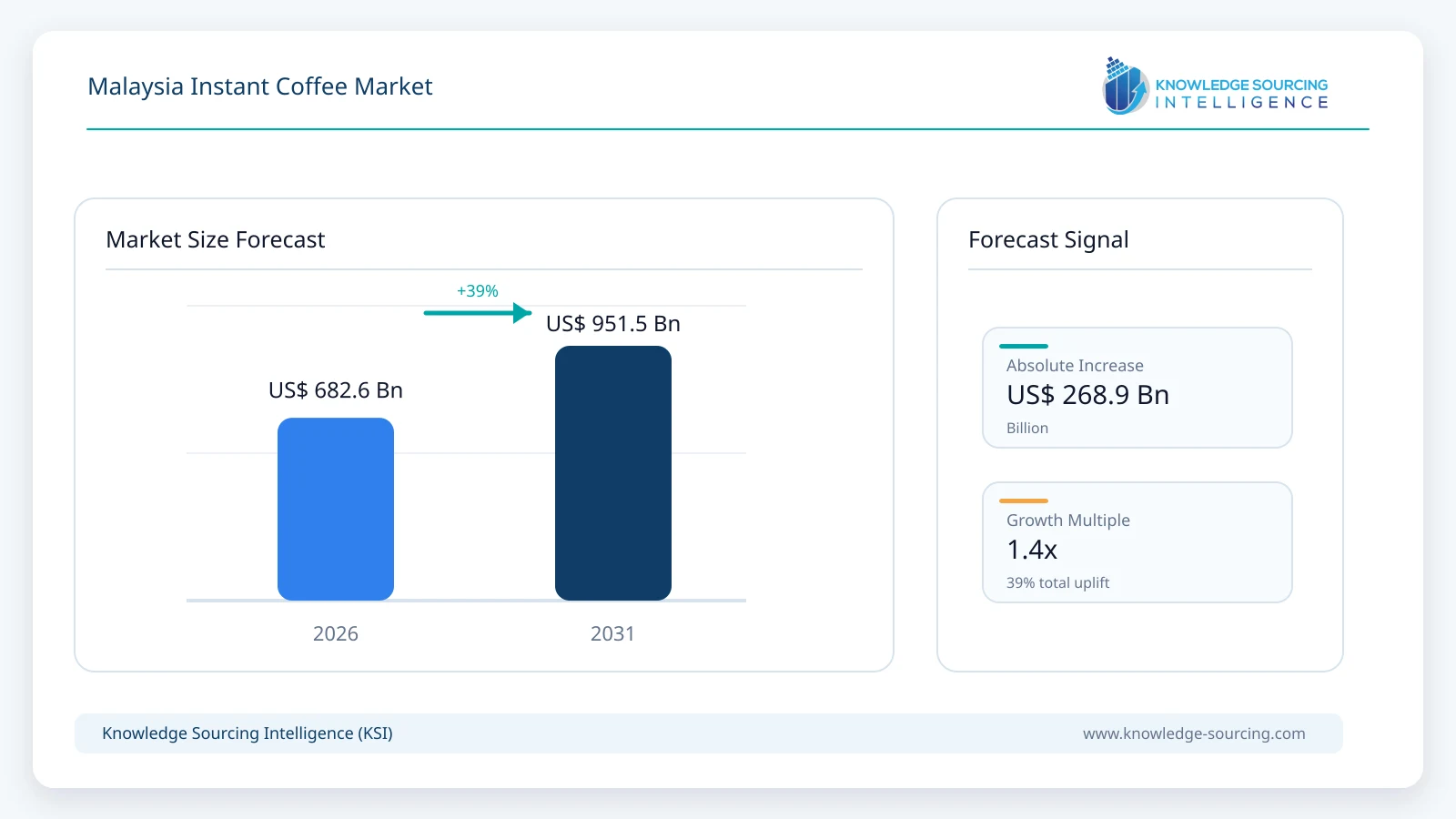
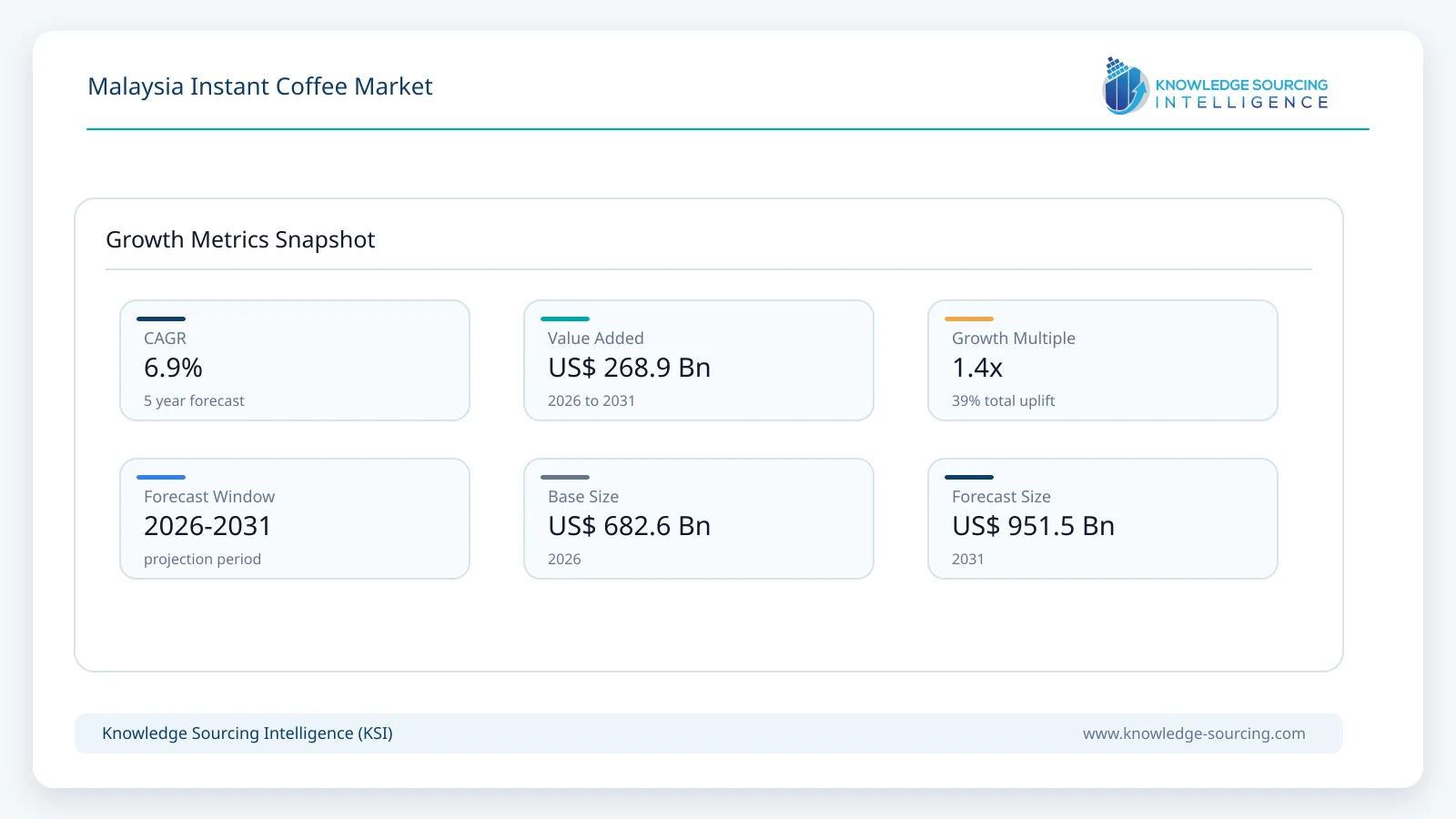
The Malaysia instant coffee market is forecast to grow at a CAGR of 6.9%, reaching USD 951.5 million in 2031 from USD 682.6 million in 2026.
Highlights:
- 1Largest End-User (Household Segment)Home consumption remains the dominant driver of volume due to the ingrained culture of morning and afternoon coffee breaks, which sustains steady recurring demand for bulk packaging and sachets.
- 2Regulatory Impact (SST and Halal Standards)The 2025 SST overhaul and strict JAKIM Halal requirements increase compliance costs for manufacturers but simultaneously enhance consumer trust and facilitate exports to Muslim-majority markets.
- 3Regional Leader (Kuala Lumpur and Selangor)The Klang Valley serves as the primary consumption and distribution hub, where high disposable income and dense retail infrastructure accelerate the adoption of premium instant coffee variants.
- 4Technology Transition (Spray-Dried to Freeze-Dried)There is a definitive shift toward freeze-dried technology as consumers demand better flavor retention, driving manufacturers to invest in high-capital dehydration equipment to capture the premium market.
- 5Pricing Sensitivity (Cost-Push Inflation)Volatility in global coffee bean prices, particularly due to climate-induced yield drops in Vietnam, forces Malaysian producers to optimize margin management through refined supply chain logistics and local sourcing initiatives.
The Kuala Lumpur region is expected to grow in the Malaysian instant coffee market due to its large urban population, busy working professionals, robust retail infrastructure, widespread café culture, and increasing adoption of premium and convenient beverage products. The region also benefits from higher disposable incomes and extensive e-commerce penetration, supporting greater consumption of instant coffee products.
The statistics reported by the government for the last quarter (when the information was available) indicated that there were positive indicators for the growth of the instant coffee market over this period.
According to the Department of Statistics Malaysia (DOSM), the total sales for the total manufacturing sector as of 2025 were RM1.97 trillion (Jul 2025), an annualised growth rate of 4.2%. In December 2025, the food and beverage and tobacco sub-category saw a growth rate of +10.4% YOY, while food processing (also considered a sub-category) increased by +9.6%, which helps to support the increased production and consumption of beverages.
The Sales value of Wholesale & retail trade recorded RM169.0 billion in March 2026, grew 9.8 per cent year-on-year. The positive growth of 15.75% was contributed by Wholesale trade and 7.5% by Retail trade. Meanwhile, for month-on-month comparison, sales value increased 8.1 per cent. This information indicates a stronger demand for instant coffee products, encourages increased innovation in new products, and ultimately propels the market growth of instant coffee in 2026.
Malaysia's Gross Domestic Product (GDP) grew by 6.3 per cent in the fourth quarter of 2025 as compared to 5.4 per cent in the preceding quarter, driven by sustained household spending on food and beverage products. E-commerce transactions also continued to rise, strengthening online sales channels for packaged beverages, including instant coffee.
Growing demand for premium products, low-sugar formulations, functional coffee blends, and sustainable packaging solutions is encouraging manufacturers to diversify their product portfolios. These factors are expected to support innovation, product premiumization, and sustained market growth through 2026.
Freeze-dried instant coffee is expected to grow due to increasing demand for premium coffee experiences, better flavor retention, and rising consumer preference for high-quality products.
Sachet pouches are expected to grow due to their affordability, portability, single-serve convenience, and strong popularity among busy consumers and households.
Online distribution channels are expected to grow due to expanding e-commerce platforms, increasing digital purchases, convenient home delivery services, and wider product accessibility.
Spray-dried instant coffee is expected to grow due to its cost-effectiveness, mass-market appeal, long shelf life, and broad retail availability.
Market Dynamics
Drivers
Expansion of Retail and E-commerce Channels
The growth of the retail and e-commerce channels continues to support the Malaysian instant coffee market by providing easy access to products and expanding the number of consumers that can be reached in urban and semi-urban areas. The availability of instant coffee products is growing through supermarkets, convenience stores, hypermarkets, and online marketplaces.
Therefore, manufacturers can introduce new flavours, premium variants, and ready-to-mix formats to a larger group of consumers. Consumers purchase packaged beverages through both physical stores and digital platforms; both types of channels provide greater convenience, promotional discounts, and quicker access to products.
Recent government data demonstrates the high growth of the Malaysian retail sector. According to the Department of Statistics Malaysia (DOSM), the sales value of Wholesale & retail trade recorded RM169.0 billion in March 2026, grew 9.8 per cent year-on-year. The positive growth of 15.7% was contributed by Wholesale trade and 7.5% by Retail trade. Meanwhile, for month-on-month comparison, sales value increased 8.1 per cent.
In terms of volume index, Wholesale & retail trade registered a growth of 4.4 per cent year-on-year to record 170.0 points. The increase was driven by a growth in Wholesale trade at 5.9 per cent and Retail trade at 5.2 per cent. For the monthly comparison, the volume index rose by 3.5 per cent, contributed by an 11.9% increase in Motor vehicles, along with 2.6% gains in both Wholesale and Retail trade. Additionally, the seasonally adjusted volume index saw a month-on-month increase of 3.5 per cent in March 2026.
The expansion of organized retail and e-commerce platforms is predicted to drive higher sales of instant coffee and ensure continued market growth through 2026.
Malaysia’s wholesale trade reached RM78.4 billion, while retail trade totaled RM72.0 billion in March 2026, highlighting the continued expansion of the country’s distribution and consumer sales network. This growth supports the instant coffee market by improving product availability across supermarkets, hypermarkets, convenience stores, and online retail platforms.
Strong wholesale activity enables manufacturers and distributors to efficiently supply instant coffee products nationwide, while rising retail sales indicate robust consumer purchasing activity. The expanding retail and e-commerce ecosystem also provides coffee brands with greater shelf presence, wider geographic coverage, and improved access to digital consumers. As a result, manufacturers can launch new products more effectively, strengthen brand visibility, and increase sales volumes, supporting the sustained growth of Malaysia’s instant coffee market.
Expansion of Modern Retail and Foodservice: The proliferation of convenience store chains and the integration of instant coffee solutions in offices and hospitals broaden the physical availability of the product, stimulating impulsive and functional consumption.
Urbanization and Lifestyle Shifts: As more Malaysians move into metropolitan areas, the traditional preference for time-consuming brewing methods is replaced by a demand for instant solutions that offer a variety of flavors and functional health benefits.
Market Restraints and Opportunities
Global Supply Chain Volatility: Heavy reliance on bean imports from Vietnam and Brazil exposes the Malaysian market to price fluctuations and logistics disruptions, necessitating more robust inventory and hedging strategies.
Health and Wellness Scrutiny: Growing consumer awareness regarding sugar content in "3-in-1" premixes poses a risk to traditional formulations, yet it creates an opportunity for "no-added-sugar" and fortified functional coffee products.
Specialty and Premiumization Opportunities: There is significant untapped potential in the single-origin and micro-ground instant coffee segments, catering to a younger demographic that seeks cafe-quality experiences at a lower price point than retail cafes.
Export Expansion via Trade Agreements: Leveraging ASEAN Free Trade Agreements (AFTA), Malaysian manufacturers have the opportunity to expand their footprint in emerging regional markets where instant coffee consumption is on a steep upward trajectory.
Raw Material and Pricing Analysis
The primary raw materials for the Malaysian instant coffee market include Robusta and Arabica green beans, sugar, and non-dairy creamers. Malaysia’s domestic production of coffee is limited, contributing less than 0.1% to global output, which necessitates substantial imports from Vietnam, Indonesia, and Brazil. In 2025, coffee bean prices have been subject to upward pressure due to climate-induced shortages in Vietnam, leading to a "cost-push" pricing environment. Pricing dynamics are also influenced by energy costs associated with the high-intensity spray-drying and freeze-drying processes. Manufacturers are increasingly adopting margin management strategies, such as "shrinkflation" or shifting toward higher-margin premium lines, to offset the rising cost of raw material procurement and transportation.
Supply Chain Analysis
The supply chain for instant coffee in Malaysia is highly integrated but vulnerable to regional risks. Production is concentrated among large-scale multinational corporations and established local players who operate sophisticated extraction and drying facilities. These manufacturers typically import raw beans through major ports like Port Klang, process them into soluble powder or liquid extracts, and distribute them through a dual-channel model of modern retail and traditional trade.
Transportation constraints and hazard classifications for certain industrial chemicals used in maintenance can impact operational flow. To mitigate these risks, leading firms are adopting integrated manufacturing strategies, where packaging and processing are co-located to reduce logistics overhead. However, the regional risk exposure remains high due to the concentration of bean sourcing in Southeast Asia, where weather patterns significantly impact harvest cycles and raw material availability.
Government Regulations
Jurisdiction | Key Regulation / Agency | Market Impact Analysis |
Malaysia | Department of Islamic Development Malaysia (JAKIM) | Mandatory Halal certification for coffee products to access the majority Muslim consumer base; non-compliance limits market reach. |
Malaysia | Sales and Service Tax (SST) 2025 Reform | Imposes a 5-10% tax on various food items and luxury imports, impacting the final retail price and forcing cost-efficiency in production. |
ASEAN | ASEAN Free Trade Area (AFTA) | Eliminates or reduces tariffs on coffee extracts traded between member states, facilitating Malaysia's position as a regional export hub. |
Global | Food Act 1983 / Food Regulations 1985 | Strict labeling and safety standards regarding additives, caffeine levels, and nutritional claims, ensuring product transparency and consumer safety. |
Key Developments
April 23, 2026: Nestlé S.A. announced that its global coffee business, led by NESCAFÉ, delivered strong first-quarter 2026 growth, with coffee becoming the company's primary growth category. The performance supports continued investment and expansion of NESCAFÉ products, including its Malaysia instant coffee portfolio.
September 2025: Starbucks Malaysia – Visit Malaysia 2026 Partnership Launch: Starbucks Malaysia partnered with Tourism Malaysia to introduce locally-inspired food and beverage concepts. This development is structurally significant as it integrates global coffee branding with local tourism, driving demand for premiumized, culturally relevant coffee experiences.
Market Segmentation
By Type: Freeze-Dried Instant Coffee
By type, the Malaysian Instant Coffee market is segmented into Freeze-Dried Instant Coffee, Spray-Dried Instant Coffee, and Others. The Freeze-Dried Instant Coffee segment is expected to grow at a significant rate, driven by increasing consumer preference for premium coffee products, superior taste and aroma retention, and rising demand for café-quality coffee experiences at home.
The growth across type segments is supported by increasing coffee consumption, rising disposable incomes, expanding urbanization, changing consumer lifestyles, and growing demand for convenient beverage solutions. Continuous product innovation and the introduction of premium instant coffee variants are further contributing to market expansion. The Freeze-Dried Instant Coffee segment is expected to witness considerable growth due to increasing consumer preference for premium coffee products, rising demand for superior taste and aroma, and growing willingness to pay for high-quality, café-style coffee experiences in Malaysia.
Freeze-dried instant coffee is a premium category of instant coffee produced through a dehydration process that preserves the coffee’s aroma, flavor, and quality more effectively than conventional spray-dried alternatives. In Malaysia, demand for freeze-dried coffee is increasing as consumers seek higher-quality and café-like coffee experiences at home and in the workplace.
The segment is witnessing strong growth due to rising disposable incomes, increasing coffee consumption among young professionals, and growing consumer preference for premium and specialty coffee products. In 2022, Malaysia's gross disposable income reached RM1,722.1 billion, with the Household sector being the largest contributor to the National disposable income, accounting for 57.5 per cent, or RM989.4 billion.
Moreover, Malaysia’s expanding middle-class population and growing café culture are encouraging consumers to trade up from traditional instant coffee products to premium freeze-dried variants. The increasing exposure to international coffee brands and specialty coffee trends is further supporting segment growth. In line with this, Malaysia’s median household income reached RM 7,017 in 2024, growing by 5.1 per cent annually.
Manufacturers are expanding their freeze-dried coffee portfolios by introducing single-origin, premium blend, and functional coffee products. Top brands include Ah Huat (famous for their freeze-dried Gold Medal White Coffee), CAROMA, and Aik Cheong, which cater to a variety of ready-to-drink and traditional white coffee preferences.
Additionally, the rapid growth of e-commerce, rising demand for convenient beverage solutions, and increasing product innovation in premium instant coffee formats are further accelerating the adoption of freeze-dried instant coffee across Malaysia.
By Distribution Channel: Online
By distribution channel, the Malaysian Instant Coffee market is segmented into online and offline channels. The online segment is expected to grow at a significant rate, driven by increasing e-commerce penetration, rising smartphone usage, expanding digital payment adoption, and growing consumer preference for convenient purchasing options.
The growth across distribution channels is supported by increasing coffee consumption, rapid urbanization, rising disposable incomes, busy consumer lifestyles, and the wider availability of instant coffee products through both digital and retail channels. The online segment is expected to show considerable growth, fueled by the rapid expansion of e-commerce platforms, increasing internet penetration, and rising middle-class consumption.
The Malaysian instant coffee market through online distribution channels is experiencing rapid growth due to increasing internet penetration, rising digital adoption, and growing consumer preference for convenient shopping experiences. Consumers are increasingly purchasing instant coffee products through e-commerce platforms, online grocery stores, and direct-to-consumer brand websites.
Malaysia’s e-commerce sector continues to expand rapidly, supported by high smartphone penetration, improved digital payment infrastructure, and growing consumer confidence in online transactions. This is creating favorable conditions for the online sales of instant coffee products across the country.
E-commerce revenue by establishment in Malaysia recorded an annual growth rate of 1.3 per cent in the third quarter of 2025. In 2024, e-commerce revenue amounted to RM1,230.1 billion, an increase of 3.9 per cent compared to the year before.
According to data from the World Bank, Malaysia maintains a highly urbanized population with strong purchasing power and widespread internet access. As of 2024, Malaysia's urban population makes up over 77% of the total population. Moreover, the population of Malaysia in 2025 was 34.2 million, as per the World Bank.
Another key growth driver is the expansion of major online marketplaces and grocery delivery platforms such as Shopee, Lazada, and GrabMart, which offer consumers a wide range of instant coffee brands, competitive pricing, subscription options, promotional discounts, and doorstep delivery services. These benefits enhance customer convenience and drive repeat purchases.
Retail growth is further supported by the expanding middle-income population in major urban centers such as Kuala Lumpur, Penang, and Johor Bahru, where consumers are increasingly seeking premium, specialty, and imported instant coffee products. The growing influence of social media marketing and digital advertising is also improving product awareness and brand engagement.
Moreover, leading coffee manufacturers and beverage companies are strengthening their online presence through digital marketing campaigns, influencer collaborations, and direct-to-consumer strategies. The increasing availability of exclusive online product launches, bundled offerings, and personalized promotions is further accelerating online sales of instant coffee in Malaysia.
Regional Analysis
Kuala Lumpur
Kuala Lumpur serves as the epicenter of the Malaysian instant coffee market, driven by a high density of corporate offices and a sophisticated consumer base. The demand in this region is characterized by a preference for premium, freeze-dried, and functional coffee variants. The presence of advanced retail infrastructure and a high concentration of e-commerce logistics hubs ensures that new product launches gain traction here before scaling nationwide.
Penang
As a major industrial and tourism hub, Penang exhibits a dual demand profile. The industrial sector drives high-volume consumption of convenient premixes among the manufacturing workforce, while the vibrant heritage and cafe culture stimulate interest in premium and specialty instant coffee brands. The regional market benefits from strong logistics connectivity via the Port of Penang, facilitating both domestic distribution and regional exports.
List of Companies
Nestlé S.A.
UCC Holdings Pte. Ltd.
Aik Cheong Coffee Roaster Sdn. Bhd.
Chek Hup Sdn. Bhd.
Gold Choice
Power Root (M) Sdn. Bhd.
BONCAFÉ (M) Sdn Bhd.
The Starbucks Coffee Company
illycaffè S.p.A.
JDE Peet's
CityCafe
Coffee Tree Trading Sdn. Bhd.
Nestlé S.A.
Nestlé is one of the world’s largest food and beverage companies, spanning from coffee to dairy and nutrition, confectionery, bottled water, and pet care. The group owns several well-known brands, including NESCAFÉ, Nespresso, KitKat, and Maggi. In Malaysia, Nestlé has kept a pretty strong footprint for over a century via Nestlé (Malaysia) Berhad, where it manufactures and distributes a wide portfolio of food-and-drink products, both for local shelves and export routes in regions like Singapore. The company also focuses on investing in local production facilities, continuous innovation, and supply chain growth to maintain its market position.
In Malaysia’s instant coffee market, NESCAFÉ is one of the most influential and widely enjoyed brands. Nestlé has been expanding its coffee lineup to match shifting consumer tastes across the region. It includes premium instant coffee, ready-to-drink coffee, and coffee concentrates. In addition, Nestlé has invested in additional coffee production capacity for NESCAFÉ Espresso Concentrate in Malaysia.
Boncafé (M) Sdn Bhd
Boncafé, part of the Massimo Zanetti Beverage Group, occupies a strategic niche in the premium and foodservice segments. Its strategy focuses on "Gourmet Coffee" positioning, recently rebranding its retail line to appeal to contemporary home-brewing enthusiasts. Boncafé's competitive advantage is its strong presence in the B2B sector, supplying hotels, airlines, and high-end offices with both soluble coffee and machinery.
Geographically, Boncafé is strong in urban centers like Kuala Lumpur and Penang. Its technology differentiation lies in its ability to provide a "total coffee solution," combining high-quality coffee extracts with technical support for dispensing equipment. This service-integrated model builds long-term institutional loyalty that is difficult for pure retail brands to displace.
Starbucks Coffee Company
Starbucks, operated in Malaysia by Berjaya Food Berhad, has successfully extended its brand equity from physical cafes into the retail instant coffee market via the "Starbucks At Home" range (in partnership with Nestlé). The strategy is purely premium, targeting consumers who want to replicate the Starbucks "Third Place" experience at home. This segment is characterized by higher price points and premium packaging formats like tins and individual premium sachets.
The company’s strength lies in its ability to leverage its massive physical store network to promote its retail products. Strategic partnerships, such as the "Visit Malaysia 2026" campaign, further embed the brand into the national cultural fabric. Starbucks utilizes its digital loyalty program to drive repeat purchases, making it a leader in the digital integration of coffee retail.
Analyst View
The Malaysian instant coffee market is transitioning from a volume-led commodity sector to a value-driven premium industry. While rising bean costs and SST reforms present margin challenges, the acceleration of e-commerce and a growing preference for high-quality, freeze-dried formats offer significant growth opportunities for brands capable of balancing convenience with artisanal quality.
Malaysia Instant Coffee Market Scope:
| Report Metric | Details |
|---|---|
| Total Market Size in 2026 | USD 682.6 million |
| Total Market Size in 2031 | USD 951.5 million |
| Forecast Unit | Mllion |
| Growth Rate | 6.9% |
| Study Period | 2021 to 2031 |
| Historical Data | 2021 to 2024 |
| Base Year | 2025 |
| Forecast Period | 2026 – 2031 |
| Segmentation | Type, Packaging Type, Distribution Channel, Province |
| Companies |
|
Market Segmentation
By Type
By Packaging Type
By Distribution Channel
By Province
Table of Contents
1. EXECUTIVE SUMMARY
2. MARKET SNAPSHOT
2.1. Market Overview
2.2. Market Definition
2.3. Scope of the Study
2.4. Market Segmentation
3. BUSINESS LANDSCAPE
3.1. Market Drivers
3.2. Market Restraints
3.3. Market Opportunities
3.4. Porter’s Five Forces Analysis
3.5. Industry Value Chain Analysis
3.6. Policies and Regulations
3.7. Strategic Recommendations
4. TECHNOLOGICAL OUTLOOK
5. MALAYSIA INSTANT COFFEE MARKET BY TYPE
5.1. Introduction
5.2. Freeze-Dried Instant Coffee
5.3. Spray-Dried Instant Coffee
5.4. Others
6. MALAYSIA INSTANT COFFEE MARKET BY PACKAGING TYPE
6.1. Introduction
6.2. Sachets/Pouches
6.3. Jars
7. MALAYSIA INSTANT COFFEE MARKET BY DISTRIBUTION CHANNEL
7.1. Introduction
7.2. Offline
7.2.1. Foodservices
7.2.2. Retail
7.2.2.1. Supermarket/Hypermarket
7.2.2.2. Convenience Stores
7.2.2.3. Others
7.3. Online
8. MALAYSIA INSTANT COFFEE MARKET BY PROVINCE
8.1. Introduction
8.2. Kuala Lumpur
8.3. Penang
8.4. Ipoh
8.5. Others
9. COMPETITIVE ENVIRONMENT AND ANALYSIS
9.1. Major Players and Strategy Analysis
9.2. Market Share Analysis
9.3. Mergers, Acquisitions, Agreements, and Collaborations
9.4. Competitive Dashboard
10. COMPANY PROFILES
10.1. Nestlé S.A.
10.2. UCC Holdings Pte. Ltd.
10.3. Aik Cheong Coffee Roaster Sdn. Bhd.
10.4. Chek Hup Sdn. Bhd.
10.5. Gold Choice
10.6. Power Root (M) Sdn. Bhd.
10.7. BONCAFÉ (M) Sdn Bhd.
10.8. The Starbucks Coffee Company
10.9. illycaffè S.p.A.
10.10. JDE Peet's
10.11. CityCafe
10.12. Coffee Tree Trading Sdn. Bhd.
11. RESEARCH METHODOLOGY
12. LIST OF FIGURES
13. LIST OF TABLES
Navigate
Trusted by the world's leading organizations











