
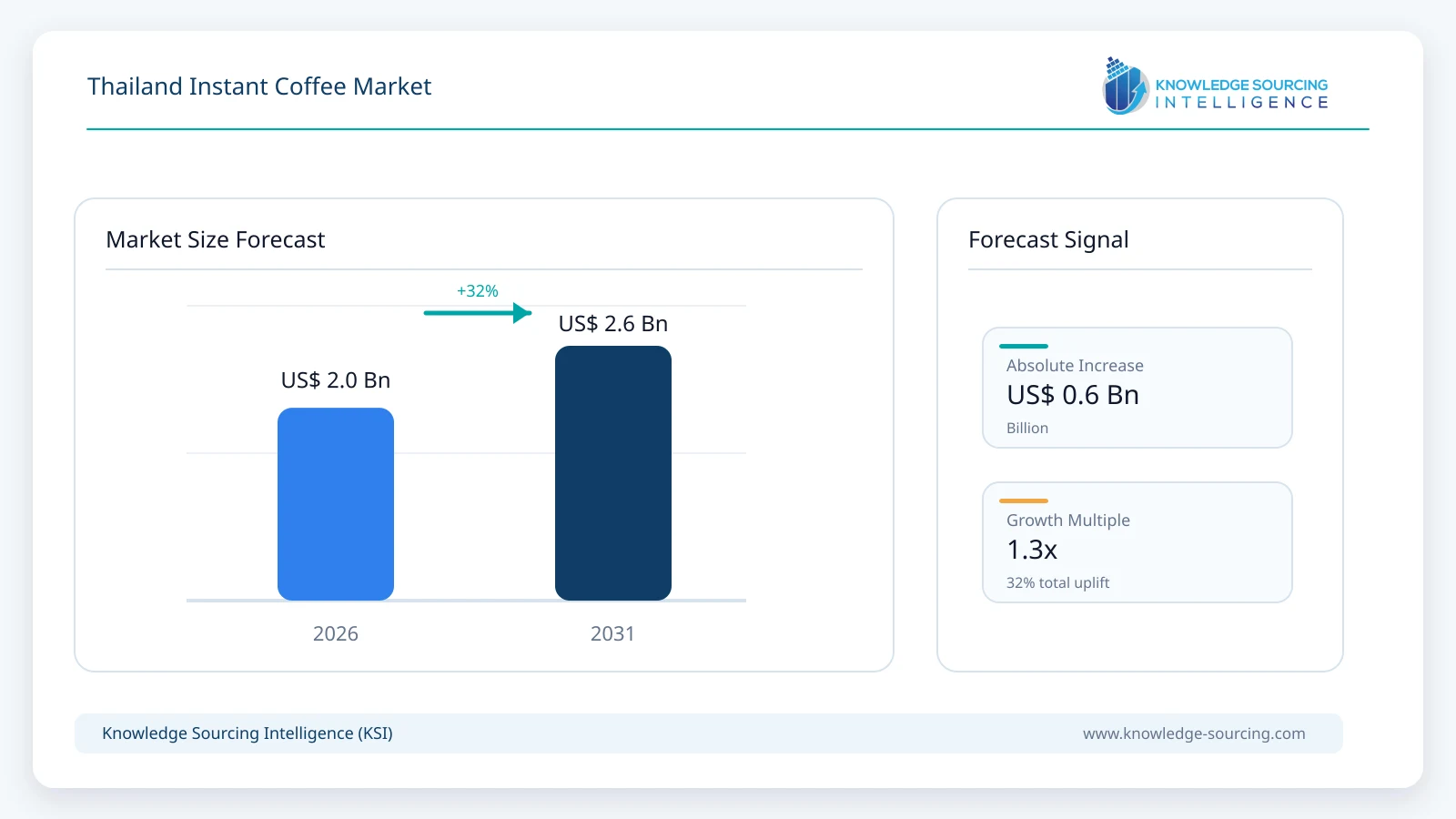
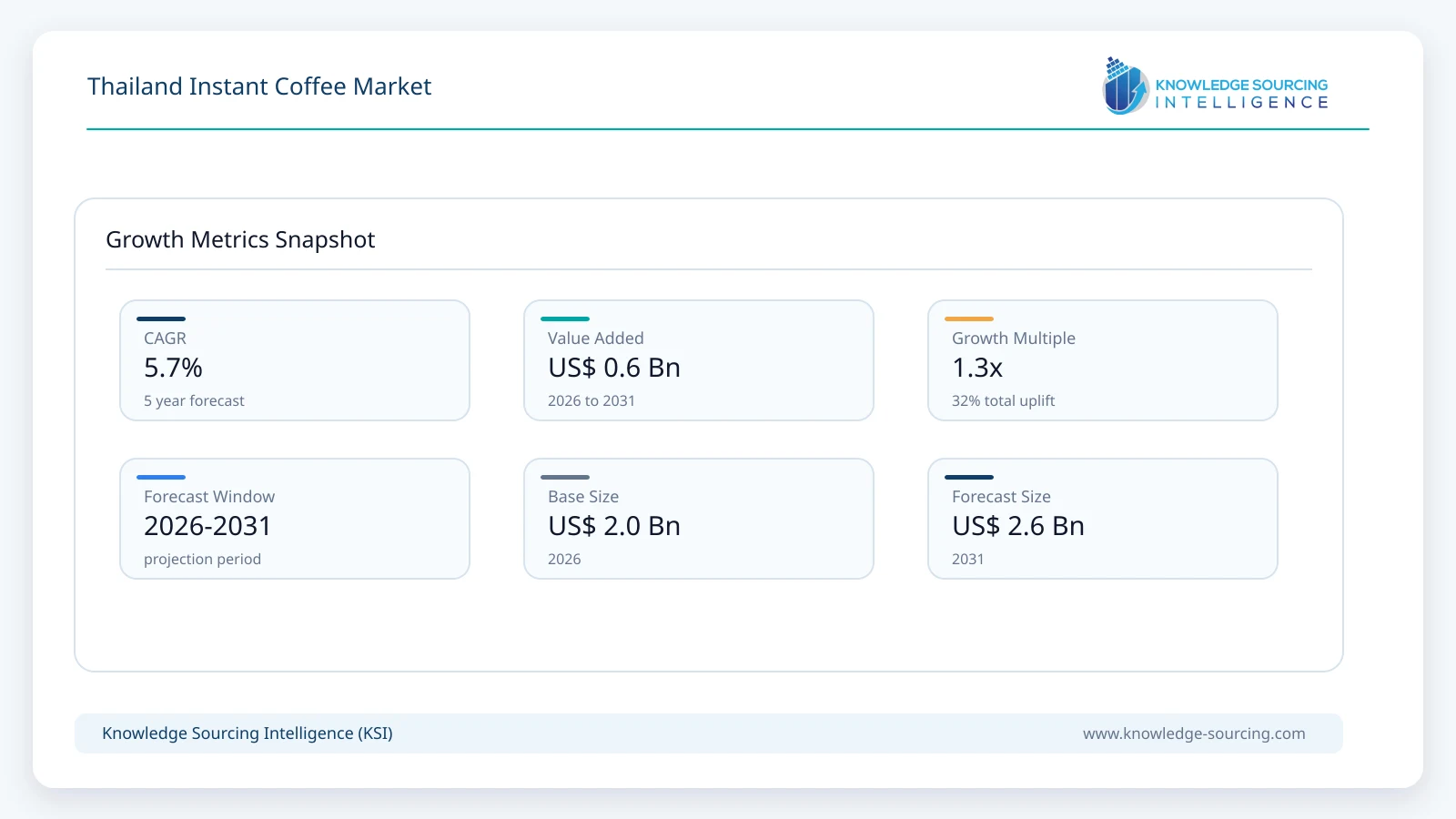
The Thailand Instant Coffee market is forecast to grow at a CAGR of 5.7%, reaching USD 2.63 billion in 2031 from USD 1.99 billion in 2026.
Highlights:
- 1Leading End-User SegmentThe retail sector holds the largest volume share, powered by widespread convenience-store networks in Bangkok and secondary provinces that serve working-class and student consumers with ready access.
- 2Technology Segment ShiftFreeze-dried instant coffee is the fastest-growing technology segment, capturing rising premium share as consumers pay more for superior aroma and flavor retention versus traditional spray-dried products.
- 3Distribution Channel DominanceConvenience stores command the leading distribution share, leveraging high outlet density, single-serve sachets, and loyalty programs that align perfectly with grab-and-go urban lifestyles.
- 4Regional ConcentrationBangkok and its metropolitan area remain the dominant regional consumption hub, accounting for the highest share due to dense office employment and strong modern retail infrastructure.
- 5Regulatory & Health ImpactUpdated Thai FDA labeling rules and sugar taxes are reshaping demand toward healthier “black” and no-sugar-added segments, accelerating reformulation and premium health-aligned product growth.
The Thai instant coffee market is fundamentally shaped by structural demand drivers rooted in the country's demographic evolution and shifting labor patterns. As the Thai economy transitions toward service-oriented sectors concentrated in urban hubs like Bangkok, the dependency on convenient, time-efficient beverage solutions has solidified instant coffee as a non-discretionary staple. Unlike short-term consumption spikes, this demand is underpinned by the entrenched "3-in-1" culture, which is now evolving into a demand for "premium convenience." This shift is critical as it necessitates significant industry investment in technology, specifically freeze-drying processes that preserve the sensory profile of the coffee bean, bridging the gap between instant formats and the growing specialty café experience.
Industry evolution is further dictated by a sustainability transition necessitated by environmental pressures on domestic coffee cultivation. The Office of Agricultural Economics has noted a persistent decline in domestic bean production despite expanding plantation areas, forcing a strategic industry dependency on high-volume imports from Vietnam and Laos. This reliance creates a market environment where pricing and supply chain resilience are paramount. Furthermore, regulatory influence from the Thai FDA regarding nutritional labeling and sugar content (Excise Tax on Sugary Drinks) is compelling manufacturers to reformulate products, shifting market demand toward "Black" instant coffee and "No Sugar Added" variants. The strategic importance of the instant coffee product thus lies in its ability to balance industrial-scale affordability with the increasing consumer requirement for health-aligned and premium sensory attributes.
Market Dynamics
Market Drivers
Urbanization and Workforce Expansion: The continuous migration of the Thai population into urban centers directly increases the demand for instant coffee. The fast-paced lifestyle of city dwellers necessitates beverages that require zero specialized equipment or significant preparation time, making soluble coffee the default choice for the domestic workforce.
Shift from Aerated Beverages to Coffee: Increasing health consciousness among Thai consumers has led to a structural decline in the consumption of carbonated soft drinks. This shift drives demand toward instant coffee, which is increasingly marketed as a functional alternative offering both mental alertness and, in the case of black coffee, lower caloric intake.
Expansion of Modern Trade Infrastructure: The aggressive expansion of convenience store chains and hypermarkets across Thailand’s secondary provinces has streamlined the supply chain. This improved physical infrastructure ensures product availability in rural areas, converting traditional tea or fresh coffee drinkers to instant formats through localized accessibility.
Premiumization through Specialty Blends: The rise of a sophisticated "cafe culture" in Thailand has paradoxically boosted the instant coffee market. As consumers become more educated about bean origins and roast profiles, demand increases for premium instant versions (e.g., micro-ground or freeze-dried) that allow for a "cafe-like" experience within the home environment.
Market Restraints and Opportunities
Domestic Supply-Demand Gap: Thailand faces a significant structural deficit in raw coffee bean production, with a 16,623-tonne decrease noted by government officials in recent cycles. This creates a dependency on imports, exposing local instant coffee manufacturers to international price volatility and currency exchange risks.
Climate-Induced Production Risks: Rising temperatures and erratic rainfall in Northern Thailand threaten the long-term viability of Arabica and Robusta crops. This environmental challenge acts as a restraint but also opens an opportunity for investment in climate-resilient coffee processing and the development of sustainable sourcing certifications that appeal to ethical consumers.
Sugar Tax and Health Regulations: The Thai government's excise tax on high-sugar beverages presents a cost challenge for traditional 3-in-1 manufacturers. However, this regulatory pressure creates a significant opportunity for the development of "lite" or sugar-free formulations, which are seeing rapid adoption among the health-conscious urban middle class.
E-commerce and Digital Distribution: The rapid growth of digital platforms in Thailand offers a new frontier for instant coffee sales. Direct-to-consumer (DTC) models allow premium and specialty instant coffee brands to bypass traditional retail barriers, offering an opportunity to capture high-margin sales through subscription models and online-exclusive product launches.
Raw Material and Pricing Analysis
The primary raw materials for the Thai instant coffee market are Robusta and Arabica green coffee beans, with Robusta accounting for the majority of soluble coffee production due to its high caffeine content and extractable solids. Pricing dynamics are currently characterized by extreme volatility; the International Coffee Organization (ICO) reported that the Robusta group indicator reached historical highs in 2024, driven by supply constraints in major exporting neighbors like Vietnam. This surge in raw material costs directly pressures the margin management strategies of Thai producers, who must balance increased input costs against the price-sensitive nature of the mass-market consumer base.
Supply chains are increasingly interdependent, with Thailand importing over 80,000 tonnes of coffee products annually to meet domestic demand. Regional pricing variations occur based on the proximity to major ports and the efficiency of internal logistics networks connecting Bangkok to the northern growing regions. In response to these "tightness cycles," major players are increasingly adopting integrated manufacturing strategies, including direct sourcing contracts with farmers and investing in energy-efficient roasting technologies to offset rising utility costs. This strategic shift is essential for maintaining price stability in a market where the "3-in-1" segment remains the cornerstone of daily consumption for millions.
Supply Chain Analysis
The supply chain for instant coffee in Thailand is characterized by high production concentration in the central and eastern industrial zones, where large-scale processing facilities leverage proximity to major distribution hubs. Energy intensity is a critical factor in this chain, particularly for freeze-dried production, which requires significant electrical input for the sublimation process. To mitigate regional risk exposure, manufacturers are increasingly diversifying their bean sourcing across the ASEAN region, utilizing the ASEAN Free Trade Area (AFTA) to facilitate the cost-effective movement of green beans from Vietnam and Laos into Thai processing plants.
Transportation constraints remain a factor in reaching remote northern and southern provinces, leading to a reliance on robust secondary distribution networks. Integrated manufacturing strategies, where roasting, extraction, and packaging occur in a single continuous flow, are becoming the industry standard to reduce logistics costs and maintain aroma integrity. Furthermore, as the market shifts toward more complex functional coffee blends, the supply chain now incorporates secondary inputs like non-dairy creamers and natural sweeteners, requiring more sophisticated inventory management and quality control protocols to comply with updated Thai FDA food safety standards.
Government Regulations
The regulatory landscape in Thailand is undergoing a period of modernization, focusing on consumer health and transparency.
Jurisdiction | Key Regulation / Agency | Market Impact Analysis |
Thailand | Thai FDA / Ministry of Public Health (No. 394) | Mandates strict GDA (Guideline Daily Amount) labeling for coffee products, forcing manufacturers to highlight sugar, fat, and sodium levels on the front of packaging. |
Thailand | Excise Department / Sugar Tax | Imposes a progressive tax on sugar-sweetened beverages, including pre-mixed 3-in-1 coffee, incentivizing the development of low-sugar and sugar-free formulations. |
International | ASEAN Food Safety Standards | Harmonizes microbial and pesticide residue limits across the region, facilitating easier cross-border trade of instant coffee products between Thailand and other ASEAN members. |
Thailand | Department of Internal Trade (DIT) | Monitors the retail price of essential goods, including instant coffee, to prevent price gouging during periods of raw material shortage, effectively capping short-term price hikes. |
Key Developments
July 2026: Nestlé announced a CHF 563 million investment to build a new Nescafé factory in Thailand, producing soluble coffee, coffee mixes and ready-to-drink coffee, with operations expected from late 2028.
October 2025: Nestlé launched NESCAFÉ Concentrate Ready-to-Mix in Thailand, introducing its first concentrated coffee portfolio locally to expand convenient cold-coffee consumption and attract younger consumers.
September 2025: Nestlé introduced the first NESCAFÉ Concentrate Ready-to-Mix portfolio in Thailand, strengthening its coffee offering around the country’s growing cold-coffee culture and convenient at-home preparation.
Market Segmentation
By Type: Freeze-Dried Instant Coffee
The freeze-dried segment is the fastest-growing technology category in Thailand, driven by the "premiumization" of home consumption. Unlike spray-drying, the freeze-drying process involves freezing coffee extract and sublimating the ice under a vacuum, which preserves the delicate volatile aromatic compounds and essential oils of the bean. Demand for this segment is specifically driven by the "hobbyist" consumer class in urban areas like Bangkok and Phuket. These consumers are moving away from traditional 3-in-1 sachets toward pure soluble coffee that offers a sensory profile closer to fresh-ground coffee. As disposable incomes rise, this segment benefits from a higher price elasticity, allowing manufacturers to capture greater margins compared to the highly competitive mass-market spray-dried sector.
By Distribution Channel: Convenience Stores
Convenience stores (C-stores) represent the most critical distribution sub-segment for instant coffee in Thailand. The structural demand is driven by the sheer density of outlets, such as 7-Eleven and CJ Express, which serve as the primary "pantry" for the Thai urban population. The "grab-and-go" nature of these outlets aligns perfectly with the functional purpose of instant coffee. C-stores drive demand through localized promotions and the stocking of small-format "single-serve" sachets, which appeal to low-to-middle-income earners who prefer small, frequent purchases over bulk buying. This channel's dominance is further solidified by the integration of digital payment systems and loyalty programs that incentivize repeat purchases of specific instant coffee brands.
Regional Analysis
Bangkok
Bangkok represents the epicenter of the Thai instant coffee market, characterized by a sophisticated consumer base and a high concentration of modern retail infrastructure. Demand in the capital is increasingly bifurcated: while the mass-market workforce continues to drive high volumes of traditional 3-in-1 products, there is a burgeoning segment of young professionals opting for premium freeze-dried and functional coffee blends. The regulatory environment in Bangkok is also the most strictly enforced, with retail chains quickly adopting new FDA labeling and sugar tax requirements. This creates a highly competitive landscape where brands must continuously innovate in packaging and health claims to maintain market share.
Phuket and Pattaya City
The market dynamics in Phuket and Pattaya City are heavily influenced by the tourism sector and the expatriate population. Demand in these provinces is seasonally affected by tourist arrivals, which drives sales of premium instant coffee formats in hotels, serviced apartments, and tourist-facing retail outlets. There is a notable preference for international brands and specialty instant coffee variants that cater to Western taste profiles. Infrastructure development in these regions, including the expansion of high-end supermarkets, supports the availability of imported and premium domestic coffee products. The competitive landscape here is less about price and more about brand prestige and product variety.
List of Companies
Nestle
KHAO SHONG GROUP CO., LTD.
King Coffee Company Limited
Fancy World Co., Ltd.
K.T.Y. Foods International Co., Ltd.
DSC SYNDICATE CO., LTD.
ANYAMANEE BRAND CO., LTD.
Ajinomoto Co., Inc. (Birdy)
Moccona (JDE Peet's)
Café Amazon (PTTOR)
Nestle
Nestle maintains a dominant market position in Thailand through its Nescafé brand, which has become synonymous with instant coffee in the region. The company’s strategy is built on a "full-category" approach, offering everything from mass-market 3-in-1 sachets to premium Gold-range freeze-dried coffee and innovative products like Nescafé Espresso Concentrate. Its competitive advantage lies in its massive economies of scale and an unparalleled distribution network that reaches the smallest village shops (Mom-and-Pop stores) across all 77 provinces. Geographically, Nestle’s strength is nationwide, supported by large-scale local manufacturing facilities that utilize both domestic and imported beans. Their integration model is highly advanced, involving "Nescafé Plan" sustainability initiatives that secure long-term relationships with Thai coffee farmers.
KHAO SHONG GROUP CO., LTD.
Khao Shong is a major domestic player with a strong heritage in the Thai market, known for its focus on "authentic" Thai coffee flavors. The company’s strategy focuses on product differentiation through unique flavor profiles, such as its signature "Condensed Milk" flavored instant coffee, which appeals to traditional local palates. Its competitive advantage is its deep understanding of local consumer behavior and its ability to offer high-quality products at a competitive price point relative to international brands. Khao Shong has also successfully expanded into the international market, leveraging its "Thai Coffee" identity to export to neighboring ASEAN countries. Its technology differentiation includes specialized roasting techniques that emphasize the bold, nutty characteristics of Thai-grown Robusta beans.
King Coffee Company Limited
King Coffee, although a relatively newer entrant compared to established giants, has rapidly gained market share by positioning itself as a premium regional expert. The company’s strategy involves leveraging high-quality Vietnamese Robusta beans, widely considered the gold standard for soluble coffee, to offer a superior taste profile. Its competitive advantage lies in its strong supply chain links to Vietnam, the world’s largest Robusta producer, which ensures cost-efficiency and supply stability even during global shortages. King Coffee targets the modern urban consumer with sleek packaging and a focus on "high-energy" functional coffee. Their integration model focuses on rapid expansion through both online e-commerce channels and flagship "King Coffee" cafes that serve as brand touchpoints for their instant product lines.
Analyst View
Thailand's instant coffee market is transitioning toward a premium, health-centric model as urban consumers demand higher-quality soluble formats. While climate-induced supply deficits remain a structural risk, innovations in freeze-drying and functional blends will drive high-value growth through 2031.
Thailand Instant Coffee Market Scope:
| Report Metric | Details |
|---|---|
| Total Market Size in 2026 | USD 1.99 billion |
| Total Market Size in 2031 | USD 2.63 billion |
| Forecast Unit | Billion |
| Growth Rate | 5.7% |
| Study Period | 2021 to 2031 |
| Historical Data | 2021 to 2024 |
| Base Year | 2025 |
| Forecast Period | 2026 – 2031 |
| Segmentation | Type, Distribution Channel, Province |
| Geographical Segmentation | Bangkok, Pattaya City, Phuket, Others |
| Companies |
|
Market Segmentation
By Type
Freeze-Dried Instant Coffee
Spray-Dried Instant Coffee
Others
By Distribution Channel
Offline
Foodservice
Retail
Supermarket/Hypermarket
Convenience Stores
Others
Online
By Province
Bangkok
Pattaya City
Phuket
Others
Table of Contents
1. INTRODUCTION
1.1. Market Overview
1.2. Market Definition
1.3. Scope of the Study
1.4. Market Segmentation
1.5. Currency
1.6. Assumptions
1.7. Base and Forecast Years Timeline
1.8. Key benefits for the stakeholders
2. RESEARCH METHODOLOGY
2.1. Research Design
2.2. Research Process
3. EXECUTIVE SUMMARY
3.1. Key Findings
4. MARKET DYNAMICS
4.1. Market Drivers
4.2. Market Restraints
4.3. Porter’s Five Forces Analysis
4.3.1. Bargaining Power of Suppliers
4.3.2. Bargaining Power of Buyers
4.3.3. Threat of New Entrants
4.3.4. Threat of Substitutes
4.3.5. Competitive Rivalry in the Industry
4.4. Industry Value Chain Analysis
4.5. Analyst View
5. THAILAND INSTANT COFFEE MARKET BY TYPE
5.1. Introduction
5.2. Freeze-Dried Instant Coffee
5.3. Spray-Dried Instant Coffee
5.4. Others
6. THAILAND INSTANT COFFEE MARKET BY DISTRIBUTION CHANNEL
6.1. Introduction
6.2. Offline
6.2.1. Foodservice
6.2.2. Retail
6.2.2.1. Supermarket/Hypermarket
6.2.2.2. Convenience Stores
6.2.2.3. Others
6.3. Online
7. THAILAND INSTANT COFFEE MARKET BY PROVINCE
7.1. Introduction
7.2. Bangkok
7.3. Pattaya City
7.4. Phuket
7.5. Others
8. COMPETITIVE ENVIRONMENT AND ANALYSIS
8.1. Major Players and Strategy Analysis
8.2. Market Share Analysis
8.3. Mergers, Acquisitions, Agreements, and Collaborations
8.4. Competitive Dashboard
9. COMPANY PROFILES
9.1. Nestle
9.2. KHAO SHONG GROUP CO., LTD.
9.3. King Coffee Company Limited
9.4. Fancy World Co., Ltd.
9.5. K.T.Y. Foods International Co., Ltd.
9.6. DSC SYNDICATE CO., LTD.
9.7. ANYAMANEE BRAND CO., LTD.
Navigate
Trusted by the world's leading organizations











