
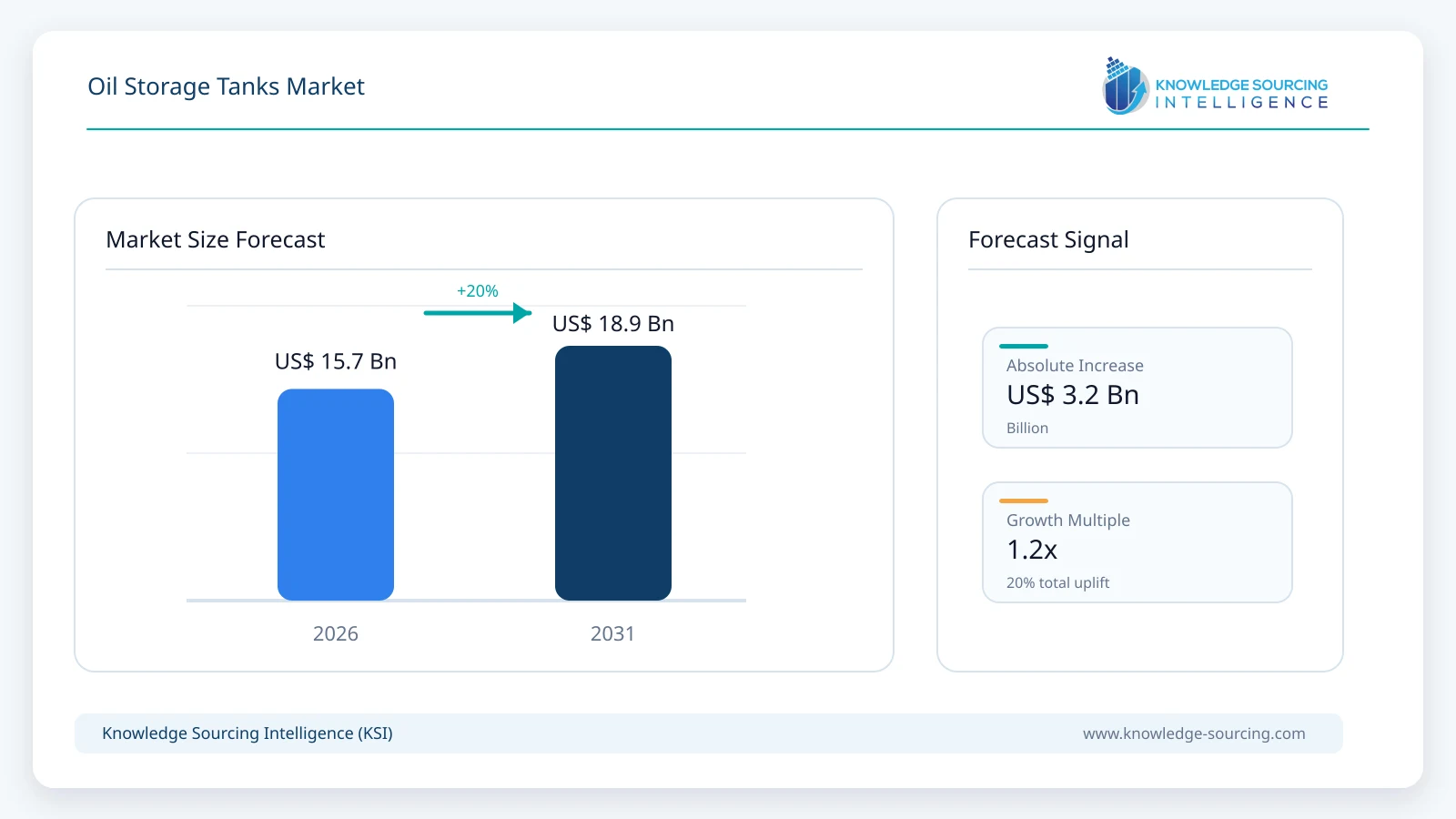
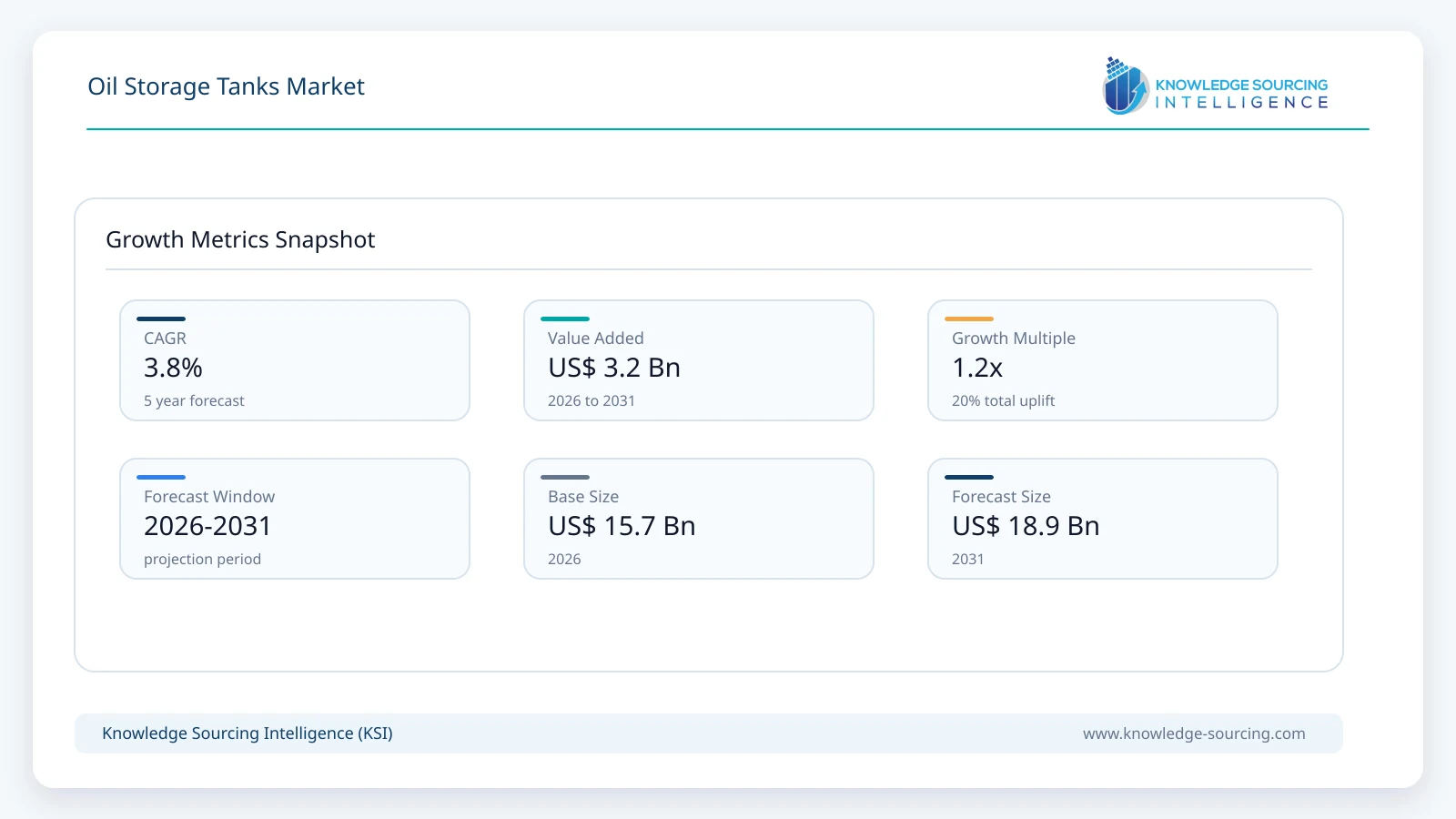
The global oil storage tanks market is forecast to grow at a CAGR of approximately 3.8%, reaching USD 18.9 billion in 2031 from USD 15.7 billion in 2026.
Highlights:
- 1Floating roof tanks account for approximately 47% of the global market in 2026, led by large crude oil and volatile petroleum storage applications.
- 2Steel accounts for nearly 78% of market value in 2026, with carbon steel remaining the principal construction material.
- 3Tanks above 100,000 barrels represent approximately 51% of market value, supported by terminals, refineries and strategic storage facilities.
- 4Crude oil accounts for approximately 53% of market demand by stored product in 2026, ahead of refined petroleum products.
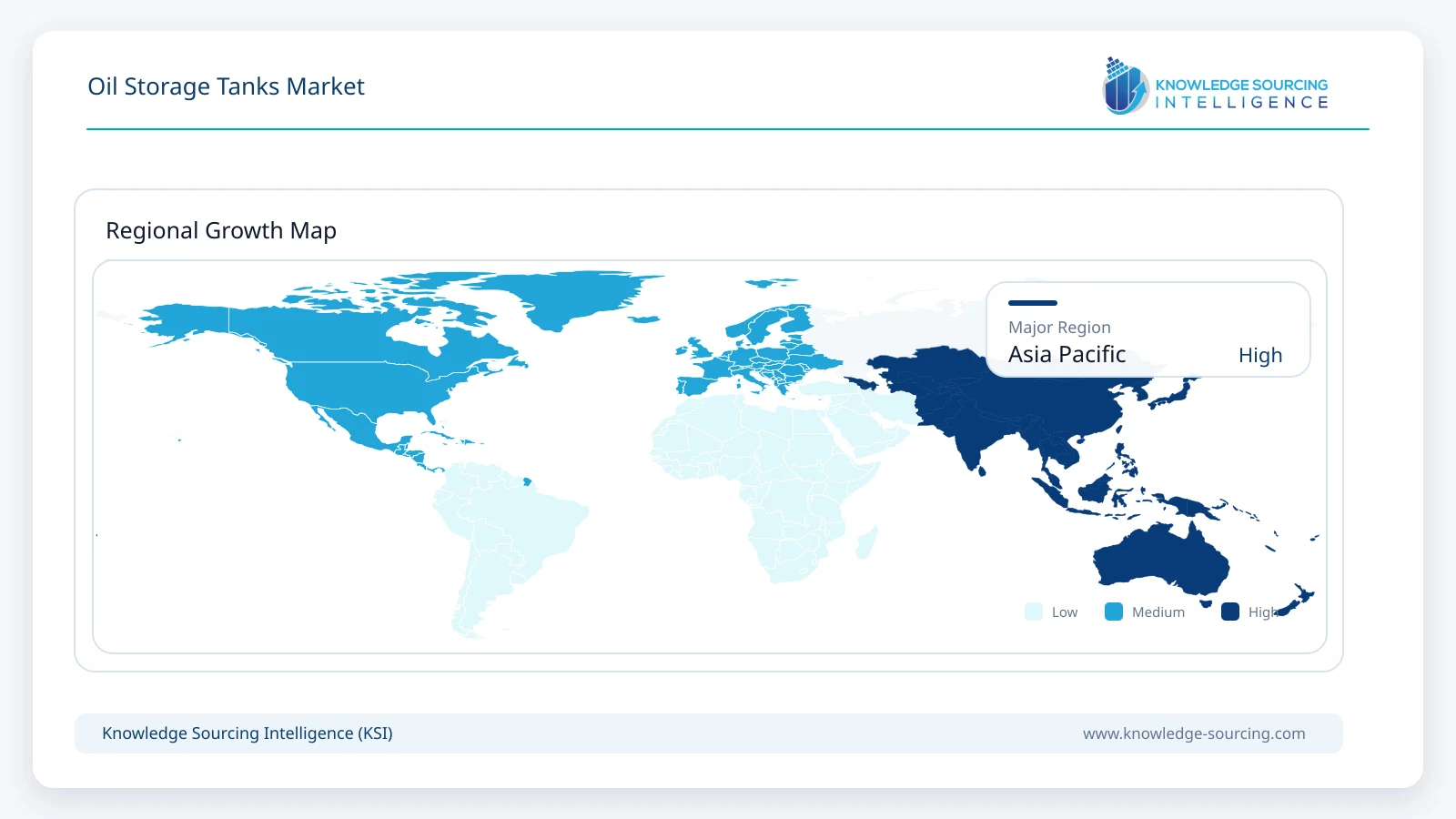
- 5Asia Pacific holds approximately 34% of the global market in 2026, supported by crude imports, strategic inventories and refining infrastructure.
- 6The market is forecast to increase from USD 15.7 billion in 2026 to USD 18.9 billion by 2031, at approximately 3.8% CAGR.
Market Overview
Oil storage tanks provide containment for crude oil, gasoline, diesel, jet fuel, fuel oil, condensates and other petroleum liquids across production fields, refineries, pipeline terminals, ports and distribution facilities. The market includes new tank construction together with replacement, reconstruction, roof and seal upgrades, corrosion repair and capacity additions. It is distinct from the wider oil storage services market, which primarily measures the rental and handling of terminal capacity. Storage remains critical to oil-market infrastructure even as long-term petroleum demand growth moderates. The International Energy Agency reported observed global oil inventories at just below 7.9 billion barrels in July 2026 after a substantial draw during the recent Middle East supply disruption, while IEA member countries are required to maintain emergency stocks equivalent to at least 90 days of net oil imports. These requirements sustain a large installed base of strategic and commercial storage infrastructure.
Tank demand is driven less by global oil consumption alone than by where crude is produced, refined, traded and held. New refineries and import terminals in Asia and the Middle East, strategic reserve programs, changes in long-distance crude flows and environmental regulations all influence project activity. Existing storage assets also require recurring inspection, floor replacement, corrosion protection, floating roof upgrades and emissions-control improvements. This lifecycle component is important because large welded tanks can remain in service for decades, allowing operators to extend asset life without building completely new vessels.
Market Trends
Tank Upgrades Are Increasing Alongside New Construction
Storage investment increasingly combines new construction with lifecycle work on the installed base. Modernization includes floor replacement, corrosion protection, floating roof and rim-seal upgrades, tank jacking, inspection systems and vapor-control improvements. HMT, for example, combines API 650 and API 620 new construction with API 653 inspection, repair and environmental solutions, reflecting the importance of aftermarket activity. Existing terminals are also repurposing tanks for changing liquid streams. Vopak approved the conversion of capacity at its Europoort terminal for pyrolysis-oil storage in 2026, showing that large storage sites can remain commercially relevant even as the product mix evolves.
Large-Capacity Tanks Remain Central to Terminal Economics
Large field-erected tanks provide lower construction cost per barrel than multiple smaller tanks where product segregation requirements permit their use. CB&I offers oil and gas storage solutions with individual capacities reaching about 1.5 million barrels and has built more than 59,000 storage structures globally. Smaller shop-built tanks remain important in upstream fields, industrial facilities and distributed fuel storage, but the highest project values remain associated with refinery tank farms, crude terminals and strategic inventory sites.
Segment Analysis
By Type
Floating roof tanks account for approximately 47% of global market value in 2026, making them the largest type segment. They are widely used for crude oil, gasoline and other volatile petroleum liquids because the roof moves with the liquid surface and reduces vapor space and evaporative losses. External floating roofs remain common in large crude-storage applications, while internal floating roofs are used where weather protection and tighter emissions control are required. Regulatory pressure on volatile organic compound emissions is increasing demand for improved rim seals, deck fittings and vapor-loss controls, while fixed roof tanks continue to serve less volatile products and smaller installations.
By Material
Steel accounts for approximately 78% of market value in 2026 because large petroleum-storage tanks are predominantly welded steel structures. Carbon steel represents the majority of this demand due to its structural strength, weldability, and competitive cost, while stainless steel is used selectively where corrosion resistance or product purity justifies the additional expenditure. API 650 atmospheric tanks and API 620 low-pressure tanks are overwhelmingly based on welded steel construction, with reinforced concrete and plastic concentrated in narrower applications.
By Storage Capacity
Tanks above 100,000 barrels account for approximately 51% of market value in 2026, supported by crude terminals, refineries, strategic storage sites and high-throughput pipeline systems. Large tanks improve economics where homogeneous bulk products can be stored at scale, while smaller capacity bands remain important for upstream production and sites requiring multiple segregated products. The previous gallon-based segmentation is therefore replaced with barrel-based capacity bands that better reflect industrial oil storage economics.
By Stored Product
Crude oil accounts for approximately 53% of market value in 2026, reflecting storage requirements at production hubs, pipelines, import terminals, refineries and strategic reserve facilities. Refined petroleum products form the second-largest group but generally require a larger number of separate vessels because gasoline, diesel, aviation fuel and fuel-oil grades must be segregated. The distinction between crude and refined products is therefore commercially important and is retained as a dedicated segmentation dimension.
Market Drivers
Strategic Stockholding and Energy Security
Recent supply disruptions have reinforced the value of accessible crude and petroleum-product inventories. In March 2026, IEA member countries agreed to make 400 million barrels of emergency oil stocks available, the largest coordinated release in the agency's history. China also accumulated substantial strategic and commercial crude inventories through 2025, while Japan, South Korea and India continue to maintain national reserve programs. India has 5.33 million tonnes of existing strategic storage and has approved another 6.5 million tonnes at Padur and Chandikhol. These programs support tank, terminal and associated transfer infrastructure even where part of the strategic reserve is held in underground caverns rather than aboveground tanks.
Changing Crude and Product Trade Flows
The geographical structure of oil trade is shifting as production grows in the Americas while refining and petroleum demand increasingly concentrate in Asia and the Middle East. The IEA expects the Atlantic Basin crude surplus to widen materially by 2030, increasing long-distance flows toward East of Suez markets. Around 4.2 million barrels per day of new refining capacity is also expected globally between 2024 and 2030, with a large share in China, India and the Middle East. These developments require storage at ports, pipeline interfaces and refinery sites because tanks buffer differences between vessel schedules, pipeline flows and processing rates.
Environmental Regulation and Emissions Control
Environmental requirements create demand for tank upgrades as well as new vessels. The U.S. EPA revised standards for volatile organic liquid storage vessels through Subpart Kc, strengthening requirements affecting floating roofs, seals and closed-vent control systems for qualifying facilities. Because storage tanks have long operating lives, compliance often results in rim-seal replacement, internal floating-roof installation, corrosion repair or reconstruction rather than complete replacement. The regulatory effect therefore supports a substantial inspection and retrofit market alongside new-build tank construction.
Market Restraints
Long Asset Lives Limit New-Build Replacement Demand
Large welded storage tanks can remain operational for decades when inspected and maintained correctly, limiting recurring replacement demand compared with shorter-lived industrial equipment. Operators can often improve usable capacity or extend service life through API 653 repairs, floor replacement, roof modification and corrosion-control work. Investment in completely new tanks is therefore more closely tied to refinery, terminal, pipeline and strategic-storage projects than to normal equipment replacement cycles.
Slower Refined Product Growth Moderates Mature Markets
Electric mobility, vehicle efficiency and changing fuel demand are reducing the need for completely new petroleum storage in some mature markets. The IEA expects global refined-product demand to peak later in the decade as declining gasoline and diesel use increasingly offsets growth in aviation and petrochemical products. Existing facilities will still require maintenance, conversion and product segregation, but the geographical emphasis of new tank construction is gradually shifting toward Asia, the Middle East and selected trade-oriented terminal projects.
Regional Outlook
Asia Pacific
Asia Pacific accounts for approximately 34% of the global oil storage tanks market in 2026, supported by the scale of crude imports, strategic inventories and refining capacity across China, India, Japan and South Korea. EIA estimates indicate that China held close to 1.5 billion barrels of strategic and commercial crude inventories in the second quarter of 2026, while Japan and South Korea also maintain substantial government stocks. India is expanding reserve infrastructure through the planned Padur and Chandikhol projects and is exploring additional international storage cooperation. Refinery construction and the region's dependence on seaborne crude imports support continued terminal and tank investment through 2031.
Competitive Landscape
The market includes global engineering and construction specialists, tank-service companies and regional fabricators. CB&I remains one of the most experienced storage contractors, with more than 59,000 storage structures completed and capabilities spanning crude, refined products and bulk terminals. HMT combines aboveground tank construction with inspection, maintenance, floating-roof and environmental systems, while Matrix Service Company provides storage and terminal engineering and construction. CST Industries, Superior Tank, T BAILEY, Fox Tank Company, Artson Engineering and ERGIL compete across welded, bolted, shop-fabricated and field-erected applications. Competitive differentiation depends on API-standard engineering, field-construction capability, safety performance, schedule execution and the ability to provide inspection and maintenance over the asset lifecycle.
Recent Developments
September 2026: Matrix Service Company received the FEED award for the storage tank farm at America First Refining's proposed Brownsville, Texas refinery, designed to process approximately 60 million barrels of crude annually.
May 2026: India and the UAE agreed to explore ADNOC crude storage of up to 30 million barrels in India's strategic reserve system and cooperation on additional storage infrastructure.
April 2026: Vopak approved the repurposing of capacity at its Europoort terminal for pyrolysis-oil storage.
April 2026: CB&I completed the acquisition of Petrofac's Asset Solutions business, expanding its broader asset-management capability.
January 2026: Superior Tank expanded its welded-steel tank offering in Texas for oil, energy and industrial customers.
Market Outlook
The oil storage tanks market is expected to record moderate growth through 2031. New-build demand is supported by refinery and terminal development in Asia and the Middle East, strategic inventory programs, shifting international crude flows and selected North American infrastructure projects. Long tank lifetimes and slower petroleum-demand growth in mature economies limit the rate at which the installed base needs complete replacement, making refurbishment, floating-roof and seal upgrades, corrosion repair, emissions compliance and tank conversion increasingly important parts of industry revenue. Large steel tanks remain the principal value pool, while Asia Pacific continues to lead regional demand.
Oil Storage Tanks Market Scope:
| Report Metric | Details |
|---|---|
| Total Market Size in 2026 | USD 15.7 billion |
| Total Market Size in 2031 | USD 18.9 billion |
| Forecast Unit | Billion |
| Growth Rate | 3.8% |
| Study Period | 2021 to 2031 |
| Historical Data | 2021 to 2024 |
| Base Year | 2025 |
| Forecast Period | 2026 – 2031 |
| Segmentation | Type, Material, Storage Capacity, Stored Product |
| Companies |
|
Market Segmentation
By Type
Floating Roof Tanks
Fixed Roof Tanks
Bunded Oil Tanks
Others
By Material
Steel
Carbon Steel
Stainless Steel
Reinforced Concrete
Plastic and Other Materials
By Storage Capacity
Up to 10,000 Barrels
10,001 to 100,000 Barrels
Above 100,000 Barrels
By Stored Product
Crude Oil
Refined Petroleum Products
Gasoline
Diesel and Middle Distillates
Jet Fuel
Fuel Oil
Other Petroleum Liquids
By Geography
North America
United States
Canada
Mexico
South America
Brazil
Argentina
Others
Europe
Germany
France
United Kingdom
Spain
Others
Middle East and Africa
Saudi Arabia
UAE
Others
Asia Pacific
China
India
Japan
South Korea
Indonesia
Thailand
Others
Table of Contents
1. INTRODUCTION
1.1. Market Overview
1.2. Market Definition
1.3. Scope of the Study
1.4. Market Segmentation
1.5. Currency
1.6. Assumptions
1.7. Base and Forecast Years
1.8. Key Benefits to Stakeholders
2. RESEARCH METHODOLOGY
2.1. Research Design
2.2. Secondary Research
2.3. Primary Research
2.4. Market Estimation
2.5. Segment Modelling
2.6. Data Triangulation and Validation
3. EXECUTIVE SUMMARY
3.1. Key Findings
3.2. Oil Storage Tanks Market Size, 2026-2031
3.3. Type Outlook
3.4. Material Outlook
3.5. Storage Capacity Outlook
3.6. Stored Product Outlook
3.7. Regional Opportunity Summary
3.8. Analyst View
4. MARKET DYNAMICS
4.1. Market Drivers
4.1.1. Strategic Oil Stockholding and Energy Security
4.1.2. Changing Global Crude and Refined Product Trade Flows
4.1.3. Expansion of Refining and Terminal Infrastructure
4.1.4. Environmental and Emissions Compliance Requirements
4.2. Market Restraints
4.2.1. Long Tank Replacement Cycles
4.2.2. Slower Refined Product Demand in Mature Markets
4.3. Market Opportunities
4.4. Porter's Five Forces Analysis
4.5. Industry Value Chain Analysis
4.6. Oil Inventory and Terminal Capacity Outlook
4.7. Policies and Regulations
5. TECHNOLOGY OUTLOOK
5.1. Floating Roof and Seal Systems
5.2. Corrosion Protection and Tank Bottom Systems
5.3. Inspection and Asset Integrity Technologies
5.4. Vapor and Emission Control Systems
6. OIL STORAGE TANKS MARKET BY TYPE
6.1. Introduction
6.2. Floating Roof Tanks
6.3. Fixed Roof Tanks
6.4. Bunded Oil Tanks
6.5. Others
7. OIL STORAGE TANKS MARKET BY MATERIAL
7.1. Introduction
7.2. Steel
7.2.1. Carbon Steel
7.2.2. Stainless Steel
7.3. Reinforced Concrete
7.4. Plastic and Other Materials
8. OIL STORAGE TANKS MARKET BY STORAGE CAPACITY
8.1. Introduction
8.2. Up to 10,000 Barrels
8.3. 10,001 to 100,000 Barrels
8.4. Above 100,000 Barrels
9. OIL STORAGE TANKS MARKET BY STORED PRODUCT
9.1. Introduction
9.2. Crude Oil
9.3. Refined Petroleum Products
9.3.1. Gasoline
9.3.2. Diesel and Middle Distillates
9.3.3. Jet Fuel
9.3.4. Fuel Oil
9.4. Other Petroleum Liquids
10. OIL STORAGE TANKS MARKET BY GEOGRAPHY
10.1. North America
10.1.1. United States
10.1.2. Canada
10.1.3. Mexico
10.2. South America
10.2.1. Brazil
10.2.2. Argentina
10.2.3. Others
10.3. Europe
10.3.1. Germany
10.3.2. France
10.3.3. United Kingdom
10.3.4. Spain
10.3.5. Others
10.4. Middle East and Africa
10.4.1. Saudi Arabia
10.4.2. UAE
10.4.3. Others
10.5. Asia Pacific
10.5.1. China
10.5.2. India
10.5.3. Japan
10.5.4. South Korea
10.5.5. Indonesia
10.5.6. Thailand
10.5.7. Others
11. COMPETITIVE ENVIRONMENT AND ANALYSIS
11.1. Major Players and Strategy Analysis
11.2. Market Positioning
11.3. Mergers, Acquisitions, Agreements and Collaborations
11.4. Competitive Dashboard
12. COMPANY PROFILES
12.1. CB&I
12.2. HMT LLC
12.3. Matrix Service Company
12.4. CST Industries, Inc.
12.5. Superior Tank Co., Inc.
12.6. T BAILEY LLC
12.7. Fox Tank Company
12.8. Artson Engineering Ltd.
12.9. ERGIL
13. APPENDIX
13.1. Market Definition and Scope
13.2. Tank Type and Capacity Classification
13.3. Currency and Conversion Assumptions
13.4. Base Year and Forecast Period
13.5. Market Estimation Approach
13.6. Primary and Secondary Research Framework
13.7. Data Triangulation and Validation
13.8. Abbreviations
Research Methodology
The market is analyzed using a combination of top-down and bottom-up approaches. The top-down assessment reviews oil storage infrastructure investment, refinery and terminal expansion, strategic petroleum reserve programs, oil trade flows, major tank-project activity and the installed storage base across key regions. The bottom-up assessment evaluates tank construction and service activity by type, material, storage capacity, stored product and geography using company disclosures, project announcements, regulatory information and industry standards. Segment estimates are reconciled against the global market total through data triangulation, with historical market cycles, material and fabrication costs, project lead times and replacement or retrofit activity incorporated into the forecast. External market-research-company estimates are not used as primaxry sizing inputs.
Navigate
Trusted by the world's leading organizations











