
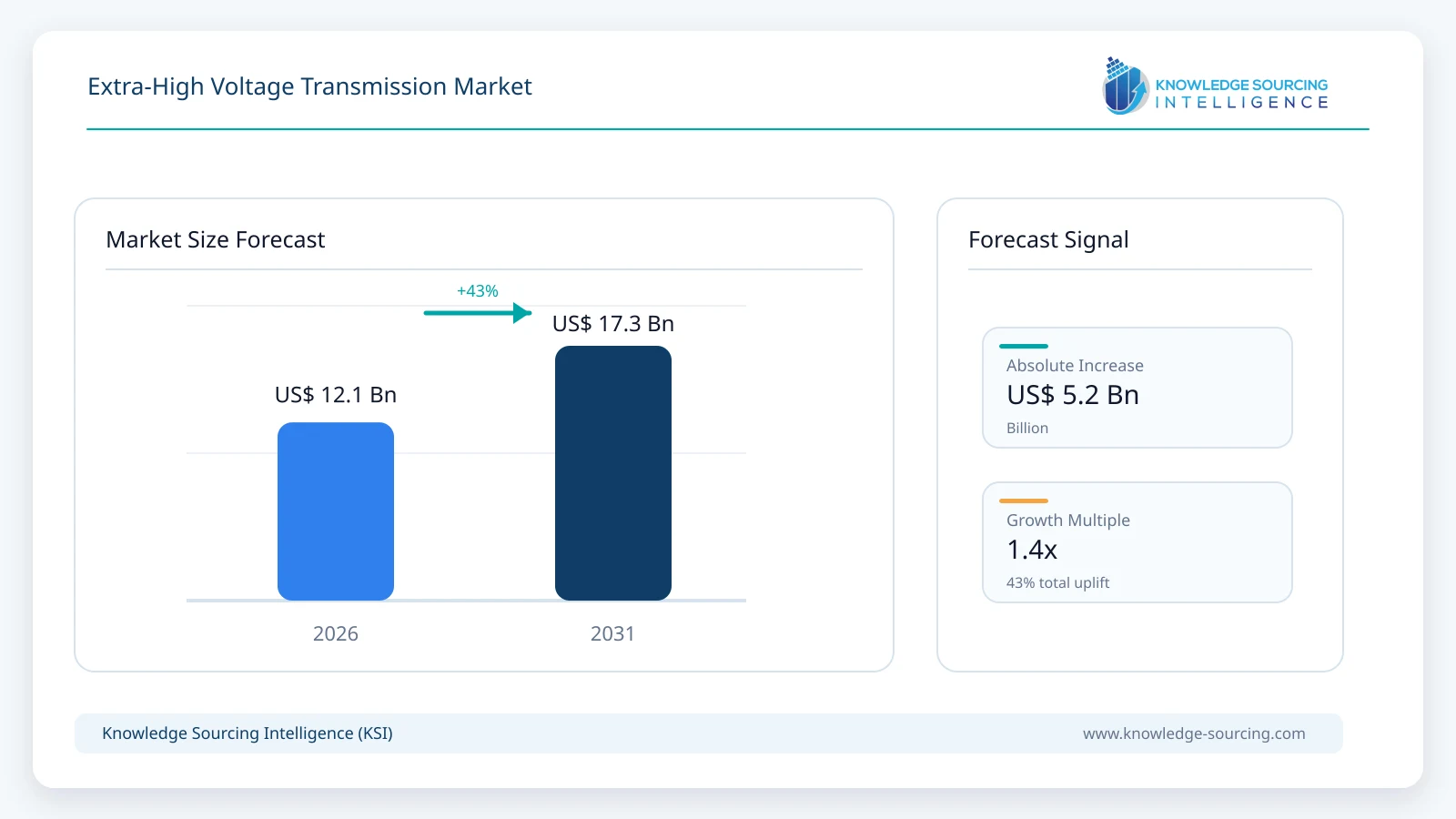
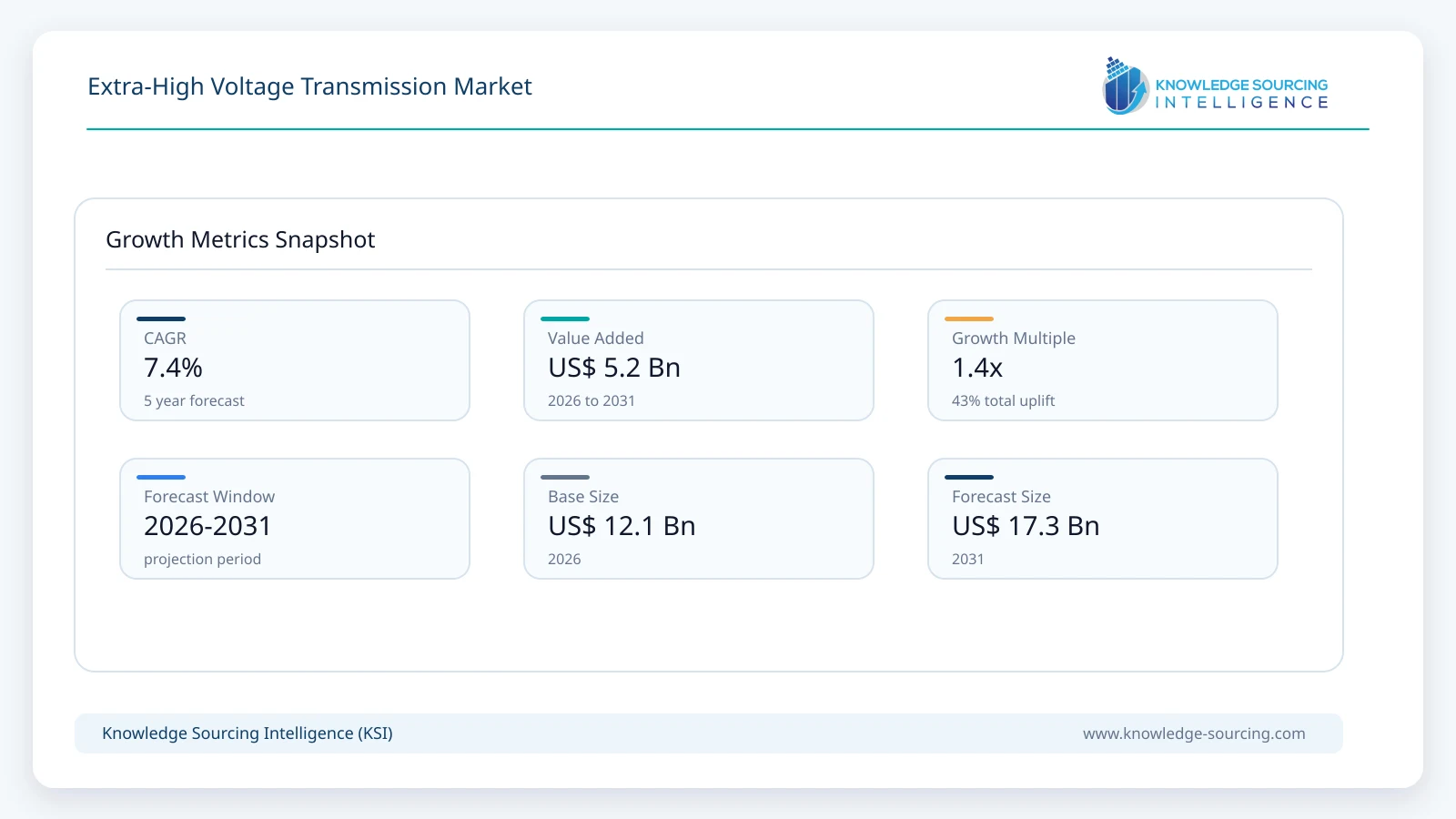
The Extra-High Voltage Transmission Market is forecast to grow at a CAGR of 7.4%, reaching USD 17.3 billion in 2031 from USD 12.1 billion in 2026.
Highlights:
- 1Leading segment by transmission typeEHV-AC holds the largest share of the Extra-High Voltage Transmission Market, valued at USD 8.47 billion in 2026, representing 70.0% of the total market.
- 2Strongest growth by power sourceWind and Solar Power is the fastest-growing power-source segment, projected to expand at a CAGR of 9.9% through 2031 as renewable generation increasingly connects to high-capacity transmission networks.
- 32031 market positionThe EHV-AC segment is expected to reach USD 11.56 billion by 2031, despite its share moderating to 66.8% as other transmission technologies and applications gain ground.
- 4Key regional marketNorth America accounts for USD 2.42 billion in 2026, equivalent to 20.0% of the Extra-High Voltage Transmission Market, supported by ongoing grid expansion and transmission infrastructure upgrades.
The market is being fundamentally transformed as power systems evolve from centralized generation to more decentralized and distributed generation across increasing geographical distances. Renewable energy projects, especially large utility-scale solar and wind farms, are often sited at significant distances from load centers, necessitating transmission networks that can furnish large amounts of electricity over a long distance.
This enables utilities and transmission system operators to increase power transfer capacity while reducing losses and enhancing grid stability. This technology is especially useful in countries with large land masses, significant renewable resources, or large gaps between electricity generation and demand centres.
EHV-AC networks remain the backbone of connected electricity systems whilst EHV-DC is growing for long-distance transmission and interconnection projects. HVDC technology has also been supporting the integration of renewable energy resources and promoting controllability through electricity flows.
Transmission technology continues to develop with the component ecosystem. Online monitoring systems are more common in modern EHV power transformers, while circuit breakers and switchgear use superior insulation and interruption technologies. The conductors themselves are being enhanced to permit higher current-carrying capacity, minimize losses, and enhance transmission functionality.
Digitisation plays an increasingly important role in the infrastructure of EHV. Utilities are establishing traditional grid digital substations and utilizing automated protection systems, remote asset monitoring, and predictive maintenance platforms to enhance network dependability while balancing operational costs.
Market Dynamics
Market Drivers
Increasing Renewable Energy Generation: The relative shift of renewable energy resources is intensifying the need for long-distance transmission infrastructure. Solar farms are often sited in hot and sunny areas, itself distant from the places where most electricity consumption takes place, and wind and hydropower are usually located far away. EHV transmission also supplies the capacity to move renewable electricity from generation locations to cities and industrial centers over large distances. Hence, the growing adoption of renewable energy targets throughout Asia-Pacific, Europe, America, and emerging economies as well is fuelling investment in EHV networks.
Increased Electric Vehicle Demand and Electrification of Industries: The rampant rise of artificial intelligence, cloud computing, data centers, electric vehicles, and electrification of industry is leading to greater consumption of electricity. Extra-high-capacity transmission connections and grid reinforcement are being required because of large electricity loads. In particular, data center clusters are reliant on stable, high-quality electricity supplies, encouraging utilities to enhance transmission capacity and improve network resiliency.
Aging Transmission Infrastructure: In many developed markets, transmission systems rely on decades-old infrastructure, requiring utilities to replace or upgrade aging transformers, circuit breakers, conductors, and substations. Rather than replacing legacy equipment on an apples-to-apples basis, utilities are taking the opportunity through these replacement cycles to upgrade networks with higher-capacity EHV equipment and digital monitoring systems.
Expansion of Cross-Border Electricity Interconnections: Interconnectivity between countries, energy security, and supply-demand balance are improved for interstate as well as electric power trading. EHV transmission facilitates bulk power transfers between two locations that are separated spatially. As renewable generation expands, cross-border interconnection is growing especially critical since interconnected networks are better able to allocate electricity from regions with excessive supply to areas with increased demand.
Market Restraints & Opportunities
Large investment in transmission corridors, substations, transformers, switchgear protection systems and land acquisition makes high capital expenditure a significant bottleneck for EHV transmission projects.
Environmental approvals, permitting, right-of-way acquisition, public consultations and complex engineering requirements can also lead to some projects taking years to develop. In some cases, these can hinder the expansion of transmission and energy systems at any time as electricity demand is soaring.
However, these challenges are also creating opportunities for smart conductors, compact substations, digital monitoring systems, grid-enhancing technologies and high-wattage transformers. Utilities are looking for technologies that add transmission capacity without new corridors.
Key Developments
March 2026: Tata Power commissioned the 400 kV Tanda–Gonda and Gonda–Basti double-circuit transmission lines, for a total length of 154 circuit kilometres. This marks completion of all the EHV transmission lines and substations related to the project of South East UP Power Transmission Company Limited, having 765 kV and 400 kV lines & three 765/400 kV substations with transformation capacity of 3,460 MVA.
July 2026: Rays Power Infra executed the 300 MWp solar power project, including commissioning of two pooled 400/33 kV pooling substations and 16.6-kilometre-long (over) 400 kV transmission line. This line links the project with the Fatehgarh 400 kV interlinking substation for evacuation of solar electricity into a wider Rajasthan grid, while also enhancing renewable-power transmission reliability.
Market Segmentation
The market is segmented by transmission type, component, power source, end user, and geography.
By Transmission Type: Alternating Current (EHV-AC)
EHV-AC is forecast to remain the predominant transmission type, registering a segment CAGR of 6.4% during the forecast period. Alternating-current systems continue to form the fundamental architecture of most interconnected electricity grids, allowing EHV-AC technology to integrate efficiently with existing transmission infrastructure. EHV-AC enables utilities to transfer substantial volumes of electricity across regional and national power networks while maintaining compatibility with established AC transmission systems.
This technology is particularly important for large countries and geographically dispersed electricity systems where generation centers are located far from major demand centers. EHV-AC networks facilitate the movement of bulk electricity over long distances and support greater network flexibility by enabling the integration of multiple generation sources. They also allow regional transmission systems to be interconnected, strengthening grid reliability and improving the ability of utilities to balance electricity supply and demand across wider service areas.
Hitachi Energy provides AC transmission solutions for high-voltage power networks, including transformers, substations, switchgear, and grid-integration technologies designed to support reliable and efficient AC transmission. Similarly, Siemens Energy provides high-voltage transmission equipment and grid technologies designed to improve reliability, efficiency, and sustainability across AC power networks. These solutions are increasingly relevant as utilities modernize aging infrastructure and expand transmission capacity.
Sustained demand for EHV-AC systems is anticipated as interconnected electricity networks continue to expand and utilities integrate growing volumes of renewable energy into existing grids. The technology’s compatibility with established AC infrastructure, ability to support large-scale power transfer, and role in strengthening regional grid connectivity are expected to underpin its continued adoption throughout the forecast period.
By Component: Power Transformers
Power transformers are expected to remain a key component segment of the UHV transmission market, accounting for an estimated 26.4% share in 2031 and reaching a segment value of USD 4.57 billion. Power transformers are essential for stepping up or stepping down electricity to different voltage levels during transmission across interconnected power networks. EHV and UHV transformers must withstand exceptionally high electrical, thermal, and mechanical stresses while delivering dependable performance under varying and sometimes highly fluctuating load conditions. Their ability to support efficient voltage transformation is critical for minimizing transmission losses and maintaining stable electricity delivery across long-distance transmission corridors.
Hitachi Energy provides power transformer technologies for utilities and transmission networks, supporting applications ranging from high-voltage transmission to distribution infrastructure. Its transformer portfolio includes solutions designed for high-throughput transmission applications, grid expansion, and the integration of renewable generation into increasingly complex electricity networks.
Siemens Energy provides power transformers for high-voltage applications, supporting transmission network expansion, grid modernization, and renewable energy integration. These transformer technologies help utilities manage changing power flows while improving the reliability and efficiency of high-voltage transmission infrastructure.
Modern EHV transformer designs are also increasingly incorporating digital monitoring and diagnostic technologies to track operating temperature, insulation conditions, dissolved gases, and other critical parameters. These capabilities enable utilities to identify abnormal operating conditions and potential equipment failures at an earlier stage, supporting predictive maintenance, reducing unplanned downtime, extending transformer service life, and minimizing the risk of widespread transmission outages.
By End User: Electric Utilities
Electric utilities are the largest end-user segment, accounting for 43.0% of the market in 2026, equivalent to USD 5.20 billion, and are expected to maintain their leading position with a 42.1% share by 2031. Electric utilities own, operate, and maintain extensive transmission and distribution infrastructure, creating sustained demand for extra-high-voltage (EHV) equipment and technologies. The expansion and modernization of EHV networks enables utilities to manage higher power flows, increase transmission capacity, improve grid reliability, reduce transmission congestion, and support the integration of renewable power generation.
The growing deployment of EHV transmission infrastructure is particularly important as utilities expand long-distance power transfer capabilities and connect geographically dispersed generation assets with major demand centers. Renewable energy projects, including large-scale solar and wind installations, are also increasing the need for robust high-voltage transmission networks capable of managing variable electricity generation. Consequently, electric utilities are investing in transmission upgrades, grid automation, protection systems, digital substations, and advanced monitoring technologies alongside conventional EHV equipment.
Schneider Electric Grid Solutions provides grid automation, digital substation, protection, and energy management technologies that support utilities in monitoring and controlling increasingly complex electricity networks. Similarly, ABB Grid Automation offers digital and automation solutions that enable utilities to integrate information from high-voltage transmission assets, improve remote monitoring and control, and strengthen operational visibility across transmission networks.
Electric utilities are increasingly incorporating smart monitoring, automation, and digital control capabilities into new transmission projects as well as modernization programs for existing infrastructure. These investments create opportunities across both conventional EHV equipment and digital grid technologies. Demand is therefore expanding beyond transformers, switchgear, circuit breakers, and transmission components toward intelligent protection, condition monitoring, substation automation, and grid-management solutions.
The continued modernization of aging transmission infrastructure, increasing electricity demand, cross-regional power transfers, and renewable-energy integration are expected to support the segment through 2031. Although the segment's share is projected to moderate from 43.0% in 2026 to 42.1% in 2031, electric utilities will remain the dominant end-user group because of their large installed asset base and ongoing responsibility for maintaining secure, reliable, and increasingly digitalized transmission networks.
Regional Analysis
Americas Market Analysis
Americas holds a significant market share with the increasing need for EHV transmission in light of renewable generation growth and additional consumption. The US is facing some transmission constraints where more big renewable projects sit further from the biggest demand centers. As wind generation in the central United States and solar generation in western and southern states are on the rise, this creates new demand for high-capacity transmission corridors. In addition, Canada is funding high-voltage transmission to link hydropower and renewable resources with population centers and industrial customers. The substantial market in Brazil has major transmission needs with geographically diffuse generation resources.
Europe, Middle East and Africa Market Analysis
As the electricity system accommodates increasing volumes of offshore wind, solar and distributed renewable generation across Europe, transmission capacity demand is also expanding. Transmission infrastructure markets in Germany, France, the United Kingdom, and Leading Countries being developed alongside renewable energy expansion, industrialisation, and electrification programs. Interconnections between countries will play a growing role in improving the security of European electricity as well as for integrating renewables. Decarbonisation of transport, heating and industrial processes will increase the bulk demand for transmission infrastructure across the region.
Asia Pacific Market Analysis
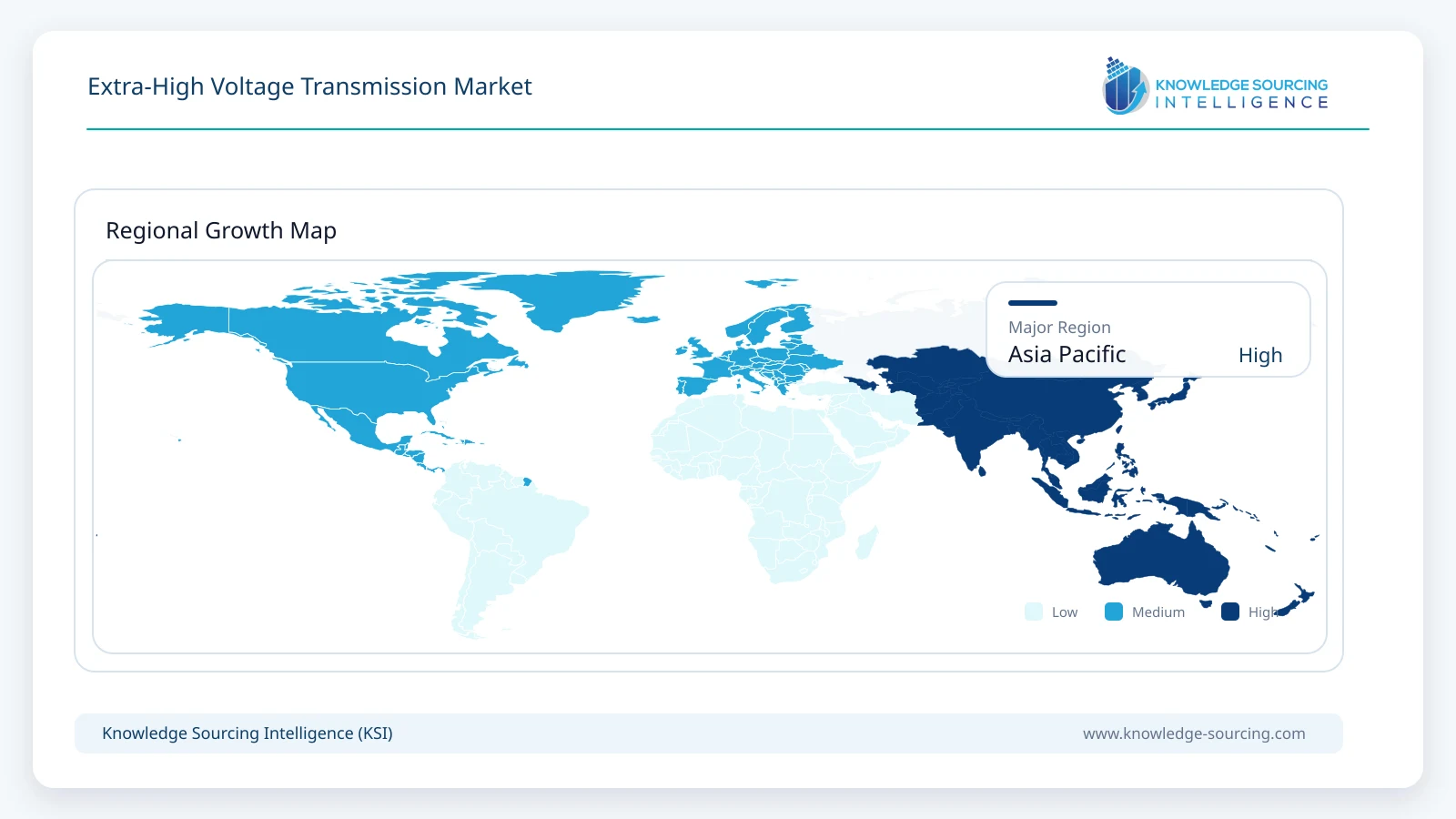
The Asia-Pacific region is expected to remain the largest regional market, supported by rapid electricity infrastructure development, industrialisation, rising power demand, and the large-scale integration of renewable energy. By 2031, Asia-Pacific is projected to account for 57.9% of the market, representing a segment value of USD 10.02 billion and growing at a CAGR of 8.5%. China remains a major contributor, driven by continued investment in ultra-high-voltage and high-voltage transmission networks designed to connect electricity generation centres in western and northern provinces with major consumption hubs in the east. India is likewise expanding transmission capacity to accommodate rising electricity demand and integrate increasing volumes of solar and wind power into the national grid. The development of renewable energy zones, particularly for large-scale solar and wind projects, is creating additional requirements for long-distance transmission connections linking generation sites with urban, commercial, and industrial demand centres. These investments, alongside grid modernisation and efforts to improve transmission reliability and efficiency, are expected to strengthen the Asia-Pacific market through 2031.
List of Companies
ABB
Siemens AG
Hitachi Ltd.
General Electric
Mitsubishi Electric
Toshiba
Schneider Electric
Hyosung Heavy Industries
TBEA Co. Ltd.
CHINT Group
ABB
ABB is a major supplier of Electrification, high-voltage equipment, and grid automation and power transmission technologies. The company has a wide portfolio of products comprising transformers, switchgear, circuit breakers, grid automation systems and HVDC technologies.ABB transmission solutions increase the capacity of utility networks to support integration of renewable energy. Its digital grid capabilities also include the ability to monitor in real time, allowing for better asset management.
Hitachi Ltd.
Hitachi Energy offers a wide range of transmission technologies available from Hitachi Energy ranging from high voltage products, power transformers, HVDC systems at substations, and grid automation. The company works to enable electricity grids to integrate renewables and deliver more electricity safely and reliably.
General Electric
Grid Solutions business of GE Vernova includes a range of products and services such as high voltage equipment, transformers, circuit breakers, protection systems, substations, and grid automation technologies. These solutions are designed to enable modernization of utility and transmission distribution networks, as well as integration and management of renewable electricity generation in the electrical grid.
Analyst View
The electricity demand, increased renewable generation, and ever-updating grid modernization are the drivers of the extra high voltage transmission market. EHV-AC will continue to be the preferred basis of transmission, whilst EHV-DC will play a far larger role for long-distance bulk power transfer and specialized interconnections. Power transformers will continue as an important device category, due to the expansion of utility infrastructure and replacement of aging equipment. Renewable energy zones, data center electricity demand from AI workloads, widespread electrification of industry, cross-border interconnections, and investment in grid resilience on the back of climate risks will result in persistent heavyweight demand for EHV transmission infrastructure across both developed as well as emerging markets over our forecast period.
Extra-High Voltage Transmission Market Scope:
| Report Metric | Details |
|---|---|
| Total Market Size in 2026 | USD 12.1 billion |
| Total Market Size in 2031 | USD 17.3 billion |
| Forecast Unit | Billion |
| Growth Rate | 7.4% |
| Study Period | 2021 to 2031 |
| Historical Data | 2021 to 2024 |
| Base Year | 2025 |
| Forecast Period | 2026 – 2031 |
| Segmentation | Transmission Type, Component, Power Source, End User, Geography |
| Companies |
|
Market Segmentation
By Transmission Type
Alternating Current (EHV-AC)
Direct Current (EHV-DC)
By Component
Transmission Lines
Power Transformers
Circuit Breakers & Switchgear
Conductors & Insulators
Others
By Power Source
Hydropower
Wind and Solar Power
Nuclear Power
Thermal Power
Other Power Sources
By End User
Transmission System Operators
Electric Utilities
Government & Public Sector Transmission Authorities
Others
By Geography
North America
USA
Canada
Brazil
Others
Europe, Middle East and Africa
United Kingdom
Germany
France
Others
Asia Pacific
China
Japan
India
South Korea
Others
Table of Contents
1. EXECUTIVE SUMMARY
2. MARKET SNAPSHOT
2.1. Market Overview
2.2. Market Definition
2.3. Scope of the Study
2.4. Market Segmentation
3. MARKET DYNAMIC
3.1. Market Drivers
3.2. Market Restraints
3.3. Market Opportunities
3.4. Porter’s Five Forces Analysis
3.5. Industry Value Chain Analysis
4. BUSINESS LANDSCAPE
4.1. Regulatory & Grid Standards Landscape
4.2. National & Regional Transmission Planning Landscape
4.3. Raw Material & Component Supply Landscape
4.4. Cross-Border Electricity Transmission Landscape
4.5. Strategic Recommendations
5. TECHNOLOGICAL OUTLOOK
5.1. Advanced Transmission Conductors
5.2. High-Voltage Direct Current Converter Technologies
5.3. Grid Protection, Automation & Control Technologies
5.4. Emerging EHV Transmission Technologies
6. EXTRA-HIGH VOLTAGE TRANSMISSION MARKET BY TRANSMISSION TYPE
6.1. Introduction
6.2. Alternating Current (EHV-AC)
6.3. Direct Current (EHV-DC)
7. EXTRA-HIGH VOLTAGE TRANSMISSION MARKET BY COMPONENT
7.1. Introduction
7.3. Transmission Lines
7.4. Power Transformers
7.5. Circuit Breakers & Switchgear
7.6. Conductors & Insulators
7.7. Others
8. EXTRA-HIGH VOLTAGE TRANSMISSION MARKET BY POWER SOURCE
8.1. Introduction
8.2.Hydropower
8.3. Wind and Solar Power
8.4. Nuclear Power
8.5. Thermal Power
8.6. Other Power Sources
9. EXTRA-HIGH VOLTAGE TRANSMISSION MARKET BY END USER
9.1. Introduction
9.2. Transmission System Operators
9.3. Electric Utilities
9.4. Government & Public Sector Transmission Authorities
9.5. Others
10. EXTRA-HIGH VOLTAGE TRANSMISSION MARKET BY GEOGRAPHY
10.1. Introduction
10.2. North Americas
10.2.1. USA
10.2.2. Canada
10.2.3. Brazil
10.2.4 Others
10.3. Europe, Middle East and Africa
10.3.1. United Kingdom
10.3.2. Germany
10.3.3. France
10.3.4. Others
10.4. Asia Pacific
10.4.1. China
10.4.2. Japan
10.4.3. India
10.4.4. South Korea
10.4.5. Others
11. COMPETITIVE ENVIRONMENT AND ANALYSIS
11.1. Major Players and Strategy Analysis
11.2. Market Share Analysis
11.3. Mergers, Acquisitions, Agreements, and Collaborations
11.4. Competitive Dashboard
12. COMPANY PROFILES
12.1. ABB
12.2. Siemens AG
12.3. Hitachi Ltd.
12.4. General Electric
12.5. Mitsubishi Group
12.6. Toshiba Corp
12.7. Schneider Electric SE
12.8. Hyosung Group
12.9. TBEA Co. Ltd
12.10. Chint Group
13. APPENDIX
13.1. Currency
13.2. Assumptions
13.3. Base and Forecast Years Timeline
13.4. Key benefits for the stakeholders
13.5. Research Methodology
13.6. Abbreviations
Navigate
Trusted by the world's leading organizations











