
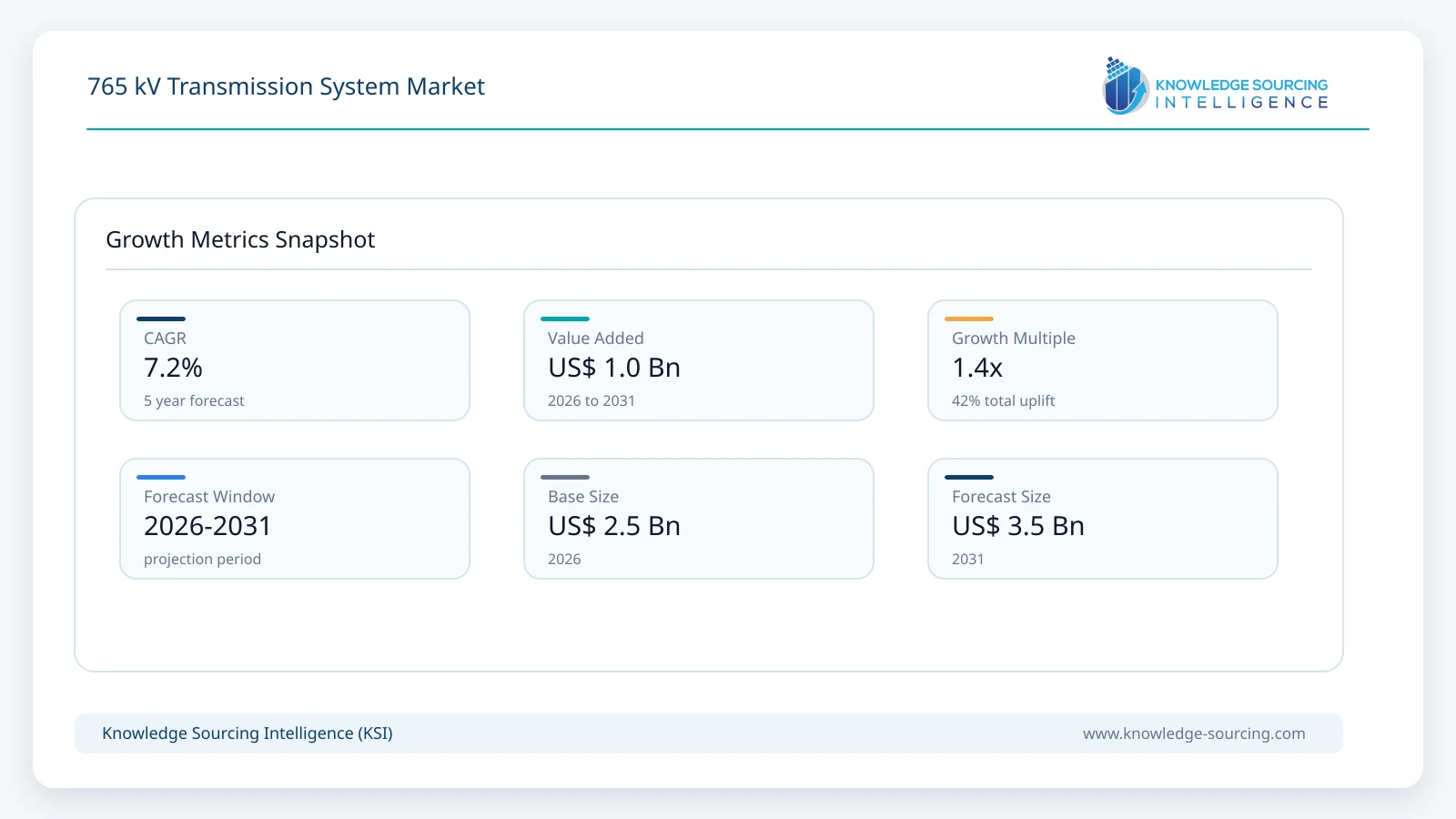
The 765 kV Transmission System Market is forecast to grow at a CAGR of 7.2%, reaching USD 3.51 billion in 2031 from USD 2.48 billion in 2026.
Highlights:
- 1Component leadershipTransmission Lines captured 36.0% of the market in 2026, with a value of USD 0.89 billion, making it the leading component category in the 765 kV transmission system market.
- 2Renewables set the paceWind and Solar Power is emerging as the fastest-growing power-source segment, advancing at a 9.5% CAGR through 2031 as renewable generation expands the need for high-capacity transmission infrastructure.
- 3Asia Pacific takes the leadThe region is forecast to reach USD 2.00 billion by 2031, raising its market share to 57.1%, driven by grid expansion, rising electricity demand, and renewable power integration.
- 4Utilities remain the core buyersElectric Utilities represented 45.0% of the market in 2026, equivalent to USD 1.12 billion, highlighting their pivotal role in deploying and upgrading 765 kV transmission infrastructure.
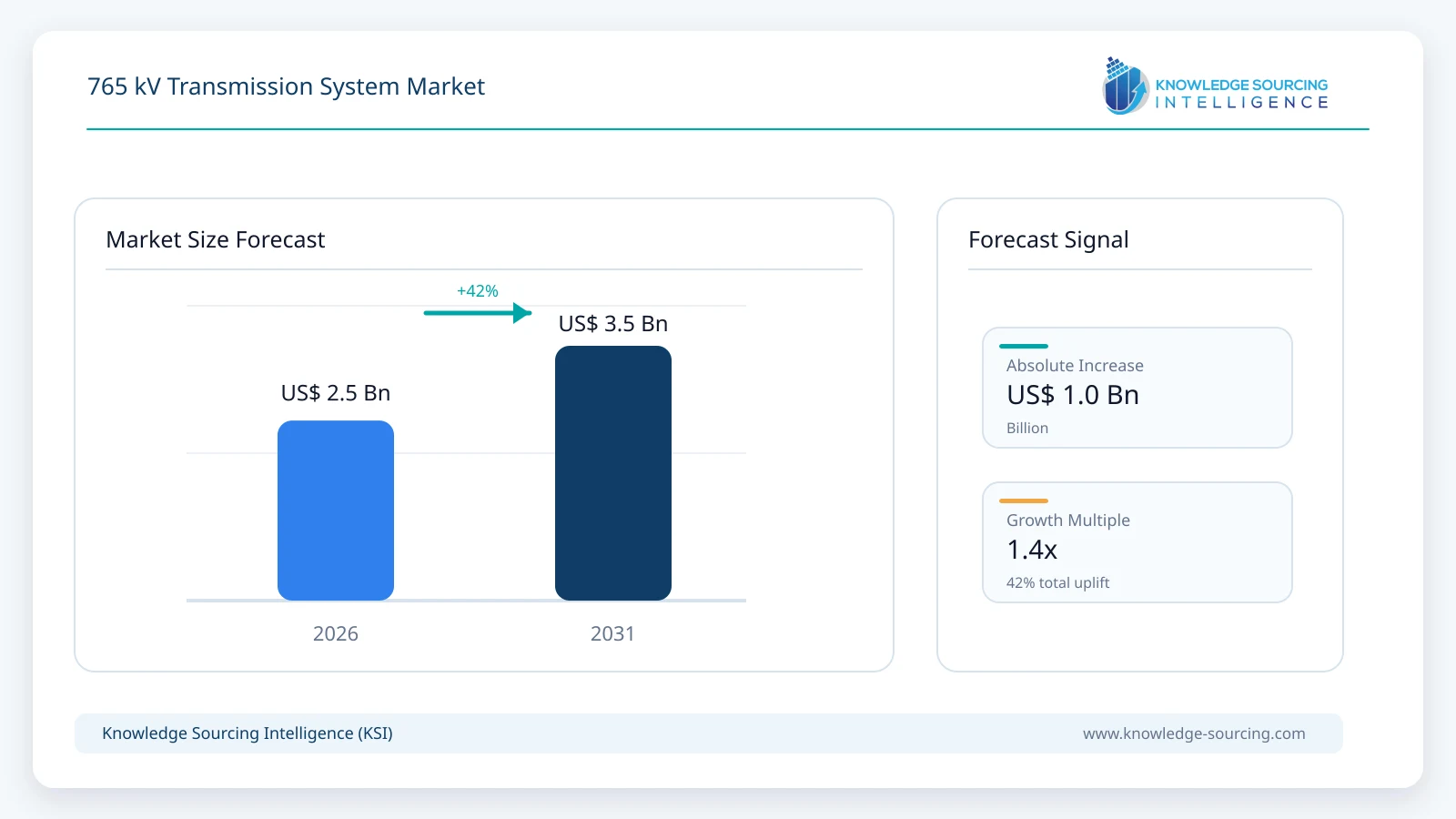
765 kV transmission system market is expected to grow due to growth in investment for high-capacity transmission infrastructure, integration of renewable energy sources, and modernization of the grid.
There is a structural change underway in the market that is being driven by growing geographic dispersal of electricity generation. Utility-scale generation projects are often located far from population centres and industrial demand hubs, such as large solar parks, wind farms or hydropower facilities. This growing spatial separation is intensifying the need for transmission systems that can carry large volumes of electricity over longer distances.
765 kV transmission systems offer the highest power-transfer capacity and help utilities reduce congestion and transmission losses. This technology is most applicable to large national grids where power has to travel from locations with high generation capacity, such as fossil and renewable generation locations, over long distances to areas of high demand.
Renewable generation growth is adding more need for 765 kV facilities. Wind and solar generation can be variable depending on the weather, so strong transmission networks to transfer electricity between regions, and essential for balancing supply and demand, become increasingly important.
Market Dynamics
Market Drivers
Expand Utility-Scale Wind and Solar Deployments: One of the key factors for the growth of the 765 kV transmission system market is the increasing utility-scale renewable energy. The large solar and wind projects are often sited in areas with good natural resources but poor local electricity demand. Further, local generation connects with and disperses through high-capacity transmission networks, so that electricity produced in these regions can reach metropolitan and industrial centers. Consequently, widespread development of renewable energy zones is leading to more demand for new 765 kV transmission lines and substations.
Growing Electricity Demand: An increase in industrial growth, urbanisation, electric mobility, building electrification, development of digital infrastructure and data centres is contributing to a higher demand for electricity. This creates additional strain on existing transmission systems as large electricity consumers depend on secure grid connections. AI and hyperscale data centers are generating huge electricity needs in some regions. This lead to utilities are fortifying transmission systems to support new high-load facilities
Learning About Grid Upgrading and Old Infrastructure Replacement: Japan, Italy, the United Kingdom, USA, and many developed as well as developing economies are experiencing aging transmission networks. With aging transmission lines, transformers, switchgear, and protection systems in need of replacement or lifecycle extension, as well as for new renewable energy sources, the challenges exacerbated by overpopulation must be addressed. Utilities are increasingly using replacement programs as an opportunity to enhance transmission capacity. Instead of replacing equipment that has equivalent capacity, network operators are more frequently assessing options for higher-voltage and greater-capacity solutions to meet possible future electricity demand.
Increasing Interregional Power Transfers: The generation and consumption of power are becoming more entwined. Regions that have excess renewable or hydropower generation would provide electricity to regions with greater demand. Large-scale interregional generation transfers are facilitated through the widespread use of 765 kV transmission systems, which allow utilities to optimize their generation resources over much wider geographical areas.
Market Restraints & Opportunities
High capital cost of 765 kV transmission projects is a key market restraint. In addition, transmission lines involve large investments in towers, conductors, land acquisition, substations and transformers, switchgear as well as protection systems.
Environmental approvals, rights of way acquisition and community concerns are the major reasons for project delays. This led to lengthy transmission corridor construction planning taking years to initiate.
However, these restraints are providing opportunities for manufacturers of compact substations, high-capacity conductors, superior insulation systems, digital monitoring technologies and condition-based maintenance solutions. Growing renewable penetration also creates opportunities for transmission developers who can design integrated generation-to-grid infrastructure.
Key Developments
January 2026: Tata Power commissioned the two transmission lines, which are the 765 kV Mainpuri–Bara line, which covers the 380 circuit-km-long and 65 kV Mainpuri–Unnao line, which covers 194 circuit kms. Both corridors, which came under the SEUPTTCL project, reinforce the Northern Grid and also facilitate evacuation of over 3,000 MW thermal power generated within Uttar Pradesh.
January 2026: Midcontinent Independent System Operator chose the 50:50 joint venture of Transource Energy and BHE Transmission to develop the Bell Center–Columbia–Sugar Creek–Illinois/Wisconsin State Line project. This is a 765 kV transmission line of about 190–200 miles, with a forecast investment of US$1.2bn and intended to become operational in 2034.
Market Segmentation
The market is segmented by component, power source, end user, and geography.
By Component: Transmission Lines
Transmission lines hold the largest component segment share, accounting for 35.0% of the market in 2031, with the segment projected to reach a value of USD 1.23 billion and expand at a 6.6% CAGR during the forecast period. The segment’s leading position is supported by the extensive infrastructure required to transmit electricity over long distances between power generation facilities, substations, regional grids, and major electricity demand centers. High-voltage transmission networks require large-scale overhead infrastructure, particularly for 765 kV corridors designed to transfer substantial electricity volumes efficiently across long distances.
The 765 kV voltage class requires specialized transmission towers, conductors, insulators, fittings, and associated line hardware capable of managing high electrical stress, mechanical loading, wind exposure, temperature variations, and other environmental conditions. Utilities are increasingly adopting advanced conductor technologies, including high-capacity and low-sag conductors, to increase power-transfer capability while improving the utilization of existing rights-of-way. These technologies are particularly relevant as electricity networks accommodate rising demand and connect geographically dispersed renewable energy resources to consumption centers.
Valmont Industries provides utility structures and transmission infrastructure solutions for power transmission applications. Its transmission structures support utilities in developing, expanding, and upgrading high-voltage electricity networks, contributing to the deployment of reliable transmission infrastructure across different grid environments.
Tata Projects provides power transmission and distribution infrastructure capabilities in India, supporting the development and modernization of transmission networks and associated grid infrastructure. Its capabilities align with the increasing need for high-voltage transmission capacity as electricity demand grows and power generation becomes more geographically distributed.
Demand for high-capacity transmission lines is increasing as utilities develop renewable energy corridors, interregional transmission projects, and grid-strengthening initiatives. The expansion of solar and wind generation often requires electricity to be transmitted from resource-rich regions to population and industrial centers, creating additional requirements for high-voltage transmission corridors. Utilities are therefore increasingly investing in technologies that enable greater power transfer through existing or constrained corridors without requiring a proportionate expansion of land and rights-of-way. This trend is expected to support continued investment in transmission lines and associated infrastructure through 2031.
By Power Source: Wind and Solar Power
The wind and solar power segment is expected to remain the dominant and fastest-growing power-source segment in the 765 kV transmission system market, accounting for 38.0% of the market in 2026, with a segment value of approximately USD 0.94 billion. Its share is projected to increase to 42.2% by 2031, reflecting the accelerating deployment of utility-scale renewable energy projects and the resulting requirement for high-capacity transmission infrastructure. Many large wind and solar generation zones are located far from major electricity consumption centers, increasing the need for long-distance transmission networks.
The growing geographical mismatch between renewable generation and electricity demand is also strengthening the role of regional and interregional grid interconnections. Wind and solar generation can fluctuate according to weather and daylight conditions, making robust transmission infrastructure essential for transferring surplus electricity between regions, reducing renewable-energy curtailment, and improving overall grid reliability. High-voltage transmission systems, including 765 kV lines, substations, transformers, and associated protection equipment, provide the capacity required to integrate large volumes of renewable electricity into the national grid.
In India, Adani Green Energy continues to develop large-scale solar and wind generation capacity, particularly through utility-scale renewable energy projects. The expansion of these generation assets increases the requirement for transmission connectivity capable of transporting electricity from renewable-rich regions to major consumption centers.
Similarly, ReNew develops large-scale solar and wind projects across India. As its renewable generation portfolio expands, additional transmission infrastructure is required to evacuate electricity efficiently and connect resource-rich generation locations with demand centers.
Consequently, the expansion of renewable energy zones is expected to remain a major demand driver for 765 kV transmission lines, substations, transformers, grid interconnections, and associated protection and control equipment through 2031.
By End User: Electric Utilities
Electric utilities operate a large majority of national and regional transmission networks and represent the largest end-user segment, supported by a projected 6.7% CAGR. Utilities are increasingly deploying 765 kV systems to expand transmission capacity, integrate renewable generation, improve grid reliability, and alleviate congestion across high-demand corridors.
In the utilities sector, the transition toward renewable power generation is increasing the need for stronger and more flexible transmission connectivity rather than localized generation alone. High-voltage transmission systems enable utility companies to transfer electricity efficiently across wider geographic areas, connect remote renewable resources, and balance supply and demand more effectively.
Siemens Energy’s Grid Technologies business provides transmission equipment and grid technologies for utilities and transmission operators, including transformers, switchgear, substations, and grid stabilization solutions. Similarly, Hitachi Energy’s Grid Integration business provides technologies supporting transmission networks and substations, along with transformers and solutions for integrating renewable generation into existing grids.
Additionally, electric utilities are adopting digital monitoring, asset management, and predictive maintenance systems to extend the operating life of critical transmission infrastructure. These technologies help utilities identify potential equipment failures earlier, optimize maintenance schedules, and strengthen grid resilience as electricity networks become more complex and increasingly dependent on high-voltage transmission infrastructure.
Regional Analysis
North America Market Analysis
North America is witnessing increasing demand for renewable power generation and transmission infrastructure to support rising electricity consumption. In 2026, the region accounts for a 20.0% share, representing a segment value of approximately USD 0.50 billion. Advanced transmission technologies are enabling electricity generated in renewable-rich areas to reach densely populated regions and major industrial centers. In the United States, large hydropower and renewable energy projects require high-capacity transmission connections to efficiently deliver electricity to major population and industrial hubs. By 2031, North America's share is projected to reach 19.1%, supported by continued investment in grid modernization and high-capacity transmission networks.
South America Market Analysis
765 kV transmission systems market has significant potential in South America due to the considerable hydropower, solar, and wind generation and offers additional significant R&D opportunities. Brazil continues to be the largest transmission market in the region due to its vast geography and geographically diverse electricity generation.
Europe Market Analysis
High-capacity cross-border transmission networks are being developed to accommodate rapidly expanding renewable generation and electrification, as Europe works to bring the growing offshore wind capacity onto land. Offshore wind development in the North Sea is creating significant requirements for high-capacity transmission infrastructure connecting renewable generation hubs with mainland electricity markets. This segment is projected to grow at a 5.8% CAGR, driven largely by renewable energy integration, energy security priorities, and rising electricity demand. These factors are accelerating investments in modern transmission infrastructure across Europe.
Middle East and Africa Market Analysis
As the governments of the Middle East and Africa region are focusing on renewable energy, industrialization, electrification, and regional electricity interconnections. the MEA high-voltage transmission system market is emerging as a growth market for high-capacity transmission systems. The establishment of regional electric power pools, industrial corridors, and large-scale renewable projects should drive the demand for several components, including high-voltage transformers, transmission lines, switchgear, and protection systems
Asia Pacific Market Analysis
The largest regional market for 765 kV transmission systems is Asia-Pacific, as the region has been investing largely in high-voltage transmission infrastructure owing to rapid industrialisation, renewable energy expansion, and increasing electricity demand. India is one of the largest markets for 765 kV transmission because 765 kV transmission is a part of the interregional transmission network in the country. In addition, China is the most experienced with ultra-high voltage transmission, and invests in long-distance electricity lines to move power from generation surplus areas of the west and north into demand centers in the east.
List of Companies
Bharat Heavy Electricals Limited
Siemens Energy
Hitachi
Avantha Group
GE Vernova
Adani Group
Tata Group
Vedanta Group
ReNew
Hyosung Heavy Industries
Bharat Heavy Electricals Limited
Bharat Heavy Electricals is the Indian manufacturer and developer of power transmission equipment. The company is well positioned in domestic manufacturing and the subsequent growth of local capabilities in 765 kV transmission as India seeks to expand operational corridors for renewable-energy evacuation along with interregional transmission networks.
Siemens AG
Siemens Energy offers high-voltage transmission equipment as part of its energy business, such as power transformers, switchgear, substations, grid stabilization technologies and digital grid solutions. Transmission technology that supports utilities and transmission system operators in the need to boost capacity, integrate renewable generation and enhance network reliability.
Hitachi Ltd.
Hitachi Power Grid provides transmission technologies enhanced by Hitachi Energy, including power transformers, substations, grid integration, and digital grid solutions. The company provides a portfolio to help utilities build higher-capacity transmission infrastructure and manage the integration of renewables in more complex environments.
Analyst View
The 765 kV Transmission System market is entering an expansion period due to renewable-energy growth, electricity demand, and grid modernization. Wind and solar will continue to be the fastest-growing power-source segment, while transmission lines will be the largest component category. Deployment will be led by the Asia-Pacific and particularly in India and China, while grid reinforcement efforts in North America and Europe are also accelerating. The high-capacity conductor, modern transformers, digital monitoring, and smart protection technologies that foster transmission efficiency and reliability will increasingly be acknowledged by the market.
765 kV Transmission System Market Scope:
| Report Metric | Details |
|---|---|
| Total Market Size in 2026 | USD 2.48 billion |
| Total Market Size in 2031 | USD 3.51 billion |
| Forecast Unit | Billion |
| Growth Rate | 7.2% |
| Study Period | 2021 to 2031 |
| Historical Data | 2021 to 2024 |
| Base Year | 2025 |
| Forecast Period | 2026 – 2031 |
| Segmentation | Component, Power Source, End User, Geography |
| Companies |
|
Market Segmentation
By Component
Transmission Lines
Power Transformers
Circuit Breakers & Switchgear
Conductors & Insulators
Others
By Power Source
Wind and Solar Power
Hydropower
Nuclear Power
Other Power Sources
By End User
Transmission System Operators
Electric Utilities
Government & Public Sector Transmission Authorities
Others
By Geography
North America
USA
Canada
Mexico
South America
Brazil
Argentina
Others
Europe
United Kingdom
Germany
France
Others
Middle East and Africa
Saudi Arabia
South Africa
Others
Asia Pacific
China
Japan
India
South Korea
Others
Table of Contents
1. EXECUTIVE SUMMARY
2. MARKET SNAPSHOT
2.1. Market Overview
2.2. Market Definition
2.3. Scope of the Study
2.4. Market Segmentation
3. MARKET DYNAMIC
3.1. Market Drivers
3.2. Market Restraints
3.3. Market Opportunities
3.4. Porter’s Five Forces Analysis
3.5. Industry Value Chain Analysis
4. BUSINESS LANDSCAPE
4.1. Regulatory & Technical Standards Landscape
4.2. Transmission Infrastructure Investment & Grid Expansion Landscape
4.3. Renewable Energy Integration & Power Evacuation Landscape
4.4. 765 kV Equipment Supply Landscape
4.5. Strategic Recommendations
5. TECHNOLOGICAL OUTLOOK
5.1. 765 kV Transmission Line & Tower Technologies
5.2. 765 kV Substation, Transformer & Switchgear Technologies
5.3. Advanced Conductors, Insulation & Surge Protection Technologies
5.4. Grid Monitoring, Protection, Automation & Digital Technologies
6. 765 KV TRANSMISSION SYSTEM MARKET BY COMPONENT
6.1. Introduction
6.2. Transmission Lines
6.3. Power Transformers
6.4. Circuit Breakers & Switchgear
6.5. Conductors & Insulators
6.6. Others
7. 765 KV TRANSMISSION SYSTEM MARKET BY POWER SOURCE
7.1. Introduction
7.2. Wind and Solar Power
7.4. Hydropower
7.5. Nuclear Power
7.6. Other Power Sources
8. 765 KV TRANSMISSION SYSTEM MARKET BY END USER
8.1. Introduction
8.2. Transmission System Operators
8.3. Electric Utilities
8.4. Government & Public Sector Transmission Authorities
8.5. Others
9. 765 KV TRANSMISSION SYSTEM MARKET BY GEOGRAPHY
9.1. Introduction
9.2. North Americas
9.2.1. USA
9.2.2. Canada
9.2.3. Mexico
9.3. South America
9.3.1. Brazil
9.3.2. Argentina
9.3.3. Others
9.4. Europe
9.4.1. United Kingdom
9.4.2. Germany
9.4.3. France
9.4.4. Others
9.5. Middle East and Africa
9.5.1. Saudi Arabia
9.5.2. South Africa
9.5.3. Others
9.6. Asia Pacific
9.6.1. China
9.6.2. Japan
9.6.3. India
9.6.4. South Korea
9.6.5. Others
10. COMPETITIVE ENVIRONMENT AND ANALYSIS
10.1. Major Players and Strategy Analysis
10.2. Market Share Analysis
10.3. Mergers, Acquisitions, Agreements, and Collaborations
10.4. Competitive Dashboard
11. COMPANY PROFILES
11.1. Bharat Heavy Electricals Limited
11.2. Siemens AG
11.3. Hitachi Ltd.
11.4. Avantha Group
11.5. General Electric
11.6. Adani Group
11.7. Tata Group
11.8. Vedanta Group
11.9. ReNew Energy Global Plc
11.10. Hyosung Group
12. APPENDIX
12.1. Currency
12.2. Assumptions
12.3. Base and Forecast Years Timeline
12.4. Key benefits for the stakeholders
12.5. Research Methodology
12.6. Abbreviations
Navigate
Trusted by the world's leading organizations











