
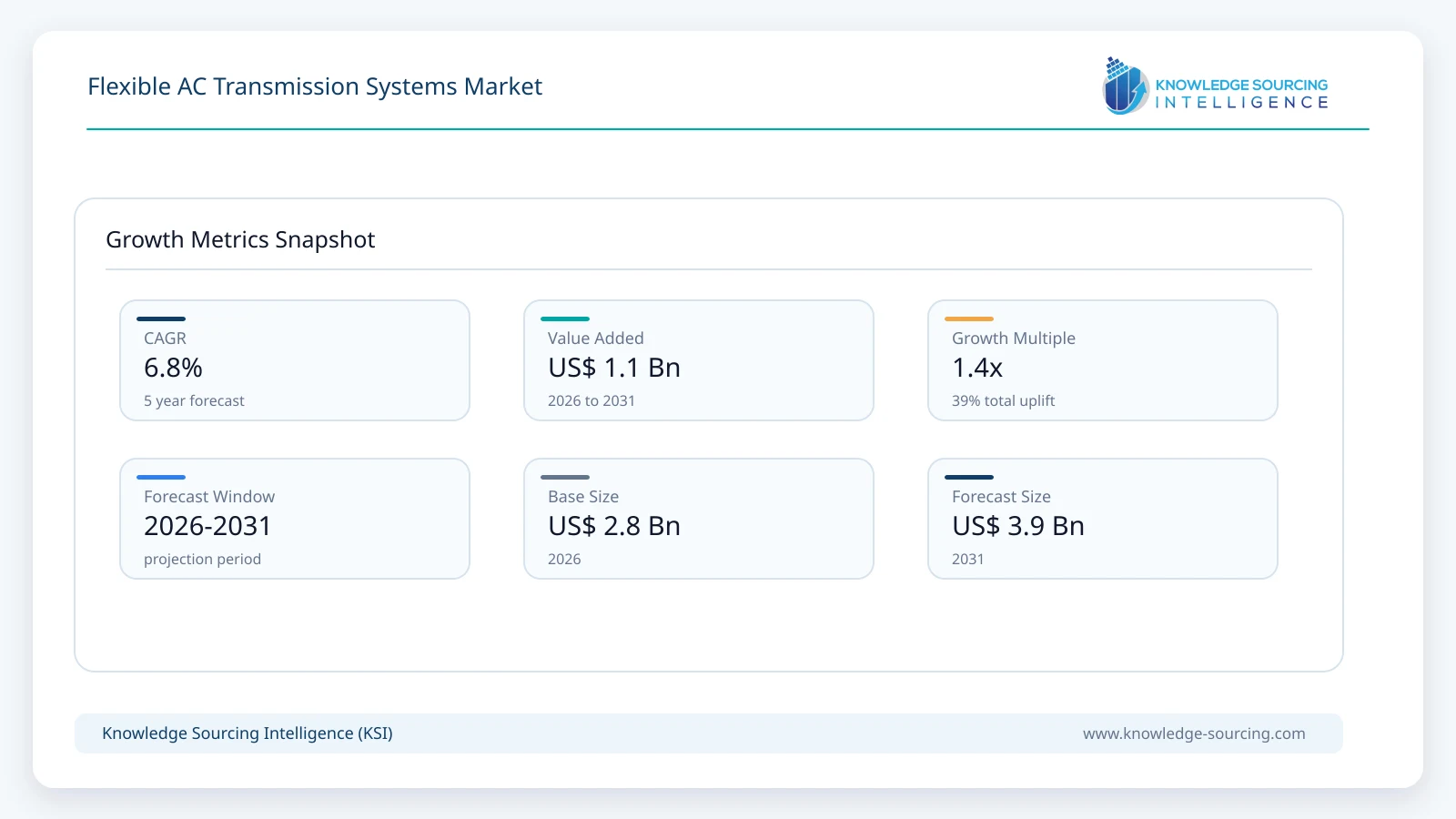
The Flexible AC Transmission Systems Market is forecast to grow at a CAGR of 6.8%, reaching USD 3.88 billion in 2031 from USD 2.79 billion in 2026.
Highlights:
- 1Leading segment by typeShunt Compensation remains the cornerstone of the Flexible AC Transmission Systems Market, accounting for 50.0% of total market revenue in 2026, equivalent to USD 1.40 billion, driven by its critical role in maintaining grid stability and power quality.
- 2Fastest-growing segment by device typeStatic Synchronous Compensators (STATCOM) are set to outperform all major segments, progressing at a CAGR of 8.7% through 2031, supported by increasing deployment in renewable energy integration and modern transmission networks.
- 3Largest opportunity by end userTransmission System Operators represent the dominant customer group, generating USD 1.06 billion in 2026 and expected to expand to USD 1.48 billion by 2031, reflecting ongoing investments in grid modernization and transmission efficiency.
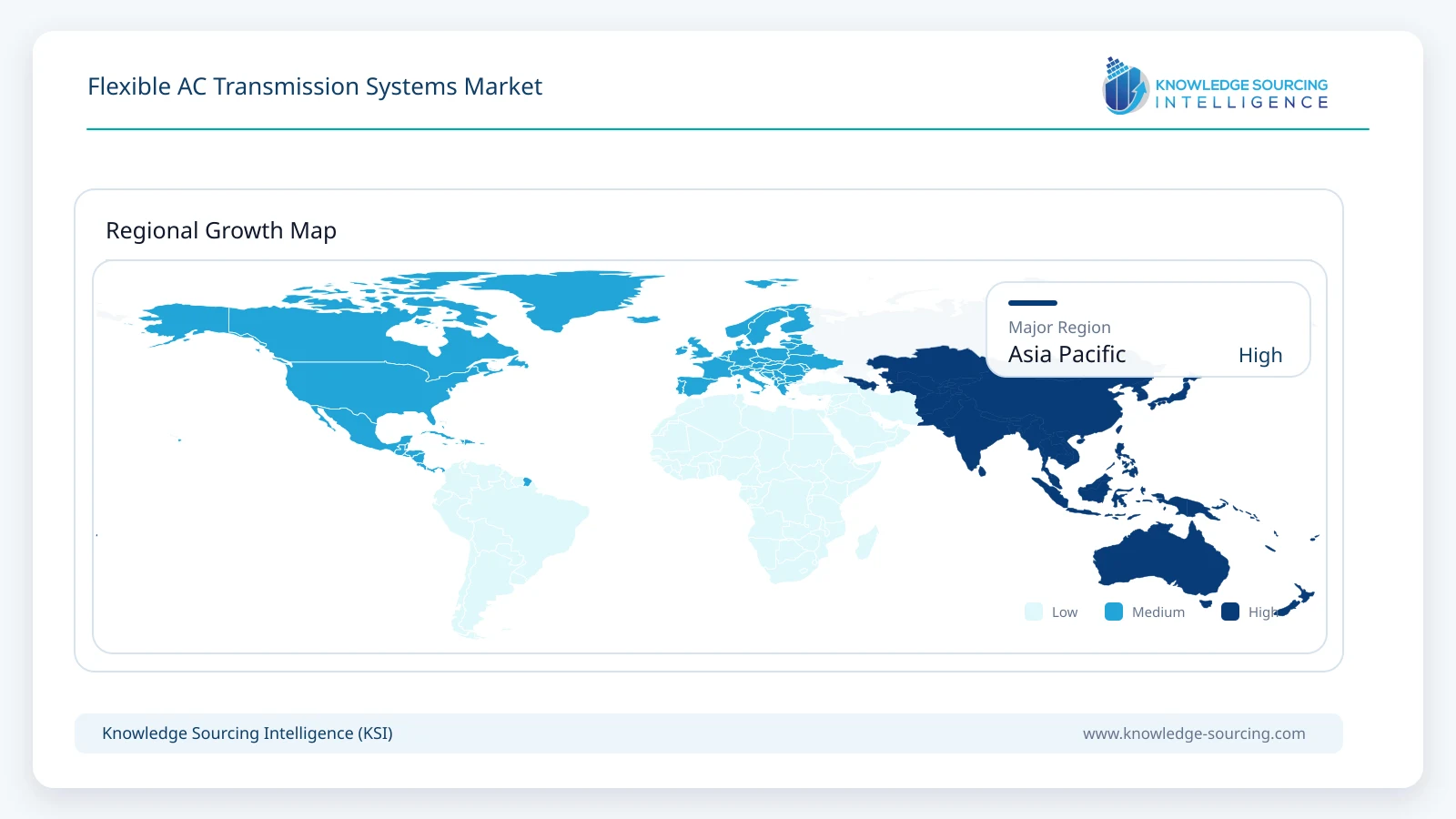
- 4Regional growth engineAsia Pacific is forecast to strengthen its market leadership, rising from 38.0% of global demand in 2026 to 40.0% by 2031.
- 5Existing infrastructure optimizationUtilities are turning to FACTS solutions as a faster and more cost-effective way to modernize aging transmission networks while meeting growing electricity demand from data centers, EVs, and industrial electrification.
- 6STATCOM and digital control growthThe industry is accelerating the shift toward advanced STATCOM platforms and digitally coordinated systems for their superior dynamic response in renewable-dominated and weak-grid environments.
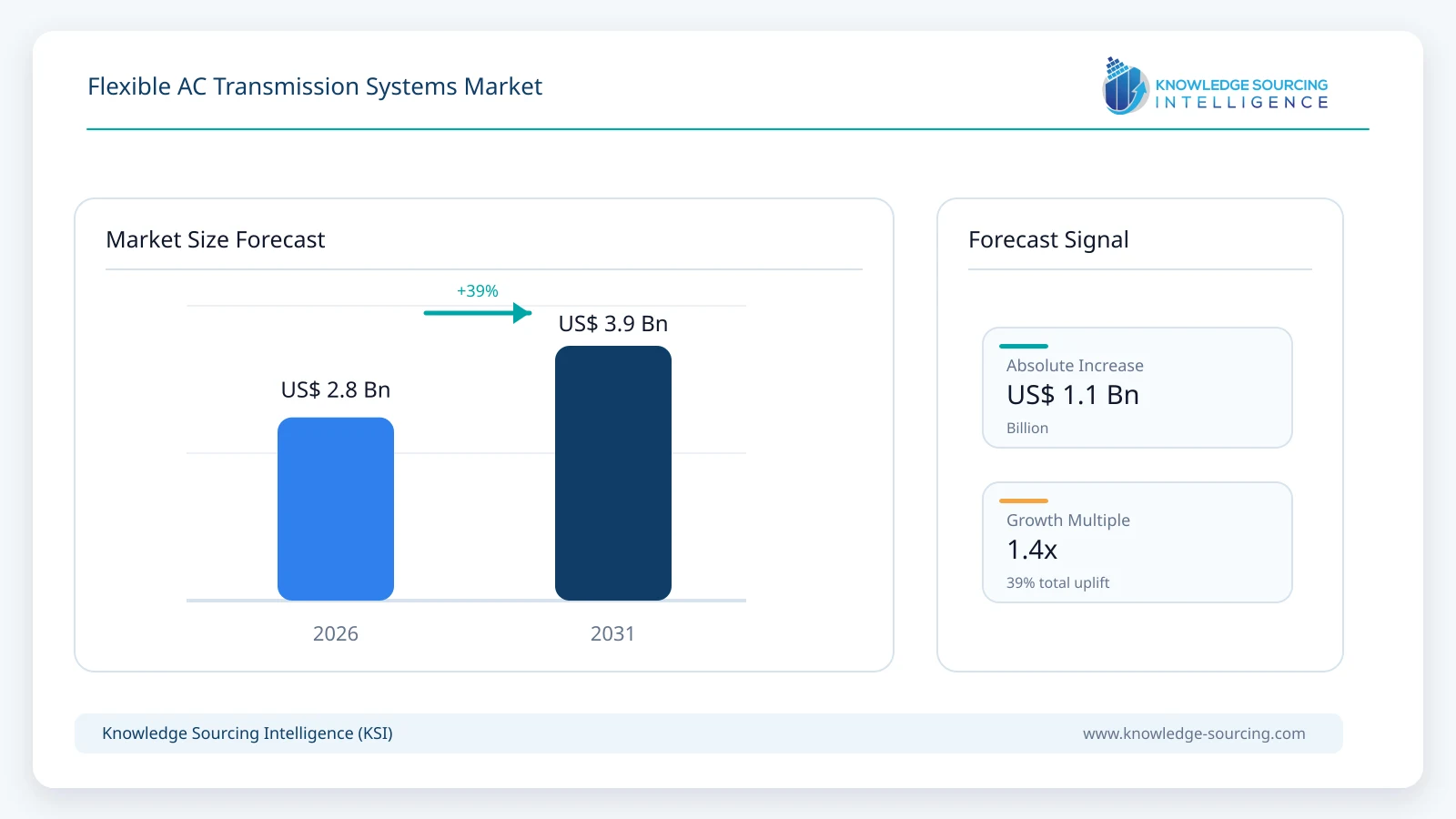
The growth of renewable energy generation, transmission congestions, and grid modernization, combined with the increasing electricity demand, are expected to be the major drivers leading to the overall increase within the global flexible AC transmission systems market.
Traditional design of AC transmission networks is usually based upon the expected generation profiles and a more constant flow of power. This operating environment is changing as penetration of variable renewable resources increases.
The large variability of wind and solar generation subjects’ transmission networks to rapid responses in voltage, reactive power, and power flows. The rapid-response feature of FACTS technologies enables transmission operators to adjust accordingly.
Shunt compensation devices adjust voltage and reactive power by controlling the electrical characteristics of transmission networks. Meanwhile, series compensation is applied to control line impedance and increase power-transfer capability, while series-shunt combinations regulate voltages and influence power flows simultaneously.
Additionally, the market is also supported by the increasing need to make maximum use of existing transmission infrastructure. Acquiring additional capacity through FACTS deployment is generally faster and more cost-effective than developing wholly new transmission corridors, especially where land acquisition, environmental approvals, and permitting create complications.
Market Dynamics
Market Drivers
Increasing Renewable Energy Integration: One of the major driving factors for FACTS deployment is the rise in wind and solar power plants. Renewable generation is intermittent and can lead to fast variations in voltage, reactive power, and flows over the transmission. Renewable energy sources have also begun to be established in regions far from major load centers for large projects. This introduces a new dimension of operational complexity and causes further demand for enabling technologies that support high-volume transmission as well as truly optimal transfer over longer distances.
Growing Transmission Congestion: In many developed markets, congestion in electricity networks occurs because transmission expansion has not kept pace with generation and demand. This challenge is further exacerbated by the rapid development of renewable projects. This is especially the case for transmission lines that have unused physical capacity but are constrained by operational limits due to voltage stability, thermal, or power-flow distribution issues.
Improve Utilisation of Existing Transmission Assets: New FACTS deployment may involve significant capital investment, permitting and environmental reviews, land acquisition, and construction of new infrastructure such as transmission corridors. Thus, FACTS systems offer utilities an additional method to improve the performance of existing networks. Series compensation enhances power-transfer capability, while shunt compensation provides voltage stability and reactive power management.
Aging Transmission Infrastructure: The transmission assets in many electricity networks have been operating for decades. Electricity demand is growing, while extremely old infrastructure needs to be up-to-date. FACTS devices can enhance transmission upgrades through dynamic control of existing assets. With the addition of digital substations, advanced protection systems and sensors, as well as monitoring technologies, utilities can utilize FACTS to enhance the reliability of their networks.
Increasing Electricity Demand: Industrial electrification, electric vehicles, data centres, heat pumps and digital infrastructure mean electricity consumption is on the rise. AI and hyperscale data centers are producing particularly concentrated electricity demand in a number of markets. This is putting additional pressure on transmission networks and pushing utilities to leverage existing capacity while in parallel constructing new transmission infrastructure.
Market Restraints & Opportunities
The high level of investment required in the purchase and installation of FACTS systems is a significant barrier. These large systems necessitate specific types of power electronics, transformers, cooling systems, control equipment, protection systems, and engineering services.
The complexity of the system can also raise deployment requirements. The design of FACTS installations needs to be integrated with existing protection and control systems to avoid any negative coupling with the bulk power system.
However, rather than stymieing growth, these challenges are opening up opportunities for suppliers developing modular FACTS platforms, digital diagnostics, compact STATCOMs, hybrid compensation systems, and more sophisticated control software.
The key opportunities exist in the areas of renewable energy integration, weak-grid stabilization, long-distance transmission, and offshore wind connections, as well as reforming congested urban transmission networks.
Key Developments
July 2026: Quality Power was awarded new orders aggregating to ?56.7 crore, including an international order of around ? 41 crore for supply of equipment on Flexible AC Transmission System suitable for high-voltage grid applications.
April 2026: Hitachi Energy reported that grid-forming converters will bring benefits to stability in both current and future power systems. It also reported Hitachi Energy’s Fgrid-ensure Portfolio, which includes STATCOM, HVDC, SFC, and other battery energy sotrag solution which is focused on supporting high renewable energy penetration.
Market Segmentation
The market is segmented by type, device type, voltage range, application, end user industry, and geography.
By Type: Shunt Compensation
Shunt compensation is expected to remain the largest type segment, reaching USD 1.89 billion by 2031 and representing 48.6% of the Flexible AC Transmission Systems (FACTS) Market, with a 6.2% CAGR during the forecast period.
Shunt compensation systems are installed in parallel with transmission networks to dynamically supply or absorb reactive power, helping maintain voltage levels within required operating limits. Their role becomes increasingly important in systems with long-distance power transmission, fluctuating renewable generation, and rapidly changing load conditions.
Key technologies within this segment include Static VAR Compensators (SVCs) and Static Synchronous Compensators (STATCOMs). Conventional SVC installations use thyristor-controlled reactors and capacitors to manage reactive power, while STATCOM systems employ voltage-source converter technology to provide faster and more precise reactive power and voltage control.
Hitachi Energy offers the SVC Classic, which supports dynamic reactive power compensation and voltage regulation. Its STATCOM solutions provide rapid reactive power compensation and dynamic voltage control, supporting grid stability under changing network conditions.
By Device Type: Static Synchronous Compensator (STATCOM)
The Static Synchronous Compensator (STATCOM) segment is valued at USD 1.14 billion in 2026, accounting for 41.0% of the Flexible AC Transmission Systems Market, making it a leading device type. STATCOMs are gaining strong adoption because they provide fast dynamic voltage regulation and continuous reactive power compensation, particularly in grids experiencing changing load conditions and increasing renewable-energy penetration. Hitachi Energy notes that STATCOM systems use voltage-source-converter principles to respond rapidly to voltage variations and maintain grid stability.
STATCOMs can dynamically inject or absorb reactive power to support voltage stability during load changes, network disturbances, and weak-grid conditions. Their power-electronics-based architecture enables rapid response compared with conventional compensation technologies, supporting applications across renewable generation, transmission networks, utilities, and power-intensive industrial facilities. This capability is increasingly relevant as wind and solar generation introduce greater variability and reduce conventional synchronous generation in power systems.
Hitachi Energy offers SVC Light® STATCOM solutions for voltage stabilization, reactive power compensation, and renewable-energy integration, while its enhanced STATCOM technology combines advanced power electronics and control systems for grids with high renewable penetration. Siemens Energy provides SVC PLUS® STATCOM, based on modular voltage-source-converter technology, for dynamic reactive power compensation and voltage support. In January 2026, Siemens Energy also announced a grid-forming STATCOM installation for Amprion in Germany, designed to deliver fast voltage support and strengthen grid stability under low short-circuit conditions.
By Application: Voltage Regulation & Reactive Power Compensation
Voltage regulation and reactive power compensation represent a major application of Flexible AC Transmission Systems (FACTS), accounting for an estimated USD 0.84 billion in 2026 and approximately 30.0% of the total market. Maintaining stable voltage levels is essential for improving transmission reliability, supporting power quality, and ensuring efficient operation of electricity networks.
Transmission lines, particularly over short and medium distances, can experience voltage fluctuations and reactive power losses when operating conditions change. Variations in electricity demand, network loading, and power-flow patterns can increase these challenges. The growing integration of renewable generation adds further complexity because electricity output from wind and solar facilities can change throughout the day depending on weather and generation conditions.
FACTS technologies dynamically control power-system parameters by injecting or absorbing reactive power, helping transmission networks manage voltage fluctuations and reduce the risk of voltage instability. Static VAR Compensators (SVCs) and Static Synchronous Compensators (STATCOMs) are particularly suitable for voltage regulation and reactive power compensation because they can respond rapidly to changing grid conditions. Their deployment is expanding across renewable energy interconnection points, transmission substations, industrial facilities, and weak-grid locations where voltage stability and reliable voltage support are critical.
Regional Analysis
North America Market Analysis
North America is a significant Flexible AC Transmission Systems (FACTS) market, supported by the modernization of aging transmission infrastructure, rising electricity demand, increasing renewable power integration, and transmission congestion. The United States is experiencing substantial additions of solar and wind capacity while electricity demand is also increasing from data centers, domestic manufacturing, industrial electrification, and other large-scale loads. In 2026, the region accounts for 24.0% of the global FACTS market, representing approximately USD 0.67 billion, and is projected to expand at a 5.7% CAGR over the forecast period. The U.S. Department of Energy’s 2026 draft National Transmission Needs Study identifies a pressing requirement for additional transmission infrastructure to accommodate new generation and load connections, relieve congestion, and maintain grid reliability.
The expansion of renewable generation is further increasing the need for flexible grid technologies capable of supporting voltage stability, power-flow management, and reliable transmission operation. The U.S. Energy Information Administration expects 86 GW of new utility-scale generating capacity to be added in 2026, with solar representing 51% and wind 14% of planned additions. At the same time, electricity demand is being accelerated by data centers and industrial activity. EIA reported that U.S. electricity demand increased by about 1.7% annually between 2020 and 2025 and forecasts continued growth, while DOE highlights data centers, manufacturing, and electrification as major contributors to rising grid requirements.
These developments create favorable conditions for FACTS technologies, including SVCs, STATCOMs, and other power-electronics-based solutions that can improve grid flexibility and support the integration of variable generation. Growing transmission investment across major U.S. grid regions, alongside the need to manage congestion and accommodate rapidly changing load profiles, is expected to sustain demand for FACTS solutions across North America.
South America Market Analysis
South America offers great potential for the FACTS market due to both the renewable energy potential and considerable needs for frequency control and long-distance transmission. Brazil is the biggest market in the region as its electricity system combines large-scale hydropower along with rapidly growing wind and solar generation.
Europe Market Analysis
Europe holds a substantial position in the FACTS market due to the decarbonization of the energy system; cross-border interconnections, large-scale wind power generation, offshore wind farms, and aging transmission infrastructure. Particularly high requirements for controllability are created by the expansion of offshore wind in the North Sea. FACTS technologies are implemented in renewable interconnection points, supporting voltage stability and reactive power management.
Middle East and Africa Market Analysis
Middle East & Africa region has an emerging FACTS market, with growth driven by renewable energy advancements, grid interconnections, and industrial development coupled with several electricity infrastructure investments. Saudi Arabia and the UAE are investing in solar while upgrading transmission. Solar projects would require reactive and voltage management where generation is predominantly located in remote areas.
Asia Pacific Market Analysis
Asia-Pacific will be the largest as well as fastest-growing regional market owing to fast electricity demand growth, rapid transmission construction, renewable energy deployment, and industrialization. China holds a major regional share with the biggest grid and largest renewable generation potential for the region. High-capacity wind and solar projects generate intermittent electricity that must be transported over long distances, due to new high-tech transmission devices to work.
List of Companies
Hitachi Energy Ltd.
Siemens AG
ABB
GE Vernova
Mitsubishi Electric
Toshiba Energy Systems
Larsen & Toubro
NR Electric
Fuji Electric
Eaton Corporation
Hitachi Energy Ltd.
Hitachi Energy is a major market player in FACTS technologies, transmission systems, substations, power electronics, and digital grid solutions. The FACTS solutions in its portfolio include static var compensators like SVC Classic, SVC Light, and STATCOM to provide dynamic reactive power compensation and voltage control.
Siemens AG
Siemens Energy is supplying FACTS, transmission, grid stabilisation and power quality technology. SVC PLUS is based on advanced modular multilevel converter technology to deliver dynamic reactive power compensation and voltage support. It is especially suitable for renewable energy projects and grids that need provision of flexible voltage support.
ABB
ABB offers FACTS solutions along with power electronics, grid stabilization, transmission and substations, and power-quality technologies. ABB brings experience in power-electronics-based compensation systems and grid integration. Its technologies enable voltage control, reactive power management, renewable integration, and transmission optimization.
Analyst View
One of the strong drivers that is steadily shaping the Flexible AC Transmission Systems market toward advanced, digitally controlled grid-stability infrastructure from traditional reactive-power compensation is renewable energy integration, transmission congestion, aging networks, and rapidly increasing electricity demand. Shunt compensation will continue to dominate as the largest segment, as voltage regulation and reactive-power management are basic needs for any modern transmission system. Meanwhile, STATCOM is set for particularly high growth due to the ongoing trend towards renewable-dominated grids and weak grid conditions that leverage its fast dynamic response and flexible reactive power capability. Voltage control and reactive power compensation will continue to be the primary application area, as utilities aim to extract maximum value from their existing infrastructure. FACTS technologies will rise depending on digitally coordinated transmission networks in the coming years.
Flexible AC Transmission Systems Market Scope:
| Report Metric | Details |
|---|---|
| Total Market Size in 2026 | USD 2.79 billion |
| Total Market Size in 2031 | USD 3.88 billion |
| Forecast Unit | Billion |
| Growth Rate | 6.8% |
| Study Period | 2021 to 2031 |
| Historical Data | 2021 to 2024 |
| Base Year | 2025 |
| Forecast Period | 2026 – 2031 |
| Segmentation | Type, Device Type, Voltage Type, Application, End User, Geography |
| Companies |
|
Market Segmentation
By Type
Shunt Compensation
Series Compensation
Combined Series-Shunt Compensation
Others
By Device Type
Static VAR Compensator (SVC)
Static Synchronous Compensator (STATCOM)
Thyristor-Controlled Series Compensator (TCSC)
Static Synchronous Series Compensator (SSSC)
Others
By Voltage Type
Up to 220 kV
Above 220–500 kV
Above 500–765 kV
Above 765 kV
By Application
Voltage Regulation & Reactive Power Compensation
Power Flow Control
Transmission Capacity Enhancement
Power Quality Improvement
Renewable Energy Integration
Congestion Management
Others
By End User
Transmission System Operators
Electric Utilities
Renewable Energy Developers
Others
By Geography
North America
USA
Canada
Mexico
South America
Brazil
Argentina
Others
Europe
United Kingdom
Germany
France
Others
Middle East and Africa
Saudi Arabia
UAE
Others
Asia Pacific
China
Japan
India
South Korea
Others
Table of Contents
1. EXECUTIVE SUMMARY
2. MARKET SNAPSHOT
2.1. Market Overview
2.2. Market Definition
2.3. Scope of the Study
2.4. Market Segmentation
3. MARKET DYNAMIC
3.1. Market Drivers
3.2. Market Restraints
3.3. Market Opportunities
3.4. Porter’s Five Forces Analysis
3.5. Industry Value Chain Analysis
4. BUSINESS LANDSCAPE
4.1. Regulatory & Technical Standards Landscape
4.2. Transmission Infrastructure Investment & Grid Reinforcement Landscape
4.3. FACTS Project Pipeline, EPC Contracting & Procurement Landscape
4.4. Input–Output Analysis
4.5. Strategic Recommendations
5. TECHNOLOGICAL OUTLOOK
5.1. Static VAR Compensator & Thyristor-Controlled Technologies
5.2. Static Synchronous Compensator & Voltage-Source Converter Technologies
5.3. Series Compensation & Unified Power Flow Control Technologies
5.4. Digital Control, Monitoring & Advanced Grid Optimization Technologies
6. FLEXIBLE AC TRANSMISSION SYSTEMS MARKET BY TYPE
6.1. Introduction
6.2. Shunt Compensation
6.3. Series Compensation
6.4. Combined Series-Shunt Compensation
6.5. Others
7. FLEXIBLE AC TRANSMISSION SYSTEMS MARKET BY DEVICE TYPE
7.1. Introduction
7.2. Static VAR Compensator (SVC)
7.3. Static Synchronous Compensator (STATCOM)
7.4. Thyristor-Controlled Series Compensator (TCSC)
7.5. Static Synchronous Series Compensator (SSSC)
7.6. Others
8. FLEXIBLE AC TRANSMISSION SYSTEMS MARKET BY VOLTAGE TYPE
8.1. Introduction
8.2. Up to 220 kV
8.3. Above 220–500 kV
8.4. Above 500–765 kV
8.6. Above 765 kV
9. FLEXIBLE AC TRANSMISSION SYSTEMS MARKET BY APPLICATION
9.1. Introduction
9.2. Voltage Regulation & Reactive Power Compensation
9.3. Power Flow Control
9.4. Transmission Capacity Enhancement
9.5. Power Quality Improvement
9.6. Renewable Energy Integration
9.7. Congestion Management
9.8. Others
10. FLEXIBLE AC TRANSMISSION SYSTEMS MARKET BY END USER
10.1. Introduction
10.2. Transmission System Operators
10.3. Electric Utilities
10.4. Renewable Energy Developers
10.5. Others
11. FLEXIBLE AC TRANSMISSION SYSTEMS MARKET BY GEOGRAPHY
11.1. Introduction
11.2. North America
11.2.1. USA
11.2.2. Canada
11.2.3. Mexico
11.3. South America
11.3.1. Brazil
11.3.2. Argentina
11.3.3. Others
11.4. Europe
11.4.1. United Kingdom
11.4.2. Germany
11.4.3. France
11.4.4. Others
11.5. Middle East and Africa
11.5.1. Saudi Arabia
11.5.2. UAE
11.5.3. Others
11.6. Asia Pacific
11.6.1. China
11.6.2. Japan
11.6.3. India
11.6.4. South Korea
11.6.5. Others
12. COMPETITIVE ENVIRONMENT AND ANALYSIS
12.1. Major Players and Strategy Analysis
12.2. Market Share Analysis
12.3. Mergers, Acquisitions, Agreements, and Collaborations
12.4. Competitive Dashboard
13. COMPANY PROFILES
13.1. Hitachi Energy Ltd
13.2. Siemens AG
13.3. ABB
13.4. GE Vernova
13.5. Mitsubishi Electric
13.6. Toshiba Energy Systems
13.7. Larsen & Toubro
13.8. NR Electric
13.9. Fuji Electric
13.10. Eaton Corporation
14. APPENDIX
14.1. Currency
14.2. Assumptions
14.3. Base and Forecast Years Timeline
14.4. Key benefits for the stakeholders
14.5. Research Methodology
14.6. Abbreviations
Navigate
Trusted by the world's leading organizations











