
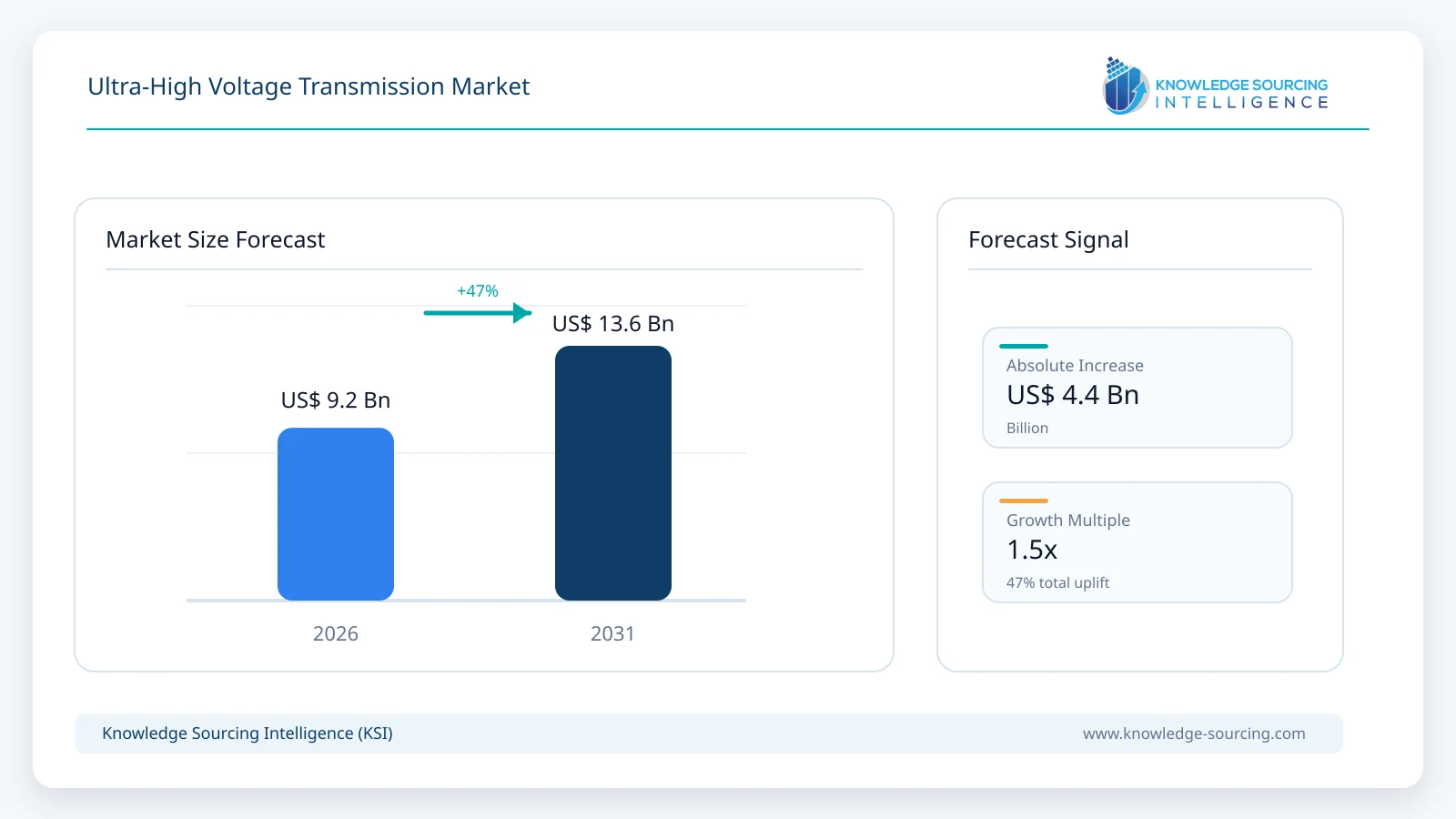
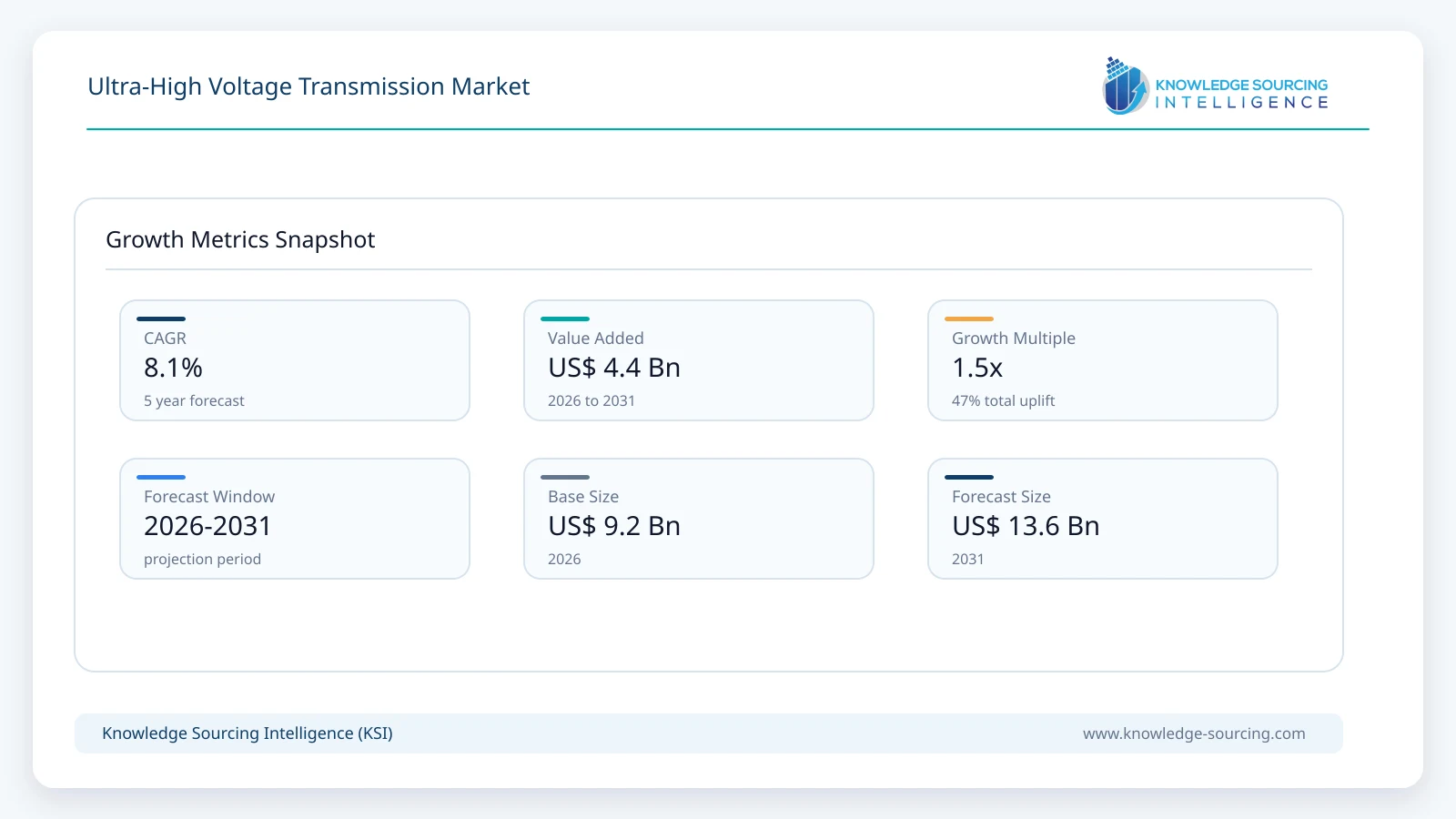
The Ultra-High Voltage Transmission Market is forecast to grow at a CAGR of 8.1%, reaching USD 13.6 billion in 2031 from USD 9.21 billion in 2026.
Highlights:
- 1Renewable Energy Expansion Driving DemandThe Solar and Wind Power segment is projected to record the highest growth rate, advancing at a CAGR of 10.9% between 2026 and 2031, supported by increasing integration of renewable energy into long-distance transmission networks.
- 2Future Market LeadershipBy 2031, the UHVDC segment is anticipated to reach USD 8.70 billion, representing 64.0% of the total market, reflecting its growing importance for efficient bulk-power transmission over extended distances.
- 3Power Transformer Market StrengthPower Transformers hold a significant position within the component landscape, contributing USD 2.76 billion in 2026 or 30.0% of market revenue, and are forecast to expand to USD 3.95 billion by 2031.
- 4Shift Toward High-Capacity Grid InfrastructureIncreasing investments in cross-regional power networks, renewable energy corridors, and grid modernization projects continue to strengthen demand for advanced ultra-high-voltage transmission equipment and systems worldwide.
Electricity grids are moving from centralized generation models toward increasingly geographically dispersed energy systems, and the market is experiencing structural transformation. Growing demand for high-capacity transmission infrastructure is driven by large-scale solar parks, offshore and onshore wind farms, hydropower projects, nuclear facilities, and burgeoning renewable energy hubs.
UHV transmission gives a valuable means for transmitting electricity over thousands of kilometers with minimal losses and fewer corridors than needed to transmit the same amount of power. This makes UHV an effective enabler, especially for countries with large land mass and considerable disparity between locations of power generation and consumption.
The UHVDC technology is also important for renewable integration. HVDC and UHVDC links allow transporting bulk electricity over long distances, and also have the function of controlled power flows between asynchronous or weakly interconnected grids. Therefore, converter station technology is quickly becoming a vital element in the market ecosystem.
In addition, there is an ever-increasing digitalization in the market. In order to increase reliability and decrease unplanned outages, utilities are implementing online monitoring systems, digital substations, fiber-optic communication, advanced protection systems, as well as predictive maintenance technologies.
Government support for grid modernization initiatives, renewable energy objectives, electricity security strategies, and rising electrification are likely to continue as significant drivers of market growth throughout the forecast period.
Market Dynamics
Market Drivers
Expanding Renewable Energy Production and Transmission over Substantial Distances: The strong geographical mismatch between renewable electricity generation and electricity demand is among the major driving factors for UHV transmission. Utilities often build the biggest solar and wind projects in places with abundant renewable resources but comparatively less electricity consumption. UHV transmission allows bulk production of electricity from renewables in remote energy zones to reach urban and industrial demand centers most optimally. China, India, the Middle East, and other regional markets are making huge investments in long-distance transmission corridors that will link renewable generation to national and regional grids.
Increased Electricity Use Due to Data Centers and Electrification of Heavy Industry: Growing demand for data centers, AI infrastructure, manufacturing electrification, electric mobility, and expanding digital economies are driving rapid growth in electricity consumption. These demand centers put pressure on transmission networks due to the need for stable, high-capacity power supplies. This can be a result of large industrial clusters and hyperscale data centres in emerging economies typically located further from urban areas that require high levels of grid reinforcements. UHV electricity networks are used by utilities within these areas to deliver transmission-level power from generation sites to these high–electricity-demand areas.
Grid Modernization and Aging Transmission Infrastructure: In many developed economies, transmission networks are facing obsolescence in equipment and capacity constraints. New transmission corridors, replacement transformers, advanced switchgear, and automated protection systems are just some of the areas where utilities are increasing their investments. The modern UHV infrastructure offers a higher transfer capacity with less energy loss, and due to the rapidly increasing demand for electrical power infrastructure, it helps utilities integrate advanced monitoring and control technologies.
Boosting Cross-Regional and Cross-Border Interconnections in Electricity: Governments throughout the world are recognized to interconnect and cooperate to promote energy security, optimize generation resources, and enhance electricity trading. UHV transmission enables high-volume electricity transfer across long distances, between regions and countries that would otherwise be more effectively served by conventional transmission. The phenomenon is especially crucial for the integration of renewable energy since electricity may be conveyed between places that are under different generation-and-demand conditions.
Market Restraints & Opportunities
UHV transmission projects demand significant upfront investment with protracted timelines for planning, environmental assessments, land acquisition, and permitting processes. Right-of-way needs that require complex negotiations can extend timelines for transmission projects, especially in high-density areas.
This also introduces complexity to the project since systems for UHV require specialized equipment. The transformers, converter stations, circuit breakers, conductors, and insulation systems are subjected to extreme electrical and mechanical stresses, thus making it necessary for the manufacturers to have specialized manufacturing capabilities.
However, these challenges present opportunities for suppliers of modular transmission equipment, digital monitoring systems, advanced conductors, and condition-based maintenance technologies. This increasing urgency of linking renewable energy areas with urban demand centers has created significant opportunities for UHVDC projects.
Key Developments
August 2026: CHINT Electric passed all routine and type tests for its self-developed 1, 000 kv/1, 000 mva ultra-high-voltage AC transformer called the "double million" transformer, capable of enhancing transmission capacity and decreasing losses. The transformer completed testing on its first attempt and is optimized for reliability as well, supporting China's next-generation power system.
October 2025: Hitachi Energy planned to deliver 1,100 kV gas-insulated switchgear (GIS) for the expansion of the Nanchang ultra-high-voltage substation in Jiangxi Province, east China, which has a previous 1,000 kV delivery. The project helps consolidate connections between Hunan and Jiangxi to enhance interprovincial power-transfer capacity, boost grid stability and facilitate larger-scale transfers of clean power across central China.
Market Segmentation
The market is segmented by transmission type, component, voltage type, power source, end user, and geography.
By Transmission Type: Ultra-High Voltage Direct Current (UHVDC)
UHVDC is forecast to remain the dominant and fastest-growing transmission type, registering a segment CAGR of 9.1% over the forecast period. This growth is primarily attributed to the significant advantages UHVDC offers in transferring bulk electricity over extremely long distances. UHVDC systems can transmit and control very large volumes of electricity with comparatively lower transmission losses, making them well suited for large-scale and geographically dispersed power networks.
This capability is particularly important as remote renewable generation increasingly needs to be transmitted over long distances to major industrial, commercial, and urban demand centers. UHVDC transmission can support the integration of hydropower from large reservoirs as well as utility-scale solar and wind resources, reducing the need for generation facilities to be located close to electricity consumption centers. This enables utilities and grid operators to develop renewable resources in areas with strong natural potential while efficiently supplying distant load centers.
Hitachi Energy supplies high-voltage direct current transmission systems and converter-station technologies designed for long-distance bulk power transfer and renewable energy integration. Its portfolio includes HVDC Classic and HVDC Light technologies, supporting different transmission and grid-integration requirements.
Siemens Energy provides HVDC transmission systems incorporating different converter technologies for long-distance electricity transmission, grid interconnection, and integration of renewable generation. Such technologies support the development of reliable transmission corridors capable of transporting electricity from resource-rich regions to high-demand markets.
Transmission corridors connecting remote renewable energy resources with industrial and urban demand centers are increasingly adopting UHVDC because of its high transfer capacity, lower losses, and controllability over long distances. The technology can also interconnect asynchronous grids and enable controlled electricity exchange, strengthening grid flexibility and supporting the expansion of renewable power systems.
By Component: Power Transformers
Power Transformers represent the largest component segment in the UHV transmission market, supported by their critical role in stepping up and stepping down voltage across high-capacity transmission networks. UHV transformers are engineered to withstand extremely high electrical, thermal, and mechanical stresses while enabling efficient long-distance power transmission with reduced losses. The Power Transformers segment is projected to grow at a CAGR of 7.4%, driven by rising investments in transmission infrastructure, grid expansion, renewable power integration, and the modernization of aging electricity networks.
Hitachi Energy offers power transformers through its Transformers business, supplying large transformer systems for transmission networks and high-voltage grid applications. Siemens Energy also provides transformer systems and related technologies designed for power transmission and other grid applications, supporting utilities as they expand and modernize UHV infrastructure.
New UHV transformers are increasingly being equipped with advanced digital monitoring and diagnostic systems that track parameters such as temperature, insulation condition, dissolved gases, load conditions, and other operating indicators. These capabilities provide utilities with greater visibility into transformer health and enable a shift from time-based maintenance toward condition-based and predictive maintenance. As UHV networks become more complex and critical to grid reliability, the adoption of intelligent monitoring technologies is expected to further support demand for advanced power transformers.
By End User: Utilities
Utilities are the largest end-user segment because they own and operate most high-voltage transmission infrastructure, needing CLMP to deliver reliable electricity across regions.
The utilities investing in UHV transmission to increase grid capacity, integrate renewable energy, improve system resilience, and mitigate congestion. Emerging corridors for electricity transmission among national and regional transmission operators due to changes in patterns of generation. ABB Grid Automation offers grid automation and digital technologies, which help utilities monitor, control, and optimally run transmission networks.
Similarly, Hitachi Energy Grid Solutions offers transmission and grid integration solutions for utilities and network operators facing increasingly dynamic electricity systems. Additionally, the transition toward renewables-dominated electricity systems is leading to greater reliance on advanced instruments of transmission capable of managing increasing variable generation and bidirectional power flows.
Regional Analysis
Americas Market Analysis
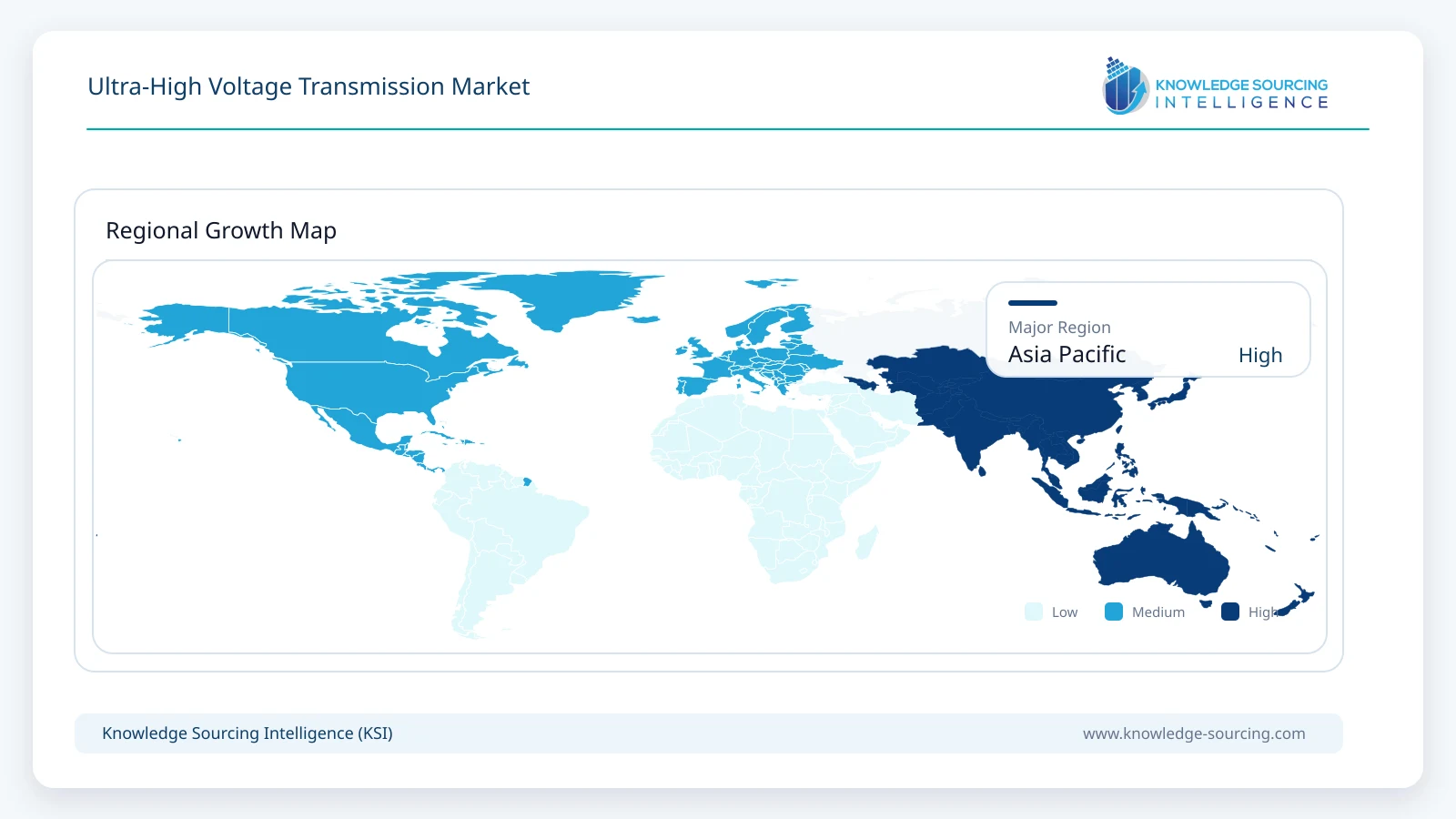
The Americas market for UHV transmission is expanding as electricity consumption rises and renewable generation grows across geographically diverse areas. The geographical disparity between renewable energy resources and major population centres, along with a shortage of viable transmission corridors, remains a major impediment to the widespread deployment of these technologies in the United States. Rather than focusing exclusively on traditional network expansion, the region is increasingly adopting advanced conductors, grid-enhancing technologies, digital substations, and high-capacity transmission infrastructure. In 2031, the Americas market is projected to account for a 12.0% share, with a segment value of USD 1.63 billion. Additionally, continued strength in Brazil is supported by extensive electricity transmission requirements associated with geographically distributed hydropower and rapidly expanding renewable energy generation.
Europe, Middle East and Africa Market Analysis
Europe is investing heavily in transmission infrastructure as the region incorporates large volumes of rapidly growing wind and solar generation. The development of offshore wind in the North Sea is driving significant demand for high-capacity transmission links from generation hubs to mainland power markets. Germany, France, and the UK are strengthening electricity interconnections for energy security and renewable power trading. Meanwhile, UHV transmission has gained traction in emerging markets of the Middle East & Africa due to investments by governments towards renewable power generation, industrial electrification and regional electricity interconnections. The renewable energy hubs are purported to be constructed in desert regions, necessitating the long-range transmission of electricity via power lines to urban and industrial centers.
Asia Pacific Market Analysis
Asia-Pacific is forecast to dominate the global UHV transmission market throughout the forecast period, accounting for an estimated 73.0% share in 2031 and reaching a segment value of USD 9.93 billion. The region’s leading position is supported by substantial investments in high-voltage transmission infrastructure across China, India, Japan, and other rapidly developing economies. Growing electricity demand, large-scale renewable energy deployment, grid modernization, and the need to transfer electricity across long distances are strengthening the adoption of UHV transmission technologies across the region.
China has developed some of the world’s largest UHVAC and UHVDC transmission networks, enabling the efficient transfer of electricity from remote generation bases to major eastern and coastal demand centers. Continued expansion of UHV transmission capacity remains a major contributor to regional market growth, particularly as China integrates large-scale renewable generation and strengthens long-distance power connectivity. India is also creating significant opportunities through its renewable energy expansion targets, increasing electricity demand, and investments in inter-regional transmission infrastructure. These developments are expected to support sustained demand for UHV transmission equipment, converter systems, substations, and associated grid technologies across Asia-Pacific.
List of Companies
ABB
Hitachi Energy
Siemens AG / Siemens Energy
General Electric
L&T Group
Tata Group
Kalpataru Projects International
Valmont Industries
Zhongtian Technology
Skipper Limited
ABB
ABB is a leading global provider of power transmission, electrification, grid automation and HVDC technologies. It has a transmission portfolio of all types, including converter stations for undersea cable transmission investments by utility providers, like power- and high-voltage products to boost renewables share, transformers for bulk power transportation, along with grid automation & more digital technologies for enhancing every aspect of capacity & reliability.
Hitachi Energy
Hitachi Energy is a global leader in power transmission technologies, with the strongest position in HVDC and grid integration. Its portfolio includes transformers, converter stations, high-voltage products & solutions, grid automation and digital transmission solutions among others. The company has vast experience in assisting long-distance energy transmission and renewables power integration.
Siemens AG
Siemens Energy specializes in high-voltage transmission and grid technologies for energy. It has a wide range of offerings such as HVDC systems, transformers, switchgear, grid stabilization technologies, and digital grid solutions. The company’s HVDC PLUS I-X is an assisted energy solution for remote energy transmission and renewable resources integration.
Analyst View
The ultra-high voltage transmission market is approaching a phase of substantial growth, where electricity systems are undergoing a simultaneous wave of electrification, renewable integration, and digital transformation. While UHVAC still plays an important role in enhancing interconnections of regional grids, UHVDC is projected to represent the greatest expansion opportunity, especially for transferring renewable power over the longest distances. This rising demand for electricity, driven by AI data centers, industrial electrification, and electric mobility, is related in various ways to the heightened demand on transmission capacity. During the forecast period, technology investments in high-capacity transformers and converter stations, advanced conductors, digital substations, and grid automation are expected to play an increasing role in improving UHV networks' effectiveness and reliability.
Ultra-High Voltage Transmission Market Scope:
| Report Metric | Details |
|---|---|
| Total Market Size in 2026 | USD 9.21 billion |
| Total Market Size in 2031 | USD 13.6 billion |
| Forecast Unit | Billion |
| Growth Rate | 8.1% |
| Study Period | 2021 to 2031 |
| Historical Data | 2021 to 2024 |
| Base Year | 2025 |
| Forecast Period | 2026 – 2031 |
| Segmentation | Transmission Type, Component, Voltage Type, Power Source, End User, Geography |
| Companies |
|
Table of Contents
1. EXECUTIVE SUMMARY
2. MARKET SNAPSHOT
2.1. Market Overview
2.2. Market Definition
2.3. Scope of the Study
2.4. Market Segmentation
3. MARKET DYNAMIC
3.1. Market Drivers
3.2. Market Restraints
3.3. Market Opportunities
3.4. Porter’s Five Forces Analysis
3.5. Industry Value Chain Analysis
4. BUSINESS LANDSCAPE
4.1. Regulatory & Grid Standards Landscape
4.2. Transmission Planning & Grid Development Landscape
4.3. Raw Material & Component Supply Landscape
4.4. Grid Modernization & Renewable Energy Integration Landscape
4.5. Strategic Recommendations
5. TECHNOLOGICAL OUTLOOK
5.1. Advanced Transmission Conductors
5.2. High-Voltage Direct Current Converter Technologies
5.3. Digital Substations & Intelligent Grid Technologies
5.4. Condition Monitoring & Predictive Maintenance Technologies
6. ULTRA-HIGH VOLTAGE TRANSMISSION MARKET BY TRANSMISSION TYPE
6.1. Introduction
6.2. Ultra-High Voltage Alternating Current (UHVAC)
6.3. Ultra-High Voltage Direct Current (UHVDC)
7. ULTRA-HIGH VOLTAGE TRANSMISSION MARKET BY COMPONENT
7.1. Introduction
7.2. Power Transformers
7.3. Converter Stations
7.4. Circuit Breakers & Switchgear
7.5. Insulators & Conductors
7.6. Others
8. ULTRA-HIGH VOLTAGE TRANSMISSION MARKET BY VOLTAGE TYPE
8.1. Introduction
8.2. 800 kV- 1,000 kV
8.3. Above 1,000 kV
9. ULTRA-HIGH VOLTAGE TRANSMISSION MARKET BY POWER SOURCE
9.1. Introduction
9.2. Hydroelectric Power
9.3. Solar and Wind Power
9.4. Coal and Thermal Power
9.5. Others
10. ULTRA-HIGH VOLTAGE TRANSMISSION MARKET BY END USER
10.1. Introduction
10.2. Transmission System Operators
10.3. Utilities
10.4. Government & Public Sector Transmission Authorities
10.5. Others
11. ULTRA-HIGH VOLTAGE TRANSMISSION MARKET BY GEOGRAPHY
11.1. Introduction
11.2. Americas
11.2.1. USA
11.2.2. Canada
11.2.3. Brazil
11.2.4 Others
11.3. Europe, Middle East and Africa
11.3.1. United Kingdom
11.3.2. Germany
11.3.3. France
11.3.4. Others
11.4. Asia Pacific
11.4.1. China
11.4.2. Japan
11.4.3. India
11.4.4. Others
12. COMPETITIVE ENVIRONMENT AND ANALYSIS
12.1. Major Players and Strategy Analysis
12.2. Market Share Analysis
12.3. Mergers, Acquisitions, Agreements, and Collaborations
12.4. Competitive Dashboard
13. COMPANY PROFILES
13.1. ABB
13.2. Hitachi Energy
13.3. Siemens AG
13.4. General Electric
13.5. L&T Group
13.6. Tata Group
13.7. Kalpataru Group
13.8. Valmont Industries
13.9. Zhongtian Technology
13.10. Skipper Group
14. APPENDIX
14.1. Currency
14.2. Assumptions
14.3. Base and Forecast Years Timeline
14.4. Key benefits for the stakeholders
14.5. Research Methodology
14.6. Abbreviations
Navigate
Trusted by the world's leading organizations











