
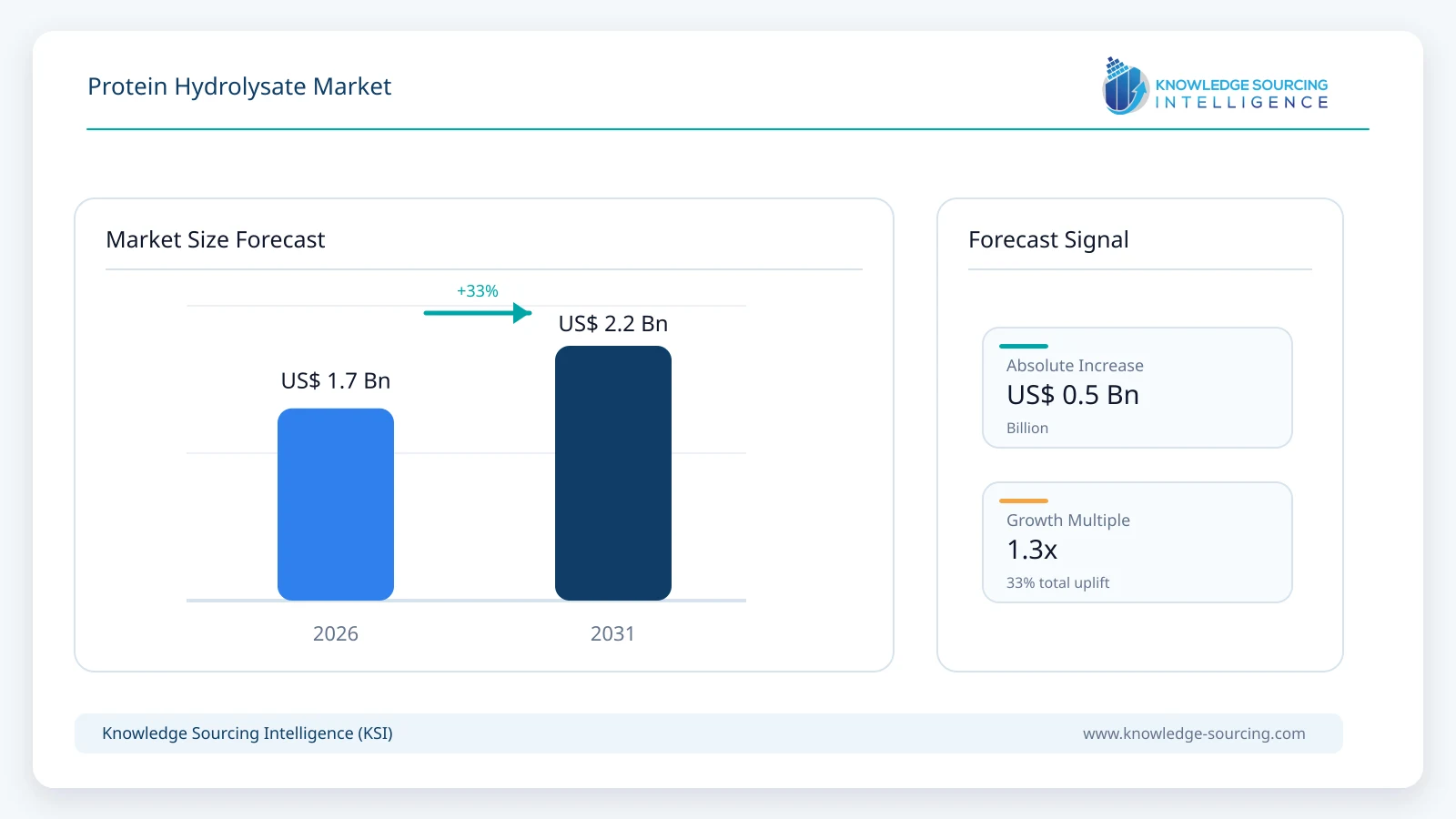
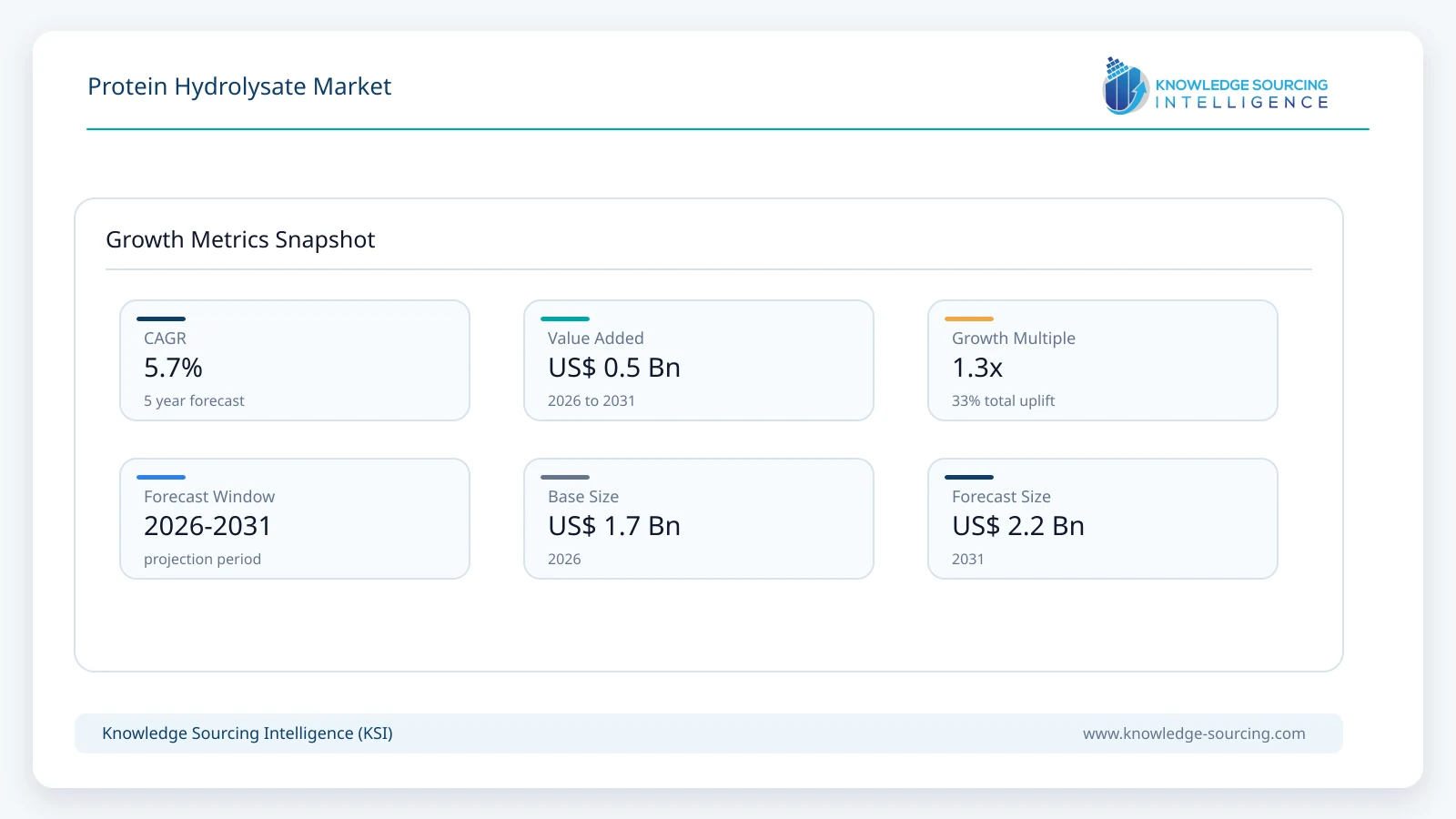
The Global Protein Hydrolysate Market is estimated at approximately USD 1.66 billion in 2026 and projects it to reach approximately USD 2.20 billion by 2031, representing a CAGR of about 5.7% during the forecast period.
Highlights:
- 1Dairy-derived hydrolysates account for approximately 64% of global market value in 2026.
- 2Powder remains the dominant form because it simplifies stability, transport and downstream formulation.
- 3Infant nutrition remains the largest application, while medical and active nutrition expand faster.
- 4Europe leads current market value, while Asia Pacific records stronger percentage growth.
- 5EU Regulation 2026/743 expanded protein-hydrolysate specifications permitted for infant and follow-on formula.
- 6Animal-origin-free hydrolysates are gaining importance in cell culture and industrial fermentation workflows.
Protein hydrolysates sit between intact proteins and free amino acids. Manufacturers use controlled hydrolysis to reduce protein chain length and create peptide distributions tailored to the end application. Degree of hydrolysis, molecular-weight distribution, residual intact protein, free-amino-acid content, solubility, heat stability and bitterness all influence commercial positioning. In infant nutrition, hydrolysate specifications are tightly linked to digestibility, antigenicity and regulatory suitability. In sports and medical nutrition, faster digestion, high protein density and functional performance are important. In animal nutrition and aquaculture, hydrolysates can improve palatability, digestibility and feed intake. In cell culture and fermentation, plant- and yeast-derived hydrolysates or peptones provide nitrogen, peptides and micronutrients for microbial or mammalian cell growth.
The supplier landscape spans dairy specialists, diversified nutrition companies, animal-protein processors and biotechnology ingredient suppliers. Arla Foods Ingredients, FrieslandCampina Ingredients, Carbery, Agropur, Hilmar, AMCO Proteins, Glanbia Nutritionals and Tatua supply dairy hydrolysates for infant, sports, medical or general nutrition. Kerry participates across food, nutrition and biopharmaceutical cell-culture hydrolysates. Bioiberica and Kemin supply specialized animal-protein hydrolysates for feed, pet food and aquaculture. Hofseth BioCare commercializes salmon protein hydrolysate, while Nu-Tek BioSciences focuses on animal-origin-free peptones and protein hydrolysates for bioprocessing. dsm-firmenich supplies the highly hydrolyzed casein peptide ingredient PeptoPro for sports and active nutrition.
Regulation remains particularly important in early-life nutrition. EFSA evaluates infant and follow-on formulas manufactured from specific protein hydrolysates on a case-by-case basis, with dossiers expected to characterize the hydrolysate, manufacturing process, stability and nutritional safety. In June 2026, Commission Delegated Regulation (EU) 2026/743 amended Regulation 2016/127 to add another set of protein-related requirements for hydrolysate-based infant and follow-on formula. This reinforces the importance of documented process consistency and clinical suitability and creates high entry barriers for suppliers serving the most sensitive applications.
Market Trends
Sensory Optimization Is Expanding Hydrolysates Beyond Highly Specialized Products
Bitterness has historically limited the use of highly hydrolyzed proteins in consumer-facing products because shorter peptides can create strong off-notes. Suppliers are addressing this through enzyme selection, degree-of-hydrolysis control, downstream filtration, flavor modulation and formulation support. Arla Foods Ingredients markets hydrolysates designed to reduce bitterness, while Kerry combines protein hydrolysates with taste and texture expertise. Carbery and Hilmar similarly emphasize peptide control and sensory performance. This matters because improved taste allows hydrolysates to move from narrowly therapeutic or performance-oriented powders into ready-to-drink beverages, bars, compact medical nutrition and other mainstream formats where palatability is essential.
Medical Nutrition and Healthy-Ageing Applications Are Increasing the Value of Peptide-Based Protein
Medical and healthy-ageing nutrition is becoming more important as formulators seek high-quality protein that can be delivered in smaller volumes and tolerated by consumers with compromised appetite or digestive capacity. Arla Foods Ingredients offers whey hydrolysates for medical nutrition, Carbery markets Optipep hydrolysates for clinical formulations, and Agropur positions BioZate products across medical and specialized nutrition. Hofseth BioCare is developing the ProGo salmon protein hydrolysate around healthy-ageing and metabolic applications, with a peer-reviewed 2026 pilot study reporting changes in markers related to lean mass and metabolic health. These applications tend to carry higher ingredient values than commodity protein because peptide profile, evidence, taste and processing performance matter alongside protein percentage.
Plant and Animal-Origin-Free Hydrolysates Are Broadening the Raw-Material Base
Dairy remains the largest source, but hydrolysates from soy, pea, wheat and other plant proteins are gaining importance in food, fermentation and bioprocess applications. Kerry provides plant-protein hydrolysate solutions, while Roquette markets hydrolyzed pea protein for industrial fermentation and agricultural uses. Nu-Tek focuses specifically on 100% animal-origin-free peptones and protein hydrolysates for cell-culture and microbial-fermentation systems. The shift is not driven only by vegan positioning: biotechnology manufacturers value reduced animal-origin risk, traceability and supply resilience, while food companies use plant hydrolysis to improve solubility, texture and digestibility. This creates a faster-growing plant segment even though dairy retains the larger installed base.
Real-Time Process Control Is Improving Consistency in Hydrolysis
Commercial hydrolysate production requires tighter control than standard protein concentration because small changes in time, pH, enzyme activity and temperature can materially alter peptide profiles and taste. Research published in 2026 using industrial-scale whey protein hydrolysate production at Arla Foods Ingredients evaluated FT-IR methods for rapid degree-of-hydrolysis measurement. Wider adoption of in-line and at-line analytics can reduce batch variability and shorten release cycles, particularly where customers require narrow molecular-weight distributions or validated performance. This is strategically important in infant nutrition, clinical nutrition and cell culture, where consistency is a prerequisite for qualification and where switching suppliers can require extensive revalidation.
Market Drivers
Specialized Infant Nutrition Sustains High-Value Hydrolysate Demand
Hydrolyzed proteins remain important in formula designed for feeding intolerance and the dietary management of cow's-milk protein allergy. Extensively hydrolyzed formulas require tightly controlled peptide distributions and low residual intact protein, while partially hydrolyzed formulas are used in selected digestive-comfort applications. EFSA's case-by-case framework and the 2026 EU regulatory amendment reinforce the commercial value of suppliers with validated manufacturing processes, analytical capabilities and regulatory dossiers. Because approval is linked to a specific hydrolysate rather than to hydrolysates as a generic ingredient class, established suppliers can maintain durable positions even when broader infant-formula volumes are mature.
Sports and Active Nutrition Continue to Broaden Protein-Consumption Occasions
Hydrolyzed whey and casein are used in sports and active nutrition where formulators value rapid digestion, high solubility and amino-acid delivery. Arla, Hilmar, Agropur, Glanbia, Carbery and dsm-firmenich all maintain hydrolysate or peptide products targeted at sports or active-lifestyle use. Demand is expanding beyond conventional post-workout powders into ready-to-drink beverages, protein bars and compact formats. The GLP-1 weight-management trend is also increasing interest in nutrient-dense protein for consumers eating smaller portions, encouraging suppliers to position hydrolysates around digestibility, muscle maintenance and compact nutrition rather than athlete-only performance.
Bioprocess and Fermentation Applications Create a High-Value Growth Niche
Protein hydrolysates and peptones provide peptide nitrogen, amino acids and micronutrients in microbial fermentation and selected cell-culture processes. Kerry markets hydrolysates specifically for cell-culture media, while Nu-Tek has built its positioning around animal-origin-free hydrolysates for biologics and fermentation. A 2026 Biotechnology Progress review co-authored with Kerry researchers highlighted both the value and the historic batch-variability challenge of hydrolysates in cell culture. As biologics, vaccines, precision fermentation and other bioprocess applications scale, reproducible animal-origin-free hydrolysates can command higher value per kilogram than conventional nutrition ingredients, although the total volume remains smaller.
Market Restraints
Bitterness, Batch Variability and Regulatory Qualification Constrain Faster Expansion
Hydrolysis creates commercial benefits but also introduces formulation and manufacturing complexity. Higher degrees of hydrolysis can increase bitterness, while raw-material variability and enzyme-process conditions can change the resulting peptide distribution. This raises analytical and quality-control costs and can limit substitution between suppliers. Infant-formula and medical-nutrition applications face particularly high qualification barriers, while bioprocess users require batch-to-batch consistency because small compositional differences can affect cell growth, product yield or glycosylation. Dairy hydrolysates also inherit exposure to whey and milk-protein prices, while plant hydrolysates face variability in protein purity and flavor. These factors keep hydrolysates at a material premium to standard concentrates and isolates and restrain adoption in price-sensitive mainstream foods.
Protein Hydrolysate Market Segment Analysis
By Source
Dairy Protein
Dairy protein remains the largest source because whey and casein hydrolysates have established use across infant, sports and medical nutrition. KSI estimates dairy-derived hydrolysates at approximately USD 1.06 billion in 2026 and projects the segment to reach about USD 1.37 billion by 2031. Growth is slower than plant hydrolysates but remains supported by highly regulated early-life applications and the nutritional familiarity of whey. Plant protein hydrolysates are expected to expand faster, reaching approximately USD 546.9 million by 2031 as soy, pea and other plant proteins gain use in functional foods, fermentation and animal-origin-free formulations. Other animal and marine hydrolysates remain smaller but differentiated in pet, aquaculture and bioactive-peptide applications.
By Form
Powder
Powder is the dominant commercial form because spray drying and agglomeration provide longer shelf life, simpler transport and easier incorporation into dry blends, bars, formula powders and ready-to-mix products. KSI projects powder hydrolysates to reach approximately USD 1.82 billion by 2031. Liquid hydrolysates retain relevance where manufacturers use them directly in feed, fermentation, sauces or other process applications, but water content increases transportation cost and can reduce storage flexibility. Supplier investments therefore continue to emphasize drying, instantization and particle engineering alongside the hydrolysis process itself.
By Application
Infant Nutrition
Infant nutrition remains the largest application because hydrolysates are critical to specific formula categories where digestibility, antigenicity and clinical suitability are tightly controlled. KSI projects the segment to reach approximately USD 604.2 million by 2031. Sports and dietary supplements are expected to reach around USD 524.4 million as hydrolyzed whey and casein move into a wider set of active-nutrition formats, while medical and clinical nutrition reaches approximately USD 408.4 million. Bioprocess and fermentation remains smaller in absolute value but is one of the faster-growing niches because animal-origin-free peptones and consistent hydrolysates support cell-culture and microbial-production workflows.
By Geography
Europe
Europe remains the largest regional market in 2026 because of its established dairy ingredient base, regulated infant-nutrition industry and concentration of specialized suppliers. KSI projects European revenue of approximately USD 642.8 million by 2031.
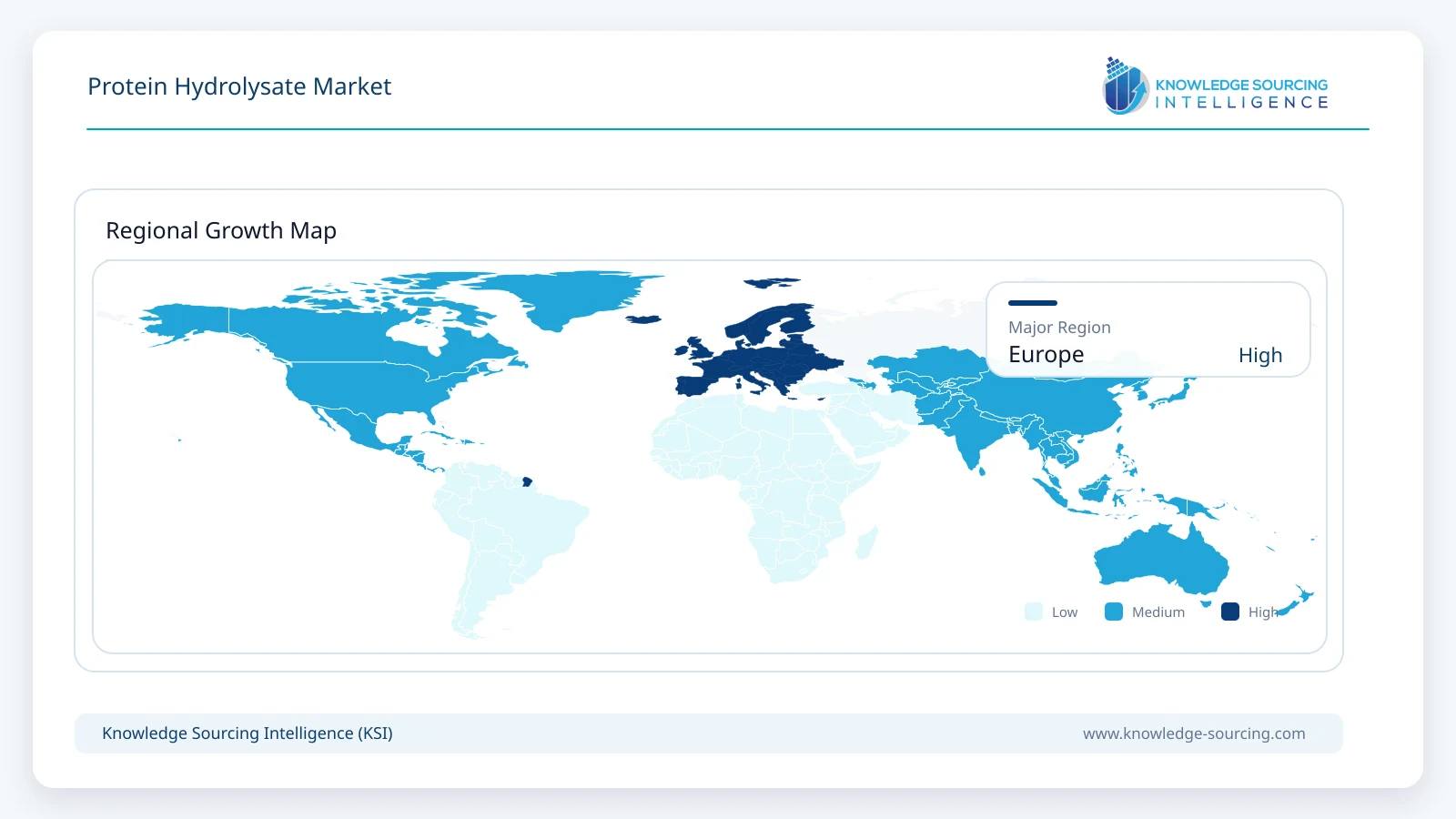
North America is close behind, supported by sports nutrition, medical nutrition and biotechnology, while Asia Pacific grows faster as specialized nutrition demand, domestic infant-formula production, active nutrition and regional bioprocessing expand. The 2026 EU regulatory amendment is also commercially relevant because it clarifies the route for additional validated hydrolysates to be incorporated into the infant-formula framework.
Competitive Environment
Competition is fragmented across dairy specialists, diversified nutrition companies, animal-protein processors and bioprocess ingredient suppliers. Arla Foods Ingredients and FrieslandCampina Ingredients have strong positions in specialized dairy proteins and early-life nutrition. Kerry combines dairy and plant hydrolysates with food-formulation and cell-culture capabilities. Glanbia Nutritionals, Agropur, Hilmar, Carbery, AMCO Proteins and Tatua compete across sports, clinical and infant nutrition. dsm-firmenich participates through PeptoPro, a highly hydrolyzed casein peptide ingredient focused on active performance.
Animal and marine hydrolysates form a distinct competitive block. Bioiberica markets Palbio hydrolyzed porcine intestinal proteins for animal nutrition, Kemin supplies PROSURANCE and Proprevia hydrolysates for pet food and aquaculture, and Hofseth BioCare markets ProGo salmon protein hydrolysate. Nu-Tek BioSciences competes in animal-origin-free peptones and protein hydrolysates for cell culture and fermentation, while Roquette participates through hydrolyzed pea protein in industrial fermentation and related applications. Competitive advantage therefore depends on source access, process control, molecular-weight consistency, sensory performance, regulatory documentation and customer application support rather than commodity protein scale alone.
Recent Developments
September 2026: Nu-Tek BioSciences highlighted 100% animal-origin-free protein hydrolysates for cell-culture-media qualification and supply security ahead of CPHI Global 2026.
August 2026: Bioiberica published updated technical work on Palbio 50 hydrolyzed porcine protein and feed-biosecurity performance.
July 2026: A peer-reviewed pilot study reported new metabolic and healthy-ageing findings for Hofseth BioCare's ProGo salmon protein hydrolysate.
June 2026: Commission Delegated Regulation (EU) 2026/743 amended EU protein requirements for infant and follow-on formula manufactured from hydrolysates.
March 2026: FrieslandCampina Ingredients completed its Borculo expansion, doubling whey-protein-isolate and MFGM capacity for specialized nutrition markets.
Protein Hydrolysate Market Scope:
| Report Metric | Details |
|---|---|
| Total Market Size in 2026 | USD 1.66 billion |
| Total Market Size in 2031 | USD 2.20 billion |
| Forecast Unit | USD Billion |
| Growth Rate | 5.7% |
| Study Period | 2021 to 2031 |
| Historical Data | 2021 to 2024 |
| Base Year | 2025 |
| Forecast Period | 2026 – 2031 |
| Segmentation | Source, Form, Application, Geography |
| Companies |
|
Market Segmentation
BY SOURCE
Dairy Protein
Whey Protein
Casein and Milk Protein
Plant Protein
Soy Protein
Pea Protein
Wheat, Rice and Other Plant Proteins
Other Animal and Marine Protein
BY FORM
Powder
Liquid
BY APPLICATION
Infant Nutrition
Sports Nutrition and Dietary Supplements
Medical and Clinical Nutrition
Animal Feed and Pet Nutrition
Food and Beverage
Bioprocess and Fermentation
Others
BY GEOGRAPHY
North America
USA
Canada
Mexico
South America
Brazil
Argentina
Others
Europe
Germany
United Kingdom
France
Netherlands
Ireland
Others
Middle East & Africa
Saudi Arabia
UAE
South Africa
Others
Asia Pacific
China
Japan
India
South Korea
Australia
Thailand
Others
Table of Contents
1. EXECUTIVE SUMMARY
2. MARKET SNAPSHOT
2.1. Market Overview
2.2. Market Definition
2.3. Scope of the Study
2.4. Market Segmentation
3. BUSINESS LANDSCAPE
3.1. Market Drivers
3.1.1. Specialized Infant Nutrition Sustains High-Value Hydrolysate Demand
3.1.2. Sports and Active Nutrition Continue to Broaden Protein-Consumption Occasions
3.1.3. Bioprocess and Fermentation Applications Create a High-Value Growth Niche
3.2. Market Restraints
3.2.1. Bitterness, Batch Variability and Regulatory Qualification Constrain Faster Expansion
3.3. Market Opportunities
3.4. Porter's Five Forces Analysis
3.5. Industry Value Chain Analysis
3.6. Policies and Regulations
3.7. Strategic Recommendations
4. TECHNOLOGICAL OUTLOOK
4.1. Enzymatic Hydrolysis and Degree-of-Hydrolysis Control
4.2. Molecular-Weight Profiling and Antigenicity Testing
4.3. Membrane Filtration and Fractionation
4.4. Debittering and Sensory Optimization
4.5. FT-IR and In-Line Process Monitoring
4.6. Spray Drying, Agglomeration and Instantization
4.7. Animal-Origin-Free Peptones and Fermentation Hydrolysates
5. PROTEIN HYDROLYSATE MARKET BY SOURCE
5.1. Introduction
5.2. Dairy Protein
5.2.1. Whey Protein
5.2.2. Casein and Milk Protein
5.3. Plant Protein
5.3.1. Soy Protein
5.3.2. Pea Protein
5.3.3. Wheat, Rice and Other Plant Proteins
5.4. Other Animal and Marine Protein
6. PROTEIN HYDROLYSATE MARKET BY FORM
6.1. Introduction
6.2. Powder
6.3. Liquid
7. PROTEIN HYDROLYSATE MARKET BY APPLICATION
7.1. Introduction
7.2. Infant Nutrition
7.3. Sports Nutrition and Dietary Supplements
7.4. Medical and Clinical Nutrition
7.5. Animal Feed and Pet Nutrition
7.6. Food and Beverage
7.7. Bioprocess and Fermentation
7.8. Others
8. PROTEIN HYDROLYSATE MARKET BY GEOGRAPHY
8.1. Introduction
8.2. North America
8.2.1. USA
8.2.2. Canada
8.2.3. Mexico
8.3. South America
8.3.1. Brazil
8.3.2. Argentina
8.3.3. Others
8.4. Europe
8.4.1. Germany
8.4.2. United Kingdom
8.4.3. France
8.4.4. Netherlands
8.4.5. Ireland
8.4.6. Others
8.5. Middle East & Africa
8.5.1. Saudi Arabia
8.5.2. UAE
8.5.3. South Africa
8.5.4. Others
8.6. Asia Pacific
8.6.1. China
8.6.2. Japan
8.6.3. India
8.6.4. South Korea
8.6.5. Australia
8.6.6. Thailand
8.6.7. Others
9. COMPETITIVE ENVIRONMENT AND ANALYSIS
9.1. Major Players and Strategy Analysis
9.2. Source and Application Positioning
9.3. Regulatory and Technical Qualification
9.4. Capacity, Product Innovation and Partnerships
9.5. Competitive Dashboard
10. COMPANY PROFILES
10.1. Arla Foods Ingredients Group P/S
10.2. FrieslandCampina Ingredients
10.3. Kerry Group plc
10.4. Glanbia Nutritionals
10.5. Agropur Ingredients
10.6. Hilmar Cheese Company, Inc.
10.7. Carbery Group
10.8. AMCO Proteins
10.9. Tatua Co-operative Dairy Company Limited
10.10. Milk Specialties Global
10.11. dsm-firmenich
10.12. Bioiberica S.A.U.
10.13. Kemin Industries, Inc.
10.14. Hofseth BioCare ASA
10.15. Roquette Frères S.A.
10.16. Nu-Tek BioSciences, LLC
11. APPENDIX
11.1. Currency
11.2. Assumptions
11.3. Base and Forecast Years Timeline
11.4. Key Benefits for Stakeholders
11.5. Research Methodology
11.6. Abbreviations
Navigate
Trusted by the world's leading organizations











