
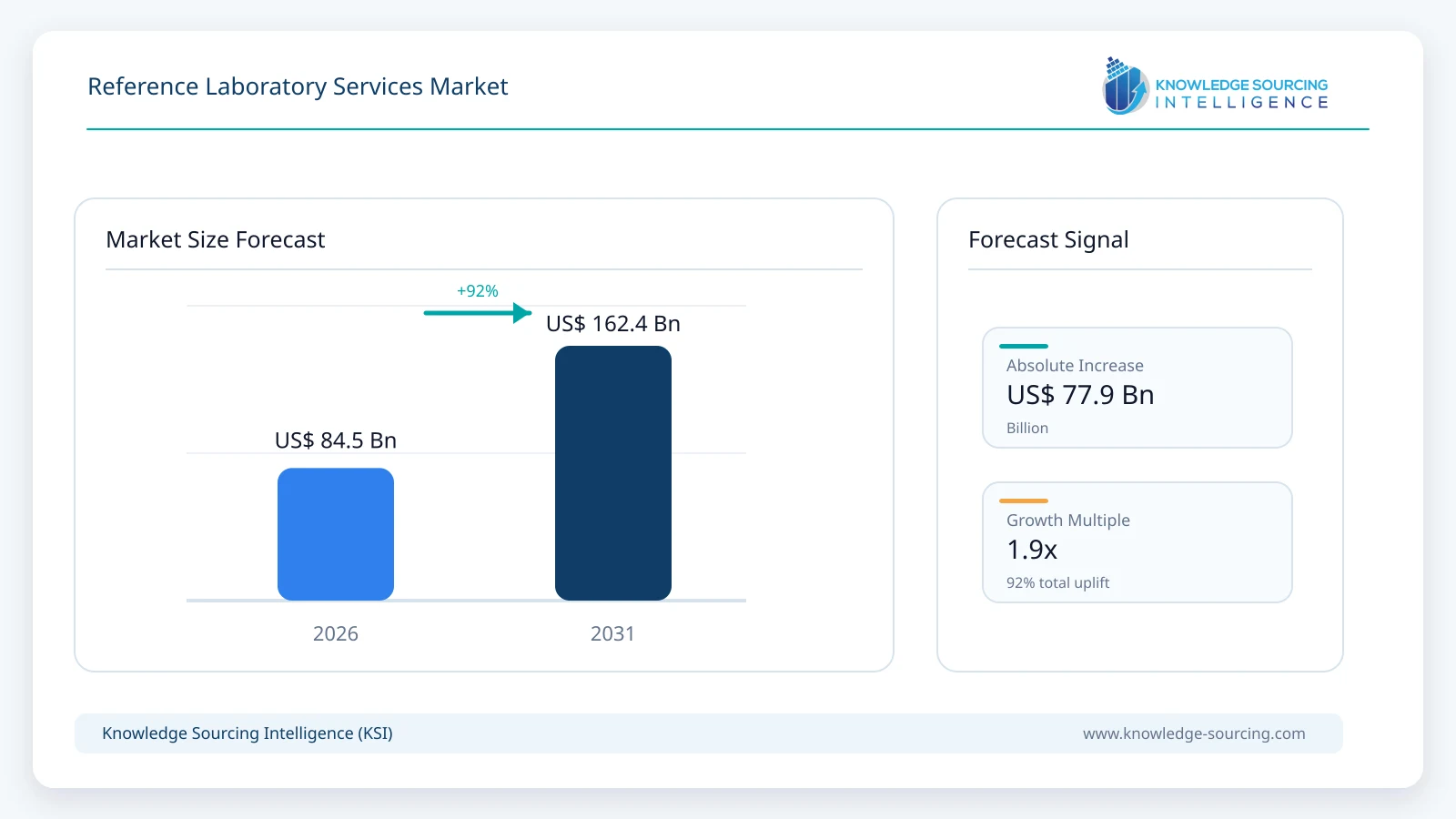
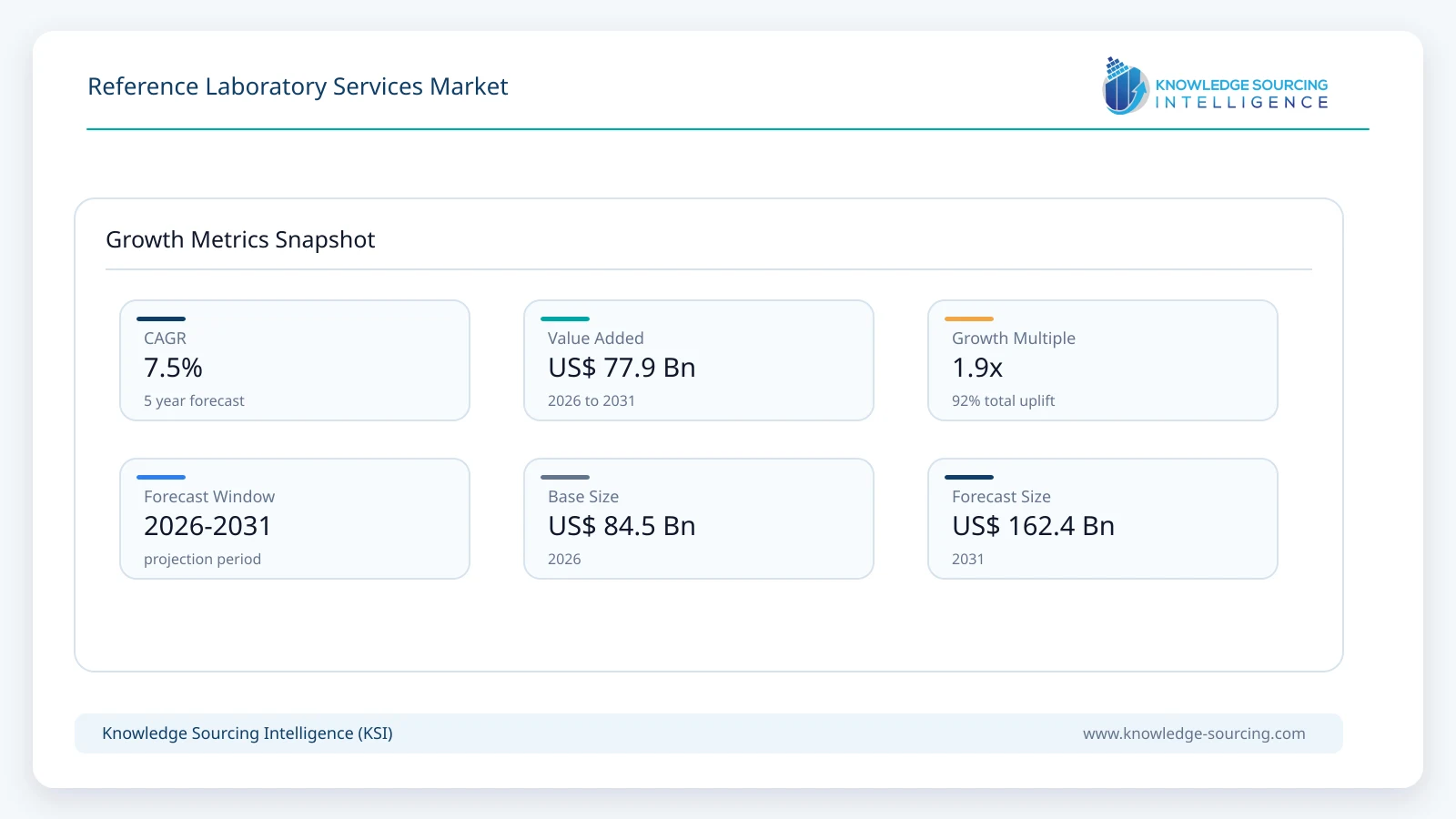
The Reference Laboratory Services Market is forecast to grow at a CAGR of 7.5%, reaching USD 162.37 billion in 2031 from USD 84.49 billion in 2026.
Highlights:
- 1Increasing adoption of precision medicine is driving demand for specialized reference laboratory services because clinicians require advanced molecular and genomic diagnostics to support individualized treatment decisions.
- 2Rising laboratory outsourcing is strengthening demand for centralized testing networks that improve operational efficiency while reducing infrastructure investments for healthcare providers.
- 3Expansion of chronic disease diagnostics is increasing utilization of high-complexity laboratory testing because long-term disease management depends on accurate and timely diagnostic information.
- 4Digital laboratory connectivity is improving collaboration between healthcare providers and reference laboratories by enabling faster test ordering, reporting, and clinical interpretation.
Reference laboratory services encompass routine, specialized, and esoteric diagnostic testing performed by centralized laboratories equipped with advanced analytical technologies, specialized expertise, and accredited quality systems. The market supports healthcare providers that require complex diagnostic capabilities including molecular diagnostics, genetic testing, microbiology, toxicology, pathology, immunology, and clinical chemistry. Growing disease complexity, expanding genomic medicine, and increasing chronic disease management are strengthening dependence on reference laboratories because healthcare institutions require access to specialized diagnostics that are not economically feasible to perform internally. Regulatory agencies continue emphasizing laboratory quality, analytical accuracy, and standardized testing procedures, encouraging healthcare organizations to collaborate with accredited reference laboratories. This structural evolution is improving diagnostic accessibility while supporting evidence-based clinical practice, pharmaceutical innovation, and population health management.
Market Dynamics
Market Drivers
Increasing Adoption of Precision Medicine: Precision medicine depends on highly specialized laboratory testing that supports disease characterization, treatment selection, and patient monitoring. Healthcare providers are increasing utilization of reference laboratories because advanced molecular diagnostics and genomic testing require specialized expertise, sophisticated instrumentation, and validated analytical workflows. Hospital laboratories cannot economically maintain every high-complexity diagnostic capability while patient demand for personalized healthcare continues expanding. Reference laboratory providers are broadening their specialized testing portfolios and bioinformatics capabilities to address evolving clinical requirements. Precision medicine therefore remains a fundamental driver of long-term market growth.
Growing Laboratory Outsourcing by Healthcare Providers: Reference laboratory services improve healthcare efficiency by allowing hospitals and physician practices to outsource complex diagnostic testing while focusing internal resources on routine laboratory operations. Healthcare organizations are expanding outsourcing strategies because financial pressures and workforce shortages are increasing operational constraints across laboratory departments. Maintaining advanced testing platforms internally requires significant capital investment, specialized personnel, and continuous regulatory compliance. Reference laboratories are strengthening nationwide logistics networks, automated laboratories, and digital reporting systems that simplify outsourced diagnostic services. Outsourcing therefore continues to support sustained demand for centralized laboratory service providers.
Rising Burden of Chronic and Complex Diseases: Reference laboratory testing supports diagnosis and long-term monitoring for oncology, cardiovascular diseases, infectious diseases, autoimmune disorders, and rare genetic conditions. Healthcare systems are increasing demand for specialized laboratory services because chronic diseases require repeated diagnostic evaluation using increasingly sophisticated analytical technologies. Conventional routine laboratory testing provides limited diagnostic information for many complex clinical conditions. Service providers are expanding advanced molecular diagnostics, biomarker testing, and personalized medicine capabilities that improve clinical decision-making. Specialized diagnostics therefore continue driving reference laboratory service expansion.
Expansion of Clinical Research and Drug Development: Reference laboratories contribute essential analytical services throughout clinical trials, biomarker development, and pharmaceutical research programs. Pharmaceutical companies and contract research organizations are increasing partnerships with specialized laboratories because global clinical development requires standardized testing, regulatory compliance, and centralized analytical expertise. Fragmented laboratory operations reduce data consistency while increasing study complexity across multinational research programs. Reference laboratory organizations are investing in harmonized laboratory networks, advanced informatics, and global logistics infrastructure that support clinical research efficiency. Research expansion therefore continues strengthening demand for specialized laboratory services.
Market Restraints
High operational costs associated with advanced diagnostic technologies, laboratory accreditation, and highly skilled personnel continue limiting profitability across specialized reference laboratories.
Transportation logistics, specimen stability requirements, and extended turnaround times remain operational challenges for geographically distant healthcare providers.
Stringent regulatory compliance, reimbursement uncertainty, and evolving quality standards continue increasing administrative and operational complexity for laboratory service providers.
Market Opportunities
Expansion of Genomic and Molecular Diagnostic Services: Genomic diagnostics enable earlier disease detection, treatment selection, and precision medicine across multiple therapeutic areas. Healthcare providers are increasing referrals for molecular testing because personalized treatment strategies require comprehensive genetic and biomarker analysis. Conventional laboratory testing provides limited molecular information for complex disease management. Reference laboratories are expanding next-generation sequencing, companion diagnostics, and genomic interpretation services that support personalized healthcare. Advanced molecular diagnostics therefore represent a significant opportunity for future market growth.
Increasing Integration of Digital Laboratory Networks: Digital connectivity enables seamless communication between healthcare providers, electronic health records, and centralized laboratory systems. Healthcare organizations are adopting integrated digital laboratory platforms because faster electronic ordering and reporting improve diagnostic efficiency and patient management. Manual communication processes reduce operational productivity while increasing administrative workload. Reference laboratory providers are strengthening laboratory information systems, application programming interfaces (APIs), and cloud-enabled reporting platforms that improve service integration. Digital transformation therefore continues expanding market opportunities.
Growth of Preventive Healthcare and Population Screening: Preventive healthcare depends on early diagnostic testing that identifies disease before clinical symptoms become severe. Governments and healthcare organizations are expanding population screening initiatives because early diagnosis reduces long-term healthcare costs and improves patient outcomes. Traditional healthcare models emphasize treatment after disease progression rather than early intervention. Reference laboratories are expanding high-volume screening services, automated laboratory platforms, and standardized quality systems that support large-scale preventive testing. Preventive diagnostics therefore create sustained demand for reference laboratory services.
Rising Demand for International Laboratory Partnerships: Global healthcare networks require standardized laboratory services capable of supporting multinational clinical care and research activities. Healthcare organizations are establishing cross-border laboratory collaborations because international clinical trials, pharmaceutical development, and specialized diagnostics require harmonized laboratory standards. Independent laboratory operations limit scalability while reducing consistency across international healthcare networks. Reference laboratory providers are expanding global laboratory partnerships, regional testing hubs, and standardized quality management systems that improve international diagnostic services. International collaboration therefore supports long-term market expansion.
Supply Chain Analysis
The reference laboratory services supply chain begins with manufacturers of analytical instruments, diagnostic reagents, consumables, specimen collection products, molecular testing kits, laboratory automation systems, and laboratory information software that provide the technological foundation for specialized diagnostic testing. These suppliers continue advancing analytical performance because healthcare providers increasingly require highly sensitive, accurate, and standardized diagnostic results across diverse clinical applications. Instrument manufacturers also collaborate with software developers and logistics providers to strengthen laboratory connectivity and specimen traceability throughout the diagnostic process.
Specimen collection centers, hospitals, physician offices, independent laboratories, pharmacies, and outpatient healthcare facilities collect patient samples before transferring them through specialized transportation networks to centralized reference laboratories. Logistics providers maintain temperature-controlled transportation and specimen integrity because diagnostic accuracy depends on appropriate handling throughout the testing process. Reference laboratories perform analytical testing, quality assurance, clinical interpretation, and electronic reporting before securely transmitting validated results to healthcare providers. Pharmaceutical companies, contract research organizations, public health agencies, academic institutions, and healthcare systems utilize these services to support clinical diagnosis, drug development, epidemiological surveillance, and scientific research, creating an integrated diagnostic ecosystem that continues strengthening demand for advanced reference laboratory services.
Government Regulations
Region | Regulatory Authority | Regulatory Focus |
United States | U.S. Food and Drug Administration (FDA) | Regulation of in vitro diagnostic devices and laboratory-developed testing oversight where applicable |
United States | Centers for Medicare & Medicaid Services (CMS), Clinical Laboratory Improvement Amendments (CLIA) | Laboratory certification, personnel qualifications, quality assurance, and testing standards |
International | International Organization for Standardization (ISO) | ISO 15189 requirements for quality and competence in medical laboratories |
International | College of American Pathologists (CAP) | Laboratory accreditation, quality management, proficiency testing, and continuous quality improvement |
Market Segmentation
By Service Type
Clinical chemistry testing represents one of the largest service segments because healthcare providers rely on biochemical analysis for disease diagnosis, treatment monitoring, preventive screening, and routine health assessments. Hospitals and physician practices are increasingly outsourcing high-volume chemistry testing as centralized reference laboratories continue improving automation, throughput, and analytical consistency. Maintaining extensive chemistry platforms within every healthcare facility increases operating costs while creating equipment utilization challenges for lower-volume institutions. Reference laboratories are expanding automated analyzers, integrated quality systems, and digital reporting capabilities that improve turnaround time and testing accuracy. Centralized clinical chemistry services therefore remain fundamental to laboratory outsourcing strategies.
By Test Type
Routine testing includes frequently requested diagnostic analyses that support preventive care, chronic disease monitoring, and general clinical assessment. Healthcare providers are increasingly outsourcing selected routine tests because centralized laboratories continue improving processing efficiency through automation and high-volume analytical platforms. Maintaining excess internal laboratory capacity increases operational costs while reducing overall resource utilization. Reference laboratories are optimizing logistics networks, automated sample handling, and integrated reporting systems that improve turnaround time and testing consistency. Efficient routine testing therefore strengthens laboratory network performance while supporting cost-effective healthcare delivery.
By End-User
Hospitals represent the largest end-user segment because they require continuous access to specialized diagnostic services supporting emergency care, inpatient treatment, oncology, infectious diseases, and chronic disease management. Healthcare systems are expanding partnerships with reference laboratories because rising diagnostic complexity exceeds the capabilities of many hospital-based laboratories. Building comprehensive specialty testing facilities requires significant capital investment while maintaining regulatory compliance increases operational costs. Reference laboratory providers are strengthening logistics, electronic reporting, and integrated laboratory connectivity that improve collaboration with hospital networks. Hospital outsourcing therefore continues driving sustained demand for reference laboratory services.
Regional Analysis
North America
North America dominates the reference laboratory services market because advanced healthcare infrastructure, widespread laboratory outsourcing, and strong adoption of precision medicine continue driving demand for specialized diagnostic testing. The United States is increasing utilization of centralized laboratory services as hospitals, physician groups, and integrated delivery networks seek cost-efficient access to complex molecular diagnostics, genetic testing, and esoteric laboratory services. Canada is strengthening laboratory modernization initiatives and expanding regional diagnostic networks to improve access to specialized testing while maintaining standardized quality. Increasing chronic disease prevalence, growing oncology testing volumes, expanding genomic medicine, and continued investment in laboratory automation are reinforcing demand for high-capacity reference laboratories. Established reimbursement systems, strong regulatory oversight, and the presence of leading laboratory service providers continue positioning North America as the largest regional market for reference laboratory services.
Europe
Europe maintains a significant market share because healthcare systems increasingly rely on centralized laboratory networks to improve diagnostic quality, operational efficiency, and regulatory compliance. Countries including Germany, the United Kingdom, France, Italy, Spain, and the Netherlands are expanding laboratory consolidation strategies as healthcare organizations seek to optimize testing capacity and reduce operational costs. Growing demand for molecular diagnostics, cancer screening, rare disease testing, and personalized medicine is encouraging greater utilization of specialized reference laboratories. Compliance with the European Union's In Vitro Diagnostic Regulation (IVDR), together with accreditation standards such as ISO 15189, is accelerating investment in quality management, digital laboratory connectivity, and standardized testing workflows. Continued expansion of cross-border research collaborations and pharmaceutical clinical trials is supporting sustained demand for advanced reference laboratory services across Europe.
Asia Pacific
Asia Pacific is becoming the fastest-growing regional market for reference laboratory services because healthcare systems are expanding access to advanced diagnostics while governments continue investing in laboratory infrastructure and precision medicine. China is increasing utilization of centralized reference laboratories as genomic medicine, oncology diagnostics, and infectious disease surveillance require sophisticated analytical capabilities beyond routine hospital laboratories. India is strengthening laboratory outsourcing because expanding healthcare coverage, rising chronic disease burden, and rapid growth of private diagnostic networks are increasing demand for specialized testing services. Japan and South Korea are integrating automation, molecular diagnostics, and artificial intelligence into reference laboratory operations as aging populations and personalized healthcare continue raising demand for complex diagnostic interpretation. Australia is expanding accredited laboratory networks to improve nationwide access to specialized pathology and genomic testing. Regional laboratory providers are investing in digital laboratory connectivity, automated sample processing, and high-throughput analytical platforms because increasing specimen volumes require faster turnaround times without compromising quality. International laboratory organizations are establishing partnerships, regional testing hubs, and technology collaborations that improve access to advanced diagnostics while supporting harmonized laboratory standards. Continuous healthcare modernization, pharmaceutical innovation, and increasing adoption of precision medicine are strengthening long-term demand for reference laboratory services throughout Asia Pacific.
Rest of the World
The Rest of the World, including Latin America, the Middle East, and Africa, represents an emerging growth market where improving healthcare infrastructure and expanding diagnostic capabilities are increasing demand for specialized laboratory services. Healthcare providers are strengthening partnerships with centralized reference laboratories because advanced molecular diagnostics and specialized pathology services remain unavailable in many local healthcare facilities. Brazil is expanding laboratory outsourcing through investments in oncology diagnostics, infectious disease testing, and private healthcare networks. Gulf Cooperation Council (GCC) countries are modernizing healthcare systems and establishing regional centers of excellence that require internationally accredited laboratory partners capable of supporting complex diagnostic testing. South Africa is strengthening laboratory capacity through investments in public health diagnostics, clinical pathology, and disease surveillance programs. Budget limitations, fragmented transportation infrastructure, and shortages of highly specialized laboratory professionals continue slowing market expansion across several developing regions. Reference laboratory providers are responding through regional laboratory hubs, digital reporting platforms, and scalable logistics networks that improve accessibility while maintaining analytical quality. Continued healthcare investment and increasing awareness of early disease diagnosis are expected to support steady growth across these developing markets.
Regulatory Landscape
The reference laboratory services market is highly competitive, with differentiation based on specialized testing capabilities, geographic laboratory networks, logistics infrastructure, accreditation standards, digital connectivity, and turnaround time. Leading providers are expanding comprehensive service portfolios that include routine diagnostics, molecular testing, genomic sequencing, pathology, toxicology, and esoteric laboratory services because healthcare providers increasingly prefer single partners capable of supporting diverse diagnostic requirements. Broad testing capabilities improve operational efficiency while reducing complexity for hospitals, physician practices, and research organizations.
Strategic competition is increasingly centered on laboratory automation, artificial intelligence, digital pathology, laboratory information systems, and integrated specimen logistics. Providers continue investing in regional laboratory expansion, advanced analytical technologies, and electronic healthcare integration because faster and more accurate diagnostic reporting strengthens customer retention and clinical value. Partnerships with pharmaceutical companies, biotechnology firms, contract research organizations, and academic institutions are expanding access to companion diagnostics, biomarker testing, and precision medicine services that support long-term business growth.
Competitive leadership is increasingly depending on the ability to combine global laboratory infrastructure, accredited quality systems, advanced molecular diagnostics, scalable logistics, and digital laboratory connectivity within unified service networks. Organizations that continue investing in automation, precision diagnostics, genomic technologies, cybersecurity, and clinical decision support are expected to strengthen their market positions as healthcare systems increasingly rely on specialized reference laboratories to manage rising diagnostic complexity and expanding demand for personalized medicine.
Competitive Landscape
Labcorp Holdings Inc.
Labcorp Holdings Inc. is strategically distinct because it operates one of the world's largest integrated reference laboratory networks, combining routine diagnostics, specialty testing, central laboratory services, and drug development support within a unified healthcare ecosystem. Healthcare providers are increasing reliance on Labcorp because expanding precision medicine, oncology diagnostics, and genomic testing require nationwide laboratory capacity supported by standardized quality systems. Maintaining comprehensive specialty testing internally increases operational costs while limiting access to advanced diagnostics for smaller healthcare organizations. Labcorp is expanding automation, digital laboratory connectivity, molecular diagnostics, and companion diagnostic capabilities that improve turnaround time and clinical decision-making. Its extensive specimen logistics network, broad payer relationships, and strong presence across clinical care, pharmaceutical research, and population health position the company as a global leader in reference laboratory services.
Quest Diagnostics Incorporated
Quest Diagnostics differentiates itself through its nationwide diagnostic network, extensive test portfolio, and strong integration with hospitals, physician practices, employers, and health plans. Healthcare organizations are increasing collaboration with Quest because growing demand for specialized diagnostics requires scalable laboratory infrastructure and advanced analytical capabilities. Expanding test complexity places pressure on local laboratories while increasing the need for standardized quality and rapid reporting. Quest is strengthening molecular diagnostics, hereditary disease testing, oncology services, digital health solutions, and artificial intelligence-enabled laboratory operations that improve analytical efficiency and patient access. Its broad geographic coverage, advanced logistics network, and continued investment in precision diagnostics reinforce its leadership position within the reference laboratory services market.
Sonic Healthcare Limited
Sonic Healthcare Limited is strategically distinguished by its decentralized international laboratory network supported by standardized quality management and medical leadership. Healthcare systems are expanding partnerships with Sonic because demand for high-quality pathology, clinical laboratory services, and specialized diagnostics continues increasing across multiple countries. Independent laboratory operations reduce efficiency while limiting access to advanced testing technologies and expert clinical consultation. Sonic is investing in laboratory automation, digital pathology, molecular diagnostics, and integrated laboratory information systems that strengthen operational performance and diagnostic accuracy. Its diversified international presence across Europe, North America, and Australia supports long-term resilience and competitive strength.
Eurofins Scientific SE
Eurofins Scientific SE differentiates itself through one of the broadest global laboratory service portfolios covering clinical diagnostics, life sciences, environmental testing, food safety, and pharmaceutical analysis. Healthcare providers and research organizations are increasing utilization of Eurofins because expanding molecular diagnostics and specialized laboratory services require internationally standardized analytical expertise. Fragmented laboratory services reduce consistency while increasing complexity for multinational healthcare and research programs. Eurofins is expanding specialty diagnostic laboratories, genomic testing, automation, and digital laboratory infrastructure that improve analytical quality and operational scalability. Its extensive acquisition strategy and global laboratory footprint continue strengthening its competitive advantage.
SYNLAB International GmbH
SYNLAB International GmbH maintains strategic differentiation through its extensive European diagnostic laboratory network supported by integrated pathology, clinical chemistry, molecular diagnostics, and preventive healthcare services. Healthcare providers are increasing referrals because expanding chronic disease management and preventive screening require accessible specialized diagnostics delivered through accredited laboratory systems. Decentralized healthcare environments increase operational variation while creating demand for harmonized laboratory quality standards. SYNLAB is strengthening automation, digital connectivity, personalized medicine services, and advanced laboratory analytics that improve efficiency across regional laboratory networks. Its established presence throughout Europe positions the company as a leading provider of integrated reference laboratory services.
ARUP Laboratories
ARUP Laboratories is strategically distinct because it operates as a nationally recognized academic reference laboratory closely affiliated with the University of Utah, emphasizing highly specialized diagnostics, medical consultation, and translational research. Hospitals and healthcare organizations are increasing referrals to ARUP because rare diseases, complex pathology, and advanced molecular diagnostics require scientific expertise beyond routine clinical laboratory capabilities. Expanding precision medicine continues increasing demand for sophisticated laboratory interpretation while strengthening the need for multidisciplinary collaboration. ARUP is advancing genomic testing, proteomics, bioinformatics, and laboratory innovation that improve diagnostic precision and clinical outcomes. Its strong academic foundation and commitment to scientific advancement reinforce its position within the specialized reference laboratory market.
Mayo Clinic Laboratories
Mayo Clinic Laboratories differentiates itself through its integration with one of the world's leading academic medical centers, enabling access to subspecialty expertise, advanced clinical consultation, and highly complex esoteric testing services. Healthcare providers are increasing collaboration with Mayo Clinic Laboratories because complex diseases require multidisciplinary diagnostic interpretation supported by physician-scientists and cutting-edge laboratory technologies. Rare disorders and personalized medicine create analytical challenges that conventional laboratory services cannot consistently address. The organization is expanding precision diagnostics, genomic sequencing, digital pathology, and global laboratory collaborations that strengthen clinical decision support. Its reputation for medical excellence and innovation continues positioning it among the most respected reference laboratory providers worldwide.
NeoGenomics, Inc.
NeoGenomics, Inc. is strategically distinguished through its exclusive focus on oncology diagnostics, molecular pathology, cytogenetics, flow cytometry, and companion diagnostic development. Oncology providers are increasing utilization of NeoGenomics because personalized cancer treatment increasingly depends on highly specialized biomarker analysis and genomic profiling. Rapid advances in targeted therapies require continuous expansion of laboratory capabilities while demanding close collaboration between diagnostic providers and pharmaceutical companies. NeoGenomics is investing in next-generation sequencing, liquid biopsy technologies, artificial intelligence, and pharmaceutical services that improve cancer diagnosis and therapeutic decision-making. Its dedicated oncology expertise and strong partnerships across the life sciences industry position the company as a leading specialist in cancer-focused reference laboratory services.
Strategic Insights and Future Market Outlook
Reference laboratory services are becoming increasingly central to modern healthcare because diagnostic complexity continues expanding across oncology, infectious diseases, rare disorders, and precision medicine. Healthcare providers are increasing reliance on centralized laboratory networks as advanced molecular diagnostics, genomic sequencing, and specialized pathology require sophisticated infrastructure that is difficult to replicate within individual hospitals. This transition is strengthening the role of reference laboratories as strategic partners that improve diagnostic accuracy, operational efficiency, and clinical decision-making.
Artificial intelligence, laboratory automation, digital pathology, cloud-based laboratory information systems, and advanced bioinformatics are transforming reference laboratory operations by improving analytical throughput, reducing manual intervention, and enhancing interpretation of complex diagnostic data. Service providers are integrating these technologies because healthcare organizations increasingly demand faster turnaround times, standardized quality, and seamless interoperability with electronic health records and clinical workflows. These digital capabilities are expected to become key competitive differentiators as testing complexity continues to increase.
Global expansion of precision medicine, decentralized clinical trials, companion diagnostics, and population health initiatives is expected to sustain long-term demand for specialized laboratory services. Organizations that combine extensive laboratory infrastructure, accredited quality systems, advanced molecular capabilities, efficient logistics, and strong digital connectivity are likely to strengthen their competitive positions as healthcare systems continue shifting toward data-driven and personalized diagnostic models.
Reference laboratory services remain an essential component of healthcare delivery because they enable broad access to specialized diagnostics while supporting clinical excellence, pharmaceutical innovation, disease surveillance, and evidence-based treatment. Continued investment in automation, genomic technologies, artificial intelligence, and integrated laboratory ecosystems is expected to strengthen the market's ability to deliver accurate, timely, and scalable diagnostic solutions throughout the forecast period.
Reference Laboratory Services Market Scope:
| Report Metric | Details |
|---|---|
| Total Market Size in 2026 | USD 84.49 billion |
| Total Market Size in 2031 | USD 162.37 billion |
| Forecast Unit | USD Billion |
| Growth Rate | 7.5% |
| Study Period | 2021 to 2031 |
| Historical Data | 2021 to 2024 |
| Base Year | 2025 |
| Forecast Period | 2026 – 2031 |
| Segmentation | Service Type, Test Type, End User, Geography |
| Companies |
|
Market Segmentation
Service Type
Test Type
End User
Geography
- North America
- South America
- Europe
- Middle East and Africa
- Asia Pacific
Table of Contents
1. EXECUTIVE SUMMARY
1.1 Market Snapshot
1.2 Key Findings
1.3 Analyst Insights
1.4 Strategic Recommendations
2. RESEARCH METHODOLOGY
2.1 Research Design
2.2 Data Collection Methodology
2.3 Market Size Estimation
2.4 Forecasting Model
2.5 Assumptions & Limitations
3. REFERENCE LABORATORY SERVICES MARKET OVERVIEW, SIZE & FORECAST
3.1 Market Definition & Scope
3.2 Industry Overview
3.3 Industry Evolution
3.4 Key Market Trends
3.5 Historical Market Analysis (2021–2025)
3.6 Market Forecast (2026–2035)
3.7 Reference Laboratory Service Workflow Analysis
3.8 Laboratory Outsourcing Trends
3.9 Test Volume & Service Mix Analysis
3.10 Digital Laboratory Network & Connectivity Analysis
3.11 Laboratory Automation & Operational Efficiency Analysis
4. MARKET DYNAMICS
4.1 Market Drivers
4.2 Market Restraints
4.3 Market Opportunities
4.4 Market Challenges
5. INDUSTRY LANDSCAPE
5.1 Industry Value Chain Analysis
5.2 Pricing Analysis
5.3 Laboratory Service Ecosystem Analysis
5.4 Reimbursement & Payer Landscape Analysis
6. INNOVATION LANDSCAPE
6.1 Emerging Technologies
6.2 Automation in Reference Laboratories
6.3 Artificial Intelligence in Laboratory Diagnostics
6.4 Digital Pathology & Remote Testing Integration
6.5 Laboratory Information Systems (LIS) & Connectivity Solutions
6.6 Advanced Molecular & Genomic Testing Innovations
7. REGULATORY LANDSCAPE
7.1 Regulatory Framework
7.2 Laboratory Accreditation Standards
7.3 Quality Assurance & Compliance Requirements
8. REFERENCE LABORATORY SERVICES MARKET LANDSCAPE ANALYSIS
8.1 Analysis by Service Type
8.2 Analysis by Test Type
8.3 Analysis by End User
9. REFERENCE LABORATORY SERVICES MARKET SEGMENT ANALYSIS (2021–2035)
9.1 By Service Type
9.1.1 Clinical Chemistry Testing
9.1.2 Microbiology Testing
9.1.3 Molecular Diagnostics
9.1.4 Genetic Testing
9.1.5 Immunology & Serology Testing
9.1.6 Anatomic Pathology Services
9.1.7 Toxicology Testing
9.1.8 Histopathology Services
9.2 By Test Type
9.2.1 Routine Testing
9.2.2 Specialized Testing
9.2.3 Esoteric Testing
9.3 By End User
9.3.1 Hospitals
9.3.2 Independent Clinical Laboratories
9.3.3 Physician Offices & Clinics
9.3.4 Academic & Research Institutions
9.3.5 Pharmaceutical & Biotechnology Companies
9.3.6 Contract Research Organizations (CROs)
10. REFERENCE LABORATORY SERVICES MARKET GEOGRAPHICAL ANALYSIS (2021–2035)
10.1 North America
10.2 Europe
10.3 Asia-Pacific
10.4 South America
10.5 Middle East & Africa
11. REFERENCE LABORATORY SERVICES MARKET COUNTRY ANALYSIS (2021–2035)
11.1 United States
11.2 Canada
11.3 Germany
11.4 United Kingdom
11.5 France
11.6 Italy
11.7 Spain
11.8 Netherlands
11.9 Switzerland
11.10 China
11.11 Japan
11.12 India
11.13 South Korea
11.14 Australia
11.15 Brazil
11.16 Saudi Arabia
11.17 South Africa
12. COMPETITIVE LANDSCAPE
12.1 Market Share Analysis
12.2 Strategic Developments
12.3 Mergers & Acquisitions, Partnerships & Collaborations
12.4 Service Expansions & New Test Launches
13. COMPANY PROFILES
13.1 Labcorp Holdings Inc.
13.2 Quest Diagnostics Incorporated
13.3 Sonic Healthcare Limited
13.4 Eurofins Scientific SE
13.5 SYNLAB International GmbH
13.6 ARUP Laboratories
13.7 Mayo Clinic Laboratories
13.8 Unilabs AB
13.9 BioReference Health, LLC
13.10 Cerba HealthCare
13.11 ACM Global Laboratories
13.12 BGI Genomics Co., Ltd.
13.13 Exact Sciences Corporation
13.14 NeoGenomics, Inc.
13.15 Fulgent Genetics, Inc.
14. REFERENCE LABORATORY SERVICES MARKET COMMERCIAL FORECAST ANALYSIS
14.1 Clinical Chemistry Services
14.2 Molecular Diagnostics Services
14.3 Genetic & Genomic Testing Services
14.4 Esoteric Laboratory Testing Services
14.5 Digital Pathology & Remote Diagnostic Services
14.6 Laboratory Outsourcing Services
14.7 Integrated Reference Laboratory Networks
15. INVESTMENT & FUNDING ANALYSIS
15.1 Investments in Reference Laboratory Infrastructure
15.2 Government Funding for Diagnostic Services
15.3 Research & Development Investments
16. FUTURE OUTLOOK
16.1 Key Growth Opportunities
16.2 Future Industry Trends
Navigate
Trusted by the world's leading organizations











