
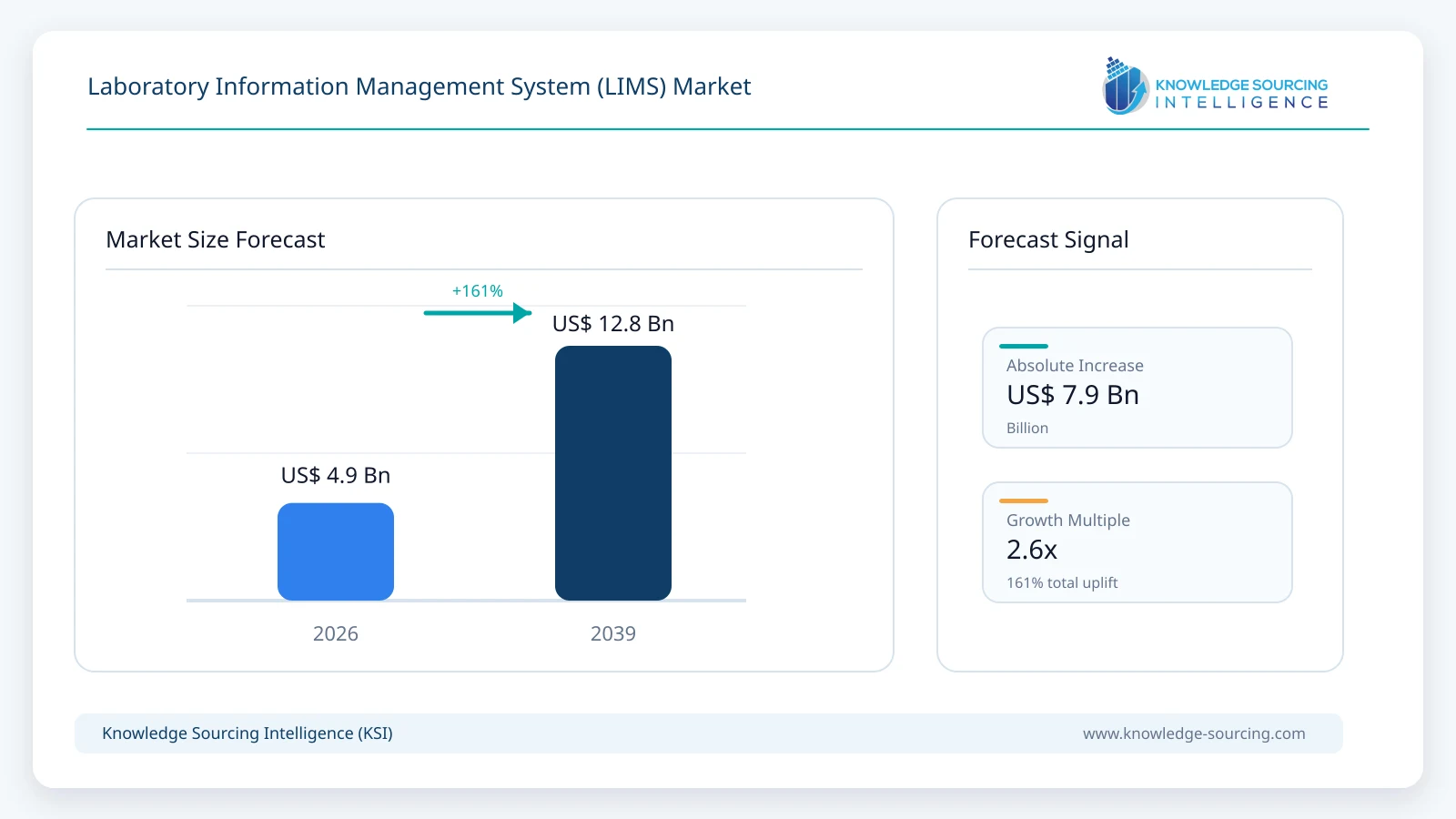
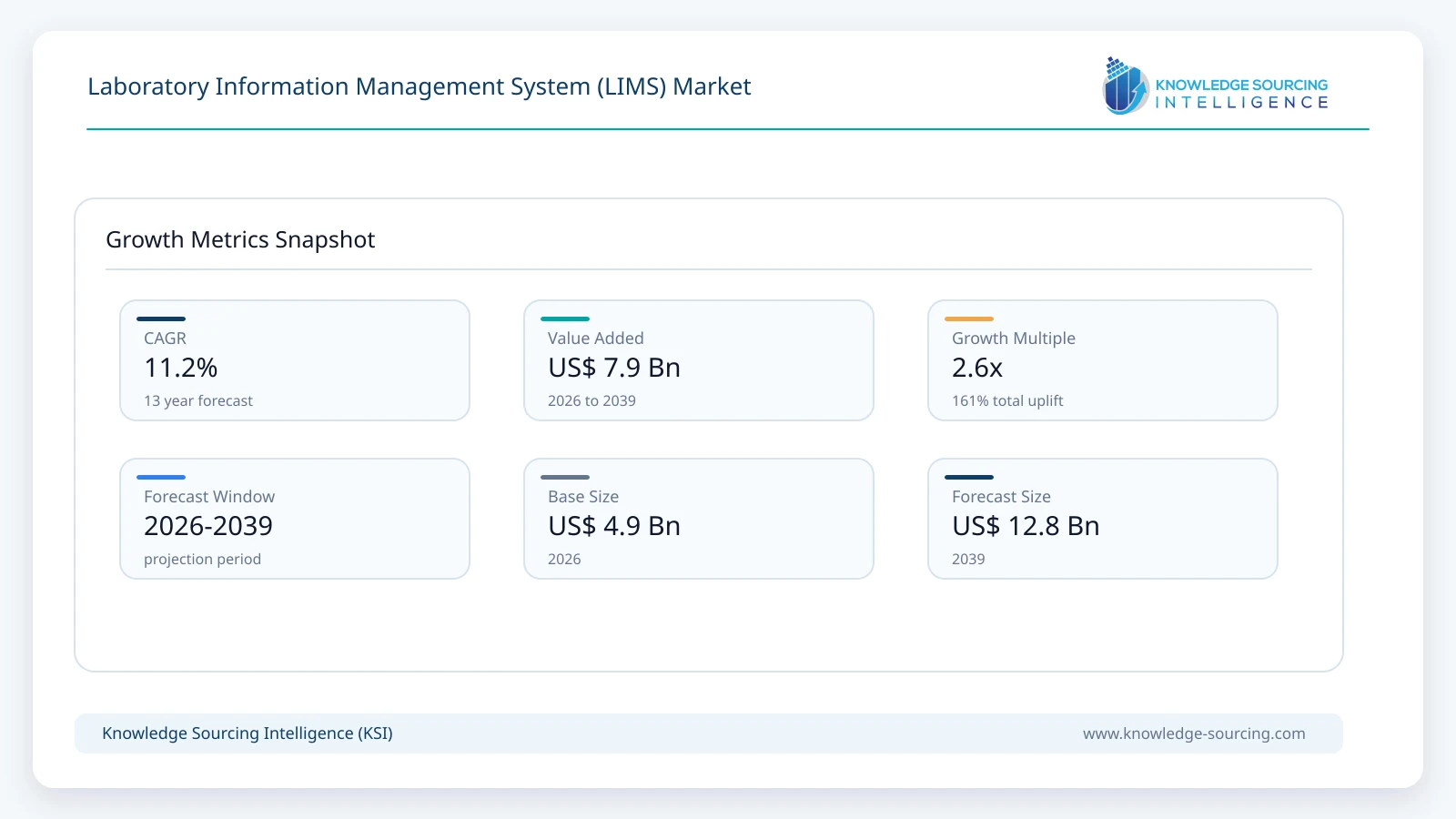
The Laboratory Information Management System (LIMS) Market is forecast to grow at a CAGR of 11.2%, reaching USD 12.81 billion in 2035 from USD 4.91 billion in 2026.
Highlights:
- 1Growing laboratory automation is increasing demand for integrated LIMS platforms because organizations require standardized workflow management and automated data capture.
- 2Expansion of cloud computing is accelerating adoption of cloud-based LIMS solutions, enabling laboratories to improve scalability and reduce infrastructure complexity.
- 3Increasing regulatory scrutiny is driving investment in compliant laboratory software that supports electronic records, audit trails, and validated workflows.
- 4Rising pharmaceutical and biotechnology research activity is strengthening demand for advanced laboratory informatics capable of managing complex analytical data.
A Laboratory Information Management System (LIMS) is software that manages laboratory samples, workflows, analytical data, quality processes, and reporting throughout the testing lifecycle. Modern LIMS platforms integrate laboratory instruments, enterprise resource planning (ERP) systems, electronic laboratory notebooks (ELNs), manufacturing execution systems (MES), and scientific data management platforms to create a unified laboratory environment.
Demand is increasing because laboratories are processing larger sample volumes while facing stricter compliance requirements and greater pressure to improve operational efficiency. Manual documentation creates workflow bottlenecks, increases the likelihood of transcription errors, and complicates regulatory audits. Organizations are replacing paper-based and fragmented digital systems with integrated LIMS platforms that automate sample tracking, data capture, and quality documentation. Regulatory agencies continue emphasizing electronic health records, audit trails, and validated software systems, making laboratory informatics an operational necessity rather than an optional technology investment. This structural transition is reinforcing LIMS as a critical component of laboratory modernization across healthcare, life sciences, environmental testing, and industrial quality assurance.
Market Dynamics
Market Drivers
Growing Laboratory Digitalization: Laboratory digitalization is transforming scientific operations by replacing manual documentation with integrated electronic workflows. Organizations are increasingly implementing LIMS because growing testing volumes require standardized sample tracking and centralized data management. Fragmented laboratory systems reduce operational efficiency and complicate regulatory compliance. Software vendors are expanding interoperable platforms that connect laboratory instruments with enterprise applications. Digital transformation strengthens laboratory productivity while improving data quality and operational consistency.
Increasing Regulatory Compliance Requirements: Laboratories operate within highly regulated environments where data integrity directly affects product quality, patient safety, and regulatory approvals. Regulatory authorities continue strengthening expectations for electronic records, audit trails, and validated computerized systems. Laboratories are upgrading legacy informatics platforms to meet evolving compliance requirements while reducing regulatory risk. LIMS providers are incorporating advanced validation, security, and traceability capabilities into software platforms. Stronger regulatory oversight continues supporting long-term demand for compliant laboratory information management solutions.
Expansion of Pharmaceutical and Biotechnology Research: Drug discovery, biologics development, cell and gene therapy research, and clinical testing require efficient management of large volumes of laboratory data. Research organizations are increasing investment in digital laboratory infrastructure because complex scientific workflows generate extensive analytical information. Manual data management slows research timelines and increases operational costs. LIMS platforms are integrating analytical instruments, bioinformatics tools, and laboratory automation systems to improve research productivity. Growing life sciences research continues expanding demand for advanced laboratory informatics.
Rising Adoption of Cloud-Based Laboratory Informatics: Cloud computing enables laboratories to deploy enterprise software with greater flexibility and lower infrastructure requirements. Organizations are increasingly selecting cloud-based LIMS because distributed laboratory networks require secure remote access and centralized administration. On-premises infrastructure often limits scalability and increases maintenance costs. Software developers are strengthening cybersecurity, data backup, and multi-site collaboration capabilities within cloud environments. Cloud deployment continues expanding as laboratories prioritize operational agility and digital collaboration.
Market Restraints
High implementation and system validation costs continue limiting adoption among small and medium-sized laboratories with constrained technology budgets.
Integration of LIMS with legacy laboratory instruments and enterprise software remains technically complex, increasing deployment time and implementation risk.
Data security, cybersecurity, and privacy concerns continue influencing purchasing decisions, particularly for cloud-based laboratory information systems managing sensitive scientific and patient data.
Market Opportunities
Artificial Intelligence-Enabled Laboratory Management: Artificial intelligence is improving laboratory operations through predictive analytics, intelligent workflow scheduling, and automated quality monitoring. Laboratories are investing in AI-enabled informatics because increasing analytical complexity requires more efficient data interpretation. Software vendors are integrating machine learning capabilities into LIMS platforms to improve operational decision-making. These developments create opportunities for higher-value laboratory informatics solutions.
Expansion of Precision Medicine and Molecular Diagnostics: Precision medicine relies on accurate laboratory data management throughout diagnostic and research workflows. Molecular diagnostics laboratories are increasing adoption of integrated LIMS because genomic testing generates large volumes of complex analytical data. Software providers are developing specialized workflows that support sequencing, molecular pathology, and personalized medicine applications. Expansion of precision healthcare strengthens long-term demand for advanced laboratory informatics.
Growth of Contract Research and Testing Services: Contract research organizations (CROs), contract development and manufacturing organizations (CDMOs), and independent testing laboratories continue expanding global operations. Multi-site laboratory networks require centralized informatics platforms that maintain standardized workflows across geographically distributed facilities. LIMS providers are developing scalable enterprise solutions supporting collaborative research and regulatory compliance. Continued outsourcing of laboratory services creates sustainable growth opportunities for enterprise LIMS vendors.
Integration of Internet of Things (IoT) and Laboratory Automation: Connected laboratory instruments are increasing the need for automated data acquisition and real-time operational monitoring. Laboratories are deploying IoT-enabled infrastructure because manual instrument integration limits workflow efficiency and increases transcription risk. LIMS developers are expanding connectivity with analytical instruments, robotics, and automated sample handling systems. Greater laboratory automation strengthens demand for interoperable informatics platforms capable of supporting digital laboratories.
Supply Chain Analysis
The LIMS supply chain begins with software developers, cloud infrastructure providers, cybersecurity vendors, database technology providers, and laboratory instrument manufacturers that supply the foundational technologies supporting laboratory informatics. These organizations continue enhancing interoperability because laboratories increasingly require seamless communication between analytical instruments and enterprise software. Technology partners also provide application programming interfaces (APIs), middleware, and validation tools that facilitate integration across complex laboratory environments.
Implementation partners, system integrators, and consulting organizations customize LIMS platforms according to laboratory workflows, regulatory requirements, and organizational objectives. Software providers are increasingly delivering cloud-hosted deployment, user training, software validation, and technical support to accelerate implementation while maintaining compliance.
Government Regulations
Region | Regulatory Authority | Regulatory Focus |
United States | U.S. Food and Drug Administration (FDA) | 21 CFR Part 11 requirements for electronic records and electronic signatures used in regulated laboratory environments |
United States | Centers for Medicare & Medicaid Services (CMS) – CLIA | Quality standards and operational requirements for clinical laboratories |
European Union | European Commission | General Data Protection Regulation (GDPR) governing processing and protection of laboratory and patient data |
European Union | European Commission | In Vitro Diagnostic Regulation (IVDR) governing laboratory diagnostics and supporting software where applicable |
Market Segmentation
By Component
Software represents the core component of the LIMS market because it manages sample lifecycle, laboratory workflows, analytical data, reporting, and regulatory documentation through a centralized digital platform. Demand is increasing as laboratories replace disconnected legacy systems with integrated informatics solutions that improve operational efficiency and data integrity. Rising testing complexity requires configurable workflows, real-time dashboards, and seamless integration with analytical instruments and enterprise applications. Vendors are expanding artificial intelligence, cloud connectivity, and advanced analytics within software platforms to support evolving laboratory requirements. This segment continues leading market demand because digital laboratory operations increasingly depend on scalable and interoperable software infrastructure.
By Deployment Mode
Cloud-based deployment is becoming the preferred implementation model because laboratories require scalable infrastructure, remote accessibility, and simplified software maintenance. Organizations are migrating to cloud environments as distributed laboratory networks demand centralized data management and collaborative access across multiple locations. Traditional on-premises infrastructure limits operational flexibility while increasing hardware maintenance requirements. Software vendors are strengthening cybersecurity, automated software updates, and disaster recovery capabilities to address customer concerns regarding cloud adoption. This deployment model continues gaining momentum because laboratories increasingly prioritize operational agility and lower infrastructure ownership costs.
By Laboratory Type
Analytical laboratories depend on LIMS to manage high sample volumes, automate testing workflows, and maintain complete traceability throughout analytical processes. Demand is increasing because laboratories require standardized data management to improve operational efficiency while reducing manual documentation. Automated sample tracking minimizes processing errors and accelerates result reporting under increasing workload conditions. LIMS providers are enhancing instrument integration and workflow automation to support complex analytical operations. This segment continues driving software adoption because analytical accuracy depends on efficient laboratory information management.
Regional Analysis
North America
North America represents the largest regional market for LIMS because pharmaceutical innovation, advanced clinical diagnostics, biotechnology research, and stringent regulatory oversight create sustained demand for laboratory informatics. Laboratories are increasingly replacing legacy systems with cloud-enabled platforms that improve operational efficiency and regulatory compliance. The United States remains the primary growth engine due to extensive pharmaceutical research, contract testing services, and early adoption of laboratory automation technologies. Regulatory requirements under FDA 21 CFR Part 11 and CLIA continue encouraging investment in validated software platforms that maintain electronic records and comprehensive audit trails. Canada is also expanding laboratory digitalization across healthcare and life sciences through investments in precision medicine and research infrastructure. Technology vendors continue strengthening regional partnerships and cloud offerings to support enterprise-scale laboratory modernization. The presence of major LIMS developers, established cloud infrastructure, and mature laboratory networks reinforces North America's leadership in laboratory informatics adoption.
Europe
Europe maintains a strong position within the LIMS market because regulated laboratory environments increasingly depend on digital systems that ensure quality, traceability, and compliance. Pharmaceutical manufacturers, contract research organizations, environmental laboratories, and clinical testing facilities are accelerating digital transformation to improve laboratory productivity and meet evolving regulatory expectations. The implementation of GDPR and IVDR continues influencing software development by emphasizing secure data management and standardized laboratory documentation. Countries including Germany, the United Kingdom, France, Switzerland, and the Netherlands continue investing in advanced laboratory infrastructure supporting life sciences research and precision healthcare. Software vendors are expanding cloud-enabled and interoperable platforms to address growing demand for multi-site laboratory management. Strong regulatory oversight and sustained research investment continue supporting stable regional market growth.
Asia Pacific
Asia Pacific is emerging as the fastest-growing LIMS market because governments, healthcare providers, pharmaceutical manufacturers, and research organizations are expanding laboratory capacity while accelerating digital transformation initiatives. Laboratories are increasingly adopting enterprise informatics platforms as pharmaceutical manufacturing, clinical diagnostics, genomic research, and environmental testing continue expanding across the region. China is investing heavily in biotechnology innovation and laboratory automation to strengthen domestic life sciences capabilities. India is modernizing pharmaceutical quality laboratories and contract research infrastructure to support growing global outsourcing demand. Japan and South Korea continue integrating advanced laboratory automation with digital informatics because aging laboratory infrastructure requires modernization while precision medicine programs generate increasingly complex analytical data. Australia is strengthening laboratory digitalization across healthcare, environmental monitoring, and academic research through sustained investment in scientific infrastructure. Cloud-based deployments are gaining wider acceptance because organizations seek scalable implementation models without extensive hardware investment. Regional vendors and international software providers are expanding localized implementation services and technical support to address diverse regulatory and operational requirements. Continued investment in biotechnology, diagnostics, food safety, and industrial quality control is reinforcing long-term demand for laboratory information management systems across Asia Pacific.
Rest of the World
The Rest of the World, including Latin America, the Middle East, and Africa, represents an emerging opportunity for the LIMS market as laboratory modernization becomes a strategic priority across healthcare, industrial testing, environmental monitoring, and food safety sectors. Laboratories are increasingly replacing paper-based documentation with digital informatics platforms because regulatory agencies continue strengthening quality management expectations. Brazil is expanding pharmaceutical manufacturing and public health laboratory capabilities, creating greater demand for compliant laboratory software. Gulf Cooperation Council (GCC) countries are investing in healthcare infrastructure, biotechnology research, and national laboratory networks to support economic diversification strategies. South Africa continues strengthening laboratory information systems across clinical diagnostics and infectious disease surveillance. Limited information technology infrastructure, budget constraints, and shortages of specialized implementation expertise continue slowing adoption across several developing markets. Software vendors are responding through cloud-based subscription models, remote implementation services, and modular deployment strategies that reduce upfront investment requirements. Increasing international collaboration and regulatory harmonization continue supporting gradual expansion of laboratory informatics throughout these regions.
Regulatory Landscape
Laboratory Information Management Systems operate within highly regulated laboratory environments where software integrity directly influences analytical quality, regulatory compliance, and patient safety. Regulatory authorities require electronic records, validated software, secure audit trails, controlled user access, and complete data traceability because laboratory information frequently supports product approvals, clinical decisions, and regulatory inspections. Software providers are continuously enhancing validation frameworks and cybersecurity controls to ensure laboratories maintain compliance while adopting increasingly digital workflows.
In the United States, the U.S. Food and Drug Administration (FDA) regulates electronic records under 21 CFR Part 11, while clinical laboratories must comply with the Clinical Laboratory Improvement Amendments (CLIA) administered by the Centers for Medicare & Medicaid Services (CMS). Pharmaceutical laboratories also operate under Good Laboratory Practice (GLP), Good Manufacturing Practice (GMP), and Good Clinical Practice (GCP) requirements established by the FDA and international regulatory authorities. LIMS vendors are incorporating configurable validation tools, electronic signatures, and automated audit trails that simplify compliance within regulated laboratory environments.
Across Europe, the General Data Protection Regulation (GDPR) governs personal data management, while the In Vitro Diagnostic Regulation (IVDR) strengthens requirements for software supporting diagnostic workflows where applicable. International laboratory accreditation standards such as ISO/IEC 17025 for testing laboratories and ISO 15189 for medical laboratories continue influencing laboratory software implementation worldwide. These evolving regulatory frameworks encourage organizations to replace fragmented legacy systems with validated enterprise informatics platforms that improve compliance, operational transparency, and long-term data integrity.
Competitive Landscape
Thermo Fisher Scientific Inc.
Thermo Fisher Scientific Inc. differentiates itself through one of the industry's most comprehensive laboratory informatics portfolios, integrating Laboratory Information Management Systems (LIMS), Scientific Data Management Systems (SDMS), Electronic Laboratory Notebooks (ELNs), and laboratory automation technologies. The company is strengthening its digital laboratory ecosystem because pharmaceutical manufacturers, biotechnology companies, and clinical laboratories increasingly require unified data management platforms that connect laboratory instruments with enterprise applications. Its Thermo Scientific™ SampleManager™ LIMS supports quality control, manufacturing, research, and regulatory compliance across highly regulated industries. The company's extensive portfolio of analytical instruments further enhances integration capabilities, allowing laboratories to streamline workflows through a single technology ecosystem. Continuous investment in cloud deployment, artificial intelligence, and workflow automation strengthens operational efficiency while reducing implementation complexity. Thermo Fisher's global service organization, regulatory expertise, and strong customer relationships position the company as a leading provider of enterprise laboratory informatics solutions for laboratories undergoing digital transformation.
LabVantage Solutions, Inc.
LabVantage Solutions specializes exclusively in laboratory informatics, making it one of the most focused providers within the LIMS industry. The company is expanding cloud-native capabilities because laboratories increasingly require scalable deployment models that reduce infrastructure management while maintaining regulatory compliance. Its integrated platform combines LIMS, ELN, SDMS, laboratory execution, and advanced analytics within a unified architecture supporting pharmaceutical, biotechnology, food, environmental, and clinical laboratories. LabVantage emphasizes configurable workflows that allow laboratories to adapt software to changing scientific and regulatory requirements without extensive redevelopment. The company continues incorporating artificial intelligence and machine learning capabilities that improve laboratory productivity through intelligent workflow automation and data analysis. Its specialization in laboratory informatics enables rapid product innovation while supporting highly regulated laboratory environments across global markets.
STARLIMS Corporation (An Abbott Company)
STARLIMS Corporation leverages Abbott's global healthcare expertise to deliver enterprise laboratory informatics solutions supporting clinical, public health, pharmaceutical, forensic, and manufacturing laboratories. The company is expanding cloud-enabled offerings because laboratories increasingly seek secure digital platforms capable of managing geographically distributed operations. STARLIMS integrates sample management, workflow automation, quality assurance, instrument connectivity, and regulatory documentation within a configurable enterprise environment. The platform supports compliance with global laboratory regulations through comprehensive audit trails, electronic signatures, and validated workflows. Continued investment in advanced analytics, cybersecurity, and interoperability strengthens its ability to support increasingly complex laboratory ecosystems. Abbott's global commercial presence further enhances STARLIMS' competitive position within regulated laboratory markets.
LabWare Inc.
LabWare Inc. remains one of the most established independent LIMS vendors and has built its reputation around highly configurable enterprise laboratory informatics platforms. The company continues enhancing LabWare LIMS and LabWare ELN because laboratories require flexible software capable of supporting diverse scientific workflows across multiple industries. Its solutions integrate laboratory automation, instrument connectivity, workflow management, and quality systems within a single configurable environment. LabWare emphasizes long-term scalability, enabling organizations to standardize laboratory operations across multiple global sites. Continuous software enhancements focus on cloud deployment, advanced analytics, and interoperability with enterprise business applications. Its extensive implementation experience and strong regulatory expertise reinforce the company's leadership in enterprise laboratory information management.
Siemens Healthineers AG
Siemens Healthineers strengthens the LIMS market through its expertise in clinical diagnostics, healthcare information technology, and laboratory automation. The company is expanding digital laboratory capabilities because healthcare providers increasingly require integrated solutions that improve diagnostic efficiency and patient data management. Its laboratory informatics portfolio supports automation, workflow optimization, and connectivity between diagnostic instruments and hospital information systems. Integration with broader healthcare IT infrastructure enables laboratories to improve operational visibility while supporting clinical decision-making. Continued investment in digital health, artificial intelligence, and enterprise diagnostics enhances Siemens Healthineers' strategic position as healthcare laboratories accelerate digital transformation.
Agilent Technologies, Inc.
Agilent Technologies combines analytical instrumentation with laboratory informatics, enabling laboratories to manage analytical workflows through integrated digital platforms. The company is strengthening informatics capabilities because analytical laboratories increasingly require seamless connectivity between laboratory instruments and enterprise software systems. Agilent's OpenLab software ecosystem supports chromatography data management, laboratory compliance, and workflow automation across pharmaceutical, environmental, chemical, and food testing laboratories. Integration between analytical hardware and informatics platforms reduces manual data handling while improving regulatory compliance and operational efficiency. Continued investment in digital laboratory technologies supports Agilent's long-term strategy of providing end-to-end scientific workflow solutions.
Revvity, Inc. (formerly PerkinElmer)
Revvity has expanded its laboratory informatics capabilities by combining advanced diagnostics, life sciences technologies, and laboratory software within a precision health framework. The company continues strengthening digital laboratory solutions because genomic research, newborn screening, and molecular diagnostics require increasingly sophisticated data management. Its informatics platforms support laboratory workflow automation, quality management, and regulatory compliance across clinical and research laboratories. Integration with diagnostic instruments and genomic technologies enables laboratories to manage complex scientific information more efficiently. Revvity's continued investment in precision medicine, diagnostics, and digital health strengthens its competitive position within laboratory informatics.
Dassault Systèmes SE (BIOVIA)
Dassault Systèmes differentiates BIOVIA through its enterprise scientific informatics platform that integrates laboratory management, scientific collaboration, product lifecycle management, and digital research environments. The company is expanding the BIOVIA ONE Lab platform because pharmaceutical, biotechnology, and industrial organizations increasingly require unified digital laboratories connecting research, quality, and manufacturing operations. BIOVIA combines LIMS, ELN, scientific data management, and advanced analytics within an integrated cloud-enabled ecosystem supporting end-to-end laboratory digitalization. The company's expertise in digital twins, simulation technologies, and enterprise collaboration provides additional strategic value for organizations modernizing research and development operations. Continued investment in artificial intelligence and cloud-based scientific informatics reinforces BIOVIA's position as a leading provider of enterprise laboratory digital transformation solutions.
Key Developments
In March 2026, LabVantage Solutions, Inc., a global provider of laboratory informatics solutions and services, today announced the launch of LabVantage CORTEX, a next-generation artificial intelligence (AI), analytics, and automation platform.
Strategic Insights and Future Market Outlook
The LIMS market is becoming increasingly central to laboratory modernization because scientific organizations require integrated digital infrastructure that supports regulatory compliance, operational efficiency, and data-driven decision-making. Laboratories are replacing fragmented legacy applications with enterprise informatics platforms capable of managing sample lifecycle, analytical data, workflow automation, and instrument connectivity within unified environments. This transition strengthens demand for scalable software architectures that support expanding laboratory operations while reducing administrative complexity.
Cloud computing, artificial intelligence, laboratory automation, and interoperability are reshaping competitive dynamics as organizations prioritize flexible deployment models and intelligent workflow optimization. Software providers are investing in configurable cloud-native platforms that simplify implementation while supporting highly regulated laboratory environments. Integration between LIMS, ELNs, SDMS, ERP systems, and analytical instruments is becoming a primary purchasing criterion because laboratories increasingly seek seamless digital ecosystems rather than standalone software applications.
Future market expansion will depend on continued digital transformation across healthcare, pharmaceutical manufacturing, biotechnology research, environmental testing, food safety, and industrial quality control laboratories. Organizations capable of delivering secure, interoperable, AI-enabled laboratory informatics platforms supported by strong implementation expertise and regulatory compliance capabilities are expected to maintain competitive leadership as laboratory operations continue evolving toward intelligent, connected, and highly automated scientific environments.
Laboratory Information Management Systems are evolving from operational record-keeping platforms into strategic digital infrastructure that enables precision science, regulatory excellence, and enterprise-wide laboratory collaboration. Continued investment in cloud technologies, artificial intelligence, and integrated scientific informatics is expected to sustain long-term demand as laboratories increasingly prioritize automation, scalability, and data integrity across the global life sciences ecosystem.
Laboratory Information Management System (LIMS) Market Scope:
| Report Metric | Details |
|---|---|
| Total Market Size in 2026 | USD 4.91 billion |
| Total Market Size in 2035 | USD 12.81 billion |
| Forecast Unit | USD Billion |
| Growth Rate | 11.2% |
| Study Period | 2021 to 2035 |
| Historical Data | 2021 to 2024 |
| Base Year | 2025 |
| Forecast Period | 2026 – 2035 |
| Segmentation | Component, Laboratory Type, End User, Geography |
| Companies |
|
Market Segmentation
Component
Laboratory Type
End User
Geography
- North America
- South America
- Europe
- Middle East and Africa
- Asia Pacific
Table of Contents
1. EXECUTIVE SUMMARY
1.1 Market Snapshot
1.2 Key Findings
1.3 Analyst Insights
1.4 Strategic Recommendations
2. RESEARCH METHODOLOGY
2.1 Research Design
2.2 Data Collection Methodology
2.3 Market Size Estimation
2.4 Forecasting Model
2.5 Assumptions & Limitations
3. LABORATORY INFORMATION MANAGEMENT SYSTEM (LIMS) MARKET OVERVIEW, SIZE & FORECAST
3.1 Market Definition & Scope
3.2 Industry Overview
3.3 Industry Evolution
3.4 Key Market Trends
3.5 Historical Market Size Analysis (2021–2025)
3.6 Market Forecast (2026–2035)
3.7 Laboratory Digital Transformation Landscape
3.8 Laboratory Workflow Analysis
3.9 Laboratory Data Management Trends
3.10 Automation & Digitalization Adoption Analysis
3.11 Laboratory Informatics Ecosystem
4. MARKET DYNAMICS
4.1 Market Drivers
4.2 Market Restraints
4.3 Market Opportunities
4.4 Market Challenges
5. INDUSTRY LANDSCAPE
5.1 Industry Value Chain Analysis
5.2 Pricing Analysis
5.3 Subscription & Licensing Model Analysis
5.4 End-user Purchasing Criteria Analysis
6. INNOVATION LANDSCAPE
6.1 Emerging Technologies
6.2 Product Innovation
6.3 AI Integration in Laboratory Informatics
6.4 Cloud-Based LIMS Evolution
6.5 IoT & Laboratory Automation Integration
6.6 Digital Twin & Predictive Analytics in Laboratory Operations
7. REGULATORY LANDSCAPE
7.1 Regulatory Framework
7.2 Data Integrity & Validation Requirements
7.3 Compliance Requirements (FDA 21 CFR Part 11, GxP, ISO/IEC Standards, GDPR)
8. LABORATORY INFORMATION MANAGEMENT SYSTEM (LIMS) MARKET LANDSCAPE ANALYSIS
8.1 Analysis by Deployment Model
8.2 Analysis by Component
8.3 Analysis by Laboratory Type
8.4 Analysis by Enterprise Size
8.5 Analysis by End-user Industry
9. LABORATORY INFORMATION MANAGEMENT SYSTEM (LIMS) MARKET SEGMENT ANALYSIS (2021–2035)
9.1 By Component
9.1.1 Software
9.1.2 Services
9.2 By Deployment Mode
9.2.1 Cloud-Based
9.2.2 On-Premises
9.2.3 Hybrid
9.3 By Laboratory Type
9.3.1 Analytical Laboratories
9.3.2 Clinical Laboratories
9.3.3 Pharmaceutical & Biotechnology Laboratories
9.3.4 Environmental Testing Laboratories
9.3.5 Food & Beverage Testing Laboratories
9.3.6 Chemical & Petrochemical Laboratories
9.3.7 Forensic Laboratories
9.3.8 Academic & Research Laboratories
9.4 By Enterprise Size
9.4.1 Large Enterprises
9.4.2 Small & Medium Enterprises (SMEs)
9.5 By End-user
9.5.1 Pharmaceutical & Biotechnology Companies
9.5.2 Contract Research Organizations (CROs)
9.5.3 Contract Development & Manufacturing Organizations (CDMOs)
9.5.4 Hospitals & Diagnostic Laboratories
9.5.5 Academic & Research Institutes
9.5.6 Food & Beverage Companies
9.5.7 Environmental Testing Organizations
9.5.8 Chemical & Industrial Laboratories
9.5.9 Government & Public Health Laboratories
10. LABORATORY INFORMATION MANAGEMENT SYSTEM (LIMS) MARKET GEOGRAPHICAL ANALYSIS (2021–2035)
10.1 North America
10.2 Europe
10.3 Asia-Pacific
10.4 South America
10.5 Middle East & Africa
11. LABORATORY INFORMATION MANAGEMENT SYSTEM (LIMS) MARKET COUNTRY ANALYSIS (2021–2035)
11.1 United States
11.2 Canada
11.3 Germany
11.4 United Kingdom
11.5 France
11.6 Italy
11.7 Spain
11.8 Netherlands
11.9 Switzerland
11.10 China
11.11 Japan
11.12 India
11.13 South Korea
11.14 Australia
11.15 Brazil
11.16 Saudi Arabia
11.17 South Africa
12. COMPETITIVE LANDSCAPE
12.1 Market Share Analysis
12.2 Strategic Developments
12.3 Mergers & Acquisitions, Partnerships & Collaborations
12.4 Product Launches & Software Upgrades
13. COMPANY PROFILES
13.1 Thermo Fisher Scientific Inc.
13.2 LabVantage Solutions, Inc.
13.3 STARLIMS Corporation (An Abbott Company)
13.4 LabWare Inc.
13.5 Siemens Healthineers AG
13.6 Agilent Technologies, Inc.
13.7 PerkinElmer Inc. (Revvity)
13.8 Dassault Systèmes SE (BIOVIA)
13.9 Autoscribe Informatics Ltd.
13.10 LabLynx, Inc.
13.11 Benchling, Inc.
13.12 Sapio Sciences LLC
13.13 Accelerated Technology Laboratories (ATL)
13.14 CloudLIMS
13.15 Orchard Software Corporation
14. LABORATORY INFORMATION MANAGEMENT SYSTEM (LIMS) MARKET COMMERCIAL FORECAST ANALYSIS
14.1 Cloud LIMS Platforms
14.2 Enterprise LIMS Solutions
14.3 Clinical Laboratory LIMS
14.4 Pharmaceutical Quality Control LIMS
14.5 Environmental Laboratory LIMS
14.6 Food & Beverage Laboratory LIMS
14.7 Multi-site Laboratory Informatics Platforms
14.8 AI-Enabled LIMS Solutions
15. INVESTMENT & FUNDING ANALYSIS
15.1 Venture Capital Trends
15.2 Government Funding for Laboratory Digitalization
15.3 R&D Investments in Laboratory Informatics
16. FUTURE OUTLOOK
16.1 Key Growth Opportunities
16.2 Future Industry Trends
Navigate
Trusted by the world's leading organizations











