
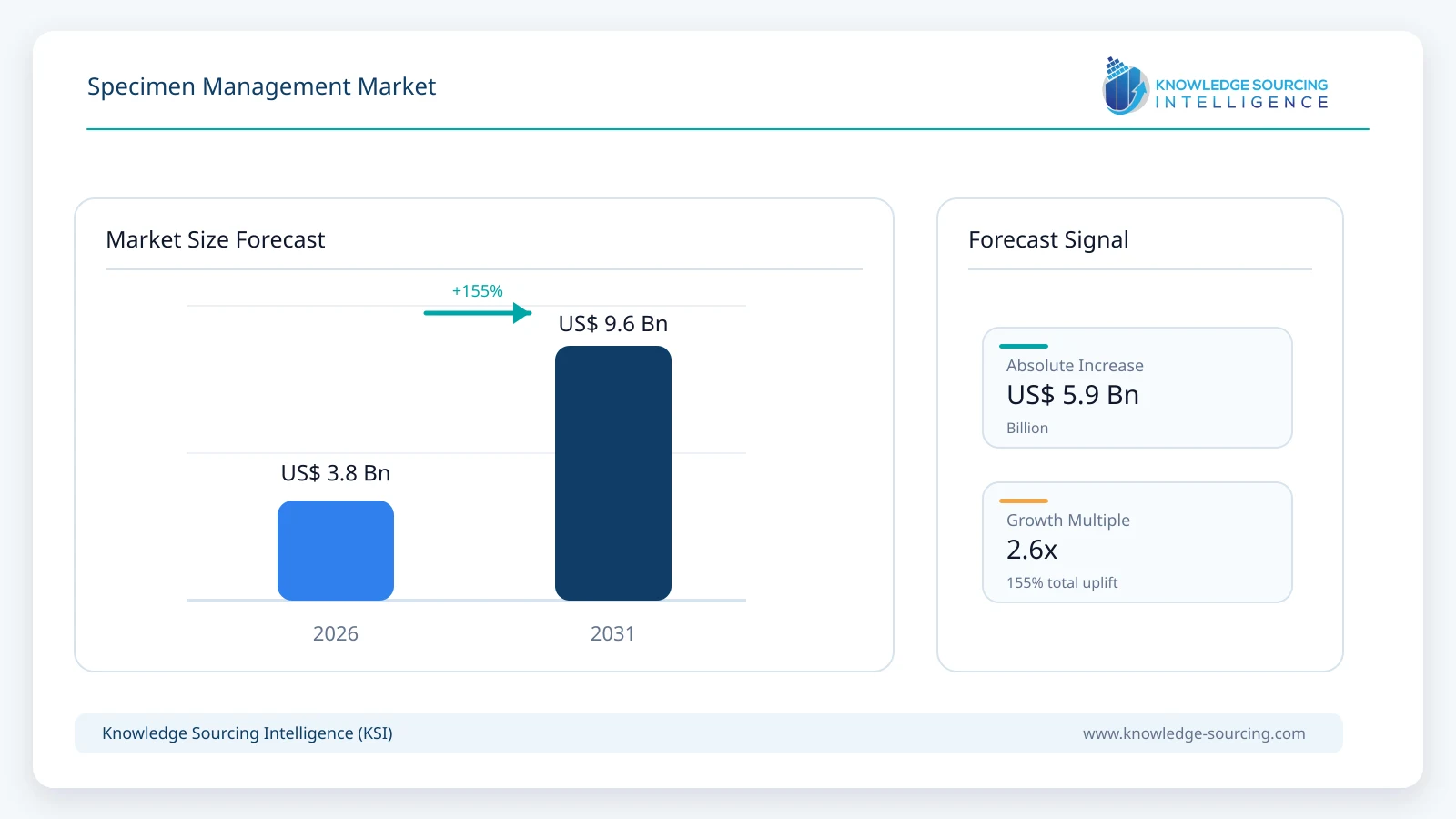
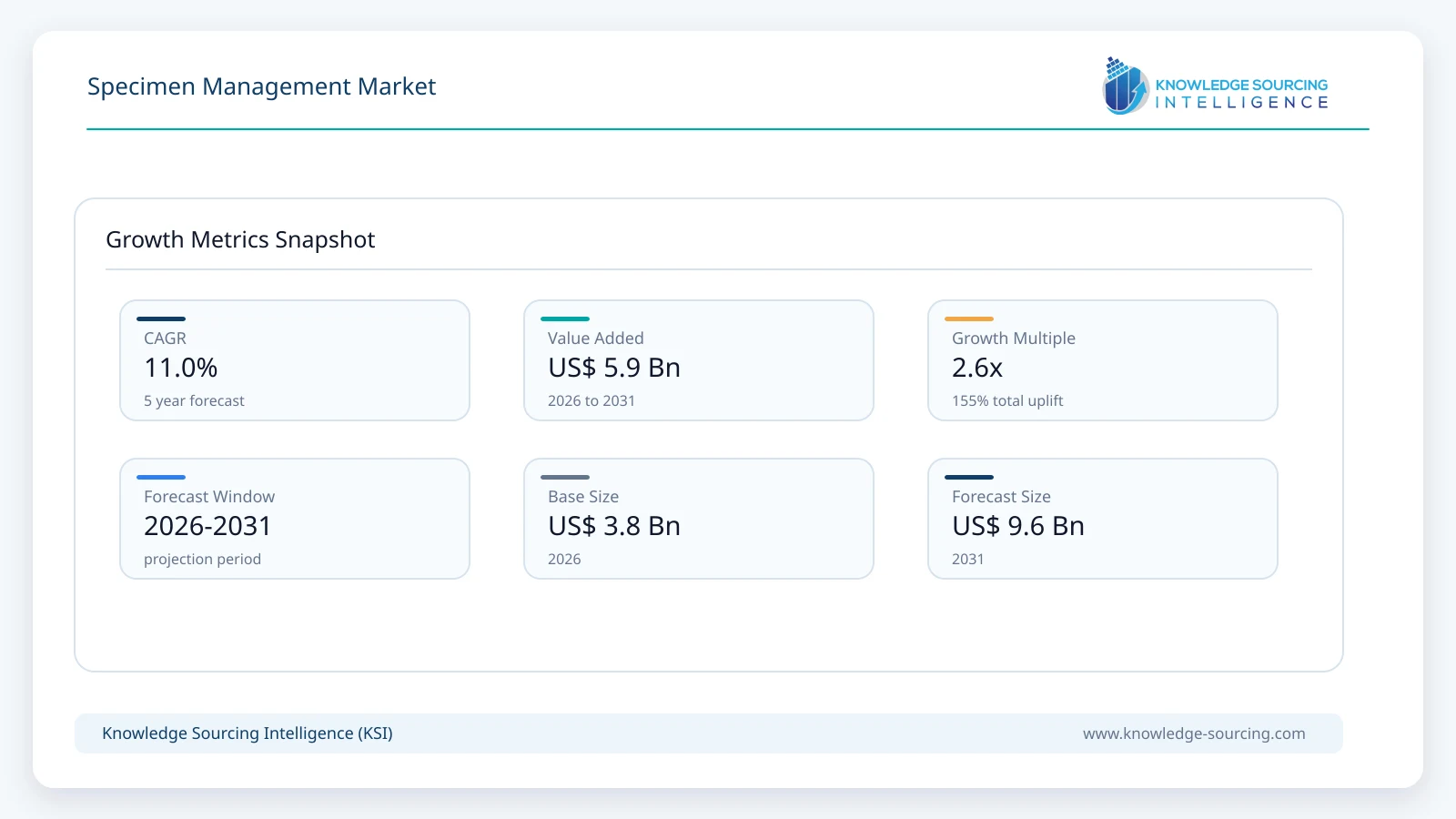
The Specimen Management Market is forecast to grow at a CAGR of 11.0%, reaching USD 9.64 billion in 2031 from USD 3.78 billion in 2026.
Highlights:
- 1Rising adoption of molecular diagnostics is increasing demand for integrated specimen management systems because complex biological samples require standardized handling and complete traceability.
- 2Laboratory automation is accelerating investment in automated storage, retrieval, and tracking technologies, improving operational efficiency while minimizing manual handling errors.
- 3Expansion of biobanking activities is strengthening demand for long-term specimen preservation solutions that maintain sample integrity across research and clinical applications.
- 4Digital laboratory transformation is driving implementation of barcode, RFID, and laboratory information management system (LIMS)-integrated specimen tracking platforms that improve workflow visibility and compliance.
Specimen management encompasses technologies, consumables, software, and services that enable laboratories to collect, label, transport, store, monitor, and retrieve biological samples throughout their lifecycle. The market serves hospitals, diagnostic laboratories, pharmaceutical companies, biotechnology firms, contract research organizations, biobanks, and academic research institutions where specimen quality determines the reliability of downstream analytical results. Increasing molecular diagnostics, genomic testing, and personalized medicine programs are expanding demand for standardized specimen workflows because larger and more complex sample inventories require continuous traceability and controlled storage environments. Regulatory agencies continue emphasizing sample integrity, documentation accuracy, and data traceability, encouraging laboratories to replace manual processes with automated specimen management platforms. This evolution strengthens operational efficiency while supporting reproducible research, regulatory compliance, and high-quality patient care.
Market Dynamics
Market Drivers
Increasing Adoption of Precision Medicine and Molecular Diagnostics: Precision medicine depends on accurate biological specimens that maintain integrity from collection through laboratory analysis. Healthcare providers are expanding genomic testing, companion diagnostics, and molecular pathology services because individualized treatment decisions require reliable biological data. Higher testing complexity increases the need for standardized specimen handling and continuous tracking throughout laboratory workflows. Manufacturers are developing integrated specimen management platforms that combine automated identification, storage, and traceability capabilities. This transition strengthens demand for advanced specimen management solutions across clinical diagnostics and research environments.
Expansion of Biobanking and Clinical Research Activities: Biobanks support biomedical research by preserving biological specimens for long-term scientific investigation. Research organizations are increasing specimen collection because translational medicine, population health studies, and regenerative medicine require extensive biological repositories. Larger specimen inventories create operational pressure on manual storage and retrieval systems while increasing documentation requirements. Technology providers are expanding automated biobank management systems that improve storage efficiency and sample traceability. These developments reinforce sustained demand for advanced specimen management infrastructure.
Growing Laboratory Automation: Laboratory automation improves efficiency by reducing manual intervention across specimen processing workflows. Diagnostic laboratories are implementing robotic handling systems because increasing sample volumes require faster turnaround without compromising quality. Manual specimen handling introduces risks related to misidentification, contamination, and workflow delays. Vendors are integrating automated specimen transport, storage, and tracking technologies with laboratory information systems to streamline operations. Automation strengthens laboratory productivity while improving specimen integrity throughout the testing lifecycle.
Increasing Regulatory Focus on Sample Traceability: Healthcare and research laboratories operate within regulated environments where specimen traceability directly influences quality assurance and patient safety. Regulatory authorities continue strengthening expectations for documented chain of custody, standardized labeling, and validated storage conditions because biological specimens support diagnostic and therapeutic decision-making. Manual documentation limits audit readiness and increases compliance risks. Laboratories are adopting digital specimen management systems that provide electronic records, audit trails, and real-time inventory monitoring. Regulatory compliance therefore remains a significant driver of market expansion.
Market Restraints
High implementation costs associated with automated storage systems, integrated software platforms, and laboratory infrastructure upgrades continue limiting adoption among smaller laboratories.
Integration of specimen management platforms with legacy laboratory information systems and existing analytical equipment remains technically complex, increasing implementation timelines.
Data security, system validation, and compliance requirements continue creating operational challenges for laboratories deploying cloud-based specimen management solutions.
Market Opportunities
Expansion of Automated Biobanking Infrastructure: Biobanking is becoming increasingly important for precision medicine, genomic research, and drug discovery because high-quality biological repositories enable long-term scientific investigations. Research institutions are expanding automated storage facilities to improve specimen preservation while reducing manual handling. Growing repository sizes require intelligent inventory management and environmental monitoring systems that maintain sample quality. Technology providers are introducing robotic storage and automated retrieval solutions supporting scalable biobank operations. These investments create substantial opportunities for specimen management vendors.
Integration of Artificial Intelligence and Digital Tracking: Artificial intelligence improves laboratory workflow optimization by analyzing specimen movement, storage utilization, and operational efficiency. Laboratories are integrating AI-enabled monitoring because expanding sample inventories require predictive inventory management and automated workflow recommendations. Traditional manual oversight limits operational visibility across large laboratory networks. Vendors are incorporating machine learning, barcode analytics, and RFID technologies that strengthen specimen traceability while reducing administrative workload. This evolution is creating opportunities for intelligent specimen lifecycle management platforms.
Growth of Decentralized Clinical Trials: Decentralized clinical trials depend on efficient specimen logistics across geographically dispersed healthcare facilities and participant locations. Pharmaceutical companies are expanding remote trial models because patient-centric research improves enrollment and retention. Distributed specimen collection increases transportation complexity while requiring consistent chain-of-custody documentation. Companies are implementing integrated specimen management platforms that coordinate collection, shipment, tracking, and laboratory receipt through centralized digital systems. This transformation supports continued growth opportunities within clinical research.
Increasing Demand for Cloud-Connected Laboratory Ecosystems: Laboratories increasingly require centralized access to specimen data across multiple facilities and collaborative research networks. Healthcare organizations are adopting cloud-enabled specimen management because distributed laboratory operations require real-time inventory visibility and standardized workflows. Standalone systems reduce collaboration and complicate multi-site specimen management. Vendors are expanding cloud-based platforms that integrate specimen tracking with laboratory information management systems and electronic laboratory notebooks. These capabilities strengthen enterprise-wide specimen management while supporting laboratory digital transformation.
Supply Chain Analysis
The specimen management supply chain begins with manufacturers of collection devices, sample containers, preservation media, barcoding technologies, RFID components, laboratory consumables, and automated storage equipment. Software developers and laboratory informatics providers supply specimen management platforms, laboratory information management systems, and tracking technologies that enable digital lifecycle management. Hardware manufacturers continue enhancing robotics, environmental monitoring systems, and automated retrieval technologies because laboratories require greater efficiency while maintaining specimen integrity. Technology partnerships between equipment manufacturers and software vendors strengthen interoperability across modern laboratory environments.
Distributors, implementation partners, laboratory automation specialists, and system integrators customize specimen management solutions according to clinical, pharmaceutical, and research workflows. These organizations provide installation, software validation, user training, maintenance, and regulatory support to ensure effective deployment within highly regulated laboratory environments.
Government Regulations
Region | Regulatory Authority | Regulatory Focus |
United States | U.S. Food and Drug Administration (FDA) | Good Laboratory Practice (GLP), specimen handling, laboratory quality systems, and electronic records under 21 CFR Part 11 |
United States | Centers for Medicare & Medicaid Services (CMS) – Clinical Laboratory Improvement Amendments (CLIA) | Quality standards for clinical laboratory specimen collection, processing, testing, and documentation |
European Union | European Commission | In Vitro Diagnostic Regulation (IVDR) governing specimen handling within diagnostic workflows where applicable |
International | International Organization for Standardization (ISO) | ISO 15189 for medical laboratories and ISO 20387 for biobanking quality and competence |
Market Segmentation
By Product Type
Specimen collection kits form the foundation of specimen management because the quality of downstream laboratory analysis depends on proper sample collection and preservation. Healthcare providers are increasing adoption of standardized collection kits as molecular diagnostics, infectious disease testing, and genomic analysis continue expanding across clinical settings. Variability in specimen collection increases the risk of contamination, insufficient sample volume, and compromised analytical accuracy. Manufacturers are developing specialized collection devices with improved preservation media, leak-resistant packaging, and user-friendly designs that support diverse diagnostic applications. Standardized specimen collection therefore strengthens laboratory efficiency while improving diagnostic reliability and regulatory compliance.
By Technology
Barcode technology remains the most widely adopted specimen tracking solution because it provides reliable identification while maintaining cost-effective implementation. Laboratories are expanding barcode utilization as diagnostic volumes increase and manual documentation becomes increasingly inefficient. Larger specimen inventories create greater pressure for standardized identification methods that reduce labeling errors. Vendors are enhancing barcode systems with mobile scanning, automated verification, and integration with laboratory information management systems. Barcode tracking therefore continues supporting efficient specimen identification across routine laboratory workflows.
By Application
Clinical diagnostics represents the largest application segment because accurate specimen management directly influences patient diagnosis and treatment decisions. Hospitals and diagnostic laboratories are processing increasing numbers of biological specimens as chronic diseases, infectious diseases, and molecular testing continue expanding. Greater testing complexity requires standardized specimen workflows that minimize handling errors and maintain sample quality. Healthcare providers are implementing automated specimen management technologies that improve turnaround time while supporting regulatory compliance. Efficient specimen management therefore strengthens diagnostic reliability and patient care.
Regional Analysis
North America
North America dominates the specimen management market because advanced healthcare infrastructure, extensive pharmaceutical research, mature biobanking networks, and stringent regulatory oversight create sustained demand for sophisticated specimen lifecycle solutions. The United States is increasing investments in laboratory automation, molecular diagnostics, and precision medicine, driving adoption of automated specimen storage, digital tracking, and integrated laboratory informatics. Canada is strengthening clinical research capabilities and genomic medicine initiatives, supporting broader implementation of standardized specimen management platforms. Continued expansion of biopharmaceutical research, contract research organizations, and clinical diagnostics is reinforcing the region's leadership in specimen management technologies.
Europe
Europe maintains a significant share of the specimen management market because regulated laboratory environments require high standards of specimen quality, traceability, and documentation. Countries including Germany, the United Kingdom, France, Switzerland, and the Netherlands are expanding biobanking programs, clinical research infrastructure, and molecular diagnostic services, increasing demand for automated specimen handling and digital tracking technologies. The implementation of the In Vitro Diagnostic Regulation (IVDR) and continued emphasis on quality management standards are encouraging laboratories to modernize specimen workflows. Strong research funding and cross-border scientific collaboration continue supporting sustained regional market growth.
Asia Pacific
Asia Pacific is emerging as the fastest-growing regional market for specimen management because healthcare systems are expanding molecular diagnostics, biobanking, and pharmaceutical manufacturing capabilities. China is increasing investment in biotechnology research and precision medicine, creating higher demand for automated specimen collection, storage, and tracking technologies. India is strengthening its contract research, clinical diagnostics, and pharmaceutical sectors, driving adoption of standardized specimen management platforms that improve sample traceability and regulatory compliance. Japan and South Korea are modernizing laboratory infrastructure through automation and digital laboratory initiatives because aging populations and increasing chronic disease burdens are generating higher testing volumes. Australia is expanding genomic medicine programs and biomedical research facilities that require advanced specimen lifecycle management. Healthcare providers across the region are adopting barcode, RFID, and cloud-based specimen management systems because multi-site laboratory networks require centralized visibility and secure chain-of-custody documentation. Technology vendors are increasing regional investments through local partnerships, implementation services, and product localization that address diverse regulatory and operational requirements. Continued government support for biotechnology innovation, clinical research, and laboratory modernization is strengthening long-term demand for integrated specimen management solutions throughout Asia Pacific.
Rest of the World
The Rest of the World, comprising Latin America, the Middle East, and Africa, represents a developing market where laboratory modernization is gradually increasing demand for specimen management technologies. Healthcare organizations are expanding diagnostic capacity because infectious disease surveillance, chronic disease management, and public health programs require reliable biological sample handling. Brazil is strengthening pharmaceutical manufacturing, clinical diagnostics, and biomedical research, supporting increased adoption of specimen tracking and storage solutions. Gulf Cooperation Council (GCC) countries are investing in precision healthcare, biotechnology research, and national laboratory infrastructure that requires standardized specimen lifecycle management. South Africa is improving laboratory services through investments in pathology, infectious disease surveillance, and academic research. Budget limitations, fragmented healthcare infrastructure, and shortages of specialized laboratory personnel continue slowing technology adoption across several developing economies. Vendors are responding through cloud-enabled software, modular automation platforms, and scalable deployment models that reduce implementation costs while improving operational efficiency. Increasing healthcare investment and international research collaboration are expected to support gradual expansion of specimen management solutions across these emerging markets.
Regulatory Landscape
Specimen management operates within a highly regulated environment because biological samples directly influence diagnostic accuracy, clinical decision-making, biomedical research, and regulatory submissions. Healthcare organizations maintain standardized specimen collection, labeling, transportation, storage, and disposal procedures to preserve sample integrity throughout the testing lifecycle. Regulatory authorities require validated processes, documented chain of custody, and comprehensive quality management systems because specimen integrity determines the reliability of laboratory outcomes. Technology providers are developing integrated digital platforms that support electronic documentation, audit trails, and standardized workflows aligned with international regulatory expectations.
In the United States, laboratories comply with Clinical Laboratory Improvement Amendments (CLIA) requirements administered by the Centers for Medicare & Medicaid Services (CMS), while regulated laboratories also follow FDA 21 CFR Part 11 for electronic records and electronic signatures. Pharmaceutical and clinical research laboratories operate under Good Laboratory Practice (GLP) and Good Clinical Practice (GCP) requirements that emphasize specimen traceability and documentation. These regulations are encouraging laboratories to replace manual specimen handling processes with automated systems that improve compliance and operational consistency.
Internationally, standards such as ISO 15189 for medical laboratories and ISO 20387 for biobanking establish quality management requirements governing specimen collection, storage, and preservation. European laboratories also operate under the In Vitro Diagnostic Regulation (IVDR) where specimen handling directly supports diagnostic workflows. Harmonization of international laboratory standards is strengthening demand for standardized specimen management technologies capable of supporting multi-site clinical research and global laboratory operations.
Competitive Landscape
Thermo Fisher Scientific Inc.
Thermo Fisher Scientific distinguishes itself through its comprehensive laboratory workflow portfolio that combines specimen collection products, cold storage systems, laboratory automation, informatics, and biobanking solutions within a unified ecosystem. The company is expanding integrated specimen management capabilities because pharmaceutical companies, clinical laboratories, and research institutions increasingly require end-to-end traceability throughout the specimen lifecycle. Its portfolio includes laboratory freezers, sample storage systems, laboratory information solutions, and automation platforms that improve operational efficiency while maintaining specimen integrity. Strong integration between analytical instruments and digital laboratory software enables customers to reduce manual intervention across specimen workflows. Continuous investment in laboratory automation, digital laboratories, and precision medicine infrastructure strengthens Thermo Fisher's leadership across clinical diagnostics, biobanking, and pharmaceutical research.
Becton, Dickinson and Company (BD)
BD differentiates itself through its global leadership in specimen collection devices and preanalytical laboratory solutions. The company is strengthening specimen management because healthcare providers increasingly require standardized collection methods that reduce variability before laboratory testing begins. BD's portfolio includes blood collection systems, specimen transport products, microbiology collection devices, and safety-engineered collection technologies that improve sample quality while enhancing patient safety. Its extensive presence across hospitals and diagnostic laboratories provides significant competitive advantages in routine clinical specimen collection. Continued investment in connected diagnostics, laboratory workflow optimization, and preanalytical quality improvement reinforces BD's strategic position within the specimen management market.
QIAGEN N.V.
QIAGEN specializes in sample technologies that support molecular diagnostics, genomics, and precision medicine applications. The company is expanding specimen workflow capabilities because molecular testing increasingly depends on high-quality biological samples suitable for nucleic acid extraction and downstream analysis. Its sample preparation technologies, automated extraction platforms, and molecular workflow solutions improve specimen quality while supporting laboratory efficiency. QIAGEN integrates specimen handling with molecular diagnostic workflows, enabling laboratories to standardize complex genomic testing processes. Continuous innovation in precision diagnostics, infectious disease testing, and genomic medicine strengthens the company's position within advanced specimen management applications.
Azenta Life Sciences
Azenta Life Sciences maintains a strong competitive position through specialized expertise in automated biobanking, biological sample storage, and laboratory automation. The company is expanding automated specimen management infrastructure because pharmaceutical companies, biotechnology firms, and research organizations require scalable storage solutions supporting millions of biological samples. Its portfolio combines automated ultra-low temperature storage, robotic retrieval systems, sample tracking software, and biorepository services that improve operational efficiency while preserving specimen integrity. Integration between hardware automation and digital inventory management enables customers to optimize long-term specimen preservation. Continued investment in genomic services, biobanking, and precision medicine strengthens Azenta's strategic differentiation.
Hamilton Company
Hamilton Company differentiates itself through advanced laboratory automation technologies that streamline specimen preparation, liquid handling, and automated sample processing. The company is expanding robotic workflow solutions because laboratories increasingly require higher throughput while reducing manual handling errors. Its automated liquid handling systems integrate with specimen tracking platforms, improving reproducibility and workflow efficiency across research and clinical laboratories. Hamilton continues strengthening automation capabilities supporting molecular biology, pharmaceutical research, and clinical diagnostics. Its engineering expertise and customizable automation platforms position the company as a leading supplier of automated specimen handling technologies.
Tecan Group Ltd.
Tecan specializes in laboratory automation and robotic sample processing systems supporting life science research and clinical diagnostics. The company is increasing investment in automated specimen handling because growing laboratory workloads require scalable automation that maintains analytical quality. Its liquid handling platforms, laboratory robotics, and workflow automation solutions improve specimen preparation while reducing operator variability. Tecan integrates automation with laboratory software and analytical instrumentation, enabling laboratories to optimize complex specimen processing workflows. Continued expansion into precision medicine, genomics, and clinical laboratory automation strengthens its competitive position within specimen management.
Greiner Bio-One International GmbH
Greiner Bio-One is strategically distinguished by its strong portfolio of specimen collection products, blood collection systems, transport media, cryogenic storage products, and laboratory consumables. The company is expanding product innovation because healthcare providers require reliable specimen collection materials that preserve biological integrity from collection through analysis. Its Vacuette® blood collection systems and specimen containers support standardized clinical workflows while improving laboratory efficiency. Greiner Bio-One emphasizes quality, regulatory compliance, and compatibility with automated laboratory systems, enabling healthcare organizations to strengthen preanalytical specimen quality. Continued investment in clinical diagnostics and laboratory consumables reinforces its global market presence.
LabVantage Solutions, Inc.
LabVantage Solutions differentiates itself through enterprise laboratory informatics that integrates specimen management, Laboratory Information Management Systems (LIMS), Electronic Laboratory Notebooks (ELNs), and scientific data management within a unified digital platform. The company is strengthening digital specimen lifecycle management because laboratories increasingly require centralized visibility across specimen collection, storage, retrieval, and analysis. Its configurable software architecture enables organizations to standardize specimen workflows while maintaining regulatory compliance across geographically distributed laboratory networks. Artificial intelligence, workflow automation, and cloud-native deployment continue expanding platform capabilities that improve operational efficiency and traceability. LabVantage's specialization in laboratory informatics positions the company as a key enabler of digital specimen management.
Key Developments
In May 2026, Verathon®, a global medical device company known for its GlideScope® and BFlex™ brands, announced the U.S. launch of SamplePro™, an integrated closed-system specimen collection solution purpose-built for the BFlex™ 2 single-use bronchoscopy platform.
In February 2026, BD, a leading global medical technology company, announced the launch of the BD Vacutainer® Urine Complete Cup Kit, a three-tube collection system that expands and supports broader testing capabilities from a single urine specimen.
Strategic Insights and Future Market Outlook
The specimen management market is evolving from standalone storage and tracking solutions into integrated digital ecosystems that support precision medicine, molecular diagnostics, pharmaceutical development, and biomedical research. Healthcare organizations are investing in intelligent specimen lifecycle management because biological sample quality increasingly determines diagnostic accuracy, research reproducibility, and regulatory compliance. This transformation is accelerating demand for platforms that combine automated storage, digital tracking, laboratory informatics, and workflow automation within a single operational environment.
Automation, artificial intelligence, cloud computing, barcode and RFID technologies, and interoperability with Laboratory Information Management Systems (LIMS) are reshaping competitive differentiation across the market. Vendors are expanding cloud-enabled and AI-assisted specimen management platforms because laboratories require real-time inventory visibility, predictive workflow optimization, and standardized operations across multiple facilities. Growing investments in decentralized clinical trials, biobanking, and genomic medicine continue increasing the importance of scalable specimen management infrastructure capable of supporting complex biological repositories.
Future market expansion is expected to be supported by continued laboratory digitalization, increasing adoption of precision medicine, and expanding pharmaceutical and biotechnology research activities. Companies that combine automated specimen handling, integrated software platforms, advanced tracking technologies, and regulatory expertise are likely to strengthen their competitive position as healthcare systems continue prioritizing specimen quality, operational efficiency, and end-to-end traceability throughout the laboratory ecosystem.
Specimen management is becoming a strategic component of modern laboratory operations because reliable biological samples underpin accurate diagnostics, successful clinical research, and high-quality biomedical innovation. Continuous advances in automation, digital laboratory infrastructure, and intelligent workflow management are expected to reinforce long-term demand for integrated specimen management solutions across global healthcare and life sciences markets.
Specimen Management Market Scope:
| Report Metric | Details |
|---|---|
| Total Market Size in 2026 | USD 3.78 billion |
| Total Market Size in 2031 | USD 9.64 billion |
| Forecast Unit | USD Billion |
| Growth Rate | 11.0% |
| Study Period | 2021 to 2031 |
| Historical Data | 2021 to 2024 |
| Base Year | 2025 |
| Forecast Period | 2026 – 2031 |
| Segmentation | Product Type, Technology, End User, Geography |
| Companies |
|
Market Segmentation
Product Type
Technology
End User
Geography
- North America
- South America
- Europe
- Middle East and Africa
- Asia Pacific
Table of Contents
1. EXECUTIVE SUMMARY
1.1 Market Snapshot
1.2 Key Findings
1.3 Analyst Insights
1.4 Strategic Recommendations
2. RESEARCH METHODOLOGY
2.1 Research Design
2.2 Data Collection Methodology
2.3 Market Size Estimation
2.4 Forecasting Model
2.5 Assumptions & Limitations
3. SPECIMEN MANAGEMENT MARKET OVERVIEW, SIZE & FORECAST
3.1 Market Definition & Scope
3.2 Industry Overview
3.3 Industry Evolution
3.4 Key Market Trends
3.5 Historical Market Size Analysis (2021–2025)
3.6 Market Forecast (2026–2035)
3.7 Laboratory Specimen Workflow Overview
3.8 Sample Traceability & Chain of Custody Analysis
3.9 Biobanking & Biospecimen Management Trends
3.10 Laboratory Automation Adoption Analysis
3.11 Digital Specimen Lifecycle Management
4. MARKET DYNAMICS
4.1 Market Drivers
4.2 Market Restraints
4.3 Market Opportunities
4.4 Market Challenges
5. INDUSTRY LANDSCAPE
5.1 Industry Value Chain Analysis
5.2 Pricing Analysis
5.3 Laboratory Workflow Optimization Analysis
5.4 Biobanking & Clinical Research Ecosystem Analysis
6. INNOVATION LANDSCAPE
6.1 Emerging Technologies
6.2 Product Innovation
6.3 AI Integration in Specimen Management
6.4 Laboratory Automation & Robotics Integration
6.5 RFID & Barcode-Based Tracking Technologies
6.6 Cloud-Based Specimen Management Solutions
7. REGULATORY LANDSCAPE
7.1 Regulatory Framework
7.2 Sample Handling & Storage Standards
7.3 Compliance Requirements
8. SPECIMEN MANAGEMENT MARKET LANDSCAPE ANALYSIS
8.1 Analysis by Product Type
8.2 Analysis by Technology
8.3 Analysis by Application
8.4 Analysis by End User
8.5 Analysis by Workflow Stage
9. SPECIMEN MANAGEMENT MARKET SEGMENT ANALYSIS (2021–2035)
9.1 By Product Type
9.1.1 Specimen Collection Kits
9.1.2 Specimen Transport Systems
9.1.3 Specimen Storage Systems
9.1.4 Specimen Tracking Systems
9.1.5 Specimen Management Software
9.1.6 Consumables & Accessories
9.2 By Technology
9.2.1 Barcode-Based Tracking
9.2.2 RFID-Based Tracking
9.2.3 Laboratory Information Management System (LIMS) Integration
9.2.4 Automated Specimen Handling Systems
9.2.5 Cloud-Based Specimen Management Platforms
9.3 By Application
9.3.1 Clinical Diagnostics
9.3.2 Biobanking
9.3.3 Drug Discovery & Development
9.3.4 Clinical Trials
9.3.5 Genomics & Precision Medicine
9.3.6 Pathology Laboratories
9.3.7 Academic & Research Studies
9.4 By End User
9.4.1 Hospitals & Health Systems
9.4.2 Clinical Diagnostic Laboratories
9.4.3 Pharmaceutical & Biotechnology Companies
9.4.4 Contract Research Organizations (CROs)
9.4.5 Biobanks
9.4.6 Academic & Research Institutes
10. SPECIMEN MANAGEMENT MARKET GEOGRAPHICAL ANALYSIS (2021–2035)
10.1 North America
10.2 Europe
10.3 Asia-Pacific
10.4 South America
10.5 Middle East & Africa
11. SPECIMEN MANAGEMENT MARKET COUNTRY ANALYSIS (2021–2035)
11.1 United States
11.2 Canada
11.3 Germany
11.4 United Kingdom
11.5 France
11.6 Italy
11.7 Spain
11.8 Netherlands
11.9 Switzerland
11.10 China
11.11 Japan
11.12 India
11.13 South Korea
11.14 Australia
11.15 Brazil
11.16 Saudi Arabia
11.17 South Africa
12. COMPETITIVE LANDSCAPE
12.1 Market Share Analysis
12.2 Strategic Developments
12.3 Mergers & Acquisitions, Partnerships & Collaborations
12.4 Product Launches
13. COMPANY PROFILES
13.1 Thermo Fisher Scientific Inc.
13.2 Becton, Dickinson and Company (BD)
13.3 QIAGEN N.V.
13.4 Azenta Life Sciences
13.5 Hamilton Company
13.6 Tecan Group Ltd.
13.7 Brooks Automation (Azenta)
13.8 Avantor, Inc.
13.9 Corning Incorporated
13.10 Greiner Bio-One International GmbH
13.11 TrakCel Ltd.
13.12 LabVantage Solutions, Inc.
13.13 LabWare Inc.
13.14 Ziath Ltd.
13.15 SPT Labtech Ltd.
14. SPECIMEN MANAGEMENT MARKET COMMERCIAL FORECAST ANALYSIS
14.1 Specimen Collection Systems
14.2 Automated Specimen Storage Systems
14.3 Specimen Tracking Solutions
14.4 Biobank Specimen Management Platforms
14.5 Clinical Trial Specimen Management Solutions
14.6 Integrated LIMS-Based Specimen Management Systems
14.7 AI-Enabled Specimen Workflow Solutions
15. INVESTMENT & FUNDING ANALYSIS
15.1 Venture Capital Trends
15.2 Government Funding for Biobanking & Laboratory Infrastructure
15.3 R&D Investments
16. FUTURE OUTLOOK
16.1 Key Growth Opportunities
16.2 Future Industry Trends
Navigate
Trusted by the world's leading organizations











