
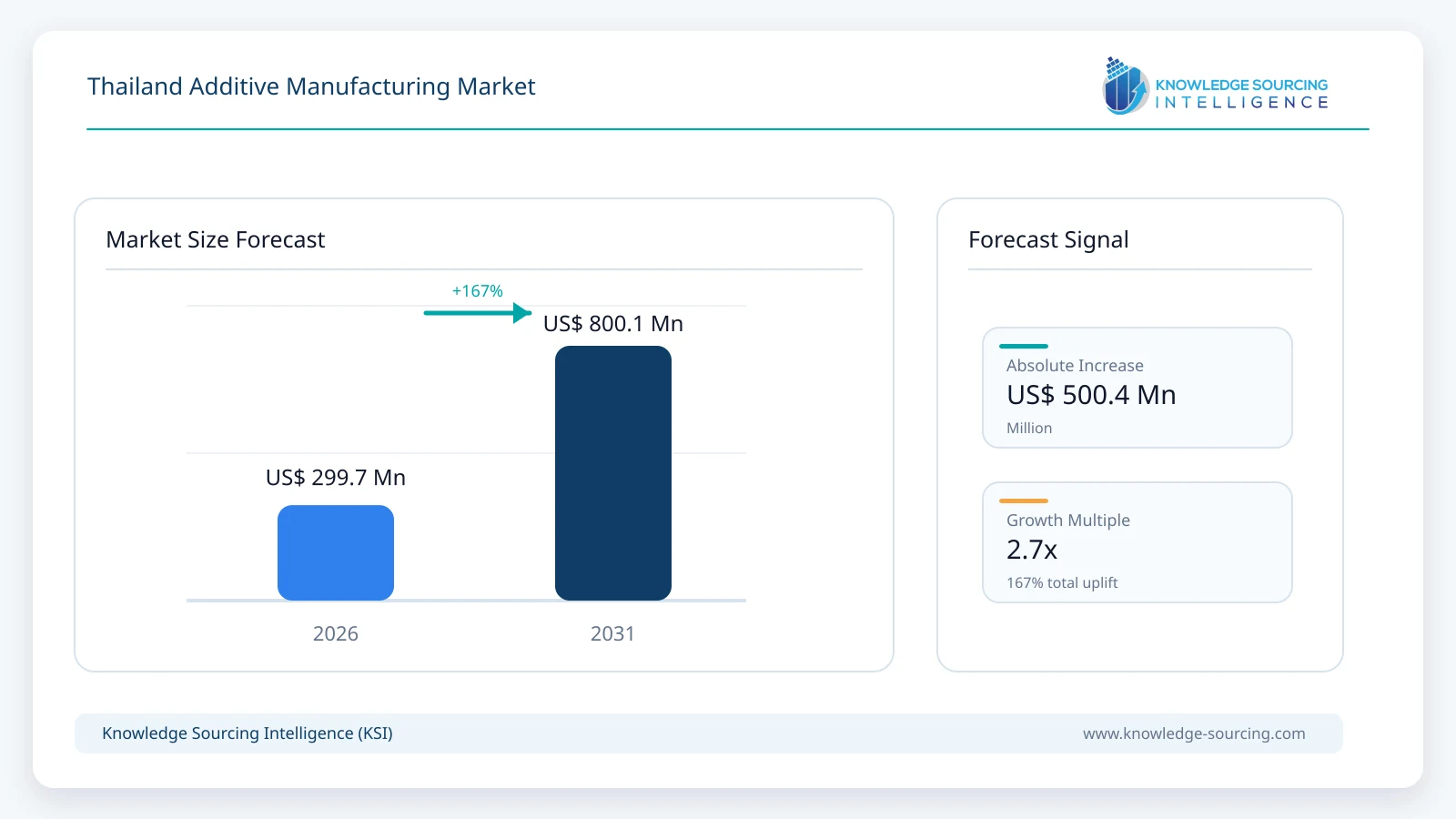
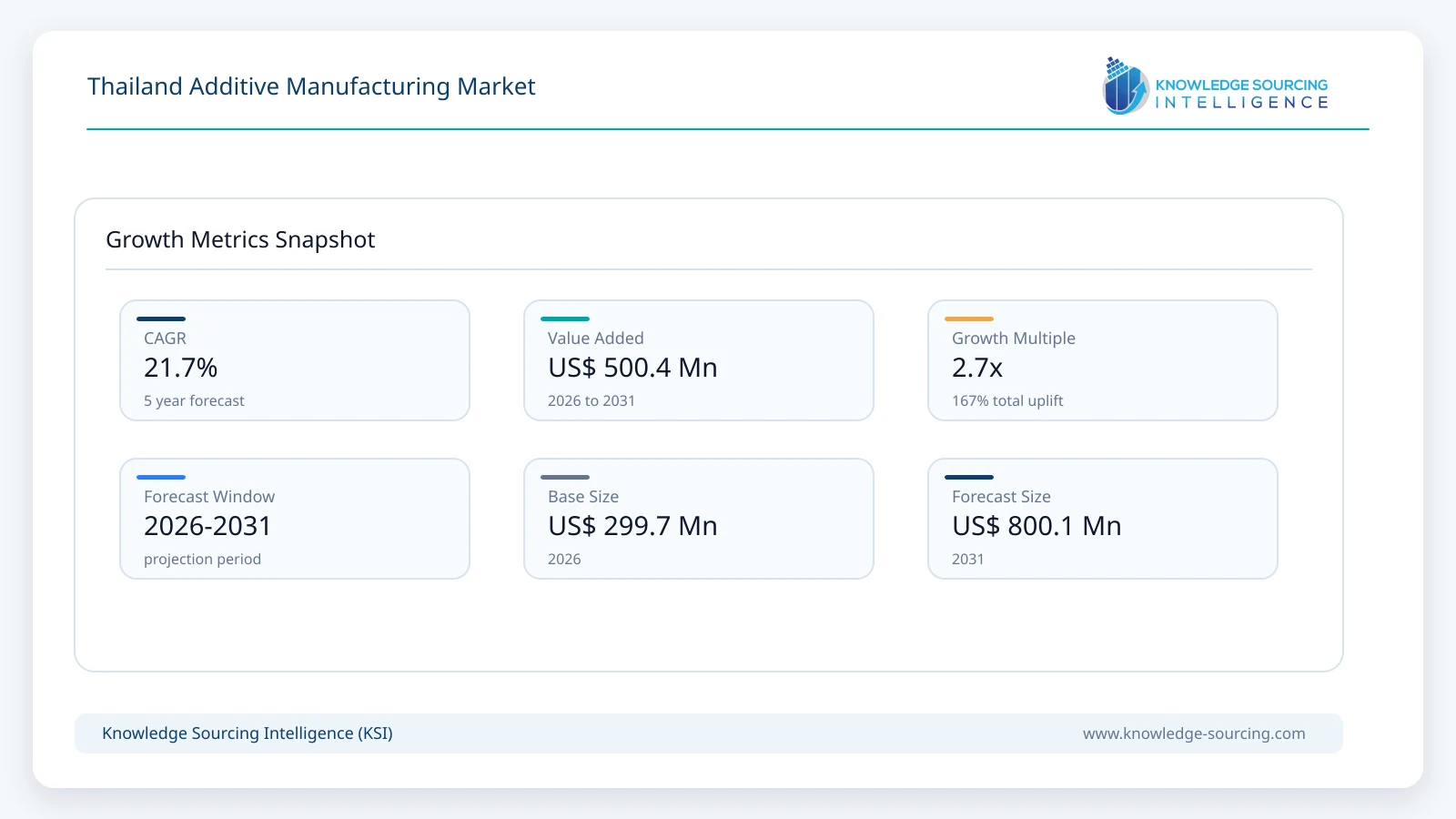
The Thailand additive manufacturing market is forecast to grow at a CAGR of 21.7%, reaching USD 800.1 million in 2031 from USD 299.7 million in 2026.
Highlights:
- 1Hardware accounts for approximately 43% of market value in 2026, supported by industrial printers, scanners and post-processing equipment.
- 2Polymers account for approximately 55% of additive manufacturing material revenue in 2026, while metals record faster value growth.
- 3Material extrusion accounts for approximately 34% of technology revenue in 2026, supported by prototyping, tooling and functional-part applications.
- 4Automotive accounts for approximately 31% of market demand in 2026, reflecting Thailand’s large vehicle and component manufacturing base.
- 5Healthcare is one of the fastest-growing end-user segments through 2031, supported by patient-specific implants, dental applications and surgical planning.
Thailand is developing additive manufacturing as part of a broader transition toward advanced, automated and digitally connected production. The country’s existing manufacturing base in automotive, electronics, medical devices, industrial machinery and consumer products provides a large addressable user pool for 3D-printing technologies. The Thailand Board of Investment explicitly includes manufacture of metal products or metal parts using 3D printers within its investment-promotion framework, while broader Smart and Sustainable Industry programs encourage adoption of automation, robotics and digital production. In the first half of 2026, BOI reported 132 applications worth approximately USD 507.6 million for projects involving machinery upgrades, digital technology, automation and robotics.
The market remains highly diverse. Entry-level polymer systems are used for concept development, education and low-cost tooling, while industrial polymer and metal platforms are increasingly used for jigs, fixtures, replacement parts, functional prototypes and limited production. Local distributor Septillion represents industrial platforms including EOS, 3D Systems, Formlabs and UltiMaker and supplies both metal and polymer additive-manufacturing systems. SiS Distribution has separately expanded into industrial 3D printing through Markforged, providing access to composite and metal systems for enterprise customers.
The current KSI forecast remains broadly appropriate because the page was recently updated and is already improving in search visibility. The correction therefore focuses on stronger segment logic, Thailand-specific evidence and market precision rather than another headline estimate reset.
Market Trends
• Industrial 3D Printing Is Moving Closer to Production Workflows
Thai manufacturers are increasingly evaluating additive manufacturing for jigs, fixtures, functional components and on-demand spare parts rather than only visual prototypes. SiS Distribution and Markforged opened a dedicated industrial 3D-printing showroom in May 2026 to demonstrate applications including jig and fixture production, functional parts, spare parts and production-workflow optimization. Local suppliers are therefore competing increasingly on application engineering, process integration and technical support rather than hardware sales alone.
• Metal Additive Manufacturing Is Becoming More Commercially Relevant
Metal printing remains smaller than polymer printing by installed base but represents a faster-growing value pool. Thailand’s BOI investment framework includes a dedicated activity category for metal products and metal parts manufactured using 3D printers, improving the investment case for industrial metal production. Septillion’s Thai portfolio includes EOS metal systems capable of processing aluminum, stainless steel, titanium, nickel alloys, copper and tool steels, giving domestic manufacturers greater access to industrial powder-bed-fusion capability.
• Medical Additive Manufacturing Is Advancing Toward Patient-Specific Applications
Healthcare is moving beyond anatomical models into patient-specific implants and surgical reconstruction. In May 2026, Thai medical-technology company Meticuly presented its patient-specific cranial implant technology during a Thai Cabinet visit to Thailand Science Park and NSTDA. The company uses additive manufacturing to produce customized implants based on individual patient anatomy, demonstrating that Thailand’s medical 3D-printing ecosystem is moving into high-value clinical applications rather than remaining concentrated on research and visualization.
• Local Distribution and Service Capacity Is Expanding
Availability of printers, materials, scanners, software and maintenance support is improving. Septillion has operated in the Thai 3D-printing market since 2013 and distributes a broad set of industrial and professional brands. In August 2026, it expanded into consumer and professional retail through its Print My Design concept with three Thai locations. This broader channel development improves familiarity with 3D printing across education, design, engineering and smaller enterprises while industrial distributors address higher-value manufacturing applications.
Market Drivers
• Thailand’s Large Automotive and Manufacturing Base
Thailand’s established position as a major automotive and industrial-production center creates a natural user base for additive manufacturing. Vehicle and parts manufacturers benefit from shorter product-development cycles, lower tooling lead times and rapid production of jigs and fixtures. The country’s continuing shift toward EV manufacturing increases the need for new component designs and production processes, creating additional opportunities for flexible manufacturing technologies.
• BOI Support for Advanced Manufacturing
Government investment policy is a significant structural driver. BOI supports machinery upgrades, automation, digital technologies and advanced manufacturing through dedicated investment-promotion categories. Its current framework includes metal parts manufactured using 3D printing, while the Smart and Sustainable Industry initiative is supporting broader automation and digitalization investment. These measures improve the economics of qualifying capital expenditure and strengthen the case for industrial AM projects.
• Medical Device and Patient-Specific Manufacturing Growth
Thailand has an established medical-device industry and continues to position healthcare as a strategic growth sector. BOI identifies medical devices as a high-potential industry and provides investment support for higher-technology production. Additive manufacturing is particularly suited to custom implants, prosthetics, anatomical models, surgical guides and dental devices, giving the technology a strong fit with Thailand’s medical-manufacturing and medical-tourism ecosystem.
Market Restraints
• Industrial Metal AM Requires High Upfront Investment
Production-grade metal systems require substantial investment in printers, powder handling, inert-gas infrastructure, heat treatment, machining, inspection and operator training. The total investment is therefore considerably larger than the printer price alone. This limits adoption among smaller manufacturers and encourages outsourcing to specialist service bureaus until utilization can justify in-house equipment.
• Skills and Qualification Remain Constraints
Industrial additive manufacturing requires expertise in design for AM, materials, build preparation, process parameters, inspection and post-processing. Aerospace, healthcare and automotive customers also require strong quality systems and repeatability before printed components can enter regulated or safety-critical applications. These requirements make technical support, training and application engineering important competitive factors and slow adoption where qualified specialists are limited.
Segment Analysis
• By Component: Hardware
Hardware accounts for approximately 43% of Thailand’s additive manufacturing market in 2026. The segment includes desktop and professional polymer printers, industrial SLS systems, metal powder-bed-fusion machines, scanners and associated post-processing equipment. Thailand remains in an investment phase where manufacturers are still building installed capacity, which keeps hardware’s share higher than in more mature additive-manufacturing markets. Software, materials and services are expected to gain share gradually as the installed base expands and customers require recurring materials, maintenance, design optimization and production support.
• By Material: Polymers
Polymers account for approximately 55% of material revenue in 2026, reflecting the widespread use of filament, resin and polymer powder systems for prototyping, tooling, dental work, consumer products and low-volume manufacturing. Metals represent a smaller but faster-growing value pool because equipment and feedstock prices are substantially higher and adoption is increasing in precision engineering, medical and higher-value industrial applications. Local availability of EOS polymer and metal systems, Formlabs resins and engineering filaments supports a progressively broader material ecosystem.
• By Technology: Material Extrusion
Material extrusion accounts for approximately 34% of market value by technology in 2026. Its position reflects comparatively low equipment cost, simple workflow and suitability for prototypes, tooling, fixtures and functional components. SLA and other vat-photopolymerization systems are important in healthcare, dental and high-resolution applications, while SLS is gaining ground in industrial polymer production. Metal powder-bed fusion remains the most strategically important high-value technology category even though its installed base is smaller.
• By End-User: Automotive
Automotive accounts for approximately 31% of market demand in 2026 and remains Thailand’s largest commercial end-user. Thailand produced approximately 1.46 million vehicles in 2025, and industry projections at the start of 2026 pointed to output approaching 1.5 million units during the year. The automotive ecosystem includes global OEMs, tier-one suppliers, mold and tooling companies and precision engineering firms, creating demand for prototypes, assembly aids, fixtures, low-volume components and design-validation parts.
Competitive Landscape
Thailand’s market combines local engineering and distribution companies with international technology providers. Septillion has one of the broadest local portfolios, covering industrial and professional printers, scanners, materials and services and representing brands including EOS and 3D Systems. Meticuly is differentiated through patient-specific medical implants and healthcare applications. SiS Distribution is expanding industrial exposure through Markforged systems focused on composite and metal manufacturing.
Other local and regional participants include Micap Machinery, TAM3D and Additive3D Asia, while global suppliers such as EOS, 3D Systems, Stratasys, HP, Formlabs, Markforged and Materialise participate through distributors, software or local customer relationships. Competitive advantage increasingly depends on application knowledge, local technical support, materials availability, maintenance, training and the ability to integrate additive manufacturing with existing production workflows rather than equipment price alone.
Recent Developments
August 2026: Septillion expanded its Thai market presence through the launch of Print My Design, opening three retail locations serving consumer, education and professional users.
May 2026: Meticuly showcased its patient-specific cranial implant technology during a Thai Cabinet visit to Thailand Science Park and NSTDA.
May 2026: SiS Distribution and Markforged launched a dedicated industrial 3D-printing showroom in Thailand with live demonstrations and application workshops.
First half 2026: Thailand BOI reported 132 Smart and Sustainable Industry applications worth approximately USD 507.6 million involving digital technology, machinery upgrades, automation and robotics.
2026: Thailand continued to provide BOI promotion for manufacture of metal products and parts using 3D printing under its advanced-manufacturing investment framework.
Market Outlook
Thailand’s additive manufacturing market is expected to remain a high-growth country market through 2031 as the technology moves deeper into automotive tooling, industrial components, patient-specific healthcare and localized production. Hardware remains the largest component category in 2026, while software, services and materials gain share as the installed base matures. Polymers retain the largest material share, but metal additive manufacturing is expected to expand faster because of higher-value engineering and medical applications.
Automotive remains the largest end-user, supported by Thailand’s extensive vehicle and component supply chain. Healthcare gains importance through patient-specific implants and medical-device manufacturing, while electronics, aerospace, industrial machinery and consumer products provide additional demand.
Thailand Additive Manufacturing Market Scope
| Report Metric | Details |
|---|---|
| Total Market Size in 2026 | USD 299.7 million |
| Total Market Size in 2031 | USD 800.1 million |
| Forecast Unit | Million |
| Growth Rate | 21.7% |
| Study Period | 2021 to 2031 |
| Historical Data | 2021 to 2024 |
| Base Year | 2025 |
| Forecast Period | 2026 – 2031 |
| Segmentation | Component, Material, Technology, End-User Industry |
| Companies |
|
Market Segmentation
By Component
Hardware
Software
Services
Materials
By Material
Polymers
Metals
Ceramics
Composites
Others
By Technology
Material Extrusion / FDM
Vat Photopolymerization / SLA
Selective Laser Sintering
Metal Powder Bed Fusion
Binder Jetting
Others
By End-User Industry
Automotive
Healthcare
Aerospace and Defense
Electronics and Precision Manufacturing
Construction
Consumer Goods
Others
Table of Contents
1. INTRODUCTION
1.1. Market Overview
1.2. Market Definition
1.3. Scope of the Study
1.4. Market Segmentation
1.5. Currency
1.6. Assumptions
1.7. Base and Forecast Years
2. RESEARCH METHODOLOGY
2.1. Research Design
2.2. Secondary Research
2.3. Primary Research
2.4. Market Estimation
2.5. Thailand Manufacturing and End-User Modelling
2.6. Segment Modelling
2.7. Data Triangulation and Validation
3. EXECUTIVE SUMMARY
3.1. Key Findings
3.2. Thailand Additive Manufacturing Market Size, 2026-2031
3.3. Component Outlook
3.4. Material Outlook
3.5. Technology Outlook
3.6. End-User Outlook
4. MARKET DYNAMICS
4.1. Market Drivers
4.1.1. Thailand’s Automotive and Industrial Manufacturing Base
4.1.2. BOI Support for Advanced Manufacturing
4.1.3. Medical Device and Patient-Specific Manufacturing Growth
4.2. Market Restraints
4.2.1. High Capital Cost of Industrial Metal AM
4.2.2. Skills, Qualification and Certification Requirements
4.3. Market Opportunities
4.4. Porter’s Five Forces Analysis
4.5. Industry Value Chain Analysis
4.6. Policies and Regulations
4.7. Strategic Recommendations
5. TECHNOLOGICAL OUTLOOK
5.1. Industrial Polymer Additive Manufacturing
5.2. Metal Powder Bed Fusion
5.3. Composite Additive Manufacturing
5.4. Patient-Specific Medical Printing
5.5. Digital Manufacturing and Workflow Software
6. THAILAND ADDITIVE MANUFACTURING MARKET BY COMPONENT
6.1. Introduction
6.2. Hardware
6.3. Software
6.4. Services
6.5. Materials
7. THAILAND ADDITIVE MANUFACTURING MARKET BY MATERIAL
7.1. Introduction
7.2. Polymers
7.3. Metals
7.4. Ceramics
7.5. Composites
7.6. Others
8. THAILAND ADDITIVE MANUFACTURING MARKET BY TECHNOLOGY
8.1. Introduction
8.2. Material Extrusion / FDM
8.3. Vat Photopolymerization / SLA
8.4. Selective Laser Sintering
8.5. Metal Powder Bed Fusion
8.6. Binder Jetting
8.7. Others
9. THAILAND ADDITIVE MANUFACTURING MARKET BY END-USER INDUSTRY
9.1. Introduction
9.2. Automotive
9.3. Healthcare
9.4. Aerospace and Defense
9.5. Electronics and Precision Manufacturing
9.6. Construction
9.7. Consumer Goods
9.8. Others
10. COMPETITIVE ENVIRONMENT AND ANALYSIS
10.1. Major Players and Strategy Analysis
10.2. Industrial versus Professional Printer Positioning
10.3. Polymer versus Metal Capability
10.4. Healthcare and Patient-Specific Manufacturing Capabilities
10.5. Local Distribution, Service and Training Networks
10.6. Partnerships, Product Launches and Expansion
10.7. Competitive Dashboard
11. COMPANY PROFILES
11.1. Septillion Co., Ltd.
11.2. Meticuly Co., Ltd.
11.3. Markforged
11.4. Micap Machinery
11.5. TAM3D
11.6. Additive3D Asia
11.7. EOS GmbH
11.8. 3D Systems Corporation
11.9. Stratasys Ltd.
11.10. Formlabs Inc.
12. APPENDIX
12.1. Market Definition and Scope
12.2. Currency and Conversion Assumptions
12.3. Base Year and Forecast Period
12.4. Market Estimation Approach
12.5. Primary and Secondary Research Framework
12.6. Data Triangulation and Validation
12.7. Abbreviations
Navigate
Trusted by the world's leading organizations











