
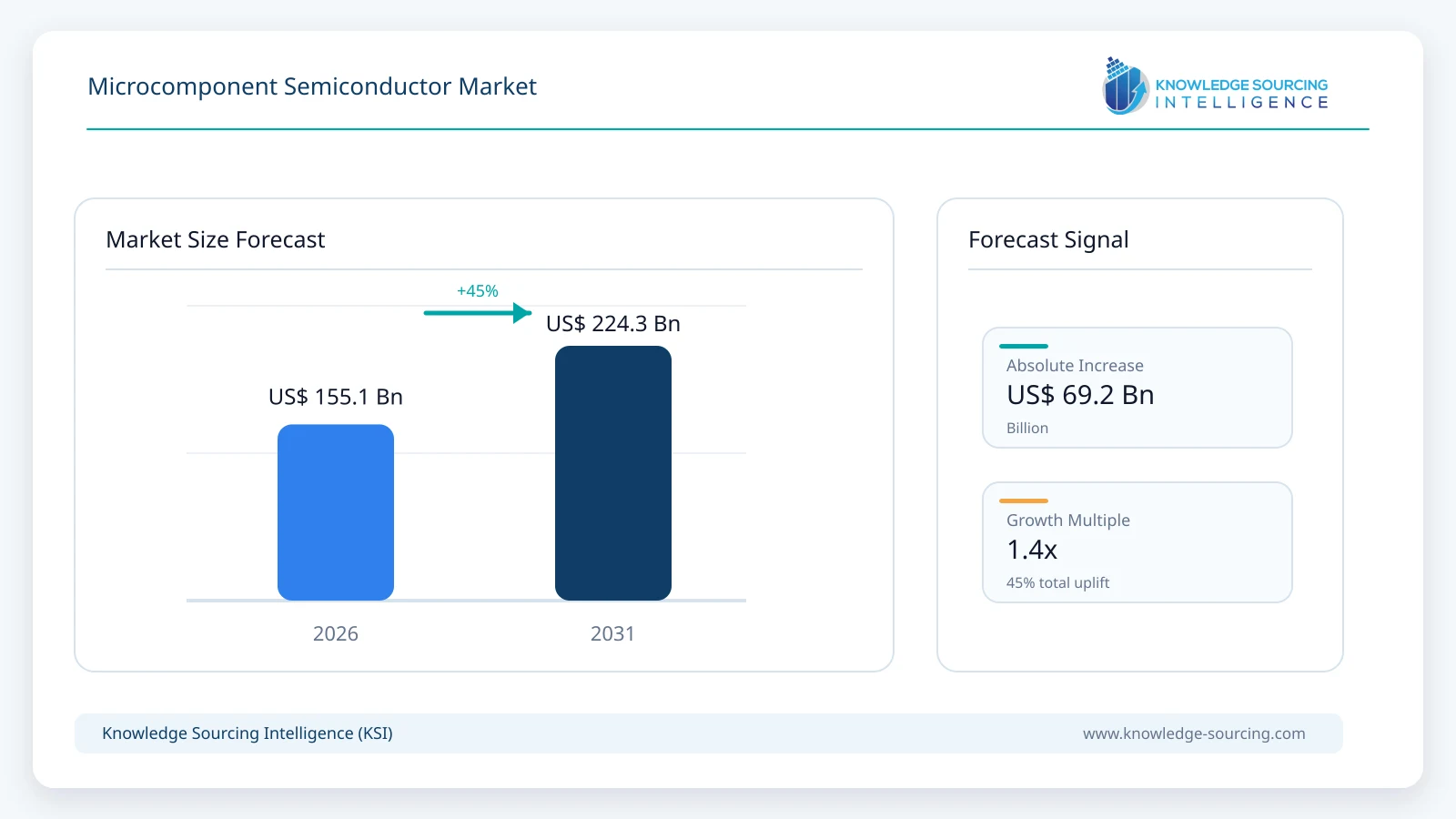
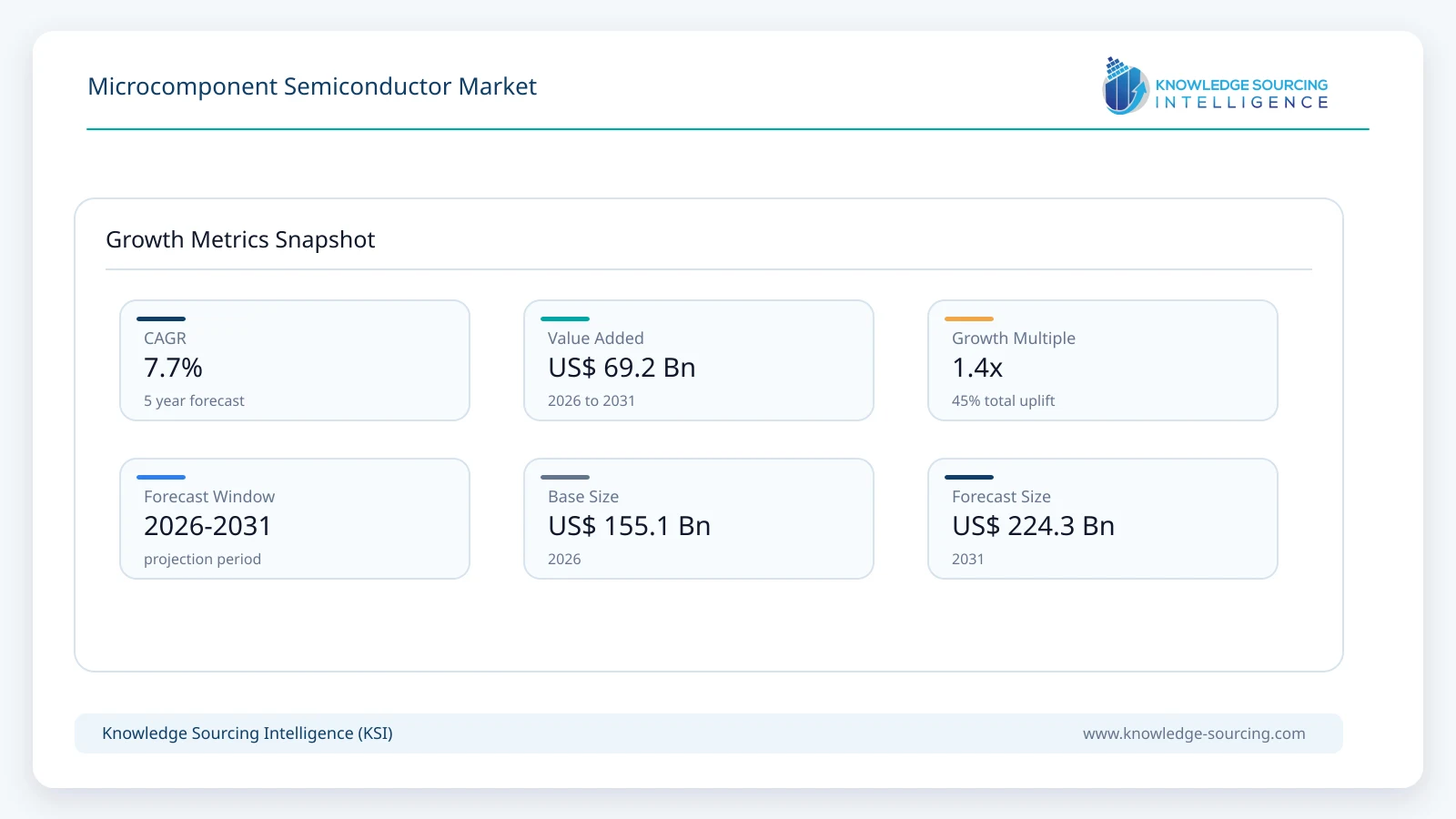
The Microcomponent Semiconductor Market is forecast to grow at a CAGR of 7.7%, reaching USD 224.3 billion in 2031 from USD 155.1 billion in 2026.
Highlights:
- 1Microcontrollers form a principal volume segment, with validation across most automotive, industrial, consumer IoT, and embedded applications.
- 2The new generations of these microprocessors are more AI-oriented and have dedicated AI acceleration along with higher-performance architectures, while DSPs continue to play key roles in various applications such as real-time signal processing.
- 3The demand for automotive is growing with the arrival of software-defined vehicles, electrification, advanced driver assistance, zonal architectures, and increasing electronic content per vehicle.
- 4Industrial applications are also growing, especially in robotics, factory automation, machine vision, motor control, and predictive maintenance, along with intelligent edge equipment.
Microcomponent semiconductors are embedded ICs that execute processing, control, computation, and digital signal-processing functions in electronic systems. The primary product categories are microprocessors (MPUs), microcontrollers (MCUs), and digital signal processors (DSPs). According to the Semiconductor Industry Association (SIA), global semiconductor sales reached $791.7 billion in 2025, growing 25.6% from 2024's level, as major momentum into 2026 remained strong for the sector, leading to growing demand in the market.
Microprocessors typically offer superior computational performance and are used in computers, embedded computing systems, networking equipment, automotive platforms, and other applications with substantial operating systems or high processing demands. Intel introduced its Panther Lake Core Ultra Series 3 platform, manufactured using Intel 18A in 2025. Intel's recent PC-oriented processor work highlights the persistent focus on performance and power efficiency for next-gen AI PCs.
A microcontroller is a computer-on-a-chip that integrates a processor core with memory and peripherals on a single device and is supposed to run control-type applications. Common applications include automotive body and zone control, motor control, appliances, industrial equipment such as IoT devices, and consumer electronic devices such as medical equipment. For example, NXP's S32K family offers functional-safety and security features in automotive MCUs based on Arm Cortex-M for body, zone-control, and electrification applications.
Digital signal processors are designed and optimized for carrying out mathematical functions on signals such as audio, radar, communications, sensor, and imaging data. The SHARC portfolio from Analog Devices delivers processors of up to 1 GHz, while its DSP portfolio is suitable for applications needing dedicated digital signal-processing abilities.
The market increasingly converges around edge AI and heterogeneous computing. The trend for new processors is to combine CPUs with GPUs, NPUs, DSPs, accelerators, connectivity, and security functions such that more computation happens locally without sending every workload to a cloud server. Such a trend is especially applicable in vehicles, robotics, industrial automation, smart cameras, medical equipment, and intelligent consumer devices.
Market Dynamics
Market Drivers
Increasing Semiconductor Content for Automotive Electronics: Microprocessors and MCUs are expanding their range of applications in automotive systems with the shift to software-defined vehicles, electrification, advanced driver assistance features, digital cockpits, and high connectivity. The S32K family of automotive MCUs from NXP illustrates the growing functional requirements of automotive microcontrollers. It offers Arm Cortex-M cores, functional safety compliant to ASIL B/D by family, embedded security, CAN FD, Ethernet, and other interfaces while enabling body control, zone control, and vehicle electrification.
Expansion of Edge AI and Intelligent Embedded Computing: AI processing with low latency and autonomy are imperative for many applications, including robotics, smart cameras, vehicles, industrial machines, and even medical devices. For instance, AMD launched Ryzen AI Embedded in January 2026. The P100 and X100 series come with a single processor platform containing Zen 5 CPU cores, RDNA 3.5 graphics, and XDNA 2 NPU technology. AMD is being utilized in automotive, industrial automation, immersive, and physical AI.
Integration of Microcontrollers in Various Connected Devices: MCUs continue to be foundational elements of embedded electronics because they deliver processing, memory, peripheral interfaces, and control functions. Results from Microchip (MCHP) fiscal 2026 are a direct testament to this category's significance. The mixed-signal microcontroller segment made USD 2.355 billion, accounting for 50.0% of company net sales, and increased by 4.7% year over year. These MCU families, such as PIC32, SAM, AVR, PIC16, and PIC18 lines, are used in applications that extend from low-power consumer electronics and IoT devices to powerful industrial control, as well as security-sensitive embedded systems.
Rise in Industrial Automation and Intelligent Machines: There is an increasing demand for microprocessors, MCUs, and DSPs because modern industrial equipment requires more real-time control, sensing, communications, machine vision, predictive maintenance, and local data processing for automation of processes. In 2025, Texas Instruments reported revenue of $2.70 billion from embedded processing, serving industrial and automotive markets. Its product line includes microcontrollers and wireless connectivity devices for advanced radar and vision-processing products.
Market Restraints & Opportunities
Extended product lifecycles and functional-safety qualification are major requirements of automotive and industrial applications. This inflates development expenses while introducing steep entry barriers for new microcomponent manufacturers.
Demand for microcomponents is still vulnerable to semiconductor inventory cycles. Customers stockpile excess components during periods of high demand and later reduce orders once inventories normalize.
Combined with the development of AI accelerators, a new product opportunity is emerging to effectively integrate such AI capabilities into both microprocessors and embedded processors. Manufacturers are moving away from separate CPU and AI-processing components in favor of integrating CPU, GPU, NPU, and DSP functions on a single SoC.
Centralized computing and Zonal Control are trends in automotive and are creating opportunities for capable MCUs or processors. Further, robotics is creating a demand for processors that can also process sensor data, vision, motion control, AI inference, and communications.
Key Developments
September 2026: Artery Technology rolled out its AT32F406/F408 mainstream MCU series based on a maximum frequency of 216 MHz Arm Cortex-M4F core. The device offered features like up to 512 KB Flash, 192 KB SRAM, high-speed ADCs, QSPI (Quad Serial Peripheral Interface), and multiple SPI, I²C, USART/UART, and timer data bus interfaces.
March 2026: Texas Instruments launched the MSPM0G5187 and AM13Ex families of microcontrollers with TinyEngine neural-processing units for edge AI. Compared with similar MCUs without hardware acceleration, the NPU reduced AI-inference latency by about 90 times and energy consumption by more than 120 times.
January 2026: AMD released the Ryzen AI Embedded P100 and X100 processors, combining Zen 5 CPUs, RDNA 3.5 graphics, and XDNA 2 NPUs for automotive, industrial automation, physical AI, robotics, and edge applications.
Market Segmentation
The market is segmented by type, industry vertical, distribution channel, and geography.
By Type: Microcontrollers
Microcontrollers constitute the highest revenue-generating product type segment owing to the fact that microcontrollers integrate processing, memory, peripherals, and control capabilities into a single device in a compact package and therefore can be deployed in highly diverse embedded applications.
NXP's S32K family offers licensed MCUs with Cortex-M for automotive body control, zonal architectures, electrification, and other vehicle functions. Various functional-safety requirements and automotive communication interfaces are also supported on the devices, including CAN FD and Ethernet.
Infineon is promoting extensive portfolios of MCUs including products such as AURIX, TRAVEO PSoC, XMC & MOTIX to cater to automotive, industrial, consumer, motor-control, and IoT applications. In addition, the MCU segment is evolving from traditional control applications to connected, secure, AI-powered software-defined embedded systems.
By Industry Vertical: Automotive
Automotive is the largest industry vertical as vehicles and systems are integrating more electronic control networks and more sophisticated computing architectures. Automotive MCUs are being utilized in many modern applications, including body control, zonal control, powertrain, battery management and electrification, infotainment, connectivity, and safety-related functions. The NXP S32K platform targets body, zone-control, and electrification applications with built-in functional safety and embedded security.
The rapid development of new technologies and trends such as software-defined vehicles and physical AI drives the demand for better-performing processors. For instance, AMD's Ryzen AI Embedded portfolio was launched in 2026 for integration in automotive digital cockpits and AI-enabled embedded applications.
By Distribution Channel: Direct Sales
Direct sales is expected to be the dominant distribution channel, especially in high-volume OEM and Tier-1 semiconductor programs where manufacturers are directly involved at times for design-in, qualification, forecasting, technical support, and long-term supply agreements.
Direct engagement is especially critical for automotive and industrial microcomponents as customers need substantial engineering support, product qualification, functional-safety documentation, and software-development tools with long lifecycles.
In addition, direct sales remain especially important for processors and MCUs that are embedded into long-life product platforms, while distributor networks and e-commerce channels become progressively more valuable for small customers, prototyping or engineering samples, and low-volume purchases.
Regional Analysis
Americas Market Analysis
The Americas does account for a substantial market as it is the largest semiconductor design ecosystem of any region, with many of the largest technology enterprises, automotive manufacturers, industrial equipment firms, and deploy AI-enabled compute at scale. SIA noted that in 2025, sales of the US semiconductor industry totaled USD 425 billion and comprised 53.4% of global semiconductor market share. Major US microprocessor suppliers, such as Intel and AMD, primarily target the North American market, while companies like Texas Instruments, Microchip Technology, and Analog Devices have invested substantially in embedded-processing portfolios.
Europe, Middle East and Africa Market Analysis
The microcomponents semiconductor market in Europe, the Middle East & Africa is driven by automotive, industrial automation, energy, and medical-equipment businesses in Germany, the United Kingdom, the Netherlands, and other European economies demanding reliable embedded processors and MCUs. In the Middle East, demand growth is being driven by smart infrastructure, industrial automation, telecommunications, and digitalization projects, and remains an evolving market with a strong rise in telecommunications, consumer electronics, and industrial applications.
Asia Pacific Market Analysis
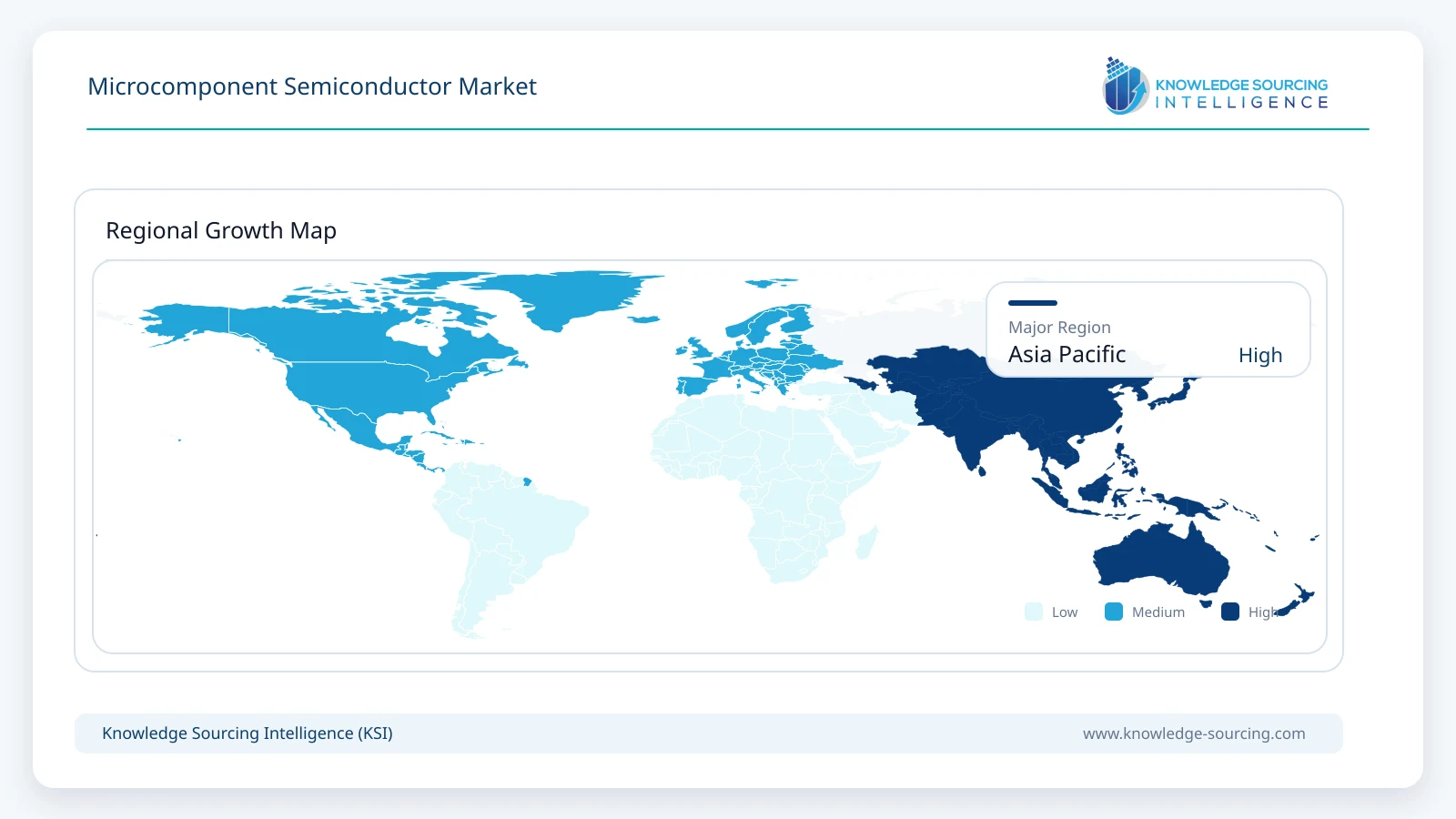
Asia Pacific will continue to be the largest and most critical region of manufacturing and consumption because it is home to key electronics, automotive, telecommunications, industrial, and consumer-device production ecosystems. China, Japan, South Korea, Taiwan, India, and Southeast Asian Economies make up a significant portion of the global semiconductor consumption and electronics manufacturing supply chain. Japan's strong MCU ecosystem includes companies including Renesas and ROHM Semiconductor, while South Korea and China is supported by major electronics and automotive supply chains.
List of Companies
Intel Corporation
Advanced Micro Devices, Inc.
ROHM Semiconductor
Microchip Technology
NXP Semiconductors
Renesas Electronics
STMicroelectronics
Texas Instruments Incorporated
Infineon Technologies
Analog Devices, Inc.
Intel Corporation
Intel is a major company in the microchip field, covering various areas including client processors, data-center processors, embedded computing, and AI-oriented computing. Its Core Ultra Series 3 / Panther Lake platform is based on Intel 18A and focused on advanced AI PCs introduced in 2025. Intel's 18A technology, which combines RibbonFET gate-all-around transistors with PowerVia backside power delivery.
Advanced Micro Devices, Inc.
AMD supplies microprocessors and embedded processors for consumer, data-center, industrial, automotive, and embedded applications. The Ryzen AI Embedded P100 and X100 are AMD's Zen 5 CPU cores, RDNA 3.5 graphics, and XDNA 2 NPUs solution that launched in January 2026. The processors are aimed at automotive, industrial automation, physical AI, robotics, and other edge applications.
Microchip Technology
Microchip Technology offers a significant MCU portfolio in the industry, which includes PIC, AVR, SAM, PIC32, dsPIC, and other microcontroller families. 8-bit, 16-bit, and 32-bit MCUs for security, connectivity, motor control, touch interfaces, and digital signal processing are among its 2026 portfolio.
Analyst View
The microcomponent semiconductor market is converting to higher intelligence and high-performance, as well as application-specific processes. Microcontrollers will hold the largest embedded footprint, and AI-enabled microprocessors and DSPs are thriving in automotive, industrial robotics, communications, and edge applications. While direct OEM sales are a critical distribution channel, distributor networks and e-commerce widen access to smaller customers and design engineers.
Microcomponent Semiconductor Market Scope:
| Report Metric | Details |
|---|---|
| Total Market Size in 2026 | USD 155.1 billion |
| Total Market Size in 2031 | USD 224.3 billion |
| Forecast Unit | Billion |
| Growth Rate | 7.7% |
| Study Period | 2021 to 2031 |
| Historical Data | 2021 to 2024 |
| Base Year | 2025 |
| Forecast Period | 2026 – 2031 |
| Segmentation | Type, Industry Vertical, Distribution Channel, Geography |
| Companies |
|
Market Segmentation
By Type
By Industry Vertical
By Distribution Channel
By Geography
Table of Contents
1. EXECUTIVE SUMMARY
2. MARKET SNAPSHOT
2.1. Market Overview
2.2. Market Definition
2.3. Scope of the Study
2.4. Market Segmentation
3. MARKET DYNAMIC
3.1. Market Drivers
3.2. Market Restraints
3.3. Market Opportunities
3.4. Porter’s Five Forces Analysis
3.5. Industry Value Chain Analysis
4. BUSINESS LANDSCAPE
4.1. Regulatory and Standards Landscape
4.2. Semiconductor Demand, Pricing and Procurement Analysis
4.3. Semiconductor Manufacturing, Capacity and Supply-Chain Landscape
4.4. Import/Export Analysis
4.5. Strategic Recommendations
5. TECHNOLOGICAL OUTLOOK
5.1. Microprocessor Architecture and Processing Technologies
5.2. Microcontroller and Real-Time Computing Technologies
5.3. Digital Signal Processing and Specialized Computing Technologies
5.4. Semiconductor Integration, Packaging and Security Technologies
6. MICROCOMPONENT SEMICONDUCTOR MARKET BY TYPE
6.1. Introduction
6.2. Microprocessors
6.3. Microcontrollers
6.4. Digital Signal Processors
7. MICROCOMPONENT SEMICONDUCTOR MARKET BY INDUSTRY VERTICAL
7.1. Introduction
7.2. Consumer Electronics
7.3. Automotive
7.4. Communication & Networking
7.5. Healthcare & Medical
7.6. Others
8. MICROCOMPONENT SEMICONDUCTOR MARKET BY DISTRIBUTION CHANNEL
8.1. Introduction
8.2. Direct Sales
8.3. Distributor Network
8.4. E-commerce Distribution
9. MICROCOMPONENT SEMICONDUCTOR MARKET BY GEOGRAPHY
9.1. Introduction
9.2. Americas
9.2.1. USA
9.2.2. Others
9.3. Europe, Middle East and Africa
9.3.1. United Kingdom
9.3.2. Germany
9.3.3. Netherlands
9.3.4. Others
9.4. Asia Pacific
9.4.1. China
9.4.2. Japan
9.4.3. South Korea
9.4.4. Taiwan
9.4.5. Others
10. COMPETITIVE ENVIRONMENT AND ANALYSIS
10.1. Major Players and Strategy Analysis
10.2. Market Share Analysis
10.3. Mergers, Acquisitions, Agreements, and Collaborations
10.4. Competitive Dashboard
11. COMPANY PROFILES
11.1. Intel Corporation
11.2. Advanced Micro Devices, Inc.
11.3. ROHM Semiconductor
11.4. Microchip Technology
11.5. NXP Semiconductors
11.6. Renesas Electronics
11.7. STMicroelectronics
11.8. Texas Instruments Incorporated
11.9. Infineon Technologies
11.10. Analog Devices, Inc.
12. APPENDIX
12.1. Currency
12.2. Assumptions
12.3. Base and Forecast Years Timeline
12.4. Key benefits for the stakeholders
12.5. Research Methodology
12.6. Abbreviations
Navigate
Trusted by the world's leading organizations











