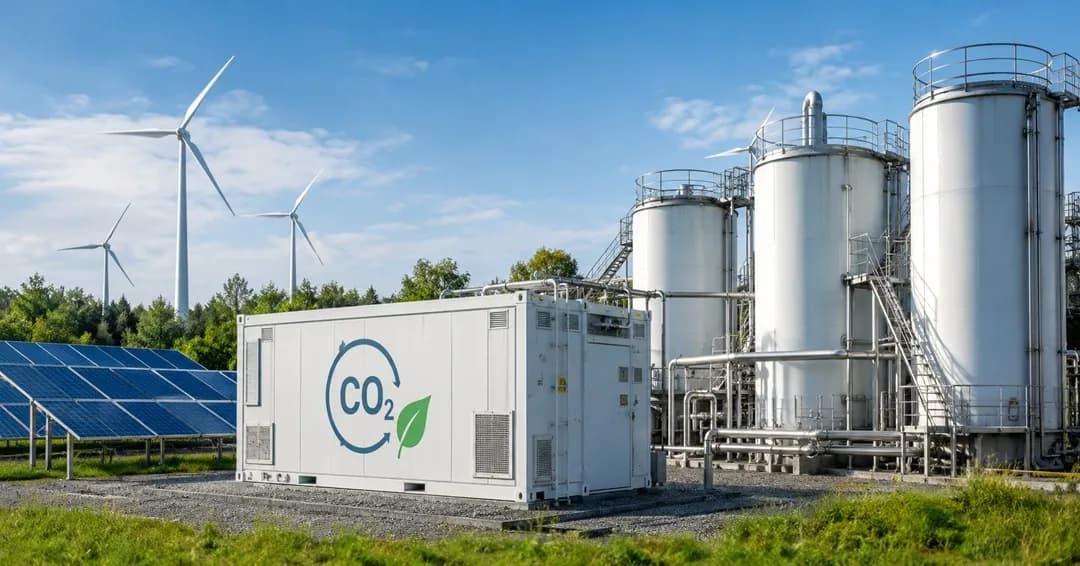
The CO2 energy storage market is gaining momentum as renewable energy integration and grid flexibility requirements increase. Advancements in closed-loop CO2 batteries, thermodynamic storage systems, and manufacturing capabilities are creating opportunities for long-duration electricity storage across utilities and industrial applications, while cost competitiveness, efficiency, and project execution remain critical adoption factors.
Growing renewable energy capacity, grid flexibility requirements, and demand for reliable electricity are creating opportunities for carbon dioxide-based energy storage technologies.
Knowledge Sourcing Intelligence (KSI) has published its latest analysis of the CO2 Energy Storage Market, examining market forecasts, technology developments, regional opportunities, and competitive dynamics. According to the report, the market is estimated at USD 0.41 billion in 2026 and is projected to reach USD 3.10 billion by 2032, registering a compound annual growth rate (CAGR) of 40.1% during the forecast period.
Market Overview
The CO2 Energy Storage Market is developing as electricity systems seek flexible solutions to balance variable renewable generation with changing demand. Carbon dioxide-based energy storage technologies use thermodynamic processes to store electricity and release it when required. Depending on their configuration, these systems can support renewable energy integration, peak-demand management, and grid flexibility.
Closed-loop CO2 battery systems use compressors, pressure vessels, heat exchangers, and thermal management components to store energy. During discharge, the system uses the stored energy and thermodynamic cycle to drive a turbine or another power-generation component. Certain designs exploit carbon dioxide's transition between gaseous and liquid states to support the storage and discharge process.
Supercritical CO2 pumped-thermal energy storage follows a different approach, converting electrical energy into thermal energy and recovering electricity through a thermodynamic cycle. Although both technology families use CO2, their system architectures, operating principles, equipment requirements, and performance characteristics differ.
These technologies could complement established storage options, particularly in applications requiring extended discharge durations. Their commercial adoption, however, will depend on capital expenditure, round-trip efficiency, equipment reliability, construction timelines, site suitability, and performance relative to alternative storage technologies.
Key Market Growth Drivers
Long-duration energy storage demand: Expanding wind and solar generation is increasing the need to shift electricity across different periods of the day. CO2-based storage systems could support renewable integration, evening peak coverage, and grid flexibility where their discharge duration, efficiency, and costs are competitive with alternative technologies.
Technology development and standardization: Improvements in compressors, heat exchangers, thermal management, pressure equipment, and plant engineering could improve system performance and project repeatability. Standardized configurations may also simplify equipment procurement, commissioning, and engineering, supporting larger installations and commercial agreements.
Industrial and data centre applications: Industrial facilities may benefit from integrating energy storage with existing infrastructure and suitable thermal resources. Data centres present another potential application as computing and digital infrastructure increase electricity requirements. Adoption will depend on power reliability, integration requirements, space availability, and project economics.
Grid modernization and energy security: Investment in renewable generation and electricity networks is increasing the need for flexible power capacity. Storage procurement programmes, capacity mechanisms, and long-term electricity agreements could support deployment where CO2-based systems meet technical requirements and demonstrate competitive economics.
Latest Industry Developments
October 2026 - Energy Dome: Energy Dome inaugurated its manufacturing facility in Piacenza, Italy, to support international CO2 Battery deployments. The company outlined plans to expand manufacturing capacity, targeting a threefold increase through further investment and production expansion. The capacity increase represents a future target rather than an already completed expansion.
July 2026 - SEC Victoria and Energy Dome: The State Electricity Commission Victoria and Energy Dome announced a planned 20 MW compressed-CO2 energy storage project in Victoria's Latrobe Valley. The facility is designed to provide approximately 10–12 hours of electricity supply, supporting the development of long-duration storage capacity in Australia.
June 2026 - Google and Energy Dome: Google and Energy Dome announced a planned 23 MW/200 MWh CO2 Battery project in County Offaly, Ireland. The project represents their first bilateral commercial deployment under their broader partnership and demonstrates interest in developing long-duration energy storage for electricity systems with growing renewable generation.
These developments indicate increasing commercial interest in CO2-based energy storage across Europe and Australia, alongside opportunities in other international markets. However, manufacturing expansion, project announcements, construction milestones, commissioning, and commercial operation represent different stages of technology deployment. Announced projects should not be interpreted as operational capacity until commissioning and operating status are confirmed.
Market Segmentation and Regional Outlook
The report examines the CO2 Energy Storage Market across technology architecture, storage duration, application, project model, and end-user categories. Technology classifications may include closed-loop compressed or liquid CO2 systems and supercritical CO2 pumped-thermal approaches, subject to the report's defined scope. Additional configurations should be assessed according to their technical principles and commercial applicability rather than assumed to represent equally established market categories.
Applications include renewable energy firming, grid capacity support, peak shifting, industrial energy storage, and potential integration with data centres and carbon-management infrastructure. Adoption will depend on system design, discharge duration, electricity market structures, operating conditions, and the availability of suitable project sites.
Asia-Pacific is an important region to monitor because of renewable energy expansion, industrial development, and investment in electricity infrastructure, particularly in China and India. The extent of regional market leadership should be assessed using the report's underlying regional revenue estimates rather than inferred from renewable capacity additions alone.
Europe offers opportunities through long-duration storage development, commercial partnerships, and initiatives to improve electricity system flexibility. The announced Ireland project illustrates interest in CO2-based storage in the region.
North America presents potential opportunities through grid modernization, renewable integration, and demand for dependable electricity supply. Project economics, procurement structures, and the availability of suitable sites will influence commercial adoption.
Australia is emerging as another market to monitor, with the planned SEC Victoria and Energy Dome project illustrating interest in alternative long-duration storage technologies.
Across these regions, financing availability, regulatory frameworks, electricity market design, construction execution, and demonstrated operating performance will influence the pace of deployment.
Competitive Landscape
The CO2 Energy Storage Market includes technology developers and companies pursuing different thermodynamic storage approaches. Participants identified for coverage include Energy Dome S.p.A., Exa Energy Technology (Shenzhen) Co., Ltd., Echogen Power Systems, EarthEn Energy, and Activated Energy LLC.
Energy Dome focuses on its closed-loop CO2 Battery technology, while Echogen Power Systems develops supercritical CO2-based power-cycle and pumped-thermal energy storage solutions. Other participants are associated with emerging carbon dioxide-based energy storage approaches, with commercial maturity and deployment status varying by company.
Competitive positioning will depend on technology maturity, round-trip efficiency, capital costs, equipment reliability, project execution, and the ability to secure financing and long-term commercial agreements. Strategic partnerships, manufacturing capacity, and independently demonstrated operating results could also influence the ability of developers to move from pilot projects and announced deployments to repeatable commercial installations.
As the sector develops, clear differentiation between technologies, verified project performance, and transparent reporting of operating status will be important for utilities, investors, industrial customers, and other prospective buyers.
Analyst Perspective
The CO2 Energy Storage Market is attracting attention as electricity systems seek additional flexibility to accommodate renewable generation and changing demand. Continued technology development, manufacturing expansion, and commercial project execution could create opportunities for CO2-based storage solutions. However, wider adoption will depend on competitive costs, reliable operating performance, financing conditions, and the ability to deliver projects at scale.
About the Market Report
The CO2 Energy Storage Market Report by Knowledge Sourcing Intelligence provides an assessment of market forecasts, growth drivers and restraints, technology developments, application opportunities, regional trends, and the competitive landscape. The report is intended to support analysis of emerging commercial opportunities across utilities, industrial facilities, and other potential end-user markets.
Have questions?
More Press Releases
Thermal Energy Storage Market to Reach USD 10.20 Billion by 2032, Driven by Renewable Energy Integration and Industrial Heat Electrification
The thermal energy storage market is advancing as renewable energy integration, industrial electrification, and energy cost management drive demand. Innovations in sensible heat, latent heat, and thermochemical storage are expanding applications across industrial heating, cooling, concentrated solar power, and commercial buildings, creating opportunities for technology providers across major regional markets worldwide.
Next-Generation Advanced EV Batteries Market to Reach USD 17.50 Billion by 2031, Driven by Demand for Higher Energy Density and Faster Charging
The global next-generation advanced EV batteries market is expanding as demand grows for higher energy density, faster charging, improved safety, and enhanced durability. Advances in solid-state, silicon-anode, sodium-ion, and lithium-metal technologies, alongside manufacturing expansion and research investments, are supporting innovation and accelerating the development of next-generation electric vehicle battery solutions.
Global EV DC-DC Converter Market to Reach USD 6.10 Billion by 2031 as High-Voltage EV Architectures Gain Momentum
The global EV DC-DC converter market is expanding as electric vehicle adoption, higher-voltage architectures, and vehicle electrical content increase. Demand is rising for efficient, compact, high-power-density converters supporting auxiliary systems and advanced electronics. Asia-Pacific remains a key market, while manufacturers focus on thermal performance, integration, reliability, and power-conversion efficiency.