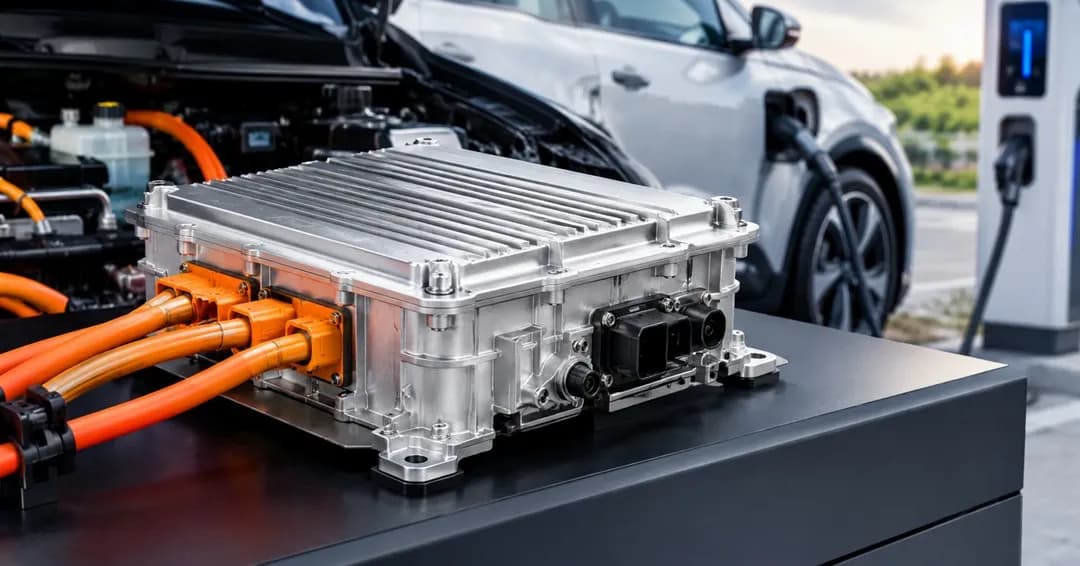
The global EV DC-DC converter market is expanding as electric vehicle adoption, higher-voltage architectures, and vehicle electrical content increase. Demand is rising for efficient, compact, high-power-density converters supporting auxiliary systems and advanced electronics. Asia-Pacific remains a key market, while manufacturers focus on thermal performance, integration, reliability, and power-conversion efficiency.
Growing EV adoption, rising vehicle electrical content, and the increasing adoption of higher-voltage architectures are accelerating demand for efficient, high-power-density DC-DC converter solutions.
Knowledge Sourcing Intelligence has published its latest analysis of the Global EV DC-DC Converter Market, projecting the market to grow from USD 3.25 billion in 2026 to USD 6.10 billion by 2031, growing at a CAGR of 13.4% during 2026–2031. The study examines the key technology, vehicle, propulsion, power-rating, and regional trends shaping demand for DC-DC converters across the expanding electric vehicle industry.
Market Overview
The global EV DC-DC converter market is expanding as electric vehicles incorporate increasingly advanced electrical and electronic systems. DC-DC converters play a critical role in EV power architectures by converting high-voltage battery power into appropriate voltage levels for auxiliary systems, electronic control units, infotainment, lighting, connectivity, thermal management, and other vehicle functions.
According to the International Energy Agency (IEA), global electric car sales are expected to exceed 23 million units in 2026, accounting for 28% of total car sales. As EV adoption expands, automakers are also developing higher-voltage architectures, including 800 V platforms, to support faster charging, improved efficiency, and higher power requirements. These developments are increasing demand for converters offering high efficiency, power density, thermal performance, reliability, and compact packaging.
The increasing integration of electronic functions is also influencing converter specifications. Manufacturers are focusing on solutions that can manage higher power requirements while maintaining compact form factors and reliable operation under demanding vehicle conditions.
Request a free sample copy or view the report summary: EV DC-DC Converter Market Report
Key Growth Drivers
Shift Toward High-Voltage EV Architectures
The adoption of higher-voltage EV platforms is creating new requirements for efficient power conversion between high-voltage traction batteries and lower-voltage vehicle networks. Advanced DC-DC converters are increasingly important for managing power efficiently while supporting the electrical demands of next-generation EV platforms.
Increasing EV Production
Rising electric vehicle production is expanding the addressable market for automotive power-electronics components. Global EV production reached approximately 17.3 million units in 2024, with China accounting for more than 70% of global production, highlighting Asia-Pacific's importance to the EV power-electronics supply chain.
Rising Vehicle Electrical Content
Modern EVs increasingly integrate ADAS, connectivity, infotainment, thermal-management systems, electronic control units, advanced lighting, and other electronically controlled functions. The growing electrical content of vehicles is supporting demand for reliable, efficient, and compact power-conversion solutions across passenger and commercial vehicle platforms.
Advances in Power Electronics
Innovations in semiconductor devices, switching technologies, thermal management, and converter design are enabling higher efficiency and power density. These advances help manufacturers develop smaller and more capable DC-DC converter systems while addressing the performance requirements of increasingly sophisticated EV electrical architectures.
Latest Industry Developments
The EV industry’s continuous advanced developments influence the demand for automotive power electronics. As per the IEA, global electric car sales surpassed 20 million units in 2025, reflecting continued expansion of the vehicle base requiring power-conversion technologies.
China remained a key player in EV manufacturing and adoption, with more than 13 million electric cars sold in 2025, according to the IEA. At the same time, automakers and automotive suppliers continued developing higher-voltage platforms and associated power-electronics systems to improve charging performance, efficiency, and electrical-system integration.
These developments support continued investment in compact, efficient, and high-power-density converter technologies.
Market Segmentation
Segmentation | Sub-Segments |
|---|---|
Converter Direction | Unidirectional, Bidirectional |
Input Voltage | Below 400 V, 400 V Class, 800 V and Above |
Output Voltage | 12 V, 24 V, 48 V and Above |
Integration Level | Standalone DC-DC Converter, OBC + DC-DC Integrated Unit, Multi-in-1 Power Electronics |
Vehicle Type | Passenger Battery Electric Vehicles, Plug-in Hybrid Electric Vehicles, Commercial Electric Vehicles, Electric Two-Wheelers and Three-Wheelers, Other Electric Vehicles |
Geography | North America, Europe, Asia Pacific, South America, Middle East and Africa |
Regional Outlook
Asia-Pacific is expected to remain a key market, supported by its large EV manufacturing base, strong electric vehicle adoption, and established automotive electronics supply chain. China remains particularly important because of its scale across EV production, battery manufacturing, and automotive component supply chains.
Europe and North America also represent important growth markets as automakers expand EV portfolios, invest in electrification, and introduce higher-performance vehicle platforms. Continued development of charging infrastructure and vehicle manufacturing capacity is expected to support demand for advanced power-conversion technologies.
Competitive Landscape
The competitive landscape includes DENSO Corporation, Valeo, BorgWarner, Marelli, Delta Electronics, TDK Corporation, and other automotive power-electronics suppliers. Market participants are focusing on higher power density, improved thermal management, system integration, product development, strategic partnerships, and manufacturing expansion to address evolving EV power-architecture requirements.
Analyst Perspective
“The transition toward higher-voltage EV architectures is increasing the technical requirements for efficient power conversion. As vehicle electrical content continues to rise, DC-DC converters are becoming increasingly important to power-management strategies across next-generation electric vehicle platforms.”
What the Study Covers
The Global EV DC-DC Converter Market Report provides market size and forecast analysis through 2031, segment-level insights, regional and country-level analysis, technology and application developments, EV power-architecture trends, competitive intelligence, company profiles, strategic developments, product launches, partnerships, investments, and key trends shaping future market demand.
Garuav Singh
ContributorHave questions?
More Press Releases
How Meta's Expected Smartwatch Reveal at Connect 2026 Could Impact the Wearable Computing Market, Expected to Reach USD 148.5 Billion by 2031
At Meta Connect 2026, scheduled for September 23–24, Meta is expected to unveil its first commercial smartwatch, reportedly codenamed Project Malibu 2, with health-tracking capabilities and a built-in Meta AI assistant. The expected launch follows Meta's revival of a smartwatch project that was shelved in 2022 amid cost reductions across its Reality Labs hardware division, with the new device reportedly designed to complement Meta's AI glasses ecosystem. The move reinforces the shift toward AI-enabled, ecosystem-connected wearables described in a new report by Knowledge Sourcing Intelligence, which values the global wearable computing market at USD 71.0 billion in 2026, growing to USD 148.5 billion by 2031.
How Potensic's Atom 3 Launch Could Impact the Consumer Drones Market, Expected to Reach USD 21.4 Billion by 2031
Potensic brought its ATOM 3 camera drone to IFA 2026 in Berlin, returning to the show for a third consecutive year to showcase the sub-249-gram drone under the theme “SEE BEYOND.” The ATOM 3 combines a 1/1.3-inch sensor and 48mm dual-focal camera with 4K/60fps HDR video, AI Follow 2.0 subject tracking, and up to 16km of video transmission, positioning it within the lightweight consumer camera-drone segment alongside competing entry-level models. According to Knowledge Sourcing Intelligence (KSI), the global consumer drones market is expected to reach USD 12.0 billion by 2026 and is forecast to reach USD 21.4 billion by 2031.
How Sonos, JBL, and 1MORE’s Latest Audio Launches Will Impact the Home Audio Equipment Market, Expected to Reach USD 46.1 Billion by 2031
Sonos, JBL, and 1MORE are advancing home and personal audio with connected ecosystems, Dolby Atmos, AI-powered sound optimization, adaptive noise cancellation, spatial audio, and longer battery life. Their 2026 launches reflect demand for immersive wireless listening, supporting growth in the Home Audio Equipment Market toward USD 46.1 billion by 2031.